Web Application Security Architecture
Web application security is a layered control problem: every boundary — edge, browser, application, data, observability — owns a slice of the attack surface, and any single layer must be assumed to fail. This article maps the 2026 control set onto that model: where strict Content Security Policy (CSP) and Trusted Types eliminate XSS classes, where WebAuthn eliminates phishing, where Argon2id eliminates GPU-friendly cracking, and where the OWASP Top 10:2025 tells us the operational defects that still dominate breaches.
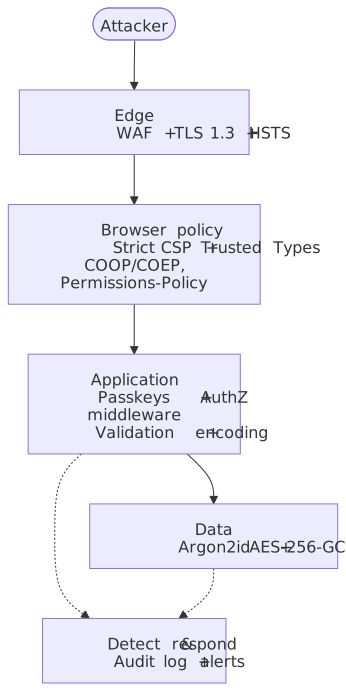
Mental model
Three claims drive every decision in this article:
- No single control holds. Treat each layer as a probabilistic filter, not a guarantee. A WAF rule, a CSP directive, a parameterized query, and a request-time authorization check are independent — when one fails, the others must still bound the blast radius.
- Configuration is the failure mode. The OWASP Top 10:2025 keeps Broken Access Control at #1 and elevates Security Misconfiguration to #2 — both are categories where the technology is sound and the deployment is not.1
- Cryptographic proof beats reputation. The 2016 Google study “CSP Is Dead, Long Live CSP!” showed that 94.72% of real CSP policies were bypassable due to allowlisted hosts that exposed JSONP or vulnerable AngularJS endpoints.2 Modern controls — nonces, SRI, signed artifacts, passkeys — replace “this domain is friendly” with “this hash / signature matches”.
| Boundary | Primary control | What it catches |
|---|---|---|
| Edge | TLS 1.3, HSTS, WAF | Network interception, generic exploit signatures |
| Browser policy | Strict CSP + nonces, Trusted Types, COOP/COEP | XSS execution, clickjacking, cross-origin leaks |
| Application | AuthN, central AuthZ middleware, validation | IDOR, privilege escalation, injection |
| Data | Argon2id, AES-256-GCM, parameterized queries | Credential cracking, dump replay, query injection |
| Observability | Audit log, anomaly detection, alerting | Slow breaches, abuse patterns, post-incident forensics |
Foundational principles
Defense in depth
No single control is infallible. Defense in depth layers controls so that the probability of all layers failing simultaneously is negligible, even when each layer alone has known weaknesses.
The classic anti-pattern is treating one layer as load-bearing — typically a WAF as the only XSS defense. WAF signature evasion is a well-explored attack class (e.g., HTML-spec edge cases, mutation-XSS payloads) and a WAF cannot sandbox JavaScript executed by a real DOM. The right position is: WAF is a coarse pre-filter, CSP is the structural control, output encoding is the per- sink control, and Trusted Types removes the unsafe sinks entirely.
Least privilege
Grant the minimum permissions a task requires, scoped tightly enough that a compromise has narrow blast radius.
const servicePermissions = { "api-read-service": { database: ["SELECT"], tables: ["users", "products"], columns: { users: ["id", "name", "email"] }, }, "api-write-service": { database: ["INSERT", "UPDATE"], tables: ["orders", "cart"], },}The harder version of this principle is temporal least privilege: grant elevated rights for a bounded window (just-in-time), then revoke. Persistent admin grants for occasional needs are how a routine credential leak becomes a domain-admin event.
Fail secure
Errors in security-critical code paths must default to deny. Attackers deliberately craft inputs that drive code into exception paths.
async function checkAccessSecure(userId, resource) { try { const allowed = await authService.check(userId, resource) return allowed === true } catch (error) { logger.error("Auth check failed", { userId, resource, error: error.message }) return false }}Caution
Error messages must not leak information. Invalid username vs
Invalid password reveals which half of the credential pair is correct.
Use a single generic Invalid credentials for both branches and log the
distinction server-side only.
OWASP Top 10:2025
The 2025 edition was published in November 2025 and is the eighth installment of the list.1 It capped each category at 40 mapped CWEs, consolidated SSRF into Broken Access Control, and introduced two new categories driven by recent breach patterns: A03 Software Supply Chain Failures (broadened from the 2021 “Vulnerable and Outdated Components”) and A10 Mishandling of Exceptional Conditions.1
| Rank | Category | Notable change |
|---|---|---|
| A01 | Broken Access Control | Unchanged from 2021; SSRF folded in |
| A02 | Security Misconfiguration | Up from #5 (2021) |
| A03 | Software Supply Chain Failures | New framing of “Vulnerable & Outdated Components” |
| A04 | Cryptographic Failures | Down from #2 (2021) |
| A05 | Injection | Down from #3 (2021) |
| A06 | Insecure Design | New in 2021, retained |
| A07 | Authentication Failures | |
| A08 | Software or Data Integrity Failures | |
| A09 | Security Logging & Alerting Failures | |
| A10 | Mishandling of Exceptional Conditions | New in 2025 |
A01: Broken Access Control
OWASP reports an average incidence rate of 3.73% across tested applications, mapped to 40 CWEs.3 Authorization logic is scattered across handlers; the fix is structural, not local.
const requireOwnership = (resourceType) => async (req, res, next) => { const resourceId = req.params.id const userId = req.user.id const isOwner = await checkOwnership(userId, resourceType, resourceId) const isAdmin = req.user.roles.includes("admin") if (!isOwner && !isAdmin) { logger.warn("Access denied", { userId, resourceType, resourceId }) return res.status(403).json({ error: "Access denied" }) } next()}app.get( "/api/users/:id/documents", authenticate, requireOwnership("user"), async (req, res) => { const documents = await db.documents.findByUserId(req.params.id) res.json(documents) },)The structural rule is: every route reads its authorization from a single
named policy. Inline if (req.user.id === resource.ownerId) checks are how
endpoints silently drift out of the policy.
OWASP’s consolidation of SSRF into A01 reflects a shared root cause: the server makes a privileged decision (whether to fetch this URL) on behalf of the user without verifying the resulting resource is one the user is authorized to reach.1 We come back to SSRF in Attack vectors.
A02: Security Misconfiguration
Defaults are tuned for developer ergonomics, not production. The most common misconfigurations:
| Component | Misconfiguration | Exploit |
|---|---|---|
| Express.js | Missing helmet() middleware |
XSS via missing CSP / X-Frame |
| Database | Default root / password |
Full database access |
| Cloud storage | Public bucket ACLs | Data exfiltration |
| Error handling | Stack traces in production | Internal structure disclosure |
| API frameworks | Verbose CORS (Access-Control-Allow-Origin: * with credentials) |
Cross-origin data theft |
A baseline Express configuration that fixes the common defaults:
import express from "express"import helmet from "helmet"import rateLimit from "express-rate-limit"const app = express()app.use( helmet({ contentSecurityPolicy: { directives: { defaultSrc: ["'self'"], scriptSrc: ["'self'"], styleSrc: ["'self'", "'unsafe-inline'"], imgSrc: ["'self'", "data:", "https:"], objectSrc: ["'none'"], frameAncestors: ["'none'"], }, }, hsts: { maxAge: 31536000, includeSubDomains: true, preload: true }, }),)app.use( rateLimit({ windowMs: 15 * 60 * 1000, max: 100, standardHeaders: true, legacyHeaders: false, }),)app.use(express.json({ limit: "100kb" }))app.use((err, req, res, next) => { logger.error("Request error", { error: err.message, requestId: req.id }) res.status(500).json({ error: "Internal error", requestId: req.id })})Tip
The 'unsafe-inline' style fallback above is the pragmatic default;
migrate to nonces or hashes for style-src once the design system stops
emitting inline styles. The script-src directive should never include
'unsafe-inline' — see Strict CSP below.
A03: Software Supply Chain Failures
Direct dependencies are the smallest part of the attack surface. A typical
Node.js application’s transitive graph runs into hundreds of packages, any of
which is a credential-harvesting opportunity if the maintainer account is
compromised. Recent representative incidents include the
event-stream 2018 takeover
and the
xz-utils 2024 backdoor.
The 2025 OWASP entry broadened the framing from “vulnerable components” to
the full pipeline: typosquatting, dependency confusion, maintainer account
compromise, and CI/CD artifact tampering.1
Baseline mitigations:
{ "scripts": { "audit": "npm audit --audit-level=high", "audit:signatures": "npm audit signatures", "sbom": "npx @cyclonedx/cyclonedx-npm --output-file sbom.json" }}For browser-loaded third-party assets, Subresource Integrity (SRI) gives cryptographic proof that the served bytes match what was reviewed:
<script src="https://cdn.example.com/lib.js" integrity="sha384-oqVuAfXRKap7fdgcCY5uykM6+R9GqQ8K/uxy9rx7HNQlGYl1kPzQho1wx4JwY8wC" crossorigin="anonymous"></script>SRI supports sha256, sha384, and sha512 digests and requires
crossorigin because the browser must fetch the resource using the CORS
protocol to compute and compare the hash.4 The
Integrity-Policy
response header (now in the SRI spec) lets a site enforce that all
matching subresources carry an integrity attribute, surfacing accidental
regressions instead of silently loading unverified bytes.
A04: Cryptographic Failures
The 2025 edition retains the broad framing: “data in transit and at rest must be encrypted with current algorithms; sensitive data must not exist in places it doesn’t need to.” The OWASP Password Storage Cheat Sheet gives the current canonical choices:
| Use case | Algorithm | Configuration |
|---|---|---|
| Password hashing | Argon2id | One of five equivalent OWASP profiles (see below); all p=1 |
| Password hashing (legacy) | bcrypt | Cost ≥ 10; max 72-byte input (Blowfish P-array limit) |
| Symmetric encryption | AES-256-GCM | 256-bit key, random 96-bit IV per operation (NIST SP 800-38D) |
| Asymmetric encryption | RSA-OAEP | 3072-bit minimum, 4096-bit preferred |
| Digital signatures | Ed25519 | 256-bit keys, deterministic signatures |
OWASP publishes five equivalent Argon2id profiles that trade memory for
time; pick the highest-memory profile the host can sustain, then bump
timeCost instead of dropping memory further.5
memoryCost (m) |
timeCost (t) |
parallelism (p) |
Notes |
|---|---|---|---|
| 47104 (46 MiB) | 1 | 1 | Argon2id only; not safe for Argon2i |
| 19456 (19 MiB) | 2 | 1 | Argon2id only; not safe for Argon2i |
| 12288 (12 MiB) | 3 | 1 | Safe for Argon2id and Argon2i |
| 9216 (9 MiB) | 4 | 1 | Safe for Argon2id and Argon2i |
| 7168 (7 MiB) | 5 | 1 | Safe for Argon2id and Argon2i |
import { hash, verify } from "@node-rs/argon2"async function hashPassword(password) { return await hash(password, { memoryCost: 47104, timeCost: 1, parallelism: 1, })}async function verifyPassword(password, hashedPassword) { return await verify(hashedPassword, password)}Why Argon2id over bcrypt. Argon2 won the 2015
Password Hashing Competition explicitly
to resist hardware-accelerated attacks: its memoryCost parameter forces
each guess into a memory-bound region, neutering the GPU and ASIC parallelism
advantage that wrecks CPU-bound functions.6 bcrypt remains
acceptable for legacy systems but caps password input at 72 bytes (Blowfish’s
18-entry × 4-byte P-array) — modern implementations transparently truncate,
which can silently mask password-length policies.
A05: Injection
Untrusted data interpreted as code, across many command surfaces:
| Type | Vector | Defense |
|---|---|---|
| SQL | String-concatenated queries | Parameterized queries, ORM placeholders |
| NoSQL | Object property injection ({$gt: ""}) |
Schema validation; coerce to expected type |
| Command | Shell concatenation | Avoid the shell — execFile with array args |
| LDAP | Filter string manipulation | Escape per RFC 4515 special characters |
| Template | User-controlled template syntax | Sandbox or disable user templates entirely |
const query = `SELECT * FROM users WHERE email = '${email}'` // VULNERABLEconst [rows] = await db.execute( "SELECT * FROM users WHERE email = ?", [email],)import { execFile } from "child_process"import { promisify } from "util"const execFileAsync = promisify(execFile)async function ping(host) { if (!/^[a-zA-Z0-9.-]+$/.test(host)) { throw new Error("Invalid hostname") } const { stdout } = await execFileAsync("ping", ["-c", "4", host]) return stdout}A06–A10 in one pass
| Rank | Category | Defining failure | Operational fix |
|---|---|---|---|
| A06 | Insecure Design | Threat model omitted at design time | Threat-modeling workshops on every new bounded context |
| A07 | Authentication Failures | Password reuse, weak MFA, fixed sessions | Passkeys, MFA, regen session on auth, rate limit |
| A08 | Software / Data Integrity Failures | Unsigned artifacts, mutable releases | Signed artifacts, SLSA-style provenance, locked images |
| A09 | Logging & Alerting Failures | Local logs only, no alerting | Centralized logs, real-time alerts on auth & PII paths |
| A10 | Mishandling Exceptional Conditions | Catch-all swallowing security failures | Structured error handling, fail-closed defaults |
Security headers
HTTP security headers move policy enforcement from the application into the browser. They are cheap (set once at the edge), composable, and they catch classes of bug that application-side fixes miss.
Content Security Policy (CSP)
CSP Level 3 is a W3C Working Draft (most recently published 2026-04-21) that restricts where a page may load and execute scripts, styles, and other resources.7
Why allowlists fail. The seminal Google study analyzed ~26,000 distinct
real CSPs and found 94.72% were trivially bypassable; 75.81% used script
allowlists that included a host serving an exploitable JSONP endpoint or a
vulnerable AngularJS version.2 The fix is to invert trust:
authenticate every script execution with a per-response cryptographic nonce,
and let 'strict-dynamic' propagate trust transitively.
Content-Security-Policy: default-src 'self'; script-src 'self' 'nonce-R4nd0mN0nc3' 'strict-dynamic'; style-src 'self' 'nonce-R4nd0mN0nc3'; object-src 'none'; base-uri 'self'; frame-ancestors 'none'; report-to csp-endpoint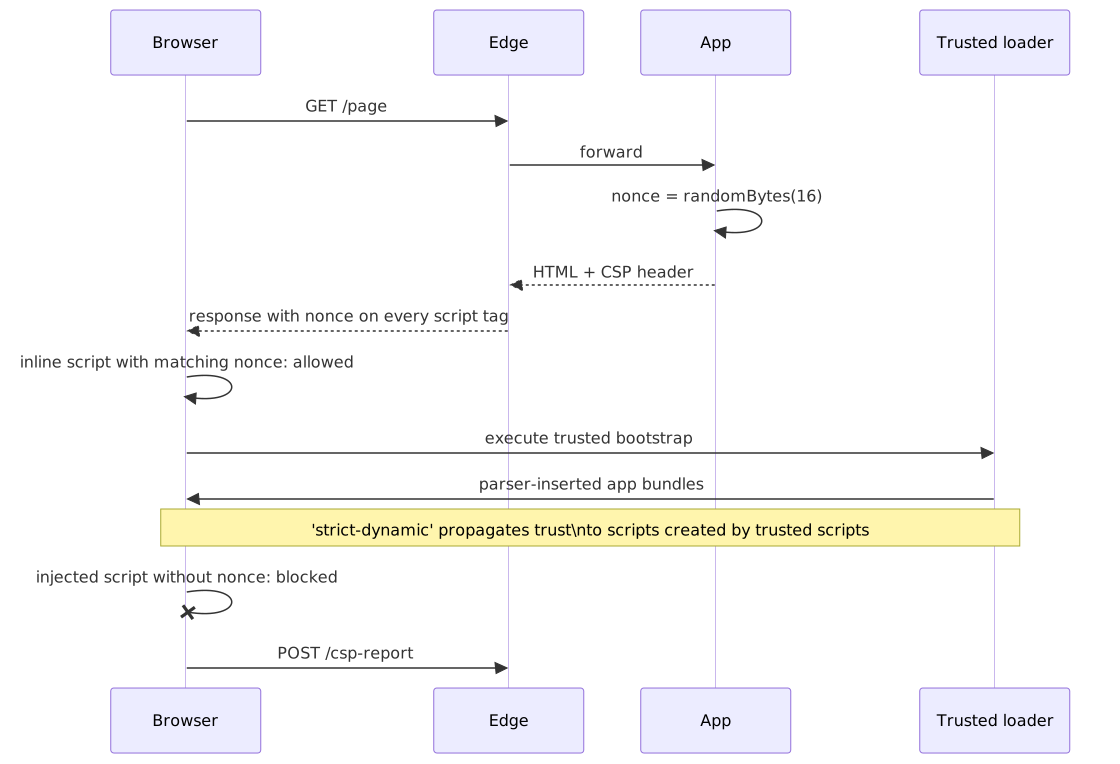
The mechanism, in four steps:
- Generate a fresh nonce per response (≥ 128 bits, base64-encoded).
- Serve it both in the CSP header and on every legitimate inline /
external
<script>tag the page emits. - Browser executes only scripts whose
nonceattribute matches. 'strict-dynamic'lets a trusted script load further scripts without listing every URL — the trust travels with the parser-inserted relationship, not with the URL.
import crypto from "crypto"function generateCSP(req, res, next) { const nonce = crypto.randomBytes(16).toString("base64") res.locals.nonce = nonce res.setHeader( "Content-Security-Policy", [ "default-src 'self'", `script-src 'self' 'nonce-${nonce}' 'strict-dynamic'`, `style-src 'self' 'nonce-${nonce}'`, "object-src 'none'", "base-uri 'self'", "frame-ancestors 'none'", ].join("; "), ) next()}Important
The nonce must be unguessable and unique per response. Reusing a nonce across responses lets an attacker who steals one nonce keep injecting indefinitely. Caching layers must vary on the response or strip the header on cache fills.
Trusted Types
Trusted Types close the
DOM-XSS gap CSP cannot reach: they refuse to let raw strings reach
injection sinks
like Element.innerHTML, document.write, or eval. As of February 2026
the API is Baseline
across all major browsers — Chrome and Edge since 83, Firefox since 148,
Safari since 26.8
Content-Security-Policy: require-trusted-types-for 'script'; trusted-types myPolicyconst policy = trustedTypes.createPolicy("myPolicy", { createHTML: (input) => DOMPurify.sanitize(input), createScript: () => { throw new Error("Scripts not allowed") }, createScriptURL: (input) => { const url = new URL(input, location.origin) if (url.origin !== location.origin) { throw new Error("Cross-origin scripts not allowed") } return url.toString() },})element.innerHTML = policy.createHTML(userInput)A 2021 Google internal review estimated Trusted Types would have prevented at least 61% of DOM XSS vulnerabilities reported through Google’s Vulnerability Reward Program, including bugs missed by static analysis pipelines.9 Its value is structural: instead of asking every developer to remember to sanitize, the browser refuses to render the unsanitized result.
HTTP Strict Transport Security (HSTS)
RFC 6797 lets a server tell
browsers to only ever connect over HTTPS for a given host. Once latched, the
policy survives until max-age expires.
Strict-Transport-Security: max-age=31536000; includeSubDomains; preload| Directive | Purpose |
|---|---|
max-age |
Policy duration in seconds (31536000 = 1 year) |
includeSubDomains |
Applies to all subdomains |
preload |
Eligible for the HSTS preload list |
Warning
The HSTS preload list is sticky. Once a host ships in a Chromium / Firefox
preload list, removal can take months to roll out to user populations.
Verify every subdomain serves valid HTTPS before enabling includeSubDomains; preload.
Other essential headers
X-Content-Type-Options: nosniffX-Frame-Options: DENYReferrer-Policy: strict-origin-when-cross-originPermissions-Policy: camera=(), microphone=(), geolocation=()Cross-Origin-Opener-Policy: same-originCross-Origin-Embedder-Policy: require-corp| Header | Mitigates |
|---|---|
X-Content-Type-Options |
MIME-sniffing attacks |
X-Frame-Options |
Clickjacking (legacy; CSP frame-ancestors supersedes it) |
Referrer-Policy |
URL leakage to third parties |
Permissions-Policy |
Feature abuse (camera, mic, geolocation, etc.) |
Cross-Origin-Opener-Policy |
Spectre-style cross-origin side channels |
Cross-Origin-Embedder-Policy |
Cross-origin resource leaks (paired with COOP for crossOriginIsolated) |
Authentication and session security
WebAuthn (passkeys)
WebAuthn Level 3 reached W3C Candidate Recommendation Snapshot status on 2026-01-13.10 The model is public-key cryptography per origin: the authenticator (TPM, Secure Enclave, hardware key, or platform passkey) generates a keypair bound to the relying-party origin, and the private key never leaves the device.
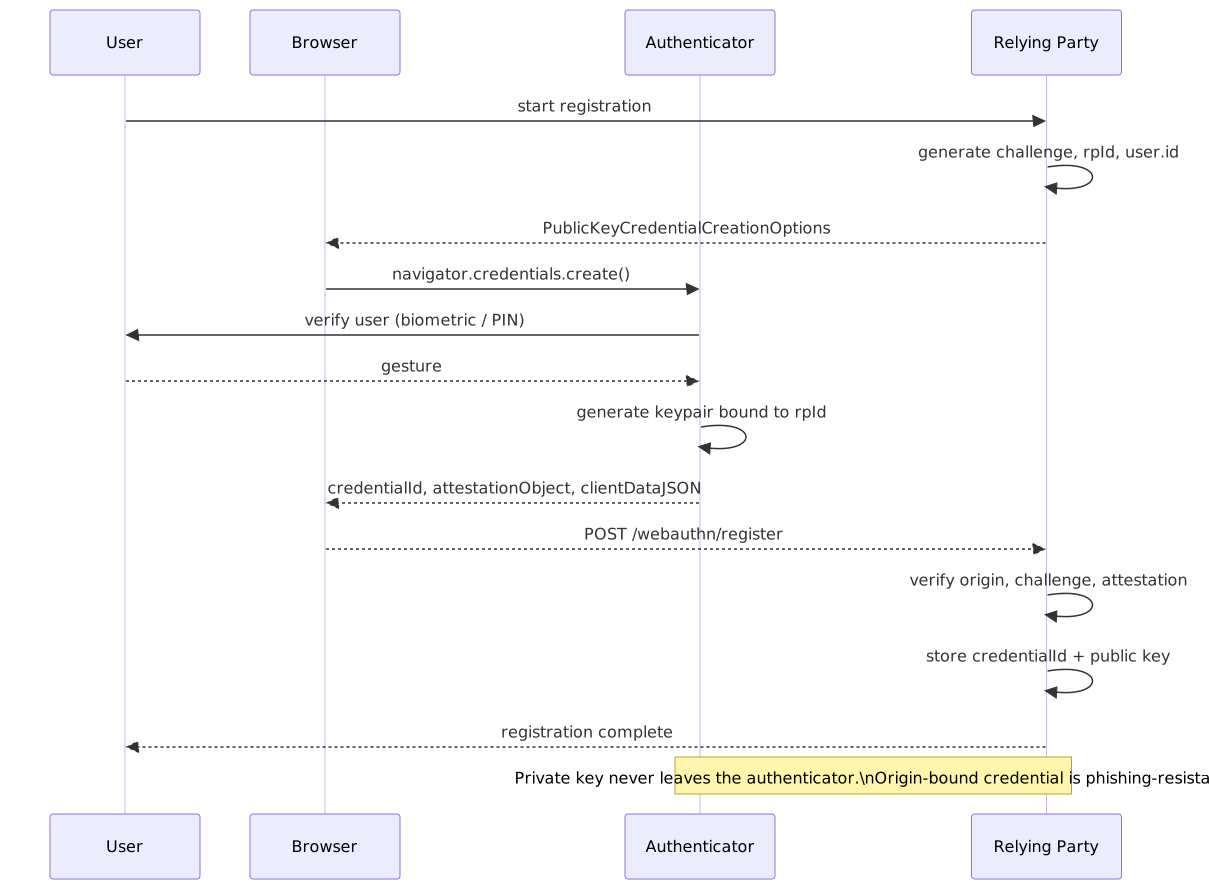
async function registerPasskey(userId, userName) { const challenge = await fetch("/api/webauthn/challenge").then((r) => r.json()) const credential = await navigator.credentials.create({ publicKey: { challenge: Uint8Array.from(challenge.value, (c) => c.charCodeAt(0)), rp: { name: "Example Corp", id: "example.com" }, user: { id: Uint8Array.from(userId, (c) => c.charCodeAt(0)), name: userName, displayName: userName, }, pubKeyCredParams: [ { alg: -7, type: "public-key" }, // ES256 { alg: -257, type: "public-key" }, // RS256 ], authenticatorSelection: { authenticatorAttachment: "platform", userVerification: "required", residentKey: "required", }, timeout: 60000, }, }) await fetch("/api/webauthn/register", { method: "POST", body: JSON.stringify({ id: credential.id, rawId: btoa(String.fromCharCode(...new Uint8Array(credential.rawId))), response: { clientDataJSON: btoa( String.fromCharCode(...new Uint8Array(credential.response.clientDataJSON)), ), attestationObject: btoa( String.fromCharCode(...new Uint8Array(credential.response.attestationObject)), ), }, }), })}Passkeys are phishing-resistant by construction: the authenticator
verifies the relying party’s rpId against the origin the browser is on, so
a credential issued for example.com will silently refuse to sign for
exarnple.com. There is no password to phish, no shared secret to exfiltrate
from a server dump, and discoverable credentials (residentKey: required)
power the username-less sign-in flow.
Secure session cookies
const sessionOptions = { name: "__Host-session", secret: process.env.SESSION_SECRET, cookie: { httpOnly: true, secure: true, sameSite: "strict", maxAge: 15 * 60 * 1000, path: "/", }, resave: false, saveUninitialized: false,}The __Host- prefix is enforced by the browser per
RFC 6265bis:
the cookie must be Secure, must have Path=/, and must not carry a
Domain attribute — eliminating the entire class of “subdomain takeover
sets a cookie that the parent trusts” attacks.
SameSite semantics:
| Value | Sent on | Use for |
|---|---|---|
Strict |
First-party requests only | Auth + state-changing actions |
Lax |
Same-site + top-level navigations with safe methods | General-purpose default |
None |
All contexts (requires Secure) |
Legitimate cross-site embeds |
Note
Per RFC 6265bis, modern browsers treat cookies without an explicit
SameSite attribute as Lax by default — Chrome shipped this in version
80 (2020) and others followed.11 If you need cross-site
cookies, set SameSite=None; Secure explicitly; without Secure, the
cookie is rejected.
Token storage
| Storage | XSS exposure | CSRF exposure | Verdict |
|---|---|---|---|
localStorage |
High | None | Never for auth tokens |
sessionStorage |
High | None | Never for auth tokens |
HttpOnly cookie |
None | Mitigable | Preferred, with SameSite=Strict |
| In-memory JS variable | Medium | None | Short-lived access tokens only |
HttpOnly cookies are inaccessible to JavaScript, so a successful XSS cannot
read them; SameSite=Strict blocks cross-origin requests from including the
cookie, neutralizing CSRF; Secure keeps them off plaintext channels. The
combination of all three is the strongest stock defense the platform offers.
Attack vectors and defenses
Cross-Site Scripting (XSS)
| Type | Vector | Persistence | Detection |
|---|---|---|---|
| Stored | Database → rendered page | Permanent | Server-side scanning |
| Reflected | URL parameter → response | None | WAF + input validation |
| DOM-based | Client-side JS → DOM sink | None | Trusted Types + strict CSP |
DOM XSS is the variant strict CSP cannot directly catch — it lives in
strings flowing into innerHTML, eval, setTimeout(string), and similar
sinks. Trusted Types fixes this at the platform layer:
document.getElementById("output").innerHTML = userInput // VULNERABLEconst policy = trustedTypes.createPolicy("sanitizer", { createHTML: (input) => DOMPurify.sanitize(input),})document.getElementById("output").innerHTML = policy.createHTML(userInput)Cross-Site Request Forgery (CSRF)
CSRF turns a victim’s authenticated session into the attacker’s submission mechanism: the victim’s browser is tricked into making a state-changing request, and the cookie rides along automatically.
Defense layers (all three together, not pick-one):
SameSitecookies (Strictfor auth,Laxfor general state).- Synchronizer / double-submit token for state-changing requests.
- Origin / Referer validation as a coarse server-side check.
Caution
The widely cited csurf package was
deprecated in September 2022
and was formally retired by the Express maintainers in
the 2025 legacy-package cleanup.
Use a maintained signed-double-submit implementation such as
csrf-csrf or the
community-maintained @dr.pogodin/csurf fork.
import { doubleCsrf } from "csrf-csrf"const { doubleCsrfProtection, generateToken } = doubleCsrf({ getSecret: () => process.env.CSRF_SECRET, cookieName: "__Host-psifi.x-csrf-token", cookieOptions: { sameSite: "strict", httpOnly: true, secure: true, path: "/" }, size: 64, getTokenFromRequest: (req) => req.headers["x-csrf-token"],})app.get("/form", (req, res) => { const token = generateToken(req, res) res.render("form", { csrfToken: token })})app.post("/transfer", doubleCsrfProtection, (req, res) => { processTransfer(req.body)})Server-Side Request Forgery (SSRF)
SSRF induces the server to make a request the attacker could not make themselves, typically to an internal service the attacker cannot route to. It is now folded into A01 because the underlying defect is authorization: the server makes the request without verifying the destination is one the caller is allowed to reach.1
Common high-value SSRF targets:
| Target | Why it matters |
|---|---|
169.254.169.254 / metadata.google.internal |
Cloud instance metadata (IAM tokens, instance creds) |
127.0.0.1, localhost |
Loopback admin endpoints, debug ports |
10.0.0.0/8, 172.16.0.0/12, 192.168.0.0/16 |
RFC 1918 private network ranges |
fc00::/7, fe80::/10 |
IPv6 private + link-local |
A robust outbound URL validator combines a deny list with post-resolution IP checks (because hostnames lie) and re-resolution before reconnect (because of DNS rebinding):
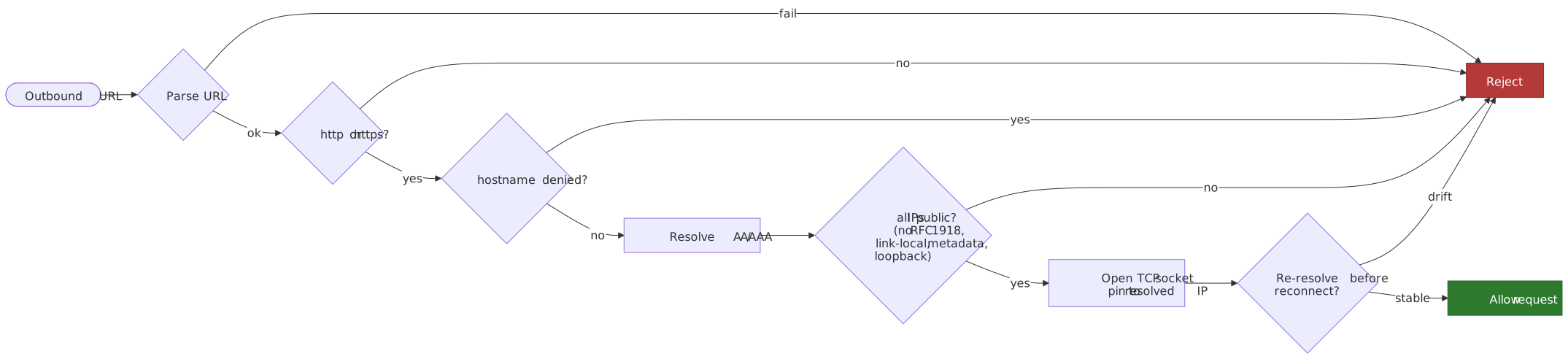
import { URL } from "url"import dns from "dns/promises"const BLOCKED_HOSTS = new Set([ "169.254.169.254", "metadata.google.internal", "localhost", "127.0.0.1",])const PRIVATE_RANGES = [ { start: 0x0a000000, end: 0x0affffff }, // 10.0.0.0/8 { start: 0xac100000, end: 0xac1fffff }, // 172.16.0.0/12 { start: 0xc0a80000, end: 0xc0a8ffff }, // 192.168.0.0/16]export async function isAllowedUrl(urlString) { const url = new URL(urlString) if (!["http:", "https:"].includes(url.protocol)) return false if (BLOCKED_HOSTS.has(url.hostname)) return false const addresses = await dns.resolve4(url.hostname) for (const addr of addresses) { const ip = addr .split(".") .reduce((acc, oct) => (acc << 8) + parseInt(oct, 10), 0) if (PRIVATE_RANGES.some((r) => ip >= r.start && ip <= r.end)) { return false } } return true}Warning
Allow-listing alone (isAllowedUrl) is not enough — the
DNS rebinding class of
attack defeats it by returning a public IP at validation time and a
private IP a few seconds later. Use the resolved IP from validation as the
connect target (pin to the IP, send the original Host header), and
re-validate on every reconnection.
Security by rendering strategy
Different rendering strategies expose different attack surfaces; the control set should follow.
| Strategy | Primary attack surface | Highest-leverage controls |
|---|---|---|
| SSR | Template injection, SSRF, session fixation, CSRF | Auto-escaping templates, session regen on auth, origin checks, strict CSRF |
| SSG | Build-pipeline supply chain, DOM XSS in client JS, cached vulns | SBOM + signature checks in CI, hash-based CSP (stable assets), immutable artifact promotion |
| CSR | DOM XSS, token leakage, open redirects | Trusted Types, HttpOnly cookies, strict CSP with nonces, allow-list redirect targets |
A SPA running an API behind a CDN inherits all three concern sets — the build pipeline of the SSG, the runtime sinks of the CSR, and the session/auth surface of the SSR backend.
Practical takeaways
- Centralize authorization in middleware. Inline
if (req.user.id === resource.ownerId)checks are how endpoints quietly drift out of policy. - Strict CSP, not allowlists. Per-response nonces plus
'strict-dynamic'beat any reasonable host allowlist.2 Pair with Trusted Types to close the DOM-XSS gap. - Argon2id at the OWASP profile. Lower the memory only when hardware cannot sustain it, and bump the time cost in compensation.5
- Passkeys over passwords for new flows. Phishing resistance is built in; no shared secret to leak.
- Use the
__Host-prefix andSameSite=Strictfor session cookies. Replace any currentcsurfusage with a maintained alternative. - Treat the supply chain as part of the runtime. SBOM + signature verification + SRI for browser-loaded third-party assets.
- Validate outbound URLs after DNS resolution, then pin the socket to the resolved IP. Hostname allow-lists alone do not stop DNS rebinding.
Appendix
Prerequisites
- HTTP fundamentals (headers, methods, status codes, cookies).
- Same-origin policy and CORS.
- Public-key cryptography fundamentals (asymmetric vs symmetric, hashing).
- Node.js / browser JavaScript familiarity.
Terminology
- CSP — Content Security Policy; browser-enforced loading restrictions.
- CSRF — Cross-Site Request Forgery; tricks an authenticated user into a request.
- HSTS — HTTP Strict Transport Security; forces HTTPS.
- IDOR — Insecure Direct Object Reference; unauthorized resource access via ID manipulation.
- OWASP — Open Worldwide Application Security Project.
- SBOM — Software Bill of Materials.
- SRI — Subresource Integrity; cryptographic verification of subresources.
- SSRF — Server-Side Request Forgery.
- WAF — Web Application Firewall.
- XSS — Cross-Site Scripting.
References
- OWASP Top 10:2025 — Introduction
- OWASP Top 10:2025 — A01 Broken Access Control
- OWASP Password Storage Cheat Sheet
- OWASP CSP Cheat Sheet
- W3C CSP Level 3
- W3C Trusted Types
- W3C WebAuthn Level 3
- W3C Subresource Integrity 2
- RFC 6797 — HSTS
- RFC 6265bis — Cookies
- NIST SP 800-38D — AES-GCM
- Password Hashing Competition
- Mozilla Observatory
- SSL Labs Server Test
Footnotes
-
OWASP Top 10:2025 — Introduction — published Nov 2025. ↩ ↩2 ↩3 ↩4 ↩5 ↩6
-
Weichselbaum et al., CSP Is Dead, Long Live CSP! On the Insecurity of Whitelists and the Future of Content Security Policy, ACM CCS 2016. ↩ ↩2 ↩3
-
OWASP Top 10:2025 — A01: Broken Access Control — incidence rate 3.73%, 40 mapped CWEs. ↩
-
W3C Subresource Integrity Level 2, Working Draft —
sha256,sha384,sha512digests;crossoriginrequired. ↩ -
OWASP Password Storage Cheat Sheet — Argon2id — five equivalent OWASP Argon2id profiles, all with
p=1. ↩ ↩2 -
Password Hashing Competition — Argon2 selected as winner on 2015-07-20;
P-H-C/phc-winner-argon2. ↩ -
W3C Content Security Policy Level 3, Working Draft 2026-04-21. ↩
-
caniuse — Trusted Types for DOM manipulation and Web Platform DX — Trusted Types Baseline (2026-02-24). ↩
-
Google, Trusted Types — mid-2021 report — analysis of DOM XSS reports to Google’s VRP. ↩
-
W3C WebAuthn Level 3, Candidate Recommendation Snapshot 2026-01-13. ↩
-
draft-ietf-httpbis-rfc6265bis — default
Laxenforcement; Chromium shipped this default in Chrome 80, see Chromium SameSite FAQ. ↩