Design a Notification System
A notification platform sits between every product surface that needs to interrupt a user — security alerts, transactional confirmations, social signals, marketing — and three classes of opinionated downstream: device push providers (APNs, FCM, Web Push), email transports, and SMS carriers. Each downstream has its own rate limits, error semantics, and reputation rules. The platform’s job is to absorb bursty producer traffic, respect per-user preferences and quiet hours, deduplicate, retry, and converge on a single coherent delivery — without becoming the reason a user uninstalls the app.
This article is a deep design pass for a senior engineer who needs to either build that platform from scratch or reason about an existing one. It assumes you are comfortable with Kafka partitioning, Cassandra time-series modeling, Redis primitives, and at-least-once semantics; it spends its weight where the non-obvious failure modes live: fan-out at the producer boundary, priority inversion, deduplication windows, channel fallback, aggregation, and the operational reality of FCM/APNs at scale.
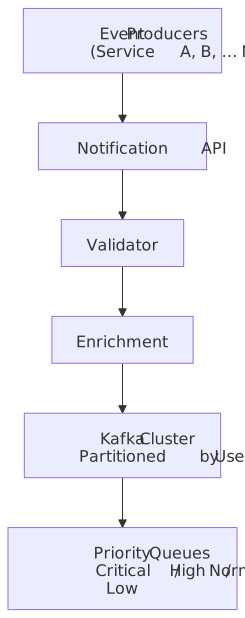
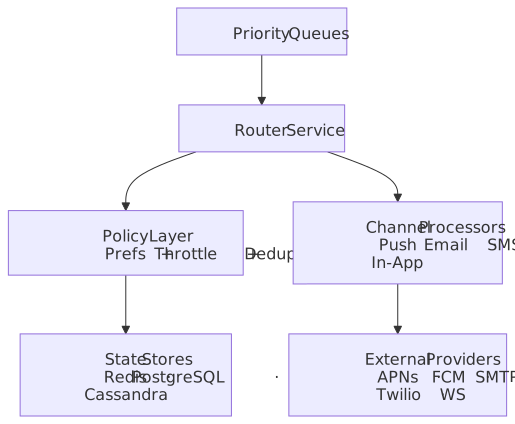
Mental model
Notification systems solve three interlocking problems:
- Reliable delivery — a notification accepted at the API edge must eventually reach the device, or end up explicitly dropped with a recorded reason. Exactly-once is unattainable across heterogeneous downstreams; the practical contract is at-least-once with idempotent consumers (Twilio Segment, “Delivering billions of messages exactly once”).
- User respect — preferences, quiet hours, frequency caps, and aggregation. Brands that manage frequency see materially longer customer lifetimes (Braze on frequency capping); the platform owns the cross-channel cap.
- Channel optimization — pick the right channel for the message at the right time. APNs, FCM, SMTP, and SMS each have distinct latency, cost, deliverability, and rate-limit profiles (FCM throttling and quotas, APNs provider API).
Core architectural decisions:
| Decision | Choice | Rationale |
|---|---|---|
| Delivery guarantee | At-least-once + idempotent consumers | Exactly-once is impractical across APNs/FCM/SMTP/SMS; deduplicate at the consumer. |
| Queue partitioning | By user_id |
Co-locates a user’s notifications for rate limiting, aggregation, and ordering inside the partition. |
| Priority handling | Separate topic per priority | Critical notifications bypass backlog from bulk sends and survive head-of-line blocking. |
| Channel selection | User preference, then fallback chain | Respect explicit choice; ensure delivery for critical regardless of channel preference. |
| Rate limiting | Token bucket per user per channel | Allows controlled bursts without exceeding long-term cap; matches provider 429 semantics. |
| Template rendering | At ingestion | Freezes content at send so deduplication, retries, and audit logs reference the same payload. |
Trade-offs you accept by adopting this shape:
- Higher per-event latency from preference and dedup lookups in exchange for user control.
- Storage overhead for a deduplication window (hours to days) plus delivery-status fan-out.
- Multiple channel processors instead of one delivery loop — more code, more isolation.
- At-least-once means clients must tolerate occasional duplicates.
Requirements
Functional requirements
| Requirement | Priority | Notes |
|---|---|---|
| Multi-channel delivery | Core | Push (iOS/Android/Web), email, SMS, in-app. |
| User preferences | Core | Opt-in/out per category and per channel. |
| Template management | Core | Variable substitution, locale, version history. |
| Scheduling | Core | Immediate, scheduled, timezone-aware delivery. |
| Delivery tracking | Core | accepted → sent → delivered → opened / clicked. |
| Rate limiting | Core | User-level and channel-level throttling. |
| Retry and fallback | Core | Bounded retries with exponential backoff; channel fallback. |
| Notification history | Extended | Queryable per-user log for product surface and support. |
| Batching/aggregation | Extended | Collapse similar notifications (“5 new likes”). |
| Quiet hours | Extended | Per-user do-not-disturb windows in user-local timezone. |
Non-functional requirements
| Requirement | Target | Rationale |
|---|---|---|
| Availability | 99.99% (4 nines) | Notifications are critical for engagement and security workflows. |
| Delivery latency (critical) | p99 < 500 ms (server-side) | Time-sensitive alerts (security, transactions) must feel synchronous. |
| Delivery latency (normal) | p99 < 5 s (server-side) | Acceptable for social and promotional traffic. |
| Throughput | 1M notifications/sec peak | Consumer-scale enterprise (Uber, LinkedIn, Slack tier). |
| Deduplication window | 24–48 hours (per producer SLA) | Balances storage vs. duplicate prevention; longer is fine if storage allows. |
| Delivery rate | > 99.9% (after retries) | After bounded retries and channel fallback. |
Note
Server-side delivery latency only measures up to the provider acknowledgement. Actual on-device delivery depends on the carrier (SMS), the OS power state (push), and the user’s mail client (email) and is outside our control.
Scale estimation
Users:
- Monthly active users: 100M.
- Daily active users: 40M (40% of MAU).
- Devices per user: 2 (mobile + web).
- Push tokens to manage: ~200M.
Traffic:
- Notifications per active user per day: 25 (mix of transactional and engagement).
- Daily volume: 40M × 25 = 1B notifications/day.
- Average rate: 1B / 86 400 ≈ 12K notifications/sec.
- Peak (3× average): ~36K notifications/sec.
- Burst events (flash sales, breaking news): 100K+ notifications/sec.
Storage:
- Notification record: ~500 B (metadata, status, timestamps).
- Daily storage: 1B × 500 B = 500 GB/day.
- 90-day retention: ~45 TB.
- Deduplication cache: 48-hour window × 1B × 32 B key ≈ 64 GB hot working set.
External provider capacity:
- FCM HTTP v1: default quota 600 000 messages per minute per Firebase project (roughly 10K/sec sustained), enforced by a one-minute token bucket; overflow returns
HTTP 429 RESOURCE_EXHAUSTED(Firebase: throttling and quotas). - APNs: no published numeric rate limit; Apple throttles or
GOAWAYs connections that exhibit abusive patterns and recommends keeping persistent HTTP/2 connections to a minimum (APNs provider API). - Amazon SES: account-level send rate is adjustable through Service Quotas and ramps with reputation; sandbox accounts are capped at 1 message/sec and 200/24h. Dedicated IPs auto-warm over a 45-day schedule (SES sending quotas, Dedicated IP warming).
- Twilio SMS: short codes default to 100 MPS; A2P 10DLC long-code throughput varies by Brand Trust Score, from ~12 SMS MPS (low trust) to ~225 SMS MPS (high trust) across major US carriers (Twilio: A2P 10DLC throughput).
Important
Provider quotas are not symmetric across carriers, regions, or product tiers. Treat them as policy variables loaded at runtime, not constants in code.
Design paths
There are three defensible base architectures. Real systems converge on a hybrid of all three; understanding the pure forms makes the trade-offs explicit.
Path A: Push-based (real-time first)
Best when sub-second in-app latency is the primary constraint and your platform already maintains persistent connections to clients.
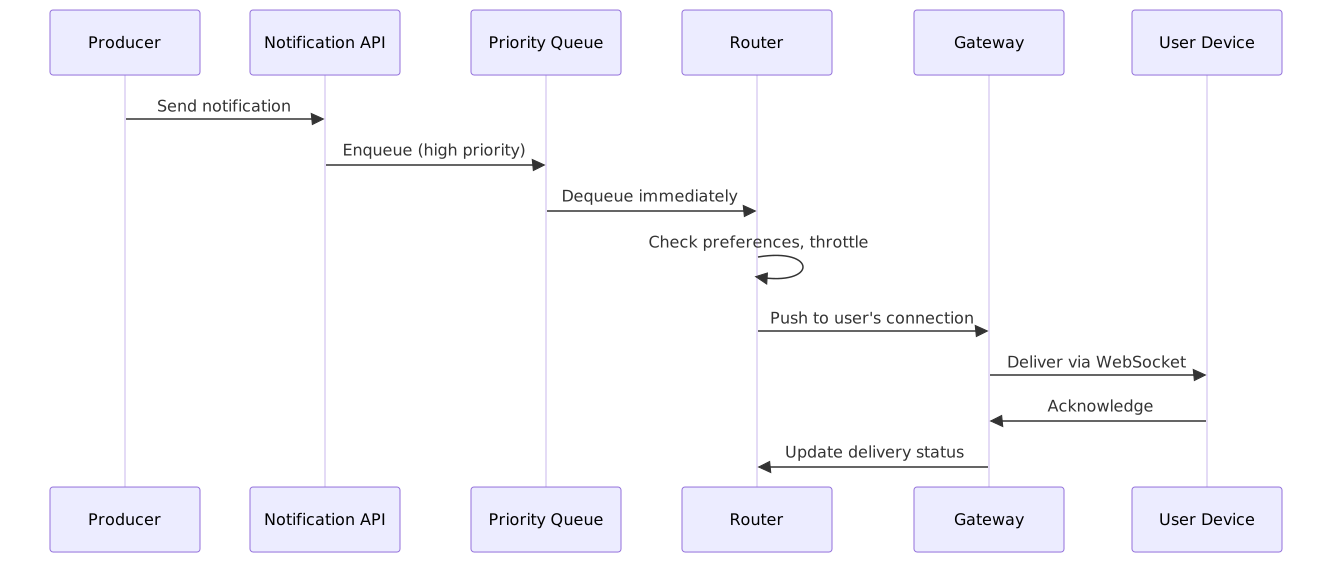
Key characteristics:
- Persistent connections (WebSocket / SSE / gRPC bidi) terminate at a stateful gateway.
- The gateway maintains a
connection → user_idmapping so the router can address a user without going through APNs/FCM. - Direct delivery for in-app traffic; APNs/FCM still required for background/closed-app delivery.
Trade-offs:
- Lowest in-app latency (often < 100 ms).
- No external provider cost for in-app traffic.
- Bidirectional channel for read/clear acknowledgements.
- Connection management is non-trivial — load-balancing sticky-session traffic, recovering after gateway restarts, and coalescing reconnect storms (Uber RAMEN gRPC migration).
- Higher infrastructure cost from carrying persistent connections.
Reference implementation: Uber’s RAMEN (Real-time Asynchronous MEssaging Network) reached 1.5M+ concurrent connections and 250K+ messages per second on its SSE-based architecture before migrating to gRPC bidirectional streaming for real-time acknowledgments and head-of-line-blocking-free heartbeats (Uber: real-time push platform, Uber: next-gen push platform on gRPC).
Path B: Queue-based (reliability first)
Best when delivery guarantee dominates latency and you need a strong audit trail.
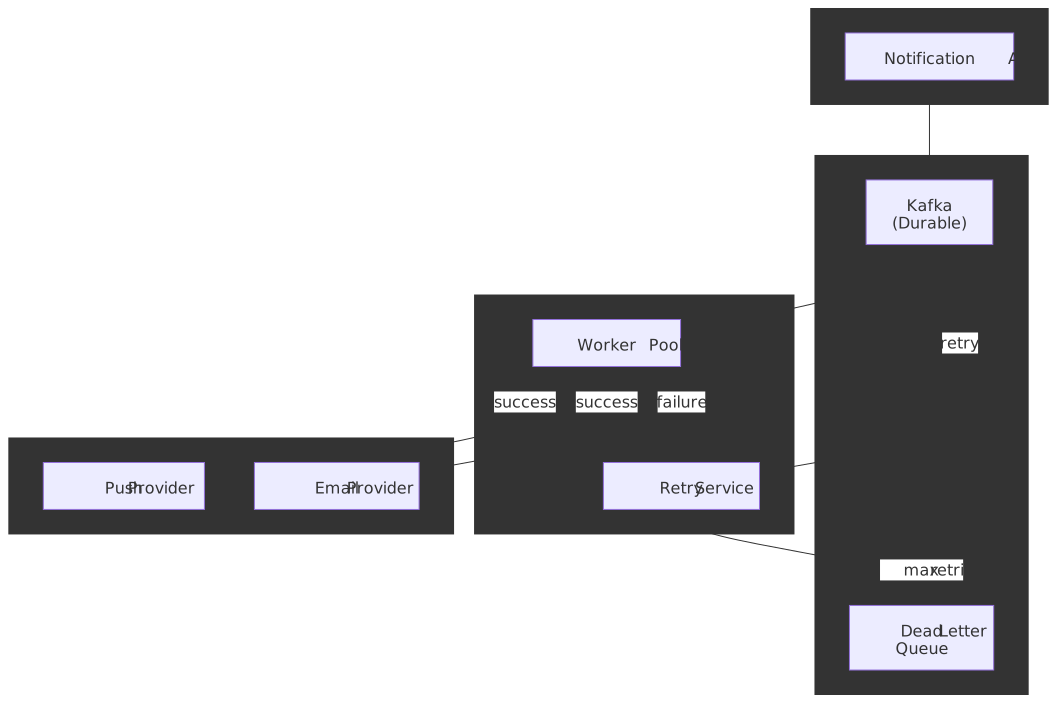
Key characteristics:
- All notifications flow through a durable log (Kafka, Pulsar, or NATS JetStream).
- Workers consume at their own pace, with built-in retry and a dead-letter queue.
- Kafka retention is the audit trail.
Trade-offs:
- Strong delivery guarantee — no message lost on a worker crash.
- Excellent burst absorption — the queue is the buffer.
- Higher per-event latency (queue hop overhead, batching).
- Ordering is only guaranteed inside a partition (Apache Kafka docs); cross-partition ordering requires application-level sequencing.
- Risk of notification storms after recovery — long backlogs can replay all at once and overwhelm downstream providers.
Reference implementation: Slack runs notification delivery on Kafka-backed pipelines with 100% trace coverage per notification, treating each notification_id as a trace_id and using span links to connect the originating message to all downstream notifications (Slack engineering: tracing notifications).
Path C: Hybrid (tiered by priority)
Best when notification mix is heterogeneous — some traffic is time-critical, most is bulk.
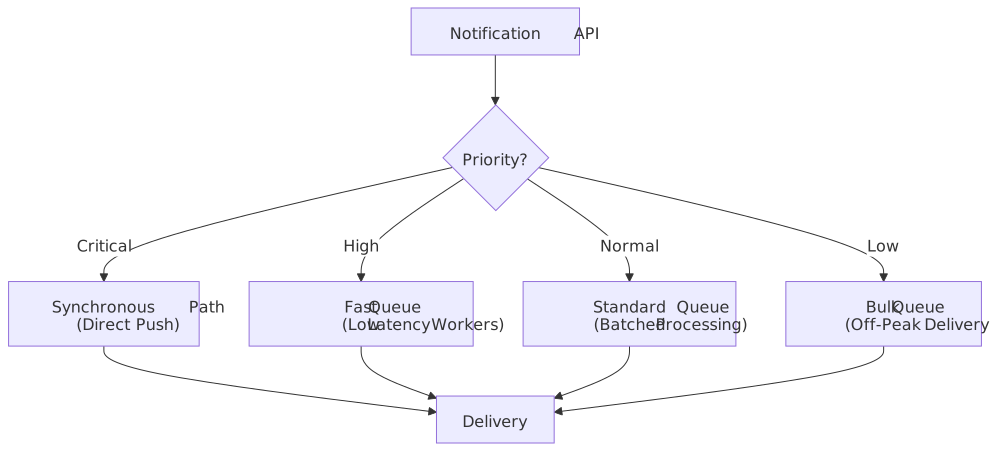
Key characteristics:
- Priority classified at ingestion based on category.
- Each priority has its own topic, partition count, worker pool, and SLA.
- Bulk traffic batches and is allowed to defer to off-peak windows.
Trade-offs:
- Optimal latency for critical traffic at acceptable cost for bulk.
- Predictable per-tier SLAs — operators can scale per-priority workers independently.
- More code paths and configuration to maintain.
- Risk of priority inversion under contention if the priority classifier is wrong or shared resources (Redis, dedup store) are saturated.
Reference implementation: Netflix’s RENO (Rapid Event Notification System) uses priority-segmented Amazon SQS queues with dedicated compute clusters per priority and a hybrid push (Zuul Push) plus pull (Cassandra-backed history) delivery model — the segmentation contains failures so a slow path does not block a fast one.
Path comparison
| Factor | Push-based | Queue-based | Hybrid |
|---|---|---|---|
| Latency (critical) | < 100 ms | 500 ms–2 s | < 100 ms |
| Latency (bulk) | Same as critical | Same as critical | Flexible (off-peak) |
| Reliability | Good | Excellent | Excellent |
| Burst absorption | Limited | Excellent | Excellent |
| Infrastructure cost | High | Medium | Medium-high |
| Operational complexity | High | Medium | Highest |
| Production reference | Uber RAMEN | Slack | Netflix RENO |
What this article designs
The rest of the article designs Path C (Hybrid) end-to-end, because:
- It reflects what production systems at scale converge to (Netflix, LinkedIn, Pinterest).
- It forces you to make the priority and trade-off thinking explicit.
- It handles the real notification mix — security alerts to weekly digests — without two separate systems.
- The pure-push and pure-queue paths fall out as degenerate cases.
High-level design
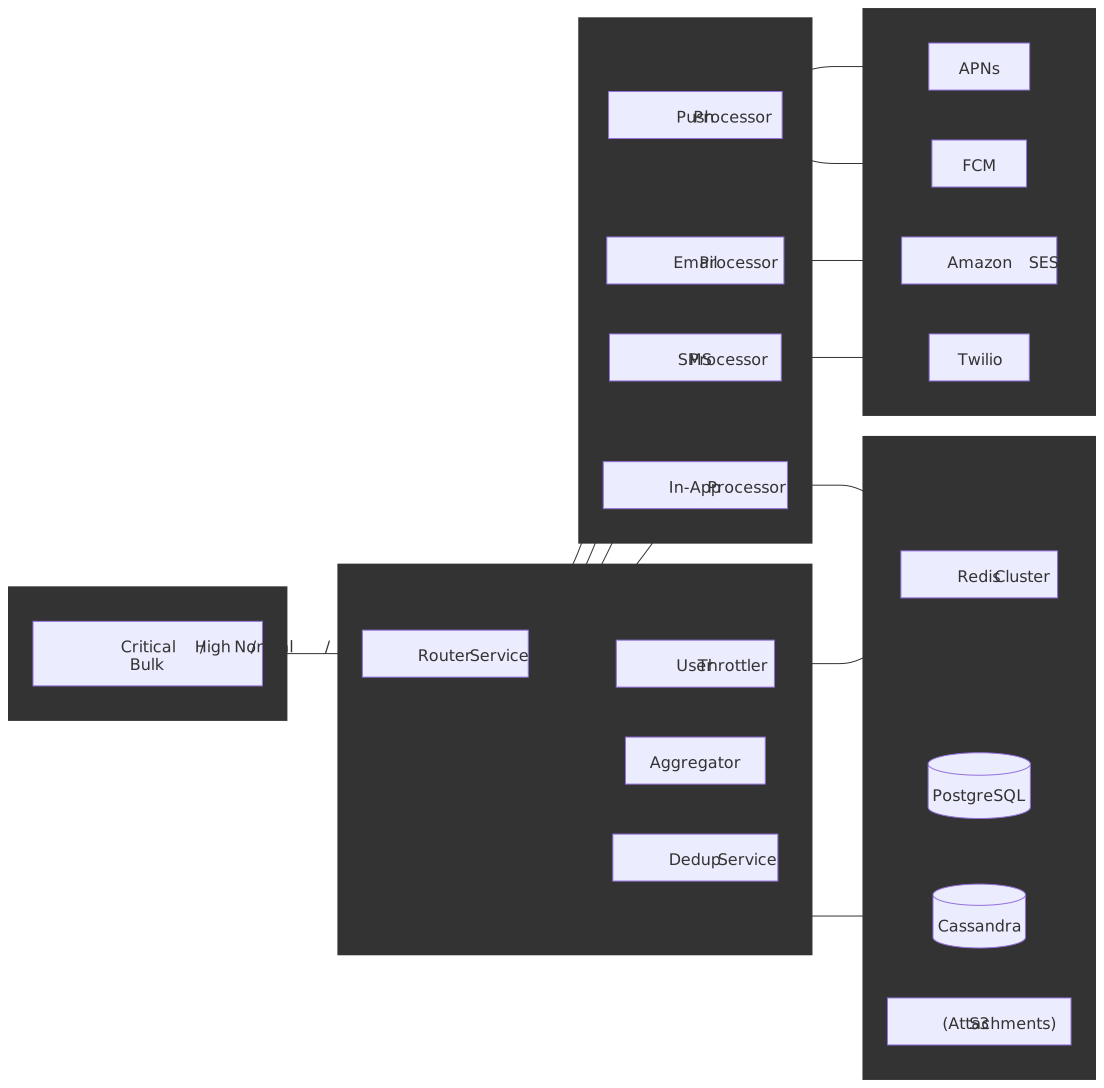
Component overview
Ingress and queueing:
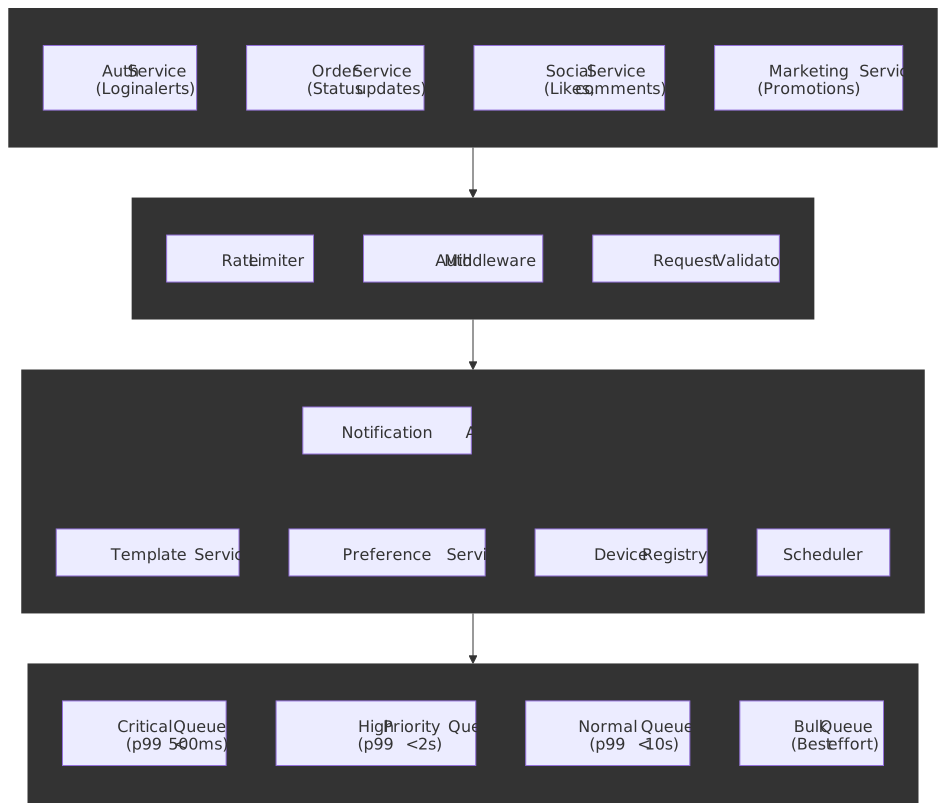
Routing, delivery, and storage:
Notification API
The producer-facing surface. Validates, enriches, and routes to the correct priority topic.
Responsibilities:
- Authenticate the producer (mTLS or signed JWT).
- Validate the request against the template’s variable schema.
- Resolve the template to its current version and render at ingestion.
- Look up the user’s preferences and current device tokens.
- Classify priority and route to the matching topic, keyed by
user_id.
Design decisions:
| Decision | Choice | Rationale |
|---|---|---|
| API style | REST with 202 Accepted |
Producers fire-and-forget; status is queryable / webhook-pushed. |
| Idempotency | Producer-supplied notificationId |
Enables safe producer retries; drives downstream dedup. |
| Batching | Up to 1 000 recipients per request | Reduces API overhead for bulk sends without losing per-recipient addressability. |
| Template rendering | At ingestion (not at send) | Freezes content; downstream can replay, dedup, and audit identical payloads. |
Template service
Manages multi-channel templates with variable substitution, locale, and version history.
interface NotificationTemplate { templateId: string name: string category: "transactional" | "marketing" | "system" channels: { push?: { title: string // "Your order {{orderId}} has shipped" body: string // "Track your package: {{trackingUrl}}" data?: Record<string, string> } email?: { subject: string htmlBody: string textBody: string } sms?: { body: string // Max 160 chars for single GSM-7 segment } } variables: VariableDefinition[] defaultLocale: string translations: Record<string, ChannelContent>}Design decisions:
- Templates stored in PostgreSQL; render-path Redis cache with a 5-minute TTL.
- Variable schema validated at template creation so runtime substitution cannot fail silently.
- Versioned table for rollback; the rendered payload records the version it used.
- Variants registered for A/B tests; the variant assignment lives in the rendered payload.
Preference service
Per-user notification preferences with channel-level and category-level granularity.
interface UserPreferences { userId: string globalEnabled: boolean quietHours?: { enabled: boolean start: string // "22:00" end: string // "07:00" timezone: string // IANA TZ identifier, e.g. "America/New_York" } channels: { push: ChannelPreference email: ChannelPreference sms: ChannelPreference inApp: ChannelPreference } categories: { [category: string]: { enabled: boolean channels: string[] // overrides global channel prefs for this category frequency?: "immediate" | "daily_digest" | "weekly_digest" } }}interface ChannelPreference { enabled: boolean frequency?: FrequencyLimit // e.g. { maxPerHour: 5, maxPerDay: 20 }}Storage strategy:
- Hot path: Redis hash keyed on
prefs:{user_id}, 1-hour TTL, refreshed write-through. - Canonical: PostgreSQL with append-only audit history (compliance and debugging).
- Cache invalidation is write-through; explicit purges happen on PATCH.
Resolution cascade (router-side):
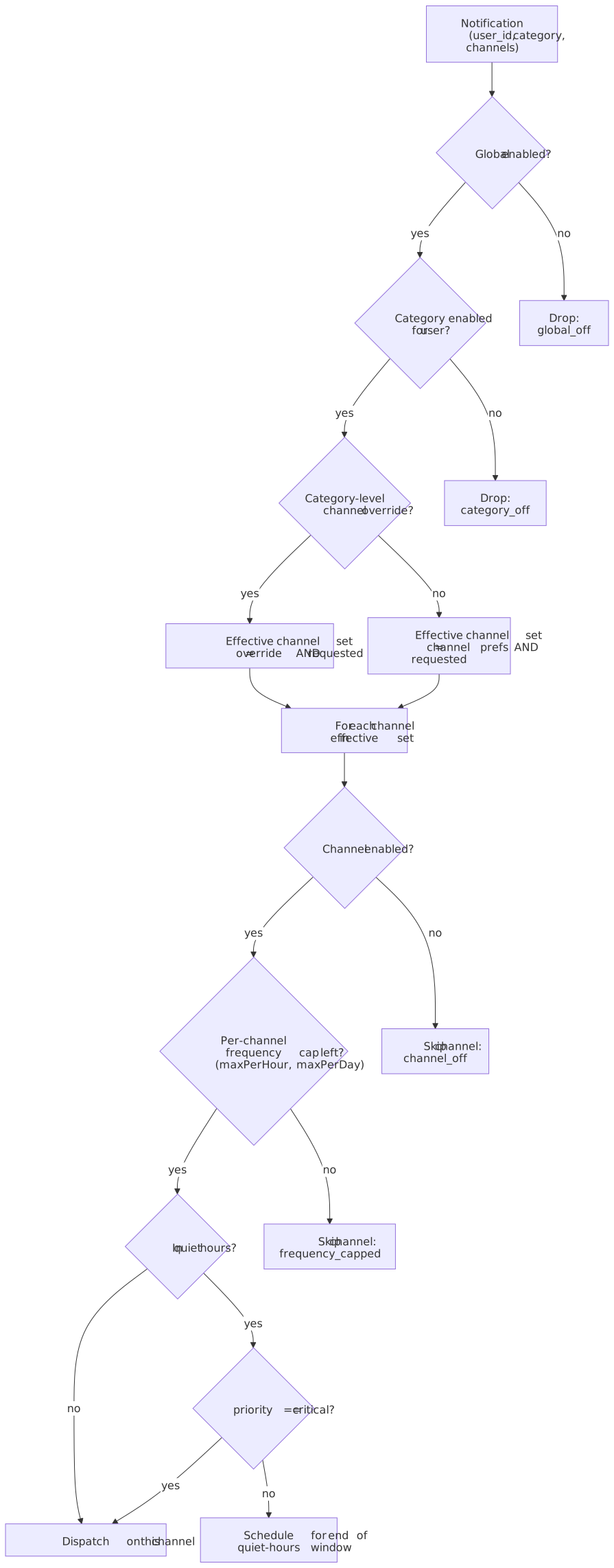
The cascade is short-circuit: the first disabled decision wins, and per-channel decisions are independent — opting out of email for the marketing category does not affect the same category’s push. Drops record a structured reason (global_off, category_off, channel_off, frequency_capped) so the analytics pipeline can attribute “not delivered” to user choice rather than infrastructure failure.
Device registry
Maintains push tokens per user, per device.
interface DeviceToken { userId: string deviceId: string platform: "ios" | "android" | "web" token: string tokenType: "apns" | "fcm" | "web_push" appVersion: string lastSeen: Date createdAt: Date updatedAt: Date status: "active" | "stale" | "invalid"}Token lifecycle:
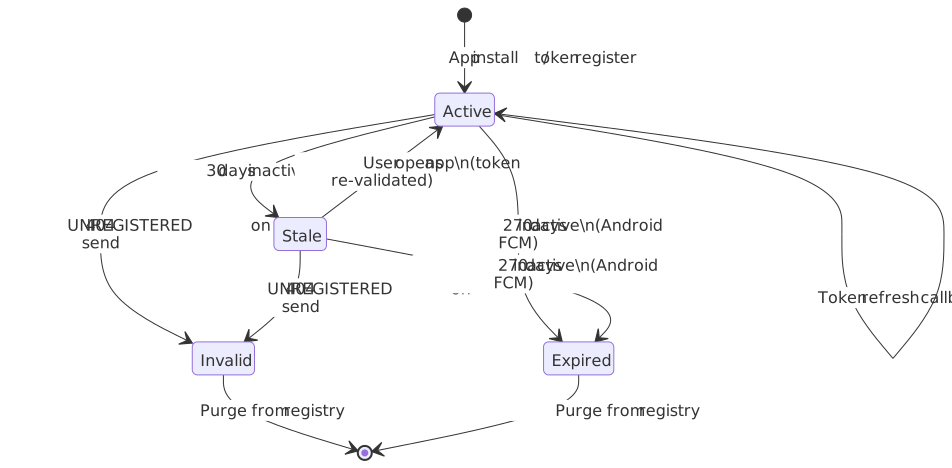
| Event | Action |
|---|---|
| App install | Register new token. |
| App launch | Refresh token if older than 7 days. |
| Token refresh callback | Update token; mark previous invalid. |
Delivery returns UNREGISTERED/404 |
Mark token invalid immediately. |
| 30 days inactive | Mark token stale (deprioritize). |
| 270 days inactive (Android FCM) | Token is automatically expired by FCM and subsequent sends return UNREGISTERED (FCM: manage tokens). |
Tip
Track FCM’s droppedDeviceInactive and droppedTooManyPendingMessages metrics — exposed via the Firebase BigQuery export — to detect token-base rot and aggressive collapse-key replacement before they erode delivery rate.
Router service
The orchestration layer that turns a “ready-to-send” notification into one or more provider calls.
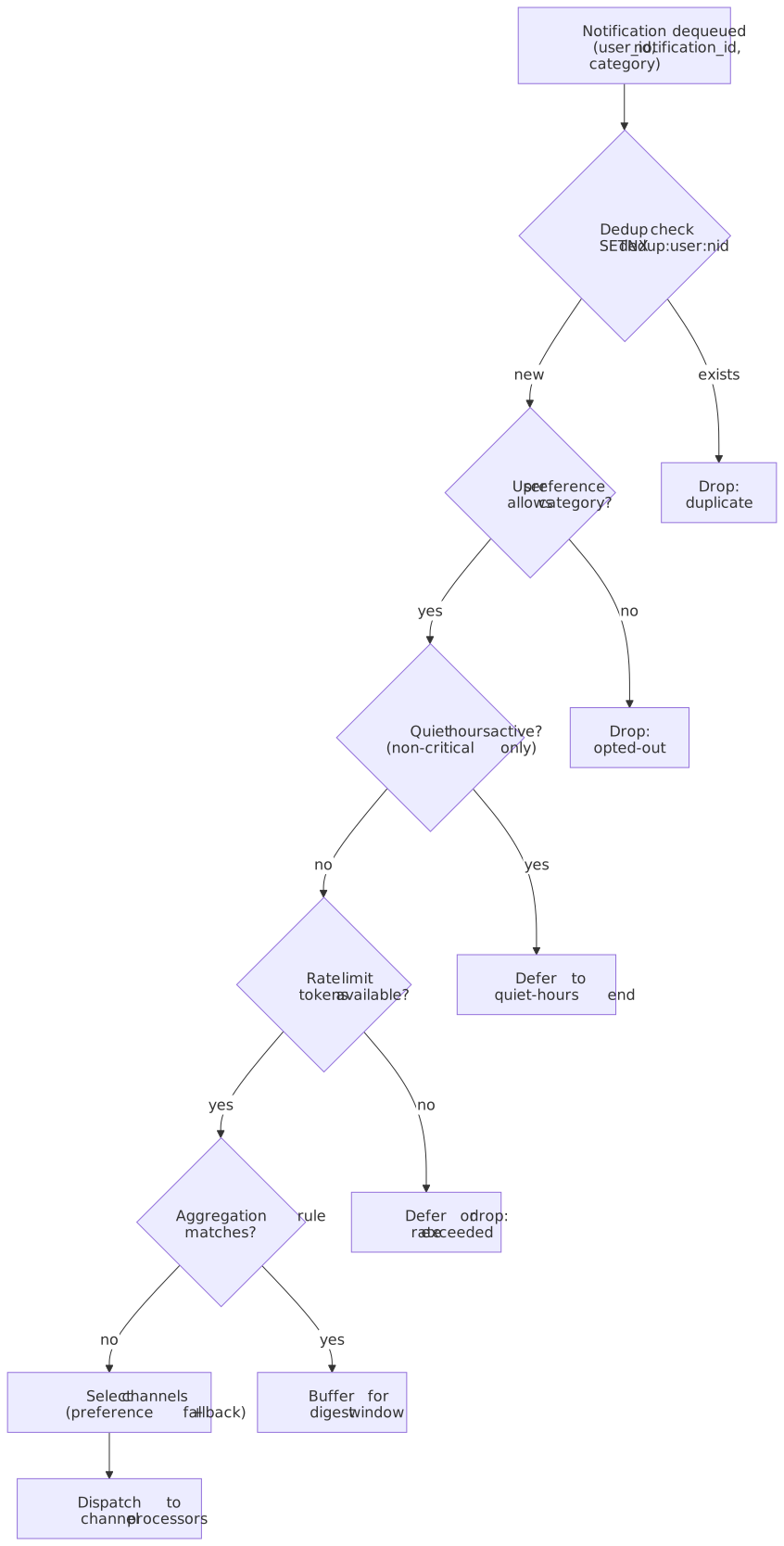
The gates are ordered cheapest-rejection-first so we waste the least work on traffic that will be dropped:
- Deduplication —
SETNX dedup:{user_id}:{notification_id}against Redis. - Preference — is the user opted in for this category and any channel?
- Quiet hours — is the user in their DND window? Critical bypasses.
- Rate limit — does the user have tokens left for this channel?
- Aggregation — does this match an open digest window?
- Channel selection — apply preference + fallback rules.
- Dispatch — push to the per-channel processor topics.
Channel processors
One independent worker pool per channel. Isolation matters: an SES outage must not block APNs throughput.
Push processor:
- Maintains long-lived HTTP/2 connections to APNs and FCM.
- Token-based auth (JWT) for APNs; service-account auth for FCM.
- Respects FCM’s 600 K-tokens-per-minute quota with a local token bucket and exponential backoff on 429 (FCM throttling and quotas).
- Maps provider error codes to retry / drop / mark-invalid actions.
Email processor:
- Manages sender reputation and IP warm-up (45-day curve for SES dedicated IPs).
- Handles bounces (hard / soft) and complaints; auto-suppresses repeat offenders.
- Implements RFC 8058 one-click unsubscribe with
List-UnsubscribeandList-Unsubscribe-Post: List-Unsubscribe=One-Clickheaders, required for senders >5 000 messages/day to Gmail and Yahoo since Feb 2024 (Gmail: email sender guidelines, RFC 8058). - Tracks open and click events via a tracking pixel and signed redirect URLs.
SMS processor:
- Routes to the appropriate sender type (short code, long code, or toll-free).
- Splits messages > 160 GSM-7 chars into concatenated segments with the appropriate UDH headers.
- Honors STOP keyword opt-outs (carrier-mandated in the US).
- Throttles to the carrier’s MPS — 100 MPS per short code, variable for A2P 10DLC.
In-app processor:
- Delivers via WebSocket for connected clients.
- Falls back to a
/notificationspolling endpoint pluslastSeencursor for disconnected clients. - Aggregates badge counts and read/unread state.
Delivery receipts
Provider acknowledgement is a two-phase contract: a synchronous ack on the send call (“we accepted the message”) and an asynchronous receipt (“we delivered / the user opened it / it bounced”). Both phases must reconcile back into the same delivery_status row keyed by notification_id.
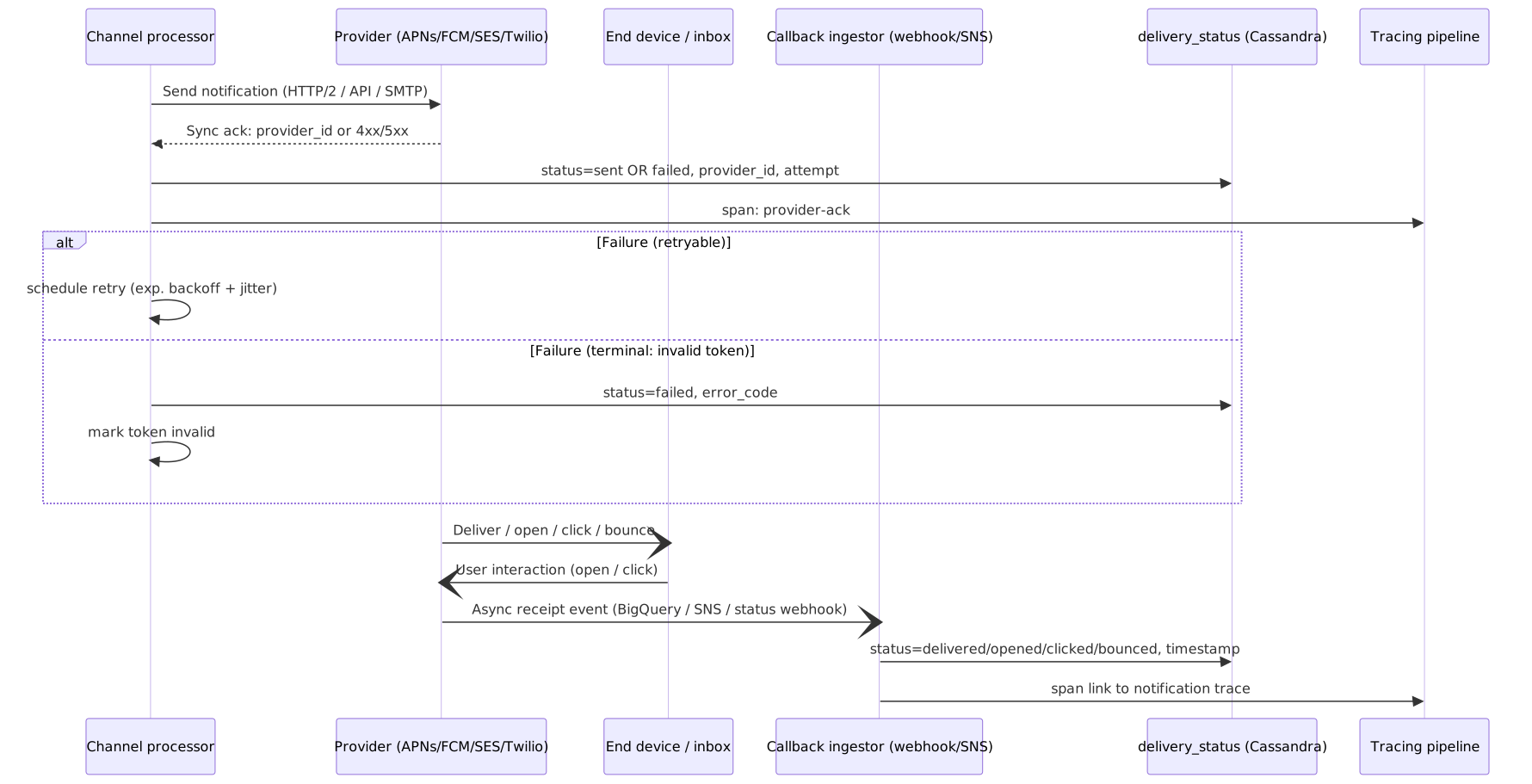
| Channel | Sync ack source | Async receipt source |
|---|---|---|
| FCM | HTTP v1 send response (messageId or error code) |
Firebase BigQuery delivery export (delivery_attempted, delivered, dropped_*) (FCM message delivery). |
| APNs | HTTP/2 response status + apns-id |
No per-message delivery receipt — Apple does not expose device-side ack to providers; rely on app-side analytics for “opened”. |
| SES | SendEmail API response (MessageId) |
SNS topic events: Delivery, Bounce, Complaint, Open, Click (SES event publishing). |
| Twilio | REST API response with sid and initial status |
Status callback URL: queued → sent → delivered / failed / undelivered (Twilio status callbacks). |
The callback ingestor is its own service so a callback storm (e.g., a bounce surge) cannot back-pressure the channel processors. Callbacks are idempotent on (notification_id, channel, device_id, status) because providers retry their webhooks freely.
API design
Send notification
POST /api/v1/notifications
{ "notificationId": "uuid-client-generated", "templateId": "order_shipped", "recipients": [ { "userId": "user_123", "variables": { "orderId": "ORD-456", "trackingUrl": "https://track.example.com/ORD-456" } } ], "priority": "high", "channels": ["push", "email"], "options": { "ttl": 86400, "collapseKey": "order_update_ORD-456", "scheduledAt": null }}{ "requestId": "req_abc123", "notificationId": "uuid-client-generated", "status": "accepted", "recipientCount": 1, "estimatedDelivery": "2026-04-21T10:00:05Z"}| Code | Error | When |
|---|---|---|
| 400 | INVALID_TEMPLATE |
Template missing or variables fail schema validation. |
| 400 | INVALID_RECIPIENT |
User ID not found in identity service. |
| 409 | DUPLICATE_NOTIFICATION |
notificationId already processed inside dedup window. |
| 429 | RATE_LIMITED |
Producer-level rate limit exceeded. |
Bulk send
POST /api/v1/notifications/bulk
{ "notificationId": "bulk_uuid", "templateId": "weekly_digest", "recipientQuery": { "segment": "active_users_7d", "excludeOptedOut": true }, "priority": "low", "channels": ["email"], "options": { "spreadOverMinutes": 60, "respectQuietHours": true }}spreadOverMinutes is the platform’s protection against burst-send anti-patterns: large segments are scheduled to deliver evenly across the window so SES, FCM, and downstream queues don’t see a vertical wall of traffic.
Get notification status
GET /api/v1/notifications/{notificationId}/status
{ "notificationId": "uuid", "status": "delivered", "recipients": [ { "userId": "user_123", "channels": { "push": { "status": "delivered", "deliveredAt": "2026-04-21T10:00:02Z", "openedAt": "2026-04-21T10:05:00Z" }, "email": { "status": "sent", "sentAt": "2026-04-21T10:00:03Z", "openedAt": null } } } ]}User preferences
GET /api/v1/users/{userId}/preferences
{ "userId": "user_123", "globalEnabled": true, "quietHours": { "enabled": true, "start": "22:00", "end": "07:00", "timezone": "America/New_York" }, "channels": { "push": { "enabled": true }, "email": { "enabled": true, "frequency": { "maxPerDay": 10 } }, "sms": { "enabled": false } }, "categories": { "marketing": { "enabled": false }, "order_updates": { "enabled": true, "channels": ["push", "email"] }, "security": { "enabled": true, "channels": ["push", "sms", "email"] } }}PATCH /api/v1/users/{userId}/preferences — partial update; the patch is applied with optimistic locking and an audit row is appended on every change.
Device registration
POST /api/v1/devices
{ "userId": "user_123", "deviceId": "device_abc", "platform": "ios", "token": "apns_token_xyz", "appVersion": "3.2.1"}Notification history
GET /api/v1/users/{userId}/notifications?limit=50&cursor=xxx — cursor-paginated listing for the user’s notification surface.
Data modeling
Notification record (Cassandra)
Cassandra is a strong fit for the notification log: high write volume, time-series access pattern, and per-user TTL. The partition key includes a time bucket so partitions stay below the recommended ~100 MB ceiling (DataStax: data modeling best practices).
CREATE TABLE notifications ( user_id UUID, bucket DATE, -- daily bucket; bound partition size for power users created_at TIMESTAMP, notification_id UUID, template_id TEXT, priority TEXT, content FROZEN<notification_content>, channels SET<TEXT>, status TEXT, delivery_attempts INT, PRIMARY KEY ((user_id, bucket), created_at, notification_id)) WITH CLUSTERING ORDER BY (created_at DESC, notification_id ASC) AND default_time_to_live = 7776000 -- 90 days AND compaction = { 'class': 'TimeWindowCompactionStrategy', 'compaction_window_unit': 'DAYS', 'compaction_window_size': 1 };CREATE TYPE notification_content ( title TEXT, body TEXT, data MAP<TEXT, TEXT>, image_url TEXT);-- Direct lookup by notification_id (for status endpoint)CREATE TABLE notifications_by_id ( notification_id UUID PRIMARY KEY, user_id UUID, bucket DATE, created_at TIMESTAMP, template_id TEXT, priority TEXT, content FROZEN<notification_content>, channels SET<TEXT>, status TEXT);Important
Without the bucket partition component, a power-user partition grows unbounded and TWCS compaction stops being effective. Pick the bucket size (hour vs day) so the largest expected partition stays under ~100 MB.
Delivery status (Cassandra)
CREATE TABLE delivery_status ( notification_id UUID, channel TEXT, user_id UUID, device_id TEXT, status TEXT, -- queued, sent, delivered, failed, opened, clicked provider_id TEXT, -- APNs message ID, SES message ID, etc. error_code TEXT, error_message TEXT, timestamp TIMESTAMP, PRIMARY KEY ((notification_id), channel, device_id));-- Time-bucketed retry indexCREATE TABLE failed_deliveries ( retry_bucket INT, -- hour bucket; bound the per-bucket scan size notification_id UUID, channel TEXT, user_id UUID, attempt_count INT, last_error TEXT, next_retry_at TIMESTAMP, PRIMARY KEY ((retry_bucket), next_retry_at, notification_id)) WITH CLUSTERING ORDER BY (next_retry_at ASC);User preferences (PostgreSQL)
CREATE TABLE user_preferences ( user_id UUID PRIMARY KEY, global_enabled BOOLEAN DEFAULT true, quiet_hours JSONB, -- {"enabled":true,"start":"22:00","end":"07:00","tz":"America/New_York"} channel_prefs JSONB, category_prefs JSONB, created_at TIMESTAMPTZ DEFAULT NOW(), updated_at TIMESTAMPTZ DEFAULT NOW());CREATE TABLE preference_history ( id BIGSERIAL PRIMARY KEY, user_id UUID NOT NULL, changed_at TIMESTAMPTZ DEFAULT NOW(), change_type TEXT, -- 'opt_in', 'opt_out', 'update' old_value JSONB, new_value JSONB, source TEXT -- 'user', 'system', 'compliance');CREATE INDEX idx_pref_history_user ON preference_history(user_id, changed_at DESC);Device tokens (PostgreSQL + Redis)
CREATE TABLE device_tokens ( device_id TEXT PRIMARY KEY, user_id UUID NOT NULL, platform TEXT NOT NULL, token TEXT NOT NULL, token_type TEXT NOT NULL, app_version TEXT, last_seen TIMESTAMPTZ, status TEXT DEFAULT 'active', created_at TIMESTAMPTZ DEFAULT NOW(), updated_at TIMESTAMPTZ DEFAULT NOW());CREATE INDEX idx_tokens_user ON device_tokens(user_id);CREATE INDEX idx_tokens_status ON device_tokens(status) WHERE status = 'active';# User's active tokens (set)SADD user:tokens:{user_id} {device_id_1} {device_id_2}# Token details (hash)HSET token:{device_id} user_id "user_123" platform "ios" token "apns_xyz" token_type "apns" status "active"# Liveness marker (TTL drives stale-detection job)SETEX token:active:{device_id} 2592000 "1" # 30 daysTemplates (PostgreSQL)
CREATE TABLE notification_templates ( template_id TEXT PRIMARY KEY, name TEXT NOT NULL, category TEXT NOT NULL, channels JSONB NOT NULL, variables JSONB, default_locale TEXT DEFAULT 'en', is_active BOOLEAN DEFAULT true, created_at TIMESTAMPTZ DEFAULT NOW(), updated_at TIMESTAMPTZ DEFAULT NOW(), version INT DEFAULT 1);CREATE TABLE template_translations ( template_id TEXT REFERENCES notification_templates(template_id), locale TEXT, channels JSONB NOT NULL, PRIMARY KEY (template_id, locale));CREATE TABLE template_versions ( template_id TEXT, version INT, channels JSONB NOT NULL, created_at TIMESTAMPTZ DEFAULT NOW(), created_by TEXT, PRIMARY KEY (template_id, version));Database selection matrix
| Data type | Store | Rationale |
|---|---|---|
| Notifications | Cassandra | Time-series, high write volume, native TTL. |
| Delivery status | Cassandra | High write volume, time-bucketed scan for retry. |
| User preferences | PostgreSQL + Redis | ACID for changes, cached for hot reads. |
| Device tokens | PostgreSQL + Redis | Relational queries; cached for delivery hot path. |
| Templates | PostgreSQL | Low volume; needs version history and constraints. |
| Deduplication | Redis | TTL semantics, atomic SETNX, sub-millisecond lookups. |
| Rate limits | Redis | Atomic INCR, sliding windows via Lua scripts. |
| Analytics | ClickHouse | Columnar aggregations across billions of records. |
Low-level design
Deduplication service
The dedup window is the most expensive Redis working set after rate limits. Use Bloom filters as a fast “definitely not duplicate” check before falling back to authoritative SETNX.
class DeduplicationService { private readonly redis: RedisCluster private readonly DEDUP_TTL = 172800 // 48 hours in seconds async isDuplicate(userId: string, notificationId: string): Promise<boolean> { const key = `dedup:${userId}:${notificationId}` // SETNX returns 1 if key was set (not duplicate), 0 if exists (duplicate) const result = await this.redis.set(key, "1", { NX: true, EX: this.DEDUP_TTL, }) return result === null // null means key existed (duplicate) } async checkBloomFilter(userId: string, notificationId: string): Promise<boolean> { const key = `bloom:dedup:${userId}` return await this.redis.bf.exists(key, notificationId) }}Note
Twilio Segment runs an analogous design at much larger scale — 60 billion keys in 1.5 TB of RocksDB with a 4-week dedup window after processing 200 billion messages (Twilio Segment: exactly-once delivery). If your dedup working set exceeds Redis economics, that’s the migration path.
Rate limiter
Token bucket per (user_id, channel) is the right default for notifications because legitimate user activity is bursty (a checkout flow can fire 3–5 notifications back-to-back) but the long-term cap must hold (Stripe: scaling your API with rate limiters).
interface RateLimitConfig { channel: string maxPerHour: number maxPerDay: number}class RateLimiter { private readonly redis: RedisCluster async checkAndConsume( userId: string, channel: string, config: RateLimitConfig, ): Promise<{ allowed: boolean; retryAfter?: number }> { const hourKey = `ratelimit:${userId}:${channel}:hour:${this.getCurrentHour()}` const dayKey = `ratelimit:${userId}:${channel}:day:${this.getCurrentDay()}` // Lua for atomic check-and-increment with rollback on overflow const result = await this.redis.eval( ` local hourCount = redis.call('INCR', KEYS[1]) if hourCount == 1 then redis.call('EXPIRE', KEYS[1], 3600) end local dayCount = redis.call('INCR', KEYS[2]) if dayCount == 1 then redis.call('EXPIRE', KEYS[2], 86400) end if hourCount > tonumber(ARGV[1]) then redis.call('DECR', KEYS[1]) return {0, 3600 - redis.call('TTL', KEYS[1])} end if dayCount > tonumber(ARGV[2]) then redis.call('DECR', KEYS[1]) redis.call('DECR', KEYS[2]) return {0, 86400 - redis.call('TTL', KEYS[2])} end return {1, 0} `, [hourKey, dayKey], [config.maxPerHour, config.maxPerDay], ) return { allowed: result[0] === 1, retryAfter: result[1] > 0 ? result[1] : undefined, } }}Channel-specific provider caps to track separately from per-user caps:
| Channel | Provider cap | Enforcement |
|---|---|---|
| FCM | 600K messages/min per project (throttling docs) | Local token bucket; exponential backoff on 429. |
| APNs | No published numeric cap; throttles abuse | Watch for 429, GOAWAY, and SHUTDOWN reasons; back off per stream. |
| SES | Account-specific, adjustable; sandbox 1/sec | Read current quota from Service Quotas API on startup. |
| SMS (Twilio) | 100 MPS short code; 12–225 SMS MPS for 10DLC | Per-sender queue with rate-limited consumer. |
Notification aggregator
Collapses similar notifications into a digest within a configurable window. Knock describes two implementation patterns — batch-on-write (open a buffer keyed by recipient + collapse key when the first event arrives, flush at the end of the window) and batch-on-read (periodic cron scans for unsent notifications and groups them) (Knock: building a batched notification engine). The implementation below is batch-on-write, which scales better with sustained load.
interface AggregationRule { category: string collapseKey: string // template, e.g., "likes_{postId}" windowSeconds: number minCount: number maxCount: number digestTemplate: string // "{{count}} people liked your post"}class NotificationAggregator { private readonly redis: RedisCluster async shouldAggregate( userId: string, notification: Notification, rule: AggregationRule, ): Promise<{ aggregate: boolean; pending: Notification[] }> { const collapseKey = this.renderCollapseKey(rule.collapseKey, notification) const bufferKey = `agg:${userId}:${collapseKey}` await this.redis.rpush(bufferKey, JSON.stringify(notification)) await this.redis.expire(bufferKey, rule.windowSeconds) const count = await this.redis.llen(bufferKey) if (count >= rule.maxCount) { const pending = await this.flushBuffer(bufferKey) return { aggregate: true, pending } } if (count >= rule.minCount) { await this.scheduleFlush(userId, collapseKey, rule.windowSeconds) } return { aggregate: false, pending: [] } } async createDigest(notifications: Notification[], rule: AggregationRule): Promise<Notification> { const count = notifications.length const actors = [...new Set(notifications.map((n) => n.actorId))].slice(0, 3) return { ...notifications[0], content: { title: this.renderTemplate(rule.digestTemplate, { count, actors }), body: `${actors[0]} and ${count - 1} others`, }, metadata: { aggregatedCount: count, originalIds: notifications.map((n) => n.notificationId), }, } }}Common aggregation patterns:
| Notification type | Collapse key | Window | Digest format |
|---|---|---|---|
| Post likes | likes_{postId} |
5 min | ”John and 5 others liked your post” |
| New followers | followers_{userId} |
1 hour | ”6 new followers today” |
| Comment replies | replies_{commentId} |
10 min | ”3 new replies to your comment” |
Tip
Provider-side collapse is a separate mechanism from server-side aggregation. FCM’s collapse_key (max 4 distinct keys per device, older messages replaced when the device is offline (FCM collapsible messages)) and APNs’ apns-collapse-id (max 64 bytes (APNs docs)) replace banners on the device, not in your queue. Use both: server-side aggregation reduces volume, provider collapse cleans up the device.
Priority router
enum NotificationPriority { CRITICAL = "critical", // Security alerts, transaction confirmations HIGH = "high", // Direct messages, mentions NORMAL = "normal", // Social notifications, updates LOW = "low", // Marketing, digests}class PriorityRouter { private readonly queues: Map<NotificationPriority, KafkaProducer> async route(notification: EnrichedNotification): Promise<void> { const priority = this.determinePriority(notification) const queue = this.queues.get(priority) // Partition by user_id so rate limiting and aggregation co-locate await queue.send({ topic: `notifications.${priority}`, messages: [ { key: notification.userId, value: JSON.stringify(notification), headers: { "notification-id": notification.notificationId, "created-at": Date.now().toString(), }, }, ], }) } private determinePriority(notification: EnrichedNotification): NotificationPriority { if (notification.category === "security") return NotificationPriority.CRITICAL if (notification.category === "transaction") return NotificationPriority.CRITICAL if (notification.category === "message") return NotificationPriority.HIGH if (notification.category === "mention") return NotificationPriority.HIGH if (notification.category === "marketing") return NotificationPriority.LOW if (notification.category === "digest") return NotificationPriority.LOW return NotificationPriority.NORMAL }}Note
Kafka guarantees ordering only within a partition (Apache Kafka docs), so keying by user_id gives you per-user ordering across all of a user’s notifications inside a single priority topic. Cross-priority ordering is not guaranteed and should not be relied on by clients.
Per-priority queue configuration:
| Priority | Partitions | Consumer parallelism | Target max latency |
|---|---|---|---|
| Critical | 50 | 50 workers | 500 ms |
| High | 100 | 100 workers | 2 s |
| Normal | 200 | 200 workers | 10 s |
| Low | 50 | 50 workers (off-peak) | Best effort |
Push delivery with retry
interface PushDeliveryResult { success: boolean messageId?: string errorCode?: string shouldRetry: boolean invalidToken: boolean}class PushProcessor { private readonly fcm: FirebaseMessaging private readonly apns: ApnsClient private readonly deviceRegistry: DeviceRegistry async deliver(notification: Notification, device: DeviceToken): Promise<PushDeliveryResult> { try { if (device.tokenType === "fcm") { return await this.deliverFcm(notification, device) } else if (device.tokenType === "apns") { return await this.deliverApns(notification, device) } } catch (error) { return this.handleError(error, device) } } private async deliverFcm(notification: Notification, device: DeviceToken): Promise<PushDeliveryResult> { const message = { token: device.token, notification: { title: notification.content.title, body: notification.content.body, }, data: notification.content.data, android: { priority: notification.priority === "critical" ? "high" : "normal", ttl: notification.ttl * 1000, collapseKey: notification.collapseKey, }, } const response = await this.fcm.send(message) return { success: true, messageId: response, shouldRetry: false, invalidToken: false } } private handleError(error: any, device: DeviceToken): PushDeliveryResult { const errorCode = error.code // Invalid token — remove immediately if (["messaging/invalid-registration-token", "messaging/registration-token-not-registered"].includes(errorCode)) { this.deviceRegistry.markInvalid(device.deviceId) return { success: false, errorCode, shouldRetry: false, invalidToken: true } } // Rate limited — retry with backoff if (errorCode === "messaging/too-many-requests") { return { success: false, errorCode, shouldRetry: true, invalidToken: false } } // Server error — retry with backoff if (errorCode === "messaging/internal-error") { return { success: false, errorCode, shouldRetry: true, invalidToken: false } } return { success: false, errorCode, shouldRetry: false, invalidToken: false } }}Retry service with exponential backoff
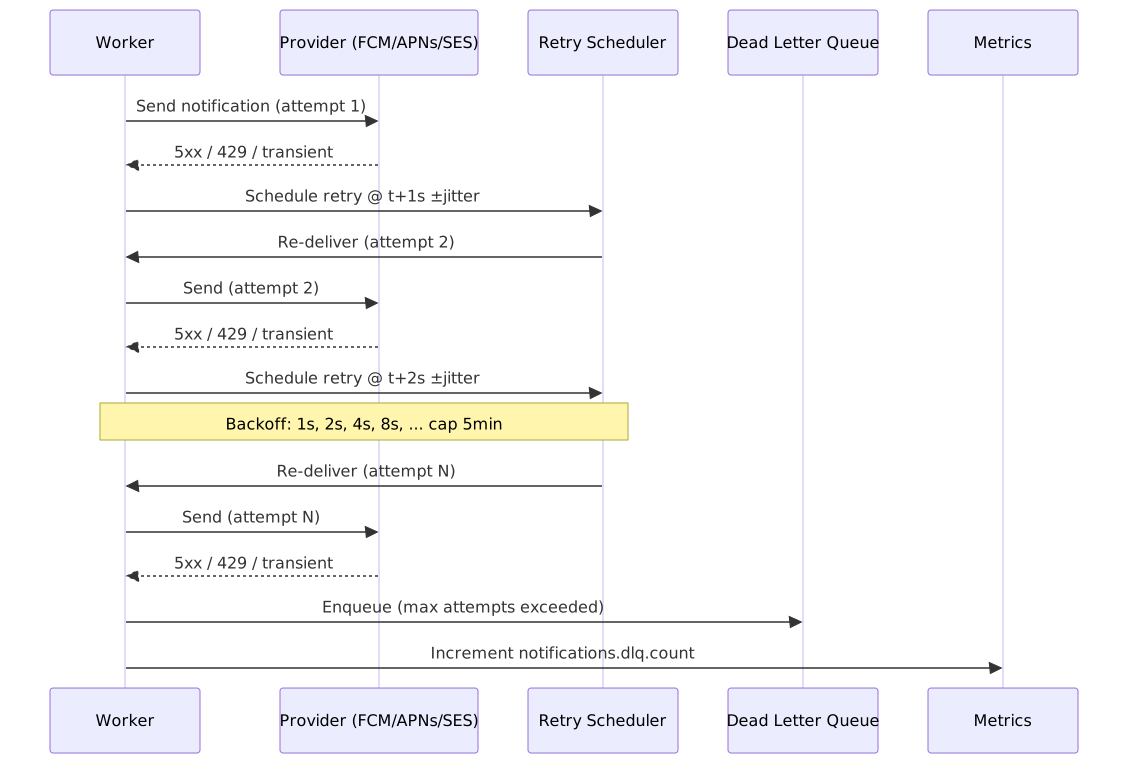
interface RetryConfig { maxAttempts: number baseDelayMs: number maxDelayMs: number jitterFactor: number}class RetryService { private readonly defaultConfig: RetryConfig = { maxAttempts: 5, baseDelayMs: 1000, maxDelayMs: 300000, // 5 minutes jitterFactor: 0.2, } async scheduleRetry( notification: Notification, channel: string, attemptCount: number, config: RetryConfig = this.defaultConfig, ): Promise<void> { if (attemptCount >= config.maxAttempts) { await this.moveToDlq(notification, channel) return } const delay = this.calculateDelay(attemptCount, config) const retryBucket = Math.floor((Date.now() + delay) / 3600000) // hour bucket await this.cassandra.execute( ` INSERT INTO failed_deliveries ( retry_bucket, notification_id, channel, user_id, attempt_count, last_error, next_retry_at ) VALUES (?, ?, ?, ?, ?, ?, ?) `, [ retryBucket, notification.notificationId, channel, notification.userId, attemptCount + 1, notification.lastError, new Date(Date.now() + delay), ], ) } private calculateDelay(attempt: number, config: RetryConfig): number { // Exponential backoff with jitter to avoid retry-storm thundering herds const exponentialDelay = config.baseDelayMs * Math.pow(2, attempt) const cappedDelay = Math.min(exponentialDelay, config.maxDelayMs) const jitter = cappedDelay * config.jitterFactor * Math.random() return Math.floor(cappedDelay + jitter) } private async moveToDlq(notification: Notification, channel: string): Promise<void> { await this.kafka.send({ topic: "notifications.dlq", messages: [ { key: notification.userId, value: JSON.stringify({ notification, channel, reason: "max_retries_exceeded", timestamp: Date.now(), }), }, ], }) this.metrics.increment("notifications.dlq.count", { channel, category: notification.category, }) }}Quiet hours handler
class QuietHoursHandler { async shouldDefer( userId: string, notification: Notification, preferences: UserPreferences, ): Promise<{ defer: boolean; deliverAt?: Date }> { // Critical notifications bypass quiet hours if (notification.priority === "critical") { return { defer: false } } if (!preferences.quietHours?.enabled) { return { defer: false } } const userNow = this.getUserLocalTime(preferences.quietHours.timezone) const isInQuietHours = this.isTimeInRange(userNow, preferences.quietHours.start, preferences.quietHours.end) if (!isInQuietHours) { return { defer: false } } const deliverAt = this.getQuietHoursEnd(preferences.quietHours.end, preferences.quietHours.timezone) return { defer: true, deliverAt } } private isTimeInRange(current: Date, start: string, end: string): boolean { const currentMinutes = current.getHours() * 60 + current.getMinutes() const [startHour, startMin] = start.split(":").map(Number) const [endHour, endMin] = end.split(":").map(Number) const startMinutes = startHour * 60 + startMin const endMinutes = endHour * 60 + endMin // Handle overnight ranges (e.g., 22:00 – 07:00) if (startMinutes > endMinutes) { return currentMinutes >= startMinutes || currentMinutes < endMinutes } return currentMinutes >= startMinutes && currentMinutes < endMinutes }}Frontend considerations
Real-time in-app notifications
class NotificationClient { private ws: WebSocket | null = null private reconnectAttempt = 0 private readonly MAX_RECONNECT_DELAY = 30000 connect(authToken: string): void { this.ws = new WebSocket(`wss://notifications.example.com/ws?token=${authToken}`) this.ws.onopen = () => { this.reconnectAttempt = 0 this.syncMissedNotifications() } this.ws.onmessage = (event) => { const notification = JSON.parse(event.data) this.handleNotification(notification) } this.ws.onclose = () => { this.scheduleReconnect() } } private handleNotification(notification: Notification): void { this.incrementBadge() this.store.dispatch(addNotification(notification)) if (notification.priority === "high" && !document.hasFocus()) { this.showToast(notification) } if (notification.showBrowserNotification) { this.showBrowserNotification(notification) } } private async syncMissedNotifications(): Promise<void> { const lastSeen = localStorage.getItem("lastNotificationTimestamp") const response = await fetch(`/api/v1/notifications?since=${lastSeen}&limit=50`) const { notifications } = await response.json() notifications.forEach((n) => this.handleNotification(n)) }}Notification list with virtualization
interface NotificationListProps { userId: string pageSize: number}const NotificationList: React.FC<NotificationListProps> = ({ userId, pageSize }) => { const { data, fetchNextPage, hasNextPage, isFetchingNextPage } = useInfiniteQuery({ queryKey: ['notifications', userId], queryFn: ({ pageParam }) => fetchNotifications(userId, { cursor: pageParam, limit: pageSize }), getNextPageParam: (lastPage) => lastPage.nextCursor }) const notifications = data?.pages.flatMap(p => p.notifications) ?? [] return ( <VirtualList items={notifications} estimatedItemSize={80} onEndReached={() => hasNextPage && fetchNextPage()} renderItem={(notification) => ( <NotificationItem key={notification.id} notification={notification} onRead={markAsRead} /> )} /> )}Push permission flow
class PushPermissionManager { async requestPermission(): Promise<"granted" | "denied" | "default"> { if (Notification.permission === "granted") { await this.registerServiceWorker() return "granted" } if (Notification.permission === "denied") { return "denied" } const permission = await Notification.requestPermission() if (permission === "granted") { await this.registerServiceWorker() const token = await this.getFcmToken() await this.registerDevice(token) } return permission } private async registerServiceWorker(): Promise<void> { const registration = await navigator.serviceWorker.register("/sw.js") registration.addEventListener("pushsubscriptionchange", async () => { const newToken = await this.getFcmToken() await this.updateDevice(newToken) }) }}Note
Web Push is the W3C/IETF standard underpinning browser notifications: the protocol is defined by RFC 8030, payload encryption by RFC 8291, and application-server identification (VAPID) by RFC 8292. FCM Web Push is a transport over the same protocol.
Infrastructure
Cloud-agnostic component map
| Component | Purpose | Options |
|---|---|---|
| Message queue | Event ingestion, priority routing | Kafka, Pulsar, NATS JetStream |
| KV store | Preferences, tokens, dedup, rate limits | Redis, KeyDB, Dragonfly |
| Primary DB | Templates, preferences, audit | PostgreSQL, CockroachDB |
| Time-series DB | Notification history, delivery status | Cassandra, ScyllaDB, DynamoDB |
| Push gateway | APNs/FCM delivery | Self-hosted, Firebase Admin |
| Email gateway | SMTP delivery | Postfix, SendGrid, SES API |
| SMS gateway | Carrier delivery | Twilio, Vonage, MessageBird |
AWS reference architecture
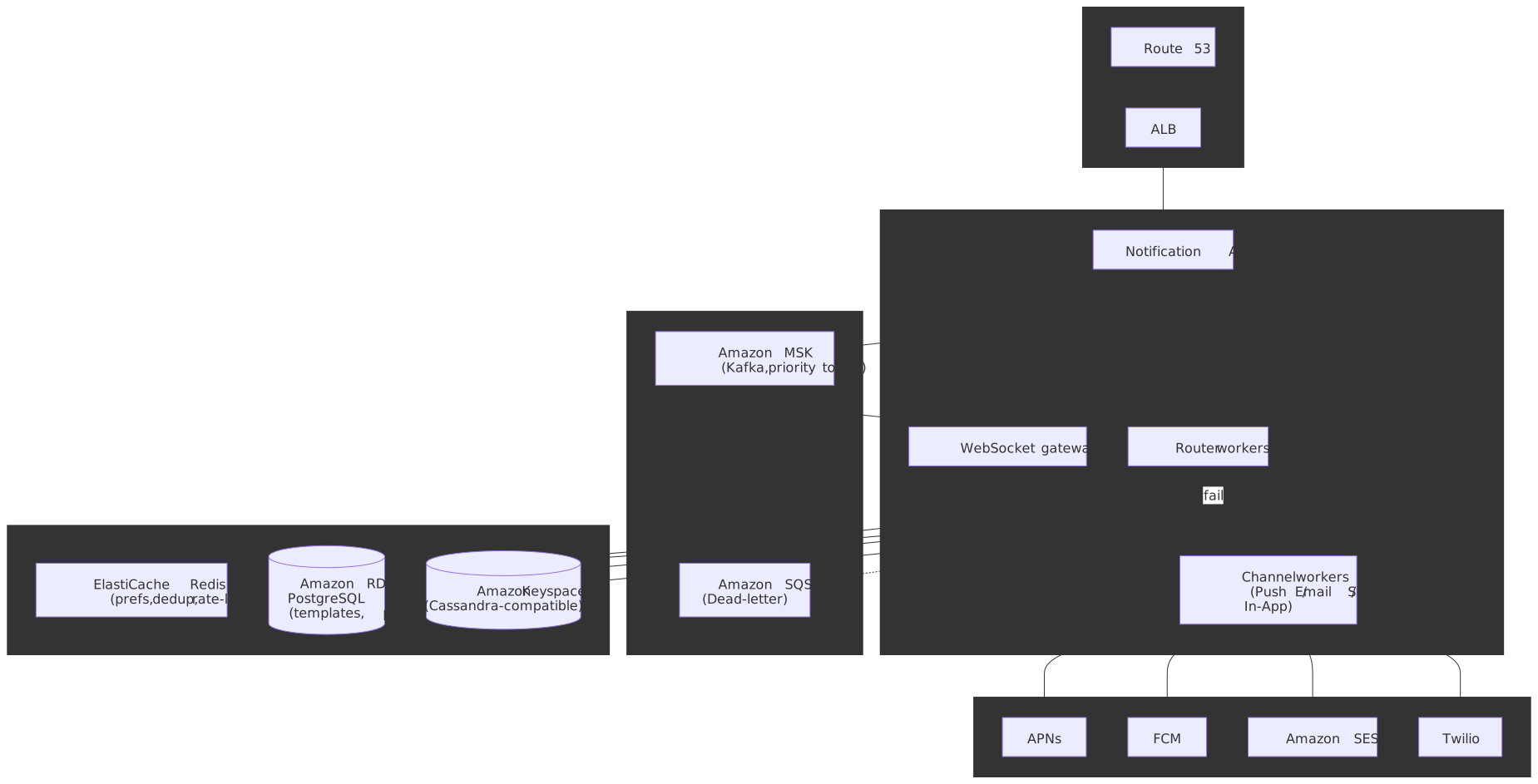
Service configurations:
| Service | Configuration | Rationale |
|---|---|---|
| Notification API (Fargate) | 2 vCPU, 4 GB, 20 tasks | Stateless, scales with traffic. |
| Router workers (Fargate) | 2 vCPU, 4 GB, 50 tasks | CPU-bound preference lookups. |
| Push workers (Fargate) | 2 vCPU, 4 GB, 30 tasks | I/O-bound provider calls. |
| WebSocket gateways (Fargate) | 4 vCPU, 8 GB, 20 tasks | Memory budget for connections. |
| ElastiCache Redis | r6g.xlarge cluster | Sub-ms reads for hot path. |
| RDS PostgreSQL | db.r6g.large Multi-AZ | Templates, preferences. |
| Amazon Keyspaces | On-demand | Serverless Cassandra. |
| MSK | kafka.m5.large × 3 | Priority topic separation. |
Self-hosted alternatives
| Managed service | Self-hosted option | When to self-host |
|---|---|---|
| Amazon MSK | Apache Kafka on EC2 | Cost at scale, specific configs. |
| ElastiCache | Redis Cluster on EC2 | Specific modules (RediSearch, RedisBloom). |
| Amazon Keyspaces | Apache Cassandra / ScyllaDB | Cost, tuning flexibility. |
| SNS Mobile Push | Direct APNs/FCM integration | Full control, cost savings. |
| Amazon SES | Postfix + DKIM/SPF | Volume discounts, deliverability control. |
Monitoring and observability
Key SLIs and alert thresholds:
| Metric | Alert threshold | Action |
|---|---|---|
| Delivery rate | < 99% | Investigate provider; check error mix. |
| p99 latency (critical) | > 500 ms | Scale workers; inspect topic lag. |
| DLQ depth | > 1 000 | Manual triage; replay or drop. |
| Rate limit hits | > 10% of traffic | Review per-user/category caps. |
| Invalid tokens | > 5% per day | Token cleanup job is failing or behind. |
| Bounce rate (email) | > 5% (hard) | Review list hygiene; audit producer. |
| Spam complaint rate | > 0.3% | Pause sender; audit content. (Gmail bulk-sender guidelines) |
Distributed tracing pattern (Slack-style):
- Each notification gets its own trace, with
notification_idas thetrace_id. - Span links connect the originating message trace to the resulting notification trace, so the originating event remains discoverable without inflating its trace.
- Spans cover the full path:
accept → enqueue → route → dispatch → provider-ack → device-ack. - Sampling is 100% for notifications (vs. ~1% for general traffic), because notification debugging is high-value and per-event payloads are small (Slack engineering: tracing notifications).
Operational reality
Failure modes
| Failure | Detection | Mitigation |
|---|---|---|
FCM 5xx / RESOURCE_EXHAUSTED |
Provider error rate spike, 429s | Per-project token bucket; exponential backoff with jitter; bulk traffic to low priority. |
APNs GOAWAY / connection reset |
Connection error metric | Reconnect, halve concurrency, monitor reason field. |
| Cassandra wide partition | Read latency p99 spike | Shrink bucket size; backfill into a re-partitioned table. |
| Redis dedup eviction | Increase in duplicate downstream events | Right-size memory; consider RocksDB tier (Segment-style) for long windows. |
| Producer floods bulk topic | Topic lag on bulk priority | Apply per-producer rate limits at API gateway; reject or shed bulk on contention. |
| Time skew on quiet hours | Off-hours delivery complaints | Source TZ from user profile, not request; validate IANA TZ at write time. |
| WebSocket reconnect storm after gateway crash | Connection-rate spike | Exponential backoff on the client; coalesce reconnects per shard. |
Scaling levers
- Add partitions to a priority topic to grow consumer parallelism — but only on creation; resizing later remaps
hash(user_id) % partition_countand breaks ordering for in-flight users (Kafka partition design). - Shard Redis dedup by user prefix when the working set exceeds a single cluster’s memory budget.
- Move dedup to disk-tier KV (RocksDB, ScyllaDB) when 4+ week dedup windows are needed; Segment chose RocksDB at 1.5 TB (Twilio Segment).
- Spread bulk sends in time (
spreadOverMinutes) so SES, FCM, and downstream queues never see a vertical wall of traffic.
Conclusion
This design gives you:
- At-least-once delivery through Kafka durability, retry with exponential backoff and jitter, and a dead-letter queue with manual replay.
- Sub-500 ms server-side delivery for critical traffic via priority-segmented topics and dedicated worker pools.
- User-centric throttling with preference-, channel-, and category-level caps, plus quiet-hours deferral that bypasses for
criticalonly. - Multi-channel coverage with isolated processors so a SES, FCM, or APNs incident degrades only its own channel.
- Horizontal scale to 1M+ notifications/sec via partitioned topics and Cassandra time-series storage.
Architectural decisions worth defending in a design review:
- Priority-based queue separation prevents bulk traffic from monopolizing the path that carries security alerts.
- User-partitioned Kafka enables co-located rate limiting and aggregation without a distributed lock.
- Independent channel processors mean an SES outage cannot starve push throughput, and an FCM 429 cannot back-pressure email.
- Template rendering at ingestion freezes the payload so dedup, retries, and audit logs all reference identical bytes.
Known limitations:
- At-least-once means clients must handle duplicates; provide an idempotency hint in the payload (
notificationId). - Cross-channel ordering is not guaranteed (push may arrive before email).
- Aggregation windows add latency for batch-eligible notifications by design.
- External provider rate limits and reputation systems are the ultimate bound on burst capacity.
Future enhancements:
- ML-based send-time optimization — Pinterest and Airship report meaningful CTR uplift from per-user predicted send times (Pinterest NEP, Airship STO model).
- Rich media notifications (images, action buttons, reply-from-notification).
- Cross-device read-state sync (mark read on phone → clear on web).
- Webhook delivery for B2B integrations as an additional channel.
Appendix
Prerequisites
- Distributed systems fundamentals (durable logs, partitioning, idempotency).
- Push notification protocols (APNs HTTP/2, FCM HTTP v1, Web Push).
- Rate-limiting algorithms (token bucket, sliding window, leaky bucket).
- Database selection trade-offs (relational, time-series, KV).
Terminology
| Term | Definition |
|---|---|
| APNs | Apple Push Notification service — Apple’s push delivery infrastructure. |
| FCM | Firebase Cloud Messaging — Google’s cross-platform push service. |
| DLQ | Dead-letter queue — store for messages that exhausted retries. |
| TTL | Time-to-live — duration after which a notification or token expires. |
| Collapse key | Identifier for grouping related notifications (newer replaces older). |
| Token bucket | Rate-limiting algorithm allowing bursts up to bucket capacity. |
| Idempotent | Operation that produces the same observable result on repeat execution. |
| VAPID | Voluntary Application Server Identification — RFC 8292; Web Push auth. |
Summary
- Multi-channel delivery (push, email, SMS, in-app) with at-least-once guarantees using durable Kafka topics, bounded retries, and a DLQ for terminal failures.
- Priority-based routing separates critical notifications (< 500 ms) from bulk traffic (best-effort, off-peak friendly).
- Preference service with Redis-cached hot path enables per-user, per-category, per-channel control plus quiet hours.
- Token-bucket rate limits at user and channel scope prevent fatigue and respect provider caps.
- Aggregation collapses similar events (“5 new likes”) to reduce interruption count.
- Cassandra time-series with
(user_id, bucket)partition keys keeps history queryable at billions/day with native TTL. - Provider-aware error handling for FCM (
UNREGISTERED,RESOURCE_EXHAUSTED), APNs (GOAWAY,BadCollapseId), and SES (bounce/complaint feedback) decides retry vs. permanent removal correctly.
References
Real-world implementations:
- Uber’s Real-Time Push Platform — original SSE design — 600K connections, ~250K msg/s.
- Uber’s Next-Gen Push Platform on gRPC — current 1.5M+ connection scale, gRPC bidi streaming.
- LinkedIn Concourse — Apache Samza-based personalized content notifications in near real-time.
- Netflix RENO — Rapid Event Notification System; SQS priority queues plus hybrid push-pull.
- Slack — Tracing Notifications — 100% sampling, span links,
notification_id = trace_id. - Pinterest NEP — Notification System and Relevance — ML-driven candidate ranker plus PID-controlled volume policy.
Standards and provider documentation:
- RFC 8030 — Generic Event Delivery Using HTTP Push (Web Push).
- RFC 8291 — Message Encryption for Web Push.
- RFC 8292 — VAPID for Web Push.
- RFC 8058 — Signaling One-Click Functionality for List Email Headers.
- Firebase Cloud Messaging — Throttling and Quotas.
- Firebase Cloud Messaging — Manage Tokens (270-day expiry).
- Firebase Cloud Messaging — Collapsible Messages.
- APNs — Sending Notification Requests.
- Amazon SES — Service Quotas and Dedicated IP Warming.
- Twilio — A2P 10DLC throughput and Trust Scores.
- Apache Kafka documentation — partitioning and ordering.
- DataStax — Cassandra data modeling best practices.
- Gmail — Email sender guidelines (2024 bulk-sender requirements).
Patterns and best practices:
- Twilio Segment — Delivering billions of messages exactly once — 60B keys, 1.5 TB RocksDB dedup.
- Stripe — Scaling your API with rate limiters — token bucket + sliding window in production.
- Knock — Building a batched notification engine — batch-on-write vs batch-on-read patterns.
- Braze — Frequency Capping — empirical impact of caps on retention.
- Airship — ML model for predictive send-time optimization.
Related articles:
- Design Real-Time Chat and Messaging — WebSocket connections, presence systems.
- Design an API Rate Limiter — token bucket and sliding window algorithms in depth.
- Design an Email System — SMTP, deliverability, and bounce handling.
- Slack’s Distributed Architecture — for context on how Slack runs notifications at scale.