Stripe: Idempotency for Payment Reliability
Stripe handles network ambiguity in a payment API the way a database handles a power loss: it makes every state transition recoverable, then retries to convergence. The mechanism is a small set of patterns — Idempotency-Key requests, atomic phases bracketing every external call, recovery points that survive process death, and jobs staged inside the same transaction that produced them. This article walks through how those pieces fit together at the scale Stripe operates ($1 trillion in 2023 payment volume on a 99.999%-uptime document store)12, what changed when API v2 shipped, and how to apply the same model to your own system.
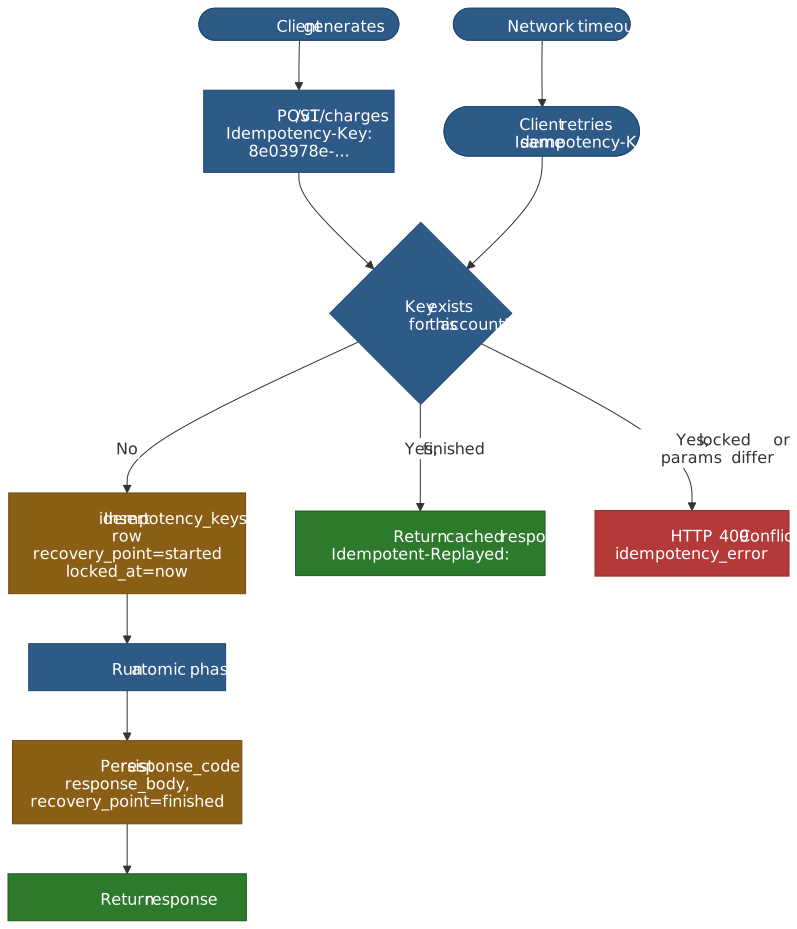
Why payment APIs need exactly-once semantics
A network call can fail in three ways that look identical from the client side:
- The connection never reaches the server.
- The server accepts the request, mutates state, then crashes before responding.
- The server completes the request, but the response is lost in transit.
Only the first is unambiguously safe to retry. The other two leave the client guessing whether a charge already happened. For a card-present flow this is recoverable through human reconciliation; for a programmatic API it shows up as duplicate charges, broken inventory, and chargebacks.
Stripe’s response is not a more clever retry algorithm — it is a contract between client and server: the client picks a unique key per logical operation and includes it on every retry; the server promises that the same key produces the same observable outcome3. The client no longer has to know whether the server saw the original request.
Note
GET and DELETE are idempotent by HTTP semantics (RFC 9110 §9.2.2). Idempotency keys exist for the verbs that aren’t — POST, and (in API v2) DELETE for endpoints that have side effects beyond resource removal45.
Mental model: the database as the coordinator
The pattern Stripe popularised — and that Brandur Leach documented in detail when he was at Stripe — sits on three load-bearing ideas3:
| Concept | What it is | Why it works |
|---|---|---|
| Idempotency key row | A (user_id, idempotency_key) row that persists request metadata, lock state, recovery point, and cached response. |
The unique constraint serializes concurrent retries; the cached response handles “the response got lost”. |
| Atomic phase | A SERIALIZABLE transaction whose boundary sits between foreign-state mutations. |
Local work either fully commits or fully rolls back; foreign calls become checkpointable. |
| Recovery point | A TEXT label persisted at the end of each atomic phase. |
A retry — by the original client or a background completer — jumps directly to the next unfinished phase. |
The single most important rule: commit local state before initiating any foreign-state mutation. Once the request has crossed your boundary (Stripe API, mailer, Kafka, another microservice), you can’t roll it back; you can only record that it happened and either retry it idempotently or compensate.
The idempotency-key row
Stripe stores idempotency keys per account in a row that tracks the request through its lifecycle. The Rocket Rides reference implementation6 uses Postgres; Stripe internally uses DocDB (Stripe’s MongoDB-derived document store)2, but the schema is functionally equivalent.
CREATE TABLE idempotency_keys ( id BIGSERIAL PRIMARY KEY, idempotency_key TEXT NOT NULL, user_id BIGINT NOT NULL, locked_at TIMESTAMPTZ, request_method TEXT NOT NULL, request_path TEXT NOT NULL, request_params JSONB NOT NULL, response_code INT NULL, response_body JSONB NULL, recovery_point TEXT NOT NULL DEFAULT 'started', last_run_at TIMESTAMPTZ NOT NULL DEFAULT now(), created_at TIMESTAMPTZ NOT NULL DEFAULT now(), CONSTRAINT idempotency_keys_user_key_unique UNIQUE (user_id, idempotency_key));Four design decisions shape every interaction with this table:
- Per-account scope. The unique key is
(user_id, idempotency_key), not the key alone. Two unrelated accounts can pick the same UUID without colliding3. locked_atas a soft lock. The first request to insert the row also locks it; concurrent requests for the same key see the lock and return409 Conflict. The lock is cleared when the row reachesfinishedor when an error path explicitly releases it.recovery_pointas a state-machine cursor. Each atomic phase ends by writing the next recovery point in the same transaction it commits work into. A retry reads the cursor and jumps to the matching phase.request_paramsfor fingerprinting. Reusing the same key with a different body is almost always a bug, and Stripe rejects it with409 Conflictand aidempotency_errortype47.
Key requirements (Stripe-specific)
| Property | Value | Source |
|---|---|---|
| Header name | Idempotency-Key |
Stripe API reference |
| Max length | 255 characters | Stripe API reference |
| Recommended | UUIDv4 or other random string with sufficient entropy | Stripe API reference |
| Scope | Per account / per sandbox | Stripe API reference, Stripe API v2 overview |
| v1 retention | At least 24 hours, then reaped | Stripe API reference, Stripe error reference |
| v2 retention | 30 days within the same account / sandbox | Stripe API v2 overview |
| Replay marker | Response includes Idempotent-Replayed: true |
Stripe error reference |
Caution
Don’t put email addresses, account IDs, or any other sensitive data in the key. Keys land in logs and metrics; treat them as opaque4.
Atomic phases: bracketing every foreign call
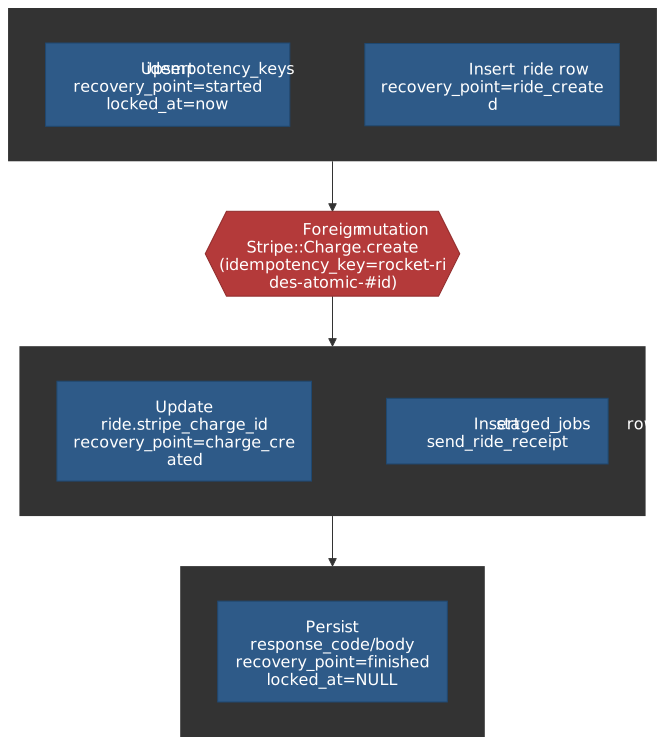
An atomic phase is a SERIALIZABLE Postgres transaction whose body executes only local mutations. The boundary of a phase is the next foreign-state mutation — the call to Stripe, the call to the mailer, the publish to Kafka. Brandur’s three rules for finding phase boundaries3:
- The idempotency-key upsert is its own phase.
- Every foreign-state mutation is its own phase.
- Every other operation between two foreign mutations gets grouped into one phase, regardless of how many DB rows it touches.
The Rocket Rides flow has one foreign call (the Stripe charge) and produces three local atomic phases plus the foreign mutation between them.
Why SERIALIZABLE
Stripe (and the Rocket Rides implementation) uses the strictest transaction isolation level available in Postgres. The reason is the idempotency-key upsert: two requests with the same key arriving within microseconds need a guarantee that exactly one of them creates the row and the other gets a 409 Conflict. Lower isolation levels can permit the write-skew anomaly that breaks this invariant3.
The cost is that concurrent transactions touching the same row pair can abort with Sequel::SerializationFailure, surfacing to the client as 409 Conflict. The official guidance is to retry on the client; the SDKs already do this7.
def atomic_phase(key, &block) DB.transaction(isolation: :serializable) do ret = block.call case ret when RecoveryPoint key.update(recovery_point: ret.name) when Response key.update( recovery_point: 'finished', locked_at: nil, response_code: ret.status, response_body: ret.body ) when NoOp # phase touched nothing on the key end endrescue Sequel::SerializationFailure halt 409, { error: 'concurrent request' }.to_jsonendEach phase returns one of three sentinel values: a new RecoveryPoint, a terminal Response (success or unrecoverable error), or a NoOp if the phase was a probe (e.g. the upsert of an already-finished key)3.
Recovery points are a DAG, not a loop
Recovery points form a directed acyclic graph anchored at started and absorbed at finished. Every successful phase advances the cursor; every unrecoverable error short-circuits straight to finished with the response cached on the row.
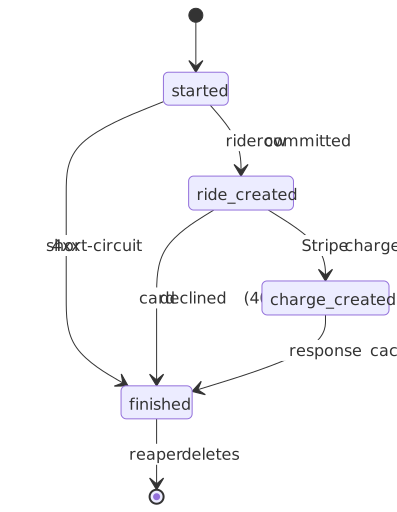
The driver loop is a case over recovery_point that runs the matching phase and lets the loop iterate again with the new cursor value. A request that starts at charge_created because a previous attempt crashed mid-flow will skip directly to phase 33.
Foreign-state mutations: the constraint that drives the design
Once you call out to Stripe, send an email, or publish to a downstream system, you cannot atomically undo it. That single fact is what forces the atomic-phase pattern: you must commit a local record of intent to call before the call, and a local record of what happened after, so that retries can be reasoned about.
When the foreign API also speaks Idempotency-Key, you derive its key deterministically from your own row’s primary key. The Rocket Rides example uses rocket-rides-atomic-#{key.id}3:
charge = Stripe::Charge.create( { amount: 20_00, currency: 'usd', customer: user.stripe_customer_id, description: "Charge for ride #{ride.id}", }, { idempotency_key: "rocket-rides-atomic-#{key.id}", },)Now both your own retries and Stripe’s internal retries are safe: every attempt sends the same derived key to Stripe, and Stripe’s idempotency layer guarantees the charge is created exactly once4.
When the foreign API isn’t idempotent
Brandur’s framing is the right one: if a foreign API doesn’t support idempotency keys and you see an indeterminate failure (timeout, connection reset), you have to mark that operation as permanently failed. You cannot safely retry, because you don’t know whether the side effect already happened3. That is why Stripe pushes idempotency support so hard onto its own ecosystem — every adopter raises the floor for everyone else.
Mapping foreign errors to phase outcomes
| Foreign outcome | What the phase returns | What the client sees |
|---|---|---|
| 2xx success | Advance recovery point, persist any returned IDs. | Eventually a 2xx with Idempotent-Replayed: true on retries. |
| 4xx — card declined / unrecoverable | Terminal Response(402, …); key jumps to finished. |
402 Request Failed with the decline reason8. |
| 5xx / timeout — recoverable foreign side | Raise; the phase aborts, lock is cleared, retry safe. | 503 with Stripe-Should-Retry: true from upstream4. |
| Indeterminate, non-idempotent | Terminal Response marking failure. |
Operator-facing alert; no automatic retry. |
Transactionally-staged job drains
The natural temptation when writing the receipt-email step is to enqueue a Sidekiq job from inside the transaction:
DB.transaction do ride = Ride.create(...) Sidekiq.enqueue(SendReceiptJob, ride.id) # WRONGendTwo failure modes here, both subtle and both production-real9:
- Worker beats the commit. Redis is fast. The worker dequeues, queries Postgres for
ride.id, and finds nothing — the outer transaction hasn’t committed yet. - Crash between commit and enqueue. Move the enqueue after the commit and the bug inverts: the row is durable, but the process dies before Redis sees the job. The receipt is silently lost.
The transactionally-staged-job-drain pattern fixes both by making the job insert part of the same transaction as the work it follows up on, then having a separate enqueuer process drain the staging table to the real queue9.
CREATE TABLE staged_jobs ( id BIGSERIAL PRIMARY KEY, job_name TEXT NOT NULL, job_args JSONB NOT NULL);acquire_lock(:enqueuer) do loop do DB.transaction(isolation_level: :repeatable_read) do jobs = StagedJob.order(:id).limit(BATCH_SIZE) next if jobs.empty? jobs.each { |j| Sidekiq.enqueue(j.job_name, *j.job_args) } StagedJob.where(Sequel.lit('id <= ?', jobs.last.id)).delete end sleep_with_exponential_backoff endend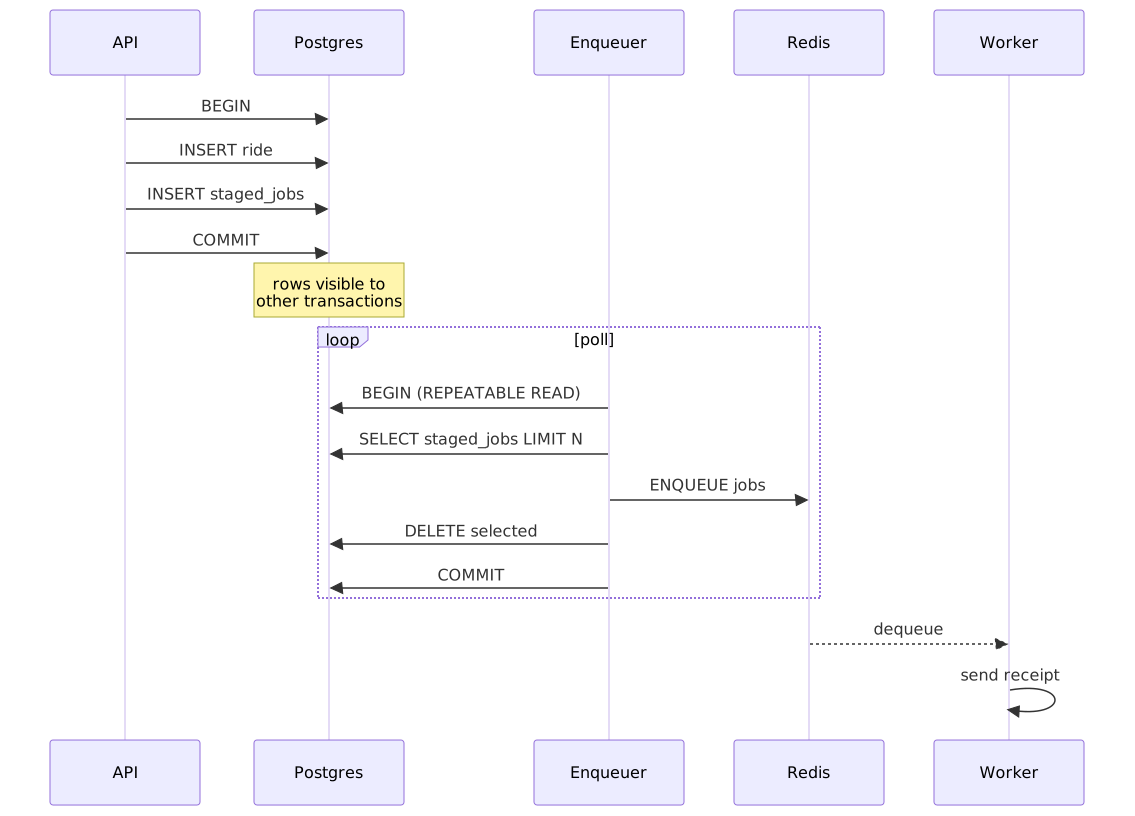
The properties this gives you are stronger than they look:
- No lost jobs. Rows only leave the staging table after Redis acknowledges the enqueue, and the enqueuer deletes them inside its own transaction.
- No phantom jobs. A rolled-back outer transaction takes the staged row with it.
- At-least-once delivery, naturally. A crash between enqueue and delete causes a re-enqueue on restart; downstream workers must already be idempotent (and yours will be, because you’ve been reading this article).
Tip
Run the enqueuer at REPEATABLE READ so its SELECT … LIMIT and the subsequent DELETE see the same snapshot9. Postgres’s serializable level would also work but adds avoidable conflict overhead.
Background recovery: the completer
Two things can leave a key stuck mid-flow: the originating client gives up before retrying, or a process crash leaves locked_at set with no live request behind it. The completer is a background process that picks up these orphans and pushes them through to finished. The Rocket Rides implementation runs in a loop, querying for keys whose locked_at is older than a grace period (5 minutes in the reference, longer in practice), and replays them via the same atomic-phase pipeline3.
GRACE = 5 * 60 # secondsloop do IdempotencyKey .where('recovery_point != ?', 'finished') .where('locked_at < ?', Time.now - GRACE) .each { |key| resume_from_recovery_point(key) } sleep 1endThe grace window has to outlast a slow-but-active request. Too short and the completer races a still-live request, double-locking; too long and abandoned work piles up. Stripe doesn’t publish its production value; the reference uses 5 minutes, and that’s a sane default unless your phases are unusually long3.
Reaping: the row isn’t permanent
Idempotency keys are bounded-storage primitives. They exist to make the near-term retry safe, not to act as an audit log. A reaper deletes rows that have outlived the retention horizon.
| Stripe surface | Retention | Source |
|---|---|---|
| API v1 | At least 24 hours | API reference |
| API v2 | 30 days, scoped to account / sandbox | API v2 overview |
| Rocket Rides demo | 72 hours (Brandur’s recommendation) | brandur.org/idempotency-keys |
After expiry, a retry with the same key is treated as a brand-new request4. Defences against the resulting duplicate-operation risk:
- Pick natural idempotency where possible (
PUToverPOST, “update or create” over “create”). - Add a business-level dedup check (does a charge for this
order_idalready exist?). - Move to API v2’s 30-day window for workflows that span days.
What changed in API v2
API v2 is a parallel namespace under /v2 that ships the post-2024 design patterns. Idempotency is one of the surfaces that got the most attention5.
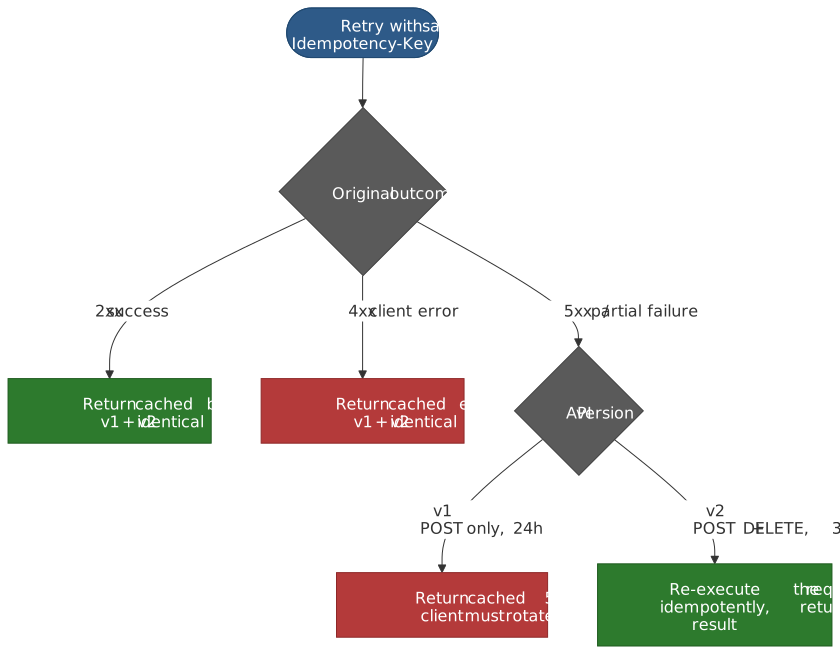
| Dimension | API v1 | API v2 |
|---|---|---|
| Verbs that accept keys | POST only (GET/DELETE ignore the header) |
POST and DELETE |
| Replay window | At least 24 hours | 30 days, same account or sandbox, same API |
| Failed-request replay | Returns the cached error, including the original 5xx | Re-executes the failed request idempotently and returns the new outcome (or an explanatory error) |
| Encoding | application/x-www-form-urlencoded requests, JSON responses |
JSON in and out |
| Versioning | Implicit per SDK release | Stripe-Version header is required |
Source: API v2 overview — Idempotency differences between API v1 and API v25.
The v2 retry behaviour is the most significant practical change. In v1, a transient infrastructure failure that produced a 500 was permanently cached: every subsequent retry of that key got the same 500 back, and the client had to mint a fresh key to actually try again47. In v2, the server attempts to re-execute the failed request without producing extraneous side effects and returns the new outcome5. For payment flows that span asynchronous webhooks and human action, the longer 30-day window lets the client safely retry a key it generated days earlier.
Error handling at the HTTP layer
Stripe’s HTTP status code reference7:
| Code | Meaning | Idempotency interaction | Recommended client action |
|---|---|---|---|
| 200 | OK | Cached and replayed on retries (Idempotent-Replayed: true) |
Done. |
| 400 | Bad Request | Cached if the endpoint started executing; otherwise not cached | Fix params; mint a fresh key for the corrected request |
| 401 | Unauthorized | Not cached (rate/auth runs before the idempotency layer) | Fix credentials; same key still safe |
| 402 | Request Failed (e.g. decline) | Cached | Surface to user; request a different card |
| 403 | Forbidden | Behaves like 401 | Same as 401 |
| 409 | Conflict | Concurrent request with same key, or parameter mismatch on same key | Backoff and retry; or mint new key on parameter change |
| 424 | External Dependency Failed | Treated like a 5xx | Retry with same key (backoff) |
| 429 | Too Many Requests | Not cached (rate limiter runs before idempotency layer) | Exponential backoff, same key safe |
| 5xx | Server Error | v1: cached; v2: re-executed | Retry with same key; expect identical body in v1 |
The Stripe-Should-Retry response header is the authoritative signal — true says retrying is safe, false says don’t bother, missing means the API can’t determine. Stripe SDKs honour it automatically7.
The 409 paths
Two distinct conditions surface as 409 Conflict with type: "idempotency_error":
- Concurrent in-flight request with the same key. The lock on the row is held; the second request loses4.
- Parameter mismatch — same key, different request body. Stripe returns the well-known message “Keys for idempotent requests can only be used with the same parameters they were first used with”710.
Both are recoverable, but only one calls for waiting and retrying — the other calls for a new key.
Retry strategy on the client
Idempotency makes retries safe; it doesn’t make them free. Without bounded backoff and jitter, every recovering server immediately gets crushed by the thundering herd of clients that synchronised their retry schedules during the outage11.
The standard recipe — already implemented in the Stripe SDKs — is exponential backoff with full jitter:
[ \text{sleep} = \min\bigl(\text{base} \cdot 2^{n-1},\ \text{cap}\bigr); \quad \text{actual} = \text{rand}(0,\ \text{sleep}) ]
The Stripe Ruby SDK ships the capability disabled by default; configure it explicitly12:
Stripe.max_network_retries = 2Once enabled, the SDK auto-generates idempotency keys for POST requests that don’t supply one, retries network errors and 429 lock timeouts on an exponential-backoff schedule with jitter, and respects the Stripe-Should-Retry header711.
Important
The default max_network_retries = 0 is intentional: blindly retrying without thinking about idempotency would create the very duplicate-write bugs the SDK exists to prevent. Treat the choice to enable retries as the moment to also confirm every relevant request includes a stable idempotency key12.
Rate limits and how they interact with idempotency
The basic global limits13:
| Mode | Operations per second |
|---|---|
| Live | 100 |
| Sandbox | 25 |
Per-resource limits are layered on top (Payment Intents has 1000 updates/hour per intent, the Files API caps at 20 reads + 20 writes/sec, etc.). When a request is rate-limited, Stripe returns 429 with Stripe-Rate-Limited-Reason set to one of global-rate, global-concurrency, endpoint-rate, endpoint-concurrency, or resource-specific13. Crucially, the rate limiter runs before the idempotency layer, so the same key remains safe to use on the retry — the request never reached the idempotency machinery in the first place7.
Object lock timeouts surface the same way (429 lock_timeout); they have a different cause (concurrent mutations on the same Stripe object) but the same mitigation — retry on the same key with backoff13.
Webhooks: a separate at-least-once channel
Idempotency keys handle the outbound request from your client into Stripe. Webhooks handle the inbound event from Stripe into your endpoint — and they have their own delivery semantics:
- At-least-once delivery. Stripe retries deliveries that don’t return
2xxfor up to three days in live mode (a few hours in sandbox)14. - No ordering guarantee. Two events in the same logical sequence may arrive out of order; design your handler to be commutative.
- Duplicate events possible. Even a single delivery can occasionally produce two
Eventobjects with the samedata.objectID andevent.type; dedupe on(event.id, event.type, data.object.id)14. - Signed for authenticity. Each delivery includes a
Stripe-Signatureheader carrying a timestamp and one or more HMAC-SHA256 signatures over{timestamp}.{raw_body}. Stripe’s libraries default to a 5-minute tolerance window to mitigate replay attacks14.
A correct handler is short:
post '/webhooks/stripe' do payload = request.body.read sig = request.env['HTTP_STRIPE_SIGNATURE'] event = Stripe::Webhook.construct_event(payload, sig, ENDPOINT_SECRET) return 200 if ProcessedEvent.exists?(event_id: event.id) DB.transaction do ProcessedEvent.create(event_id: event.id) handle(event) end 200endThe signature verification rejects forged events; the ProcessedEvent insert (with a unique constraint on event_id) makes duplicate deliveries idempotent14. Combined with a transactionally-staged-job-drain for any heavy follow-up work, you can return 200 quickly and let downstream processing happen at its own pace.
Trade-offs and limits
The pattern optimises for correctness over throughput in three measurable ways:
| Cost | Why | Mitigation |
|---|---|---|
| Extra database round-trips per request | Idempotency upsert + recovery-point updates + cached response read | Co-locate the table with the rest of the request’s hot path; consider partitioning by (user_id, created_at). |
Conflict overhead from SERIALIZABLE |
Concurrent requests on the same key abort one transaction; same-row contention raises latency | Treat 409s on retry as expected; use jittered exponential backoff client-side |
| Operational surface area | Three new background processes (enqueuer, completer, reaper) | Keep them small, well-monitored, and idempotent themselves |
This pattern doesn’t fit cleanly when:
- The foreign API isn’t idempotent. You can still record intent, but you can’t safely auto-retry indeterminate failures.
- The data store doesn’t offer real ACID transactions. Atomic phases collapse — every operation becomes a foreign-state mutation3.
- The work is fan-in/fan-out across regions where serialisable isolation has unbounded coordination cost. Look at sagas with explicit compensations instead.
- Throughput dwarfs correctness needs (analytics ingest, telemetry). Use simpler at-least-once with downstream dedup.
IETF standardisation
The pattern Stripe popularised is on its way to becoming a formal HTTP header. draft-ietf-httpapi-idempotency-key-header-07 (last revised 2025-10-15, expires 2026-04-18 in its current form)15 specifies an Idempotency-Key request header with structured-field syntax, prescribed semantics for retries vs. concurrent requests, and recommended error responses (409 for in-flight, 422 for fingerprint mismatch). The draft’s “Implementation Status” appendix lists the surface area of adoption15:
Idempotency-Keyheader (matches Stripe’s spelling): Stripe, Adyen, Dwolla, Interledger, WorldPay, Yandex Cloud, Finastra, Datatrans, http4s.- Different header name, same concept: PayPal (
PayPal-Request-Id, 45-day retention)16, Razorpay (X-Payout-Idempotency), Twilio (I-Twilio-Idempotency-Tokenfor webhooks), Chargebee (chargebee-idempotency-key), Open Banking UK (x-idempotency-key), BBVA (X-Unique-Transaction-ID). - Body field instead of header: Square (
idempotency_keyin body), Google Standard Payments (requestIdin body).
The draft’s IESG state currently shows “Expired”, but it’s been advancing through revisions for several years and the latest revision is recent15. Until it ships as an RFC, Stripe’s Idempotency-Key is the de facto standard most adopters mirror.
Applying this to your own system
If your system has any of these properties, the pattern earns its complexity:
- A non-idempotent operation whose accidental repetition has business cost (charges, inventory decrements, notifications, account creation).
- An ACID-compliant primary store (Postgres, MySQL, CockroachDB, Spanner, well-configured MongoDB).
- A foreign-state mutation (third-party API, transactional email, message broker) that supports its own idempotency mechanism.
The minimal version is genuinely small: the table, an upsert with SERIALIZABLE isolation, response caching, parameter fingerprinting, and a 4xx/409 on mismatch. That covers the bulk of real production failures. Add recovery points and the completer when you have multiple atomic phases or long-running workflows; add the staged-job drain when you start emitting follow-up work.
The reference implementation lives at brandur/rocket-rides-atomic — about 700 lines of Ruby, including tests, that exercise every code path described above3.
References
Footnotes
-
Stripe, “Stripe’s 2023 annual letter” — “Our users processed a collective $1 trillion on Stripe, equivalent to 1% of global GDP and growing.” ↩
-
J. Morzaria & S. Narkhede, Stripe Engineering, “How Stripe’s document databases supported 99.999% uptime with zero-downtime data migrations” (2024-06-06). ↩ ↩2
-
B. Leach, “Implementing Stripe-like Idempotency Keys in Postgres” (2017-10-27). Companion repo: brandur/rocket-rides-atomic. ↩ ↩2 ↩3 ↩4 ↩5 ↩6 ↩7 ↩8 ↩9 ↩10 ↩11 ↩12 ↩13
-
Stripe, “API reference — Idempotent requests”. ↩ ↩2 ↩3 ↩4 ↩5 ↩6 ↩7 ↩8
-
Stripe, “API v2 overview — Idempotency”. ↩ ↩2 ↩3 ↩4
-
GitHub, “brandur/rocket-rides-atomic” — the canonical reference implementation cited by the Stripe blog post. ↩
-
Stripe, “Advanced error handling” — including
Stripe-Should-Retry,Idempotent-Replayed, the HTTP status code reference, and the 24-hour retention statement. ↩ ↩2 ↩3 ↩4 ↩5 ↩6 ↩7 ↩8 -
Stripe, “API errors” — defines
idempotency_error, the409 Conflictstatus, and the402 Request Failedsemantics. ↩ -
B. Leach, “Transactionally Staged Job Drains in Postgres” (2017-09-20). ↩ ↩2 ↩3
-
The exact error message “Keys for idempotent requests can only be used with the same parameters they were first used with” is reproduced in many Stripe SDK error tests and Stack Overflow reports; see e.g. Stack Overflow #51278290. ↩
-
Stripe Engineering, “Designing robust and predictable APIs with idempotency” (2017) — original Stripe blog post by Brandur Leach covering exponential backoff with jitter. ↩ ↩2
-
Stripe-Go GitHub issue #804 confirming that
MaxNetworkRetriesdefaults to0across Stripe SDKs (same default in stripe-ruby and stripe-node) and that automatic retries plus auto-generated idempotency keys are explicitly opt-in. See also Stripe’s error reference. ↩ ↩2 -
Stripe, “Rate limits” — global limits, the
Stripe-Rate-Limited-Reasonheader values, and lock-timeout semantics. ↩ ↩2 ↩3 -
Stripe, “Webhooks” — three-day retry window, signature verification with HMAC-SHA256, 5-minute tolerance default, duplicate-event guidance. ↩ ↩2 ↩3 ↩4
-
J. Jena & S. Dalal, “The Idempotency-Key HTTP Header Field” — IETF draft, currently
-07, last revised 2025-10-15. Adopter list in §4 (“Implementation Status”). ↩ ↩2 ↩3 -
PayPal Developer, “Idempotency” —
PayPal-Request-Idheader semantics. The 45-day retention window is documented on the API requests page. ↩