Zero-Downtime Data Migrations: Backfills, Dual Writes, and Safe Cutovers
Schema migrations answer “what does the DDL look like next?” Data migrations answer “how do we move rows, blobs, or derived documents from system A to system B while production keeps accepting traffic, and how do we prove we can roll back?” This article stays on that second problem: backfills, dual writes or log-driven fan-out, reconciliation, cutover, rollback, and decommissioning—the parts that usually decide whether an outage becomes a story or a footnote.
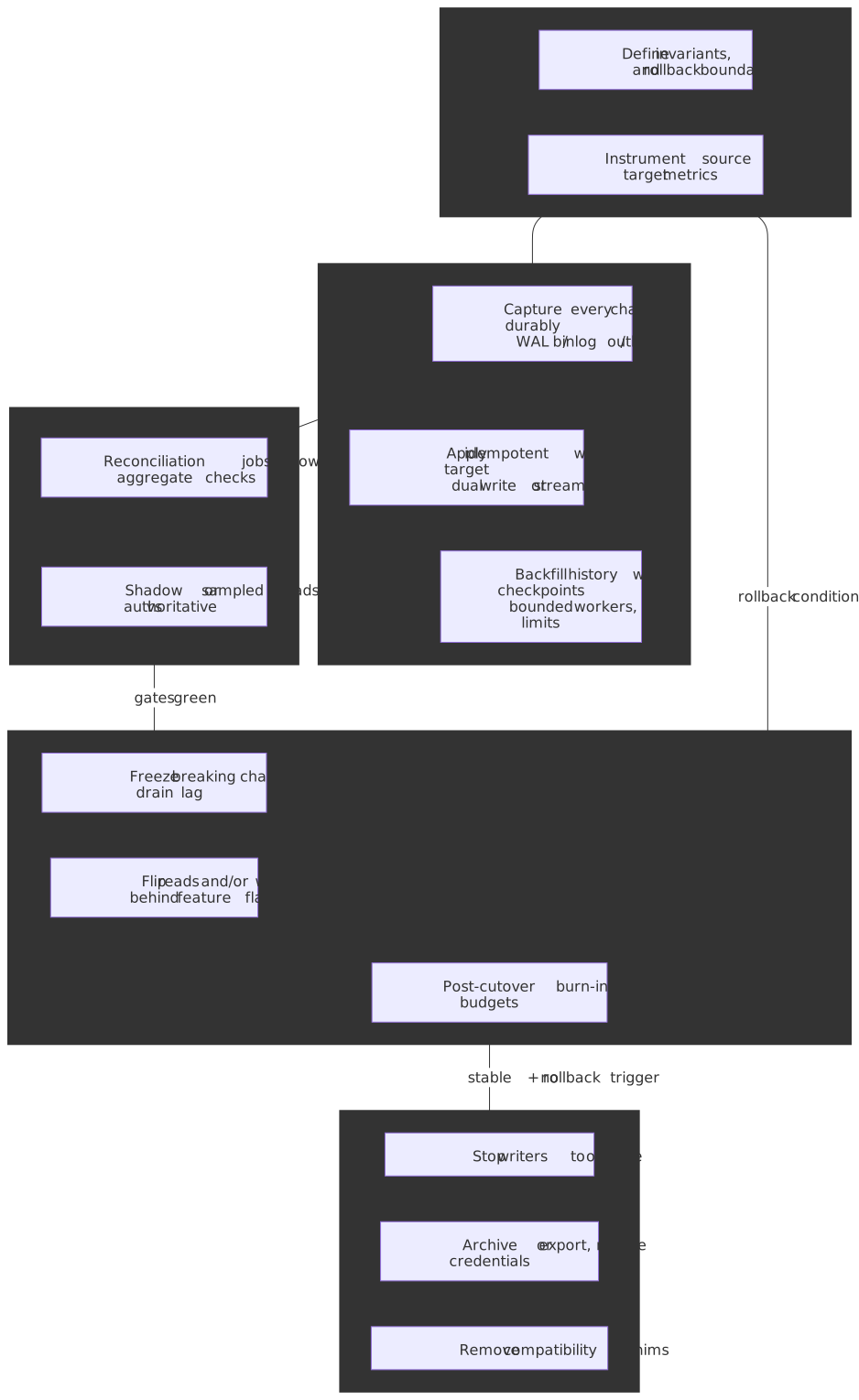
What “zero downtime” actually promises
Zero downtime means users keep making progress on their work while you change storage layout, vendor, or region. It does not mean zero risk, zero cost, or zero observable behavior change. You are trading a short hard outage for a longer soft window where two representations of truth coexist. The engineering problem is to keep that window bounded, measurable, and reversible.
PostgreSQL documents logical replication as a publisher/subscriber stream that can copy existing data and then apply ongoing changes; operators still must reason about conflicts, schema mapping, and monitoring lag (PostgreSQL documentation: Logical replication). MySQL’s replication model is likewise built around a durable log consumed by replicas, with operational guidance around lag and binlog retention (MySQL Reference Manual: Replication). Managed movers such as AWS DMS expose the same primitive at product level: initial load plus ongoing change data capture until you cut over (AWS DMS documentation: CDC). The pattern generalizes: capture → apply → verify → switch → retire.
At the architectural scale, the same shape is Martin Fowler’s Strangler Fig: route a slice of traffic through a façade and grow the new system around the old until the old can be removed safely (Fowler: Strangler Fig Application). At the schema scale, it is Parallel Change — also called expand/contract — where any breaking change is decomposed into an additive expand, a migration window, and a final contract (Fowler: Parallel Change). Most production data migrations are an instance of one of these two patterns, executed at the row, table, or service level.
Invariants before you touch traffic
Pick one authoritative source of truth per entity for each phase. Common choices:
- Old primary during overlap. New store is a follower; reads still come from the old path unless you have proven otherwise.
- Split authority (dangerous). Different services write different fields; only use when your reconciliation story is airtight.
Write explicit invariants, for example:
- Ordering: For a given key, visible history matches a total order you can replay (commit order, monotonic version column, or log sequence).
- Completeness: Every successful user-visible mutation eventually appears in the capture stream (Debezium and similar CDC connectors read the transaction log precisely to avoid missed application paths).
- Idempotency: Replaying the same event or batch twice does not corrupt final state (see RFC 9110: safe and idempotent methods for the HTTP analogy; the same discipline applies to consumers).
- Rollback boundary: You can revert reads to the old store without data loss or you accept forward-only loss and document it.
Note
If you cannot state rollback in one sentence, you are not ready for a production cutover—only for a rehearsal.
Schema evolution: expand and contract
Most “data migration” work that engineers actually ship is a column rename, a type change, a normalization split, or a new index added under load — Parallel Change applied to a relational schema. The discipline is to never combine a write-shape change with a read-shape change in the same deploy. Expand the schema additively, migrate readers and writers across the additive surface, then contract the old shape after a burn-in.
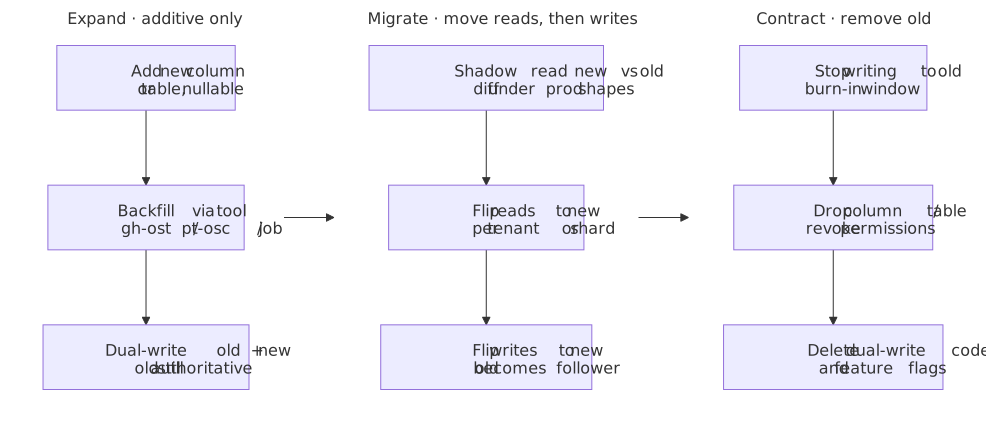
For large tables, the expand step is the one that breaks naive ALTER TABLE. Two production-grade lock-free DDL tools dominate the MySQL world:
- gh-ost (GitHub Online Schema Transmogrifier) reads the binary log to capture writes against the original table while it copy-builds a “ghost” table out of band, then atomically swaps. Because it is triggerless, it does not amplify write contention on the source the way trigger-based tools do, and it can be paused, throttled by replication lag, or aborted (github/gh-ost). GitHub uses it as the default schema-change mechanism for its 1,200+ host MySQL fleet, including continuous test migrations on production replicas (GitHub: Upgrading GitHub.com to MySQL 8.0).
- pt-online-schema-change (Percona Toolkit) takes the older, trigger-based approach: a shadow table plus AFTER INSERT/UPDATE/DELETE triggers keep it in sync during the copy (Percona: pt-online-schema-change). Triggers add per-write overhead and interact awkwardly with foreign keys; gh-ost is usually the safer default in 2026, but pt-osc is still the only option in some restricted environments.
Postgres does not need an external tool for most schema changes — recent versions ship transactional DDL, CREATE INDEX CONCURRENTLY, and lock-light ALTER TABLE variants — but the same expand/contract sequencing applies, especially across logical replication boundaries where the publisher and subscriber must agree on the wire schema (PostgreSQL documentation: Logical replication).
Tip
Expand-only DDL is the only kind of DDL safe to ship under a flag-gated rollout. If a deploy contains a DROP COLUMN, RENAME, or NOT NULL tightening, it is by definition not a rollout — it is a cutover, with all the gates that implies.
Dual writes versus single commit plus fan-out
There are two families of write path, each with different failure physics.
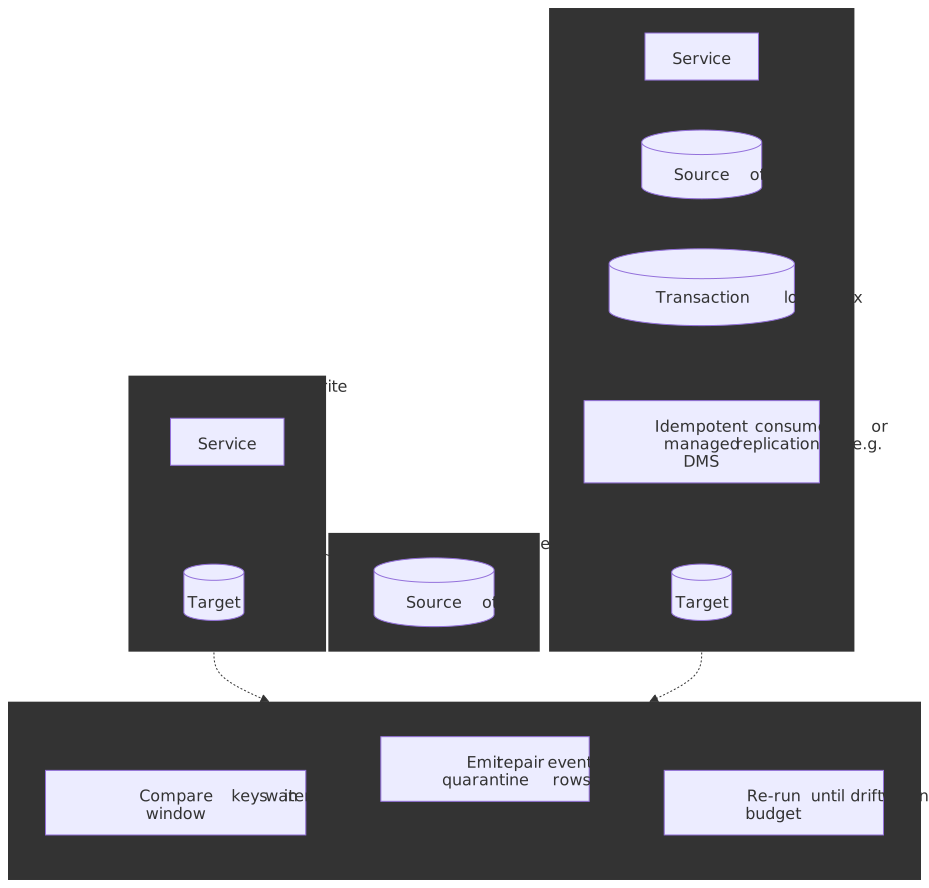
Application dual write updates the legacy store and the new store inside one request. It is easy to reason about locally, but partial failure is the default case: one side commits, the other times out. You need retries, deduplication keys, and often a repair queue—conceptually the same work as a stream consumer, only less uniform across services.
Single commit + durable fan-out keeps the database as the choke point: after commit, changes appear in the WAL/binlog or an outbox table that a relay publishes—Chris Richardson’s canonical write-up calls this the Transactional outbox and pairs it with two relay variants (log tailing and polling publisher). This is how large online migrations avoid asking every engineer to remember the second write (Stripe engineering: Online migrations). The operational cost shifts to connectors, ordering, retention, and consumer lag.
Neither removes reconciliation. Both need continuous proof that the follower store matches the contract you will read after cutover.
Backfills, lag, and throughput
A backfill is a batched historical copy; streaming (or dual writes) covers the tail. Production systems almost always run under rate limits: IOPS, replication bandwidth, page cache churn, and lock duration on hot rows all matter. AWS explicitly positions ongoing replication as continuing until lag is acceptable for cutover (AWS DMS documentation: CDC).
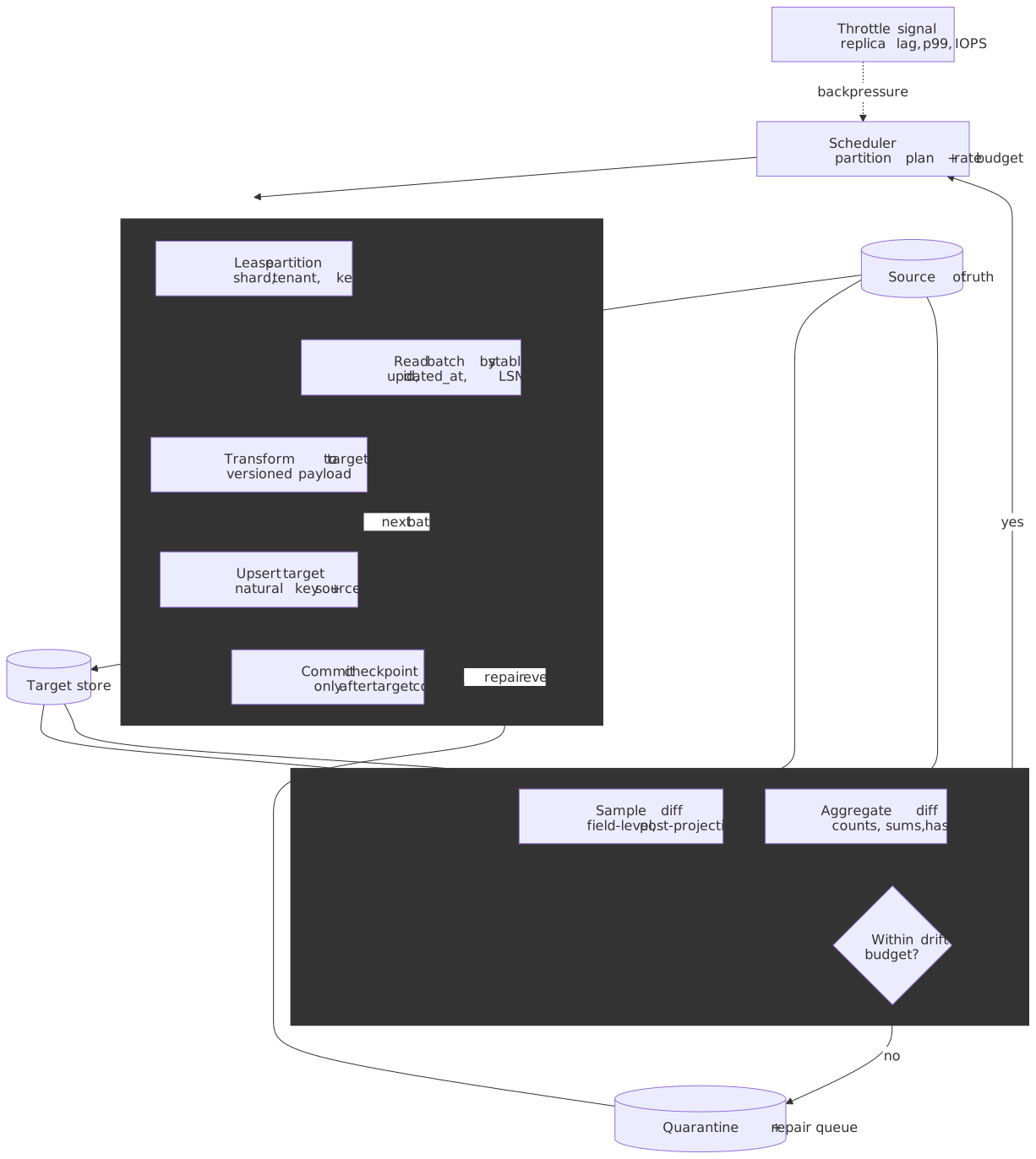
Operational tactics that survive audits:
- Watermarks and checkpoints per partition so workers restart without scanning from epoch zero.
- Idempotent upserts keyed by stable natural or surrogate keys; store
source_updated_atorsource_lsnon the target row for last-write-wins decisions you can defend. - Adaptive throttling when replica lag, consumer lag, or p99 write latency crosses SLO-driven ceilings—your backfill should be the first workload you shed, not user traffic.
- Hot key isolation so one viral entity cannot stall the entire job; shuffle partitions and cap batch sizes.
Checkpoint discipline (concrete shape)
Most backfill incidents are “we restarted the job and duplicated work” or “we advanced the watermark past an uncommitted transaction.” A boring, safe worker loop looks like this in responsibilities (not a mandate on language or framework):
- Lease a partition (hash range, tenant id, table slice) so two pods do not double-apply the same keys concurrently unless your writes are strictly commutative.
- Read a batch ordered by a stable cursor (
updated_at,(shard, id), or log position). - Transform and upsert into the target with a deterministic payload version.
- Commit the checkpoint only after the target batch commit succeeds—same spirit as transactional outbox relays, where downstream delivery is tied to durable progress (Microservices.io: Transactional outbox).
If the source is a relational log, prefer log sequence over wall clock when you have it: clocks lie; LSNs and binlog positions reflect commit order the database already agreed on (PostgreSQL documentation: Logical replication).
Lag is a product decision
Treat replication or consumer lag like any other SLO: define who suffers when lag grows (reads from follower? analytics? risk checks) and what mitigation is allowed (disable non-critical consumers, widen read-your-writes exceptions, temporarily route hot tenants to the old path). MySQL’s replication docs are explicit that replicas apply events asynchronously—design for eventual visibility unless you buy stronger guarantees with topology and routing (MySQL Reference Manual: Replication).
Validation and reconciliation
Validation is more than row counts. Counts can match while semantic drift (wrong currency scale, missing soft deletes, truncated strings) slips through.
Layer checks:
| Layer | What it catches | Cost |
|---|---|---|
| Aggregate | Missing shards, wildly wrong totals | Cheap nightly |
| Sampled deep compare | Field-level bugs, encoding issues | Moderate |
| Shadow reads | Read-path incompatibility (indexes, nullability) | Higher—do before trusting new path |
Stripe ran shadow reads with GitHub’s Scientist library: the production code path executes the legacy query while a control path queries the new store, results are diffed, and mismatches alert engineers without affecting users (Stripe engineering: Online migrations). The exact tool matters less than the property: never let cutover be the first time the new read path sees production query shapes.
Run reconciliation continuously during overlap, not as a single pre-cutover script. Quarantine mismatches with enough context (key, versions, payload hashes) for a human to classify data bug vs. expected divergence.
What to diff when schemas differ
During expand/contract style moves, the target table often carries extra columns, different indexes, or normalized joins. Reconciliation should compare business projections, not raw storage:
- Map both sides through the same read model code path used in production, or through a SQL view that mirrors post-cutover joins.
- Freeze default expressions and time zones for the migration window; subtle
NOW()vs. sourceupdated_atdifferences create ghosts that pass row counts. - For deletes, decide whether tombstones,
deleted_at, or hard deletes are canonical, and assert the same rule on both sides—CDC connectors often emit delete events you must not drop on the floor (Debezium documentation).
Cutover criteria and gates
Cutover is a risk management event, not a merge request. Treat it like a launch: explicit owner, time box, and pre-declared abort conditions. The checklist below is the same information as the diagram—use whichever format your team actually runs in a war room.
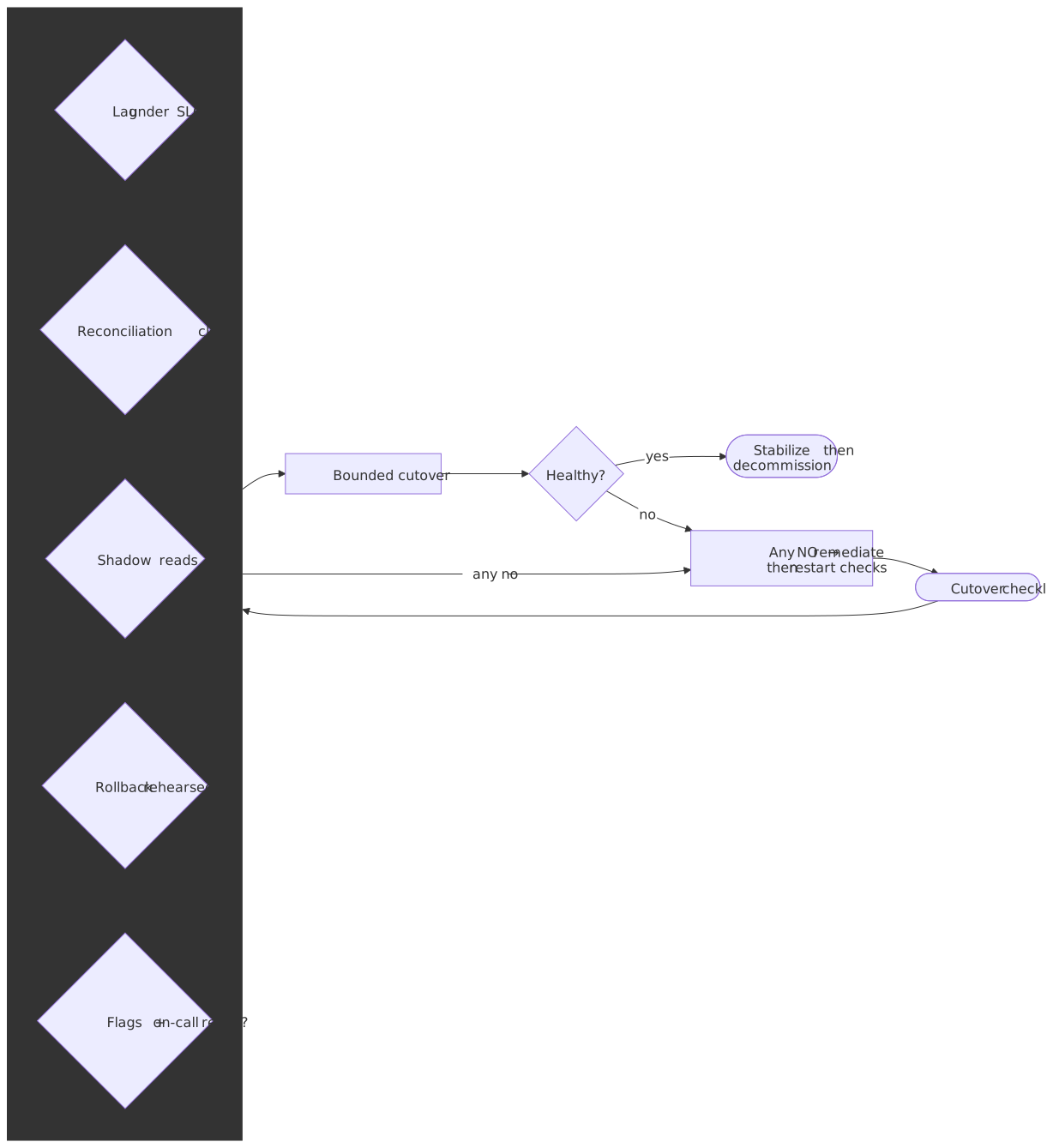
Concrete go conditions often include:
- Consumer or replication lag below a percentile budget for a sustained window, not a single lucky minute (PostgreSQL logical replication monitoring lists lag views operators rely on).
- Reconciliation error rate near zero with all known exceptions ticketed and classified.
- Shadow reads (or canary traffic) show parity on correctness metrics you defined up front.
- Rollback rehearsal completed on production-like data: restore flags, DNS or connection strings, and cache invalidation paths.
Expand reads before expand writes (when reshaping tables)
Stripe’s public write-up on large online migrations describes a practical sequencing: dual-write, then move reads, then move writes, then delete old data (Stripe engineering: Online migrations). The lesson generalizes: reads fail loudly on wrong indexes and nullability; writes fail loudly on constraint and trigger mismatch. Ordering work so read paths exercise the new store under production query shapes before you make the new store authoritative for writes reduces the chance that cutover day is the first time your ORM touches real cardinality.
Feature flags should default off, roll out per tenant or shard, and log which code path served each request so post-incident forensics does not devolve into guessing.
Rollback: when to pull the cord
Rollback is not “re-deploy yesterday’s binary.” It is returning the read path (and possibly write path) to a known-good authority without silently discarding user work.
Trigger examples:
- Sustained drift between stores after cutover, especially growing drift (suggests a logic bug, not noise).
- Correctness regressions on golden workflows or payment-adjacent flows.
- Latency or error budget violations tied to the new path that cannot be mitigated within the change window.
If the new store has accepted writes that the old store never learned, rollback may be lossy unless you also replay forward—state this explicitly in the runbook. Many teams keep a short forward sync path from new → old only for emergency rollback windows, then delete it after confidence hardens.
Decommissioning and organizational cleanup
Decommissioning is where migrations die of neglect: old tables linger, cron jobs keep writing “just in case,” and costs creep. A clean finish includes:
- Traffic proof: No production reads or writes hit the legacy path for a full billing or release cycle—whichever is stricter for your business.
- Credential and network isolation: Revoke DB users, firewall rules, and object-store prefixes so accidental writes fail loudly.
- Code deletion: Remove feature flags, compatibility mappers, and temporary dual-write branches; static analysis or coverage gaps here have caused reintroduction bugs months later.
- Retention and compliance: Export archives if policy requires, then drop with auditable tickets.
Prove “zero traffic” with data, not grep
Before dropping the old cluster, collect connection counts, query fingerprints, and egress bytes tagged by application role. Dashboards beat assertions in Slack. After code deletion, run the same checks for a week—surprise traffic almost always means a forgotten reporting job or a vendor integration still pointed at the legacy DSN.
For long-running pipelines that replace rather than move data, Google’s SRE workbook chapter on data processing emphasizes monitoring, idempotent stages, and failure design (Google SRE Workbook: Data processing)—the same muscles you use for backfill workers at scale.
Cost and toil
Dual clusters and double-written rows are not free. Make the decommission date a tracked milestone with an owner the same way the cutover date is; otherwise finance will notice the migration months before engineering considers it “done.”
Production case studies
The same five-phase shape — capture, apply, verify, switch, retire — survives at very different scales. Three public engineering postmortems are worth reading in full because they make the trade-offs concrete.
Stripe: online migrations on a single primary. Stripe’s now-canonical write-up describes the four-step recipe their teams use for any large schema or storage move: dual-write, backfill, then move reads, then move writes, then delete the old data. Shadow reads use GitHub’s Scientist to run the legacy and candidate paths side by side and diff the result without affecting users. The lesson generalizes well outside Stripe: the read path almost always exposes mismatches earlier and cheaper than the write path (Stripe engineering: Online migrations).
Shopify: tenant moves between MySQL pods with Ghostferry. Shopify’s pod architecture pins each shop to a MySQL shard, and growth eventually concentrates load on a few shards. Their open-source mover, Ghostferry, batch-copies rows for the target shop_id while tailing the source binlog, enters a brief cutover guarded by an application-level multi-reader / single-writer (MRSW) lock on the shop, updates the routing table, and prunes stale data on the old shard afterward. The central algorithm is modeled in TLA+ so correctness arguments are mechanical, not anecdotal (Shopify: Shard Balancing with Ghostferry; Shopify/ghostferry). When the unit you are moving is a tenant, not a table, this is the reference design.
GitHub: rolling MySQL 5.7 → 8.0 across 1,200 hosts. GitHub’s year-long upgrade is a master class in mixed-version operation and rollback discipline. Replicas were upgraded a data center at a time while 5.7 replicas stayed online to absorb traffic if the 8.0 path misbehaved. The primary was promoted via orchestrator failover rather than in-place upgrade, with a parallel 5.7 replication chain kept as a rollback target. They had to engineer backward replication from 8.0 → 5.7 — unsupported by upstream MySQL — by pinning client character sets via the Trilogy library and temporarily simplifying role-based privileges; this only held because client behavior was uniform across the Rails monolith (GitHub: Upgrading GitHub.com to MySQL 8.0). For horizontally sharded keyspaces they upgraded one Vitess shard at a time and updated the VTGate-advertised version per keyspace.
Vitess: sharding moves as first-class workflows. When the migration unit is “this table belongs in a different keyspace,” Vitess’s MoveTables workflow — built on VReplication — handles the copy, ongoing CDC, traffic mirroring, and cutover as named lifecycle states (Create, MirrorTraffic, SwitchTraffic, Complete), with explicit reverse workflows for rollback (Vitess: MoveTables). The interesting design point is that traffic mirroring is a separate gate from traffic switching — a productized version of “shadow reads before real reads.”
Cross-service consistency during the overlap. When a single user action would have committed in one transaction on the legacy store but now spans the legacy store and a new service, Saga-style compensating transactions are the fallback for atomicity that distributed transactions can’t provide (microservices.io: Saga). Treat compensations as production code, not as cleanup scripts: they will run during the migration, and they will run again if you need to rewind.
Common failure modes (short catalog)
| Failure mode | Early signal | Mitigation |
|---|---|---|
| Missed writes outside the capture path | Reconciliation gaps clustered by service | Move capture to the log or outbox; block cutover until coverage proven |
| Backfill starving the tail | Growing lag while historical percent climbs | Throttle backfill; raise resources; partition hot keys |
| Non-idempotent consumers | Duplicate events corrupt state | Deterministic upserts; unique constraints; poison-message quarantine |
| Cutover under schema skew | Shadow read mismatches on defaults/encoding | Freeze DDL; align serializers; add contract tests |
| “Rollback” without a writer path | User-visible flapping reads | Rehearse two-way plan or accept forward-only |
Closing heuristic
If you remember only three questions before flipping traffic:
- Where is truth right now, for reads and writes?
- What metric proves the follower is equivalent, not just “caught up”?
- What is the smallest reversible step if the metric lies?
Answer those on paper, not only in Terraform, and the long overlap window becomes boring—which is the point.
References
- PostgreSQL documentation: Logical replication
- MySQL Reference Manual: Replication
- AWS DMS documentation: CDC
- Debezium documentation
- Microservices.io: Transactional outbox pattern
- Microservices.io: Saga pattern
- Stripe engineering: Online migrations
- Shopify engineering: Shard Balancing with Ghostferry
- Shopify/ghostferry on GitHub
- GitHub engineering: Upgrading GitHub.com to MySQL 8.0
- github/gh-ost — GitHub’s online schema migration tool for MySQL
- Percona Toolkit: pt-online-schema-change
- Vitess: MoveTables (VReplication)
- Martin Fowler: Strangler Fig Application
- Martin Fowler: Parallel Change (expand and contract)
- RFC 9110: Safe and idempotent request methods
- Google SRE Workbook: Data processing
- Martin Kleppmann, Designing Data-Intensive Applications — stream processing, exactly-once semantics, and log-based integration trade-offs (author site)