Heaps and Priority Queues: Internals, Trade-offs, and When Theory Breaks Down
Heaps provide the fundamental abstraction for “give me the most important thing next” in O(log n) time. Priority queues — the abstract interface — power task schedulers, shortest-path algorithms, and event-driven simulations. Binary heaps dominate in practice not because they’re theoretically optimal, but because array storage exploits cache locality. Understanding the gap between textbook complexity and real-world performance reveals when to use standard libraries, when to roll your own, and when the “better” algorithm is actually worse.
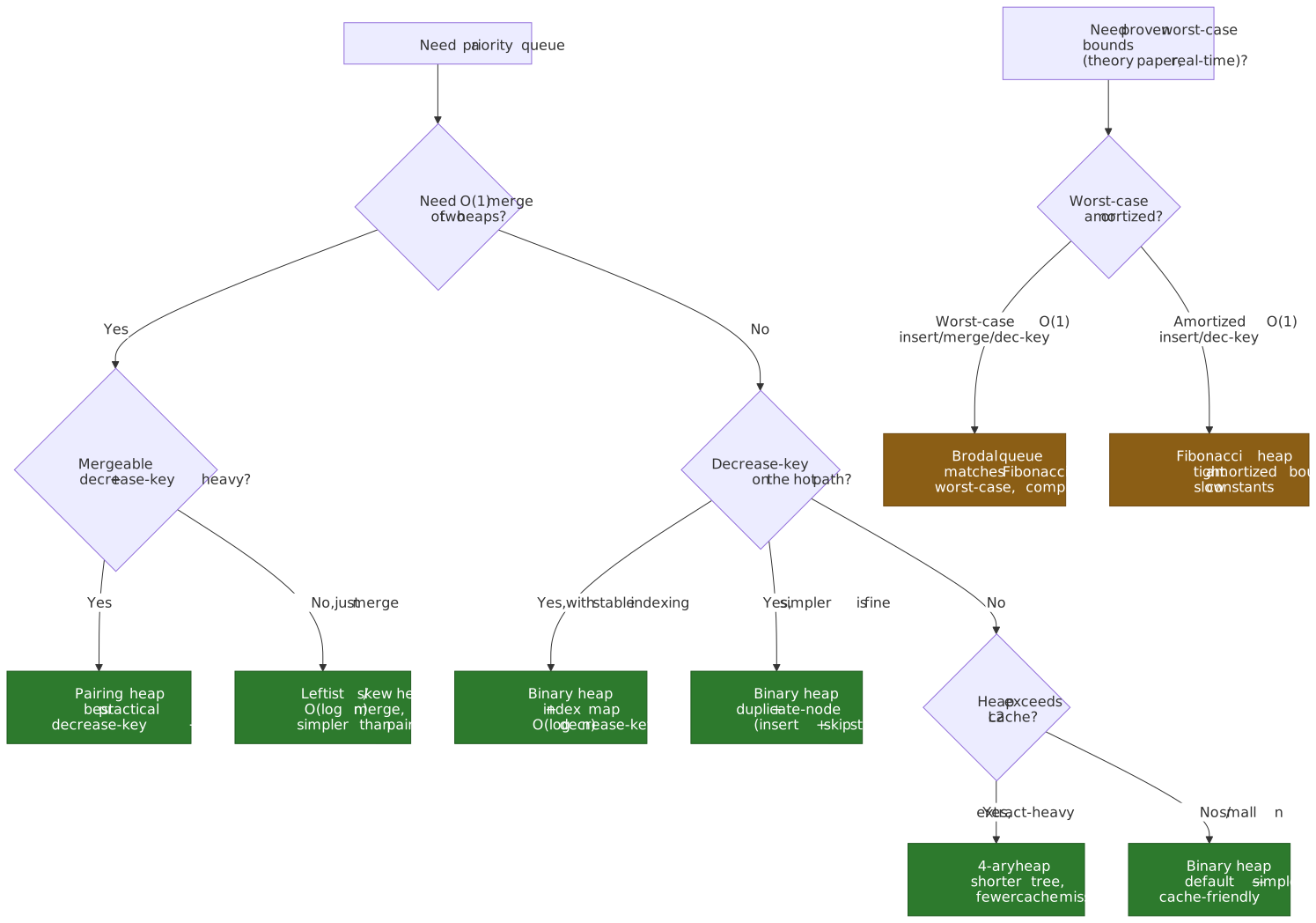
Abstract
A heap is a complete binary tree stored in an array where each parent dominates its children (min-heap: parent ≤ children, max-heap: parent ≥ children). Array indices encode parent-child relationships: for a node at index i, the parent is at ⌊(i-1)/2⌋, children at 2i+1 and 2i+21. This implicit structure eliminates pointer overhead and enables contiguous memory access.
The core operations:
| Operation | Binary Heap | What Happens |
|---|---|---|
peek |
O(1) | Root is always min/max |
insert |
O(log n) | Add at end, bubble up |
extractMin/Max |
O(log n) | Swap root with last, bubble down |
buildHeap |
O(n) | Heapify bottom-up (not n × log n) |
decreaseKey |
O(log n) | Update value, bubble up |
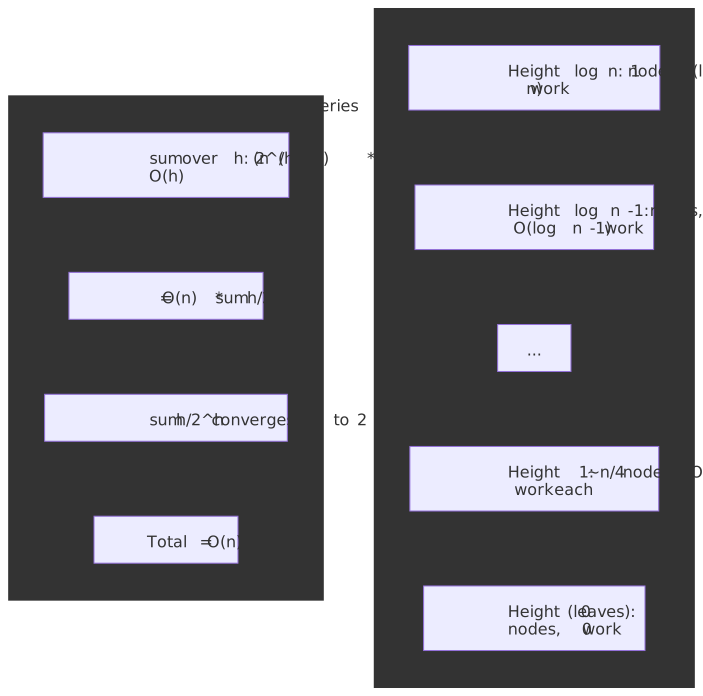
The O(n) buildHeap complexity is counterintuitive — it works because most nodes are near the leaves where heapify is cheap2. Fibonacci heaps offer O(1) amortized decreaseKey3, but their constant factors make them slower than binary heaps in practice for all but very large, dense graphs4.
Important
Theoretical complexity is dominated by cache effects once the heap exceeds L1/L2. A 4-ary heap is consistently faster than a binary heap on large workloads — LaMarca and Ladner measured roughly
Warning
Binary-heap decreaseKey is only value → index map maintained on every swap, you must scan to find the node first — turning the operation into
The Heap Property and Array Representation
A binary heap satisfies two constraints1:
- Shape property — a complete binary tree: all levels filled except possibly the last, which fills left-to-right.
- Heap property — each node dominates its children (min-heap:
A[parent] ≤ A[child], max-heap:A[parent] ≥ A[child]).
The complete-tree constraint is what makes the array representation work. Without it, gaps would appear in the array as nodes are removed.
Why Array Storage Works
The complete binary tree constraint enables an elegant array representation without explicit pointers:
// Fundamental relationships for array-based heapsfunction parent(i: number): number { return Math.floor((i - 1) / 2) // Equivalent: (i - 1) >> 1}function leftChild(i: number): number { return 2 * i + 1 // Equivalent: (i << 1) + 1}function rightChild(i: number): number { return 2 * i + 2 // Equivalent: (i << 1) + 2}CLRS uses 1-indexed arrays where parent(i) = ⌊i/2⌋, left(i) = 2i, right(i) = 2i + 1. Production implementations almost always use 0-indexed arrays — the arithmetic is slightly messier but avoids wasting index 0.
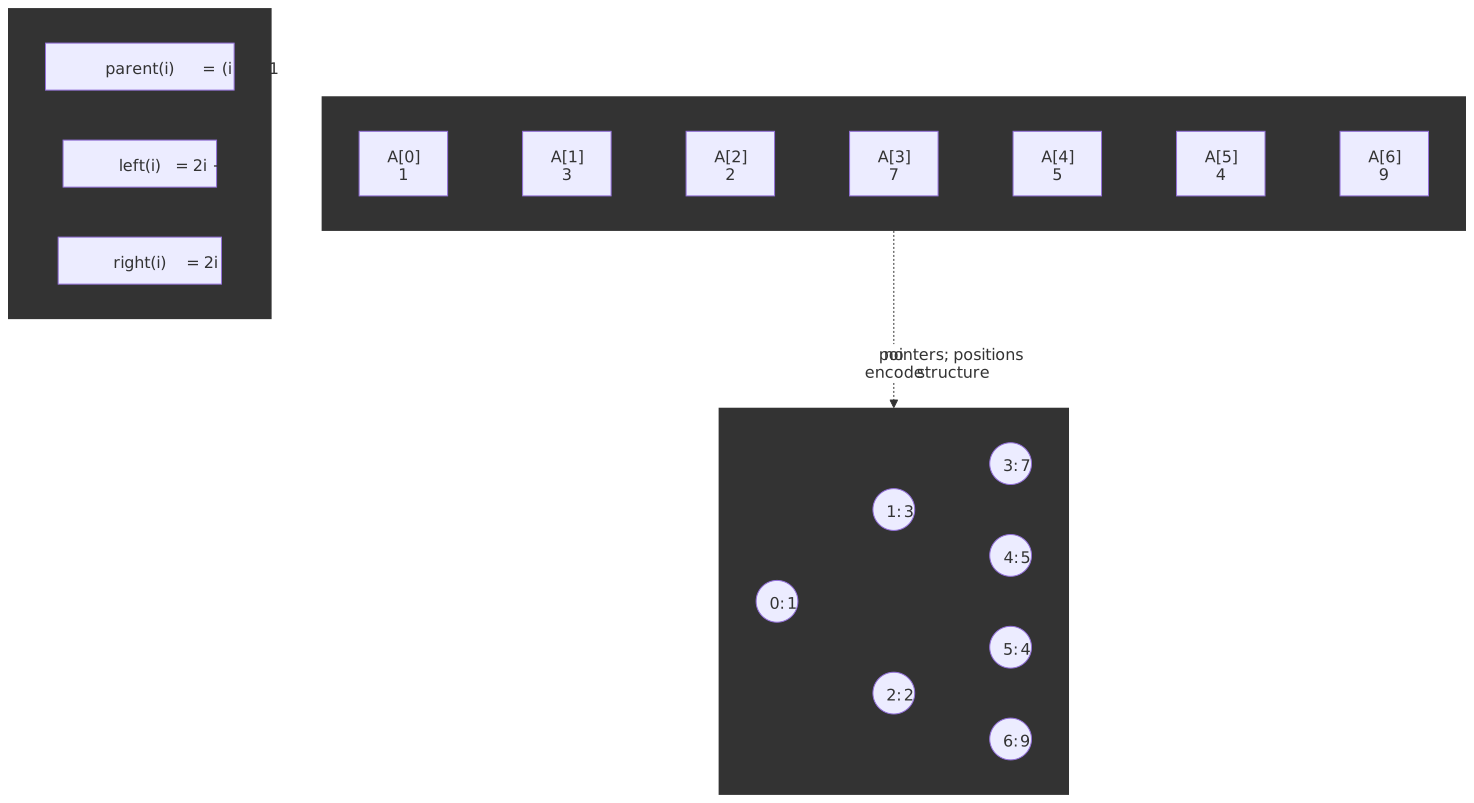
Memory layout advantage: with 64-byte cache lines and 8-byte elements, one cache line holds eight heap nodes. Sequential access during heapify loads multiple nodes for free. This is the structural reason array-based heaps outperform pointer-based structures despite identical asymptotic complexity5.
The Shape Guarantee
The complete tree property means:
- A heap with n nodes has height
⌊log₂ n⌋. - Level k contains at most
2^knodes. - The last level may be incomplete, but fills left-to-right.
This guarantees balanced structure without rotations or rebalancing — unlike binary search trees, where adversarial insertion order creates O(n) height.
Core Operations: How Bubbling Works
Insert (Bubble Up / Sift Up)
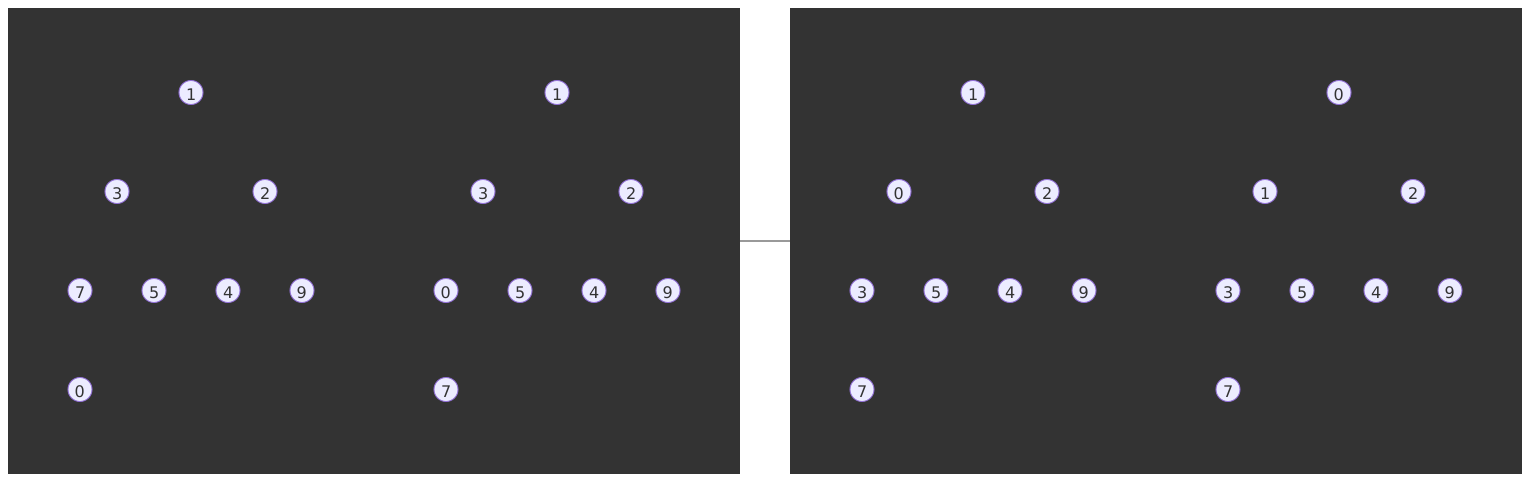
Insert places the new element at the end (maintaining completeness), then restores the heap property by repeatedly swapping with the parent if violated:
// Binary min-heap implementation// heap is an array, size is the current element countclass MinHeap<T> { private heap: T[] = [] private compare: (a: T, b: T) => number constructor(compareFn: (a: T, b: T) => number = (a, b) => (a as number) - (b as number)) { this.compare = compareFn } insert(value: T): void { this.heap.push(value) // Add at end (O(1) amortized) this.bubbleUp(this.heap.length - 1) // Restore heap property } private bubbleUp(index: number): void { while (index > 0) { const parentIdx = Math.floor((index - 1) / 2) if (this.compare(this.heap[index], this.heap[parentIdx]) >= 0) { break // Heap property satisfied } // Swap with parent ;[this.heap[index], this.heap[parentIdx]] = [this.heap[parentIdx], this.heap[index]] index = parentIdx } }}Worst case: the new element is smaller than the root, requiring log n swaps up the entire height. Best case: the element belongs at the bottom, O(1). Average case for random insertions: about half the path to root, still O(log n).
Extract Min/Max (Bubble Down / Sift Down)
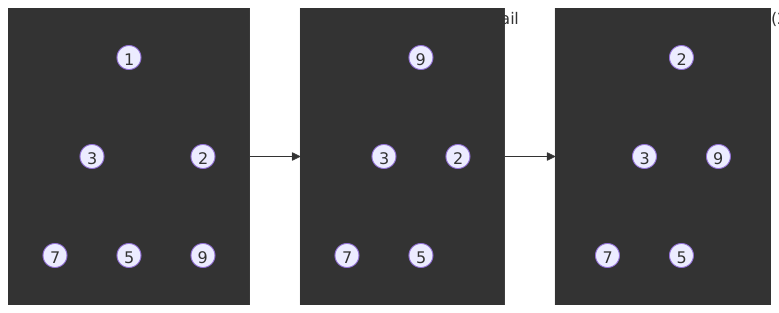
Extraction swaps the root with the last element, removes the last, then restores the heap property by bubbling down:
// Continuing the MinHeap classextractMin(): T | undefined { if (this.heap.length === 0) return undefined; if (this.heap.length === 1) return this.heap.pop(); const min = this.heap[0]; this.heap[0] = this.heap.pop()!; // Move last to root this.bubbleDown(0); // Restore heap property return min;}private bubbleDown(index: number): void { const size = this.heap.length; while (true) { const left = 2 * index + 1; const right = 2 * index + 2; let smallest = index; // Find smallest among node and its children if (left < size && this.compare(this.heap[left], this.heap[smallest]) < 0) { smallest = left; } if (right < size && this.compare(this.heap[right], this.heap[smallest]) < 0) { smallest = right; } if (smallest === index) break; // Heap property satisfied [this.heap[index], this.heap[smallest]] = [this.heap[smallest], this.heap[index]]; index = smallest; }}Key detail: we compare with both children and swap with the smaller one (min-heap). Swapping with the larger child would violate the heap property for the other subtree.
Why Swap-with-Last Works
Removing the root directly would leave a hole requiring expensive restructuring. Swapping with the last element:
- Maintains the complete tree shape (last element gone, root replaced).
- Only potentially violates the heap property at the root.
- Bubbling down is bounded by tree height.
Tip
CPython’s heapq deliberately violates the textbook bubble-down at this point. After moving the tail to the root, it bubbles up the smaller child along the path to a leaf, then sifts the original tail element down only once — a bottom-up technique attributed to Knuth (TAOCP Vol. 3, §5.2.3) that measurably reduces comparisons because the moved element usually does belong near the bottom7.
Build Heap: The O(n) Surprise
The naive approach — insert n elements one by one — costs O(n log n). But building a heap by calling heapify (bubble down) from the middle of the array upward runs in O(n)2.
The Mathematical Insight
At most ⌈n/2^(h+1)⌉ nodes exist at height h. Heapify at height h costs O(h). The total work:
The infinite series
// Convert arbitrary array to valid heapfunction buildHeap<T>(arr: T[], compare: (a: T, b: T) => number): void { const n = arr.length // Start from last non-leaf node, heapify each for (let i = Math.floor(n / 2) - 1; i >= 0; i--) { heapify(arr, n, i, compare) }}function heapify<T>(arr: T[], size: number, index: number, compare: (a: T, b: T) => number): void { let smallest = index const left = 2 * index + 1 const right = 2 * index + 2 if (left < size && compare(arr[left], arr[smallest]) < 0) smallest = left if (right < size && compare(arr[right], arr[smallest]) < 0) smallest = right if (smallest !== index) { ;[arr[index], arr[smallest]] = [arr[smallest], arr[index]] heapify(arr, size, smallest, compare) }}Practical implication: when you have all elements upfront, use buildHeap. It’s roughly 2× faster than repeated insert for the same result, and standard libraries expose it directly (heapq.heapify in Python, std::make_heap in C++, heap.Init in Go).
Heap Sort: O(n log n) Guaranteed, But Slower in Practice
Heap sort works by building a max-heap, then repeatedly extracting the maximum:
// In-place, unstable, O(n log n) guaranteedfunction heapSort<T>(arr: T[], compare: (a: T, b: T) => number): void { const n = arr.length // Build max-heap (reverse comparison) for (let i = Math.floor(n / 2) - 1; i >= 0; i--) { maxHeapify(arr, n, i, compare) } // Extract elements one by one for (let i = n - 1; i > 0; i--) { ;[arr[0], arr[i]] = [arr[i], arr[0]] // Move max to end maxHeapify(arr, i, 0, compare) // Restore heap on reduced array }}Why Heap Sort Loses to Quicksort
| Factor | Heap Sort | Quicksort |
|---|---|---|
| Worst case | O(n log n) always | O(n²) without pivot optimization |
| Cache locality | Poor — jumps across the array | Excellent — linear partitioning |
| Branch prediction | Poor — unpredictable swap paths | Better — partition scans are predictable |
| Practical speed | 1× baseline | Typically 2-3× faster |
Quicksort scans memory linearly during partitioning, loading cache lines efficiently. Heap sort jumps between parent and children nodes, causing cache misses8. Modern implementations like introsort use heap sort as a fallback when quicksort recursion exceeds 2 ⌊log₂ n⌋ — getting quicksort’s average speed with heap sort’s worst-case guarantee. C++ std::sort is required to be O(n log n), and libstdc++ implements it as introsort precisely because of this trade-off.
Heap Sort Is Not Stable
Stability means equal elements maintain their original relative order. Heap sort swaps elements across large distances (root with last position), breaking stability9. For stability use merge sort, Timsort (Python’s list.sort), or pdqsort (Rust’s slice sort).
D-ary Heaps: When More Children Means Faster
A d-ary heap generalizes binary heaps to d children per node6:
- Index calculations:
parent(i) = ⌊(i-1)/d⌋, children atd*i + 1throughd*i + d. - Tree height:
log_d(n)instead oflog_2(n). insert: fewer levels to bubble up (faster).extractMin: more comparisons per level to find the smallest child (slower).
Why 4-ary Heaps Win in Practice
LaMarca and Ladner’s foundational study on caches and heaps showed that aligning the fanout with the cache line size dramatically reduces cache misses for extractMin-heavy workloads, and that 4-ary aligned heaps consistently beat binary heaps on out-of-cache workloads5. The original paper measured roughly
The reasons:
- Reduced height — a 4-ary heap with 1M elements has height ~10 vs ~20 for binary.
- Cache line utilization — four 8-byte children fit in a 64-byte cache line, so all candidate children are usually loaded by a single line fetch.
- Fewer cache misses — despite more comparisons per level, the dominant cost on modern hardware is memory traffic, not ALU work.
// D-ary heap with d=4const D = 4function parent(i: number): number { return Math.floor((i - 1) / D)}function firstChild(i: number): number { return D * i + 1}// During bubble-down, compare all D childrenfunction findSmallestChild(heap: number[], parentIdx: number, size: number): number { let smallest = parentIdx const start = D * parentIdx + 1 const end = Math.min(start + D, size) for (let i = start; i < end; i++) { if (heap[i] < heap[smallest]) { smallest = i } } return smallest}When to use d-ary: large heaps that exceed L2 cache and where memory access dominates CPU cycles. For small heaps (< ~1000 elements), binary heaps are simpler and fast enough — the tree fits in L1 and the wider fanout buys nothing.
Fibonacci Heaps: Theoretically Optimal, Practically Slow
Fibonacci heaps achieve3:
insert: O(1) amortizedfindMin: O(1)decreaseKey: O(1) amortizedextractMin: O(log n) amortizedmerge: O(1)
This makes Dijkstra’s algorithm O(E + V log V) instead of O((V + E) log V) with a binary heap11 — a meaningful improvement when E approaches V².
Why Fibonacci Heaps Lose in Practice
- High constant factors — the lazy consolidation machinery and per-node bookkeeping (parent, child, sibling pointers, mark bit, degree) add substantial overhead4.
- Pointer chasing — the node-based structure defeats cache prefetching.
- Complex implementation — more opportunities for bugs, harder to optimize.
- Amortized ≠ consistent — individual operations can spike to O(n).
Experimental studies — Stasko & Vitter (1987)12, Moret & Shapiro (1992), and Larkin, Sen & Tarjan (2014)13 — consistently show pairing heaps outperform Fibonacci heaps in decreaseKey-heavy graph workloads despite weaker theoretical guarantees14. For most applications, a binary heap with the “duplicate node” strategy beats both.
The Duplicate Node Strategy
Instead of decreaseKey, insert a new node with the updated priority. When extracting, skip stale entries11:
// Used in Dijkstra's algorithm implementations// Trade memory for simplicity—no need to track node positionsinterface PQEntry<T> { priority: number value: T valid: boolean // Or use a Set to track processed nodes}class SimplePriorityQueue<T> { private heap: PQEntry<T>[] = [] insert(priority: number, value: T): void { this.heap.push({ priority, value, valid: true }) this.bubbleUp(this.heap.length - 1) } // Instead of decrease-key, insert again and mark old as invalid update(oldEntry: PQEntry<T>, newPriority: number): void { oldEntry.valid = false this.insert(newPriority, oldEntry.value) } extractMin(): T | undefined { while (this.heap.length > 0) { const entry = this.extractRoot() if (entry?.valid) return entry.value // Skip invalid entries from previous decrease-key operations } return undefined }}This wastes memory (duplicate entries) but avoids tracking node positions in the heap — a significant implementation simplification. The heap can grow to O(E) in the worst case for Dijkstra, which is rarely an issue in practice.
Other Variants Worth Knowing
Most production code never reaches for these, but they fill specific gaps in the design space and show up in algorithms papers.
| Variant | Headline property | When to reach for it |
|---|---|---|
| Leftist heap | merge via right-spine bound on rank15 |
You need a mergeable heap and want a simple pointer-based structure with proven bounds. |
| Skew heap | Self-adjusting cousin of leftist; same amortized merge, no rank stored |
Same as leftist when amortized bounds are acceptable; less code. |
| Binomial heap | Educational; rarely shipped except as a Fibonacci-heap building block. | |
| Brodal queue | Worst-case insert, findMin, meld, decreaseKey; |
Real-time systems where a single |
Note
CLRS treats binary, binomial, and Fibonacci heaps end-to-end; Sedgewick adds leftist and pairing variants. The Tarjan / Sleator pairing-heap paper (1986) and the Brodal–Okasaki (1996) and Brodal (1996) papers cover the worst-case end of the spectrum. None of these has displaced the binary heap from standard libraries.
Standard Library Implementations
Almost every mainstream standard library that ships a priority queue ships a binary heap. The interface differences matter more than the algorithmic ones.
Python: heapq Module
Python’s heapq provides functions operating on regular lists. It is min-heap only — for a max-heap, negate values or use _heapq_max (private).
# heapq operates on lists, doesn't wrap themimport heapqdata = [5, 1, 8, 3, 2]heapq.heapify(data) # O(n) in-place transformationheapq.heappush(data, 4) # O(log n) insertsmallest = heapq.heappop(data) # O(log n) extract min# No decrease-key—use duplicate node strategy# No max-heap—negate values or use custom comparisonCPython ships a C accelerator at Modules/_heapqmodule.c; import heapq transparently uses it when available and falls back to the pure-Python Lib/heapq.py7.
Warning
heapq is not stable. Equal-priority items may come out in any order. The Python docs explicitly recommend (priority, count, task) tuples with a monotonically increasing count from itertools.count() as the standard tiebreaker — this also avoids TypeError when task itself is unorderable18.
Go: container/heap Package
Go’s container/heap requires implementing an interface rather than providing a ready-to-use type:
// Go's heap requires implementing heap.Interface// which embeds sort.Interface (Len, Less, Swap) plus Push and Poppackage mainimport ( "container/heap")type IntHeap []intfunc (h IntHeap) Len() int { return len(h) }func (h IntHeap) Less(i, j int) bool { return h[i] < h[j] }func (h IntHeap) Swap(i, j int) { h[i], h[j] = h[j], h[i] }// Push and Pop are called by heap package, not directlyfunc (h *IntHeap) Push(x any) { *h = append(*h, x.(int)) }func (h *IntHeap) Pop() any { old := *h n := len(old) x := old[n-1] *h = old[0 : n-1] return x}// Usagefunc main() { h := &IntHeap{5, 1, 8, 3, 2} heap.Init(h) // O(n) heap.Push(h, 4) // O(log n) min := heap.Pop(h) // O(log n)}Why Go’s design is confusing: the Push and Pop methods on your type are for the heap package to call internally — you call heap.Push(h, x) and heap.Pop(h). This indirection enables generic algorithms without generics (pre-Go 1.18 design), and container/heap was never re-typed after generics landed19.
C++ and Java
- C++ does not expose a “heap object”. The standard library provides the algorithm trio
std::make_heap,std::push_heap,std::pop_heapoperating on any random-access range, andstd::priority_queueis a thin container adaptor over astd::vectorplus those algorithms. Default is a max-heap; passstd::greater<T>as the comparator for min-heap behavior20. - Java ships
java.util.PriorityQueue, an array-backed binary heap. Default is a min-heap; passComparator.reverseOrder()for max-heap behavior. Likeheapq, it is unbounded, unsynchronised, and not stable for equal priorities.
JavaScript: No Built-in Heap
JavaScript has no standard heap or priority queue — neither ECMAScript nor the WHATWG runtime specs define one. Common approaches:
- Third-party libraries —
fastpriorityqueueis V8-tuned;heap-jsis API-friendly. - Roll your own — ~50 lines for a basic binary heap.
- Sorted array — O(n) insert but trivial; fine for very small n.
// Production-grade implementation would add error handlingclass MinHeap<T> { private heap: T[] = [] constructor(private compare: (a: T, b: T) => number = (a, b) => (a as any) - (b as any)) {} push(val: T): void { this.heap.push(val) let i = this.heap.length - 1 while (i > 0) { const p = (i - 1) >> 1 if (this.compare(this.heap[i], this.heap[p]) >= 0) break ;[this.heap[i], this.heap[p]] = [this.heap[p], this.heap[i]] i = p } } pop(): T | undefined { if (this.heap.length <= 1) return this.heap.pop() const top = this.heap[0] this.heap[0] = this.heap.pop()! let i = 0 while (true) { const l = 2 * i + 1, r = 2 * i + 2 let min = i if (l < this.heap.length && this.compare(this.heap[l], this.heap[min]) < 0) min = l if (r < this.heap.length && this.compare(this.heap[r], this.heap[min]) < 0) min = r if (min === i) break ;[this.heap[i], this.heap[min]] = [this.heap[min], this.heap[i]] i = min } return top } peek(): T | undefined { return this.heap[0] } get size(): number { return this.heap.length }}Real-World Applications
Dijkstra’s Shortest Path
The canonical priority-queue application. Each vertex gets a tentative distance; the heap efficiently finds the next vertex to process:
// Graph represented as adjacency list// Edge: { to: number, weight: number }interface Edge { to: number weight: number}type Graph = Edge[][]interface HeapEntry { vertex: number distance: number}function dijkstra(graph: Graph, source: number): number[] { const n = graph.length const dist = Array(n).fill(Infinity) dist[source] = 0 const heap = new MinHeap<HeapEntry>((a, b) => a.distance - b.distance) heap.push({ vertex: source, distance: 0 }) const visited = new Set<number>() while (heap.size > 0) { const { vertex, distance } = heap.pop()! if (visited.has(vertex)) continue // Skip stale entries visited.add(vertex) for (const { to, weight } of graph[vertex]) { const newDist = distance + weight if (newDist < dist[to]) { dist[to] = newDist heap.push({ vertex: to, distance: newDist }) // Duplicate node strategy } } } return dist}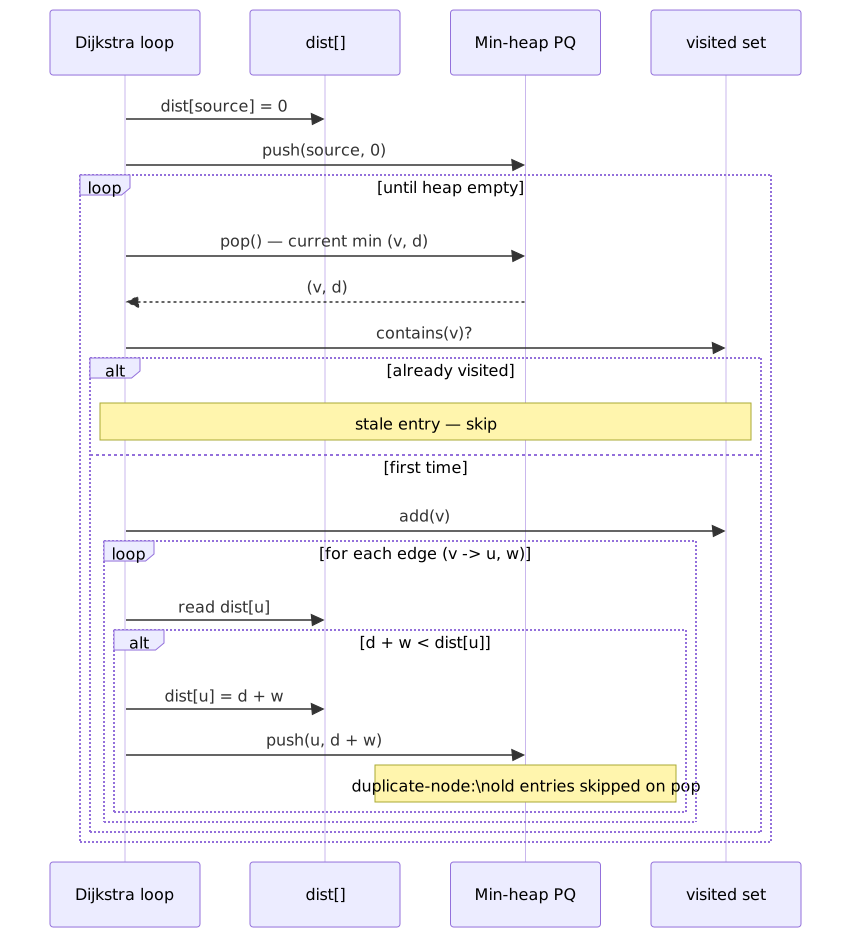
Complexity: O((V + E) log V) with binary heap. For dense graphs (E ≈ V²) this becomes O(V² log V); a Fibonacci heap improves it to O(E + V log V), but the constant-factor penalty is rarely worth it on real hardware11.
K-way Merge (External Sorting)
Merging k sorted streams using a heap of size k:
// Merge k sorted iterators into one sorted output// Used in external sorting, merge sort, database joinsinterface StreamEntry<T> { value: T streamIndex: number}function* kWayMerge<T>(streams: Iterator<T>[], compare: (a: T, b: T) => number): Generator<T> { const heap = new MinHeap<StreamEntry<T>>((a, b) => compare(a.value, b.value)) // Initialize heap with first element from each stream for (let i = 0; i < streams.length; i++) { const result = streams[i].next() if (!result.done) { heap.push({ value: result.value, streamIndex: i }) } } // Extract min and refill from same stream while (heap.size > 0) { const { value, streamIndex } = heap.pop()! yield value const next = streams[streamIndex].next() if (!next.done) { heap.push({ value: next.value, streamIndex }) } }}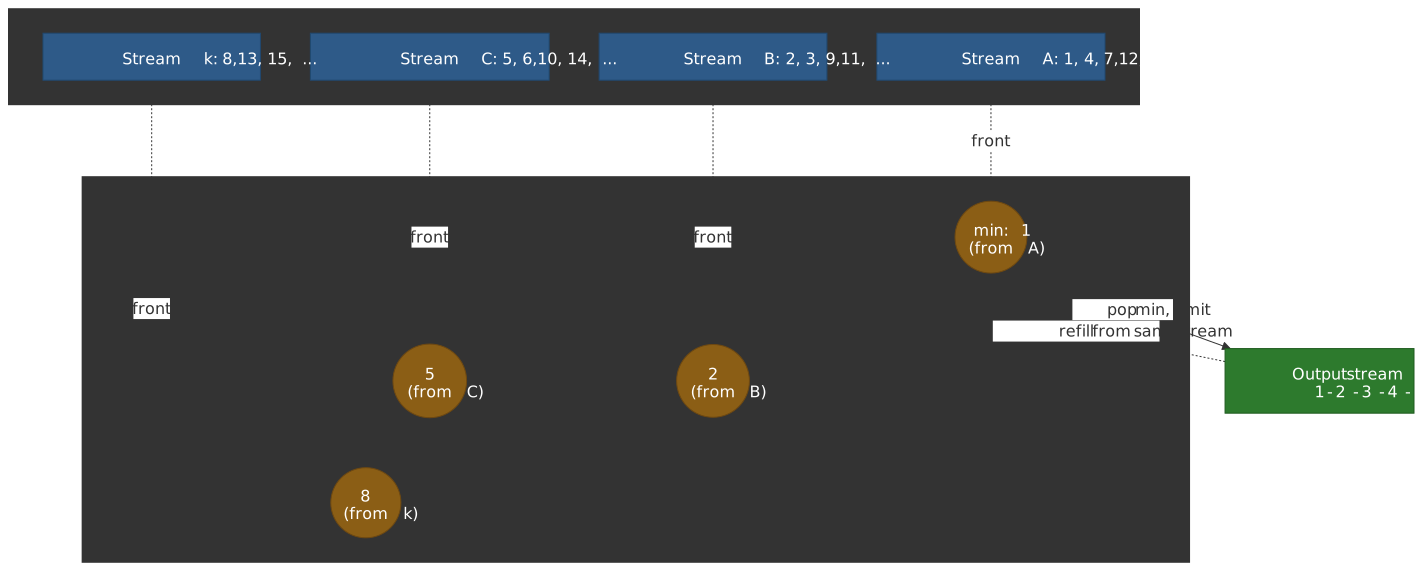
Complexity: O(n log k) where n is the total elements across all streams. Each of n elements enters and leaves the heap once at O(log k). This is the engine inside heapq.merge, external merge sort in databases, and the merge step of LSM-tree compaction. A loser-tree (tournament tree) variant cuts the per-pop comparison count from
Event-Driven Simulation / Task Scheduling
Priority queues order events by timestamp, enabling efficient simulation:
// Generic event-driven simulation frameworkinterface Event { timestamp: number execute: () => Event[] // Returns new events to schedule}class EventScheduler { private queue = new MinHeap<Event>((a, b) => a.timestamp - b.timestamp) private currentTime = 0 schedule(event: Event): void { if (event.timestamp < this.currentTime) { throw new Error("Cannot schedule event in the past") } this.queue.push(event) } run(until: number): void { while (this.queue.size > 0 && this.queue.peek()!.timestamp <= until) { const event = this.queue.pop()! this.currentTime = event.timestamp const newEvents = event.execute() for (const e of newEvents) { this.schedule(e) } } }}Finding K Largest/Smallest Elements
A min-heap of size k efficiently tracks the k largest elements in a stream:
// O(n log k) for n elements, O(k) spacefunction topK<T>(items: Iterable<T>, k: number, compare: (a: T, b: T) => number): T[] { const heap = new MinHeap<T>(compare) for (const item of items) { if (heap.size < k) { heap.push(item) } else if (compare(item, heap.peek()!) > 0) { heap.pop() heap.push(item) } } // Extract in sorted order const result: T[] = [] while (heap.size > 0) { result.push(heap.pop()!) } return result.reverse()}For the k largest, use a min-heap of size k and keep only elements larger than the current minimum. The heap always contains the k largest seen so far. This is exactly how heapq.nlargest and heapq.nsmallest work internally.
Edge Cases and Failure Modes
Empty Heap Operations
extractMin and peek on an empty heap should be handled gracefully:
// Return undefined rather than throwpeek(): T | undefined { return this.heap[0]; // undefined if empty}pop(): T | undefined { if (this.heap.length === 0) return undefined; // ... rest of implementation}Comparison Function Pitfalls
Incorrect comparisons cause subtle bugs:
// Common mistakes in comparison functions// WRONG: NaN comparisonconst badCompare = (a: number, b: number) => a - b// NaN - anything = NaN, which is neither < 0 nor >= 0// WRONG: Inconsistent orderingconst unstable = (a: Obj, b: Obj) => Math.random() - 0.5// Heap operations require transitive, antisymmetric comparison// CORRECT: Handle edge casesconst safeCompare = (a: number, b: number) => { if (Number.isNaN(a)) return 1 // Push NaN to bottom if (Number.isNaN(b)) return -1 return a - b}Heap Corruption from External Mutation
If stored objects are mutated, the heap property breaks:
// DO NOT mutate objects in a heap without re-heapifyinginterface Task { priority: number name: string}const heap = new MinHeap<Task>((a, b) => a.priority - b.priority)const task = { priority: 5, name: "important" }heap.push(task)// WRONG: This corrupts the heaptask.priority = 1 // Heap doesn't know about this change// CORRECT: Remove, update, re-insert// Or use immutable objects// Or implement decrease-key that maintains heap invariantCaution
A silent heap corruption surfaces as extractMin returning elements out of order, sometimes thousands of operations later. The original mutation site is long gone. If you cannot guarantee immutability, defensively re-heapify (O(n)) before any read-critical extraction.
Integer Overflow in Index Calculations
For very large heaps (>2³⁰ elements), 32-bit index arithmetic can overflow. In JavaScript, Number is double-precision so safe up to 2⁵³, but the bitwise shift trick (i - 1) >> 1 truncates to int32 — guard with Math.floor((i - 1) / 2) for heaps that could exceed 2³¹ entries.
// Use Math.floor for very large heaps; bitwise shift truncates to int32function leftChild(i: number): number { const result = 2 * i + 1 if (result < i) throw new Error("Index overflow") return result}In practice, heaps rarely exceed millions of elements — a 4-byte integer index handles up to ~2 billion entries.
Conclusion
Binary heaps provide the right balance of simplicity, performance, and generality for most priority-queue needs. The array representation eliminates pointer overhead and exploits cache locality. Understanding the O(n) buildHeap analysis and why heap sort underperforms quicksort despite better worst-case bounds illuminates the gap between theoretical and practical performance.
For graph algorithms, the duplicate-node strategy — insert new entries instead of decreaseKey — usually beats sophisticated heaps by avoiding position-tracking overhead. When the heap exceeds cache, consider a 4-ary heap for the cache-friendlier wider tree. Fibonacci heaps remain a textbook curiosity except for specialised applications on very large, dense graphs.
The priority-queue abstraction itself matters more than the heap variant. Standard libraries provide adequate implementations; optimise the data structure only after profiling proves it’s the bottleneck.
Appendix
Prerequisites
- Big O notation and amortized analysis.
- Basic tree terminology (height, complete, balanced).
- Array indexing and memory layout concepts.
Terminology
- Heap property — parent dominates children (min-heap: parent ≤ children, max-heap: parent ≥ children).
- Complete binary tree — all levels filled except possibly the last, which fills left-to-right.
- Bubble up (sift up) — move an element toward the root to restore the heap property.
- Bubble down (sift down, heapify) — move an element toward the leaves to restore the heap property.
- Decrease-key — update an element’s priority and restore the heap property; critical for graph algorithms.
- Amortized analysis — average cost per operation over a sequence, allowing expensive operations if rare.
- D-ary heap — generalisation where each node has d children instead of 2.
- Implicit data structure — structure encoded in array positions rather than explicit pointers.
Summary
- Binary heaps store complete trees in arrays; parent/child relationships come from index arithmetic.
- Insert bubbles up (O(log n)), extract bubbles down (O(log n)), peek is O(1).
buildHeapruns in O(n), not O(n log n) — most nodes are cheap to heapify.- Heap sort guarantees O(n log n) but loses to quicksort due to cache effects.
- 4-ary heaps run roughly 10-30% faster than binary heaps on out-of-cache workloads.
- Fibonacci heaps have better theoretical bounds but lose to pairing heaps and binary heaps in practice.
- For Dijkstra without explicit decrease-key, use the duplicate-node strategy with a binary heap.
- JavaScript lacks a built-in heap; Python’s
heapqis min-heap only; Go requires interface implementation; C++ ships max-heap algorithms; Java ships a min-heap class.
Footnotes
-
Binary heap — Wikipedia. Comprehensive overview of binary heap structure and array-index relationships. ↩ ↩2
-
CS 161 Lecture 4 — Stanford. The bottom-up
buildHeapO(n) proof from CLRS, with the convergingseries. ↩ ↩2 -
Fibonacci heap — Wikipedia. Detailed analysis of Fibonacci heap amortized bounds. ↩ ↩2
-
“What are the disadvantages of Fibonacci Heaps?” — CS Stack Exchange. Summary of constant-factor and cache penalties; cross-validates against the Larkin/Sen/Tarjan paper. ↩ ↩2
-
A. LaMarca and R. E. Ladner, “The Influence of Caches on the Performance of Heaps”, ACM Journal of Experimental Algorithmics, 1996. Foundational measurement of cache misses across heap fanouts; introduces aligned 4-heaps. ↩ ↩2 ↩3
-
d-ary heap — Wikipedia. Summary of cache-performance benefits and reported speedups for d > 2. ↩ ↩2 ↩3
-
Lib/heapq.py— CPython source. Comments at the top of the file describe the bottom-up_siftupoptimization and explicitly cite Knuth, TAOCP Vol. 3, §5.2.3. ↩ ↩2 -
A. LaMarca and R. E. Ladner, “The Influence of Caches on the Performance of Sorting”, Journal of Algorithms, 1999. Companion paper covering heap sort, merge sort, and quicksort cache behaviour. ↩
-
Heapsort — Wikipedia. Stability and cache-performance characteristics, plus links to bottom-up variants. ↩
-
P. Sanders, “Fast Priority Queues for Cached Memory”, ACM JEA, 1999. Shows aligned 4-ary and sequence heaps running >
faster than binary heaps in cache hierarchies. ↩ -
“Time Complexity of Dijkstra’s Algorithm” — Baeldung on CS. Side-by-side derivation of binary-heap and Fibonacci-heap variants; covers the duplicate-node strategy. ↩ ↩2 ↩3
-
J. T. Stasko and J. S. Vitter, “Pairing Heaps: Experiments and Analysis”, CACM, 1987. Earliest large experiment showing pairing heaps beat Fibonacci heaps in practice. ↩
-
D. H. Larkin, S. Sen, and R. E. Tarjan, “A Back-to-Basics Empirical Study of Priority Queues”, ALENEX 2014. Modern replication of pairing-vs-Fibonacci experiments. ↩
-
Pairing heap — Wikipedia. Survey of pairing-heap experiments, including Larkin-Sen-Tarjan. ↩
-
“15-210 Lecture 27 — Priority Queues and Leftist Heaps”, Carnegie Mellon. Proves the
work bound for leftist-heap meld. ↩ -
Brodal queue — Wikipedia. Summary of the worst-case bounds achieved by Brodal (1996) and Brodal–Okasaki (1996). ↩
-
G. S. Brodal, “Worst-case efficient priority queues”, SODA 1996. Original construction with worst-case
insert / find-min / meld / decrease-key. ↩ -
heapq— Heap queue algorithm — Python documentation. Documents min-heap-only behaviour, the(priority, count, task)tiebreaker pattern, and the lack of stability. ↩ -
“Why Are Golang Heaps So Complicated?” — DoltHub. Walkthrough of
container/heap’s pre-generics interface design. ↩ -
std::priority_queue— cppreference. Specifies the binary-heap algorithms (make_heap/push_heap/pop_heap) underneath the adaptor. ↩