Sorting Algorithms: Complexity, Stability, and Use Cases
A comprehensive guide to sorting algorithms covering fundamental concepts, implementation details, performance characteristics, and real-world applications. Learn when to use each algorithm and understand the engineering trade-offs behind production sorting implementations.
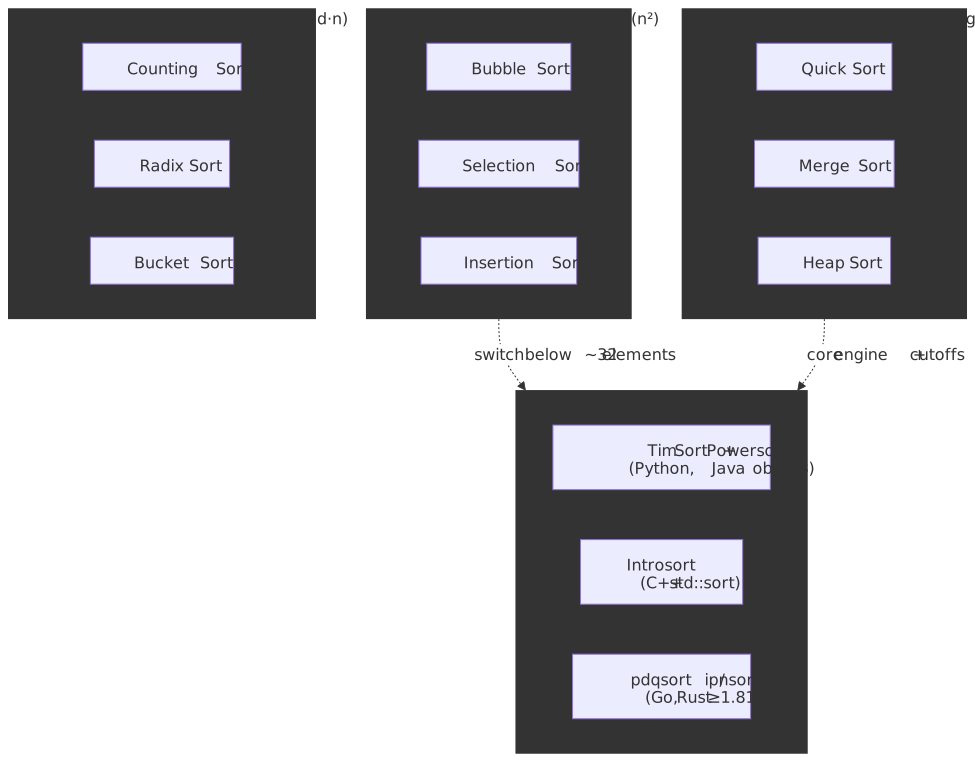
Abstract
Sorting algorithms exist on a spectrum defined by three fundamental constraints:
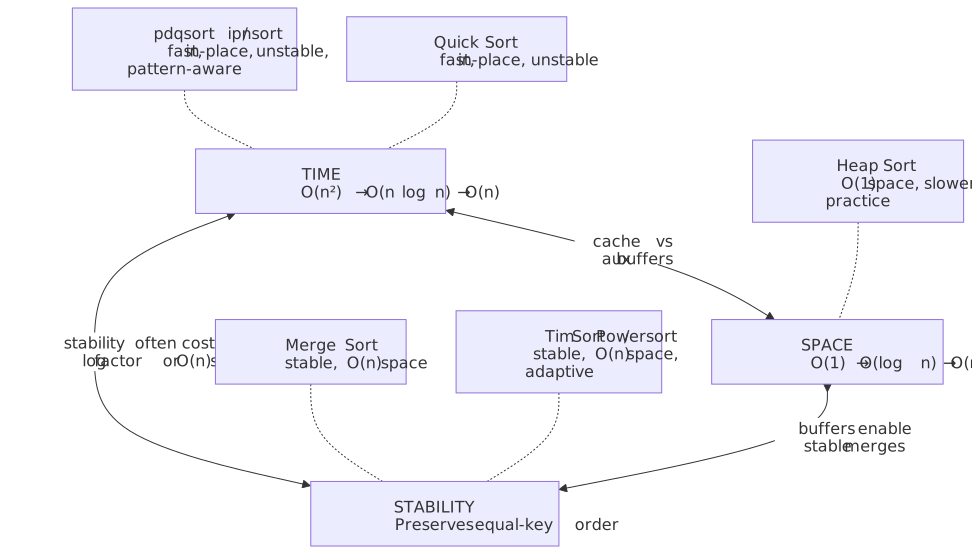
Core mental model:
- Comparison sorts (Quick Sort, Merge Sort, Heap Sort) are bounded by Ω(n log n)—a mathematical limit proven via decision trees. You cannot comparison-sort faster without exploiting input structure.
- Non-comparison sorts (Counting, Radix, Bucket) achieve O(n) by trading generality for constraints on input type (integers, fixed-width keys, uniform distribution).
- Production sorts (Tim Sort, Introsort, pdqsort) are hybrids that detect patterns and switch strategies—they exploit the gap between theoretical bounds and real-world data characteristics.
The practical insight: Cache locality and branch prediction often matter more than asymptotic complexity. Quick Sort’s 2-3× speedup over Heap Sort comes from sequential memory access, not Big-O.
Core Concepts
The Fundamental Trade-offs
-
Time vs Space: Merge Sort uses O(n) extra space for O(n log n) guaranteed time. Quick Sort uses O(log n) stack space but has O(n²) worst case. This trade-off exists because maintaining sorted subarrays during merge requires temporary storage.
-
Stability vs Performance: Stable sorts preserve relative order of equal elements—critical for multi-key sorting (sort by department, then by salary within department). Quick Sort sacrifices stability for in-place partitioning; Merge Sort maintains stability but needs auxiliary arrays.
-
Adaptivity: Some algorithms (Insertion Sort, Tim Sort) detect existing order and exploit it. Tim Sort achieves O(n) on already-sorted data by identifying “runs” of ordered elements. Non-adaptive algorithms (Heap Sort, standard Quick Sort) perform the same regardless of input order.
-
In-place vs Out-of-place: In-place algorithms modify the original array using O(1) or O(log n) extra space; out-of-place algorithms need O(n) auxiliary memory. The choice affects memory pressure in constrained environments.
The Ω(n log n) Comparison Sort Lower Bound
Comparison-based sorting cannot do better than Ω(n log n) in the worst case. This is a mathematical limit, not a practical limitation.
The decision tree argument: Any comparison-based algorithm can be modeled as a binary decision tree where each node represents a comparison. With n elements, there are n! possible permutations. The tree must have at least n! leaves (one per permutation). A binary tree of height h has at most 2^h leaves, so:
Using Stirling’s approximation:
Information-theoretic interpretation: Each comparison yields one bit of information. To distinguish among n! possibilities, you need at least log₂(n!) bits—roughly n log n comparisons.
Breaking the barrier: Non-comparison sorts (Counting, Radix, Bucket) achieve O(n) by exploiting input structure—they don’t compare elements, they examine digits or values directly. This requires constraints: bounded integer range, fixed-width keys, or uniform distribution.
Comparison-Based Sorting
Bubble Sort
Design rationale: Bubble Sort repeatedly swaps adjacent elements if they’re in wrong order. Largest elements “bubble up” to the end with each pass. The algorithm exists primarily for educational purposes—its simplicity makes it ideal for teaching sorting concepts, but its O(n²) time makes it impractical for production use.
function bubbleSort(arr: number[]): number[] { const n = arr.length for (let i = 0; i < n - 1; i++) { let swapped = false // Inner loop: compare adjacent pairs for (let j = 0; j < n - i - 1; j++) { if (arr[j] > arr[j + 1]) { ;[arr[j], arr[j + 1]] = [arr[j + 1], arr[j]] swapped = true } } if (!swapped) break // Optimization: early exit if sorted } return arr}| Property | Value |
|---|---|
| Time | O(n²) worst/avg, O(n) best (sorted) |
| Space | O(1) |
| Stable | Yes |
| In-place | Yes |
| Use case | Educational, detecting sorted arrays |
Why the swapped flag exists: Without it, Bubble Sort always runs O(n²) even on sorted input. The flag enables O(n) detection of already-sorted arrays—one of Bubble Sort’s few practical uses.
When to actually use it: Almost never in production. The only legitimate scenarios are: (1) teaching sorting fundamentals, (2) checking if an array is already sorted (though a simple linear scan is clearer), or (3) extremely memory-constrained embedded systems with n < 10 where code size matters more than performance.
Selection Sort
Design rationale: Selection Sort finds the minimum element and places it at the beginning, repeating for the remaining array. The key insight is that it performs exactly n-1 swaps regardless of input—making it optimal when write operations are expensive relative to comparisons.
function selectionSort(arr: number[]): number[] { const n = arr.length for (let i = 0; i < n - 1; i++) { let minIdx = i // Find minimum in unsorted portion for (let j = i + 1; j < n; j++) { if (arr[j] < arr[minIdx]) { minIdx = j } } // Single swap per iteration if (minIdx !== i) { ;[arr[i], arr[minIdx]] = [arr[minIdx], arr[i]] } } return arr}| Property | Value |
|---|---|
| Time | O(n²) always |
| Space | O(1) |
| Stable | No (swapping breaks stability) |
| In-place | Yes |
| Use case | Minimizing swaps (memory writes) |
Why it’s unstable: When swapping the minimum with the current position, equal elements can change relative order. For example, sorting [2a, 2b, 1] swaps 2a with 1, producing [1, 2b, 2a]—the two 2s reversed.
When to use it: Selection Sort earns its keep when each write is dramatically more expensive than each comparison. The textbook case is flash storage with bounded program/erase cycles — NAND blocks tolerate roughly 10³–10⁵ P/E cycles before wear-out, which is why wear-levelling is built into every modern flash translation layer (JEDEC JESD218). On general-purpose data structures the comparison-heavy variant Cycle Sort (which performs the theoretical minimum number of writes) is preferred over Selection Sort; in practice both are niche compared to choosing a write-friendly storage layout in the first place.
Insertion Sort
Design rationale: Insertion Sort builds a sorted array one element at a time, inserting each element into its correct position within the already-sorted prefix. Its power lies in adaptivity—it does O(k) work where k is the number of inversions (out-of-order pairs). For nearly-sorted data, k stays small relative to n, giving near-linear performance.
function insertionSort(arr: number[]): number[] { const n = arr.length for (let i = 1; i < n; i++) { const key = arr[i] let j = i - 1 // Shift elements right until correct position found while (j >= 0 && arr[j] > key) { arr[j + 1] = arr[j] j-- } arr[j + 1] = key } return arr}| Property | Value |
|---|---|
| Time | O(n²) worst/avg, O(n) best |
| Space | O(1) |
| Stable | Yes |
| In-place | Yes |
| Adaptive | Yes - O(n + k) where k = inversions |
| Use case | Small arrays, nearly sorted data, online |
Why hybrid sorts use Insertion Sort for small subarrays: For n < 20-50 elements, Insertion Sort’s low overhead (no recursion, no function calls, tight inner loop) beats Quick Sort and Merge Sort despite worse asymptotic complexity. The crossover point depends on hardware but typically falls in the 16-64 element range.
Online sorting: Insertion Sort processes elements as they arrive—each new element is inserted into the sorted portion in O(n) worst case. This makes it suitable for real-time systems where data streams continuously and you need a sorted view at any moment.
Cache behavior: The inner loop shifts elements sequentially through memory, maximizing L1 cache hits. Combined with branch predictability (the while condition becomes consistent after a few iterations), this makes Insertion Sort remarkably fast on small arrays.
Merge Sort
Design rationale: Merge Sort uses divide-and-conquer: split the array in half, recursively sort each half, then merge the sorted halves. The key insight is that merging two sorted arrays takes O(n) time with O(n) auxiliary space in the classic two-buffer formulation. The teaching implementation below uses slice() for readability, which allocates additional arrays beyond that textbook baseline.
function mergeSort(arr: number[]): number[] { if (arr.length <= 1) return arr const mid = Math.floor(arr.length / 2) const left = mergeSort(arr.slice(0, mid)) const right = mergeSort(arr.slice(mid)) return merge(left, right)}function merge(left: number[], right: number[]): number[] { const result: number[] = [] let i = 0, j = 0 // Key: use <= for stability (equal elements from left come first) while (i < left.length && j < right.length) { if (left[i] <= right[j]) { result.push(left[i++]) } else { result.push(right[j++]) } } return result.concat(left.slice(i)).concat(right.slice(j))}| Property | Value |
|---|---|
| Time | O(n log n) always |
| Space | O(n) |
| Stable | Yes |
| In-place | No |
| Parallelizable | Yes - independent subproblems |
| Use case | Linked lists, external sorting, stability needed |
Why O(n) space is unavoidable for array-based stable sorting: To maintain stability while merging, you must preserve the relative order of equal elements. This requires comparing elements from both halves without modifying either until the comparison is complete—necessitating auxiliary storage.
Linked list optimization: For linked lists, merge requires only O(1) extra space—you just rewire node pointers rather than copying elements. This makes Merge Sort optimal for linked list sorting.
External sorting: When data exceeds RAM, Merge Sort’s sequential access pattern (read chunks, sort in memory, write sorted chunks, k-way merge) minimizes disk seeks. Database systems (PostgreSQL, MySQL) use merge-based algorithms for large result sets.
Bottom-up variant: Iterative Merge Sort avoids recursion overhead by starting with size-1 subarrays and doubling the merge size each pass. Same O(n log n) time, but eliminates O(log n) stack frames.
Quick Sort
Design rationale: Quick Sort picks a pivot element, partitions the array so smaller elements are left of the pivot and larger elements are right, then recursively sorts the partitions. Its power comes from in-place partitioning with excellent cache locality—sequential memory access during partition makes it 2-3× faster than Heap Sort in practice despite similar Big-O.
function quickSort(arr: number[], low: number = 0, high: number = arr.length - 1): number[] { if (low < high) { const pivotIdx = partition(arr, low, high) quickSort(arr, low, pivotIdx - 1) quickSort(arr, pivotIdx + 1, high) } return arr}// Lomuto partition scheme - simpler but ~3× more swaps than Hoarefunction partition(arr: number[], low: number, high: number): number { const pivot = arr[high] let i = low - 1 for (let j = low; j < high; j++) { if (arr[j] < pivot) { i++ ;[arr[i], arr[j]] = [arr[j], arr[i]] } } ;[arr[i + 1], arr[high]] = [arr[high], arr[i + 1]] return i + 1}| Property | Value |
|---|---|
| Time | O(n log n) avg, O(n²) worst |
| Space | O(log n) stack space |
| Stable | No |
| In-place | Yes |
| Use case | General purpose, cache-friendly |
Pivot selection strategies and their trade-offs:
| Strategy | Worst-case trigger | Overhead | Use when |
|---|---|---|---|
| First/Last | Sorted or reverse-sorted input | O(1) | Only as a fallback inside a smarter scheme (e.g. inside median-of-three) |
| Random | Vanishingly unlikely on any single input | O(1) + RNG | Reasonable default; what rand_pivot schemes assume |
| Median-of-three | Adversaries that target the three sampled positions | O(1) | Common production default (e.g. classic qsort) |
| Ninther / median-of-medians-of-three | Adversaries that target nine sampled positions | O(1) | Used by pdqsort and Bentley-McIlroy “engineering a sort function” |
| True median-of-medians | None — guaranteed O(n log n) | O(n) | Hard real-time and provably-bounded systems only — too slow for general use |
3-Way Partition (Dutch National Flag Problem): Essential for arrays with many duplicates. Standard 2-way partition degrades to O(n²) when all elements are equal; 3-way partition handles this in O(n) by grouping equal elements in the middle.
function quickSort3Way(arr: number[], low: number, high: number): void { if (low >= high) return let lt = low // arr[low..lt-1] < pivot let gt = high // arr[gt+1..high] > pivot let i = low + 1 const pivot = arr[low] // Partition into: <pivot | ==pivot | >pivot while (i <= gt) { if (arr[i] < pivot) { ;[arr[lt], arr[i]] = [arr[i], arr[lt]] lt++ i++ } else if (arr[i] > pivot) { ;[arr[i], arr[gt]] = [arr[gt], arr[i]] gt-- } else { i++ } } quickSort3Way(arr, low, lt - 1) quickSort3Way(arr, gt + 1, high)}Why Quick Sort variants dominate unstable sorting: C++‘s std::sort (Introsort), Go’s sort.Sort (pdqsort since Go 1.19), and Rust’s sort_unstable (pdqsort 2017–2024, ipnsort from Rust 1.81 onward) all derive from the Quick Sort family. The combination of in-place partitioning, cache-friendly sequential access, and predictable branch behaviour makes them roughly 2–3× faster than non-Quick-Sort alternatives on random data (Sedgewick & Wayne).
Heap Sort
Design rationale: Heap Sort builds a max-heap from the array, then repeatedly extracts the maximum to build the sorted array from the end. It’s the only comparison sort that’s both in-place (O(1) space) and guaranteed O(n log n)—no pathological inputs exist. The trade-off is poor cache locality: parent-child relationships (i, 2i+1, 2i+2) cause random memory access patterns.
function heapSort(arr: number[]): number[] { const n = arr.length // Build max-heap bottom-up in O(n) time for (let i = Math.floor(n / 2) - 1; i >= 0; i--) { heapify(arr, n, i) } // Extract max n times: O(n log n) for (let i = n - 1; i > 0; i--) { ;[arr[0], arr[i]] = [arr[i], arr[0]] heapify(arr, i, 0) } return arr}function heapify(arr: number[], n: number, i: number): void { let largest = i const left = 2 * i + 1 const right = 2 * i + 2 if (left < n && arr[left] > arr[largest]) largest = left if (right < n && arr[right] > arr[largest]) largest = right if (largest !== i) { ;[arr[i], arr[largest]] = [arr[largest], arr[i]] heapify(arr, n, largest) }}| Property | Value |
|---|---|
| Time | O(n log n) always |
| Space | O(1) |
| Stable | No |
| In-place | Yes |
| Cache-friendly | No - random access pattern |
| Use case | Guaranteed O(n log n) in-place |
Why build-heap is O(n), not O(n log n): Intuition suggests n insertions at O(log n) each = O(n log n). But bottom-up heapify does less work: most nodes are near the bottom (height 0-1), few are at the top. Summing the work:
Why Heap Sort loses to Quick Sort in practice: The parent-child index relationships (i → 2i+1, 2i+2) cause cache misses. For a 10M element array, parent and children are ~5M indices apart—far beyond any cache line. Branch prediction also suffers: the comparison arr[left] > arr[largest] vs arr[right] > arr[largest] is essentially random.
When to use Heap Sort: (1) Real-time systems where O(n²) worst-case is unacceptable and you can’t afford O(n) auxiliary space. (2) Partial sorting—finding top-k elements in O(n + k log n). (3) Priority queue operations where you need repeated extract-min/max.
Non-Comparison Sorting
Non-comparison sorts break the Ω(n log n) barrier by examining element values directly rather than comparing pairs. The trade-off: they require constraints on input type (integers, fixed-width keys, uniform distribution).
Counting Sort
Design rationale: Counting Sort counts occurrences of each distinct value, then uses cumulative counts to place elements in their final positions. It achieves O(n + k) time where k is the value range—faster than comparison sorts when k = O(n). The trade-off is O(k) space for the count array, making it impractical when k >> n.
function countingSort(arr: number[]): number[] { if (arr.length === 0) return arr const max = Math.max(...arr) const min = Math.min(...arr) const range = max - min + 1 const count = new Array(range).fill(0) const output = new Array(arr.length) // Phase 1: Count occurrences - O(n) for (const num of arr) { count[num - min]++ } // Phase 2: Cumulative counts give final positions - O(k) for (let i = 1; i < range; i++) { count[i] += count[i - 1] } // Phase 3: Build output (backwards for stability) - O(n) for (let i = arr.length - 1; i >= 0; i--) { output[count[arr[i] - min] - 1] = arr[i] count[arr[i] - min]-- } return output}| Property | Value |
|---|---|
| Time | O(n + k) where k is range |
| Space | O(n + k) |
| Stable | Yes (if implemented correctly) |
| Use case | Small range of integers |
Why iterate backwards for stability: When placing elements, going backwards ensures that among equal values, the last one encountered (rightmost in original) goes to the highest index position. This preserves relative order.
When k makes sense: Counting Sort is optimal when k ≤ n. For exam scores (0-100) with 1000 students: O(1100) beats O(1000 × 10). For 32-bit integers (k = 4 billion): use Radix Sort instead.
Real-world applications: Image processing (8-bit pixels, k=256), grading systems (0-100), character frequency counting (k=26 for lowercase English), histogram generation.
Radix Sort
Design rationale: Radix Sort processes elements digit-by-digit, using a stable sort (typically Counting Sort) as a subroutine. LSD (Least Significant Digit) Radix Sort processes from rightmost digit to leftmost; stability ensures earlier digits remain sorted when processing later digits. Time is O(d × (n + k)) where d is digit count and k is the radix (base)—effectively O(n) when d is constant.
function radixSort(arr: number[]): number[] { if (arr.length === 0) return arr const max = Math.max(...arr) // LSD: sort by each digit position, least significant first for (let exp = 1; Math.floor(max / exp) > 0; exp *= 10) { countingSortByDigit(arr, exp) } return arr}function countingSortByDigit(arr: number[], exp: number): void { const n = arr.length const output = new Array(n) const count = new Array(10).fill(0) for (const num of arr) { const digit = Math.floor(num / exp) % 10 count[digit]++ } for (let i = 1; i < 10; i++) { count[i] += count[i - 1] } for (let i = n - 1; i >= 0; i--) { const digit = Math.floor(arr[i] / exp) % 10 output[count[digit] - 1] = arr[i] count[digit]-- } for (let i = 0; i < n; i++) { arr[i] = output[i] }}| Property | Value |
|---|---|
| Time | O(d × (n + k)) where d = digits |
| Space | O(n + k) |
| Stable | Yes |
| Use case | Fixed-length integers, strings |
LSD vs MSD (Most Significant Digit):
| Variant | Process Order | Stability Required | Best For |
|---|---|---|---|
| LSD | Right → Left | Yes (critical) | Fixed-width integers |
| MSD | Left → Right | Not required | Variable-length strings, early termination |
Why LSD needs stability: After sorting by units digit, [170, 45, 75, 90] becomes [170, 90, 45, 75]. When sorting by tens digit, 170 and 75 both have tens digit 7. Stability ensures 170 stays before 75 (preserving the units-digit order).
Choosing the radix: Base 10 is intuitive but not optimal. Base 256 (byte-based) reduces passes for 32-bit integers from 10 to 4, at the cost of larger count arrays. For 64-bit integers, 8 passes with base 256 is typically faster than 20 passes with base 10.
Real-world applications: IP address sorting (4 passes, base 256), suffix array construction in bioinformatics (DNA alphabet k=4), timestamp sorting (8 passes for 64-bit Unix timestamps).
Bucket Sort
Design rationale: Bucket Sort distributes elements into buckets based on their value, sorts each bucket (typically with Insertion Sort), then concatenates results. It achieves O(n) expected time when elements are uniformly distributed—each bucket contains O(1) elements on average, making per-bucket sorting O(1). The trade-off: skewed distributions degrade to O(n²) when many elements land in one bucket.
function bucketSort(arr: number[], bucketCount: number = 10): number[] { if (arr.length === 0) return arr const min = Math.min(...arr) const max = Math.max(...arr) const bucketSize = (max - min) / bucketCount + 1 const buckets: number[][] = Array.from({ length: bucketCount }, () => []) // Distribute: O(n) for (const num of arr) { const idx = Math.floor((num - min) / bucketSize) buckets[Math.min(idx, bucketCount - 1)].push(num) } // Sort + concatenate: O(n) expected if uniform return buckets.flatMap((bucket) => insertionSort(bucket))}| Property | Value |
|---|---|
| Time | O(n) expected, O(n²) worst |
| Space | O(n + k) where k = bucket count |
| Stable | Depends on bucket sorting algorithm |
| Use case | Uniformly distributed floating point |
Why uniform distribution matters: With n elements and n buckets, uniform distribution means each bucket gets ~1 element (expected). Insertion Sort on 1-element arrays is O(1). Total: O(n) distribution + O(n × 1) sorting = O(n). Skewed distribution (all elements in one bucket) degrades to O(n²) Insertion Sort.
Choosing bucket count: Too few buckets → many elements per bucket → slower sorting. Too many buckets → wasted space + overhead. Rule of thumb: use n buckets for n elements when distribution is uniform.
Stability: Bucket Sort is stable if the per-bucket sort is stable and elements are placed in buckets in order. Using stable Insertion Sort and processing buckets left-to-right preserves stability.
Real-world applications: Sorting uniformly distributed floats in [0,1) (graphics, random samples), sensor data with known ranges, geographic coordinates within bounded regions.
Algorithm Comparison
Quick Reference Table
| Algorithm | Best | Average | Worst | Space | Stable | Adaptive |
|---|---|---|---|---|---|---|
| Bubble Sort | O(n) | O(n²) | O(n²) | O(1) | Yes | Yes |
| Selection Sort | O(n²) | O(n²) | O(n²) | O(1) | No | No |
| Insertion Sort | O(n) | O(n²) | O(n²) | O(1) | Yes | Yes |
| Merge Sort | O(n log n) | O(n log n) | O(n log n) | O(n) | Yes | No |
| Quick Sort | O(n log n) | O(n log n) | O(n²) | O(log n) | No | No |
| Heap Sort | O(n log n) | O(n log n) | O(n log n) | O(1) | No | No |
| Counting Sort | O(n + k) | O(n + k) | O(n + k) | O(n + k) | Yes | N/A |
| Radix Sort | O(dn) | O(dn) | O(dn) | O(n + k) | Yes | N/A |
| Bucket Sort | O(n) | O(n) | O(n²) | O(n + k) | Yes* | N/A |
*Bucket Sort stability depends on the per-bucket sorting algorithm used.
Decision Flowchart
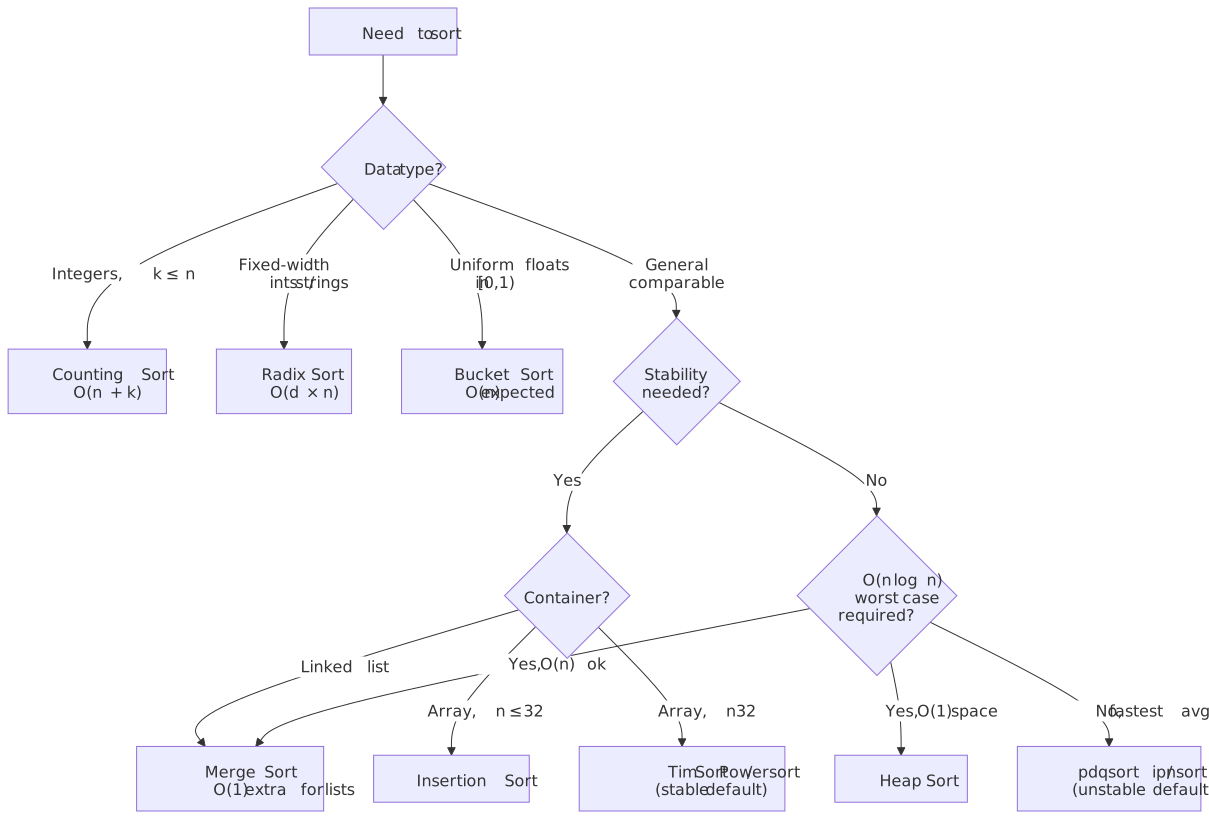
Why Quick Sort Beats Heap Sort in Practice
Both Quick Sort and Heap Sort are in-place, unstable, O(n log n) average-case algorithms. On paper, Heap Sort looks better with its O(n log n) guaranteed worst case. Yet Quick Sort is the preferred choice in most standard libraries. Here’s why:
1. Cache Locality
Quick Sort wins decisively here.
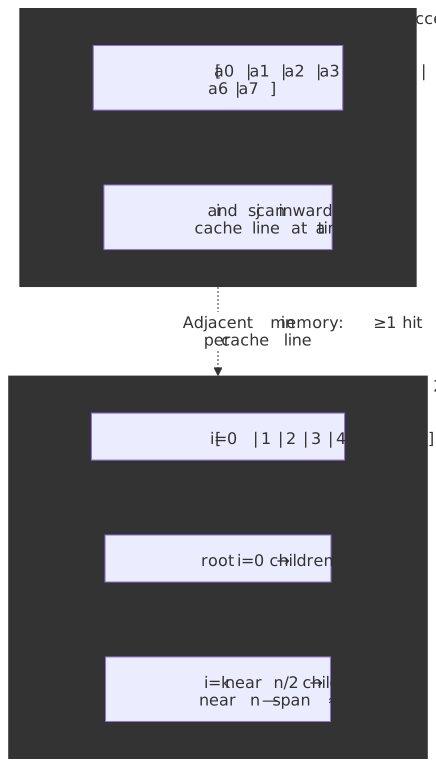
- Quick Sort: The partition step scans the array sequentially. Adjacent elements are accessed together, maximizing L1/L2 cache hits.
- Heap Sort: Heapify jumps between index
iand indices2i+1,2i+2. For large arrays, parent and children are far apart in memory, causing frequent cache misses.
Real impact: On modern CPUs, a cache miss costs 100-300 cycles (Intel Optimization Manual). Quick Sort’s sequential access pattern can be 2-3x faster than Heap Sort for large arrays purely due to cache behavior.
2. Lower Constant Factors
Quick Sort does less work per element (Sedgewick & Wayne, Algorithms 4th Ed):
| Operation | Quick Sort | Heap Sort |
|---|---|---|
| Comparisons | ~1.4n log n | ~2n log n |
| Swaps | ~0.3n log n | ~n log n |
| Pointer arithmetic | Simple (i++, j—) | Complex (2i+1, 2i+2) |
// Quick Sort partition - simple operationswhile (arr[i] < pivot) i++ // Simple incrementwhile (arr[j] > pivot) j-- // Simple decrement// Heap Sort heapify - more complexleft = 2 * i + 1 // Multiplication + additionright = 2 * i + 2 // Multiplication + additionif (left < n && arr[left] > arr[largest]) ...if (right < n && arr[right] > arr[largest]) ...3. Branch Prediction
Modern CPUs predict which way branches (if statements) will go. Mispredictions are costly (~15-20 cycles).
Quick Sort: After a few iterations, the CPU learns the pattern. Elements mostly go one way based on their relation to the pivot.
Heap Sort: The comparison arr[left] > arr[largest] vs arr[right] > arr[largest] is essentially random — the CPU can’t predict which child is larger, causing frequent mispredictions.
Note
Branch-prediction hit rates are workload- and CPU-dependent. The often-quoted heuristic — partition predicts well (≈90 %+) and heapify predicts poorly (close to a coin flip) — is consistent with the published BlockQuicksort and pdqsort analyses, which were motivated specifically by recovering predictability inside partition. Treat it as direction, not a measurement.
4. Practical Worst Case is Avoidable
Quick Sort’s O(n²) worst case sounds scary, but it’s easily prevented:
// Randomized pivot - O(n²) becomes astronomically unlikelyfunction partition(arr: number[], low: number, high: number): number { // Random pivot selection const randomIdx = low + Math.floor(Math.random() * (high - low + 1)) ;[arr[randomIdx], arr[high]] = [arr[high], arr[randomIdx]] // ... rest of partition}Probability intuition:
- For O(n²) to occur, you need a long run of pivots that consistently land near the smallest or largest element, producing maximally-unbalanced partitions.
- With a uniformly-random pivot the expected comparison count is ~1.39 n log₂ n (Sedgewick 1977), and concentration bounds make the bad-case probability shrink super-polynomially in n. The exact tail depends on the pivot scheme and is best reasoned about qualitatively rather than from a hand-wavy
1/n!argument.
Median-of-three is another practical defense:
// Pick median of first, middle, lastconst mid = Math.floor((low + high) / 2)if (arr[low] > arr[mid]) swap(arr, low, mid)if (arr[low] > arr[high]) swap(arr, low, high)if (arr[mid] > arr[high]) swap(arr, mid, high)// Use arr[mid] as pivot5. Space Complexity: O(1) vs O(log n) is Negligible
Theoretically, Heap Sort uses O(1) space while Quick Sort uses O(log n) for the recursion stack. In practice, this difference is meaningless:
| Array Size | Quick Sort Stack Space | Actual Memory |
|---|---|---|
| 1,000 | log₂(1000) ≈ 10 frames | ~200 bytes |
| 1,000,000 | log₂(10⁶) ≈ 20 frames | ~400 bytes |
| 10,000,000 | log₂(10⁷) ≈ 24 frames | ~480 bytes |
| 1,000,000,000 | log₂(10⁹) ≈ 30 frames | ~600 bytes |
Key insight: Even for a billion elements, Quick Sort uses only ~600 bytes of stack space. When you’re sorting gigabytes of data, 600 bytes is nothing.
For comparison, the array itself for 10 million 64-bit integers takes 80 MB. The 400 bytes of stack space is 0.0005% of that.
6. Benchmark Reality
Typical benchmarks on 10,000,000 random 64-bit integers show Quick Sort roughly 2-3× faster than Heap Sort. Concrete numbers below are illustrative — exact timings depend heavily on the hardware, allocator, and the specific implementation, but the ranking is consistent across published benchmarks (Sedgewick & Wayne, pdqsort paper).
| Algorithm | Time (illustrative) | Ratio vs Quick Sort |
|---|---|---|
| Quick Sort | ~800 ms | 1.0× |
| Merge Sort | ~1200 ms | 1.5× |
| Heap Sort | ~2000 ms | 2.5× |
When to Actually Use Heap Sort
Despite Quick Sort’s advantages, Heap Sort has its place:
- Hard real-time systems: When O(n²) worst case is absolutely unacceptable and you can’t use extra space for Merge Sort
- Embedded systems: When stack space is truly constrained (unusual today)
- Security-critical code: When adversarial input could trigger Quick Sort’s worst case (though randomized pivot largely solves this)
- Partial sorting: Finding top-k elements with a heap is O(n log k)
Summary: Quick Sort vs Heap Sort
| Factor | Quick Sort | Heap Sort | Winner |
|---|---|---|---|
| Cache locality | Sequential access | Random jumps | Quick Sort |
| Comparisons | ~1.4n log n | ~2n log n | Quick Sort |
| Swaps | ~0.3n log n | ~n log n | Quick Sort |
| Branch prediction | Predictable | Random | Quick Sort |
| Worst case | O(n²) (avoidable) | O(n log n) | Heap Sort |
| Space | O(log n) | O(1) | Tie* |
| Practical speed | Fast | 2-3x slower | Quick Sort |
*The space difference is negligible in practice
Bottom line: Use Quick Sort (with randomized pivot) as your default. The theoretical worst case is a non-issue in practice, and the real-world performance gains from cache efficiency and lower constant factors are substantial.
Production Hybrid Algorithms
Modern language runtimes don’t use any single algorithm—they combine multiple approaches to exploit each algorithm’s strengths while avoiding its weaknesses.
Tim Sort (Python, Java Objects, JavaScript)
Tim Sort, developed by Tim Peters for Python in 2002 (listsort.txt), combines Merge Sort and Insertion Sort. It exploits a key observation: real-world data often contains pre-existing order (“runs”).
How it works:
- Scan the array for natural runs (already-sorted sequences, including descending runs which are reversed in place).
- Ensure a minimum run length (
minrun, typically 32–64) by extending short runs with Binary Insertion Sort. - Push runs onto a stack; whenever the stack invariant is violated, merge adjacent runs using an optimised merge that switches into “galloping mode” when one run dominates.
Why it’s effective: On random data, Tim Sort performs like Merge Sort. On partially-sorted data (common in practice — appending to sorted lists, nearly-sorted databases), it approaches O(n) because natural runs require minimal merging.
Note
Since Python 3.11 the merge policy is no longer Tim Peters’ original “stack invariant” heuristic — CPython adopted Powersort1 (Munro & Wild, 2018), a near-optimal merge-ordering policy that fixes Timsort’s known stack-depth blind spots while preserving the run-detection and galloping merge. Run detection, minrun, and the merging primitives are still the Timsort ones; only which runs to merge next changed.
Introsort (C++ STL)
Introsort (introspective sort), invented by David Musser in 1997, starts with Quick Sort but monitors recursion depth. If depth exceeds 2 × log₂(n), it switches to Heap Sort to guarantee O(n log n) worst case. For small subarrays (typically n < 16), it uses Insertion Sort.
Design insight: Introsort gets Quick Sort’s average-case speed (cache locality, low constant factors) with Heap Sort’s worst-case guarantee—the best of both worlds.
Pattern-Defeating Quicksort (pdqsort) (Go, Rust unstable until 1.81)
pdqsort, created by Orson Peters, extends Introsort with pattern detection. It recognises sorted, reverse-sorted, and equal-element sequences, handling them in O(n) time. It also uses BlockQuicksort’s branchless partitioning to keep branch prediction healthy on random data.
Adoption:
- Go switched the
sortpackage to pdqsort in Go 1.19, and the genericslices.Sort(also pdqsort-based) shipped in Go 1.21. On patterned data Peters’ paper reports speedups in the order of 2–60× over a traditionalstd::sort-style introsort, depending on the pattern. - Rust:
sort_unstablewas based on pdqsort from RFC 1884 (2017) until Rust 1.81 (Sept 2024) replaced it with ipnsort (unstable) and replaced the Timsort-derivedsortwith driftsort (stable). Both new implementations were designed by Lukas Bergdoll and explicitly chosen for better behaviour on partially-sorted inputs and short types.
Language Standard Library Implementations
| Language | Stable sort | Unstable sort | Notes |
|---|---|---|---|
| JavaScript | Tim Sort (V8 ≥ 7.0) | — | Stability mandated by ES2019 (V8 blog, MDN Array.prototype.sort) |
| Python | Tim Sort + Powersort merge | — | list.sort() / sorted(). Powersort merge policy adopted in CPython 3.11; runs and galloping inherited from Timsort |
| Java | Tim Sort (Object[]) |
Dual-Pivot Quicksort (primitives) | Yaroslavskiy/Bentley/Bloch DPQS for primitives since JDK 7; Tim Sort for Object[] |
| C++ | Merge Sort (std::stable_sort) |
Introsort (std::sort) |
LLVM’s libc++ adopted BlockQuicksort partitioning inside std::sort for arithmetic types in 2022 to recover branch-prediction performance |
| Go | sort.Stable (block-merge) |
pdqsort | pdqsort in Go 1.19; generic slices.Sort in Go 1.21 |
| Rust | driftsort (1.81+) | ipnsort (1.81+) | Replaced Timsort-derived sort and pdqsort-based sort_unstable in Rust 1.81 (Sept 2024) |
Key insight: Every production implementation is a hybrid. The choice reflects trade-offs: stability (Tim Sort for objects), raw speed (pdqsort for unstable), or guaranteed worst-case (Introsort).
Parallel Sorting
For multi-core systems, parallelization can significantly reduce wall-clock time:
- Merge Sort: Natural parallelism—each recursive subproblem is independent. Split work across cores, then merge results.
- Quick Sort: Parallelize left and right partitions after each pivot selection. Less balanced than Merge Sort due to pivot variance.
- Sample Sort: Extension of Quick Sort for distributed systems. Sample elements to choose good splitters, distribute to processors, sort locally, merge.
- Bitonic Sort: O(n log² n) comparisons but highly parallel (O(log² n) parallel steps). Used in GPU sorting where massive parallelism compensates for extra work.
Conclusion
Sorting algorithm selection depends on three factors: data characteristics, system constraints, and requirements.
For general-purpose sorting on comparable data, use your language’s default—modern implementations (Tim Sort, Introsort, pdqsort) are highly optimized hybrids. For integers with bounded range, Counting Sort or Radix Sort achieve O(n). For stability, Merge Sort or Tim Sort. For guaranteed O(n log n) in O(1) space, Heap Sort.
The Ω(n log n) lower bound for comparison sorts is mathematical—you cannot do better without exploiting input structure. Non-comparison sorts (Counting, Radix, Bucket) trade generality for speed by examining values directly.
In practice, cache locality and branch prediction often matter more than asymptotic complexity. Quick Sort’s 2-3× advantage over Heap Sort comes from sequential memory access, not Big-O. Profile before optimizing.
Appendix
Prerequisites
- Big-O notation and complexity analysis
- Basic data structures (arrays, linked lists, heaps)
- Understanding of recursion and divide-and-conquer strategies
Terminology
- Stable sort: A sort that preserves the relative order of elements with equal keys
- In-place sort: A sort that uses O(1) or O(log n) auxiliary space (not counting the input array)
- Adaptive sort: A sort whose performance improves when input is partially sorted
- Comparison sort: A sort that only examines elements through pairwise comparisons
- Non-comparison sort: A sort that examines element values directly (digits, ranges)
- Inversion: A pair of elements (i, j) where i < j but arr[i] > arr[j]
- Run: A maximal sequence of consecutive elements that is already sorted
Summary
- Comparison sorts are bounded by Ω(n log n)—proven via decision tree argument
- Quick Sort dominates general-purpose sorting due to cache locality and low constants, despite O(n²) worst case
- Merge Sort is preferred when stability or guaranteed O(n log n) is required
- Heap Sort is the only comparison sort that’s both in-place and guaranteed O(n log n)
- Non-comparison sorts (Counting, Radix, Bucket) achieve O(n) with input constraints
- Production sorts (Tim Sort, Introsort, pdqsort) are hybrids that detect patterns and switch strategies
References
Specifications and Foundational Texts:
- Introduction to Algorithms (CLRS), 4th Edition - Chapter 8.1: Comparison sort lower bound proofs; Chapter 7: Quicksort; Chapter 6: Heapsort
- Algorithms, 4th Edition (Sedgewick & Wayne) - Chapters 2.1-2.4: Sorting implementations with empirical analysis
- The Art of Computer Programming, Vol. 3: Sorting and Searching - Knuth’s definitive reference
Algorithm Papers and Design Documents:
- Pattern-defeating Quicksort (pdqsort) — Orson Peters’ algorithm combining Quick Sort, Heap Sort, and pattern detection
- BlockQuicksort: How Branch Mispredictions don’t affect Quicksort (Edelkamp & Weiß, 2016) — branchless partitioning used inside pdqsort
- Nearly-Optimal Mergesorts: Powersort and Peeksort (Munro & Wild, 2018) — the merge policy CPython 3.11 adopted
- Introsort (Wikipedia) — David Musser’s 1997 introspective sort combining Quick Sort and Heap Sort
- Timsort (Wikipedia) and
Objects/listsort.txt— Tim Peters’ 2002 hybrid Merge Sort + Insertion Sort with the original design notes - Engineering a Sort Function (Bentley & McIlroy, 1993) — origin of the median-of-three / ninther / 3-way-partition tooling that production sorts inherit
Implementation References:
- V8: Stable
Array.prototype.sort— ECMAScript 2019 stability mandate - V8: Getting things sorted — V8 7.0 / Chrome 70 Tim Sort implementation
- CPython 3.11 release notes — Powersort merge policy adoption
- Go 1.19 release notes and Go 1.21
slicespackage — pdqsort adoption timeline - pdqsort reference implementation
- Rust 1.81 release notes and Voultapher/sort-research-rs
driftsortwrite-up — driftsort + ipnsort replacing Timsort + pdqsort - LLVM libc++
std::sortchange to BlockQuicksort + pdqsort — modern C++ unstable sort pipeline
Performance Analysis:
- Intel 64 and IA-32 Architectures Optimization Reference Manual — CPU cache behaviour, memory latency, branch prediction
- JEDEC JESD218 — SSD endurance and write-cycle limits — context for “write-minimising” sorts on flash storage