OWASP Top 10: Web Application Security Risks
The OWASP Top 10 is a ranked list of the most critical web application security risks, derived from real-world vulnerability data. The 2025 edition — the eighth installment of the project — drew on data contributed for over 2.8 million applications, analyzed 589 distinct CWEs in the source dataset, and finalized 248 CWEs distributed across the 10 published categories, with a hard cap of 40 CWEs per category. The result is the de-facto industry baseline for application security priorities.1
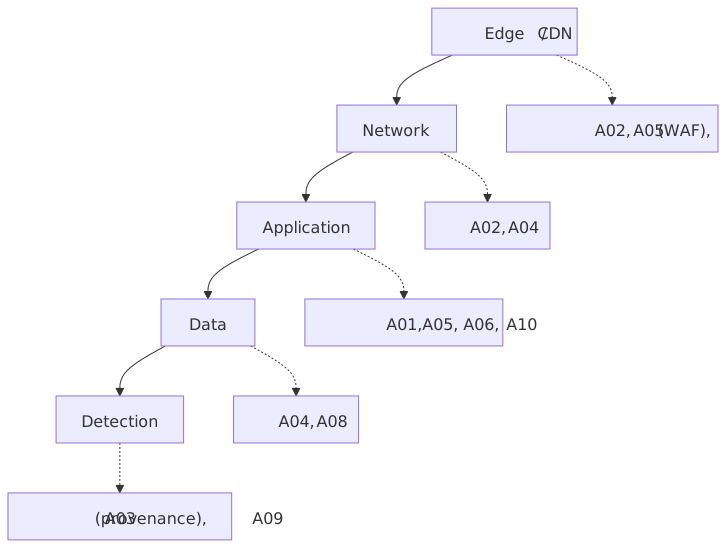
Abstract
OWASP Top 10:2025 is “data-informed, but not blindly data-driven”: eight categories were ranked from contributed application-test data, the remaining two (Software Supply Chain Failures and Security Logging & Alerting Failures) were promoted by a community survey because the available data systematically under-represents them.1 The 2025 cut introduced two new categories (A03 Software Supply Chain Failures, A10 Mishandling of Exceptional Conditions), consolidated SSRF into Broken Access Control, and elevated Security Misconfiguration to #2 because 100% of tested applications had at least one misconfiguration CWE present.2
Core mental model:
| Categories | Root cause | Primary control |
|---|---|---|
| A01 Access Control / A02 Misconfiguration | Missing enforcement / hardening | Deny by default, secure defaults, IaC review |
| A03 Supply Chain / A04 Cryptographic | Untrusted artifacts, weak primitives | SBOM, signed artifacts, modern algorithms |
| A05 Injection / A06 Insecure Design | Untrusted input, missing controls | Parameterized APIs, threat modeling |
| A07 Authentication / A08 Integrity | Identity & integrity assumptions | MFA, signed updates, rollback on failure |
| A09 Logging & Alerting / A10 Exceptional Cond. | Insufficient visibility, fail-open | Centralized alerting, fail-closed, rollback |
Why the rankings shift. OWASP scopes a category by grouping CWEs into a root-cause bucket, then ranks by an exploitability + impact score weighted by incidence rate. Position changes between editions reflect both real industry shifts and OWASP’s deliberate move from symptom-led categories (“Sensitive Data Exposure”) to root-cause categories (“Cryptographic Failures”) begun in 2021.1
What changed since 2021
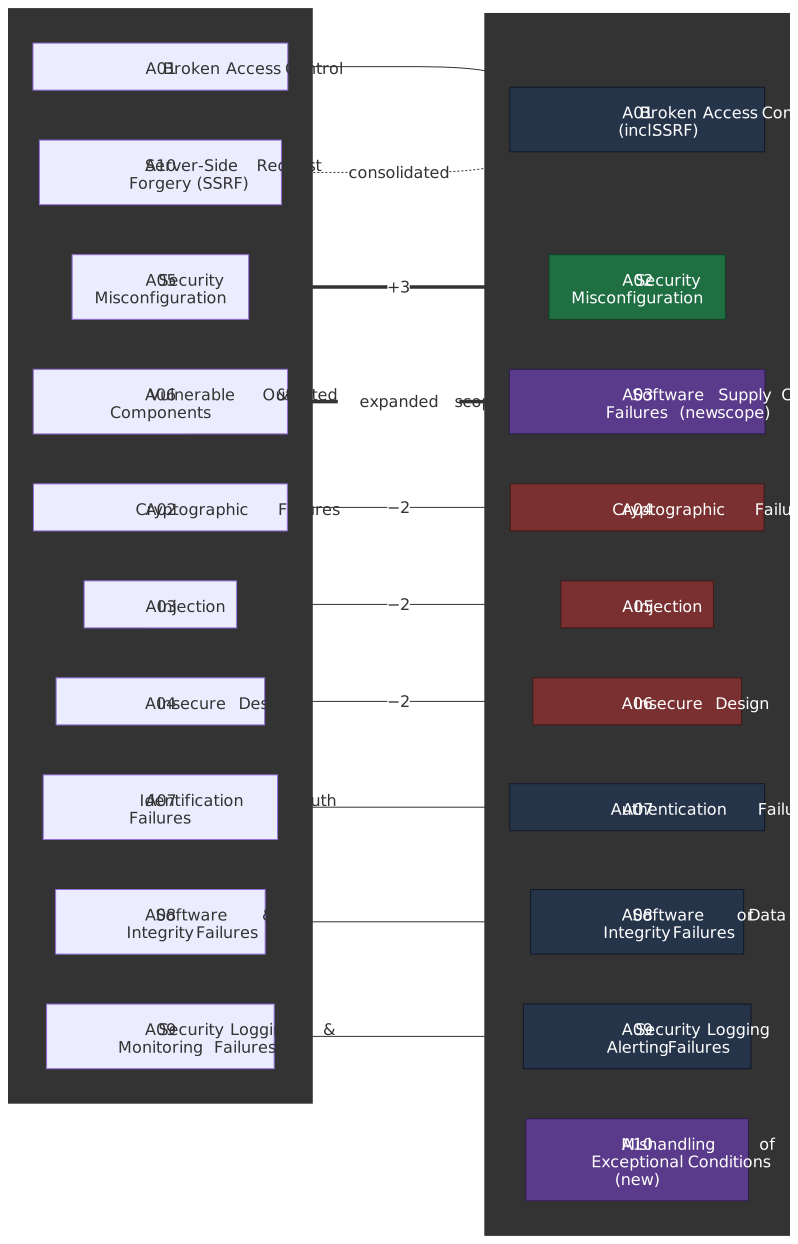
| 2021 → 2025 change | What it means |
|---|---|
| SSRF (A10:2021) → A01:2025 | SSRF is fundamentally an authorization bypass against internal targets, so it now lives inside Broken Access Control.3 |
| Misconfiguration: #5 → #2 | More behavior is configuration-defined; cloud and IaC drift makes misconfiguration more prevalent than weak crypto.2 |
| Vulnerable Components → Supply Chain Failures | Scope expands from “outdated dependency” to the full chain: developer machines, IDE extensions, registries, build systems.4 |
| New: A10 Mishandling Exceptional Conditions | Replaces a vague “code quality” bucket with concrete failure modes: fail-open, uncaught exception, partial transaction.5 |
| A07 renamed | Drops “Identification” — the category targets authentication-specific weaknesses, not the broader identification surface.6 |
A08 renamed (and → or) |
Clarifying name change only: “Software or Data Integrity Failures”.7 |
| A09 renamed | ”Monitoring” → “Alerting” because logging that nobody alerts on is forensically interesting but operationally useless.8 |
A01: Broken Access Control
Broken Access Control retains the #1 slot. Across the contributed data, 100% of applications tested had at least one access-control CWE present. The category covers 40 CWEs, 1,839,701 occurrences, and 32,654 CVEs — by far the largest CVE population of any category.3 Server-Side Request Forgery (SSRF, CWE-918) was folded in because forging requests to internal resources is, mechanically, an authorization bypass.
Vulnerability patterns
| Pattern | Example | CWE |
|---|---|---|
| Privilege escalation | Regular user reaches admin endpoints | CWE-269 |
| IDOR (Insecure Direct Object Reference) | /api/users/123 → /api/users/456 |
CWE-639 |
| Missing function-level controls | POST / PUT / DELETE lack authz |
CWE-285 |
| CORS misconfiguration | Wildcard origin with credentials | CWE-942 |
| SSRF (now consolidated here) | http://169.254.169.254/ metadata access |
CWE-918 |
| Path traversal | ../../../etc/passwd |
CWE-22 |
Prevention
import { Request, Response, NextFunction } from "express"import { verify } from "jsonwebtoken"import { hasPermission } from "./rbac"export function authorize(resource: string, action: string) { return async (req: Request, res: Response, next: NextFunction) => { const token = req.headers.authorization?.split(" ")[1] if (!token) return res.status(401).json({ error: "No token" }) const payload = verify(token, process.env.JWT_SECRET!) const allowed = await hasPermission(payload.sub, resource, action) if (!allowed) return res.status(403).json({ error: "Forbidden" }) next() }}app.get("/api/users/:id", authorize("users", "read"), getUser)app.put("/api/users/:id", authorize("users", "update"), updateUser)app.delete("/api/users/:id", authorize("users", "delete"), deleteUser)The non-negotiable controls per OWASP A01 guidance:3
- Deny by default — explicit grants for every resource.
- Server-side enforcement — never trust client-side state.
- Record-ownership validation — verify the requesting principal owns the row, not just that they can call the endpoint.
- Centralized access control — one module, one place to audit.
- Short-lived JWTs / revoke-on-logout sessions — invalidate stateful sessions server-side; keep stateless tokens short with refresh-token rotation.
- Rate limit controller and API access to slow automated tooling.
SSRF-specific prevention
import { URL } from "url"import dns from "dns/promises"import ipaddr from "ipaddr.js"const ALLOWED_HOSTS = new Set(["api.example.com", "cdn.example.com"])async function fetchSafely(userUrl: string): Promise<Response> { const url = new URL(userUrl) if (url.protocol !== "https:") throw new Error("Only HTTPS allowed") if (!ALLOWED_HOSTS.has(url.hostname)) throw new Error("Host not on allowlist") // DNS rebinding protection: resolve once, validate every address, then fetch. const addresses = await dns.resolve4(url.hostname) for (const addr of addresses) { const parsed = ipaddr.parse(addr) if (parsed.range() !== "unicast") throw new Error("Private IP not allowed") } return fetch(url.toString(), { redirect: "error" })}Caution
Cloud metadata services are the canonical SSRF target. On AWS, enforce IMDSv2 so a single SSRF GET cannot mint credentials; on GCP and Azure, block the metadata IPs at the egress layer for any tier that accepts user-controlled URLs.
A02: Security Misconfiguration
Security Misconfiguration jumped from #5 to #2. 100% of tested applications had at least one misconfiguration CWE, with a max incidence rate of 27.70%, average 3.00%, ~719k occurrences, and 16 mapped CWEs.2 XML External Entities (XXE, CWE-611) stays consolidated here — it is fundamentally a parser misconfiguration, not a separate vulnerability class.
Common misconfigurations
| Layer | Misconfiguration | Impact |
|---|---|---|
| Cloud | S3 / blob bucket public by default | Data breach |
| Container | Container running as root | Container escape |
| Framework | Debug mode in production | Stack traces leak |
| Server | Directory listing enabled | Source exposure |
| Headers | Missing security headers | XSS, clickjacking |
| Defaults | Unchanged admin credentials | Full compromise |
| Parser | DTD / external entity processing on | File disclosure, SSRF |
Security headers
Strict-Transport-Security: max-age=31536000; includeSubDomains; preloadX-Content-Type-Options: nosniffX-Frame-Options: DENYReferrer-Policy: strict-origin-when-cross-originPermissions-Policy: geolocation=(), microphone=(), camera=()Content-Security-Policy: default-src 'self'; script-src 'self' 'nonce-{random}';Configuration hardening
import { XMLParser } from "fast-xml-parser"// fast-xml-parser is a pure-JS parser and does NOT resolve external DTD entities,// so the classic file-disclosure XXE is not reachable here. The flags below stay// conservative anyway and document intent. For DOM/SAX parsers backed by// libxml2/Xerces, you MUST also disable DOCTYPE / external entity loading// explicitly — that is where most real-world XXE bugs live.const parser = new XMLParser({ ignoreAttributes: false, processEntities: false, htmlEntities: false,})The OWASP A02 hardening workflow:2
- Repeatable hardening — automated, identical environments differing only in secrets.
- Minimal install — drop sample apps, docs, unused features and frameworks.
- Automated config verification — config checks in CI, drift detection in production.
- Short-lived credentials — identity federation (OIDC, SPIFFE) over hardcoded secrets in code or pipelines.
- Cloud IAM and firewall audits — at least annually if not continuous.
A03: Software Supply Chain Failures
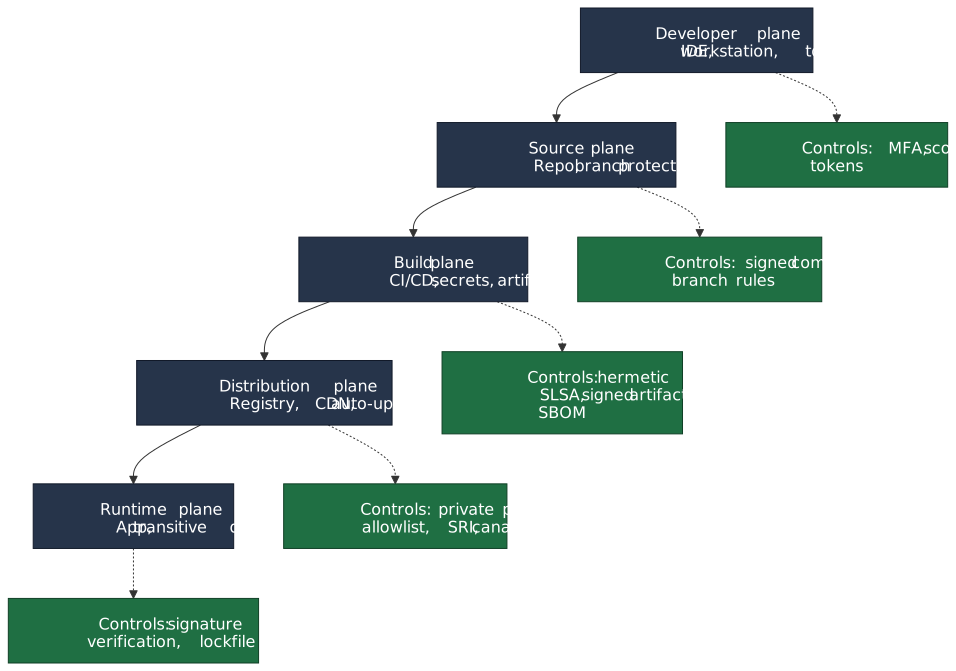
New in 2025, A03 is the renamed and expanded successor to A06:2021 Vulnerable and Outdated Components. It absorbed every supply-chain failure mode, not just outdated dependencies. The community survey ranked it #1 — exactly 50% of respondents put it first — because the contributed data underrepresents an obviously growing risk class. The category page lists 6 mapped CWEs but surfaces only 11 CVEs in the dataset, while still recording the highest average incidence rate of any 2025 category at 5.72%.4
Why it was added
Three incidents shaped the new category:
- SolarWinds (2019) — a build-system compromise in the Orion product cascaded into roughly 18,000 organizations via signed but malicious updates.4
- Log4Shell (CVE-2021-44228) — a single Apache Log4j JNDI lookup CVE put an enormous fraction of Java services at risk overnight, and remained the textbook supply-chain CVE for years.4
- Shai-Hulud (2025) — the first successful self-propagating npm worm. Compromised packages ran a post-install script that exfiltrated tokens to public GitHub repositories and then used any harvested npm tokens to publish malicious versions of additional packages, reaching 500+ package versions before npm disrupted it.4
Supply chain risk vectors
| Risk | Example | Control |
|---|---|---|
| Known vulnerabilities | Log4Shell (CVE-2021-44228) | SCA scanning + SBOM diffing |
| Typosquatting | lodahs instead of lodash |
Private proxy with explicit allowlist |
| Maintainer compromise | event-stream (2018), ua-parser-js (2021) |
Audit upstream version diffs, lock files |
| Build system compromise | SolarWinds Orion | Signed builds, SLSA provenance |
| Self-propagating worms | Shai-Hulud (npm, 2025) | Scoped CI tokens, no long-lived publish |
Dependency management
{ "name": "secure-app", "version": "1.0.0", "scripts": { "audit": "npm audit --production", "audit:fix": "npm audit fix", "sbom": "npx @cyclonedx/cyclonedx-npm --output-file sbom.json" }, "dependencies": { "express": "4.18.2" }, "overrides": { "lodash": "4.17.21" }}Supply-chain hygiene per the OWASP A03 prevention list:4
- SBOM — generate with CycloneDX or SPDX and diff it on every release.
- Continuous scanning — OWASP Dependency-Check / Dependency-Track, npm audit, Snyk, GitHub Dependabot, all in CI.
- Lockfile discipline — pin versions; review transitive bumps deliberately rather than letting
^ranges float in production. - Private proxy registry — proxy public packages, scan before allowing, and block direct internet pulls from build runners.
- Subresource Integrity (SRI) for any third-party browser asset:
<script src="https://cdn.example.com/lib.js" integrity="sha384-oqVuAfXRKap7fdgcCY5uykM6+R9GqQ8K/uxy9rx7HNQlGYl1kPzQho1wx4JwY8wC" crossorigin="anonymous"></script>If the CDN script changes, the browser refuses execution. Treat SRI hashes as another lockfile.
- Staged rollouts for both your code and dependency upgrades — never ship a fleet-wide major bump on day zero of release.
A04: Cryptographic Failures
Cryptographic Failures fell from #2 to #4. The category covers 32 mapped CWEs, ~1.66M occurrences, and 2,185 CVEs. It targets root causes (broken algorithms, weak keys, predictable PRNGs, missing authenticated encryption) rather than the symptom of data exposure.9
Vulnerability patterns
| Pattern | Weakness | Impact |
|---|---|---|
| Cleartext transmission | No TLS, HTTP fallback | MITM credential theft |
| Weak algorithms | MD5 / SHA-1 for passwords, DES | Offline cracking |
| Insufficient entropy | Predictable tokens, weak PRNG | Session hijacking |
| Hardcoded secrets | API keys committed to source | Credential compromise |
| Missing authenticated encryption | AES-CBC without HMAC | Padding oracle |
Password storage
import { hash, verify } from "argon2"// Argon2id parameters above OWASP minimum (m=19 MiB, t=2, p=1).// Tune so your hardware lands at ~250-500ms per hash.const PASSWORD_OPTIONS = { type: 2, // argon2id (hybrid: side-channel + time-memory tradeoff resistant) memoryCost: 65536, // 64 MiB timeCost: 3, parallelism: 4,}export async function hashPassword(password: string): Promise<string> { return hash(password, PASSWORD_OPTIONS)}export async function verifyPassword(password: string, stored: string): Promise<boolean> { return verify(stored, password)}Why Argon2id. It is the OWASP Password Storage Cheat Sheet primary recommendation for new systems. Memory-hardness defeats GPU/ASIC cracking; the id variant combines Argon2i’s side-channel resistance with Argon2d’s time-memory-tradeoff resistance. OWASP’s minimum parameters are m=19 MiB, t=2, p=1; the example above is well above that floor and is appropriate for typical server hardware.
Important
OWASP A04 explicitly tells you to prepare now for post-quantum cryptography, citing the ENISA roadmap that targets 2030 for high-risk systems being PQC-safe. Inventory your KEM and signature usage well before that window closes.9
Data classification workflow
- Identify sensitive data per PCI DSS, GDPR, HIPAA.
- Encrypt at rest with AES-256-GCM (authenticated) or equivalent.
- Encrypt in transit with TLS 1.2+ (TLS 1.3 preferred), forward-secrecy ciphers, no CBC.
- Manage keys in an HSM or cloud KMS — never in source.
- Rotate keys on schedule and immediately on suspected compromise.
A05: Injection
Injection fell from #3 to #5 but is still hugely consequential: 37 mapped CWEs, 1.4M occurrences, and 62,445 CVEs — the most CVEs of any 2025 category. The CVE volume is dominated by Cross-Site Scripting (CWE-79, >30k CVEs) and SQL Injection (>14k CVEs).10 XSS stays consolidated here — it is HTML/JavaScript injection.
Note
Prompt injection against LLMs is treated separately by the OWASP Top 10 for LLM Applications as LLM01:2025 Prompt Injection. The web-app A05 does not cover prompt injection.10
Attack surface
| Injection type | Entry point | Prevention |
|---|---|---|
| SQL | Database queries | Parameterized queries, ORM |
| XSS | HTML output | Output encoding, CSP |
| Command | OS shell calls | Avoid the shell; use execFile-style API |
| NoSQL | Document queries | Schema validation, typed query builders |
| Template | Server-side templates | Sandbox, restricted syntax |
| LDAP | Directory queries | Escape special characters |
SQL injection prevention
import { Pool } from "pg"const pool = new Pool()// VULNERABLE: string concatenation.async function getUserUnsafe(id: string) { // Attacker payload: "1; DROP TABLE accounts;--" return pool.query(`SELECT * FROM accounts WHERE id = ${id}`)}// SAFE: parameterized query.async function getUserSafe(id: string) { return pool.query("SELECT * FROM accounts WHERE id = $1", [id])}// SAFE: ORM with typed parameters.async function getUserORM(id: number) { return prisma.user.findUnique({ where: { id } })}Content Security Policy
CSP is the primary defense-in-depth control for XSS — it tells the browser which sources are allowed to execute script:
Content-Security-Policy: default-src 'self'; script-src 'self' 'nonce-abc123'; style-src 'self' 'unsafe-inline'; img-src 'self' data: https:; connect-src 'self' https://api.example.com; frame-ancestors 'none'; base-uri 'self'; form-action 'self';Deploy in two phases: ship Content-Security-Policy-Report-Only first, analyze violation reports, then enforce. Treat any inline-script violation as a refactor, not as a CSP exception.
A06: Insecure Design
Insecure Design fell from #4 to #6 — not because design failures got rarer but because Misconfiguration and Supply Chain leapfrogged it. It still spans 39 CWEs, ~730k occurrences, and 7,647 CVEs.11 The category targets architectural flaws that cannot be fixed by secure implementation — an insecure design cannot be saved by perfect code.
Design vs implementation
| Insecure design | Implementation bug |
|---|---|
| No rate limiting on password reset | Rate limit bypassable via header |
| Security questions for credential recovery | SQL injection in security-question handler |
| Trust boundary not modeled | JWT validation missing on one endpoint |
| No business-logic validation | Off-by-one in a quantity check |
Prevention
- Secure development lifecycle with threat modeling on the critical flows, not the whole app.
- Security requirements written into user stories so they ship with the feature, not after.
- A paved-road library of authentication, authorization, and session patterns — opt out by exception, not by default.
- Plausibility checks at every tier (can a user really order 10,000 items? buy 600 cinema seats?).
- Rate limits on expensive operations.
Example: the cinema chain group-booking attack
OWASP’s canonical Insecure Design scenario: a cinema chain offers group-booking discounts and only requires a deposit beyond fifteen attendees. An attacker threat-models the flow and books 600 seats across multiple cinemas in a few requests, blocking real customers and never paying.11 The fix is design-level: cap concurrent un-deposited holds, require escalating deposits past a threshold, and bot-detect the request pattern.
A07: Authentication Failures
Authentication Failures keeps #7 with 36 mapped CWEs, ~1.12M occurrences, and 7,147 CVEs. The name shortened from “Identification and Authentication Failures” to focus the category on authentication-specific weaknesses. OWASP attributes the lack of upward movement to wider use of standardized identity frameworks.6
Vulnerability patterns
| Weakness | Exploitation | Control |
|---|---|---|
| Credential stuffing | Automated login with breached passwords | MFA, throttling |
| Hybrid credential spray | Winter2025 → Winter2026 increments |
MFA, breach-aware password rules |
| Weak passwords | Dictionary attacks | Min 8+ chars, breach-list check |
| Session fixation | Attacker sets session ID before login | Regenerate session on login |
| Missing logout | Sessions persist after logout / SSO partial | Server-side invalidation, SLO |
| Exposed session IDs | IDs in URLs | Cookie-only, HttpOnly |
Session management
import session from "express-session"import RedisStore from "connect-redis"import { createClient } from "redis"const redisClient = createClient()app.use( session({ store: new RedisStore({ client: redisClient }), secret: process.env.SESSION_SECRET!, name: "__Host-session", // __Host- prefix forces Secure, Path=/, no Domain resave: false, saveUninitialized: false, cookie: { secure: true, httpOnly: true, sameSite: "strict", maxAge: 15 * 60 * 1000, // 15 minutes }, }),)app.post("/login", async (req, res) => { const user = await authenticate(req.body) // Regenerate session on auth to defeat fixation. req.session.regenerate(() => { req.session.userId = user.id res.json({ success: true }) })})NIST SP 800-63B password guidance
NIST SP 800-63B reversed decades of password theater. OWASP A07 endorses the same guidance:6
- No composition rules — forced symbols make passwords worse, not better.
- No periodic rotation — change only on evidence of compromise.
- Minimum 8 characters (12+ in practice), maximum at least 64.
- Check against breached password lists — integrate something like the Have I Been Pwned Pwned Passwords k-anonymity API.
- Allow paste — password managers are the actual primary defense.
- MFA wherever possible — preferably a phishing-resistant factor (WebAuthn / passkeys) rather than SMS.
A08: Software or Data Integrity Failures
A08 stays at #8 with a clarifying name change (“and” → “or”). It covers 14 CWEs, ~501k occurrences, and 3,331 CVEs. The line OWASP draws between A03 and A08: A03 covers the supply chain producing the artifact, A08 covers your runtime trusting an artifact or data blob without verifying it (auto-update, deserialization, cookie integrity).7
Integrity patterns
| Pattern | Example | Impact |
|---|---|---|
| Unsigned updates | Auto-update without verification | Malicious code |
| Insecure deserialization | Untrusted data → object instantiation | RCE |
| CI/CD compromise | Build-server access | Supply-chain attack |
| CDN modification | Third-party JS changed at the CDN | Client-side attack |
Deserialization safety
import Ajv from "ajv"const ajv = new Ajv()const schema = { type: "object", properties: { userId: { type: "integer" }, action: { type: "string", enum: ["read", "write"] }, }, required: ["userId", "action"], additionalProperties: false,}const validate = ajv.compile(schema)function processInput(untrusted: string) { const data = JSON.parse(untrusted) if (!validate(data)) throw new Error("Invalid input schema") // Now safe to use data.userId, data.action.}Caution
Java deserialization (rO0 base64 prefix), .NET BinaryFormatter, Python pickle, and PHP unserialize() are RCE primitives whenever the byte stream is attacker-influenced. Never deserialize untrusted input with these. JSON + a schema validator like Ajv is the safe default.
CI/CD integrity controls
- Signed commits on protected branches.
- Reproducible / hermetic builds — same source ⇒ same binary, ideally with SLSA provenance.
- Artifact signing — verify before deployment.
- Least-privilege runners — short-lived, scoped credentials per job; no persistent admin tokens.
- Secret scanning — block credentials in logs and artifacts.
A09: Security Logging & Alerting Failures
A09 keeps #9 with the deliberate rename from “Security Logging and Monitoring Failures”: alerting is the verb that matters. The category has only 5 mapped CWEs and 723 CVEs because it is hard to detect via static testing — it returned through the community survey for the third time.8 As a calibration point, the IBM Cost of a Data Breach 2025 report puts the global mean time to identify and contain a breach at 241 days, the lowest in nine years and still measured in hundreds of days.12
What to log
| Event | Required fields | Alert threshold |
|---|---|---|
| Login failure | User, IP, timestamp, user-agent | 5 failures / minute |
| Access denied | User, resource, action | Any sensitive resource |
| Input validation failure | Sanitized input, endpoint | 10 / minute / IP |
| Admin action | User, action, target | All |
| Rate-limit triggered | IP, endpoint, count | All |
Log injection prevention
import pino from "pino"const logger = pino({ formatters: { level: (label) => ({ level: label }) },})// SAFE: structured logging, attacker-controlled values are values, not formatting.logger.info({ userId: user.id, action: "login" }, "User authenticated")// UNSAFE: user input concatenated into the log string enables injection.// logger.info(`User ${username} logged in`)// username = "admin\n[ALERT] Breach"Alerting strategy
- Real-time alerts for auth failures, privilege changes, sensitive-resource access.
- Anomaly detection for unusual access patterns (high false-positive rate; treat as a secondary signal).
- Tamper-evident storage for logs — append-only sinks, separate retention boundary.
- Incident response playbook per NIST SP 800-61r2 (or the in-progress r3 once finalized).
- Periodic drill — purple-team exercises validate that detection actually fires.
A10: Mishandling of Exceptional Conditions
New in 2025 and replacing what used to be a vague “code quality” bucket. A10 covers 24 mapped CWEs, ~770k occurrences, and 3,416 CVEs. It addresses failures to prevent, detect, or respond to abnormal states — crashes, fail-open conditions, partial transactions.5
Failure modes
| Failure | Example | Impact |
|---|---|---|
| Resource exhaustion | Unhandled upload exception leaks fds | DoS |
| Data exposure | Raw DB error returned to client | Reconnaissance |
| Fail-open | Exception bypasses an auth check | Unauthorized access |
| Incomplete transaction | Transfer interrupted mid-process | Financial fraud |
Prevention
import { Transaction } from "sequelize"async function transferFunds(from: number, to: number, amount: number) { const t = await sequelize.transaction() try { await Account.decrement("balance", { by: amount, where: { id: from }, transaction: t }) await Account.increment("balance", { by: amount, where: { id: to }, transaction: t }) await t.commit() } catch (error) { await t.rollback() // Fail closed: no partial state survives. logger.error({ from, to, amount, err: error.message }, "Transfer failed") throw new Error("Transfer failed") // Don't leak internals. }}The OWASP A10 control surface:5
- Local handling at the point of failure — meaningful recovery beats a top-level catch-all.
- Global exception handler as a safety net, never as the primary strategy.
- Fail closed — transactional rollback, deny on error, never partial state.
- Resource quotas — rate limits, memory caps, connection caps.
- Sanitized error messages — no stack traces, no internal paths, no DB metadata back to users.
Conclusion
The OWASP Top 10:2025 is the clearest articulation yet of the modern AppSec baseline:
- Access control is still #1 — every endpoint is an authorization decision. SSRF is now part of this category.
- Misconfiguration is the new #2 — secure defaults are still rare; cloud and IaC make misconfigurations reproducible at scale.
- Supply chain is unavoidable — the new A03 reflects SolarWinds, Log4Shell, and self-propagating npm worms. Spend on SBOM, signing, and provenance.
- Mishandling exceptional conditions joins the list — fail-closed, transactional rollback, and bounded resources are now first-class controls.
- Detection enables response — logging without alerting is forensic dust; if your pages don’t fire, your detection doesn’t exist.
Use the Top 10 as a baseline for threat modeling, code-review checklists, and security testing. For high-assurance systems, escalate to the OWASP Application Security Verification Standard (ASVS), which covers the same ground at far greater depth.
Appendix
Prerequisites
- HTTP request/response model.
- Web application architecture (client/server, API tiers).
- Authentication flows (sessions, tokens).
Summary
- A01–A02 (Access Control, Misconfiguration): deny by default, secure defaults, cloud IAM hygiene.
- A03–A04 (Supply Chain, Crypto): verify dependencies, modern algorithms, prepare for PQC by 2030.
- A05–A06 (Injection, Design): parameterized APIs, threat modeling on the critical flows.
- A07–A08 (Auth, Integrity): MFA, breach-list checks, signed updates, no untrusted deserialization.
- A09–A10 (Logging & Alerting, Exceptional Conditions): centralized alerting, fail closed.
- 2025 added Software Supply Chain Failures and Mishandling of Exceptional Conditions; SSRF moved into A01.
References
- OWASP Top 10:2025 — official project landing page.
- Introduction — OWASP Top 10:2025 — methodology, dataset, and what changed.
- OWASP Application Security Verification Standard (ASVS) — comprehensive security requirements.
- OWASP Cheat Sheet Series — implementation guidance per category.
- CWE Top 25 Most Dangerous Software Weaknesses — complementary ranking, language-agnostic.
- NIST SP 800-63B Digital Identity Guidelines — authentication requirements.
- NIST SP 800-61r2 Computer Security Incident Handling Guide — incident response.
- RFC 6749 OAuth 2.0 and OAuth 2.1 draft — authorization framework.
- RFC 8446 TLS 1.3 — transport security.
- SLSA — Supply-chain Levels for Software Artifacts — build-integrity framework.
Footnotes
-
OWASP, Introduction — OWASP Top 10:2025. Methodology, dataset (2.8M+ applications), 589 CWEs analyzed, 248 CWEs across the 10 categories, eight categories from data and two from the community survey. ↩ ↩2 ↩3
-
OWASP, A02:2025 Security Misconfiguration. 16 CWEs; max incidence 27.70%; avg incidence 3.00%; ~719k occurrences; 1,375 CVEs; XXE (CWE-611) consolidated here. ↩ ↩2 ↩3 ↩4
-
OWASP, A01:2025 Broken Access Control. 100% of tested apps had at least one A01 CWE; 40 CWEs mapped; 1,839,701 occurrences; 32,654 CVEs; SSRF (CWE-918) consolidated here. ↩ ↩2 ↩3
-
OWASP, A03:2025 Software Supply Chain Failures. 6 CWEs (table) / 5 CWEs (intro narrative); 9.56% max incidence; 5.72% average incidence; 50% of community-survey respondents ranked it #1; references SolarWinds, Log4Shell (CVE-2021-44228), and the CISA alert on the Shai-Hulud npm supply chain compromise. ↩ ↩2 ↩3 ↩4 ↩5 ↩6
-
OWASP, A10:2025 Mishandling of Exceptional Conditions. New category in 2025; 24 CWEs; ~770k occurrences; 3,416 CVEs. ↩ ↩2 ↩3
-
OWASP, A07:2025 Authentication Failures. 36 CWEs; ~1.12M occurrences; 7,147 CVEs; renamed from “Identification and Authentication Failures”; endorses NIST 800-63B password guidance. ↩ ↩2 ↩3
-
OWASP, A08:2025 Software or Data Integrity Failures. 14 CWEs; ~501k occurrences; 3,331 CVEs; clarifying rename from “Software and Data Integrity Failures”. ↩ ↩2
-
OWASP, A09:2025 Security Logging & Alerting Failures. 5 CWEs; ~260k occurrences; 723 CVEs; renamed from “Security Logging and Monitoring Failures”. ↩ ↩2
-
OWASP, A04:2025 Cryptographic Failures. 32 CWEs; ~1.66M occurrences; 2,185 CVEs; recommends TLS 1.2+ with forward secrecy and warns on the ENISA-aligned 2030 PQC migration target. ↩ ↩2
-
OWASP, A05:2025 Injection. 37 CWEs; ~1.4M occurrences; 62,445 CVEs; XSS dominates the CVE count. Prompt injection lives in the separate OWASP Top 10 for LLM Applications. ↩ ↩2
-
OWASP, A06:2025 Insecure Design. 39 CWEs; ~730k occurrences; 7,647 CVEs; cinema-chain group-booking scenario quoted from the official page. ↩ ↩2
-
IBM, 2025 Cost of a Data Breach Report. Mean time to identify and contain a breach = 241 days, the lowest in nine years. ↩