GitHub: Scaling MySQL from One Database to 1,200+ Hosts
How GitHub evolved its MySQL infrastructure from a single monolithic database to a fleet of 1,200+ hosts across 50+ clusters serving 5.5 million queries per second (QPS)—through vertical partitioning, custom tooling (gh-ost, orchestrator, freno), Vitess adoption, and a major version upgrade—while keeping github.com available throughout.
Abstract
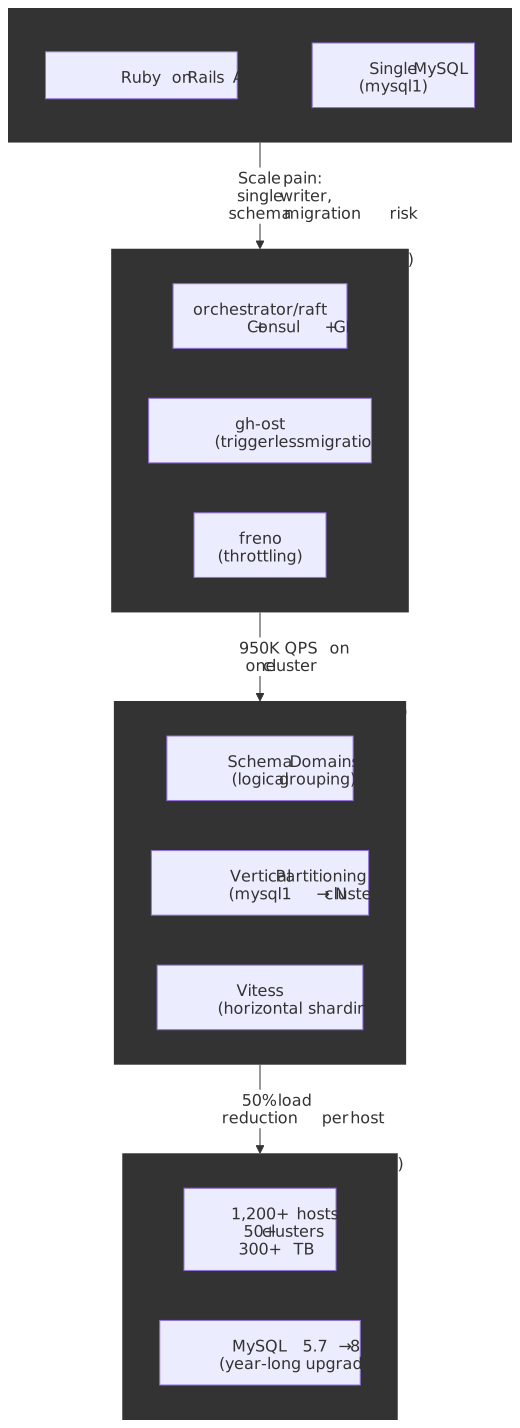
GitHub’s database story is a masterclass in scaling a relational database without abandoning it. The mental model:
| Phase | Problem | Solution | Key Insight |
|---|---|---|---|
| Monolith (~2008–2014) | Single MySQL primary = single point of failure; schema changes = production risk | Datacenter migration, functional partitioning, read replicas | You can defer architectural rework if you optimize hardware and config aggressively |
| Tooling & HA (2014–2019) | Trigger-based migrations lock tables; failovers take minutes; replication lag blindsides apps | gh-ost (triggerless), orchestrator/raft (10–13s failover), freno (cooperative throttling) | Build the operational tooling first—it makes every subsequent migration safer |
| Partitioning (2019–2021) | mysql1 at 950K QPS; any incident affects all features |
Schema domains, vertical partitioning, Vitess for horizontal sharding | Partition by logical domain, not by load—the boundaries are already in your code |
| Fleet scale (2022–2024) | 50+ clusters on MySQL 5.7 approaching EOL; fleet too large for manual ops | Rolling MySQL 8.0 upgrade with backward replication; automation investment | Prior partitioning turned one massive upgrade into 50+ smaller, independent ones |
The transferable insight: GitHub never did a “big rewrite.” Each phase built operational capability (tooling, partitioning, automation) that made the next phase lower-risk. The tools they built along the way—gh-ost, orchestrator, freno—became industry standards adopted far beyond GitHub.
Context
The System
GitHub.com is a Ruby on Rails monolith backed by MySQL. Every non-Git operation—user authentication, repository metadata, issues, pull requests, notifications, actions—reads from or writes to MySQL.
| Metric | 2018 | 2021 | 2023 |
|---|---|---|---|
| MySQL hosts | ~150 | ~500+ | 1,200+ |
| Database clusters | ~15 | ~50+ | 50+ |
| Data stored | ~15 TB | ~100+ TB | 300+ TB |
| Queries per second | Not published | 1.2M | 5.5M |
| Host type | Bare metal | Bare metal | Azure VMs + bare metal |
The Architecture
Each MySQL cluster follows a primary-replica topology: a single primary node accepts writes while replica nodes asynchronously replay changes and serve read traffic. ProxySQL pools connections from the Rails monolith, and GLB (GitHub Load Balancer) / HAProxy routes traffic to the correct primary.
Why MySQL?
GitHub started on MySQL in 2008 and never left. Instead of migrating to a different database, they invested in making MySQL work at scale—building custom tooling where the ecosystem fell short. This “invest in what you know” strategy avoided the risk and engineering cost of a database migration while still achieving the operational characteristics they needed.
Phase 1: The Monolith (~2008–2014)
The Single Database
GitHub.com began as a Ruby on Rails application with a single MySQL database, known internally as mysql1. This cluster housed the data for nearly every feature: user profiles, repositories, issues, pull requests, stars, and notifications.
The early architecture was straightforward:
- Single primary accepting all writes
- Read replicas spreading read load across multiple machines
- No connection pooling initially—the Rails app opened connections directly to MySQL
Where It Broke
By 2014, the single-cluster architecture had hit concrete limits:
- Single point of failure: Any incident affecting
mysql1—a failed migration, a lock contention spiral, a hardware fault—impacted every feature on github.com simultaneously - Schema migration risk: Altering a table schema on a multi-hundred-gigabyte table was a multi-hour operation that could cause lock contention and degrade the entire site
- Vertical scaling limits: Even with the best available hardware, a single primary could not absorb the growing write load indefinitely
The 2013 Datacenter Migration
On Saturday, August 31, 2013 (5am PDT), GitHub’s infrastructure team (led by Sam Lambert) executed a major datacenter migration. The retrospective “Making MySQL Better at GitHub” was published a year later. The team:
- Migrated the bulk of GitHub.com’s MySQL infrastructure to a new datacenter with upgraded hardware and networking
- Used
tcpdumpto extract productionSELECTqueries and replay them against the new cluster for workload validation - Tuned InnoDB parameters (
innodb_buffer_pool_size,innodb_thread_concurrency,innodb_io_capacity,innodb_buffer_pool_instances) through iterative 12-hour test cycles, changing one variable at a time - Introduced functional partitioning: moved large historical data tables to isolated clusters to free buffer pool resources for hot data
Results:
| Metric | Before | After |
|---|---|---|
| Average page load time | Baseline | 50% reduction |
| P99 response time | Baseline | 66% reduction |
| Migration downtime | — | 13 minutes (Saturday 5am PDT, 31 Aug 2013) |
The migration bought time, but the fundamental architecture—a single primary for most data—remained. The next phase addressed the operational tooling needed to safely evolve the schema and topology at scale.
Phase 2: Tooling and High Availability (2014–2019)
GitHub’s database team recognized that before partitioning the database, they needed tooling that made schema changes, failovers, and replication management safe and automated. Between 2014 and 2019, they built (or adopted and heavily contributed to) four critical tools.
gh-ost: Triggerless Online Schema Migration
Problem: GitHub runs multiple schema migrations daily—adding columns, modifying indexes, changing constraints. The industry-standard tool, pt-online-schema-change from Percona, uses MySQL triggers to propagate changes. At GitHub’s scale, triggers caused critical issues:
- Lock contention: Triggers execute within the transaction space of every affected query, competing independently for locks on the shadow table. GitHub experienced near-complete table lockdowns during peak traffic
- No true pause: You cannot remove triggers mid-migration without losing data, so throttling only slows the row-copy—triggers keep firing on every write
- No concurrent migrations: The trigger overhead makes running multiple migrations on different tables simultaneously impractical
- Opaque testing: Trigger-based migrations simulate poorly on replicas because Statement-Based Replication (SBR) runs single-threaded, which does not represent the primary’s concurrent workload
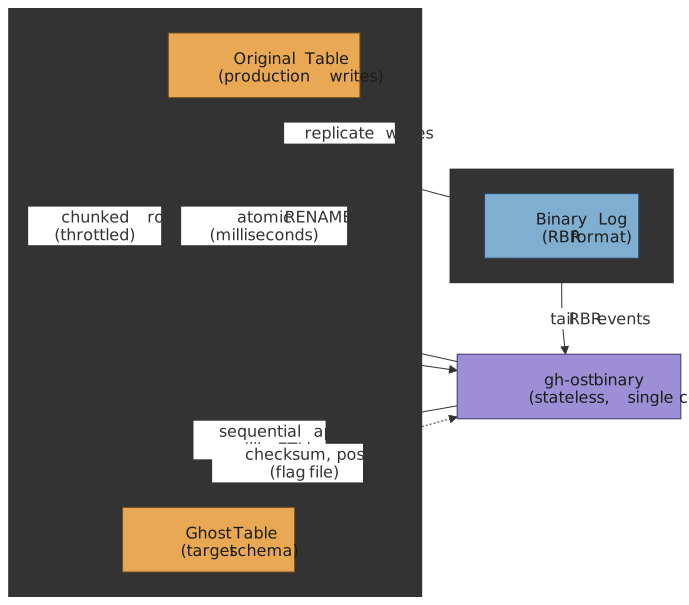
Solution: In August 2016, GitHub open-sourced gh-ost (GitHub’s Online Schema Transmogrifier), a triggerless migration tool. Instead of triggers, gh-ost connects to a MySQL replica and tails the binary log in Row-Based Replication (RBR) format. It creates a shadow (“ghost”) table with the desired schema, copies rows incrementally, and applies ongoing changes from the binary log asynchronously. When the ghost table is synchronized, it performs an atomic table swap.
The key insight: gh-ost presents as a single sequential connection writing to the ghost table—comparable to an Extract, Transform, Load (ETL) process rather than an invasive trigger chain operating inside every production transaction.
Key operational features:
| Feature | How It Works | Why It Matters |
|---|---|---|
| True pause | Suspending gh-ost stops all writes to the primary | Safe throttling under load |
| Dynamic control | Reconfigure chunk-size, max-lag-millis at runtime via Unix socket/TCP |
No restart needed during multi-hour migrations |
| Postponed cutover | Flag file prevents final swap; ghost table stays in sync | Ops can defer cutover to business hours |
| Production testing | --test-on-replica runs the full migration on a replica, swaps tables, then reverses and checksums |
Validates correctness without touching the primary |
GitHub runs continuous migration tests on all production tables (including tables of hundreds of GB) using dedicated test replicas. Each test executes a trivial ENGINE=InnoDB migration, checksums both tables, and reports any inconsistency. By 2020, almost all of GitHub’s MySQL data had been recreated by gh-ost—most of it multiple times.
orchestrator: Automated Failover with Raft Consensus
Problem: The previous failover mechanism used DNS and VIPs (Virtual IP Addresses), which suffered from DNS TTL (Time to Live) propagation delays, split-brain scenarios, and required the dead primary to cooperate in the failover process.
Solution: GitHub adopted and became the primary upstream maintainer of orchestrator, a MySQL replication topology management and high-availability tool authored by Shlomi Noach (originally at Outbrain in 2014, then Booking.com, then GitHub from 2016 to 2020). The architecture:
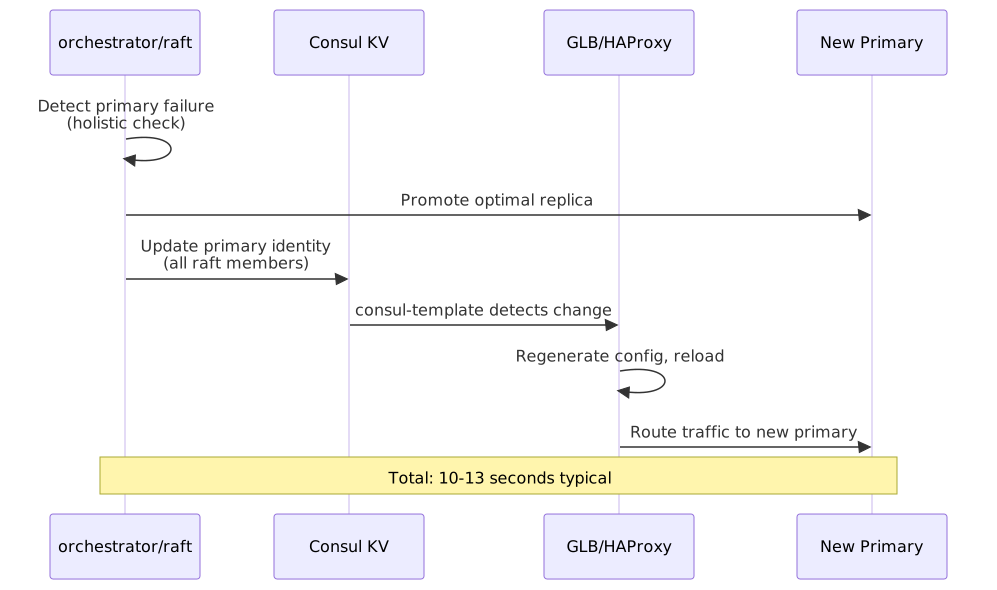
- orchestrator/raft: Multiple orchestrator nodes across data centers communicate via Raft consensus. No single data center constitutes a majority, preventing isolated-DC split-brain
- Consul: Per-datacenter key-value store maintaining primary node identities (Fully Qualified Domain Name, port, IP addresses)
- GLB/HAProxy: Anycast load balancer with writer pools containing exactly one backend (the primary) per cluster. consul-template watches for Consul KV changes and reloads HAProxy automatically
- Holistic failure detection: orchestrator monitors both the primary AND all replicas. Failover only proceeds when replicas corroborate that the primary is unreachable—preventing false positives
Failover performance:
| Scenario | Total Outage |
|---|---|
| Typical | 10–13 seconds |
| Extended | Up to 20 seconds |
| Extreme | Up to 25 seconds |
Replication configuration: Semi-synchronous replication with a 500ms timeout ensures the primary waits for at least one local replica acknowledgment before confirming commits. This provides lossless failover for local datacenter failures while falling back to asynchronous mode if the timeout is exceeded.
freno: Cooperative Throttling
Problem: Large bulk operations—schema migrations, data archiving, Elasticsearch indexing—walk through millions of rows and cause MySQL replication lag. When replicas fall behind, users see stale data. The original Rails-side throttler polled replicas synchronously and sequentially, creating stale connections and adding load to the primary.
Solution: freno is a standalone, highly available service (using Raft consensus) that continuously polls replica lag and exposes a simple HTTP API:
- Applications send an HTTP
HEADrequest before proceeding with bulk writes - freno returns
HTTP 200(proceed) or a throttle response based on the current maximum replication lag across all monitored replicas - Lag measurement uses pt-heartbeat timestamps injected every 100 milliseconds
Impact:
- Memcached caching (20ms TTL) reduced freno query load from ~800 requests/second to ~50 requests/second
- Roughly 30% of read traffic was rerouted from the primary to replicas
- Elasticsearch indexing achieved consistent reads under 600ms at p95
Trilogy: A Purpose-Built MySQL Client
In parallel, GitHub developed Trilogy, a MySQL client library written in C with Ruby bindings. In production since 2015 (open-sourced August 2022), Trilogy replaced the mysql2 gem:
- Eliminates dependency on
libmariadb/libmysqlclient(no version mismatch issues) - Minimizes memory copies when building and parsing network packets
- Designed for embedding in the Ruby VM (handles blocking syscalls correctly)
During the MySQL 8.0 upgrade, Trilogy’s consistent behavior gave the team confidence that the Rails monolith’s connections would not break backward replication—a critical property for safe rollback. Multi-client clusters using other frameworks saw backward replication break within hours.
Important
The choice of database client gates rollback safety on a major-version upgrade. If your applications use heterogeneous MySQL drivers (Java, Python, Node, Go) writing to the same cluster, expect backward replication from 8.0 → 5.7 to break within hours of cutover—compressing your rollback window from days to a single shift.
Automated Schema Migration Pipeline
By 2020, GitHub had assembled these tools into a fully automated migration pipeline:
- Developer opens a PR with schema changes
- GitHub Action runs
skeema diff, posts the generated SQL to the PR - skeefree (internal service) analyzes the change, maps it to the correct production cluster, and determines the strategy: direct SQL for
CREATE/DROP, gh-ost forALTER TABLE - Database infrastructure team reviews and approves via GitHub PR review
- skeefree queues the migration (one
ALTERper cluster at a time), invokes gh-ost, and posts progress updates to the PR DROP TABLEoperations are converted toRENAMEwith a timestamp suffix, providing a multi-day rollback window before garbage collection
Scale: ~2 schema migrations run daily on production, with peaks of up to 6 per day. Some larger tables require hours or days to migrate. This entire flow previously required hours of manual work daily from a database infrastructure engineer.
Phase 3: Partitioning (2019–2021)
With reliable tooling in place, GitHub could address the fundamental architecture problem: the mysql1 cluster was still handling 950,000 queries per second and remained a single point of failure for core features.
The Approach: Schema Domains
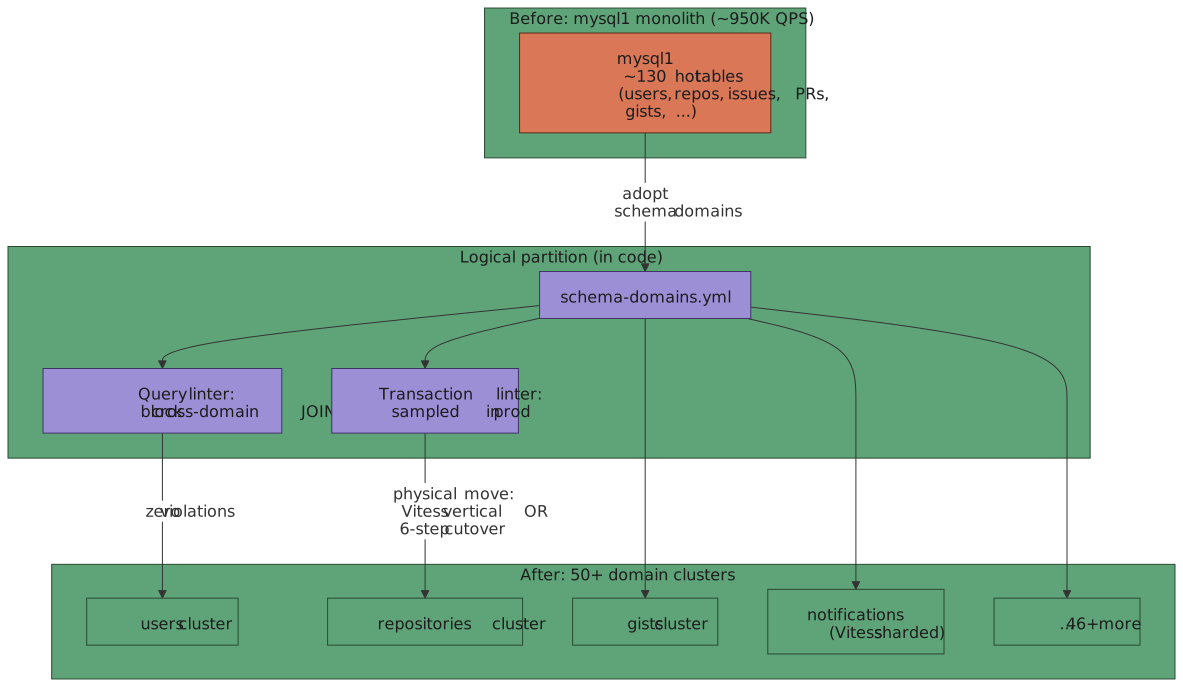
Rather than sharding by hash or range (which fragments the application’s data model), GitHub introduced schema domains—logical groupings of related tables that are frequently joined or transacted together:
gists: - gist_comments - gists - starred_gistsrepositories: - issues - pull_requests - repositoriesusers: - avatars - gpg_keys - public_keys - usersThis approach partitions along the boundaries that already exist in the application code. Tables within a domain stay together; tables in different domains can be moved to separate clusters independently.
Enforcement: SQL Linters
Before physically moving tables, GitHub deployed two linters to identify and eliminate cross-domain dependencies:
Query linter: Verified that only tables from the same schema domain appear in a single query. Cross-domain joins were flagged and required rewriting—typically replacing includes with preload in ActiveRecord, which executes separate queries instead of joins.
Transaction linter: Ran in production with heavy sampling to identify transactions that span domain boundaries—operations that would lose ACID (Atomicity, Consistency, Isolation, Durability) guarantees after partitioning.
Developers could annotate known violations during remediation:
Repository.joins(:owner).annotate("cross-schema-domain-query-exempted")Once a domain had zero violations, it was “virtually partitioned” and ready for physical migration.
Two Migration Methods
GitHub used two complementary approaches to move tables between clusters without downtime:
Vitess vertical sharding: Deployed Vitess’s VTGate in Kubernetes clusters as the MySQL protocol endpoint. VReplication (Vitess’s replication engine) streamed table data to the destination cluster while applications connected through VTGate, which handled routing transparently.
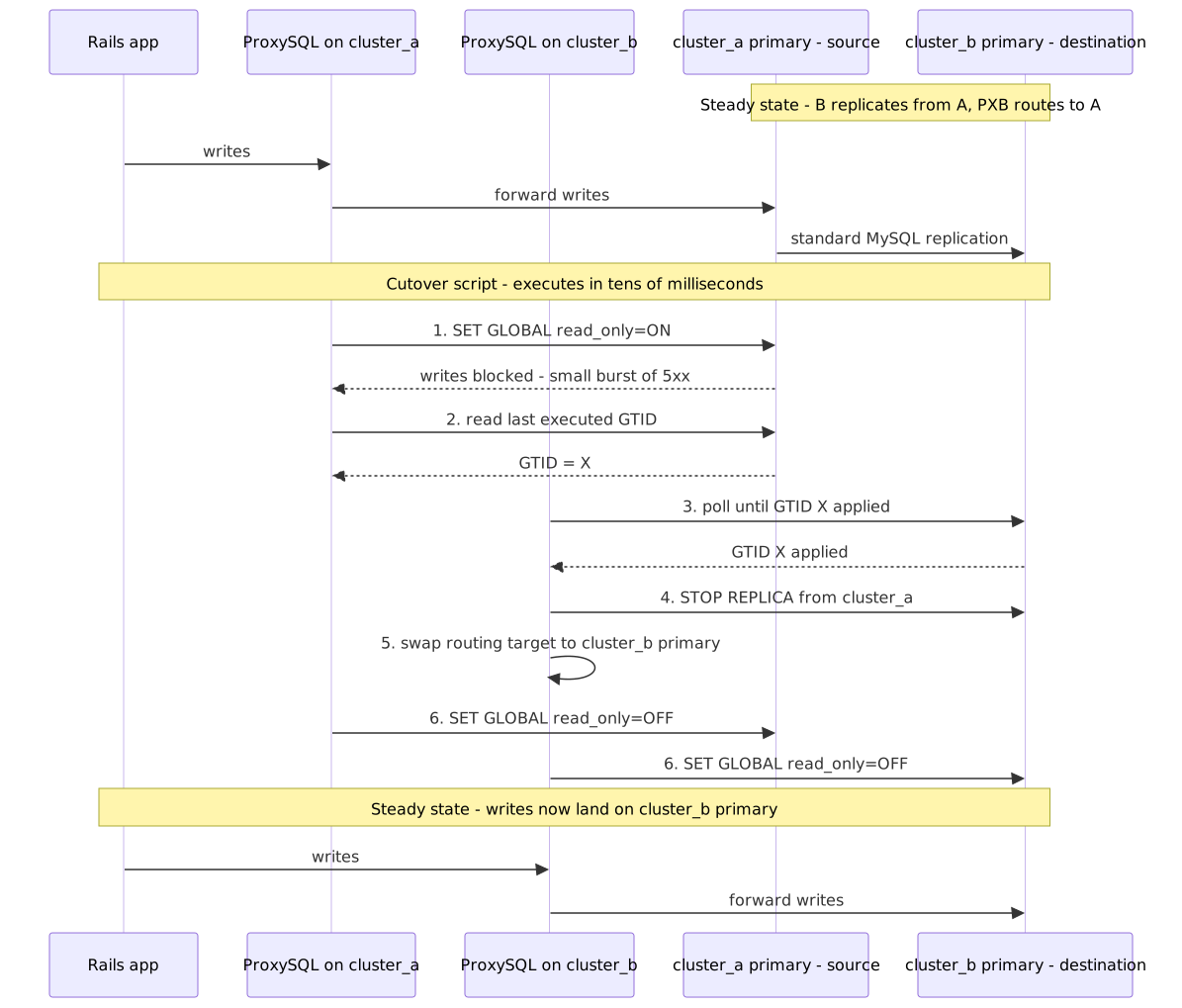
Custom write-cutover: A lighter-weight alternative using standard MySQL replication. The destination cluster (cluster_b) is configured as a sub-cluster of the source (cluster_a); ProxySQL on cluster_b initially routes everything back to cluster_a’s primary, so reads and writes already pass through the destination’s proxy without splitting traffic. At cutover time a script executes six steps in tens of milliseconds:
SET GLOBAL read_only=ONoncluster_a’s primary (a small burst of write 5xx is expected and budgeted into the off-peak window)- Read the last executed GTID (Global Transaction Identifier) from
cluster_a - Poll
cluster_b’s primary until that GTID is applied STOP REPLICAoncluster_b’s primary- Update ProxySQL on
cluster_bto point atcluster_b’s primary SET GLOBAL read_only=OFFon both primaries
The custom approach served as risk mitigation—a simpler alternative when Vitess’s overhead was not justified for a particular table set, and an independent tool so a single-vendor outage would not block all migrations.
Results
GitHub migrated approximately 130 of the busiest tables—repositories, issues, pull requests—off mysql1 and distributed them across multiple new clusters.
| Metric | 2019 (Before) | 2021 (After) | Change |
|---|---|---|---|
| Total queries/second | 950,000 | 1,200,000 | +26% |
| Replica queries/second | 900,000 | 1,125,000 | +25% |
| Primary queries/second | 50,000 | 75,000 | +50% |
| Per-host load | Baseline | — | 50% reduction |
| Database clusters | ~5 | 50+ | 10x growth |
The load reduction contributed directly to fewer database-related incidents and improved github.com reliability. Critically, the 10x growth in cluster count—from ~5 clusters to 50+—meant that incidents were now scoped to individual feature domains rather than affecting the entire platform.
Vitess for Horizontal Sharding
For domains that outgrew even a single-primary cluster (Notifications, Actions, and eventually Issues and Pull Requests), GitHub adopted Vitess’s horizontal sharding:
- VTGate deployed in Kubernetes as the application-facing MySQL endpoint
- VTTablet manages communication between VTGate and individual MySQL instances
- Applications connect to VTGate endpoints instead of directly to MySQL
- GitHub maintains a fork (
github/vitess-gh) with customizations for their environment
As of 2023, Vitess manages approximately 150 TB of GitHub’s data and handles 750,000 QPS of their total database workload.
Phase 4: Fleet Scale and MySQL 8.0 (2022–2024)
The Upgrade Challenge
By mid-2022, GitHub’s fleet had grown to 1,200+ MySQL hosts across 50+ clusters—all running MySQL 5.7, which was approaching end of life. The last time GitHub upgraded MySQL versions, they had approximately 5 clusters. Now they had 10x more, each with different workload characteristics and application dependencies.
The Five-Step Rolling Upgrade
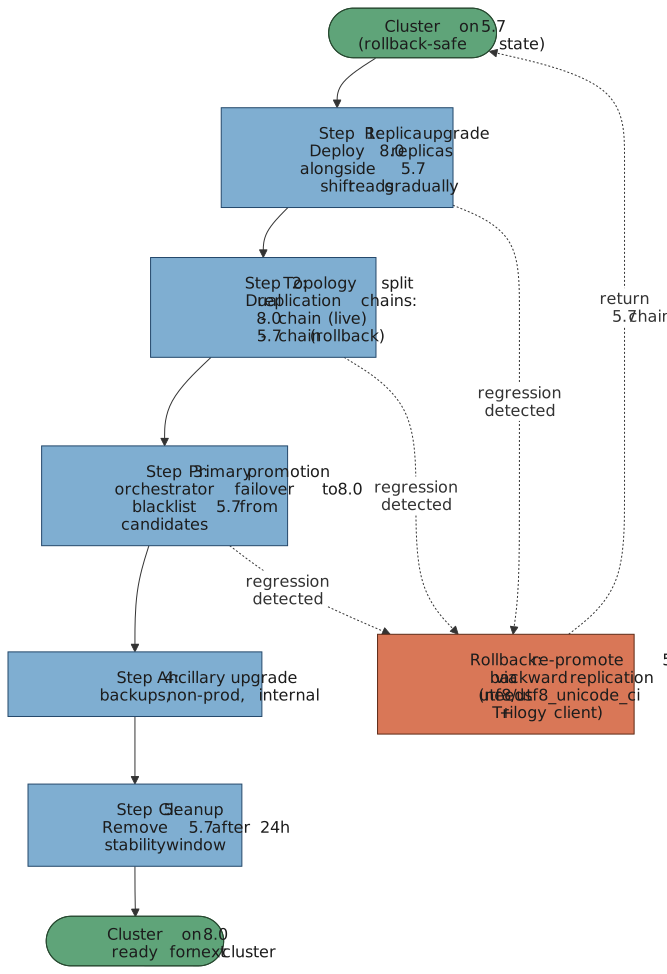
The team designed a per-cluster upgrade process that preserved rollback capability at every step:
Step 1 — Rolling replica upgrades: Deploy MySQL 8.0 replicas alongside existing 5.7 replicas. Gradually shift read traffic to 8.0 servers while monitoring for query plan regressions.
Step 2 — Topology reconfiguration: Create dual replication chains—one serving 8.0 traffic, another maintaining offline 5.7 replicas specifically for rollback.
Step 3 — Primary promotion: Use orchestrator to perform a graceful failover, promoting an 8.0 replica to primary. Blacklist 5.7 hosts from failover candidate selection.
Step 4 — Ancillary upgrades: Upgrade backup servers and non-production instances.
Step 5 — Cleanup: Remove 5.7 servers after a minimum 24-hour production traffic cycle confirms stability.
Challenges Encountered
Character set incompatibility: MySQL 8.0 defaults to utf8mb4_0900_ai_ci collation, which MySQL 5.7 does not support. Backward replication from 8.0 to 5.7 (needed for rollback) broke immediately. The fix: configure 8.0 servers with utf8 / utf8_unicode_ci defaults—sacrificing 8.0’s improved collation until all clusters were upgraded and rollback was no longer needed.
Replication bug: MySQL 8.0.28 patched an issue where the replica_preserve_commit_order variable caused replication applier hangs under write-intensive load. GitHub’s GTID-based replication met all triggering criteria, requiring version 8.0.28 as the minimum deployment target.
Query plan regressions: Queries passing CI against controlled test data failed in production against real-world data distributions. Most notably, queries with large WHERE IN clauses (tens of thousands of values) crashed MySQL outright. The team relied on SolarWinds DPM (Database Performance Monitor) for query sampling to detect these regressions before they caused outages.
Vitess version advertisement: VTGate advertises an upstream MySQL version to its clients, and some drivers branch on that string. One Java client issued query-cache control statements that worked against 5.7 but errored against 8.0 (which removed the query cache entirely). For each Vitess keyspace, the team had to upgrade the underlying MySQL one shard at a time and flip VTGate’s advertised version manually—neither could move ahead of the other without breaking clients.
Why Prior Partitioning Made This Possible
The partitioning work from Phase 3 turned what would have been a single high-risk upgrade into 50+ independent, smaller upgrades. Each cluster could be upgraded on its own timeline, and a regression in one cluster only affected that domain’s features—not the entire platform.
Outcome
| Metric | Value |
|---|---|
| Fleet size | 1,200+ hosts (Azure VMs + bare metal) |
| Data managed | 300+ TB |
| Query throughput | 5.5 million QPS |
| Database clusters | 50+ |
| Upgrade duration | Over 1 year (July 2022 – late 2023) |
| MySQL version | 8.0 across entire fleet |
Options Considered (Across Phases)
GitHub’s approach was notably conservative compared to industry peers. At various points, they evaluated alternatives:
Option 1: Migrate Away from MySQL
Approach: Move to PostgreSQL, CockroachDB, or a purpose-built distributed database.
Why not chosen: The Rails monolith had deep MySQL dependencies—query patterns, schema conventions, ActiveRecord behaviors. A database migration would have been a multi-year effort with high risk and uncertain benefit. Instead, GitHub chose to build tooling that made MySQL work at their scale.
Option 2: Adopt Vitess Fully (Replace All Clusters)
Approach: Deploy Vitess across the entire fleet rather than only for horizontally sharded domains.
Why not chosen: Vitess adds operational complexity (VTGate, VTTablet, topology management). For clusters that don’t need horizontal sharding, standard MySQL with orchestrator/Consul provides the same availability guarantees with less overhead. GitHub uses Vitess selectively—where the sharding capability justifies the complexity.
Option 3: Shard by Hash/Range
Approach: Traditional horizontal sharding based on a shard key (e.g., user_id % N).
Why not chosen: Hash-based sharding fragments the data model and requires application-level routing for every query. Schema domains partition along natural boundaries in the code, preserving the ability to join within a domain and transact atomically. Vitess handles the cases where true horizontal sharding is needed.
Decision Factors
| Factor | Migrate DB | Full Vitess | Hash Sharding | Schema Domains |
|---|---|---|---|---|
| Risk | Very high | Medium | Medium | Low |
| Application changes | Massive | Moderate | Significant | Targeted |
| Timeline | Multi-year | 1–2 years | 1–2 years | Incremental |
| Preserves MySQL expertise | No | Partially | Yes | Yes |
| Tooling reuse | None | Partial | Full | Full |
Lessons Learned
Technical Lessons
1. Build the Tooling Before the Migration
The insight: GitHub invested 5 years (2014–2019) building gh-ost, orchestrator, freno, and the automated migration pipeline before attempting the database partitioning in 2019. Each tool reduced the risk of the next step.
How it applies elsewhere: If your team plans a major database migration, first ask: Can we safely perform schema changes? Can we fail over in under 30 seconds? Can we throttle bulk operations without operator intervention? If the answer to any is “no,” build that capability first.
Warning signs you need this:
- Schema migrations require maintenance windows
- Failovers take minutes and require manual intervention
- Replication lag is discovered by users, not by tooling
2. Partition by Domain, Not by Load
The insight: GitHub partitioned along schema domain boundaries—logical groupings of tables used together—rather than by load or row count. This preserved transactional consistency within domains and aligned with how engineers already thought about the data.
How it applies elsewhere: Look at your application’s JOIN and transaction patterns. The natural partition boundaries are already in your code. SQL linters can identify cross-domain dependencies automatically.
Warning signs you need this:
- A single database cluster is a blast radius for all features
- Schema changes on one feature’s tables risk impacting unrelated features
- Your largest cluster handles queries for functionally independent workloads
3. Triggers Are a Liability at Scale
The insight: MySQL triggers execute within the transaction of the triggering query, competing for locks and adding interpreter overhead to every affected row. At GitHub’s write rates, this caused near-complete table lockdowns during migrations.
How it applies elsewhere: If your schema migration tool uses triggers (pt-online-schema-change, LHM, oak-online-alter-table), evaluate gh-ost. The binary log approach decouples migration overhead from production write traffic.
Process Lessons
1. Automate the Migration Pipeline End-to-End
What they learned: Before skeefree and the GitHub Actions integration, each migration required hours of manual coordination per day by a database infrastructure engineer. Automating the pipeline through PR-based workflows let engineers request migrations without understanding the underlying tooling.
What they’d do differently: GitHub acknowledged that the MySQL 8.0 upgrade still required excessive manual intervention. Future work focuses on self-healing automation and reduced per-cluster manual steps.
2. Maintain Backward Replication for Rollback
What they learned: During the MySQL 8.0 upgrade, backward replication from 8.0 to 5.7 was the only viable rollback mechanism. Clusters using the consistent Trilogy client maintained backward replication indefinitely. Multi-client clusters using different MySQL drivers broke backward replication within hours, compressing the rollback window.
The implication: Standardizing the database client across all applications (not just the monolith) directly affects your ability to safely roll back infrastructure changes.
Organizational Lessons
1. Small, Specialized Teams Punching Above Their Weight
GitHub’s database infrastructure team authored and maintained gh-ost, orchestrator, freno, Trilogy, and the migration automation pipeline. Key individuals—Shlomi Noach (gh-ost, orchestrator, freno), Tom Krouper (testing automation), Hailey Somerville and Brian Lopez (Trilogy)—built tools that became industry standards. The team’s deep MySQL expertise, combined with building open-source tooling rather than proprietary solutions, created a virtuous cycle: external adoption improved the tools, which improved GitHub’s own operations.
Conclusion
GitHub’s MySQL story spans 15+ years and demonstrates that a monolithic relational database can scale to 5.5 million QPS across 1,200+ hosts—without abandoning MySQL. The strategy was not a single migration but a sequence of investments: custom tooling (2014–2019), logical then physical partitioning (2019–2021), selective Vitess adoption for horizontal sharding, and a fleet-wide version upgrade (2022–2024).
The approach is reproducible. The core tools—gh-ost, orchestrator, freno—are open source and battle-tested at GitHub’s scale. The schema domain concept requires only a YAML config and SQL linters to enforce. The partitioning strategy works incrementally: one domain at a time, validating each step before proceeding.
The deeper lesson is about sequencing. GitHub built operational safety (tooling and automation) before attempting structural changes (partitioning and sharding). This meant that when they finally partitioned mysql1, they had years of production data validating their migration tools, years of automated failover proving their HA architecture, and an established pipeline for schema changes that made the application-layer refactoring predictable. Each phase reduced the risk of the next.
Appendix
Prerequisites
- Familiarity with MySQL replication (primary-replica topology, binary logs, GTIDs)
- Understanding of database sharding concepts (vertical vs. horizontal partitioning)
- Basic knowledge of service discovery patterns (Consul, DNS-based routing)
Terminology
| Term | Definition |
|---|---|
| gh-ost | GitHub’s Online Schema Transmogrifier—a triggerless online schema migration tool for MySQL |
| orchestrator | MySQL replication topology management and high-availability tool using Raft consensus |
| freno | Cooperative throttling service that rate-limits bulk operations based on MySQL replication lag |
| Trilogy | MySQL client library written in C with Ruby bindings, built by GitHub as a replacement for the mysql2 gem |
| skeefree | GitHub’s internal schema migration orchestration service |
| VTGate | Vitess’s proxy component that applications connect to instead of MySQL directly |
| VReplication | Vitess’s replication engine for moving table data between clusters |
| Schema domain | A logical grouping of related tables that are frequently joined or transacted together |
| GTID | Global Transaction Identifier—a unique identifier for each transaction in MySQL replication |
| GLB | GitHub Load Balancer—their custom anycast load balancer built on HAProxy |
Summary
- GitHub scaled MySQL from a single database to 1,200+ hosts across 50+ clusters serving 5.5 million QPS—without migrating away from MySQL
- Custom tooling (gh-ost, orchestrator, freno) was built before partitioning, reducing the risk of every subsequent migration
- Schema domains—logical groupings enforced by SQL linters—defined partition boundaries along natural application boundaries, not arbitrary shard keys
- Vitess was adopted selectively for horizontal sharding of domains that outgrew single-primary clusters (Notifications, Actions, Issues, Pull Requests)
- The MySQL 5.7 to 8.0 upgrade was made tractable by prior partitioning: 50+ independent cluster upgrades instead of one monolithic operation
- Key lesson: build operational safety first, then use it to de-risk structural changes
References
- Partitioning GitHub’s relational databases to handle scale — Thomas Maurer, GitHub Blog, September 2021
- Upgrading GitHub.com to MySQL 8.0 — Jiaqi Liu, Daniel Rogart, Xin Wu, GitHub Blog, December 2023
- MySQL High Availability at GitHub — Shlomi Noach, GitHub Blog, June 2018
- gh-ost: GitHub’s online schema migration tool for MySQL — Shlomi Noach, GitHub Blog, August 2016
- Automating MySQL schema migrations with GitHub Actions and more — Shlomi Noach, GitHub Blog, February 2020
- MySQL infrastructure testing automation at GitHub — Tom Krouper and Shlomi Noach, GitHub Blog, July 2017
- Mitigating replication lag and reducing read load with freno — GitHub Blog, March 2019
- Making MySQL Better at GitHub — Sam Lambert, GitHub Blog, September 2014
- Introducing Trilogy: a new database adapter for Ruby on Rails — GitHub Blog, August 2022
- Orchestrator at GitHub — Shlomi Noach, GitHub Blog, December 2016
- Introduction to Vitess and Real-World Usage — Arthur Schreiber (GitHub) and Florent Poinsard (PlanetScale), KubeCon EU 2023
- GitHub Upgrades its MySQL Infrastructure from v5.7 to 8.0 — InfoQ, February 2024
- github/gh-ost — GitHub repository (MIT License, 13,000+ stars)
- openark/orchestrator — GitHub repository (archived February 2025; active development continues at percona/orchestrator)
- github/freno — GitHub repository (MIT License)
- trilogy-libraries/trilogy — GitHub repository (MIT License)