Exactly-Once Delivery
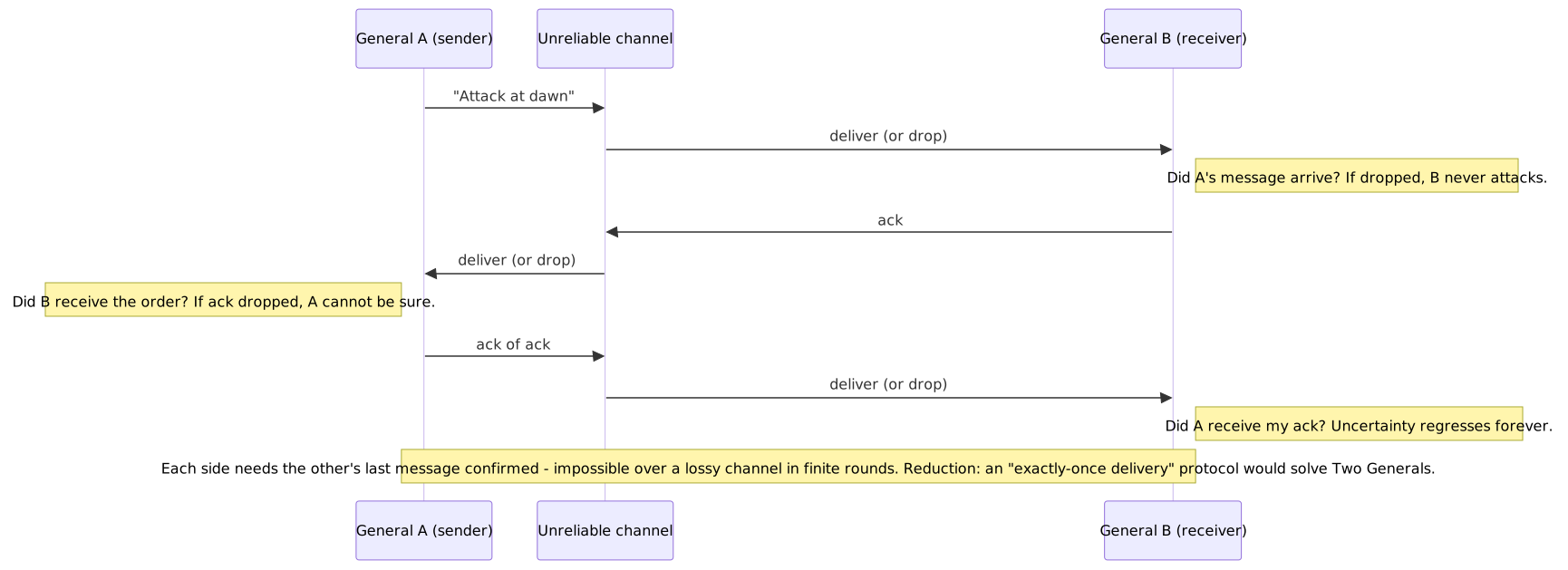
Exactly-once delivery — moving a message across an unreliable network so that it arrives once and only once — is impossible. The Two Generals’ Problem (Akkoyunlu, Ekanadham, Huber, 1975) shows that no finite acknowledgement protocol over a lossy channel can give both sides certainty that the last message arrived; the FLP impossibility result (Fischer, Lynch, Paterson, 1985) shows that even with reliable channels no deterministic protocol can solve consensus when one process may fail. What production systems call “exactly-once” is really exactly-once processing: at-least-once delivery composed with an idempotent sink (or transactional offset commit) so each message’s effect lands once even when the message itself is delivered many times. Tyler Treat frames the distinction as “delivery is a transport-layer semantic — it’s impossible; processing is an application-layer semantic — it’s achievable”, and Jay Kreps reframes Kafka’s guarantee the same way in “Exactly-once, once more”.
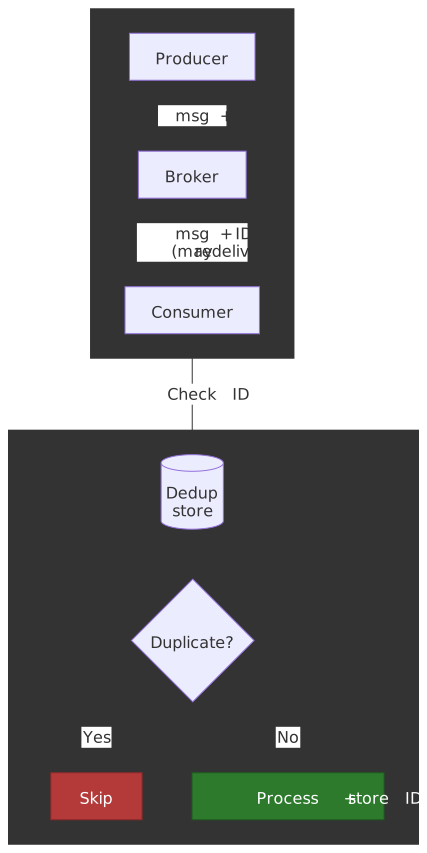
Mental Model
Six anchors that the rest of the article builds on:
- Delivery vs processing. “Exactly-once delivery” is a transport-layer claim and is impossible (Two Generals). “Exactly-once processing” is an application-layer claim and is achievable when the producer, the transport, the consumer’s state, and its offset commit form a closed system.
- Network unreliability is fundamental. Messages can be lost, duplicated, or reordered. No protocol can guarantee exactly-once delivery at the network layer.
- Effective exactly-once is a composition, not a primitive: at-least-once delivery (never lose a message) + idempotency or deduplication (make duplicates harmless) = single observable effect.
- Three layers can carry the dedup: producer (idempotent producers with sequence numbers in Kafka, idempotency keys in Stripe), broker (dedup windows — 5 min fixed in SQS FIFO, 20s–7d in Azure Service Bus), or consumer (processed-message table, transactional offset commits).
- Every dedup mechanism has a window, and the window is the bug. Retry timeouts that exceed the window silently re-introduce duplicates.
- Most guarantees stop at the system boundary. Kafka EOS does not extend to your Postgres write; Pub/Sub exactly-once is regional. Cross-system delivery still needs the outbox pattern, an idempotent sink, or a coordinator that participates in both transactions (Flink-style 2PC, KIP-939).
The Problem
Why Naive Solutions Fail
Approach 1: Fire-and-forget (at-most-once)
Send the message once with no retries. If the network drops it, the message is lost forever.
- Fails because: Message loss is common—TCP connections drop, services restart, packets get corrupted
- Example: Payment notification lost → customer never knows payment succeeded → duplicate payment attempt
Approach 2: Retry until acknowledged (at-least-once)
Keep retrying until you receive an acknowledgment. Never lose a message.
- Fails because: The acknowledgment itself can be lost. Producer retries a message that was actually processed.
- Example: Transfer
100 again → $200 withdrawn
Approach 3: Distributed transactions across the network (two-phase commit)
Coordinate sender and receiver in a 2PC transaction so that the message and its effect commit atomically.
- Fails because: 2PC is a blocking protocol — if the coordinator crashes after the prepare phase, participants stay locked until it recovers (no termination under partitions). It also requires both endpoints to expose XA-style transaction semantics, which most messaging stacks deliberately do not.
- 2PC is not useless — it is the basis of Flink’s
TwoPhaseCommitSinkFunctionand Kafka’s transaction coordinator — but it only delivers effective exactly-once inside a closed system with bounded coordination, never across an arbitrary network of independent peers. - Example: a textbook XA transaction across a TCP socket between sender and receiver leaves both sides locked indefinitely if the coordinator dies between prepare and commit.
The Core Challenge
The fundamental tension: reliability requires retries, but retries create duplicates.
The Two Generals’ Problem proves this for the network: two parties cannot achieve certainty of agreement over an unreliable channel — any finite sequence of confirmations leaves doubt about whether the final message arrived. An “exactly-once delivery” protocol would solve Two Generals; therefore no such protocol exists.
Important
FLP impossibility (Fischer, Lynch, Paterson, 1985). No deterministic algorithm can solve consensus in an asynchronous system where even one process may fail. The theorem assumes reliable message delivery but unbounded delays — every fault-tolerant consensus algorithm has runs that never terminate.1
Practical systems circumvent FLP through randomised algorithms (Ben-Or, Rabin), partial-synchrony assumptions (Paxos, Raft), or unreliable failure detectors. The implication for exactly-once: we cannot guarantee it at the protocol level, so we shift the work and make duplicates harmless instead. Every “effectively exactly-once” system in this article rests on a small Paxos- or Raft-replicated coordinator to commit the closed-system 2PC — Kafka’s transaction coordinator, Flink’s JobManager, the database’s transaction log.
Delivery Semantics
At-Most-Once
Each message is delivered zero or one times. Messages may be lost but are never redelivered.
Implementation: Send once, no retries, no acknowledgment tracking.
Trade-offs:
- ✅ Lowest latency and complexity
- ✅ No duplicate handling needed
- ❌ Data loss is guaranteed over time
- ❌ Unsuitable for critical operations
Use cases: Metrics collection, logging, real-time analytics where occasional loss is acceptable.
At-Least-Once
Each message is delivered one or more times. Messages are never lost, but duplicates occur.
Implementation: Retry with exponential backoff until acknowledgment received. Store unacked messages durably.
Trade-offs:
- ✅ No data loss
- ✅ Simple to implement
- ❌ Consumer must handle duplicates
- ❌ Ordering not guaranteed with retries
Use cases: Event sourcing, audit logs, any system where data loss is unacceptable and consumers are idempotent.
Exactly-Once (Effectively)
Each message’s effect occurs exactly once. The message may be delivered multiple times, but the system ensures idempotent processing.
Implementation: At-least-once delivery + one of:
- Idempotent operations (natural or designed)
- Deduplication at consumer (track processed message IDs)
- Transactional processing (atomic read-process-write)
Trade-offs:
- ✅ No data loss, no duplicate effects
- ❌ Higher complexity and latency
- ❌ Requires coordination between producer, broker, and consumer
- ❌ Deduplication window creates edge cases
Use cases: Financial transactions, order processing, any operation where duplicates cause real-world harm.
Comparison
| Aspect | At-Most-Once | At-Least-Once | Exactly-Once |
|---|---|---|---|
| Message loss | Possible | Never | Never |
| Duplicates | Never | Possible | Prevented |
| Complexity | Low | Medium | High |
| Latency | Lowest | Medium | Highest |
| State required | None | Retry queue | Dedup store + retry queue |
Design Paths
Path 1: Idempotent Operations
Make the operation itself idempotent—applying it multiple times produces the same result as applying it once.
When to choose this path:
- Operations are naturally idempotent (SET vs INCREMENT)
- You control the consumer’s state model
- Minimal infrastructure investment desired
Key characteristics:
- No deduplication storage required
- Works regardless of delivery semantics
- Requires careful operation design
Natural idempotency examples:
// SET operations are naturally idempotentawait db.query("UPDATE users SET email = $1 WHERE id = $2", [email, userId])// DELETE with specific criteria is idempotentawait db.query("DELETE FROM sessions WHERE user_id = $1 AND token = $2", [userId, token])// GET operations are always idempotentconst user = await db.query("SELECT * FROM users WHERE id = $1", [userId])Non-idempotent operations that need transformation:
// ❌ Non-idempotent: INCREMENTawait db.query("UPDATE accounts SET balance = balance + $1 WHERE id = $2", [amount, accountId])// ✅ Idempotent version: SET with version checkawait db.query( ` UPDATE accounts SET balance = $1, version = $2 WHERE id = $3 AND version = $4`, [newBalance, newVersion, accountId, expectedVersion],)Trade-offs vs other paths:
| Aspect | Idempotent Operations | Deduplication |
|---|---|---|
| Storage overhead | None | Message ID store |
| Design complexity | Higher (rethink operations) | Lower (add dedup layer) |
| Failure modes | Version conflicts | Window expiry |
| Latency | Lower | Higher (dedup lookup) |
Path 2: Idempotency Keys (API Pattern)
Client generates a unique key per logical operation. Server tracks keys and returns cached results for duplicates.
When to choose this path:
- Exposing APIs to external clients
- Operations are not naturally idempotent
- Client controls retry behavior
Key characteristics:
- Client generates unique key (UUID v4)
- Server stores operation result keyed by idempotency key
- Subsequent requests with same key return cached result
- Keys expire after a window (typically 24 hours)
Implementation approach:
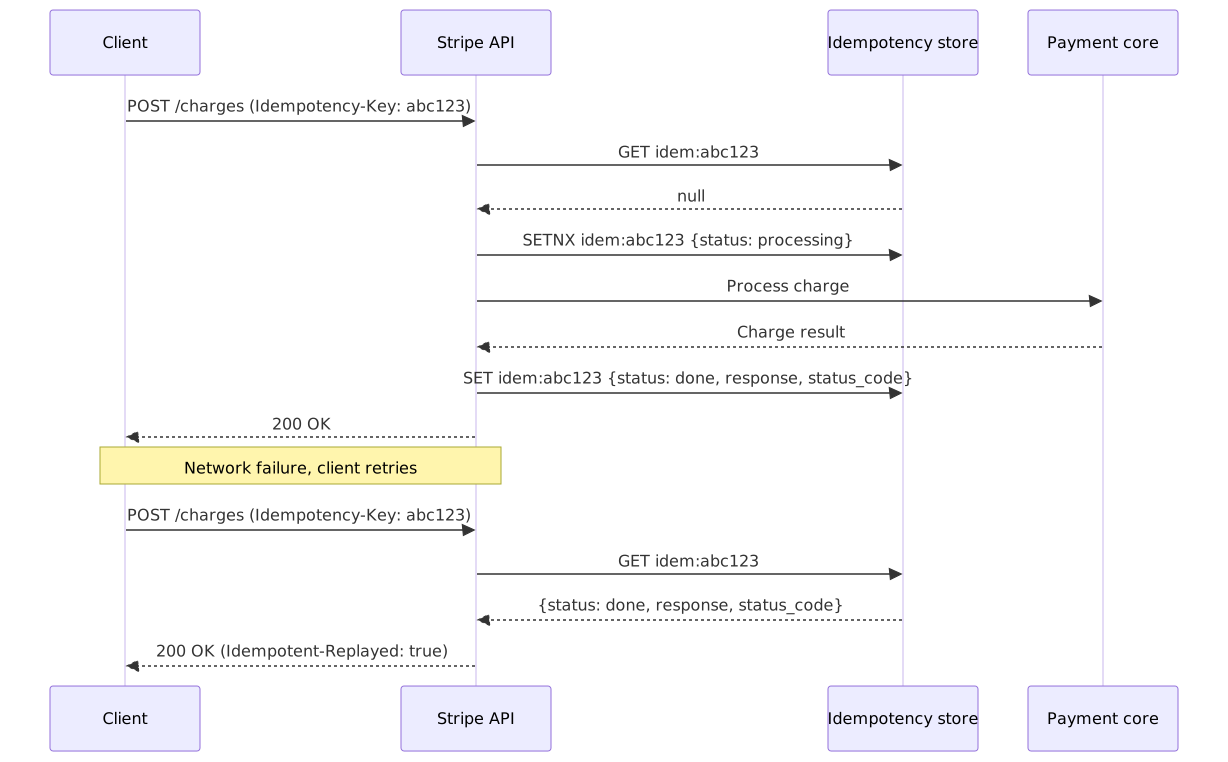
// Server-side idempotency key handlingimport { Redis } from "ioredis"interface IdempotencyRecord { status: "processing" | "completed" | "failed" response?: unknown createdAt: number}async function handleWithIdempotency( redis: Redis, idempotencyKey: string, operation: () => Promise<unknown>,): Promise<{ cached: boolean; response: unknown }> { // Check for existing record const existing = await redis.get(`idem:${idempotencyKey}`) if (existing) { const record: IdempotencyRecord = JSON.parse(existing) if (record.status === "completed") { return { cached: true, response: record.response } } // Still processing - return 409 Conflict throw new Error("Request already in progress") } // Mark as processing (with TTL to handle crashes) await redis.set( `idem:${idempotencyKey}`, JSON.stringify({ status: "processing", createdAt: Date.now() }), "EX", 3600, // 1 hour TTL for processing state "NX", // Only set if not exists ) // Execute operation and store result // ... operation execution and result caching}Stripe’s implementation details:
- Keys stored in Redis cluster shared across all API servers
- 24-hour retention window
- Keys recycled after window expires
- Response includes original status code and body
Real-world example:
Stripe processes millions of payment requests daily. Their idempotency key system:
- Client includes
Idempotency-Keyheader with UUID - Server returns
Idempotent-Replayed: trueheader for cached responses - First request that fails partway through is re-executed on retry
- First request that succeeds is returned from cache on retry
Result: Zero duplicate charges from network retries.
Path 3: Broker-Side Deduplication
Message broker tracks message IDs and filters duplicates before delivery to consumers.
When to choose this path:
- Using a message broker that supports deduplication
- Want to offload deduplication from consumers
- Willing to accept deduplication window constraints
Key characteristics:
- Producer assigns unique message ID
- Broker maintains recent message IDs in memory/storage
- Duplicates filtered before consumer delivery
- Window-based: IDs forgotten after expiry
Kafka idempotent producer (since 0.11, default since 3.0):
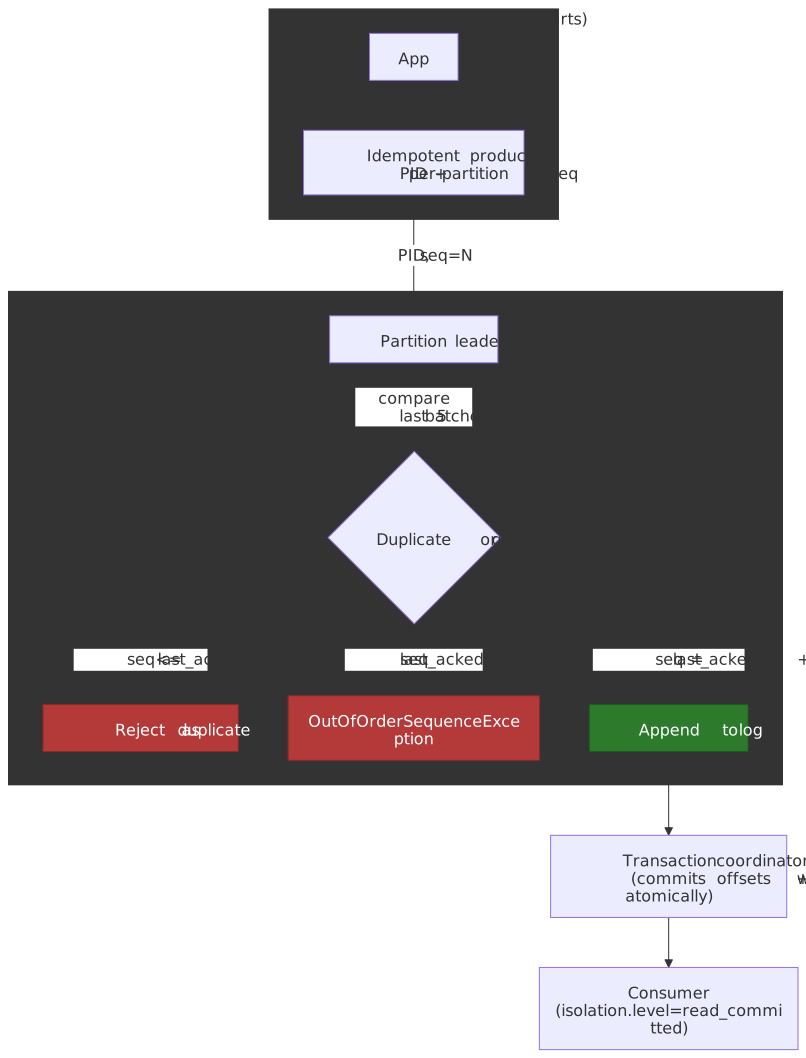
The broker assigns a 64-bit Producer ID (PID) to each producer instance. The producer assigns monotonically increasing 32-bit sequence numbers per topic-partition:
Producer → [PID: 12345, Seq: 0] → Broker (accepts)Producer → [PID: 12345, Seq: 1] → Broker (accepts)Producer → [PID: 12345, Seq: 1] → Broker (duplicate, rejects)Producer → [PID: 12345, Seq: 3] → Broker (out-of-order, error)Configuration (Kafka 3.0+):
# Defaults changed in Kafka 3.0 - these are now on by defaultenable.idempotence=trueacks=allPrior to Kafka 3.0:
enable.idempotencedefaulted tofalseandacksdefaulted to1. Enabling idempotence required explicit configuration.
Key limitation: Idempotence is only guaranteed within a producer session. If the producer crashes and restarts without a transactional.id, it gets a new PID and sequence numbers reset—previously sent messages may be duplicated.
AWS SQS FIFO deduplication:
- Fixed 5-minute deduplication window (cannot be changed)
- Two methods: explicit
MessageDeduplicationIdor content-based (SHA-256 of body) - After window expires, same ID can be submitted again
- Best practice: anchor
MessageDeduplicationIdto business context (e.g.,order-12345.payment) - With partitioning enabled:
MessageDeduplicationId + MessageGroupIddetermines uniqueness
Trade-offs vs other paths:
| Aspect | Broker-Side | Consumer-Side |
|---|---|---|
| Consumer complexity | Lower | Higher |
| Dedup window control | Broker-defined | Application-defined |
| Cross-broker dedup | No | Yes |
| Storage location | Broker | Application database |
Path 4: Consumer-Side Deduplication
Consumer tracks processed message IDs and skips duplicates.
When to choose this path:
- Broker doesn’t support deduplication
- Need longer deduplication windows than broker provides
- Want application-level control over dedup logic
Key characteristics:
- Consumer stores processed message IDs durably
- Check before processing; skip if seen
- ID storage must be in same transaction as state updates
- Flexible window: can retain IDs indefinitely
Implementation with database constraints:
// Idempotent consumer with database constraintsimport { Pool } from "pg"interface Message { id: string payload: unknown}async function processIdempotently( pool: Pool, subscriberId: string, message: Message, handler: (payload: unknown) => Promise<void>,): Promise<{ processed: boolean }> { const client = await pool.connect() try { await client.query("BEGIN") // Insert message ID - fails if duplicate (primary key violation) const result = await client.query( `INSERT INTO processed_messages (subscriber_id, message_id, processed_at) VALUES ($1, $2, NOW()) ON CONFLICT DO NOTHING RETURNING message_id`, [subscriberId, message.id], ) if (result.rowCount === 0) { // Duplicate - skip processing await client.query("ROLLBACK") return { processed: false } } // Process message (state updates happen here) await handler(message.payload) await client.query("COMMIT") return { processed: true } } finally { client.release() }}Schema:
CREATE TABLE processed_messages ( subscriber_id VARCHAR(255) NOT NULL, message_id VARCHAR(255) NOT NULL, processed_at TIMESTAMP NOT NULL DEFAULT NOW(), PRIMARY KEY (subscriber_id, message_id));-- Index for cleanup queriesCREATE INDEX idx_processed_messages_time ON processed_messages (processed_at);Real-world example:
A payment processor handling webhook retries:
- Each webhook includes unique
event_id - Before processing: check if
event_idexists inprocessed_webhookstable - If exists: return 200 OK immediately (idempotent response)
- If not: process event, insert ID, return 200 OK
- Daily job: delete records older than 30 days
Result: Webhooks can be retried indefinitely without duplicate effects.
Path 5: Transactional Processing
Wrap read-process-write into an atomic transaction. Either all effects happen or none do.
When to choose this path:
- Using Kafka with exactly-once requirements
- Processing involves read → transform → write pattern
- Need atomicity across multiple output topics/partitions
Key characteristics:
- Producer, consumer, and state updates are transactional
- Consumer offset committed as part of transaction
- Aborted transactions don’t affect state
- Requires
isolation.level=read_committedon consumers
Kafka transactional producer/consumer:
// Kafka exactly-once consume-transform-produceimport { Kafka, EachMessagePayload } from "kafkajs"const kafka = new Kafka({ brokers: ["localhost:9092"] })const producer = kafka.producer({ transactionalId: "my-transactional-producer", maxInFlightRequests: 1, idempotent: true,})const consumer = kafka.consumer({ groupId: "my-group", readUncommitted: false, // read_committed isolation})async function processExactlyOnce() { await producer.connect() await consumer.connect() await consumer.subscribe({ topic: "input-topic" }) await consumer.run({ eachMessage: async ({ topic, partition, message }: EachMessagePayload) => { const transaction = await producer.transaction() try { // Transform message const result = transform(message.value) // Produce to output topic (within transaction) await transaction.send({ topic: "output-topic", messages: [{ value: result }], }) // Commit consumer offset (within same transaction) await transaction.sendOffsets({ consumerGroupId: "my-group", topics: [{ topic, partitions: [{ partition, offset: message.offset }] }], }) await transaction.commit() } catch (error) { await transaction.abort() throw error } }, })}function transform(value: Buffer | null): string { // Your transformation logic return value?.toString().toUpperCase() ?? ""}Kafka’s transactional guarantees:
- Atomicity: All messages in transaction commit together or none commit
- Isolation: Consumers with
read_committedonly see committed messages - Durability: Committed transactions survive broker failures
Flink-style end-to-end 2PC. Apache Flink generalises this pattern into the TwoPhaseCommitSinkFunction so any sink that supports transactions (Kafka, Pulsar, JDBC with XA) can participate in Flink’s checkpoint barrier as a 2PC coordinator. The checkpoint barrier acts as the prepare phase; notifyCheckpointComplete from the JobManager is the commit phase.2
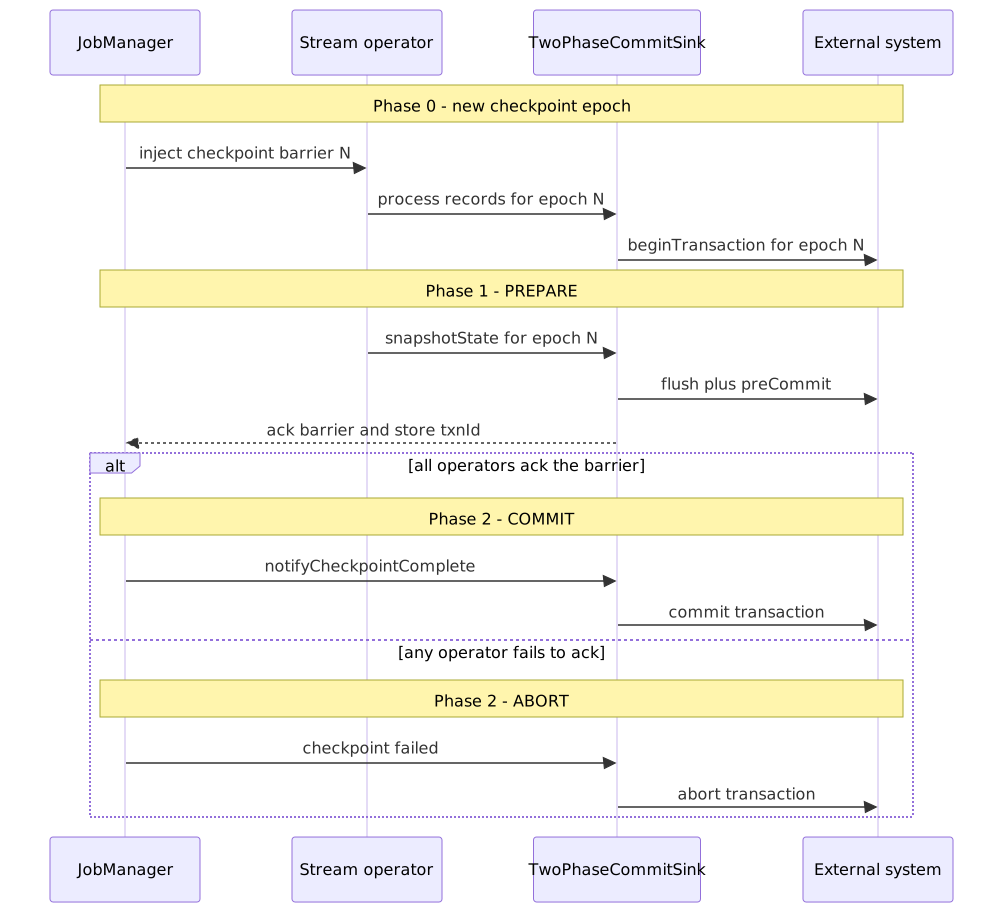
The four hooks: beginTransaction() opens a new external transaction at the start of each checkpoint epoch; invoke() writes records into it; preCommit() flushes and stores the transaction id in the checkpoint state; commit() is called by the JobManager only after every operator has acked the checkpoint; abort() rolls back if any operator fails. End-to-end latency is bounded by the checkpoint interval — downstream consumers never see a record from a checkpoint that did not commit. Pulsar 2.8.0 ships an equivalent transaction API that plugs into the same Flink contract.3
Trade-offs vs other paths:
| Aspect | Transactional | Consumer-Side Dedup |
|---|---|---|
| Latency | Higher (coordination) | Lower |
| Complexity | Framework handles | Application handles |
| Cross-system | Kafka ecosystem only | Works with any broker |
| Recovery | Automatic | Manual offset management |
Path 6: Transactional Outbox
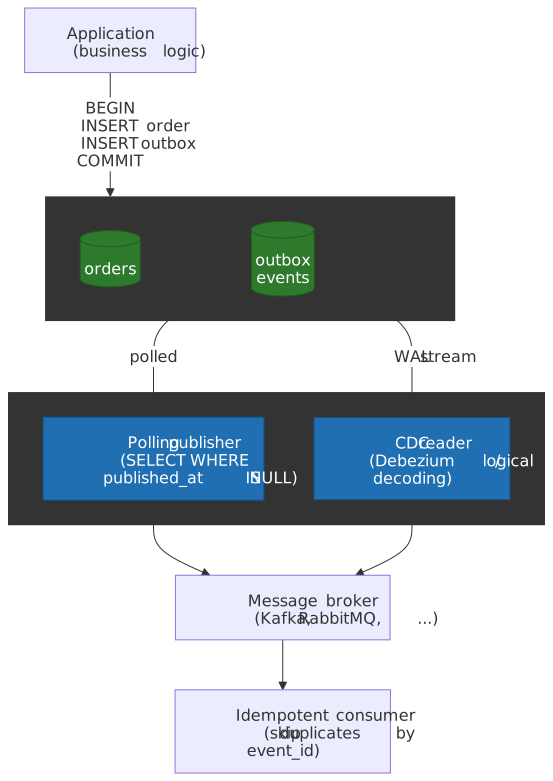
Solve the dual-write problem by writing business data and events to the same database transaction, then asynchronously publishing events to the message broker.
When to choose this path:
- Need to update a database AND publish an event atomically.
- Cannot tolerate lost events or phantom events (event published but DB write failed, or vice versa).
- Using a broker that doesn’t support distributed transactions with your database.
Key characteristics:
- Business data and outbox event written in a single database transaction.
- Background relay (poller or CDC reader) publishes outbox rows to the broker.
- Rows marked as published or deleted after successful publish.
- Requires idempotent consumers — the relay can publish duplicates on crash recovery.
Implementation approaches:
| Approach | Description | Trade-offs |
|---|---|---|
| Polling Publisher | Background service polls outbox table periodically | Simple, adds latency (polling interval) |
| Change Data Capture (CDC) | Tools like Debezium read database transaction logs | Lower latency, preserves order, more infrastructure |
| Log-only outbox | PostgreSQL logical decoding without materializing rows | Minimal database growth, Postgres-specific |
Implementation with polling publisher:
// Transactional outbox patternimport { Pool, PoolClient } from "pg"interface OutboxEvent { id: string aggregateType: string aggregateId: string eventType: string payload: unknown createdAt: Date}async function createOrderWithEvent(pool: Pool, order: Order): Promise<void> { const client = await pool.connect() try { await client.query("BEGIN") // Write business data await client.query( `INSERT INTO orders (id, customer_id, total, status) VALUES ($1, $2, $3, $4)`, [order.id, order.customerId, order.total, "created"], ) // Write event to outbox in same transaction await client.query( `INSERT INTO outbox (id, aggregate_type, aggregate_id, event_type, payload) VALUES ($1, $2, $3, $4, $5)`, [crypto.randomUUID(), "Order", order.id, "OrderCreated", JSON.stringify(order)], ) await client.query("COMMIT") } catch (error) { await client.query("ROLLBACK") throw error } finally { client.release() }}// Polling publisher (separate process)async function publishOutboxEvents(pool: Pool, publisher: MessagePublisher): Promise<void> { const client = await pool.connect() // ... polling and publishing logic}Outbox table schema:
CREATE TABLE outbox ( id UUID PRIMARY KEY, aggregate_type VARCHAR(255) NOT NULL, aggregate_id VARCHAR(255) NOT NULL, event_type VARCHAR(255) NOT NULL, payload JSONB NOT NULL, created_at TIMESTAMP NOT NULL DEFAULT NOW(), published_at TIMESTAMP NULL);CREATE INDEX idx_outbox_unpublished ON outbox (created_at) WHERE published_at IS NULL;Trade-offs vs direct publishing:
| Aspect | Transactional Outbox | Direct to Broker |
|---|---|---|
| Atomicity | Guaranteed | Dual-write problem |
| Latency | Higher (async relay) | Lower (direct) |
| Complexity | Higher (outbox + relay) | Lower |
| Ordering | Preserved (by created_at) | Depends on broker |
| Infrastructure | Database + relay process | Broker only |
Real-world usage:
Debezium’s outbox connector reads the outbox table via CDC and publishes to Kafka. This eliminates the need for a custom polling publisher and provides exactly-once delivery when combined with Kafka transactions.
Decision Framework
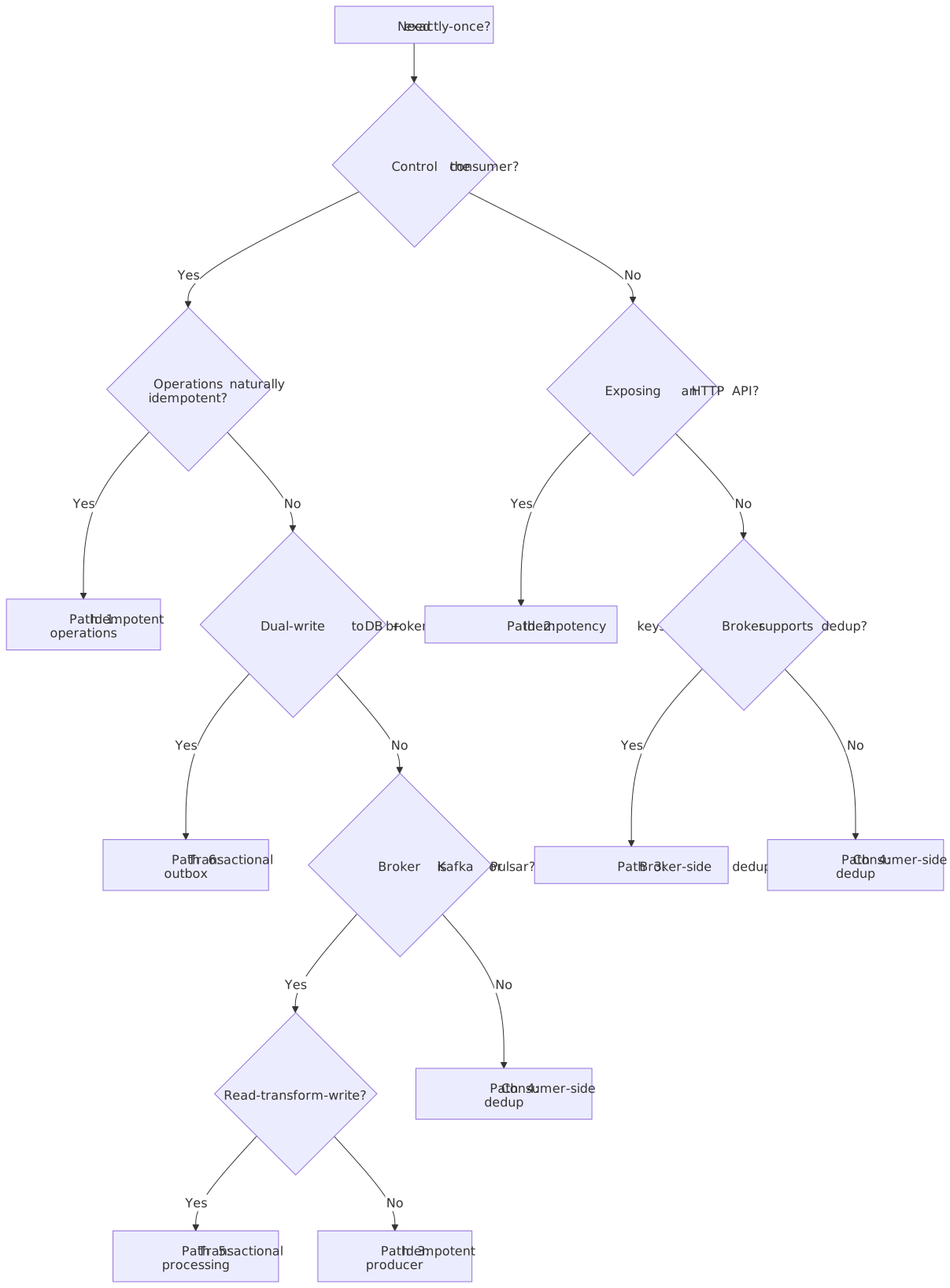
The six paths above can be selected with a small set of questions about who controls the consumer, whether operations are naturally idempotent, and which broker family is in play.
Production Implementations
Kafka: Confluent’s EOS
Context: Apache Kafka, originally developed at LinkedIn, now maintained by Confluent. Processes trillions of messages per day across major tech companies.
Implementation choices:
- Pattern variant: Idempotent producer + transactional processing
- Key customization: Producer ID (PID) with per-partition sequence numbers
- Scale: Tested at 1M+ messages/second with exactly-once guarantees
Architecture:
Specific details:
- Broker assigns a 64-bit Producer ID (PID) to each producer on init.
- Per topic-partition sequence numbers are 32-bit integers, monotonically increasing per producer.
- The broker tracks the last 5 record batches per
(PID, topic-partition). This is whymax.in.flight.requests.per.connectionis capped at 5 when idempotence is enabled — exceed it and the broker can no longer detect duplicates or gaps.4 - A gap (
seq > last_acked + 1) raisesOutOfOrderSequenceExceptioninstead of silently re-ordering. transactional.idpersists the PID across producer restarts; without it, a restart gets a fresh PID and previously-sent messages can be redelivered.- A transaction coordinator runs a two-phase commit across topic-partitions and offsets so the consume-transform-produce loop is atomic.
Version evolution:
| Version | Change |
|---|---|
| Kafka 0.11 | KIP-98 introduced idempotent producers and transactions. |
| Kafka 2.6 | EOS v2 (KIP-447) — one transactional producer per Streams thread instead of per task. Streams added the exactly_once_beta config name. |
| Kafka 3.0 | enable.idempotence=true and acks=all become producer defaults (KIP-679). Streams renames the option to exactly_once_v2. |
| Kafka 3.3 | KIP-618 adds exactly-once for Kafka Connect source connectors. |
| Kafka 4.0 | Removed deprecated exactly_once and exactly_once_beta Streams guarantees; users must migrate to exactly_once_v2.5 |
Note
KIP-939: Support Participation in 2PC is Accepted with implementation tracked in KAFKA-15370. It adds a PrepareTransaction RPC so an external coordinator (e.g. Flink, an XA transaction manager) can drive an atomic dual-write across Kafka and a database — eventually removing the need for an outbox in some topologies. As of 2026-Q2 the feature has not landed in a released Kafka version.
What worked:
- Idempotency is on by default since 3.0, so the common case has no extra configuration to remember.
- The consume-transform-produce loop is the canonical Streams pattern; the framework handles offset commits inside the transaction.
What was hard:
- The transaction coordinator is a single point of coordination per
transactional.id. Hot transactional ids can become a bottleneck. - Consumer rebalancing during a transaction can cause duplicates if the consumer is not using
isolation.level=read_committed. - EOS stops at the Kafka cluster boundary — beyond Kafka, consumers must still be idempotent.
Source: KIP-98 — Exactly Once Delivery and Transactional Messaging.
Stripe: Idempotency Keys
Context: Payment processing platform handling millions of API requests daily. A single duplicate charge causes real financial harm.
Implementation choices:
- Pattern variant: Client-generated idempotency keys with server-side caching
- Key customization: 24-hour retention, Redis-backed distributed cache
- Scale: Handles all Stripe API traffic with idempotency support
Architecture:
Specific details:
- Keys are client-provided strings, up to 255 characters.
- The cached entry includes the original status code and body.
- A successful retry receives the cached response with the
Idempotent-Replayed: trueheader. - Keys still in
processingstate return409 Conflictso concurrent retries cannot race past each other. - A separate Redis cluster isolates the idempotency store from the rest of the platform’s failure domains.
Note
Stripe’s API v1 retains idempotency keys for ~24 hours; API v2 extends this to 30 days. Pick a window longer than your worst-case retry budget — see “Deduplication window expiry” below.
What worked:
- Completely eliminates duplicate charges from network issues
- Clients can safely retry with exponential backoff
- No application logic changes needed for idempotent endpoints
What was hard:
- Determining correct 24-hour window (too short = duplicates, too long = storage cost)
- Handling partial failures (charge succeeded but idempotency record write failed)
- Cross-datacenter replication of idempotency store
Source: Designing robust and predictable APIs with idempotency
Google Pub/Sub: Exactly-Once Delivery
Context: Google Cloud’s managed messaging service. Added exactly-once delivery (GA December 2022).
Implementation choices:
- Pattern variant: Broker-side deduplication with acknowledgment tracking
- Key customization: Regional scope, unique message IDs
- Scale: Google-scale messaging with exactly-once in single region
Specific details:
- Exactly-once is guaranteed within a single cloud region only — subscribers spread across regions can still receive duplicates.6
- Pub/Sub assigns unique message IDs; the subscriber doesn’t have to invent its own.
- Subscribers receive acknowledgement confirmation (success or failure).
- Only the latest acknowledgement ID can acknowledge a message; older IDs fail with
INVALID_ARGUMENT. - Default ack deadline is 60 seconds if unspecified.
Supported configurations:
| Feature | Exactly-once support |
|---|---|
| Pull subscriptions | Yes |
| StreamingPull API | Yes |
| Push subscriptions | No |
| Export subscriptions | No |
Performance trade-offs:
- Higher latency: Significantly higher publish-to-subscribe latency than regular subscriptions, because the service runs an internal delivery-state persistence layer.
- Throughput limitation: client throughput is bounded by ~1,000 messages/second per ordering key when exactly-once is combined with ordered delivery (ordered delivery alone is also capped at 1 MB/s per ordering key).
- Publish-side duplicates: the subscription may still see duplicates that originate on the publish side (the guarantee covers redelivery, not republish).
Client library minimum versions (required for exactly-once):
| Language | Version |
|---|---|
| Python | v2.13.6+ |
| Java | v1.139.0+ |
| Go | v1.25.1+ |
| Node.js | v3.2.0+ |
What worked:
- Eliminates need for application-level deduplication in many cases
- Ack confirmation tells subscriber definitively if message was processed
What was hard:
- Regional constraint: Cross-region subscribers may receive duplicates
- Push subscriptions excluded (no ack confirmation mechanism)
- Still requires idempotent handlers for regional failover scenarios
- “The feature does not provide any guarantees around exactly-once side effects”—side effects are outside scope
Source: Cloud Pub/Sub exactly-once delivery
Azure Service Bus: Duplicate Detection
Context: Microsoft’s managed messaging service with configurable deduplication windows.
Implementation choices:
- Pattern variant: Broker-side deduplication with configurable window
- Key customization: Window from 20 seconds to 7 days
- Limitation: Standard/Premium tiers only (not Basic)
Specific details:
- Tracks
MessageIdfor every message inside the configured detection window (default 10 minutes, range 20 seconds to 7 days). - Duplicate messages are accepted at the API (the send succeeds) but silently dropped by the broker.
- Duplicate detection cannot be enabled or disabled after queue/topic creation.
- With partitioning:
MessageId + PartitionKeydetermines uniqueness.
Configuration:
duplicateDetectionHistoryTimeWindow: P7D # ISO 8601 duration, max 7 daysBest practice for MessageId:
{application-context}.{message-subject}Example: purchase-order-12345.paymentTrade-off: Longer windows provide better duplicate protection but consume more storage for tracking message IDs.
Source: Azure Service Bus duplicate detection
NATS JetStream: Message Deduplication
Context: High-performance messaging system with built-in deduplication.
Implementation choices:
- Pattern variant: Header-based deduplication with sliding window
- Key customization: Configurable window (default 2 minutes)
- Alternative: Infinite deduplication via
DiscardNewPerSubject(NATS 2.9.0+)
Specific details:
- Uses
Nats-Msg-Idheader for duplicate detection - Server tracks message IDs within deduplication window
- Double acknowledgment mechanism prevents erroneous re-sends after failures
Infinite deduplication pattern (NATS 2.9.0+):
// Stream configuration for infinite deduplication{ "discard": "new", "discard_new_per_subject": true, "max_msgs_per_subject": 1,}// Include unique ID in subject// Subject: orders.create.{order-id}Publish fails if a message with that subject already exists—provides infinite exactly-once publication.
Source: JetStream Model Deep Dive
Apache Pulsar: Transactions
Context: Multi-tenant distributed messaging with native exactly-once support since Pulsar 2.8.0.
Implementation choices:
- Pattern variant: Transaction API for atomic produce and acknowledgement
- Key customization: Cross-topic atomicity
- Scale: Used in production at Yahoo, Tencent, Verizon
Specific details:
- Transaction API enables atomic produce and acknowledgement across multiple topics
- Idempotent producer + exactly-once semantics at single partition level
- If transaction aborts, all writes and acknowledgments roll back
Transaction flow:
1. Begin transaction2. Produce to topic A (within transaction)3. Produce to topic B (within transaction)4. Acknowledge consumed message (within transaction)5. Commit or abortIntegration: Works with Apache Flink via TwoPhaseCommitSinkFunction for end-to-end exactly-once.
Source: Pulsar Transactions
Implementation Comparison
| Aspect | Kafka EOS | Stripe Idempotency | Pub/Sub | Azure Service Bus | NATS JetStream | Pulsar |
|---|---|---|---|---|---|---|
| Variant | Producer + transactions | Client keys + cache | Broker dedup | Broker dedup | Header dedup | Transactions |
| Scope | Kafka cluster | Any HTTP client | Single region | Queue/Topic | Stream | Multi-topic |
| Dedup window | Session/configurable | 24 hours | Regional | 20s–7 days | 2 min (default) | Transaction |
| Latency impact | 3% | Cache lookup | Significant | Minimal | Minimal | Transaction overhead |
| Client changes | Config only | Add header | Library upgrade | None | Add header | Transaction API |
Common Pitfalls
1. Deduplication Window Expiry
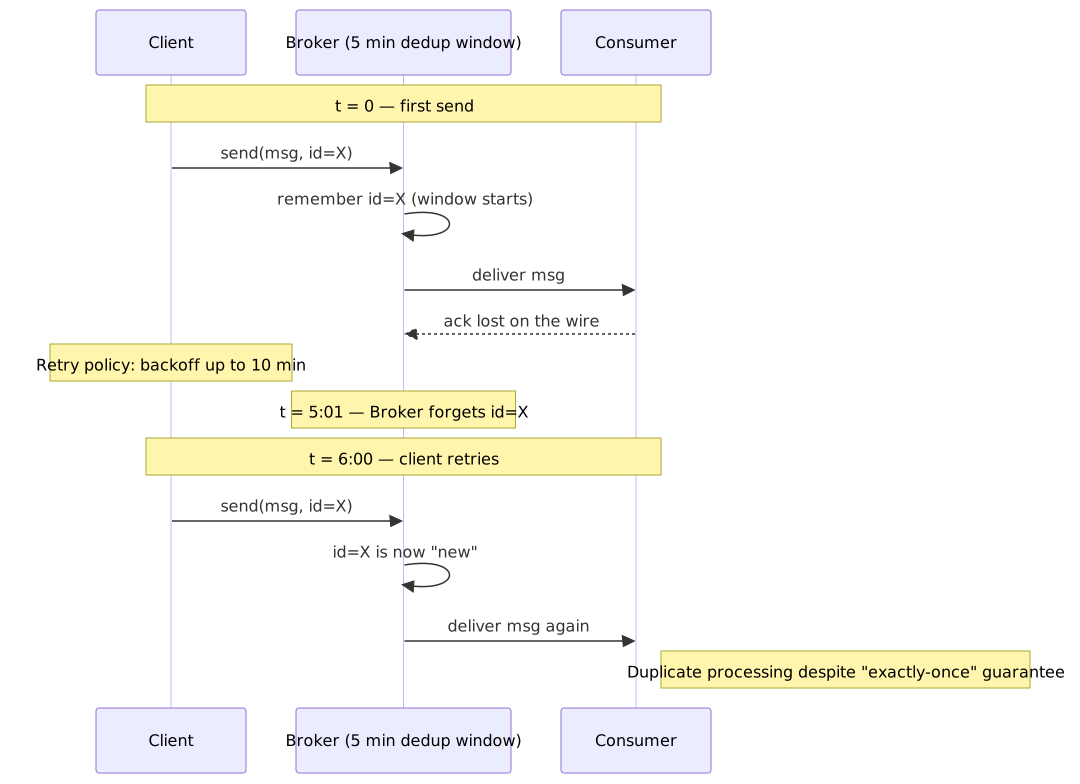
The mistake: Retry timeout longer than the broker’s deduplication window.
Example:
- Send message with id
Xat T = 0. - AWS SQS FIFO has a fixed 5-minute deduplication window.
- Client retry policy: exponential backoff up to 10 minutes.
- At T = 6 minutes the client retries; SQS no longer remembers
Xand accepts it as a new message. - Result: the consumer processes the same logical operation twice despite the “exactly-once” guarantee.
Solutions:
- Ensure max retry delay < deduplication window. With SQS FIFO that means capping at well under 5 minutes.
- Use exponential backoff with a cap:
min(2^attempt * 100ms, windowSize * 0.8). - For critical operations: implement consumer-side deduplication as a backup so the consumer survives any window expiry upstream.
2. Producer Restart Losing Sequence State
The mistake: Idempotent producer without transactional.id loses sequence state on restart.
Example:
- Kafka producer with
enable.idempotence=truebut notransactional.id - Producer crashes after sending message with seq=42
- Producer restarts, gets new PID, sequence resets to 0
- Messages with seq 0-42 are accepted again as “new”
- Result: 43 duplicate messages
Solutions:
- Set
transactional.idfor producers that must survive restarts - Or: accept potential duplicates and ensure consumer idempotency
3. Consumer Rebalancing Race Condition
The mistake: Processing message but not committing offset before rebalance.
Example:
- Consumer processes message from partition 0
- Before offset commit: rebalance triggered (session timeout, new consumer joins)
- Partition 0 reassigned to different consumer
- New consumer reads from last committed offset (before the processed message)
- Result: Message processed twice by two different consumers
Solutions:
- Use transactional consumers (offset committed with output)
- Implement idempotent consumer pattern (database constraint on message ID)
- Increase
session.timeout.msfor slow processing - Use cooperative rebalancing (
partition.assignment.strategy=CooperativeStickyAssignor)
4. Assuming Idempotency Key Uniqueness
The mistake: Using predictable keys that collide across users/operations.
Example:
- Developer uses
orderIdas idempotency key - User A creates order 12345, key = “12345”
- User B creates order 12345 in different tenant, same key = “12345”
- User B’s request returns User A’s cached response
- Result: Data leakage between tenants
Solutions:
- Include tenant/user ID in key:
{tenantId}:{operationId} - Use client-generated UUIDs (UUID v4)
- Never derive keys solely from user-provided identifiers
5. Idempotency for GET Requests
The mistake: Adding idempotency keys to read operations.
Example:
- Developer adds idempotency keys to all endpoints including GET
- GET /user/123 with key “abc” returns user data, cached
- User updates their profile
- GET /user/123 with key “abc” returns stale cached data
- Result: Clients see outdated data indefinitely
Solutions:
- Idempotency keys only for state-changing operations (POST, PUT, DELETE)
- GET requests are naturally idempotent—no key needed
- If caching reads, use standard HTTP caching (ETags, Cache-Control)
6. Clock Skew in Last-Write-Wins
The mistake: Using wall-clock timestamps for conflict resolution in distributed system.
Example:
- Node A (clock +100ms skew) writes value V1 at local time T1
- Node B (accurate clock) writes value V2 at local time T2
- T1 > T2 due to clock skew, but V2 was actually written later
- LWW comparison: V1 wins because T1 > T2
- Result: Causally later write (V2) is discarded
Solutions:
- Use Lamport timestamps or vector clocks instead of wall clocks
- Use hybrid logical clocks (HLC) for ordering with physical time hints
- Accept that LWW with physical clocks is eventually consistent, not causally consistent
7. Assuming EOS Extends Beyond System Boundaries
The mistake: Believing Kafka’s exactly-once guarantees extend to downstream systems.
Example:
- Kafka Streams app with
processing.guarantee=exactly_once_v2 - App reads from Kafka, processes, writes to PostgreSQL
- Assumption: “Kafka handles exactly-once, so PostgreSQL writes are safe”
- Reality: Kafka EOS only covers Kafka-to-Kafka. The PostgreSQL write is outside the transaction.
- Result: Consumer crashes after PostgreSQL write but before Kafka offset commit → duplicate write on restart
Solutions:
- Use transactional outbox pattern for database writes
- Implement idempotent database operations (upsert with message ID)
- Use KIP-939 (when available) for native 2PC with external databases
- Always design downstream consumers as idempotent regardless of upstream guarantees
8. Dual-Write to Database and Broker
The mistake: Writing to a database and then publishing to a message broker as two independent operations, treating success of the first as permission to attempt the second.
Example:
- Order service does
INSERT orders→ returns 200, thenproducer.send("OrderCreated", ...). - The DB row commits, the broker call fails (network blip, broker reboot, slow GC).
- The order exists; downstream services never learn about it. A retry from the caller may produce a second row but still no event — or, worse, an event with no row if the order is reordered.
- Symmetric failure: broker accepts, DB commit fails — phantom event for an order that does not exist.
Solutions:
- Replace the dual-write with a transactional outbox (Path 6): the event row commits in the same DB transaction as the business data, and a relay (poller or CDC) publishes it at-least-once.
- Or use a coordinator that participates in both transactions (Flink
TwoPhaseCommitSinkFunction, future Kafka KIP-939). - Never use a “best-effort”
try { send } catch { log.warn }— the warning is the bug.
9. Ack Before Side Effect (or Side Effect Before Ack)
The mistake: Choosing the wrong ordering of “process the message” vs “ack the broker”.
- Ack-then-process: ack first, then run the side effect. If the consumer crashes between the two, the message is acked but the side effect never happened — message loss, indistinguishable from at-most-once.
- Process-then-ack: run the side effect, then ack. If the consumer crashes between the two, the broker redelivers the message and the side effect runs again — duplicate, indistinguishable from naive at-least-once.
This is a re-statement of Two Generals at the consumer boundary: there is no ordering of “ack” and “side effect” that is safe under crash without an external invariant.
Solutions:
- Make the side effect idempotent (Path 1 or Path 2) so process-then-ack is safe to replay.
- Or commit the side effect and the offset in the same transaction (Path 5: Kafka EOS, Flink 2PC sink, JDBC + Kafka KIP-939).
- Or write the offset to the same database as the side effect (consumer-side dedup, Path 4) so a crash recovers a consistent
(state, last_processed_offset)pair. - Never rely on “if the side effect throws, we don’t ack” alone — partial side effects (HTTP call sent but response lost; DB row written but commit ack lost) are common and break the assumption.
Implementation Guide
System Selection Guide
| Requirement | Recommended System | Reason |
|---|---|---|
| Kafka ecosystem | Kafka with EOS v2 | Native support, minimal overhead |
| Serverless/managed | SQS FIFO or Pub/Sub | No infrastructure to manage |
| Configurable window | Azure Service Bus | 20s to 7 days window |
| High performance | NATS JetStream | Low latency, simple model |
| Cross-topic atomicity | Pulsar or Kafka | Transaction APIs |
| HTTP API idempotency | Redis + custom code | Stripe pattern |
When to Build Custom
Build custom when:
- Existing solutions don’t fit your consistency requirements
- Cross-system exactly-once needed (Kafka → external database)
- Need longer deduplication windows than broker provides
- Performance requirements exceed library capabilities
Implementation checklist:
- Define deduplication key format (unique, collision-resistant)
- Choose deduplication storage (Redis, database, in-memory)
- Set deduplication window (longer than max retry delay)
- Implement atomic state update + dedup record insert
- Add cleanup job for expired deduplication records
- Test with network partition simulation
- Test with producer/consumer restart scenarios
- Document failure modes and recovery procedures
Testing Exactly-Once
Unit tests:
- Same message ID processed twice → single state change
- Different message IDs → independent state changes
- Concurrent identical requests → single effect
Integration tests:
- Producer crash mid-send → no duplicates after restart
- Consumer crash mid-process → message reprocessed once
- Broker failover → no duplicates or losses
Chaos testing:
- Network partition between producer and broker
- Kill consumer during processing
- Slow consumer causing rebalance
- Clock skew between nodes
Conclusion
Exactly-once delivery is mathematically impossible across an unreliable network — Two Generals and FLP both close that door. What we ship is exactly-once processing: at-least-once delivery composed with an idempotent sink or a transactional offset commit, so each message’s observable effect lands exactly once even when the message itself is delivered many times.
The key insight is that exactly-once is a composition, not a primitive:
- Never lose messages (at-least-once delivery with retries and persistence)
- Make duplicates harmless (idempotent operations, deduplication tracking, or transactional processing)
Choose your implementation based on your constraints:
- Idempotent operations when you control the state model
- Idempotency keys for external-facing APIs
- Broker-side deduplication when your broker supports it (Kafka, SQS FIFO, Pub/Sub, Azure Service Bus, NATS JetStream)
- Consumer-side deduplication for maximum control and longer windows
- Transactional processing for Kafka/Pulsar consume-transform-produce patterns
- Transactional outbox when you need atomic database + event writes
Every approach has failure modes around the deduplication window. Design your retry policies to fit within the window, and consider layered approaches (broker + consumer deduplication) for critical paths.
Critical reminder: Most exactly-once guarantees stop at system boundaries. Kafka EOS doesn’t extend to your PostgreSQL database. Pub/Sub exactly-once is regional. Always design downstream consumers as idempotent, regardless of upstream guarantees.
Appendix
Prerequisites
- Understanding of distributed systems fundamentals (network failures, partial failures)
- Familiarity with message brokers (Kafka, SQS, or similar)
- Basic knowledge of database transactions
Terminology
- Idempotency: Property where applying an operation multiple times produces the same result as applying it once
- PID (Producer ID): Unique 64-bit identifier assigned to a Kafka producer instance by the broker
- Deduplication window: Time period during which the system remembers message IDs for duplicate detection
- EOS (Exactly-Once Semantics): Kafka’s term for effectively exactly-once processing guarantees
- 2PC (Two-Phase Commit): Distributed transaction protocol that ensures atomic commits across multiple participants
- CDC (Change Data Capture): Technique for reading database changes from transaction logs
- Transactional outbox: Pattern where events are written to an outbox table in the same database transaction as business data
Summary
- Exactly-once delivery is impossible (Two Generals 1975, FLP 1985); exactly-once processing is achievable inside a closed system with idempotent sinks or a transactional offset commit.
- Six implementation paths: idempotent operations, idempotency keys, broker-side dedup, consumer-side dedup, transactional processing (Kafka EOS / Flink 2PC sink), transactional outbox.
- Every deduplication mechanism has a window — design retry policies to fit inside it.
- Kafka EOS: idempotent producers (PID + per-partition sequence, broker tracks last 5 batches) + transactional consumers (
read_committed); idempotence has been the default since Kafka 3.0, EOS v2 since 2.6, source-connector EOS since 3.3, KIP-939 (external 2PC participation) accepted but not yet released as of 2026-Q2. - Flink generalises the same 2PC pattern via
TwoPhaseCommitSinkFunction: the checkpoint barrier is the prepare phase,notifyCheckpointCompleteis the commit phase. Pulsar 2.8.0 ships the matching transaction API. - Deduplication windows vary: SQS FIFO (5 min fixed), Azure Service Bus (20 s – 7 d, default 10 min), NATS JetStream (2 min default, infinite via
discard_new_per_subjectsince 2.9), Pub/Sub (regional only, push subscriptions excluded). - Most exactly-once guarantees stop at system boundaries — always design downstream consumers as idempotent.
- Anti-patterns to avoid: dual-write (DB then broker), ack-then-process or process-then-ack without idempotency, idempotency keys on GETs, wall-clock LWW, predictable idempotency keys.
- Test with chaos: network partitions, restarts, rebalancing, clock skew.
References
Theoretical Foundations
- Impossibility of Distributed Consensus with One Faulty Process - FLP impossibility theorem (1985)
- A Brief Tour of FLP Impossibility - Accessible explanation of FLP
- Two Generals’ Problem - First computer communication problem proven unsolvable
Apache Kafka
- KIP-98 - Exactly Once Delivery and Transactional Messaging - Kafka’s exactly-once specification
- KIP-129 - Streams Exactly-Once Semantics - Kafka Streams exactly-once
- KIP-447 - Producer scalability for exactly once semantics - EOS v2 improvements
- KIP-939 - Support Participation in 2PC - Kafka + external database atomic writes
- Message Delivery Guarantees for Apache Kafka - Confluent official docs
- Exactly-once Support in Apache Kafka - Jay Kreps on Kafka EOS
- Exactly-once, once more - Jay Kreps reframing the delivery vs processing debate
Cloud Messaging Services
- Cloud Pub/Sub exactly-once delivery - Google Pub/Sub implementation
- AWS SQS FIFO exactly-once processing - AWS implementation
- Azure Service Bus duplicate detection - Azure implementation
Other Messaging Systems
- JetStream Model Deep Dive - NATS deduplication
- Pulsar Transactions - Apache Pulsar exactly-once
API Idempotency
- Designing robust and predictable APIs with idempotency - Stripe’s idempotency key pattern
- Implementing Stripe-like Idempotency Keys in Postgres - Detailed implementation guide
Patterns
- Transactional outbox pattern - Microservices.io pattern reference
- Reliable Microservices Data Exchange With the Outbox Pattern - Outbox pattern with CDC
- Idempotent Consumer Pattern - Microservices.io pattern reference
- An Overview of End-to-End Exactly-Once Processing in Apache Flink (with Apache Kafka, too!) - Flink TwoPhaseCommitSinkFunction explained
- Paxos Made Simple - Lamport’s relevance: every closed-system 2PC coordinator in this article (Kafka, Flink, JobManager) is a small Paxos- or Raft-replicated state machine
General
- The impossibility of exactly-once delivery - Theoretical foundations
- You Cannot Have Exactly-Once Delivery - Why true exactly-once is impossible
Footnotes
-
Michael J. Fischer, Nancy A. Lynch, Michael S. Paterson. “Impossibility of Distributed Consensus with One Faulty Process”, Journal of the ACM 32(2), April 1985. ↩
-
Apache Flink. “An Overview of End-to-End Exactly-Once Processing in Apache Flink (with Apache Kafka, too!)”, 2018. ↩
-
Apache Pulsar. “What are transactions?” and “Why transactions?” — atomic produce + ack across multiple topic-partitions since Pulsar 2.8.0. ↩
-
Confirmed by the librdkafka maintainers in Default for max.in.flight.requests.per.connection breaks idempotency: “the broker tracks the last 5 sequence numbers per producer-partition for duplicate detection”. ↩
-
See the Kafka 4.0 Streams upgrade guide. ↩
-
All Pub/Sub-specific behaviour in this section is from Cloud Pub/Sub exactly-once delivery and the GA announcement (1 December 2022). ↩