LRU Cache Design: Eviction Strategies and Trade-offs
Learn the classic LRU cache implementation, understand its limitations, and explore modern alternatives like LRU-K, 2Q, ARC, and SIEVE for building high-performance caching systems.
Abstract
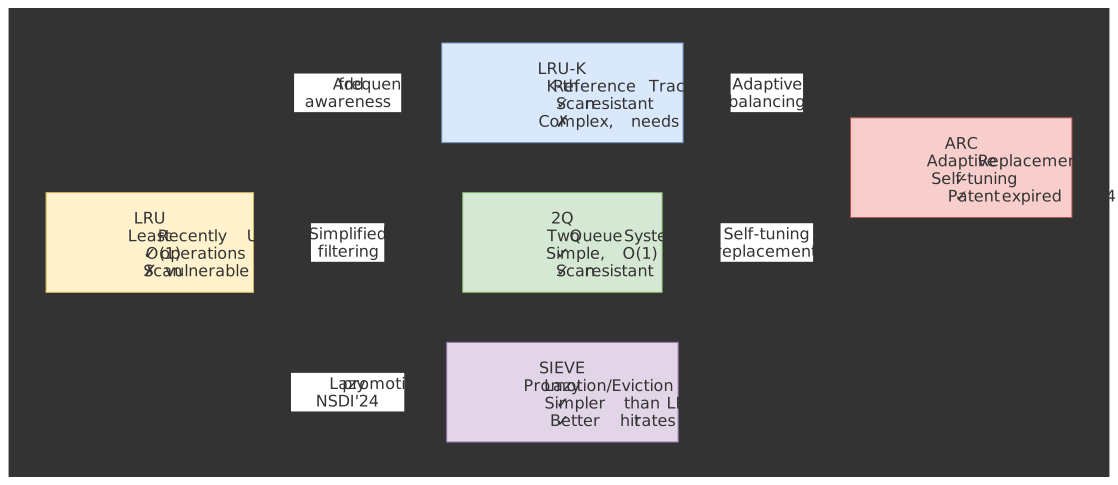
Cache eviction is fundamentally a prediction problem: given limited memory, which items should be kept to maximize future hits? The core insight is that different access patterns require different prediction strategies.
The Trade-off Space:
| Strategy | Predicts Future Access By | Vulnerable To | Best For |
|---|---|---|---|
| Recency (LRU) | Recent access | Sequential scans | Temporal locality |
| Frequency (LFU) | Access count | One-time popular items | Stable popularity |
| Hybrid (ARC, 2Q) | Both signals | Complexity overhead | Mixed workloads |
| Lazy (SIEVE) | Visited bit + FIFO | Very short TTLs | Web caches |
Key Design Decisions:
-
Recency vs. Frequency: LRU assumes “recently used = soon needed.” This fails catastrophically during sequential scans. Solutions: filter first-time accesses (2Q), adapt dynamically (ARC), or use lazy promotion (SIEVE).
-
Exact vs. Approximated: True LRU requires O(1) linked list operations on every access. Approximated LRU (Redis, Linux) samples random keys, trading accuracy for throughput—often 95%+ as effective with better scalability.
-
Memory Overhead vs. Accuracy: Ghost lists (ARC) and history tracking (LRU-K) improve hit rates but consume memory. SIEVE achieves comparable results with just one bit per entry.
Mental Model: Think of cache eviction as a bouncer at a club with limited capacity. LRU removes whoever hasn’t been seen longest. 2Q makes newcomers wait in a probationary area. ARC keeps notes on who was wrongly kicked out and learns from mistakes. SIEVE marks regulars with a wristband and only evicts unmarked patrons.
The Classic: Understanding LRU
Least Recently Used (LRU) is a cache eviction policy based on a single assumption: recently accessed data is likely to be accessed again soon. This principle, called temporal locality, holds for many workloads—web browsing, file system access, database queries—making LRU the default choice for general-purpose caching.
Why LRU Works:
- Temporal locality is common: users revisit pages, code re-executes hot paths, queries repeat
- Simple mental model: recent = important, old = expendable
- No frequency tracking: avoids overhead of counting accesses
Why LRU Fails:
- Sequential scans: A full table scan evicts your entire working set with data you’ll never access again
- No frequency signal: An item accessed 1000 times gets evicted after one scan if it wasn’t touched recently
- One-shot pollution: Batch jobs, backups, and analytics queries poison the cache
LRU Implementation: Achieving O(1) Operations
A cache is only useful if it’s fast. Both get and put must be O(1)—anything slower defeats the purpose of caching. The challenge: tracking recency requires ordering, but maintaining sorted order is O(n) or O(log n).
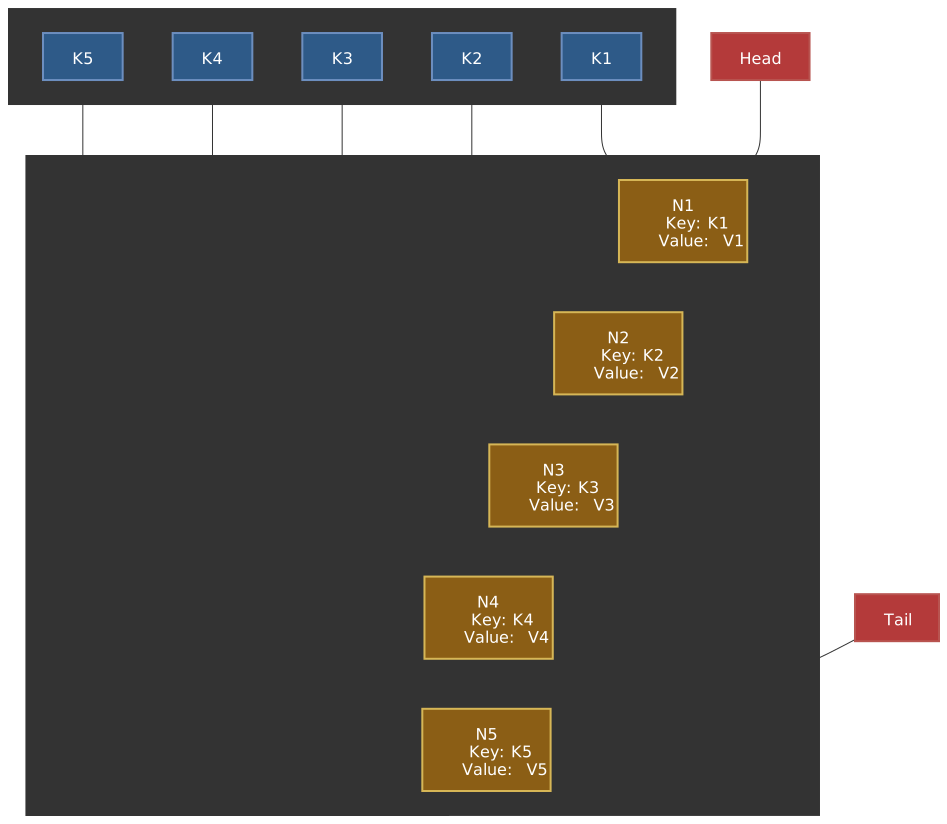
The Classic Solution: Hash Map + Doubly Linked List
| Data Structure | Purpose | Operation |
|---|---|---|
| Hash Map | O(1) key lookup | map[key] → node pointer |
| Doubly Linked List (DLL) | O(1) order maintenance | Head = MRU, Tail = LRU |
How Operations Work:
| Operation | Steps | Complexity |
|---|---|---|
get(key) |
Hash lookup → unlink → relink at head | O(1) |
put(key, value) |
Update/create at head, evict tail if full | O(1) |
| Eviction | Remove tail node, delete from hash map | O(1) |
Why Doubly Linked List? A singly linked list requires O(n) to find the predecessor for unlinking. Doubly linked lists store prev and next pointers, enabling O(1) removal from any position.
Implementation 1: Utilizing JavaScript Map’s Insertion Order
class LRUCache<K, V> { capacity: number cache: Map<K, V> constructor(capacity: number) { this.capacity = capacity this.cache = new Map() } get(key: K): V | null { if (!this.cache.has(key)) { return null } else { const value = this.cache.get(key)! // Remove and re-insert to move to end (most recently used) this.cache.delete(key) this.cache.set(key, value) return value } } put(key: K, value: V): void { if (this.cache.has(key)) { // Update existing key - remove and re-insert this.cache.delete(key) } else if (this.cache.size >= this.capacity) { // Remove least recently used (first key in Map) const keyToRemove = this.cache.keys().next().value this.cache.delete(keyToRemove) } this.cache.set(key, value) }}Implementation 2: Classic Doubly Linked List & Hash Map
class LRUCache { capacity: number cache: Map<number, ListNode> list: DoublyLinkedList constructor(capacity: number) { this.capacity = capacity this.cache = new Map() this.list = new DoublyLinkedList() } get(key: number): number { if (!this.cache.has(key)) { return -1 } else { const node = this.cache.get(key)! // Move to head (most recently used) this.list.removeNode(node) this.list.addToHead(node) return node.value } } put(key: number, value: number): void { if (this.cache.has(key)) { // Update existing key const node = this.cache.get(key)! node.value = value this.list.removeNode(node) this.list.addToHead(node) } else { if (this.cache.size >= this.capacity) { // Remove least recently used (tail) const removed = this.list.removeTail() if (removed) { this.cache.delete(removed.key) } } const node = new ListNode(key, value) this.list.addToHead(node) this.cache.set(key, node) } }}class ListNode { key: number value: number prev: ListNode | null next: ListNode | null constructor(key: number, value: number) { this.key = key this.value = value this.prev = null this.next = null }}class DoublyLinkedList { head: ListNode | null tail: ListNode | null constructor() { this.head = null this.tail = null } addToHead(node: ListNode): void { node.prev = null node.next = this.head if (this.head) { this.head.prev = node } this.head = node if (!this.tail) { this.tail = node } } removeNode(node: ListNode): void { const { prev, next } = node if (prev) prev.next = next if (next) next.prev = prev if (node === this.head) this.head = next if (node === this.tail) this.tail = prev node.prev = null node.next = null } removeTail(): ListNode | null { if (this.tail) { const removed = this.tail if (this.head === this.tail) { this.head = null this.tail = null } else { this.tail = this.tail.prev if (this.tail) { this.tail.next = null } } return removed } return null }}When LRU Fails: The Scan Problem
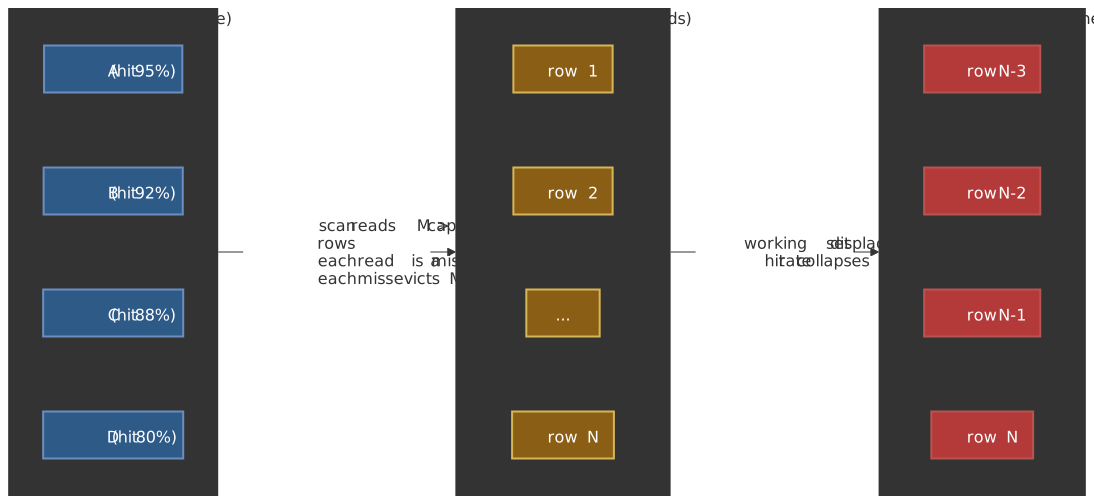
LRU equates “recently used” with “important”—an assumption that breaks catastrophically during sequential scans.
The Failure Mechanism:
Before scan: Cache contains hot items A, B, C, D (frequently accessed)During scan: Items 1, 2, 3, 4... sequentially accessedAfter scan: Cache contains cold items (last N scanned), hot items evictedResult: Miss storm as application reloads working setWhy This Matters:
- A single
SELECT * FROM large_tablecan destroy hours of cache warmup - Background jobs (backups, ETL, analytics) poison production caches
- The scan data is never accessed again, but it displaced data that would have been
Quantifying the Impact:
In a cache with 10,000 entries holding a working set with 95% hit rate:
- A 50,000-item sequential scan evicts the entire working set
- Hit rate drops to ~0% until the working set is reloaded
- If working set reload takes 100ms per item, that’s 1,000 seconds of degraded performance
Common LRU Failure Scenarios
| Scenario | Why It Fails | Frequency |
|---|---|---|
| Database full table scans | Analytics queries touch every row once | Common in OLAP |
| File system traversals | find, du, backup tools |
Daily operations |
| Batch processing | ETL jobs process datasets sequentially | Nightly jobs |
| Memory-mapped file reads | Sequential file I/O | Log processing |
| Cache warmup after restart | Loading entire dataset sequentially | Deployments |
Design Choices: Scan-Resistant Algorithms
To overcome LRU’s scan vulnerability, several algorithms incorporate additional signals beyond recency. Each makes different trade-offs between complexity, memory overhead, and adaptivity.
LRU-K: History-Based Filtering
Mechanism: Track the timestamps of the last K accesses per item. Evict based on the K-th most recent access time, not the most recent.
Why It Works: Items accessed only once (scan data) have no K-th access time and are evicted first. Items with K accesses have proven popularity.
Best When:
- Database buffer pools with mixed OLTP/OLAP workloads
- Workloads where frequency is a better predictor than recency
- K can be tuned for the specific access pattern (typically K=2)
Trade-offs:
- ✅ Scan-resistant: single-access items evicted quickly
- ✅ Frequency-aware: distinguishes truly popular items
- ✅ LRU-1 degenerates to standard LRU (backward compatible)
- ❌ Requires K timestamps per entry (memory overhead)
- ❌ K parameter needs tuning (workload-dependent)
- ❌ Naive eviction is O(n); requires heap for O(log n)
Real-World Example: The original LRU-K paper (O’Neil, O’Neil & Weikum, SIGMOD 1993) demonstrated that on a one-hour OLTP trace at small buffer sizes, LRU-1 needed more than twice the buffer pages of LRU-2 to match the same hit ratio — the “equi-effective buffer size ratio” the authors used to compare policies. The gain shrinks as buffer size grows, but for memory-constrained workloads with mixed sequential and random access, the improvement is substantial.
class LRUKCache { capacity: number k: number cache: Map<number, { value: number; accessTimes: number[] }> constructor(capacity: number, k: number = 2) { this.capacity = capacity this.k = k this.cache = new Map() } get(key: number): number { if (!this.cache.has(key)) { return -1 } const item = this.cache.get(key)! const now = Date.now() // Add current access time item.accessTimes.push(now) // Keep only the last K access times if (item.accessTimes.length > this.k) { item.accessTimes.shift() } return item.value } put(key: number, value: number): void { const now = Date.now() if (this.cache.has(key)) { const item = this.cache.get(key)! item.value = value item.accessTimes.push(now) if (item.accessTimes.length > this.k) { item.accessTimes.shift() } } else { if (this.cache.size >= this.capacity) { this.evictLRU() } this.cache.set(key, { value, accessTimes: [now] }) } } private evictLRU(): void { let oldestTime = Infinity let keyToEvict = -1 for (const [key, item] of this.cache) { if (item.accessTimes.length < this.k) { // Items with fewer than K accesses are evicted first if (item.accessTimes[0] < oldestTime) { oldestTime = item.accessTimes[0] keyToEvict = key } } else { // For items with K+ accesses, use K-th most recent access const kthAccess = item.accessTimes[item.accessTimes.length - this.k] if (kthAccess < oldestTime) { oldestTime = kthAccess keyToEvict = key } } } if (keyToEvict !== -1) { this.cache.delete(keyToEvict) } }}Time Complexity Note: The implementation above has O(n) time complexity for eviction due to the linear scan through all cache entries in evictLRU(). For true O(1) operations, you would need:
- Min-Heap Approach: Use a min-heap ordered by K-th access time, achieving O(log n) eviction
- Approximation Approach: Sample random entries instead of scanning all (trading accuracy for speed)
- Hybrid Approach: Maintain sorted structure with periodic rebalancing
In practice, the O(n) eviction complexity is acceptable for small to medium cache sizes (< 10,000 entries), and the simpler implementation reduces bugs and maintenance overhead. For larger caches, production systems typically use approximated LRU-K with sampling.
2Q: Probationary Filtering
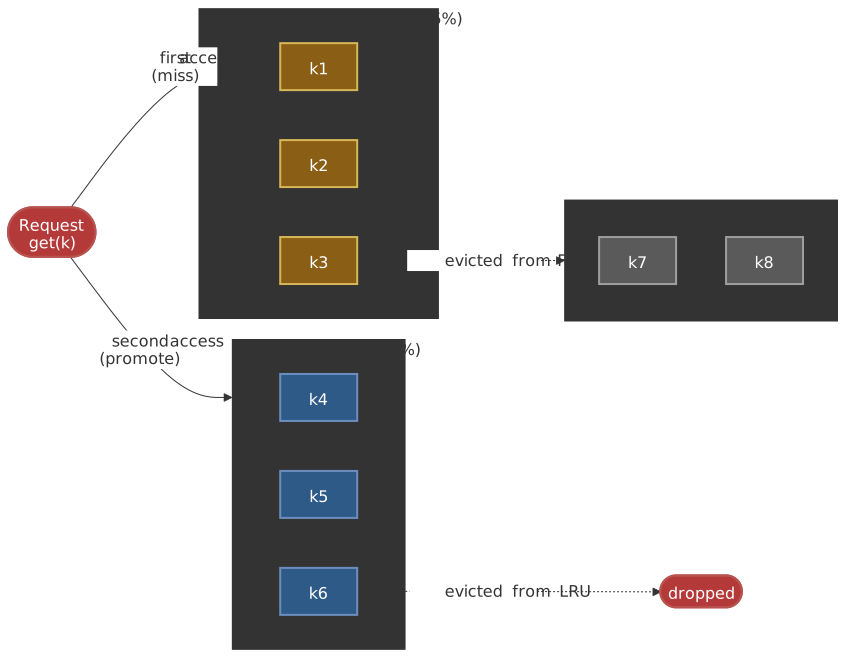
Mechanism: Use two queues to filter first-time accesses before admitting to the main cache. Source: Johnson & Shasha, VLDB 1994.
| Queue | Type | Purpose |
|---|---|---|
| A1in (Probationary) | FIFO | Holds first-time accesses |
| Am (Main) | LRU | Holds proven items (accessed 2+ times) |
| A1out (Ghost) | Keys only | Remembers recently evicted A1 items |
Why It Works: Sequential scan data enters A1, gets evicted from A1 (never touching Am), and the main cache remains unpolluted. Only items accessed twice make it to Am.
Best When:
- Production databases needing scan resistance — PostgreSQL backpatched 2Q into 8.0.2 to dodge the ARC patent.
- Systems requiring O(1) operations without tuning parameters.
- Patent-free implementations required (no patent on 2Q).
Trade-offs:
- ✅ True O(1) operations (no heap, no timestamps)
- ✅ Simple to implement and debug
- ✅ Excellent scan resistance
- ✅ No patents
- ❌ Fixed queue sizes may not adapt to workload changes
- ❌ Requires tuning A1/Am size ratio (typically 25%/75%)
- ❌ Ghost list (A1out) adds memory overhead
Real-World Example: PostgreSQL introduced ARC in 8.0.0, discovered IBM’s pending US patent, and backpatched 2Q into 8.0.2 (LWN coverage). The PostgreSQL developers found 2Q provided comparable performance to ARC without legal exposure. They later moved to clock sweep in 8.1 for better concurrency characteristics under multi-core load.
class TwoQueueCache { capacity: number a1Size: number amSize: number // A1: probationary queue (FIFO) - uses Map insertion order a1: Map<number, number> // Am: main cache (LRU) - uses Map insertion order with re-insertion on access am: Map<number, number> constructor(capacity: number) { this.capacity = capacity this.a1Size = Math.floor(capacity * 0.25) // 25% for probationary this.amSize = capacity - this.a1Size this.a1 = new Map() this.am = new Map() } get(key: number): number { // Check main cache first (LRU: re-insert to move to end) if (this.am.has(key)) { const value = this.am.get(key)! this.am.delete(key) this.am.set(key, value) return value } // Check probationary queue if (this.a1.has(key)) { const value = this.a1.get(key)! // Promote to main cache this.a1.delete(key) this.am.set(key, value) // Ensure main cache doesn't exceed capacity if (this.am.size > this.amSize) { this.evictFromAm() } return value } return -1 } put(key: number, value: number): void { // If already in main cache, update (LRU: re-insert) if (this.am.has(key)) { this.am.delete(key) this.am.set(key, value) return } // If in probationary queue, promote to main cache if (this.a1.has(key)) { this.a1.delete(key) this.am.set(key, value) if (this.am.size > this.amSize) { this.evictFromAm() } return } // New item goes to probationary queue (FIFO) this.a1.set(key, value) if (this.a1.size > this.a1Size) { this.evictFromA1() } } private evictFromA1(): void { // Remove oldest item from A1 (FIFO - first key in Map) const oldestKey = this.a1.keys().next().value if (oldestKey !== undefined) { this.a1.delete(oldestKey) } } private evictFromAm(): void { // Remove least recently used from Am (LRU - first key in Map) const oldestKey = this.am.keys().next().value if (oldestKey !== undefined) { this.am.delete(oldestKey) } }}Implementation Note: This implementation achieves true O(1) operations by leveraging JavaScript Map’s guaranteed insertion order (ES2015+). The A1 queue uses FIFO semantics (oldest = first inserted = first key), while Am uses LRU semantics (re-insert on access moves to end, evict from beginning).
ARC: Adaptive Self-Tuning
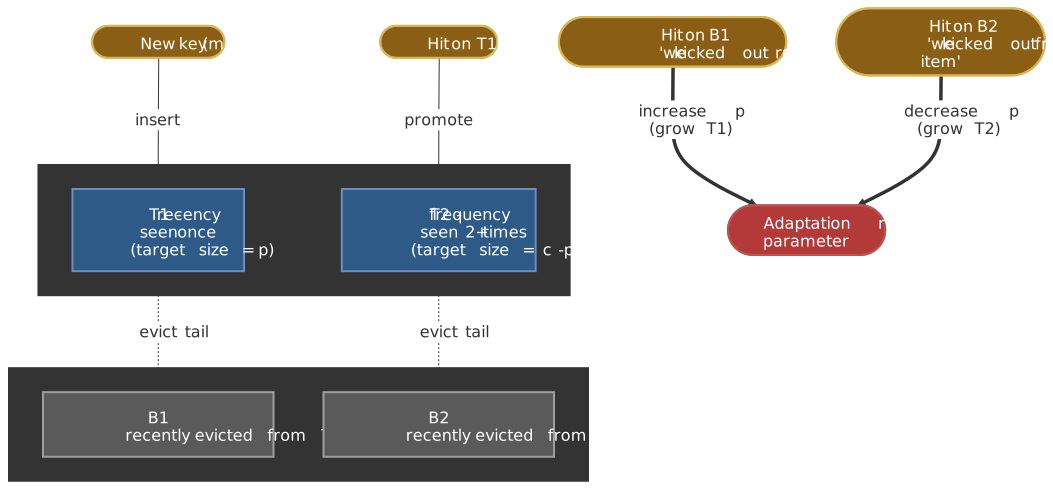
Mechanism: Maintain two LRU lists (T1 for recency, T2 for frequency) with adaptive sizing based on “ghost lists” that remember recently evicted keys. Source: Megiddo & Modha, USENIX FAST 2003.
| List | Contents | Purpose |
|---|---|---|
| T1 | Recently accessed once | Recency-focused cache |
| T2 | Accessed multiple times | Frequency-focused cache |
| B1 | Keys evicted from T1 | Ghost list for recency misses |
| B2 | Keys evicted from T2 | Ghost list for frequency misses |
The Learning Rule:
- Hit in B1 → “We shouldn’t have evicted that recent item” → Increase T1 size
- Hit in B2 → “We shouldn’t have evicted that frequent item” → Increase T2 size
- Parameter
pcontrols the T1/T2 split and adapts continuously
Why It Works: The ghost lists act as a feedback mechanism. ARC learns from its eviction mistakes and automatically adjusts the recency/frequency balance for the current workload.
Best When:
- Workloads with unpredictable or shifting access patterns
- Systems where self-tuning eliminates operational burden
- ZFS (uses ARC for its Adjustable Replacement Cache)
Trade-offs:
- ✅ Self-tuning: no parameters to configure
- ✅ Handles mixed workloads dynamically
- ✅ Ghost lists provide learning without storing values
- ✅ Patent expired February 22, 2024 (US6996676B2) — now freely usable
- ❌ Memory overhead: 4 data structures + ghost lists can equal cache size
- ❌ More complex to implement and debug
- ❌ Ghost list maintenance adds CPU overhead
Patent History and Industry Impact:
ARC was developed by Nimrod Megiddo and Dharmendra S. Modha at IBM Almaden Research Center. The patent (US6996676B2, filed November 14, 2002, granted February 7, 2006) had significant industry implications:
| System | Response to ARC Patent |
|---|---|
| PostgreSQL | Used ARC in 8.0.0/8.0.1 → backpatched 2Q into 8.0.2 → clock sweep in 8.1 |
| ZFS | Adopted ARC at inception (2005); shipped under Sun’s CDDL licence with ARC referenced in the source — IBM did not enforce the patent against open ZFS forks |
| MySQL | Adopted LIRS-style scan-resistant LRU instead |
| Open-source projects | Generally avoided ARC until patent expiration |
Real-World Example: ZFS has used ARC since its inception (2005), with the ARC patent acknowledged in the source. ZFS extended it with L2ARC for SSD-tier caching, demonstrating that the adaptive approach works well for storage systems with mixed sequential/random workloads.
class ARCCache { capacity: number p: number // Adaptation parameter // Main cache lists t1: Map<number, { value: number; timestamp: number }> // Recently accessed once t2: Map<number, { value: number; timestamp: number }> // Recently accessed multiple times // Ghost lists (keys only) b1: Set<number> // Recently evicted from T1 b2: Set<number> // Recently evicted from T2 constructor(capacity: number) { this.capacity = capacity this.p = 0 this.t1 = new Map() this.t2 = new Map() this.b1 = new Set() this.b2 = new Set() } get(key: number): number { // Check T1 if (this.t1.has(key)) { const item = this.t1.get(key)! this.t1.delete(key) this.t2.set(key, { value: item.value, timestamp: Date.now() }) return item.value } // Check T2 if (this.t2.has(key)) { const item = this.t2.get(key)! item.timestamp = Date.now() return item.value } // Check ghost lists for adaptation if (this.b1.has(key)) { this.adapt(true) // Increase T1 size this.b1.delete(key) } else if (this.b2.has(key)) { this.adapt(false) // Increase T2 size this.b2.delete(key) } return -1 } put(key: number, value: number): void { // If already in cache, update if (this.t1.has(key)) { const item = this.t1.get(key)! this.t1.delete(key) this.t2.set(key, { value, timestamp: Date.now() }) return } if (this.t2.has(key)) { this.t2.set(key, { value, timestamp: Date.now() }) return } // New item goes to T1 this.t1.set(key, { value, timestamp: Date.now() }) // Ensure capacity constraints this.ensureCapacity() } private adapt(increaseT1: boolean): void { if (increaseT1) { this.p = Math.min(this.p + 1, this.capacity) } else { this.p = Math.max(this.p - 1, 0) } } private ensureCapacity(): void { const totalSize = this.t1.size + this.t2.size if (totalSize <= this.capacity) { return } // Calculate target sizes const targetT1 = Math.min(this.p, this.capacity) const targetT2 = this.capacity - targetT1 // Evict from T1 if needed while (this.t1.size > targetT1) { const oldestKey = this.getOldestKey(this.t1) if (oldestKey !== null) { const item = this.t1.get(oldestKey)! this.t1.delete(oldestKey) this.b1.add(oldestKey) // Limit ghost list size if (this.b1.size > this.capacity) { const firstKey = this.b1.values().next().value this.b1.delete(firstKey) } } } // Evict from T2 if needed while (this.t2.size > targetT2) { const oldestKey = this.getOldestKey(this.t2) if (oldestKey !== null) { const item = this.t2.get(oldestKey)! this.t2.delete(oldestKey) this.b2.add(oldestKey) // Limit ghost list size if (this.b2.size > this.capacity) { const firstKey = this.b2.values().next().value this.b2.delete(firstKey) } } } } private getOldestKey(map: Map<number, { value: number; timestamp: number }>): number | null { let oldestKey = null let oldestTime = Infinity for (const [key, item] of map) { if (item.timestamp < oldestTime) { oldestTime = item.timestamp oldestKey = key } } return oldestKey }}Important
The reference ARC in the paper is O(1) per operation: T1, T2, B1, and B2 are doubly linked lists, eviction takes the tail in O(1), and the ghost lists are size-bounded with 2c entries total. The toy above uses a timestamp scan (O(n)) so the four-list state machine is easier to follow. A production port should mirror the LRU implementation pattern — hash map + DLL per list — and bound |T1| + |B1| ≤ c, |T1| + |T2| + |B1| + |B2| ≤ 2c exactly as the paper specifies.
SIEVE: Lazy Promotion (NSDI’24)
Mechanism: Maintain a single FIFO queue with one “visited” bit per entry and a “hand” pointer for eviction. Source: Zhang et al., NSDI 2024.
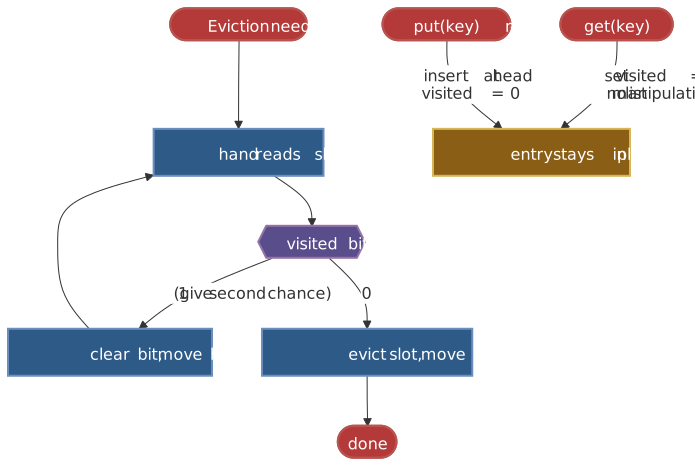
Queue: [A*] [B] [C*] [D*] [E] ← hand points here *=visited bit setOn hit: Set visited bit (no list manipulation)On miss: Move hand from tail, reset visited bits, evict first unvisited itemWhy It Works:
- Items accessed multiple times have their visited bit set and survive the hand sweep
- Scan data enters, never gets revisited, and is evicted on the first hand pass
- No list manipulation on hits = better cache locality and concurrency
Best When:
- Web caches with high throughput requirements
- Systems where lock contention is a concern
- Workloads where items tend to be accessed in bursts
Trade-offs:
- ✅ Simpler than LRU (no list manipulation on hits)
- ✅ Better throughput (fewer memory operations)
- ✅ One bit per entry (minimal memory overhead)
- ✅ Beats every other algorithm on more than 45% of the 1,559 evaluated traces (next-best beats others on 15%)
- ❌ Less effective for very short TTLs (items may be evicted before hand reaches them)
- ❌ Newer algorithm (2024), less battle-tested than LRU/2Q/ARC
Real-World Example: SIEVE was evaluated on 1,559 traces / 247 billion requests / 14.8 billion objects sourced from seven production datasets (NSDI’24 paper). On the CDN1 dataset it reduces miss ratio by 21% on average vs. FIFO (author writeup). It has been adopted as a primitive by TiDB, Pelikan, and several other open-source caches — Pelikan was originally open-sourced from Twitter, but adoption inside Twitter’s production cache fleet is not publicly confirmed.
class SIEVECache<K, V> { capacity: number cache: Map<K, { value: V; visited: boolean }> order: K[] // FIFO order hand: number // Eviction pointer constructor(capacity: number) { this.capacity = capacity this.cache = new Map() this.order = [] this.hand = 0 } get(key: K): V | null { const entry = this.cache.get(key) if (!entry) return null // Lazy promotion: just set the visited bit (no list manipulation) entry.visited = true return entry.value } put(key: K, value: V): void { if (this.cache.has(key)) { const entry = this.cache.get(key)! entry.value = value entry.visited = true return } // Evict if at capacity while (this.cache.size >= this.capacity) { this.evict() } // Insert at head (newest position) this.cache.set(key, { value, visited: false }) this.order.unshift(key) } private evict(): void { // Move hand from tail toward head, looking for unvisited item while (this.order.length > 0) { // Wrap around if needed if (this.hand >= this.order.length) { this.hand = this.order.length - 1 } const key = this.order[this.hand] const entry = this.cache.get(key) if (!entry) { // Key was deleted externally this.order.splice(this.hand, 1) continue } if (entry.visited) { // Give it another chance, reset visited bit entry.visited = false this.hand-- if (this.hand < 0) this.hand = this.order.length - 1 } else { // Evict this item this.cache.delete(key) this.order.splice(this.hand, 1) return } } }}Window TinyLFU (Caffeine)
Mechanism: Combine a small “window” LRU cache with a large “main” SLRU cache using frequency-based admission filtering. The 2015 paper proposed a fixed 1% window / 99% main split; Caffeine starts there but adapts the split via a hill-climbing controller that probes hit-rate as the workload shifts between recency-heavy and frequency-heavy. Source: Einziger, Friedman & Manes, ACM TOS 2017.
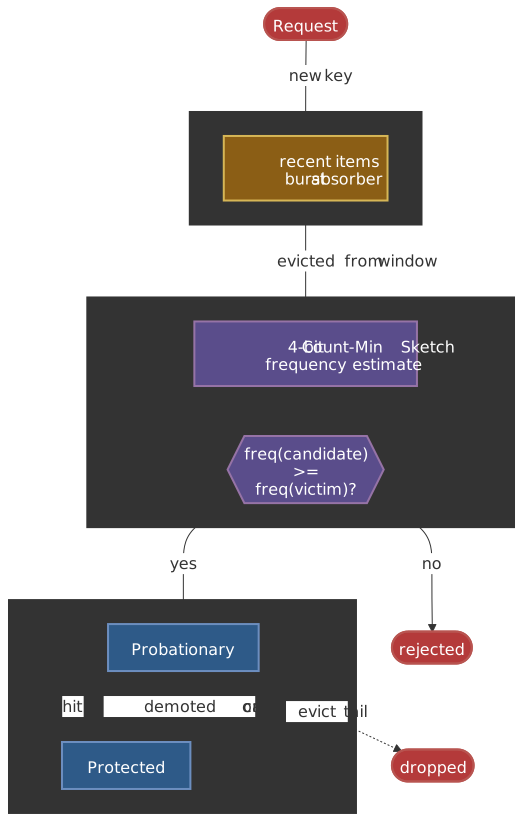
Request → Window LRU → Admission Filter → Main SLRU (~1%, adaptive) ↓ (probationary → protected) 4-bit Count-Min Sketch (shared frequency estimate, periodically aged)Why It Works:
- Window cache absorbs bursty / one-shot traffic so it never reaches the admission filter (recency).
- Main cache uses segmented LRU (probationary → protected, with demotion on pressure).
- Admission filter blocks low-frequency items from polluting the main cache.
- 4-bit
CountMinSketchis a single shared structure (~8 bytes per cache entry) that gives frequency estimates without per-key counters; an aging step periodically halves all counters so the sketch tracks recent popularity, not all-time popularity.
Best When:
- High-throughput Java applications
- Workloads with skewed popularity distributions
- Systems needing near-optimal hit rates with bounded memory
Trade-offs:
- ✅ Near-optimal hit rates across most published traces (Caffeine simulator results)
- ✅ ~8 bytes overhead per entry from the 4-bit CountMinSketch (Caffeine wiki) — no ghost lists doubling cache size
- ✅ Battle-tested (Caffeine is the de facto Java cache library;
mokaports it to Rust) - ❌ More complex than LRU/2Q/SIEVE
- ❌ Requires frequency decay (aging) — adds CPU overhead
- ❌ Reference implementation is Java; ports lag
Real-World Example: On a “shifting” trace where workload mix changes mid-run, adaptive W-TinyLFU has been reported to reach roughly 40% hit rate while LRU and ARC sit near 20%. The key insight: don’t track evicted keys (like ARC’s ghost lists) — use probabilistic frequency counting on every observed key.
How to Choose
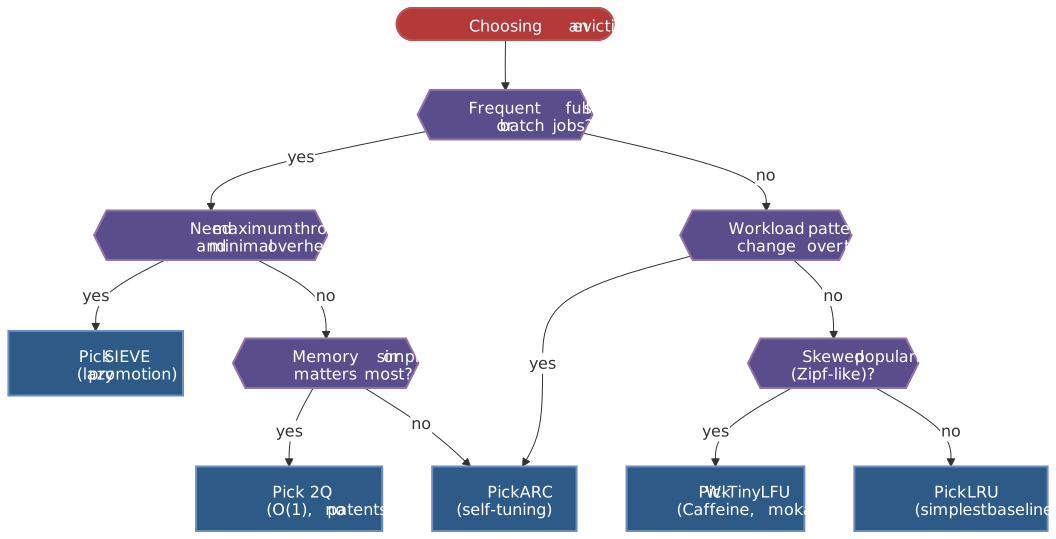
Decision Matrix
| Factor | LRU | 2Q | ARC | SIEVE | W-TinyLFU |
|---|---|---|---|---|---|
| Implementation complexity | Low | Medium | High | Low | High |
| Memory overhead per entry | 16 bytes | 24 bytes | 32+ bytes | 1 bit | 8 bytes |
| Scan resistance | Poor | Good | Excellent | Good | Excellent |
| Self-tuning | No | No | Yes | No | Partial |
| Throughput (ops/sec) | High | Medium | Medium | Highest | High |
| Patent concerns (as of 2024) | None | None | None | None | None |
Choosing by Workload Pattern
| If Your Workload Has… | Choose | Rationale |
|---|---|---|
| Strong temporal locality | LRU | Simple, effective, O(1) |
| Frequent full scans | 2Q or SIEVE | Probationary filtering prevents pollution |
| Unpredictable patterns | ARC | Self-tuning adapts automatically |
| High throughput needs | SIEVE | No list manipulation on hits |
| Skewed popularity (Zipf) | W-TinyLFU | Frequency-based filtering excels |
| Memory constraints | SIEVE or LRU | Minimal per-entry overhead |
Common Decision Patterns
“I just need a cache, nothing special” → Start with LRU. It’s simple, well-understood, and works for most workloads.
“Full table scans are killing my cache” → Use 2Q. It filters scan data effectively with O(1) operations and no patents.
“My workload keeps changing” → Use ARC. It adapts automatically and the patent expired in 2024.
“I need maximum throughput” → Use SIEVE. No list manipulation on hits means better CPU cache locality.
“I’m building a CDN or web cache” → Use W-TinyLFU (Caffeine) or SIEVE. Both handle popularity skew well.
Real-World Applications
The choice of algorithm has profound, practical implications across different domains.
| Aspect | LRU | LRU-K | 2Q | ARC | SIEVE |
|---|---|---|---|---|---|
| Primary Criteria | Recency | K-th Recency (History) | Recency + Second Hit Filter | Adaptive Recency/Frequency | Visited bit + FIFO |
| Scan Resistance | Poor | Good (for K>1) | Very Good | Excellent | Good |
| Complexity | Low | High | Moderate | Moderate-High | Low |
| Time Complexity | O(1) | O(n) naive, O(log n) with heap | O(1) | O(1) | O(1) |
| Memory Overhead | 2 pointers/entry | K timestamps + 2 pointers/entry | 3 maps + metadata | 4 structures + ghosts | 1 bit/entry |
| Tuning | None | Manual (parameter K) | Manual (queue sizes) | Automatic / Self-Tuning | None |
Memory Overhead Analysis
Memory overhead determines how much of your allocated cache space actually holds data vs. metadata.
| Algorithm | Per-Entry Overhead | For 10K entries (64B values) |
|---|---|---|
| LRU | ~40-50 bytes (hash + 2 pointers) | ~1.6 MB |
| LRU-K (K=2) | ~56-66 bytes (+ K timestamps) | ~2.0 MB |
| 2Q | ~60-80 bytes (2 maps + metadata) | ~2.1 MB |
| ARC | ~80-120 bytes (4 structures + ghosts) | ~2.6 MB |
| SIEVE | ~1 bit + FIFO position | ~1.0 MB |
| W-TinyLFU | ~8 bytes (CountMinSketch) | ~1.1 MB |
Key Insight: ARC’s ghost lists can grow to equal the cache size (storing evicted keys), effectively doubling memory usage for metadata. Caffeine’s W-TinyLFU solved this by using probabilistic frequency counting instead of ghost lists—same accuracy, fraction of the memory.
Production Implementations
Real-world systems often use approximated or specialized variants of these algorithms, optimized for their specific constraints.
Redis: Approximated LRU
Redis uses random sampling instead of tracking exact recency for all keys (key eviction docs).
Mechanism:
- Sample N random keys (default: 5, configurable via
maxmemory-samples). - Evict the least recently used among the sampled keys.
- Repeat until memory is below threshold.
Why This Design:
- No linked list = no pointer overhead per key (just 24 bits for the LRU clock).
- No lock contention from list manipulation.
- Sampling 10 keys gets close enough to true LRU for most workloads (Redis docs publish a comparison plot vs. theoretical LRU).
maxmemory-policy allkeys-lrumaxmemory-samples 5 # Increase to 10 for near-true LRU accuracyAs of Redis 3.0: the eviction code keeps a persistent pool of good candidates across cycles instead of throwing the sample away each iteration, raising accuracy without increasing per-key memory.
Linux Kernel: MGLRU
The Linux kernel evolved from a two-list approach to Multi-Generational LRU (kernel docs).
| Era | Algorithm | Limitations |
|---|---|---|
| Pre-6.1 | Active/Inactive lists | Binary hot/cold, poor scan resistance |
| 6.1+ | MGLRU | Multiple generations, better aging |
MGLRU (merged in Linux 6.1, backported to some 5.x kernels):
- Multiple generations (typically 4) instead of 2 lists.
- Pages move to younger generations when accessed.
- Workload-aware: adapts scan frequency to access patterns.
Google’s deployment results (Chrome OS + Android, v11 cover letter via Phoronix):
- ~40% decrease in
kswapdCPU usage. - 85% decrease in low-memory kills at the 75th percentile.
- 18% decrease in app launch time at the 50th percentile (commonly summarized as “smoother UI”).
Distribution Support: Enabled by default in Fedora and Arch Linux. Available but not default in Ubuntu and Debian.
Memcached: Segmented LRU
Memcached uses per-slab-class LRU with modern segmentation, introduced in 1.5.0 and described in detail on the Modern LRU blog post.
Slab Allocator: Memory is divided into slab classes (64B, 128B, 256B, …). LRU is per-class, not global — eviction from the 128B class only evicts 128B items, even if there are older 256B items.
Modern Segmented LRU (since 1.5.0):
| Queue | Purpose |
|---|---|
| HOT | Recently written items (FIFO, not LRU) |
| WARM | Frequently re-accessed items (LRU) |
| COLD | Eviction candidates |
| TEMP | Very short TTL items (no bumping) |
Key Optimization: Items are only “bumped” between queues at most once every 60 seconds, which dramatically reduces mutex contention on hot keys.
PostgreSQL: Clock Sweep
PostgreSQL uses clock sweep for buffer pool management since version 8.1.
Mechanism:
- Circular buffer array with
usage_countper buffer (0–5). - “Clock hand” sweeps through buffers.
- On sweep: if
usage_count > 0, decrement and skip; if 0, evict. - On access: increment
usage_count(saturates at 5).
Why Clock Sweep:
- No linked list = no pointer manipulation on buffer access.
- Single atomic increment instead of list relinking.
- Better concurrency than 2Q (which PostgreSQL used briefly after 8.0.2).
Implementation Detail: The nextVictimBuffer pointer is a simple unsigned 32-bit integer that wraps around the buffer pool. This simplicity enables high concurrency without complex locking. See the InterDB walk-through for the full clock-sweep code path.
Concurrency and Thread Safety
Production caches must handle concurrent access. The key trade-off: simplicity vs. scalability.
| Strategy | Pros | Cons | Used By |
|---|---|---|---|
| Global mutex | Simple, correct | Serializes every get and every put |
Toy caches, low-throughput services |
| Sharded / striped | Concurrent access to different shards, predictable tail | Hot shard bottleneck, eviction skewed across shards | Java ConcurrentHashMap, Go bigcache |
| Read-write lock | Multiple readers, single writer | Writer starvation; LRU get mutates the order list |
Read-heavy variants only |
| Lock-free / async | Best multi-core throughput, no lock-contention tail | Complex; relies on ring buffers + replay | Caffeine (read/write buffers + drain) |
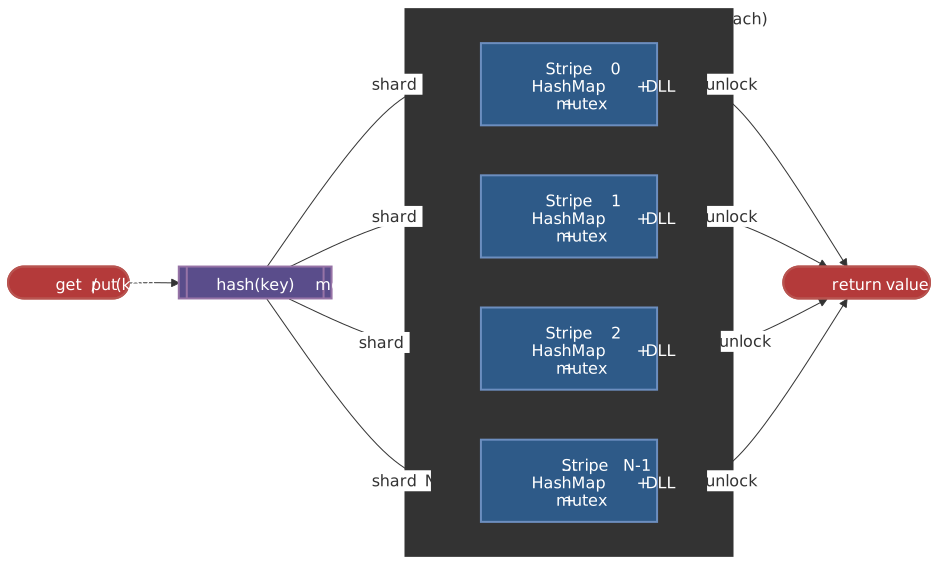
Note
A read-write lock is the wrong default for a strict LRU. Every get has to move the touched node to the head of the doubly linked list, which is a write to the order structure even when the value is unchanged. Either drop strictness (e.g. SIEVE’s visited bit, CLOCK’s usage_count) or batch the order updates the way Caffeine does — its read buffer is a striped ring buffer that records hits and a single drain task replays them under the eviction lock, so the read path stays effectively lock-free.
Production Recommendation: Don’t implement concurrent caches yourself. Use battle-tested libraries:
| Language | Library | Notes |
|---|---|---|
| Node.js | lru-cache |
Size limits, TTL support |
| Java | Caffeine | Near-optimal hit rates, lock-free |
| Go | groupcache |
Distributed, singleflight |
| Rust | moka |
Concurrent, TinyLFU-based |
| Python | cachetools |
Simple, extensible |
Common Pitfalls
1. Cache Stampede (Thundering Herd)
The Mistake: Multiple requests miss the cache simultaneously, all hit the backend.
Why It Happens: Cache entry expires, N requests arrive before any can repopulate.
The Consequence: Backend overwhelmed with N duplicate requests for the same data.
The Fix: Use the “singleflight” pattern — only one request fetches, others wait for its result. Go ships golang.org/x/sync/singleflight; other ecosystems either provide it (e.g. Caffeine’s LoadingCache) or it has to be built around the cache.
class StampedeProtectedCache<K, V> { private cache: Map<K, V> private pending: Map<K, Promise<V>> // In-flight requests constructor() { this.cache = new Map() this.pending = new Map() } async get(key: K, fetch: () => Promise<V>): Promise<V> { // Return cached value if present if (this.cache.has(key)) return this.cache.get(key)! // If another request is fetching, wait for it if (this.pending.has(key)) return this.pending.get(key)! // This request will fetch const promise = fetch().then((value) => { this.cache.set(key, value) this.pending.delete(key) return value }) this.pending.set(key, promise) return promise }}2. Cache Inconsistency
The Mistake: Updating database then cache, or vice versa, without atomicity.
Why It Happens: Race conditions between concurrent updates.
The Consequence: Cache serves stale data indefinitely.
The Fix: Use cache-aside with TTL, or write-through with single source of truth. For critical data, prefer short TTLs over complex invalidation.
3. Unbounded Cache Growth
The Mistake: Caching everything without size limits.
Why It Happens: “More cache = better performance” thinking.
The Consequence: OOM crashes, GC pauses, or swapping.
The Fix: Always set a max size. For LRU, this is trivial—eviction handles it. For other patterns, monitor memory usage.
4. Wrong Cache Key Granularity
The Mistake: Cache keys too coarse (cache entire page) or too fine (cache every DB row).
Why It Happens: Not analyzing actual access patterns.
The Consequence: Too coarse = low hit rate, too fine = high overhead.
The Fix: Profile your workload. Match cache granularity to access granularity.
5. Ignoring Cache Warmup
The Mistake: Deploying with cold cache and expecting production performance.
Why It Happens: Testing with warm caches, deploying fresh.
The Consequence: Slow starts, backend overload on deployment.
The Fix: Pre-warm caches before routing production traffic, or use rolling deployments that let caches warm gradually.
Conclusion
Cache eviction is fundamentally about prediction: given limited memory, which items should you keep to maximize future hits? The answer depends entirely on your access patterns.
Decision Framework:
- Start with LRU for most applications—it’s simple, well-understood, and works for temporal locality
- Switch to 2Q or SIEVE when sequential scans are poisoning your cache (analytics queries, batch jobs, backups)
- Consider ARC when your workload is unpredictable and you can’t tune parameters (patent expired February 2024)
- Use W-TinyLFU (Caffeine) for CDNs and web caches with skewed popularity distributions
Production Reality: Most systems use approximated or specialized variants. Redis samples random keys. Linux uses multiple generations. PostgreSQL uses clock sweep. The textbook algorithms are starting points, not endpoints.
The right cache eviction policy can be the difference between a system that degrades gracefully under load and one that falls over. Understand your access patterns, profile your workload, and choose accordingly.
Appendix
Prerequisites
- Understanding of hash tables and linked lists
- Basic knowledge of time complexity (Big O notation)
- Familiarity with cache concepts (hits, misses, eviction)
Summary
- LRU assumes temporal locality: recently accessed = soon needed. This fails during sequential scans.
- Scan resistance requires additional signals: 2Q uses probationary filtering, ARC uses ghost lists, SIEVE uses visited bits.
- Approximated algorithms dominate production: Redis samples keys, Linux uses MGLRU, PostgreSQL uses clock sweep.
- Memory overhead varies significantly: SIEVE uses 1 bit/entry; ARC can double memory for ghost lists.
- No single best algorithm: the optimal choice depends on your access patterns, memory constraints, and operational requirements.
- Common pitfalls are preventable: cache stampede, inconsistency, unbounded growth, and cold starts all have standard solutions.
References
Original Research Papers
-
O’Neil, E. J., O’Neil, P. E., & Weikum, G. (1993). The LRU-K Page Replacement Algorithm For Database Disk Buffering. ACM SIGMOD Record, 22(2), 297-306.
-
Johnson, T., & Shasha, D. (1994). 2Q: A Low Overhead High Performance Buffer Management Replacement Algorithm. VLDB 1994, 439-450.
-
Megiddo, N., & Modha, D. S. (2003). ARC: A Self-Tuning, Low Overhead Replacement Cache. USENIX FAST 2003, 115-130.
-
Zhang, Y., Yang, J., Yue, Y., Vigfusson, Y., & Rashmi, K.V. (2024). SIEVE is Simpler than LRU: an Efficient Turn-Key Eviction Algorithm for Web Caches. USENIX NSDI 2024.
-
Einziger, G., Friedman, R., & Manes, B. (2017). TinyLFU: A Highly Efficient Cache Admission Policy. ACM Transactions on Storage.
Patents
-
US Patent 6,996,676 - ARC (IBM). Granted February 7, 2006. Expired February 22, 2024.
-
US Patent Application 20060069876 - CAR (IBM). Filed September 30, 2004.
Production Implementations
-
Redis Key Eviction - Official documentation on approximated LRU.
-
Linux MGLRU Documentation - Kernel documentation for Multi-Generational LRU.
-
PostgreSQL Buffer Manager - Detailed explanation of clock sweep algorithm.
-
Caffeine Wiki - Efficiency - W-TinyLFU benchmarks and design.
-
SIEVE Project Website - Algorithm details and implementations.
PostgreSQL History
- PostgreSQL Mailing List: ARC Patent Discussion - Original discussion about patent concerns.
Further Reading
-
CMU 15-445 Database Systems - Advanced course covering buffer pool management.
-
MDN Web Docs - Map - ES2015 Map insertion order guarantee.