API Gateway Patterns: Routing, Auth, and Policies
An API gateway concentrates the cross-cutting policies that every microservice would otherwise reimplement: TLS termination, authentication, rate limiting, routing, transformation, caching, and observability. Centralization is the value, and centralization is the risk: the gateway becomes a load-bearing piece of infrastructure whose failure modes are global. This article walks a senior engineer through the choices that decide whether the gateway is a resilience layer or a single point of failure, with citations and worked examples from Netflix Zuul, Envoy, Kong, AWS API Gateway, Apigee, and the Canva 2024-11-12 outage.
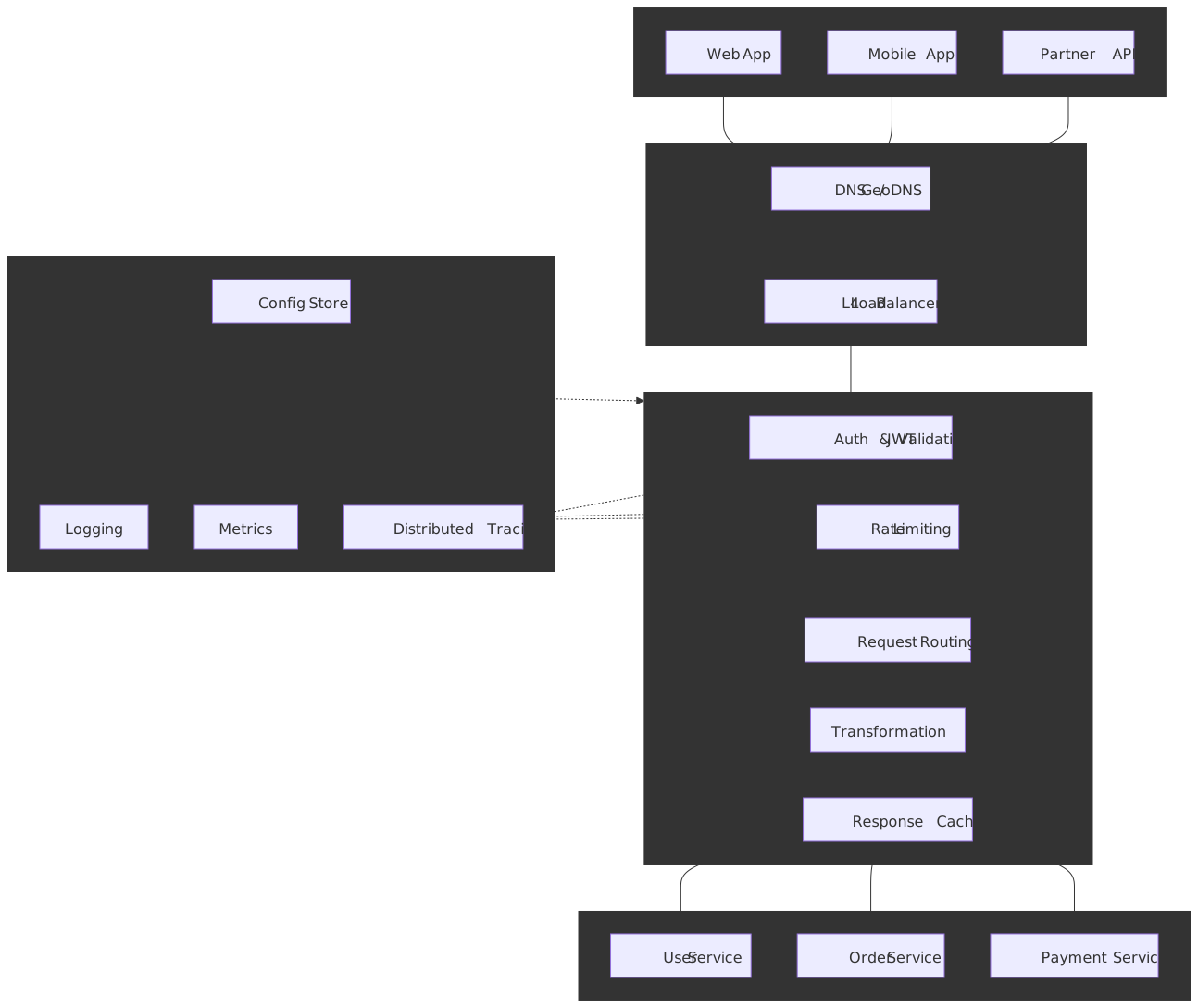
Mental model
The gateway is a programmable reverse proxy with strong opinions about policy. Read the microservices.io API Gateway pattern for the canonical statement: it solves the N×M problem (N client types speaking to M services) by centralizing what would otherwise be duplicated client-side or service-side. The core trade-off is centralization vs coupling: a single enforcement point simplifies clients and standardizes policy but turns the gateway into shared fate.
| Concern | Gateway responsibility | Why at the gateway |
|---|---|---|
| Authentication | JWT verification, API key lookup | Reject unauthorized requests before backend load |
| Rate limiting | Token bucket, sliding window | Protect backends from abuse at the edge |
| Routing | Path/header-based dispatch | Decouple client URLs from service topology |
| Transformation | Protocol translation, payload shaping | Adapt external formats to internal contracts |
| Observability | Trace initiation, access logs | Capture full request context at a single entry |
There are three deployment shapes the rest of the article keeps coming back to:
- Edge gateway for north-south traffic from the public internet.
- Internal gateway / service mesh for east-west service-to-service traffic.
- Backend for Frontend (BFF) as a per-client gateway tier, popularized by Sam Newman and the SoundCloud team.
Gateway responsibilities
Request routing
Gateways decouple client-facing URLs from backend service topology. Clients call /api/users regardless of which service, version, or zone handles the request.
Path-based routing (most common):
/api/v1/users/* → user-service-v1/api/v2/users/* → user-service-v2/api/orders/* → order-service/static/* → CDN originHeader-based routing:
Stripe-Version: 2026-03-25 → service-v2026-03-25X-Client-Type: mobile → mobile-optimized-backendX-Tenant-ID: acme → tenant-acme-clusterWeighted traffic splitting for canary releases:
routes: - match: /api/users backends: - service: user-service-v2 weight: 5 - service: user-service-v1 weight: 95Trade-off: path-based versioning (/v1/, /v2/) is explicit and discoverable but pollutes URLs and makes evolving identifiers painful. Header-based versioning keeps URLs stable but requires client cooperation. Stripe’s public API uses date-based version headers (Stripe-Version: 2026-03-25), with each account pinned to a specific version on first use and per-request override available. This lets old SDKs run unchanged for years while new clients opt in to fresh behavior.
Authentication and authorization
Gateways verify credentials before requests reach backends, rejecting unauthorized traffic at the edge so it does not consume backend capacity.
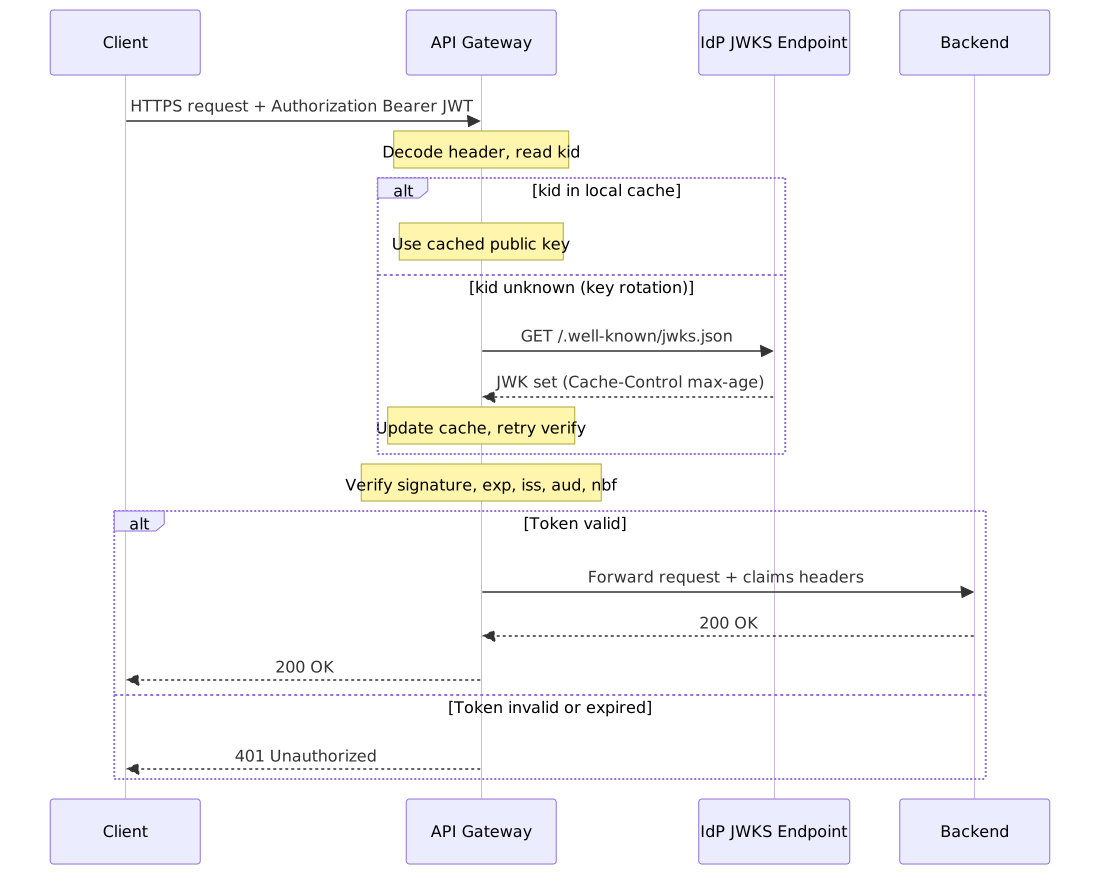
JWT verification (stateless). A JWT is a signed JSON envelope defined by RFC 7519; the OAuth profile for it as a bearer access token is RFC 9068. The gateway:
- Reads the token from the
Authorization: Bearer <token>header. - Decodes the JOSE header, looks up the
kidagainst a cached JWKS (/.well-known/jwks.json). - Verifies the signature using the IdP’s public key.
- Validates the registered claims (
exp,iat,nbf,iss,aud). - Forwards the validated claims to the backend as immutable headers.
Important
Two JWT footguns the gateway must handle correctly. First, never accept alg: none — reject the token before signature verification if the header advertises a non-allow-listed algorithm. Second, when a token arrives with a kid not in the JWKS cache, refetch the JWKS once before rejecting: this is how key rotation propagates without client downtime. Use the JWKS endpoint’s Cache-Control headers and a minimum refetch interval (5–10 min) to avoid abuse.
Token introspection (stateful). RFC 7662 defines a synchronous lookup against the authorization server for opaque tokens or revocation enforcement. Cost: a network round trip per request (typically tens of ms). Use it when immediate revocation matters more than latency.
API key lookup. A pre-shared secret keyed against a fast store (Redis, local cache) that returns the associated tenant, rate-limit bucket, and permissions. Cheaper than JWT for partner APIs where keys are long-lived and revocation is administrative.
Authorization layering. Coarse-grained checks at the gateway (route-level: can this principal call this endpoint?); fine-grained checks at the service (resource-level: can this principal access this specific record?). The gateway should never need to read application data to make an auth decision.
Rate limiting and quotas
Rate limiting protects backends from abuse and shares capacity fairly across clients.
Token bucket is the workhorse. The parameter set appears in IETF traffic-control work as far back as the RFC 1363 flow specification (Token Bucket Rate, Token Bucket Size) and is documented in the Diffserv informal management model (RFC 3290, token-bucket meter and shaper). It parameterizes a flow as a refill rate R and a burst size B. Each request consumes one token; idle clients accumulate up to B tokens and can burst, then drain back to the steady-state R.
Leaky bucket (RFC 3290, shaper section) is the dual: requests queue and depart at a constant rate, smoothing bursts into a steady stream. Use it when the constraint is downstream throughput, not fairness.
Sliding window log stores the timestamp of every request inside the window and counts entries. Most accurate, highest memory.
Sliding window counter is the practical compromise: combine the current window’s count with a weighted slice of the previous window’s. If the current minute is 40s in with 50 requests and the previous minute had 100, the weighted count is 50 + 100 × (60 − 40)/60 ≈ 83. Bounded memory, near-sliding accuracy, no per-request log.
Distributed accuracy. With multiple gateway instances, a local counter undercounts because each instance only sees a slice of traffic. The Kong rate-limiting plugin documents three policies for this exact problem:
| Policy | Storage | Accuracy | Latency cost | When |
|---|---|---|---|---|
local |
In-memory per node | Approximate (drifts with node count) | Lowest | High throughput, slight overrun acceptable |
cluster |
Kong data store (e.g., Postgres) | Accurate | Highest (DB round trip per request); not supported in Konnect/hybrid | Small clusters, audit-strict limits |
redis |
Shared Redis | Accurate | Medium (≈1 ms per request) | Default for distributed enforcement |
Kong’s rate-limiting-advanced plugin adds true sliding-window semantics and a sync_rate knob that controls how often local counters are flushed to Redis (0 = synchronous, highest accuracy and cost; >0 = async, lower cost, brief overrun possible). Pair Redis with a consistent-hashing front load balancer to bias each client to the same node and reduce the distributed drift before it ever hits the shared store.
Real numbers from public APIs:
- Stripe (live mode): 100 ops/sec global limit per account, with stricter per-resource limits (e.g., 1,000 updates/hour per
PaymentIntent). Sandbox mode is 25 ops/sec. - GitHub REST API: 60 req/hr unauthenticated per IP, 5,000 req/hr per authenticated user/OAuth app, 15,000 req/hr for GHEC org-owned apps. Status surfaced via
x-ratelimit-*headers.
Request and response transformation
Gateways adapt external API contracts to internal service contracts so backends can evolve without breaking clients.
Header transformation:
request: add: X-Request-ID: ${uuid()} X-Forwarded-For: ${client_ip} remove: - X-Internal-Debugresponse: remove: - X-Powered-By - ServerProtocol translation: REST↔gRPC bridging is the most common case (gateway accepts JSON, forwards Protobuf to a gRPC service); GraphQL federation composes a unified schema across services; SOAP↔REST bridges legacy estates.
Payload transformation: field renaming (user_id → userId), filtering of internal fields, and lightweight aggregation.
Caution
Payload transformation belongs at the gateway only when it is purely structural. The moment the transformation depends on business rules (“if the user is a Plus member, hide field X”), move it to a BFF or a domain service. Conditional logic in the gateway turns the gateway into a deployment bottleneck and a testing nightmare.
Caching at the edge
Gateway caching reduces backend load and tail latency for cacheable responses.
Client → CDN (seconds–years) → Gateway cache (seconds–minutes) → BackendThe cache key is normally hash(method, path, sorted(query_params), vary_headers). Suggested TTLs:
| Content | TTL | Rationale |
|---|---|---|
| Versioned static asset | 1 week+ | Hashed URL doubles as cache key |
| User profile | 5–15 min | Balance freshness vs load |
| Search results | 30–60 s | Volatile but extremely high read load |
| Real-time data | No cache | Freshness is the product |
AWS API Gateway REST APIs expose cache TTL with default 300 s and maximum 3,600 s; HTTP APIs do not natively support response caching, only the cheaper proxying model. AWS API Gateway carries a 99.95% monthly uptime SLA per region.
Warning
Caching authenticated responses requires the cache key to include user identity (or any header that varies the response). Forgetting this leaks user A’s data to user B. The standard guards: include the principal in the key, honor backend Cache-Control: private, and never cache Authorization-bearing responses without an explicit policy.
Observability
The gateway is the natural origin for distributed traces because it sees every request before it fans out. The minimum it must do:
- Generate a trace ID, or honor an incoming W3C
traceparentheader. - Inject trace context into downstream calls.
- Emit a gateway span with timing, routing decision, and auth result.
A useful access-log shape:
{ "timestamp": "2026-04-21T10:30:00Z", "trace_id": "abc123", "client_ip": "203.0.113.42", "method": "POST", "path": "/api/orders", "status": 201, "latency_ms": 142, "backend": "order-service", "rate_limit_remaining": 97}Capture request rate by endpoint and client, latency p50/p95/p99 per route, error class (4xx vs 5xx vs timeout), rate-limit rejections by client, and cache hit ratio. Modern gateways (Kong, Envoy, Apigee, AWS API Gateway) emit OpenTelemetry-compatible traces and metrics; standardize on OTel so the gateway data joins the rest of the trace pipeline.
Architecture patterns
Edge gateway vs internal gateway
Edge gateway (north-south): public-facing, terminates TLS, enforces strict auth, runs WAF and DDoS controls, applies global rate limits, and globally distributes endpoints for latency.
Internal gateway (east-west): service-to-service inside the cluster, lighter auth (typically mTLS / SPIFFE identities), focused on routing, retries, and circuit breaking. In Kubernetes shops this role is increasingly played by a service mesh (Istio, Linkerd, Consul Connect) rather than a discrete gateway.
Most production systems run both, layered:
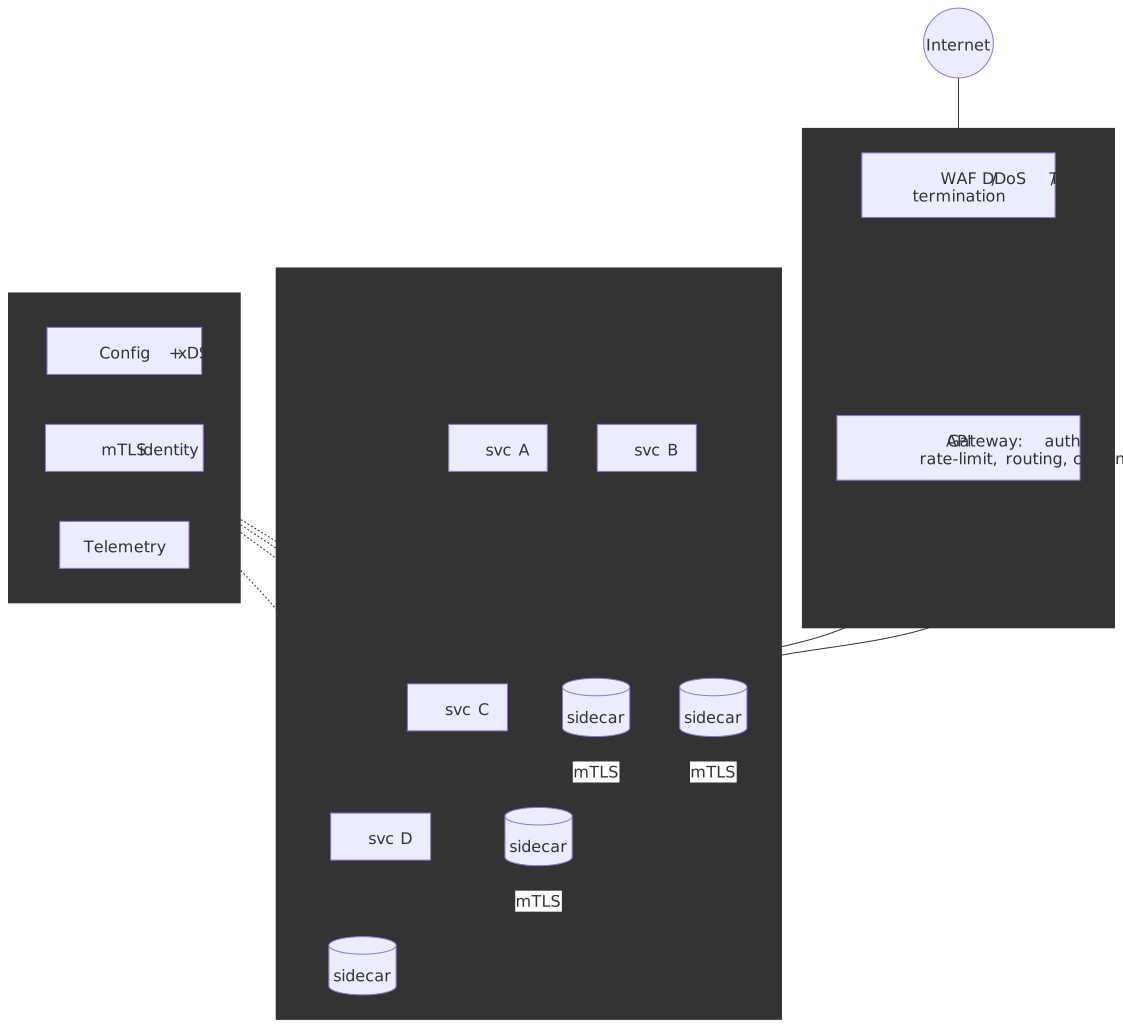
The Kubernetes Gateway API standardizes the resource model across both planes: Gateway / HTTPRoute for ingress, and the GAMMA initiative extends the same shapes to mesh east-west. Treating north-south and east-west as the same routing primitive lets one team reason about both.
| Aspect | API gateway | Service mesh |
|---|---|---|
| Traffic direction | North-south (external) | East-west (internal) |
| Deployment | Centralized edge cluster | Sidecar per service |
| Auth focus | External credentials | Service identity (mTLS) |
| Protocol | HTTP/REST/GraphQL | Any (TCP, gRPC, HTTP) |
| Routing | Content-based | Service discovery |
| Rate limiting | Per client / API key | Per service |
| Observability | Request-level | Connection-level |
Christian Posta’s “Do I Need an API Gateway if I Have a Service Mesh?” is the canonical write-up of why the answer is usually “yes, both”. Mesh handles transport-level concerns transparently; gateway handles API-level concerns (versioning, payload shaping, partner contracts) explicitly.
Backend for Frontend (BFF)
The BFF pattern is a dedicated gateway per client type, owned by the client team. Sam Newman’s pattern article traces the design back to the SoundCloud team (Phil Calçado, Lukasz Plotnicki) who needed a way to evolve the mobile and web APIs at the speed of the respective product teams without coordinating each release with platform.
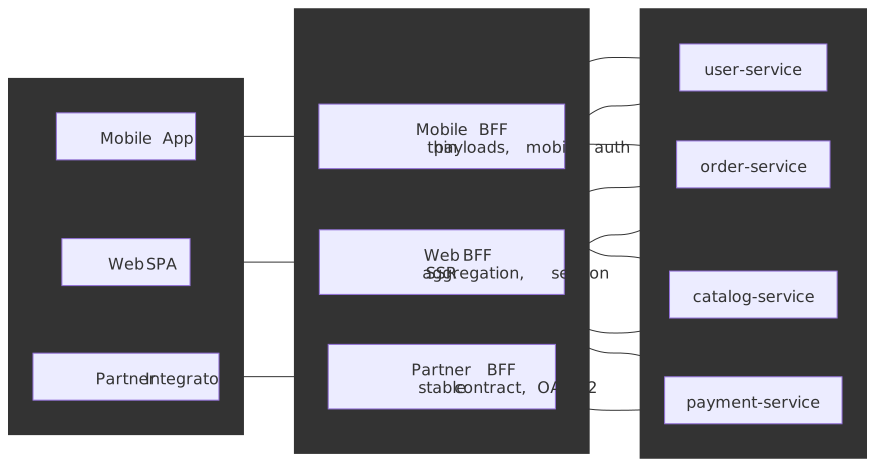
A BFF lets the mobile team strip payload to the bytes that fit a phone screen, the web team aggregate richer data for SSR, and the partner team expose a slow-moving, contractually stable surface — all without one shared schema fighting three sets of constraints. The cost is operational: N client types means N services to deploy, monitor, and on-call. Worth it once client divergence is real; premature otherwise.
Per-domain gateways vs one shared gateway
A single global gateway is the easiest to operate until it isn’t. Once the gateway is the chokepoint for unrelated business domains, a single bug — a memory leak in a logging library, say — takes everything down at once. The pragmatic split is per business domain:
- ✅ Failure isolation (orders’ gateway down ≠ payments’ gateway down).
- ✅ Independent scaling per traffic profile.
- ✅ Domain teams own their gateway as part of their product.
- ❌ Policy duplication (auth/rate limit config must stay in sync).
- ❌ More infrastructure to operate.
The Canva incident below is the canonical cautionary tale of one gateway plane carrying every business domain.
Design choices and trade-offs
Stateless vs stateful gateway
A stateless gateway treats every instance as identical: configuration comes from etcd / Consul / Kubernetes, hot data (rate-limit counters, JWKS) is cached locally with TTL or push-based invalidation. Any instance can serve any request; horizontal scaling is just “add a replica”. This is the default for every modern gateway.
A stateful gateway holds session affinity, in-process rate-limit counters, or local connection state that another instance does not have. It can be faster (no external lookups) but turns scaling into a state-migration problem and makes deploys risky.
In practice you want stateless with caches: configuration is external, hot data is cached locally with bounded staleness, and exactness (where you need it) is delegated to a shared store like Redis.
Custom vs managed gateways
| Open-source gateway | Strengths | Trade-offs |
|---|---|---|
| Kong | Plugin ecosystem, Lua and Go plugins | Operational complexity at scale |
| Envoy | High-performance L7 proxy, dynamic config via xDS, used by Istio/Consul/AWS App Mesh | Configuration is verbose; needs a control plane |
| NGINX (+OSS) | Mature, predictable, ubiquitous | Limited gateway features without paid module / Kong on top |
| Apache APISIX | Modern, good dashboard, extensible plugin model | Smaller community than Kong/Envoy |
| Managed service | Strengths | Trade-offs |
|---|---|---|
| AWS API Gateway | Serverless, autoscaling, 99.95% SLA | Lambda cold starts; AWS-shaped pricing |
| Google Apigee | Federated API governance, analytics | Pricing complexity; steep learning curve |
| Azure API Management | First-class Azure integration, hybrid deployment | Azure-shaped pricing and runtime |
| Factor | Choose managed | Choose self-hosted |
|---|---|---|
| Team ops capacity | Limited | Dedicated platform team |
| Scale | < ~1B requests/month | Cost-sensitive at scale |
| Customization | Standard patterns | Unique requirements |
| Compliance | Cloud-native apps | On-prem / data residency |
| Latency requirements | < 10 ms acceptable | Sub-millisecond critical |
The cost crossover for managed gateways usually appears between 1B and 10B requests/month — above that, request-priced services start to dominate the bill and a self-hosted Envoy or Kong on platform infrastructure becomes cheaper if you have the platform team to operate it.
Synchronous vs asynchronous
Most gateway traffic is synchronous: client → gateway → service → gateway → client, with the client blocked on the response. For long-running operations the gateway can return 202 Accepted with a status URL; the client polls or receives a webhook callback. A common hybrid: try sync up to a budget (say 30 s); on timeout, hand the request to a queue and return 202 with the status URL.
Real-world implementations
Netflix Zuul (Zuul 1) and Zuul 2
Netflix’s “Open Sourcing Zuul 2” reports that Netflix runs 80+ Zuul 2 clusters routing more than 1 million requests per second to roughly 100 backend service clusters.
Zuul 1’s filter pipeline (PRE / ROUTE / POST / ERROR) was implemented on top of a thread-per-request model. Zuul 2 rebuilt the pipeline on Netty with an event-loop-per-core, async/non-blocking design — better suited to the high-connection-count workloads that came with persistent push channels and HTTP/2. The Zuul 2 filter taxonomy becomes Inbound, Endpoint, and Outbound, with sync and async variants; the cardinal rule for engineers writing filters is never block the event loop — offload anything blocking to a worker thread pool via async filters.
Zuul 2 request path ┌─ Inbound filters (auth, rate limit, decorate) │ └─ Endpoint filter (origin selection, load balance) │ ┌─ Outbound filters (decorate response, capture metrics) │ └─ Response written back to clientTwo design choices worth borrowing:
- Service-discovery-driven routing. Zuul queries Eureka for healthy instances rather than holding a static config. Coupled with zone-aware load balancing, the gateway shifts traffic away from a degraded availability zone before SREs notice.
- Push-based filter deployment. Filters are loaded dynamically (originally as Groovy, now Java); a new auth mechanism is a new filter, not a Zuul deploy.
Amazon API Gateway
Three variants, three sweet spots:
| Variant | Use case | Notable features |
|---|---|---|
| HTTP API | Simple proxy | Lower latency and cost, JWT authorizers, OIDC |
| REST API | Full features | Request validation, response caching, WAF, Usage Plans |
| WebSocket | Bi-directional | Connection management, route selection |
Caching is REST-API-only, default 300 s, configurable 0–3,600 s. Account-level throttling defaults to 10,000 req/s with a 5,000 burst per region in major regions; newer / smaller regions default to 2,500 / 1,250. The 99.95% monthly SLA implies up to ~22 minutes/month of allowed downtime per region.
Lambda-backed routes inherit Lambda’s cold-start envelope. As of 2026:
| Mitigation | Effect | Cost shape |
|---|---|---|
| Default on-demand | Python/Node typically 200–400 ms; Java/.NET 500–2,000+ ms | Pay-per-invoke, no idle |
| Provisioned Concurrency | Eliminates cold start; double-digit-ms response times | Pay for pre-warmed concurrency, idle or not |
| SnapStart (Java/.NET/Python) | Restores from a pre-initialized snapshot; ~10× faster Java cold starts (≈2 s → ≈200 ms) | Negligible incremental cost |
VPC-attached Lambda cold starts used to add 3–10 s for ENI attach; that was largely eliminated by Hyperplane ENIs in 2019, so legacy “VPC adds 10 s” advice is stale.
Kong
Kong’s design philosophy is “small core, everything is a plugin.” The plugin pipeline runs in a deterministic order per phase (certificate → rewrite → access → header transformation → response → log), with rate limiting and auth living in the access phase.
Rate-limiting policies, as documented in the official plugin reference:
| Policy | Storage | Accuracy | Cost | Notes |
|---|---|---|---|---|
local |
In-memory per node | Approx. | Lowest | Pair with consistent-hash LB to bias clients to the same node |
cluster |
Kong data store (e.g., Postgres) | Exact | Highest (DB hit per request); not supported in hybrid/Konnect | OK for small tightly-controlled clusters |
redis |
Shared Redis | Exact | Medium | Most common production choice; sync_rate controls async flushing |
Custom plugins are written in Lua, Go, JavaScript, or Python via the Kong PDK.
Envoy
Envoy’s official FAQ on performance is unusually candid: the project does not publish a canonical latency or throughput number because the answer depends entirely on filter chain, TLS posture, observability budget, and hardware. The benchmarking guidance prescribes release builds, -c opt, disabling stats and generate_request_id for baseline measurements, open-loop generators (Nighthawk), and not measuring at saturation.
What you can rely on:
- Native xDS dynamic configuration: control plane (Istio, Consul Connect, AWS App Mesh, Envoy Gateway) pushes routing/cluster/listener config without restarts.
- L7 policy primitives: retries, timeouts, circuit breaking via concurrency thresholds (max connections, max pending requests, max requests, max active retries — per upstream cluster).
- Observability: native OpenTelemetry tracing, Prometheus stats, structured access logs.
- Load balancing: round robin, least request, ring hash, Maglev consistent hash.
Note
Envoy’s circuit breakers are threshold-based load shedders, not the classical three-state Nygard breaker. They count outstanding work against a per-cluster limit and reject the next request when the limit is exceeded — there is no half-open probe phase. If you need true closed/open/half-open semantics, layer a classic circuit breaker library in the application.
Google Apigee
Apigee’s architecture splits cleanly into two planes:
- Management plane — Google-hosted: API lifecycle, policy authoring, analytics, developer portal.
- Runtime plane — request processing. Customer-deployed in Apigee hybrid (Kubernetes in your VPC); Google-managed in Apigee X.
The runtime plane is itself a few services: Message Processors that execute proxies and policies; a Synchronizer that pulls config from the management plane and writes it to local disk so the runtime survives a management-plane outage; Cassandra for runtime state (KVMs, quotas, OAuth tokens); and MART for management-plane↔runtime data plane access. Three deployment shapes today: Apigee X (full SaaS), Apigee hybrid (customer runtime, Google management), and Apigee Edge (legacy).
Apigee’s distinctive feature is its analytics surface — traffic patterns, error rates, latency distributions, developer adoption — which makes it the default choice for teams running APIs as a product.
Common pitfalls
1. Gateway as a single point of failure
The mistake. All traffic funnels through one gateway plane, every business domain shares the same fate.
Real incident — Canva, 2024-11-12 (~52 minutes). From the Canva engineering post-mortem:
- A Cloudflare network event briefly stalled requests for a critical JavaScript asset; over 270k client requests for that asset queued up.
- When Cloudflare recovered, those queued requests completed almost simultaneously — a classic thundering herd. The API gateway saw ~1.5 million requests/second, roughly 3× peak.
- A recently-deployed telemetry library re-registered metrics under a lock inside a third-party library on every request. Lock contention serialized work on the gateway’s event loop, throttling effective throughput.
- As tasks fell behind, the load balancer opened more connections to already-overloaded instances. Off-heap memory grew until the Linux OOM killer terminated containers within ~2 minutes — faster than autoscaling could replace them. Cascading failure followed.
The fixes the report calls out are the textbook ones: failure-domain isolation between business domains, circuit breakers between gateway and backends, graceful degradation paths (cached/static content during gateway issues), and load shedding before complete failure. The deeper lesson is that the gateway’s event-loop budget is finite — anything that locks it (telemetry, sync logging, blocking auth lookups) becomes an outage vector.
2. Business logic in the gateway
The gateway’s position makes it tempting to add “just one more thing.” Over time you find yourself routing on customer tier, computing pricing, or feature-flagging in the gateway. The tax: every product change becomes a gateway deploy (high blast radius), every test environment needs a full gateway, the gateway team becomes the bottleneck, and the gateway becomes a monolith with global access.
The fix: gateway does auth, rate limiting, routing, transformation, observability. Aggregation belongs in a BFF. Feature flags belong in a feature-flag service. Business decisions belong in the domain service.
3. Over-caching at the edge
Caching is a footgun if you forget that “personalized” responses must include identity in the cache key. Symptoms: stale data after writes, cache stampedes when many keys expire together, cross-user data leaks. Mitigations: include the principal (or Vary header set) in the key, honor backend Cache-Control, stagger TTLs (jitter), and prefer event-driven invalidation for high-write resources. Treat a suspiciously high cache hit ratio as a signal that the cache is masking missing freshness.
4. Lying health checks
A /health that returns 200 only because the process is running tells the gateway nothing useful: traffic still routes to a backend that fails every request. The fix is the standard liveness/readiness split, with the readiness probe checking critical dependencies (DB ping, cache ping, queue connectivity), but cheaply.
func ReadinessHandler(deps Deps) http.HandlerFunc { return func(w http.ResponseWriter, r *http.Request) { ctx, cancel := context.WithTimeout(r.Context(), 250*time.Millisecond) defer cancel() if err := deps.DB.PingContext(ctx); err != nil { http.Error(w, "db unavailable", http.StatusServiceUnavailable) return } if err := deps.Cache.Ping(ctx).Err(); err != nil { http.Error(w, "cache unavailable", http.StatusServiceUnavailable) return } w.WriteHeader(http.StatusOK) }}5. Ignoring connection draining
Terminating a backend or gateway instance immediately during deploy returns 502/503 to in-flight requests. The fix is connection draining (also called deregistration delay on AWS ELBs, default 300 s): the gateway stops sending new requests to the draining instance, lets in-flight ones complete (or time out), then terminates. Set the drain timeout above your longest expected request duration.
Performance
Latency budget
Treat the gateway’s latency contribution as a budget you spend on policy. Rough envelopes from production reports and vendor docs (cited individually elsewhere):
| Component | Typical latency |
|---|---|
| Network hop | 0.1–1 ms |
| TLS termination | 0.5–2 ms |
| JWT verification (cached JWKS) | 0.1–1 ms |
| Rate-limit check (local) | < 0.1 ms |
| Rate-limit check (Redis) | 1–5 ms |
| Routing decision | < 0.1 ms |
| Baseline overhead, well-tuned | 1–5 ms |
Things that blow the budget: token introspection (RFC 7662 lookup adds a network round trip — tens of ms); complex transformations (a few ms each); custom plugins (varies wildly with what they do); Lambda cold starts (hundreds of ms to multiple seconds). Always measure under realistic load (50–80% capacity), never at peak — latency is non-linear near saturation.
Connection pooling
Opening a new TCP+TLS connection per request burns 2–4 round trips. Gateways maintain pools to backends:
upstream backend: max_connections: 100 # Total to all instances max_connections_per_host: 10 # Per backend instance idle_timeout: 60s # Reap idle connections connect_timeout: 5s # Fail fast on connectHTTP/2 multiplexing flips the equation: one connection carries many concurrent streams. Gateway-to-backend H2 cuts the connection count by one or two orders of magnitude while preserving throughput. Netflix’s Zuul team describes the connection-churn savings explicitly.
Cold-start mitigation (serverless)
See the AWS API Gateway table above for the current Lambda numbers. Two takeaways: SnapStart is the cheapest fix for JVM/.NET cold starts; Provisioned Concurrency is the only mitigation that guarantees warm capacity at the cost of paying for idle. “Keep-warm pings” are unreliable — Lambda recycles environments aggressively and ping-driven warmth is non-contractual.
Circuit breaker integration
The classic Nygard / Fowler circuit breaker has three states:
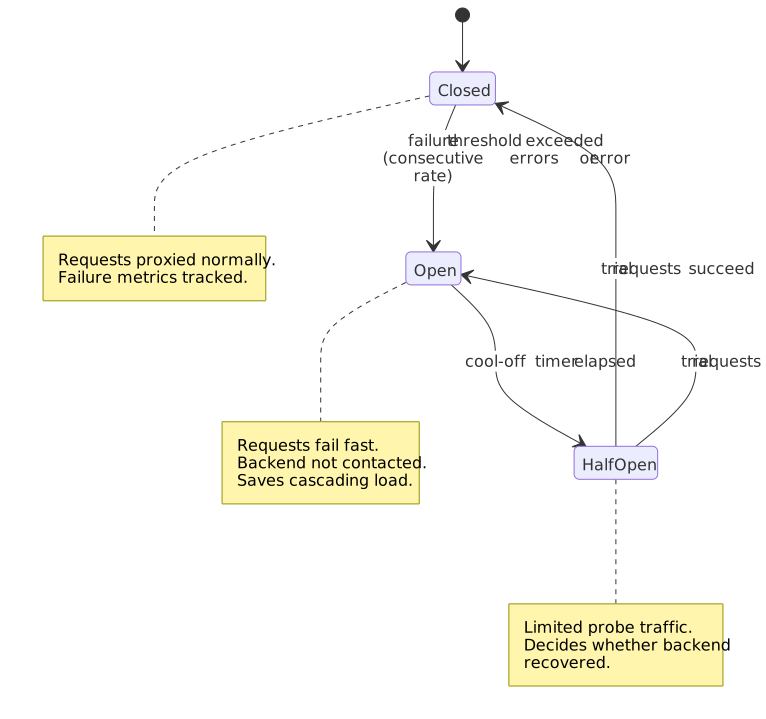
Sample knobs:
circuit_breaker: failure_threshold: 5 # consecutive failures to open success_threshold: 3 # consecutive probes to close open_timeout: 30s # cool-off in open state failure_rate_threshold: 50% # alternative: percentage tripGateway-side fallbacks when the breaker is open: serve a cached response, return a degraded payload, route to a backup service, or return an error with explicit retry guidance (Retry-After).
Important
A Nygard-style breaker and Envoy’s per-cluster concurrency thresholds are complementary, not equivalent. Envoy sheds excess load instantly under overload but never enters a half-open probing state; a true breaker reacts to failure patterns over time. Run both: Envoy as the always-on shedder, an application-layer breaker as the recovery probe.
API versioning
Path-based versioning
/v1/users → user-service-v1/v2/users → user-service-v2Pros: explicit, browser-testable, easy in logs. Cons: URL pollution and a permanent commitment to never re-using the same path.
Header-based versioning
GET /usersAccept: application/vnd.myapi.v2+jsonor the simpler:
GET /usersStripe-Version: 2026-03-25Pros: clean URLs, flexible versioning schemes, RESTful. Cons: invisible to a casual curl, harder to reason about in CDN configs and logs.
Gateway implementation
routes: - match: { path_prefix: /v1/ } route: { cluster: api-v1 } - match: { path_prefix: /v2/ } route: { cluster: api-v2 } - match: headers: - { name: API-Version, exact_match: "2026-01" } route: { cluster: api-2026-01 }Backward compatibility
Safe additive changes: new optional fields in responses, new endpoints, new optional query parameters or headers. Breaking changes that need a new version: removing a field, changing a field’s type, restructuring a URL, changing required parameters.
Stripe’s playbook (blog post, API reference) is the public reference implementation: date-stamped versions, accounts pinned at first use, request-level overrides via Stripe-Version, and a long support window. Internally Stripe runs version change modules in reverse chronological order to transform a modern internal response into the shape an older account expects — a useful pattern for any team that promises long compatibility windows.
Practical takeaways
- Centralize policies, not business logic. Auth, rate limiting, routing, observability — yes. Pricing, feature flags, aggregation logic — no.
- Plan for failure-domain isolation. Per-domain gateways beat one global gateway once two unrelated outages can no longer share blast radius. The Canva post-mortem makes the case more vividly than any architecture review.
- Pick the rate-limit storage strategy by accuracy budget. Local for hot paths where a small overrun is acceptable; Redis (with
sync_ratetuned to your accuracy/latency budget) for everything else; cluster mode only when you genuinely need exact accounting and can afford a DB hit per request. - Choose architecture by team and scale. Small teams: a managed gateway (AWS API Gateway, Apigee). Large teams with platform engineering capacity: Kong or Envoy for flexibility, cost, and customization.
- Measure what matters. Gateway latency overhead, cache hit ratio, rate-limit rejection rate, error rate by route. These four numbers tell you whether the gateway is helping or hurting.
- Treat gateway code as load-bearing. Anything that locks the event loop (sync logging, in-band auth lookups, badly-instrumented telemetry) is an outage vector. The Canva incident shows how a benign-looking telemetry library can be enough.
The recurring pattern across Netflix, AWS, Apigee, and Canva is consistent: gateways are infrastructure, not application logic. They enforce policies and route traffic. The moment business logic creeps in, the gateway becomes a bottleneck for both performance and organizational velocity.
Appendix
Prerequisites
- HTTP/HTTPS basics; TLS handshake.
- Microservices and load-balancing fundamentals.
- Familiarity with at least one of: Kong, Envoy, AWS API Gateway, NGINX.
Summary
- Gateways centralize cross-cutting concerns (auth, rate limiting, routing, observability) at a single enforcement point — that is both the value and the risk.
- Edge gateways handle north-south traffic with strict security; service meshes handle east-west traffic with mTLS, retries, and circuit breaking.
- BFF gives each client team a per-client gateway shaped to their device and team boundaries.
- Stateless-with-caches is the default scaling shape; rate limit accuracy lives on a
local | redis | clustercontinuum with corresponding latency. - The Canva 2024 outage illustrates what happens when a single shared gateway plane absorbs a thundering herd while a telemetry deployment locks the event loop.
- AWS API Gateway: 99.95% SLA, REST cache TTL default 300 s / max 3,600 s, HTTP API has no native cache.
- Stripe’s date-based versioning with account pinning is the canonical long-compatibility-window playbook.
References
- API Gateway pattern — microservices.io — Chris Richardson’s canonical pattern statement.
- Open Sourcing Zuul 2 — Netflix Tech Blog — Netflix scale, async/non-blocking design.
- Zuul 2: The Netflix Journey to Asynchronous, Non-Blocking Systems — pre-open-source design retrospective.
- Curbing Connection Churn in Zuul — connection pool design notes.
- Kong Rate Limiting plugin and Rate Limiting Advanced —
local | cluster | redissemantics. - Envoy “How fast is Envoy?” FAQ and benchmarking FAQ.
- Envoy circuit breaking.
- AWS API Gateway SLA and REST quotas.
- AWS Lambda SnapStart and Provisioned Concurrency.
- Apigee architecture overview and Apigee hybrid.
- Stripe API versioning, APIs as infrastructure, and Stripe rate limits.
- GitHub REST API rate limits.
- Sam Newman: Backends For Frontends.
- Christian Posta: Do I Need an API Gateway if I Have a Service Mesh?.
- Kubernetes Gateway API and GAMMA initiative.
- Canva incident report: API Gateway outage — November 12, 2024 post-mortem.
- Martin Fowler: Circuit Breaker and Michael Nygard, Release It! (2nd ed.).
- RFC 7519 — JSON Web Token (JWT).
- RFC 7517 — JSON Web Key (JWK).
- RFC 9068 — JWT profile for OAuth 2.0 access tokens.
- RFC 7662 — OAuth 2.0 Token Introspection.
- OAuth 2.1 draft (draft-ietf-oauth-v2-1).
- RFC 1363 and RFC 3290 §4.4 — token bucket / leaky bucket parameters.