Critical Rendering Path: Style Recalculation
Style Recalculation is the fourth phase of the Critical Rendering Path, running after the DOM and CSSOM trees are available and before Layout consumes the result.
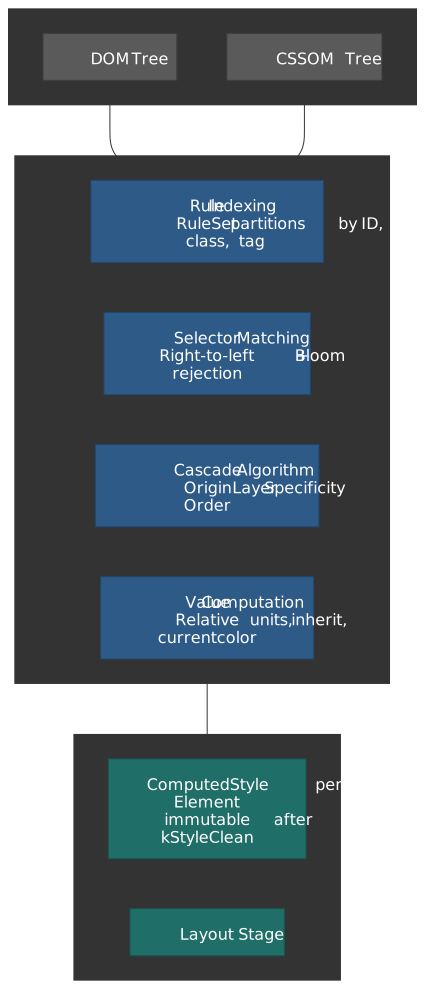
Style Recalculation transforms the DOM and CSSOM into computed styles for every element. The browser engine matches CSS selectors against DOM nodes, resolves cascade conflicts, and computes absolute values—producing the ComputedStyle objects that the Layout stage consumes. In Chromium’s Blink engine, this phase is handled by the StyleResolver, which uses indexed rule sets, Bloom filters, and invalidation sets to minimize work on each frame.
Abstract
Style Recalculation answers one question for every DOM element: what is the final value of each CSS property? The mental model:
- Index rules by rightmost selector — Engines partition stylesheets into hash maps keyed by ID, class, and tag. This lets the matcher skip irrelevant rules entirely.
- Match selectors right-to-left — Starting from the key selector (rightmost) and walking ancestors. Bloom filters enable fast rejection of impossible ancestor chains.
- Resolve conflicts via the Cascade — Origin, encapsulation context,
!important, layers, specificity, then source order. CSS Cascade Level 5 added@layerfor explicit precedence control. - Compute absolute values — Convert relative units (
rem,%,vh) and keywords (inherit,initial) to concrete pixel values or constants.
The cost scales with: (number of elements needing recalc) × (number of rules to consider per element) × (cascade complexity). Minimizing each factor is the optimization target.
From Render Tree to Style Recalculation
Older browser documentation merged style computation with layout under the term Render Tree construction. Modern Chromium (RenderingNG/BlinkNG) treats Style Recalculation as a discrete pipeline phase with strict lifecycle invariants. Under BlinkNG the ComputedStyle for an element reaches its final value during the style phase and is immutable thereafter — code paths that previously mutated it during layout were systematically refactored out.1
Why it matters: before BlinkNG, mutating
ComputedStyleafter the style phase made it hard to reason about when style data was finalized and blocked features that depend on a strict style → layout → paint ordering, including container queries and@scope.
Blink enforces the invariant through DocumentLifecycle: modifying a ComputedStyle property is only legal while the lifecycle state is kInStyleRecalc. Once the engine advances to kStyleClean, any further write is a contract violation that is caught in DCHECK builds.
The Process
1. Rule Indexing
Before any matching occurs, the engine compiles and indexes all active stylesheets. In Blink, the RuleSet object partitions rules by their rightmost compound selector (the “key selector”):
- Rules ending in
#headergo into theIdRulesmap under key"header" - Rules ending in
.nav-linkgo into theClassRulesmap under key"nav-link" - Rules ending in
divgo into theTagRulesmap
This indexing happens via FindBestRuleSetAndAdd() during stylesheet parsing. When matching an element, the engine only considers rules from the relevant buckets—not the entire stylesheet.
Design rationale: Examining every rule for every element is O(elements × rules). Indexing reduces this to O(elements × relevant-rules), where relevant-rules is typically orders of magnitude smaller for well-structured CSS.
2. Selector Matching
The engine evaluates selectors right to left, starting from the key selector and walking up the ancestor chain.
“The selector represents a particular pattern of element(s) in a tree structure.” — W3C Selectors Level 4
Why right-to-left? Consider .container .nav .item:
- Left-to-right: Find all
.containerelements, then check if any descendant is.nav, then.item. Requires traversing down potentially huge subtrees. - Right-to-left: Find all
.itemelements (the key selector), then verify ancestors include.navand.container. Most elements fail the key selector immediately—no ancestor traversal needed.
The rightmost selector acts as a filter. Since most rules don’t match most elements, failing fast on the key selector avoids expensive ancestor walks.
Bloom Filters for Ancestor Matching
When a selector does require ancestor verification (descendant or child combinators), Blink consults a counting Bloom filter to fast-reject impossible matches before any ancestor walk. The implementation lives in SelectorFilter, which wraps the generic WTF::BloomFilter.
The Bloom filter is a probabilistic membership structure:
- False positives are possible — it may say “could be present” when it isn’t.
- False negatives are impossible — if it says “not present,” that is definitive.
The counting variant tracks per-bucket counts so the engine can both add an ancestor’s identifiers when it descends into a subtree and remove them on backtrack, keeping the filter tight against the current ancestor chain instead of accumulating noise from siblings.
Mechanism. As the engine traverses the DOM, it pushes each ancestor’s IDs, classes, and tag name into the filter. For a selector like .container .nav .item, when matching an .item element the engine first probes the filter for .nav and .container. If either probe returns “not present,” the rule is rejected immediately — no parent-pointer walk required.
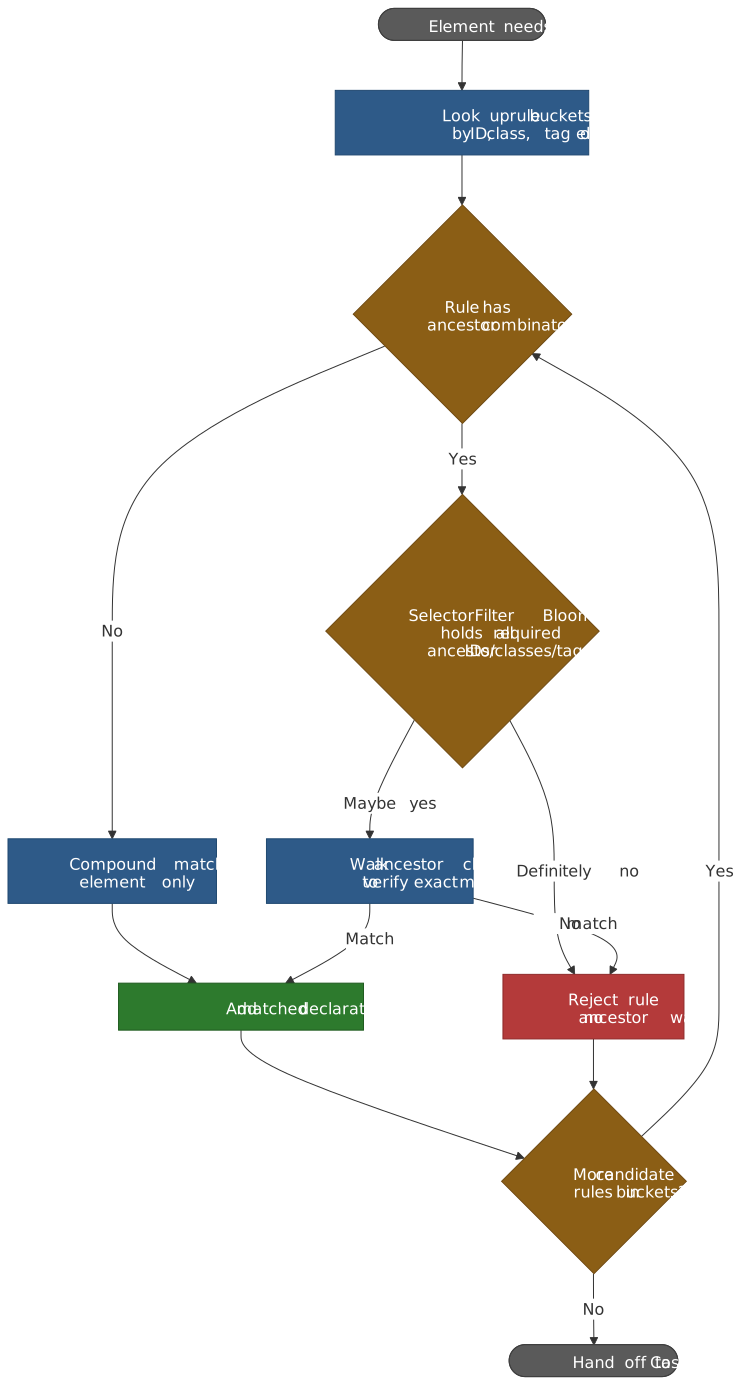
“WebKit saw a 25% improvement overall with a 2X improvement for descendant and child selectors.” — Antti Koivisto on the original WebKit Bloom-filter rollout, recapped in CSS Selector Performance has changed (for the better).
Trade-off: larger stylesheets and deeper trees both increase the false-positive rate. The filter accelerates rejection but every “maybe” still costs an exact ancestor traversal, so simpler key selectors and shorter combinator chains keep the win.
3. The Cascade Algorithm
When multiple declarations target the same property on the same element, the CSS Cascade Level 5 algorithm picks a single winner by walking these criteria in descending priority. Each step is total-order; ties drop to the next step.
| Priority | Criterion | Resolution |
|---|---|---|
| 1 | Origin & Importance | Transition > !important UA > !important user > !important author > Animation > author > user > UA |
| 2 | Encapsulation Context | For normal rules, outer (less encapsulated) context wins. For !important, inner context wins. |
| 3 | Element-Attached Styles | Inline style="..." beats rule-based declarations of the same origin |
| 4 | Cascade Layers | For normal rules, later layers (and unlayered) win. For !important, earlier layers win. |
| 5 | Specificity | ID count → class/attribute/pseudo-class count → type/pseudo-element count |
| 6 | Source Order | Last declaration in tree order wins |
Cascade Layers (@layer)
CSS Cascade Level 5 introduced @layer for explicit precedence control independent of specificity. Layers are ordered by first declaration:
/* Layer order: reset < base < components < utilities *//* Unlayered styles form an implicit final layer with highest normal priority */@layer reset, base, components, utilities;@layer reset { * { margin: 0; box-sizing: border-box; }}@layer components { .btn { padding: 8px 16px; } /* Lower precedence than unlayered */}/* Unlayered: wins over all layers for normal declarations */.btn-override { padding: 12px 24px;}Key inversion for !important: For normal declarations, later layers win. For !important declarations, earlier layers win. This lets foundational layers (resets) use !important to enforce invariants without being overridden by component layers.
4. Value Computation
After cascade resolution, the engine computes absolute values. This involves:
- Resolving relative units:
2rem→32px(if root font-size is 16px) - Resolving percentages:
width: 50%→ computed value remains50%; the used value (after layout) becomes pixels - Applying keywords:
inheritcopies parent’s computed value;initialuses the property’s initial value - Handling
currentcolor: Resolves to the element’s computedcolorvalue
Computed vs. Used vs. Resolved Values:
| Value Type | When Determined | Example |
|---|---|---|
| Computed | After cascade, before layout | width: 50% stays 50% |
| Used | After layout | width: 50% becomes 400px |
| Resolved | What getComputedStyle() returns |
Returns used value for dimensions if rendered; computed otherwise |
The CSSOM spec notes: “The concept of ‘computed value’ changed between revisions of CSS while the implementation of getComputedStyle() had to remain the same for compatibility.” This is why getComputedStyle() returns resolved values, not strictly computed values.
Performance Optimization
Understanding Invalidation
When DOM changes (element added/removed, class toggled, attribute modified), the engine must determine which elements need style recalculation. Blink uses InvalidationSets to minimise this scope, as documented in CSS Style Invalidation in Blink.2
How InvalidationSets work:
- During stylesheet compilation, every selector is analysed and recorded in a
RuleFeatureSet. The rule.c1 div.c2 { color: red }produces a descendant invalidation set: “if.c1is added or removed on an ancestor, invalidate descendants matchingdiv.c2.” - DOM changes call into
StyleEngine::*ChangedForElement(e.g.ClassChangedForElement), which routes toPendingInvalidations::ScheduleInvalidationSetsForNode. That call either marks the node withSetNeedsStyleRecalc(kLocalStyleChange | kSubtreeStyleChange)for an immediate hit, or appends pending sets toPendingInvalidationsMap. - When style is about to be read (typically
Document::UpdateStyleAndLayoutTreeahead of the next frame),StyleInvalidator::Invalidatewalks the tree depth-first and applies the pending sets to descendants whose IDs / classes / tags match. - Only nodes that end up dirty re-enter style recalculation; everything else reuses the cached
ComputedStyle.
Sibling and :has() propagation are separate paths. Sibling invalidation (for +/~ combinators) is documented in a separate Blink design doc and operates forward along the sibling chain; for :has(), Blink instead stores per-element bits in HasInvalidationFlags so it can decide whether a descendant mutation needs to bubble up to an ancestor at all (covered below).3
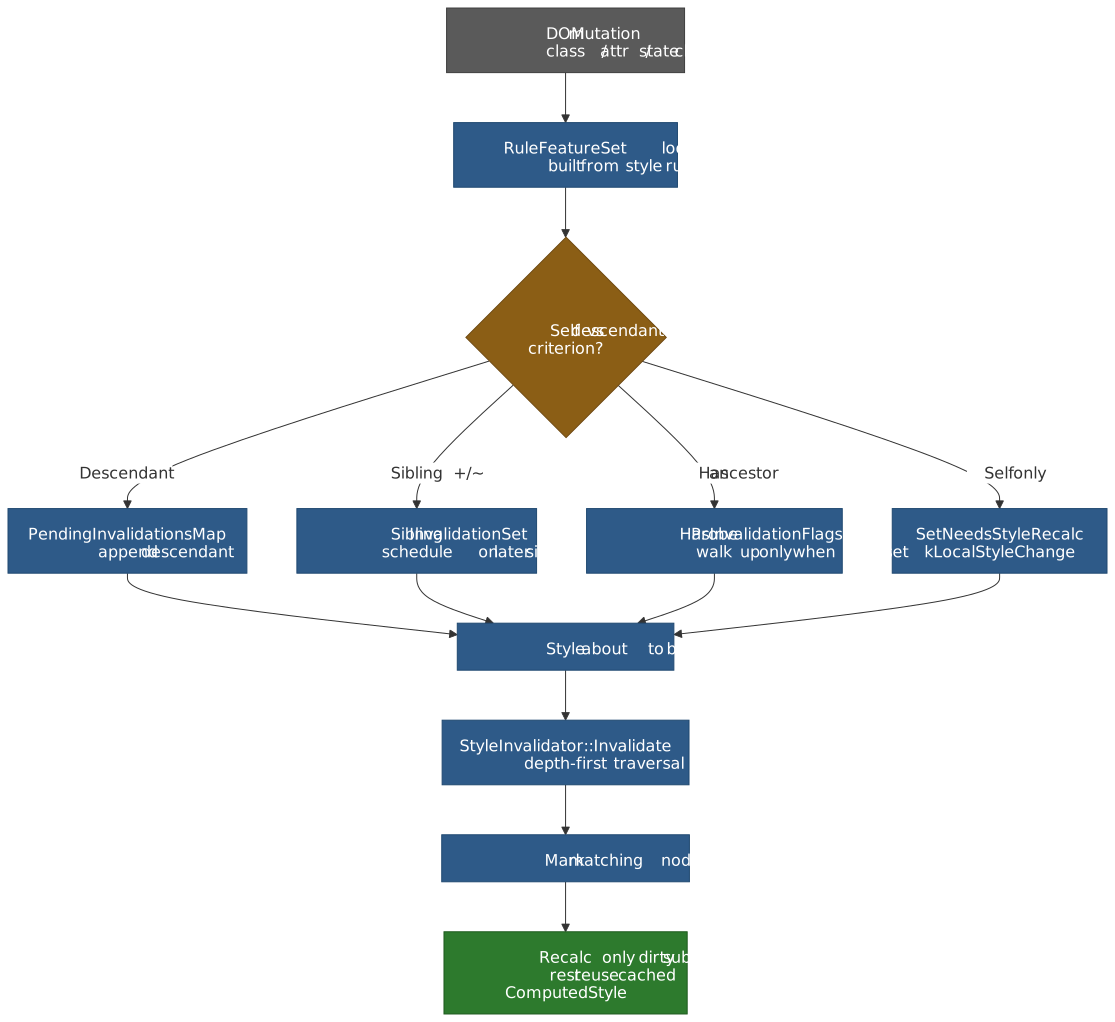
Design rationale: Invalidating everything on every change is correct but expensive. InvalidationSets accept some over-invalidation (marking elements that didn’t actually change) to avoid the cost of precise dependency tracking — the doc is explicit that they “err on the side of correctness.”
The Matched Properties Cache
Blink’s MatchedPropertiesCache (MPC) enables style sharing between elements with identical matching rules. When element B would resolve to the same ComputedStyle as element A (same matched rules, same inherited values), the cache returns A’s style directly.
When MPC hits: Sibling elements with identical classes and no style-affecting attributes often share styles. Lists, tables, and repeated components benefit significantly.
When MPC misses: Elements with CSS custom properties, animations, or pseudo-class states (:hover, :focus) may not share styles.
Selector Complexity and Cost
“Roughly half of the time used in Blink (the rendering engine used in Chromium and derived browsers) to calculate the computed style for an element is used to match selectors, and the other half is used to construct the computed style representation from the matched rules.” — Rune Lillesveen, Blink engineer, quoted in web.dev: Reduce the scope and complexity of style calculations.
Selector cost depends on:
| Factor | Impact | Example |
|---|---|---|
| Key selector specificity | Classes/IDs are O(1) lookup; universal/tag are broader | .nav-link vs a |
| Combinator chain length | Each combinator requires ancestor/sibling traversal | .a .b .c .d |
| Attribute selectors | [attr] is fast; [attr*="value"] requires string scanning |
[class*="icon-"] |
| Pseudo-classes | :nth-child() requires sibling counting; :has() is expensive |
:nth-last-child(-n+1) |
Production measurement: Edge DevTools (109+) includes Selector Stats showing elapsed time, match attempts, and match count per selector. Use this to identify expensive selectors rather than guessing.
:has() Invalidation Cost
:has() (CSS Selectors Level 4 §6.2) inverts the usual matching direction — a descendant change can affect an ancestor’s style — which would naively force the engine to walk every mutation up the DOM. Blink avoids that with two pieces of pre-computed metadata, set when stylesheets are compiled:
HasInvalidationFlagsbits stored on everyElement(e.g.AffectedBySubjectHas,AncestorsOrAncestorSiblingsAffectedByHas,SiblingsAffectedByHas). If no relevant bit is set in a mutated element’s subtree, no upward walk happens at all.- Per-class / per-attribute filters derived from the
:has()argument: a mutation only triggers:has()re-evaluation if the changed identifier appears inside some:has(...)selector that the document actually uses.
The combined effect: on a page that does not use :has(), the cost is zero; on a page that does, only mutations that touch identifiers referenced inside a :has() argument bubble up, and only along ancestor chains whose flags say a :has() subject sits above them.3
Warning
The cost still scales with the size of the :has() argument. Web Platform Tests’ has-complexity.html explicitly stress-tests deep :has(...) arguments. Prefer :has(.flag) over :has(.parent .child + .other), and prefer narrow class arguments over broad attribute selectors.
Container Queries Scoping Cost
Container queries (originally drafted in CSS Containment Level 3, now folded into CSS Conditional Rules Module Level 5) introduce a second axis the engine must evaluate during recalc: @container rules whose match depends on an ancestor’s resolved size or style. The container-type property is the explicit opt-in and pulls in layout / size / style containment from the contain family — without it, a child changing size could resize its parent and trigger an infinite query/layout loop, so containment is a correctness requirement, not just a hint.4
Two concrete cost implications:
- Scoped recalc. Chromium evaluates
@containerrules against the nearest matching ancestor with a compatiblecontainer-type. Once resolved, the result is cached per query container; a size change that does not cross a query threshold does not re-trigger style recalc for the subtree — the query feature filter rejects it first. - Forced style/layout interleaving. Because container size depends on layout but feeds back into style, Chromium runs an interleaved style → layout pass for any subtree whose container size has changed. Deep
container-type: sizechains amplify that cost;container-type: inline-sizeis cheaper because only the inline axis participates.
Tip
Prefer container-type: inline-size and a single container-name per logical component. Putting container-type: size on a generic wrapper forces the engine into block-axis containment for every descendant query, which is rarely what you want.
Parallel Style Recalc — Stylo / Quantum CSS
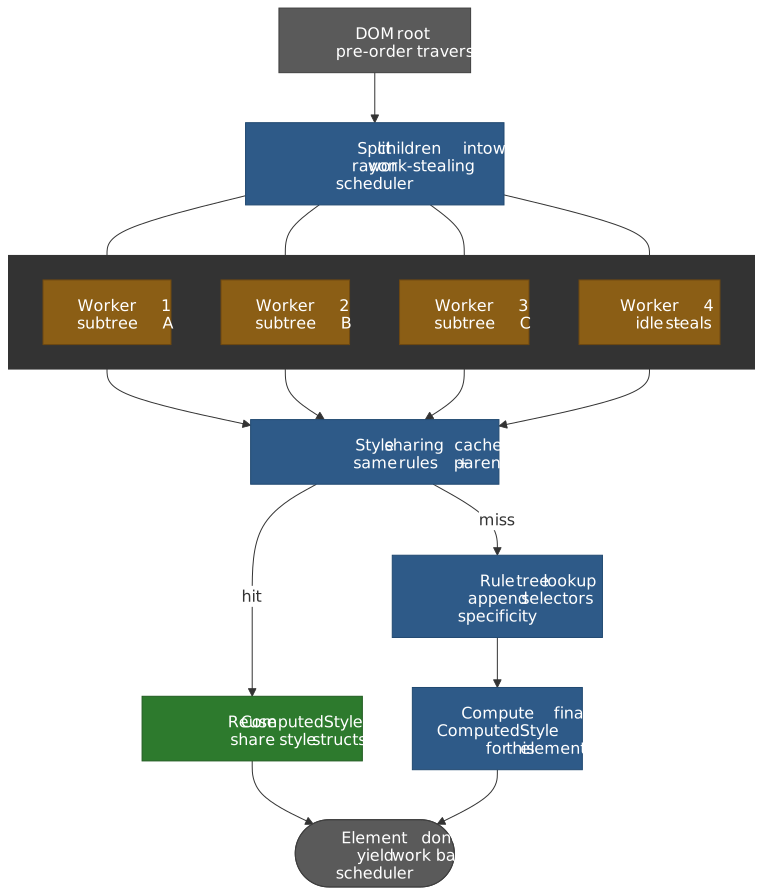
Style recalc is “embarrassingly parallel” within the constraint that a node’s computed style depends on its parent’s. Servo’s Stylo, shipped as Firefox’s CSS engine in 2017 (project name Quantum CSS), exploits that with three reinforcing optimizations described in Inside a super fast CSS engine: Quantum CSS:
- Parallel pre-order traversal. The DOM tree is split into work units and dispatched onto a
rayonwork-stealing thread pool — idle cores steal subtrees from busy cores’ queues, so uneven trees don’t serialize on a single hot branch. - Rule tree. Selector match results for an element are recorded as a path in a shared trie keyed on (rule, specificity). On restyle, an element whose ancestor changed in a way that cannot affect rule matching keeps its existing path and skips selector matching entirely.
- Style sharing cache. Sibling-like elements with the same id/class/inline-style and the same parent computed-style pointer reuse one another’s
ComputedStyle. Stylo’s variant additionally records a bit-vector of “weird selector” probes (e.g.:nth-child) so it does not have to give up the way Blink/WebKit historically did.
Blink does not parallelize the recalc traversal itself, but it does maintain conceptually similar caches — the MatchedPropertiesCache (style sharing) and shared ComputedStyle pointers between elements that resolve to the same value.
Style Thrashing
Style Thrashing (also called layout thrashing or forced synchronous layout) occurs when JavaScript interleaves style reads (getComputedStyle(), offsetWidth, getBoundingClientRect()) with style writes (element.style.width = ..., class toggles), forcing the engine to synchronously flush pending style and layout each time a value is read:
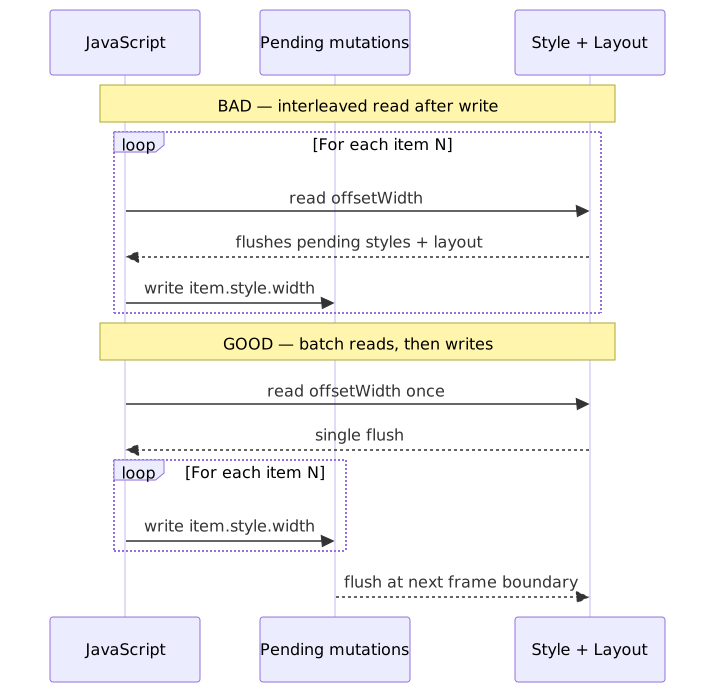
// Assume container and items existconst container = document.getElementById("container")const items = document.querySelectorAll(".item")// BAD: Interleaved Read/Write — forces recalc on every iterationitems.forEach((item) => { const width = container.offsetWidth // READ → Triggers Sync Recalc item.style.width = `${width}px` // WRITE → Invalidates styles})// GOOD: Batch Reads, then Batch Writesconst width = container.offsetWidth // Single READitems.forEach((item) => { item.style.width = `${width}px` // WRITE (batched)})// Helper functions omitted for brevityfunction measureAll() { /* ... */}function applyAll() { /* ... */}Why it’s expensive: Each read after a write forces the engine to flush pending style changes to return accurate values. With N items, the bad pattern causes N recalculations; the good pattern causes 1.
Measuring Style Recalculation
Chrome/Edge DevTools:
- Open the Performance panel and click the Capture settings (gear) icon.
- Tick Enable CSS selector stats (slow) — available in Microsoft Edge 109+ and Chrome DevTools.5
- Record an interaction; the purple Recalculate Style events now expose a Selector Stats tab in the bottom pane with elapsed time, match attempts, fast-reject count, and match count per selector.
Long Animation Frames (LoAF) API: For production monitoring, the PerformanceLongAnimationFrameTiming entry exposes styleAndLayoutStart (when the engine began the end-of-frame style + layout pass) and per-script forcedStyleAndLayoutDuration (time a script spent forcing synchronous style/layout from getBoundingClientRect, offsetWidth, etc.). The web-vitals library exposes these on its INP attribution entries (longAnimationFrameEntries, totalStyleAndLayoutDuration), so you can attribute slow interactions to either end-of-frame recalc or specific script-induced thrashing in the field.
Benchmark example: The Edge DevTools team’s photo gallery demo is the canonical worked example for Selector Stats; recordings published by the team show the long-running Recalculate Style task on that demo dropping from roughly hundreds of milliseconds to tens once the slowest selectors (long descendant chains and [class*="…"] substring matches) are simplified. Reproduce the trace yourself before quoting numbers — the absolute values depend on hardware, viewport, and Chromium version.
Conclusion
Style Recalculation sits at the intersection of CSS language semantics and engine implementation. The cascade algorithm (origin → layer → specificity → order) is specified by W3C; the optimisation strategies (rule indexing, counting Bloom filters, invalidation sets, HasInvalidationFlags, the matched properties cache, Stylo’s rule tree and work-stealing scheduler) are engine implementation details.
For production applications, focus on:
- Simple selectors with class-based key selectors — enables efficient indexing and fast rejection.
- Tight
:has()arguments and explicitcontainer-type— keeps invalidation walks short and prevents accidental block-axis containment. - Avoiding style thrashing — batch reads before writes; LoAF tells you which scripts are still doing it in the field.
- Measuring before optimising — use Selector Stats to find actual bottlenecks, not theoretical ones.
The rendering pipeline continues to evolve. BlinkNG’s strict phase separation now enables features like container queries that require precise style-layout boundaries — a constraint that would have been impossible under the older, leakier architecture.
Appendix
Prerequisites
- DOM construction and CSSOM construction (earlier CRP articles)
- CSS Specificity calculation basics
- Basic algorithmic complexity (O-notation)
Where this fits in the series
- Previous: CSSOM Construction — how the CSS rule set is parsed and normalised before recalc starts.
- Next: Layout — how the immutable
ComputedStyleproduced here flows into box-tree generation and geometry.
Terminology
| Term | Definition |
|---|---|
| UA Stylesheet | User-Agent stylesheet; browser’s default styles (e.g., display: block for <div>) |
| Computed Value | Value after cascade resolution and inheritance, before layout |
| Used Value | Final value after layout calculations (e.g., percentages resolved to pixels) |
| Resolved Value | What getComputedStyle() returns; may be computed or used depending on property and render state |
| Key Selector | Rightmost compound selector; determines which rule bucket an element checks |
| InvalidationSet | Blink data structure tracking which elements need recalculation when specific classes/attributes change |
| Bloom Filter | Probabilistic data structure for fast set membership testing; allows false positives but not false negatives |
| Matched Properties Cache | Blink optimization enabling style sharing between elements with identical matching rules |
Summary
- Style Recalculation produces a
ComputedStylefor every DOM element by matching rules, resolving cascade conflicts, and computing absolute values. - Engines index rules by rightmost selector and match right-to-left; counting Bloom filters fast-reject impossible ancestor chains.
- The CSS Cascade (Level 5) resolves conflicts via: origin → encapsulation → element-attached → layer → specificity → order, and inverts layer order for
!important. - InvalidationSets minimise recalc scope; sibling combinators and
:has()use separate paths (HasInvalidationFlagskeeps:has()opt-in cheap). - Container queries scope recalc per query container but force interleaved style → layout passes when the container’s size changes.
- Stylo / Quantum CSS parallelises recalc with
rayonwork stealing, a shared rule tree, and a style sharing cache; Blink does not parallelise the traversal but uses theMatchedPropertiesCachefor sharing. - Style thrashing forces synchronous recalc — always batch reads before writes.
- Measure with DevTools Selector Stats; LoAF (
forcedStyleAndLayoutDuration) attributes field thrashing to specific scripts.
References
- W3C CSS Cascading and Inheritance Level 5 — authoritative cascade algorithm and
@layersemantics. - W3C Selectors Level 4 — selector syntax, specificity,
:has()definition. - W3C CSSOM — resolved / computed / used value definitions.
- W3C CSS Containment Module Level 3 and CSS Conditional Rules Module Level 5 (Editor’s Draft) — container queries and
container-type. - Chromium: CSS Style Calculation in Blink —
RuleSet,ScopedStyleResolver,SelectorChecker. - Chromium: CSS Style Invalidation in Blink —
RuleFeatureSet,PendingInvalidationsMap,StyleInvalidator. - Chrome for Developers: BlinkNG — rendering pipeline architecture and immutable
ComputedStyle. - Mozilla Hacks: Inside a super fast CSS engine — Quantum CSS (Stylo) — parallel pre-order traversal, rule tree, style sharing cache.
- Servo Book: Style* and Servo wiki: Layout Overview — Stylo design notes.
- Igalia / Byungwoo Lee: How Blink invalidates styles when
:has()in use? —HasInvalidationFlagsmechanics. - Microsoft Edge Blog: The Truth About CSS Selector Performance — modern selector benchmarks and Selector Stats.
- Chrome DevTools: Analyze CSS selector performance during Recalculate Style events — Selector Stats workflow.
- web.dev: Reduce the scope and complexity of style calculations — practical optimisation guidance.
- Performance Calendar: CSS Selector Performance Has Changed — historical Bloom filter impact.
Footnotes
-
Chrome for Developers, RenderingNG deep-dive: BlinkNG, section “Immutable computed style”. ↩
-
Chromium,
third_party/blink/renderer/core/css/style-invalidation.md. The companionstyle-calculation.mdexplains howScopedStyleResolverandRuleSetcompile and index the rules that invalidation sets are derived from. ↩ -
Byungwoo Lee (Igalia, Blink team), How Blink invalidates styles when
:has()in use?, 2023-05-31. ↩ ↩2 -
Miriam Suzanne et al., CSS Conditional Rules Module Level 5 (Editor’s Draft) and CSS Containment Module Level 3. Chrome for Developers, Container queries are stable across browsers, describes the
container-typeopt-in and its containment requirements. ↩ -
Chrome DevTools, Analyze CSS selector performance during Recalculate Style events. The Chrome implementation is upstreamed from Microsoft’s original Edge work. ↩