Trees and Graphs: Traversals and Applications
Trees and graphs are the connective tissue of working systems — file systems and B-tree indexes, build DAGs and package managers, schedulers and routers, virtual DOMs and union-find connectivity. This article is the senior-engineer mental model: which tree variant fits which workload, when adjacency lists beat matrices, why three colours are needed for directed cycle detection, what Kahn’s algorithm actually does in a build pipeline, when Dijkstra silently lies (negative weights), and why path-compressed union-find behaves like O(1) in practice. Each section pairs the mechanism with a diagram, a complexity row, and the production system that depends on it.
Mental model
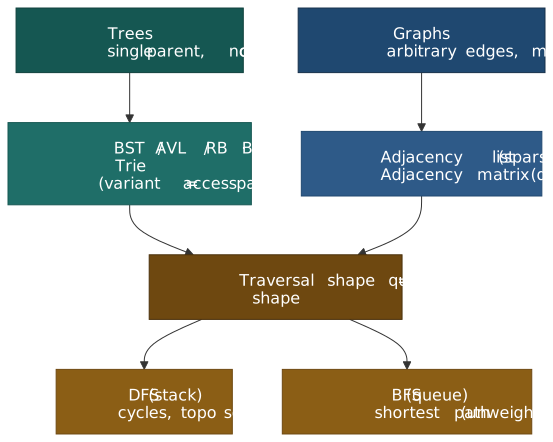
Trees and graphs share a node-and-edge substrate. The distinction is structural: trees enforce a single parent and forbid cycles; graphs allow arbitrary connections, including cycles and multi-edges. Once you internalise that, the rest is engineering trade-offs:
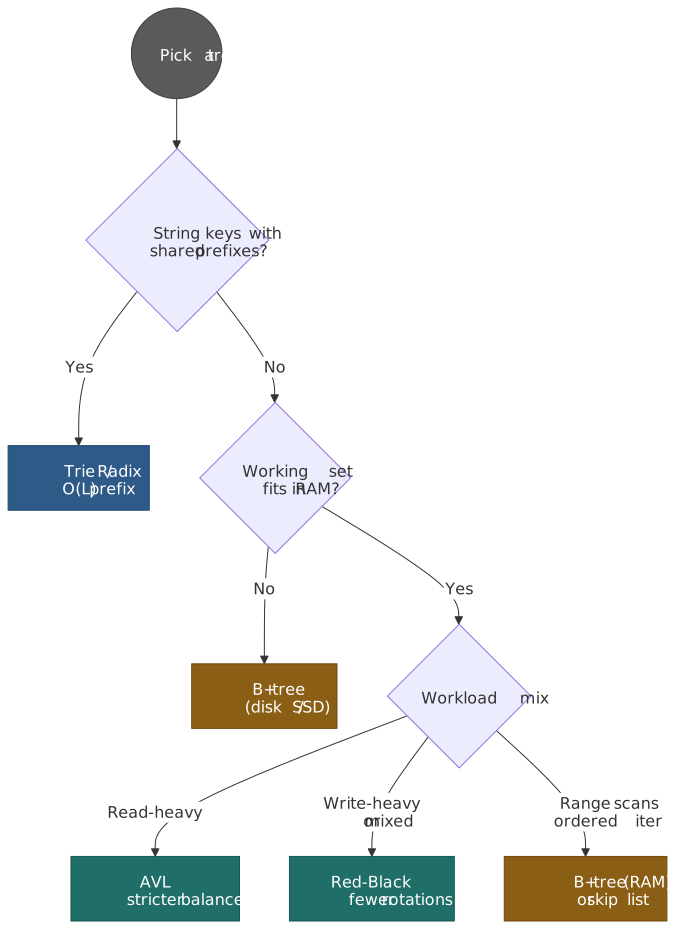
- Tree variant = access-pattern fit. AVL trades insert/delete cost for tighter height (search-heavy). Red-black trees trade height for rotation budget (write-heavy and the default in standard libraries). B/B+ trees raise fanout so the working set fits fewer disk or SSD pages (databases, file systems). Tries amortise per-character work across shared prefixes (autocomplete, IP routing).
- Graph representation = density bet. Adjacency matrices give O(1) edge lookup but always cost O(V²) space — only worth it on dense graphs. Adjacency lists cost O(V + E) and dominate everywhere else, which means almost everything real (social networks, road maps, dependency graphs).
- Traversal = question shape. DFS uses a stack and probes deep first — natural for cycle detection, topological order, and any “explore one branch fully” problem. BFS uses a queue and explores level by level — the only traversal that finds shortest paths in unweighted graphs in linear time.
- Union-Find = connectivity oracle. Path compression plus union-by-rank pushes the amortised cost per operation to O(α(n)), where α is the inverse Ackermann function — at most 4 for any input the universe can hold1.
Tree variants
Binary search tree (BST)
A BST holds the in-order invariant left subtree < node < right subtree. Search, insert, and delete are O(h) where h is the height. The catch: the height isn’t bounded unless something keeps it bounded.
interface BSTNode<T> { value: T left: BSTNode<T> | null right: BSTNode<T> | null}// Sorted insertions degenerate the tree to a linked list:// insert(1), insert(2), insert(3), insert(4)// 1 -> 2 -> 3 -> 4 (height = n, all ops O(n))//// The fix is a balancing invariant: AVL, Red-Black, B-tree, treap, ...Warning
A “plain” BST is a teaching artefact, not a production data structure. Sorted-input degeneration is the most common interview-grade footgun. Reach for a self-balancing variant or a hash map by default; only hand-roll a BST when you control the key distribution.
AVL trees: strict balance for search-heavy workloads
AVL trees, named after Adelson-Velsky and Landis (1962), were the first self-balancing BSTs2. Every node’s balance factor — the height difference between left and right subtrees — must stay in {-1, 0, +1}. Insert or delete may break this; the tree restores it with a single or double rotation along the path back to the root.
- What you get: the tightest height bound of the common balanced trees (
h ≤ 1.44 · log₂(n+2))3. Lookups visit fewer nodes than a comparable red-black tree. - What you pay: more rotations per modification (potentially log n on the path back to the root) — a cost that matters under heavy mutation.
- When to reach for it: search-dominated workloads where you can amortise the rotation cost — read-mostly indexes, lookup-heavy in-memory dictionaries.
Red-black trees: looser balance for write-heavy workloads
Red-black trees come from Guibas and Sedgewick’s 1978 paper “A Dichromatic Framework for Balanced Trees”4. The invariants are colour-based, not height-based:
- Every node is red or black.
- The root is black.
- NIL leaves are black.
- A red node’s children are both black (no two reds in a row).
- Every root-to-leaf path crosses the same number of black nodes (“black-height”).
Together these bound the height at 2 · log₂(n+1) — looser than AVL — but in exchange every insert needs at most 2 rotations and every delete at most 3, making modifications cheaper on average5.
- Production footprint: Java’s
TreeMapandTreeSet, the GCC and LLVM standard libraries’std::map/std::set, and the Linux kernel’s red-black tree (include/linux/rbtree.h) used by the Completely Fair Scheduler — and now the EEVDF scheduler since Linux 6.6 — to keep the runqueue ordered by virtual deadline67. - Why the kernel chose RB over a heap: the scheduler needs O(log n) insert and remove plus O(1) “leftmost” lookup (the next task). A red-black tree gives both with a contiguous parent/child layout that doesn’t need the heap’s sift-down on arbitrary removal6.
AVL vs red-black: the trade-off
| Aspect | AVL | Red-Black |
|---|---|---|
| Balance | Strict (height diff ≤ 1) | Loose (height ≤ 2 × optimal) |
| Search | Slightly faster (shorter height) | Slightly slower |
| Insert/Delete | Up to log n rotations | ≤ 2 (insert) / ≤ 3 (delete) rotations |
| Use case | Read-dominant | Write-dominant or mixed (the std-lib default) |
Tip
If you’re not sure, pick red-black. Standard libraries shipped that decision because the rotation budget matters more for typical workloads than the constant-factor lookup difference.
B-trees and B+ trees: page-aware indexes
Binary trees are wrong for storage that fetches in pages. A modern HDD pays roughly 4–10 ms per random seek; a NVMe SSD pays 20–80 µs8. Either way the cost per node access dwarfs the comparison cost, so the engineering goal is to make each fetched page do as much work as possible. That means raising the fanout.
A B-tree of order m9:
- Every node holds up to
m − 1keys andmchildren. - Every non-root node holds at least
⌈m/2⌉ − 1keys. - All leaves sit at the same depth (perfectly balanced).
Sized so a node fits one page (4–16 KB), a B-tree with millions of keys is typically 3–4 levels deep, so a point lookup costs 3–4 page fetches.
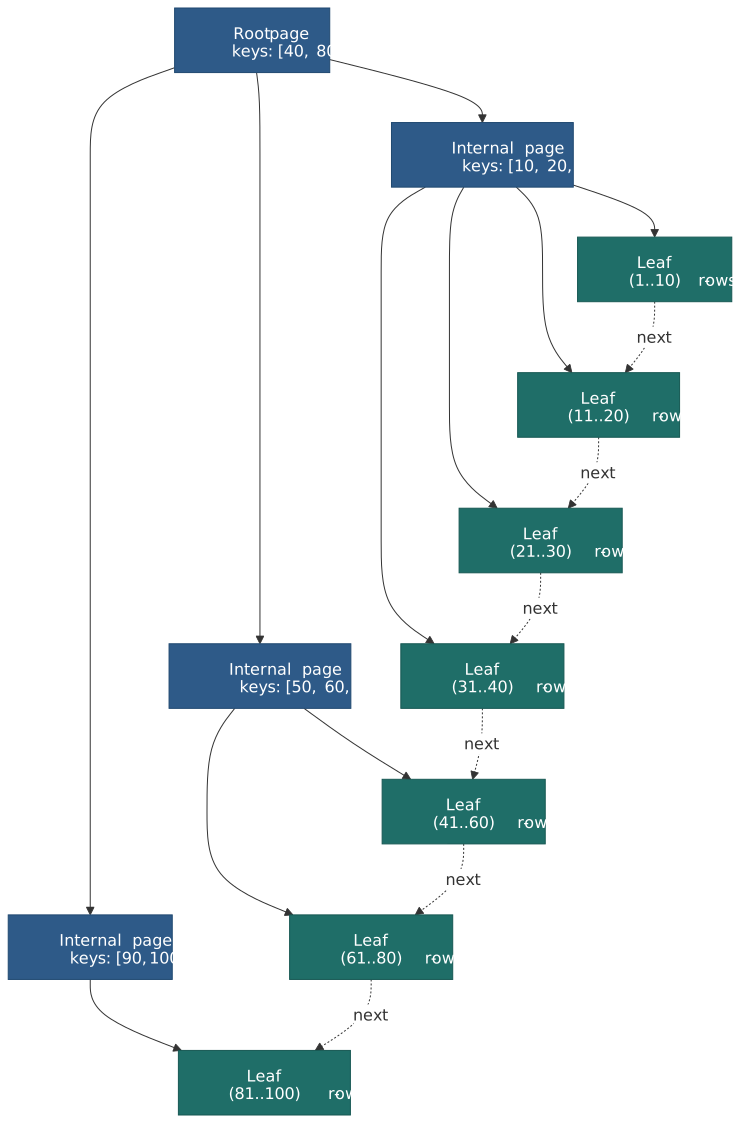
A B+ tree is the variant most production databases ship1011:
- Internal nodes store only routing keys.
- All values live in the leaf level.
- Leaves are linked into a doubly-linked list for cheap range scans.
Production footprint:
- PostgreSQL uses Lehman & Yao’s high-concurrency B+ tree variant, which adds a right-link per page so readers traverse without blocking on splits10.
- MySQL InnoDB stores every table as a clustered B+ tree on the primary key; secondary indexes are separate B+ trees whose leaves hold the primary-key value rather than a row pointer11.
- SQLite uses a B-tree for index pages and a B+ tree for table pages12.
- File systems: NTFS, HFS+, Btrfs, and XFS use B/B+ trees for directories and on-disk indexes; ext4 uses an HTree (a hashed B-tree variant with fixed depth 1–2) for directory indexing13.
interface BTreeNode<K, V> { keys: K[] // up to m - 1 children: BTreeNode<K, V>[] // up to m isLeaf: boolean}// Order-4 node holding keys [10, 20, 30] partitions the key space:// (-inf, 10) [10, 20) [20, 30) [30, +inf)// child 0 child 1 child 2 child 3//// 1M keys, order 100 (~100 keys per page) -> height ≤ 3 -> at most// 3 page fetches per point lookup, regardless of where the key sits.Tries: prefix-shared search
Tries (aka prefix trees) replace per-key comparison with per-character descent. Each edge represents one character; a marked node means “a stored string ends here”. Lookup, insert, and delete are O(L) where L is the key length — independent of how many strings are stored.
- What they buy: prefix queries that hash maps cannot answer (autocomplete, “all keys starting with
pre”), and longest-prefix matching for routing tables. - What they cost: more memory than a hash table — every distinct character on the path needs a node or edge unless you compress.
- The compressed variants matter in practice:
- Radix / Patricia tries collapse single-child chains into a single edge labelled with multiple characters14.
- LC-tries add level compression on top, expanding dense subtries into a single node with a
2^k-entry vector. The Linux IPv4 routing table (fib_trie) has used an LC-trie for longest-prefix-match lookups since kernel 2.6.3915.
Application footprint: autocomplete, spell checking, IP routing (LC-trie / Patricia), genomic suffix structures.
Graph representations
Adjacency matrix
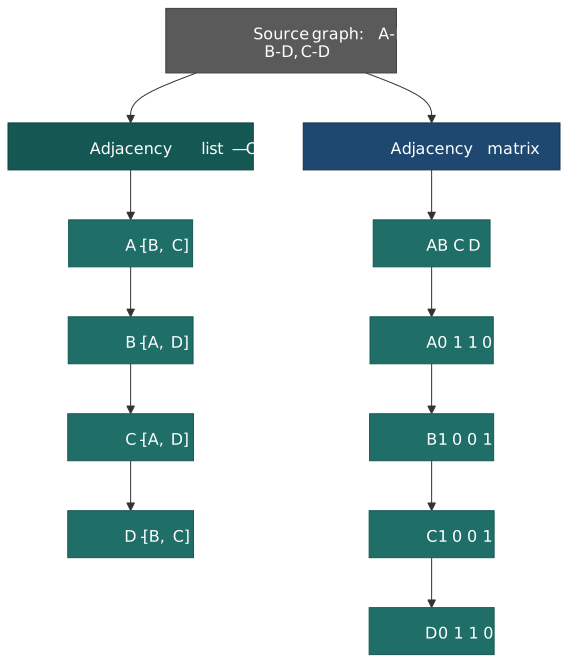
A V × V matrix where matrix[i][j] carries the edge weight (or 0/1 for unweighted). Edges are O(1) to look up but space is O(V²) regardless of how many edges exist.
class GraphMatrix { private matrix: number[][] constructor(vertices: number) { this.matrix = Array.from({ length: vertices }, () => Array(vertices).fill(0)) } addEdge(u: number, v: number, weight = 1): void { this.matrix[u][v] = weight // For undirected: this.matrix[v][u] = weight } hasEdge(u: number, v: number): boolean { return this.matrix[u][v] !== 0 // O(1) }}When it wins: dense graphs (E ≈ V²), heavy edge-existence queries, small graphs where V² is acceptable, and algorithms that benefit from cache-friendly contiguous memory (Floyd-Warshall is the canonical example).
Adjacency list
Each vertex maps to its set of neighbours. Space is O(V + E); edge-existence is O(degree) with arrays, O(1) with sets or hash maps.
class GraphList { private adj: Map<number, Set<number>> constructor() { this.adj = new Map() } addEdge(u: number, v: number): void { if (!this.adj.has(u)) this.adj.set(u, new Set()) this.adj.get(u)!.add(v) } hasEdge(u: number, v: number): boolean { return this.adj.get(u)?.has(v) ?? false } neighbors(u: number): number[] { return [...(this.adj.get(u) ?? [])] }}When it wins: sparse graphs (E ≪ V²) — which is virtually every real graph (social networks, road networks, dependency graphs), and any algorithm that iterates neighbours rather than probing arbitrary edges.
Representation trade-offs
| Operation | Adjacency Matrix | Adjacency List |
|---|---|---|
| Space | O(V²) | O(V + E) |
| Edge lookup | O(1) | O(1) with set, O(degree) with list |
| Neighbour iteration | O(V) | O(degree) |
| Add edge | O(1) | O(1) |
| Remove edge | O(1) | O(degree) with list, O(1) with set |
| Dense graphs | Efficient | Wasteful |
| Sparse graphs | Wasteful | Efficient |
Tip
Default to adjacency lists with hash sets per vertex. Switch to matrices only when the graph is provably dense (Floyd-Warshall, dense bipartite matching) or when you need branch-free edge lookups in a hot loop.
Traversal algorithms
Depth-first search (DFS)
DFS goes deep before wide. The recursive version uses the call stack; the iterative version uses an explicit stack so you can run it on graphs deeper than your call-stack limit.
function dfsRecursive( graph: Map<number, number[]>, start: number, visited = new Set<number>(),): void { if (visited.has(start)) return visited.add(start) // process(start) for (const neighbor of graph.get(start) ?? []) { dfsRecursive(graph, neighbor, visited) }}function dfsIterative(graph: Map<number, number[]>, start: number): void { const visited = new Set<number>() const stack = [start] while (stack.length > 0) { const node = stack.pop()! if (visited.has(node)) continue visited.add(node) // process(node) const neighbors = graph.get(node) ?? [] for (let i = neighbors.length - 1; i >= 0; i--) { if (!visited.has(neighbors[i])) stack.push(neighbors[i]) } }}Tree DFS variants are useful in their own right:
- Preorder (root → left → right): tree copying, serialisation.
- Inorder (left → root → right): produces sorted output for a BST.
- Postorder (left → right → root): tree deletion, expression evaluation, dependency resolution where children must finish before the parent.
Complexity: O(V + E) time, O(V) space (visited set + stack/recursion depth).
Caution
Recursive DFS on a graph with depth > ~10⁴ blows the JavaScript call stack and most language defaults. For deep graphs (file system trees, dependency DAGs across large monorepos), the iterative form is the safe default.
Breadth-first search (BFS)
BFS explores all neighbours of the current node before any of their children, using a queue.
function bfs(graph: Map<number, number[]>, start: number): void { const visited = new Set<number>([start]) const queue: number[] = [start] while (queue.length > 0) { const node = queue.shift()! // process(node) for (const neighbor of graph.get(node) ?? []) { if (!visited.has(neighbor)) { visited.add(neighbor) queue.push(neighbor) } } }}The defining property: in an unweighted graph, the first time BFS visits a node, it’s via a shortest path (in edge count). That single fact powers most “minimum hops” problems — friend-of-a-friend search, web crawls bounded by depth, network reachability checks.
Complexity: O(V + E) time, O(V) space.
Note
Array.shift() is O(n) in V8 and most engines, so a naïve BFS in JavaScript can degrade to O(V²) on large graphs. Use a circular buffer, Deque, or an index-based queue head pointer if BFS is on a hot path.
DFS vs BFS
| Aspect | DFS | BFS |
|---|---|---|
| Data structure | Stack (explicit or call stack) | Queue |
| Exploration | Deep first | Level by level |
| Path finding | Any path | Shortest path (unweighted) |
| Memory | O(max depth) | O(max width) |
| Use cases | Cycle detection, topological sort, maze solving | Shortest path, level traversal, nearest neighbours |
In wide-shallow graphs, DFS uses less memory; in deep-narrow graphs, BFS uses less. For balanced trees, both stay at O(log n).
Cycle detection
Undirected graphs: DFS with parent tracking
In undirected graphs, the parent → child → parent round-trip is structural, not a cycle. So the rule is: an edge to an already-visited node that isn’t the immediate parent is a back edge — and a back edge is a cycle.
function hasCycleUndirected(graph: Map<number, number[]>, vertices: number[]): boolean { const visited = new Set<number>() function dfs(node: number, parent: number | null): boolean { visited.add(node) for (const neighbor of graph.get(node) ?? []) { if (!visited.has(neighbor)) { if (dfs(neighbor, node)) return true } else if (neighbor !== parent) { return true } } return false } for (const v of vertices) { if (!visited.has(v) && dfs(v, null)) return true } return false}Directed graphs: three-colour DFS
In a directed graph, “I’ve seen this node before” doesn’t mean “I’m in a cycle” — you might just be re-arriving via a different path. The cycle question is: did I re-arrive at a node still on the current DFS path? That requires three states, not two.
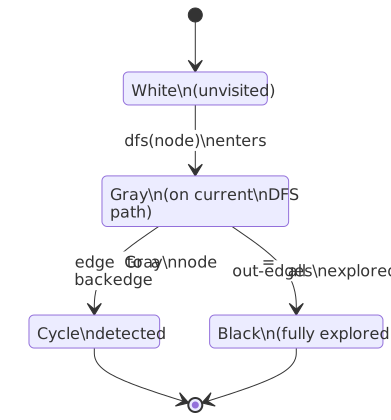
enum Color { WHITE, GRAY, BLACK }function hasCycleDirected(graph: Map<number, number[]>, vertices: number[]): boolean { const color = new Map<number, Color>() vertices.forEach((v) => color.set(v, Color.WHITE)) function dfs(node: number): boolean { color.set(node, Color.GRAY) for (const neighbor of graph.get(node) ?? []) { if (color.get(neighbor) === Color.GRAY) return true // back edge if (color.get(neighbor) === Color.WHITE && dfs(neighbor)) return true } color.set(node, Color.BLACK) return false } for (const v of vertices) { if (color.get(v) === Color.WHITE && dfs(v)) return true } return false}This same machinery underlies most directed-DAG validators: import-cycle detection in module bundlers, dependency cycle detection in package managers, build-graph validation in CI.
Topological sorting
A topological order on a directed acyclic graph lists vertices so that for every edge u → v, u precedes v. It is the canonical output of dependency resolution.
Kahn’s algorithm (BFS-based)
Repeatedly emit a vertex with in-degree 0; decrement the in-degree of each of its out-neighbours; repeat until empty. If you ran out of zero-in-degree vertices but vertices remain, the graph has a cycle.
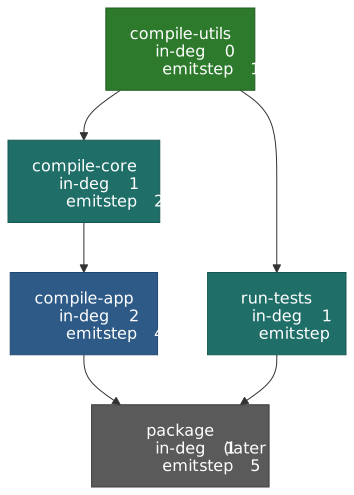
function topologicalSortKahn( graph: Map<number, number[]>, vertices: number[],): number[] | null { const inDegree = new Map<number, number>() vertices.forEach((v) => inDegree.set(v, 0)) for (const [, neighbors] of graph) { for (const neighbor of neighbors) { inDegree.set(neighbor, (inDegree.get(neighbor) ?? 0) + 1) } } const queue = vertices.filter((v) => inDegree.get(v) === 0) const result: number[] = [] while (queue.length > 0) { const node = queue.shift()! result.push(node) for (const neighbor of graph.get(node) ?? []) { const newDegree = inDegree.get(neighbor)! - 1 inDegree.set(neighbor, newDegree) if (newDegree === 0) queue.push(neighbor) } } return result.length === vertices.length ? result : null // null = cycle}DFS-based approach
Visit each unvisited vertex; emit it on the way back up (postorder); reverse at the end. The same colour bookkeeping that detected directed cycles tells you when the input isn’t a DAG.
function topologicalSortDFS(graph: Map<number, number[]>, vertices: number[]): number[] | null { const visited = new Set<number>() const inStack = new Set<number>() const result: number[] = [] function dfs(node: number): boolean { if (inStack.has(node)) return false if (visited.has(node)) return true visited.add(node) inStack.add(node) for (const neighbor of graph.get(node) ?? []) { if (!dfs(neighbor)) return false } inStack.delete(node) result.push(node) return true } for (const v of vertices) { if (!visited.has(v) && !dfs(v)) return null } return result.reverse()}Both are O(V + E). Pick Kahn’s when you also want to drive a worker pool (it produces ready vertices in batches as in-degrees hit zero); pick the DFS form when the surrounding code already does a DFS.
Real-world applications: build systems (Make, Maven, Gradle, Bazel), package managers (npm, pip, cargo), database migrations, course-prerequisite scheduling, and any pipeline where step A must complete before step B begins.
Shortest paths
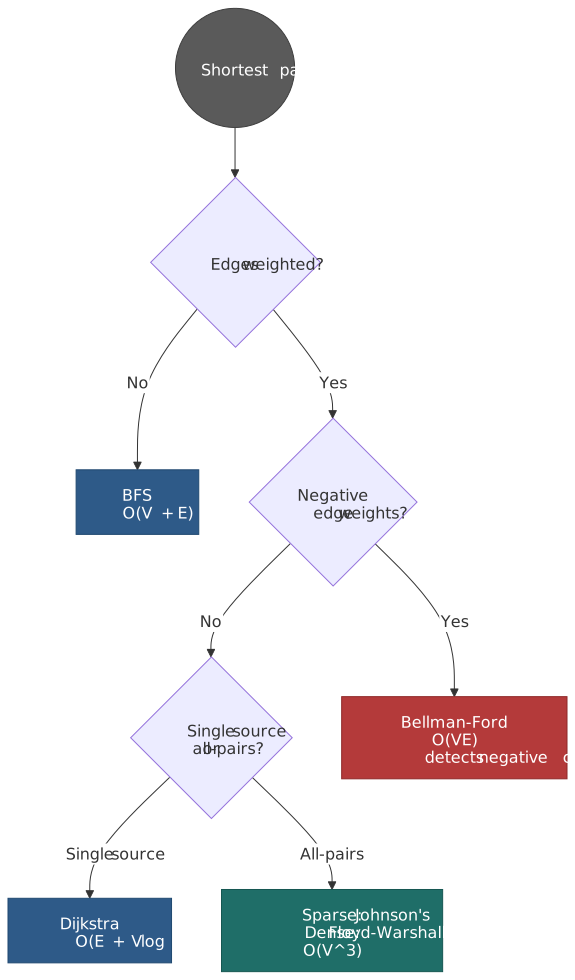
BFS for unweighted graphs
When every edge counts the same, BFS is the shortest-path algorithm. The first visit to a node is via a shortest path; reconstruct the path with a parent pointer back-chain.
function shortestPath( graph: Map<number, number[]>, start: number, end: number,): number[] | null { const visited = new Set<number>([start]) const parent = new Map<number, number>() const queue = [start] while (queue.length > 0) { const node = queue.shift()! if (node === end) { const path = [end] let current = end while (parent.has(current)) { current = parent.get(current)! path.unshift(current) } return path } for (const neighbor of graph.get(node) ?? []) { if (!visited.has(neighbor)) { visited.add(neighbor) parent.set(neighbor, node) queue.push(neighbor) } } } return null}Dijkstra (non-negative weights)
Always extract the unsettled vertex with the smallest tentative distance; relax its outgoing edges; repeat. The greedy invariant — once a vertex is settled, its distance is final — depends critically on edges being non-negative.
- Complexity: O((V + E) log V) with a binary heap. The classic Fibonacci-heap result is O(E + V log V) but the constant factors usually make a binary or
d-ary heap competitive in practice16. - Footprint: GPS routing (with A* on top), OSPF link-state routing, anything weighted with non-negative costs.
Caution
Dijkstra silently produces wrong answers on graphs with negative edge weights — it never revisits a “settled” vertex, so a later, cheaper path through a negative edge is missed. If your graph can have negative weights, you need Bellman-Ford. There is no “fix Dijkstra to handle negatives” without becoming Bellman-Ford.
Bellman-Ford (handles negative weights)
Relax every edge V − 1 times. After that many rounds the shortest path distances are final unless a negative cycle exists; one extra round detects the cycle by spotting an edge that still relaxes.
- Complexity: O(V·E) — slower than Dijkstra by a factor of
V / log V, paid in exchange for negative-weight support and explicit cycle detection. - Footprint: the original distance-vector routing protocols (RIP), arbitrage detection across currency exchange rates (a profitable cycle is a negative cycle in
-log(rate)space).
Algorithm selection
| Scenario | Algorithm | Time complexity |
|---|---|---|
| Unweighted graph | BFS | O(V + E) |
| Non-negative single source | Dijkstra | O(E + V log V) |
| Negative weights / cycles | Bellman-Ford | O(V · E) |
| All-pairs (dense) | Floyd-Warshall | O(V³) |
| All-pairs (sparse, no negs) | V × Dijkstra | O(V · (E + V log V)) |
| All-pairs (sparse, w/ negs) | Johnson’s (reweight + Dijkstra) | O(V · E + V² log V) |
Union-Find (disjoint set union)
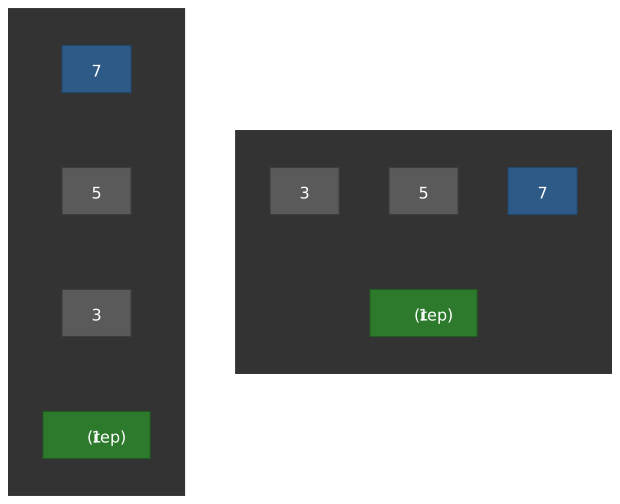
Union-Find answers “are x and y in the same connected component?” in near-constant amortised time. The two optimisations that get it there are:
- Union by rank (or by size): when merging two trees, attach the shorter under the taller so heights stay logarithmic.
- Path compression: every
findwalk re-points every visited node directly at the root, flattening the tree as a side effect of querying it.
class UnionFind { private parent: Map<number, number> private rank: Map<number, number> constructor(elements: number[]) { this.parent = new Map() this.rank = new Map() elements.forEach((e) => { this.parent.set(e, e) this.rank.set(e, 0) }) } find(x: number): number { if (this.parent.get(x) !== x) { this.parent.set(x, this.find(this.parent.get(x)!)) // path compression } return this.parent.get(x)! } union(x: number, y: number): void { const rootX = this.find(x) const rootY = this.find(y) if (rootX === rootY) return const rankX = this.rank.get(rootX)! const rankY = this.rank.get(rootY)! if (rankX < rankY) this.parent.set(rootX, rootY) else if (rankX > rankY) this.parent.set(rootY, rootX) else { this.parent.set(rootY, rootX) this.rank.set(rootX, rankX + 1) } } connected(x: number, y: number): boolean { return this.find(x) === this.find(y) }}With both optimisations, the amortised cost of m operations on n elements is Θ(m · α(n)), where α is the inverse Ackermann function — at most 4 for any n you can store on real hardware117.
Footprint: Kruskal’s MST, dynamic connectivity, percolation models, image segmentation, and the cycle detector in undirected graph builders.
Production applications
DOM and virtual DOM (React)
The DOM is a tree; React’s reconciliation diffs two virtual DOM trees. The general “minimum edit distance between trees” problem is O(n³)18; React shaves it to O(n) with two heuristics, lifted directly from the official docs:
- Two elements of different types produce different trees — React tears the old subtree down rather than diffing across the boundary.
- Sibling elements with stable
keyprops are matched by key across renders; without keys, React falls back to index-based matching, which thrashes when list order changes.
That’s why missing or unstable keys cause “lost focus / scroll position when a row reorders” — the DOM nodes are correct, but they’re now associated with different React fibers.
File systems
Modern file systems use trees at two levels: directory hierarchies as logical trees, and on-disk indexes as B/B+ trees or hashed variants13.
- Directory entries → inode numbers map names to metadata; ext4 indexes large directories with HTree (a hashed B-tree variant).
- NTFS, HFS+, Btrfs, XFS use B-trees / B+ trees for directory indexes and on-disk metadata.
- Dentry cache in the Linux VFS layer caches resolved path components so repeated lookups don’t replay the on-disk traversal.
Build and package systems
Maven, Gradle, npm, cargo, pip, Bazel, and Buck all model their build graph as a DAG and run topological sort on it. Gradle’s two-phase resolution19 is representative:
- Graph resolution: build the DAG of declared and transitive dependencies.
- Artifact resolution: fetch files for every resolved component.
The topological order both forces correct compile order and reveals the parallelism — every group of zero-in-degree tasks is independent and can be scheduled across cores.
Database indexes
B+ trees dominate database indexing because they minimise page fetches under realistic working-set sizes. A binary index of 1 million keys is ~20 levels deep; a B+ tree with fanout ~100 is 3 levels deep — and on a large table that often means 3 page reads rather than 20, the difference between sub-millisecond lookup and disk-bound query1011.
Network routing
The Linux kernel’s IPv4 forwarding table is an LC-trie (fib_trie)15. Longest-prefix-match descents stop early thanks to path and level compression, keeping per-packet routing decisions in CPU-cache time.
Social networks
Friend graphs use BFS for the “n-th degree” queries that power “people you may know” panels, and personalised PageRank for ranking. Mutual-connections heuristics fall out as a one-step BFS combined with set intersection — no special data structure required, just an adjacency list.
Complexity reference
Tree operations
| Structure | Search | Insert | Delete | Space | Best for |
|---|---|---|---|---|---|
| BST (balanced) | O(log n) | O(log n) | O(log n) | O(n) | Generic ordered map (textbook) |
| AVL | O(log n) | O(log n) | O(log n) | O(n) | Read-heavy in-memory dictionaries |
| Red-black | O(log n) | O(log n) | O(log n) | O(n) | Standard libraries, kernel queues |
| B / B+ tree | O(log n) | O(log n) | O(log n) | O(n) | Disk / SSD-resident indexes |
| Trie (uncompressed) | O(L) | O(L) | O(L) | O(n·L) | Prefix queries |
| Radix / LC-trie | O(L) | O(L) | O(L) | O(n) | IP routing, dictionary compression |
Graph operations by representation
| Operation | Adjacency Matrix | Adjacency List |
|---|---|---|
| Space | O(V²) | O(V + E) |
| Edge lookup | O(1) | O(1)/O(degree) |
| Neighbour iteration | O(V) | O(degree) |
| Add edge | O(1) | O(1) |
| Remove edge | O(1) | O(1)/O(degree) |
Algorithm complexity
| Algorithm | Time | Space | Use case |
|---|---|---|---|
| DFS | O(V + E) | O(V) | Cycle detection, topological sort |
| BFS | O(V + E) | O(V) | Shortest path (unweighted) |
| Dijkstra | O(E + V log V) | O(V) | Shortest path (non-negative weights) |
| Bellman-Ford | O(V · E) | O(V) | Shortest path with negative weights |
| Floyd-Warshall | O(V³) | O(V²) | All-pairs (dense graphs) |
| Johnson’s | O(V·E + V² log V) | O(V²) | All-pairs (sparse, possibly negative) |
| Topological sort | O(V + E) | O(V) | Dependency resolution |
| Union-Find | O(α(n)) | O(n) | Dynamic connectivity, MST |
Practical takeaways
- Pick the tree by workload, not by familiarity. AVL for read-heavy in-memory dictionaries, red-black as the safe default (it’s what every standard library shipped), B+ trees the moment data lives on disk or SSD, tries and their compressed variants for prefix-keyed problems.
- Default to adjacency lists with hash sets. Matrices only earn their O(V²) cost on dense graphs or in algorithms (Floyd-Warshall) that exploit the contiguous layout.
- DFS for “explore one branch fully”, BFS for “shortest path / nearest first”. Iterate, don’t recurse, when graphs may be deeper than a few thousand nodes.
- Three-colour DFS for directed cycle detection, parent-tracking DFS for undirected. The two-state version that works in undirected graphs silently misses cycles in directed ones.
- Negative weights → Bellman-Ford, otherwise Dijkstra. Don’t try to retrofit Dijkstra; the greedy invariant breaks the moment an edge can be negative.
- Path-compressed union-find is effectively O(1). Reach for it any time the question is “are these in the same set?” — Kruskal, percolation, dynamic connectivity, dynamic equivalence classes.
Appendix
Prerequisites
- Big O notation and amortised analysis
- Recursion and iteration
- Arrays, hash maps, stacks, queues
- Comfortable reading TypeScript / pseudocode
Terminology
- BST (Binary Search Tree): binary tree with the in-order key invariant.
- AVL tree: self-balancing BST keeping balance factor in {-1, 0, +1}.
- Red-black tree: self-balancing BST using node colouring; the standard-library default.
- B-tree / B+ tree: multi-way trees designed for paged storage; B+ trees keep all values at the leaf level for cheap range scans.
- Trie / radix tree / LC-trie: prefix trees with progressively more aggressive compression.
- DAG: directed graph with no directed cycle.
- DFS / BFS: depth-first / breadth-first traversals.
- Topological order: linearisation of a DAG respecting edge direction.
- Union-Find / DSU: disjoint-set data structure with near-O(1) amortised operations.
References
Footnotes
-
Tarjan, “Efficiency of a Good But Not Linear Set Union Algorithm”, Journal of the ACM (1975). The original O(α(n)) amortised bound for union-by-rank + path compression. ↩ ↩2
-
Adelson-Velsky, Landis, “An algorithm for the organization of information” (1962). Wikipedia summary. ↩
-
“AVL tree” — Wikipedia — the height bound
h ≤ 1.44 · log₂(n+2)and rotation cases. ↩ -
Guibas, Sedgewick, “A Dichromatic Framework for Balanced Trees” (1978). ↩
-
“Red–black tree” — Wikipedia — invariants, height bound, rotation budget. ↩
-
“CFS Scheduler” — kernel.org — red-black tree as the runqueue, leftmost-task selection. ↩ ↩2
-
“sched/eevdf: Sort the rbtree by virtual deadline” — Linux kernel mail archive — EEVDF (default since Linux 6.6) keeps the rbtree, sorted by virtual deadline. ↩
-
Melbicom, “Dedicated Server Storage: HDD vs SSD vs NVMe” — random-read latency: NVMe 0.02–0.08 ms, SATA SSD ~0.1 ms, 7200 RPM HDD 4–10 ms. ↩
-
“B-tree” — Wikipedia — order, fanout, page-aligned design rationale. ↩
-
PostgreSQL
nbtreeREADME — Lehman & Yao high-concurrency B+ tree implementation. ↩ ↩2 ↩3 -
MySQL Reference Manual — InnoDB clustered and secondary indexes — B+ tree clustered indexes, secondary indexes carrying the primary key. ↩ ↩2 ↩3
-
SQLite B-Tree module — index pages use B-trees, table pages use B+ trees. ↩
-
“HTree” — Wikipedia and Linux kernel ext4 directory docs — fixed-depth hashed B-tree variant for ext3/ext4 directory indexing. ↩ ↩2
-
“Radix tree” — Wikipedia — Patricia / radix trie compression and routing-table use. ↩
-
Linux kernel “LC-trie implementation notes” — LC-trie as the IPv4 routing table since 2.6.39. ↩ ↩2
-
MIT 6.046J Lecture 16 — disjoint-set data structures and Fibonacci heap context. ↩
-
“Disjoint-set data structure” — Wikipedia — α(n) ≤ 4 for any practical input; Fredman/Saks lower bound. ↩
-
React legacy docs — Reconciliation — generic O(n³), heuristic O(n) using element type and
keyprop. ↩ -
Gradle docs — Graph and artifact resolution — two-phase dependency resolution. ↩