OAuth 2.0 and OIDC Flows: Authorization Code to PKCE
OAuth 2.0 is an authorization-delegation framework; OpenID Connect (OIDC) layers identity on top. This article walks the canonical OAuth 2.1 flow set — Authorization Code + PKCE, Device Authorization Grant, Client Credentials — explains how OIDC ID tokens, refresh-token rotation, DPoP, and the BFF pattern fit on top, and pins each design choice to the specific RFC or attack it answers, so a senior engineer can pick a flow, validate a token, and harden a deployment without re-deriving the threat model.
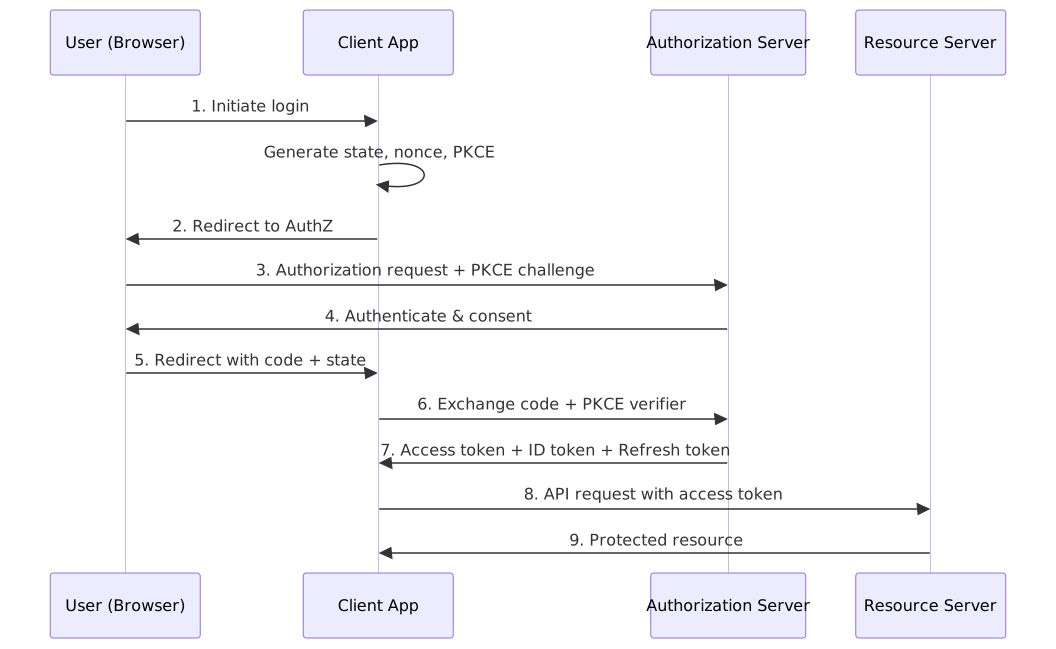
Abstract
OAuth 2.0 is an authorization delegation framework—it lets users grant applications limited access to their resources without sharing credentials. OIDC (OpenID Connect) is an identity layer on top of OAuth—it proves who the user is via ID tokens. The core security model relies on:
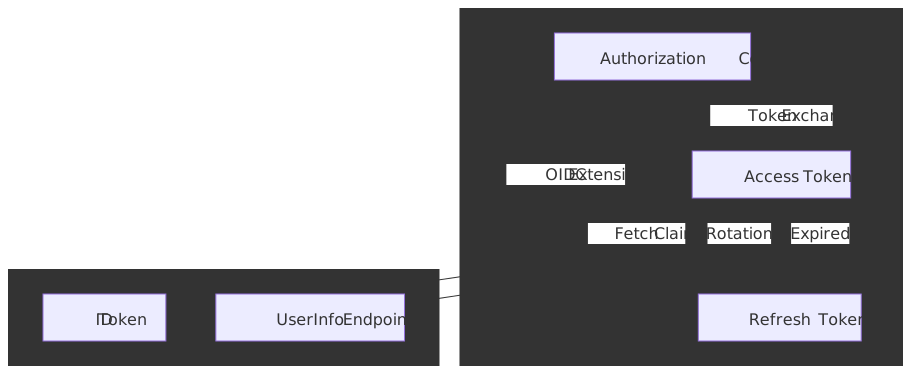
| Component | Purpose | Lifetime | Audience |
|---|---|---|---|
| Authorization Code | One-time credential for token exchange | ~10 minutes | Authorization server |
| Access Token | Resource access credential | 5-60 minutes | Resource server (API) |
| Refresh Token | Long-lived credential for new access tokens | Days/weeks | Authorization server |
| ID Token | Identity proof (JWT with user claims) | Minutes | Client application |
Key Design Principles
- PKCE is mandatory for all clients (OAuth 2.1)—prevents authorization code interception
- Tokens are bearer credentials—possession equals authorization; protect accordingly
- State prevents CSRF; nonce prevents replay; PKCE prevents interception—all three are required
- Implicit flow is deprecated—tokens in URLs leak via history, referrer, logs
- Access tokens are for APIs; ID tokens are for clients—never use ID tokens to call APIs
OAuth 2.0 Core Architecture
Four Defined Roles
OAuth 2.0 (RFC 6749) defines four roles that interact during authorization:
| Role | Description | Example |
|---|---|---|
| Resource Owner | Entity granting access to protected resources | End user |
| Resource Server | Server hosting protected resources, validates access tokens | API server |
| Client | Application requesting access on behalf of resource owner | Web/mobile app |
| Authorization Server | Issues tokens after authenticating the resource owner | Auth0, Okta, Keycloak |
Design rationale: OAuth separates the client from the resource owner. Instead of the client storing user credentials (the pre-OAuth antipattern), the client obtains tokens with specific scope and lifetime. This enables revocable, scoped access without credential exposure.
Client Types
Clients are classified by their ability to maintain credential confidentiality:
| Type | Can Store Secrets? | Examples | Token Strategy |
|---|---|---|---|
| Confidential | Yes | Server-side web apps | Client secret + PKCE |
| Public | No | SPAs, mobile apps, CLIs | PKCE only (no secret) |
OAuth 2.1 (draft-15): The distinction matters less now — PKCE is mandatory for all clients (§7.5). Confidential clients still use secrets (or, preferably,
private_key_jwt/ mTLS) for client authentication, but secrets alone are insufficient as a defence against authorization-code interception.
Protocol Endpoints
| Endpoint | Purpose | HTTP Method |
|---|---|---|
| Authorization | Obtain user consent via redirect | GET |
| Token | Exchange grants for tokens | POST |
| Revocation | Invalidate tokens | POST |
| Introspection | Validate token metadata | POST |
| UserInfo (OIDC) | Fetch user profile claims | GET/POST |
Picking a flow
OAuth 2.1 narrows the canonical flow set to three, plus refresh tokens for session continuity. Everything else (Implicit, Resource Owner Password Credentials) is removed.1
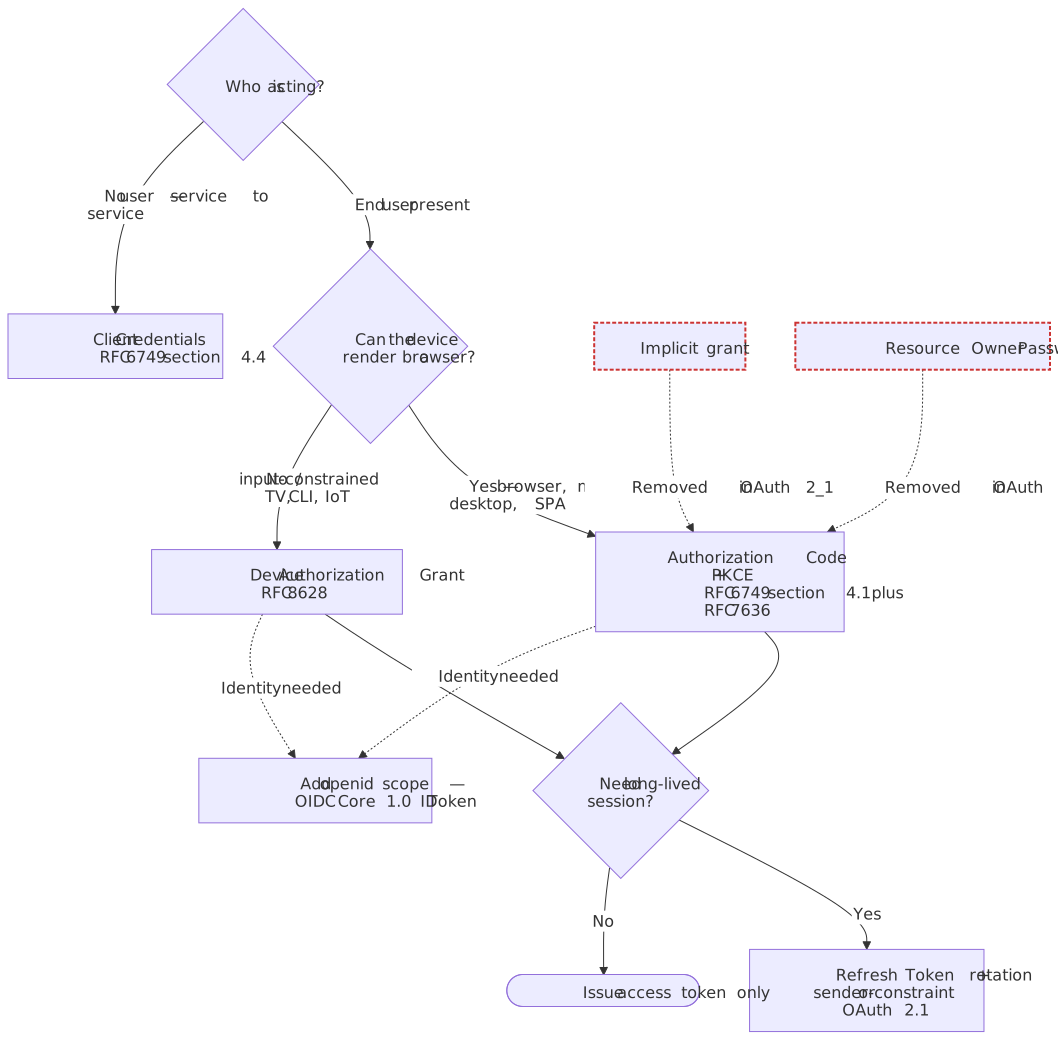
| Caller | Device capability | Canonical flow | Identity layer |
|---|---|---|---|
| End user | Browser-capable (web, SPA, mobile, desktop) | Authorization Code + PKCE (RFC 6749 §4.1, RFC 7636) | Add openid scope for OIDC |
| End user | Input-constrained (smart TV, CLI, IoT, kiosk) | Device Authorization Grant (RFC 8628) | Add openid scope for OIDC |
| Workload (no end user) | Server-to-server | Client Credentials (RFC 6749 §4.4) | None — no user identity exists |
| Any flow needing session | — | Refresh token with rotation or sender-constraint (OAuth 2.1 §4.3) | — |
Authorization Code Flow with PKCE
The Authorization Code flow with PKCE (Proof Key for Code Exchange) is the only recommended flow for all client types as of OAuth 2.1.
Step 1: Generate Security Parameters
Before initiating the flow, the client generates three security parameters:
import crypto from "crypto"// PKCE: code_verifier (43-128 chars, cryptographically random)const codeVerifier = crypto.randomBytes(32).toString("base64url")// e.g., "dBjftJeZ4CVP-mB92K27uhbUJU1p1r_wW1gFWFOEjXk"// PKCE: code_challenge (SHA256 hash of verifier)const codeChallenge = crypto.createHash("sha256").update(codeVerifier).digest("base64url")// e.g., "E9Melhoa2OwvFrEMTJguCHaoeK1t8URWbuGJSstw-cM"// CSRF protectionconst state = crypto.randomBytes(16).toString("hex")// OIDC replay protectionconst nonce = crypto.randomBytes(16).toString("hex")// Store in session for validationsession.oauthParams = { codeVerifier, state, nonce }Why three parameters?
| Parameter | Protects Against | Validated By |
|---|---|---|
state |
CSRF attacks (forged authorization responses) | Client (callback) |
nonce |
ID token replay attacks | Client (ID token validation) |
code_verifier/code_challenge |
Authorization code interception | Authorization server (token endpoint) |
Step 2: Authorization Request
The client redirects the user to the authorization server:
GET /authorize? response_type=code &client_id=CLIENT_ID &redirect_uri=https://client.example/callback &scope=openid profile email &state=abc123xyz &nonce=def456uvw &code_challenge=E9Melhoa2OwvFrEMTJguCHaoeK1t8URWbuGJSstw-cM &code_challenge_method=S256HTTP/1.1Host: auth.example.comRequired parameters:
| Parameter | Purpose | Requirement |
|---|---|---|
response_type=code |
Request authorization code | REQUIRED |
client_id |
Client identifier | REQUIRED |
redirect_uri |
Callback URL (exact match required) | REQUIRED in OAuth 2.1 |
code_challenge |
PKCE challenge | REQUIRED in OAuth 2.1 |
code_challenge_method |
S256 (SHA256) or plain |
REQUIRED if challenge present |
state |
CSRF protection | REQUIRED |
scope |
Requested permissions | RECOMMENDED |
nonce |
Replay protection (OIDC) | REQUIRED for OIDC |
Step 3: User Authentication and Consent
The authorization server:
- Authenticates the user (login if no session)
- Displays consent screen with requested scopes
- Records user’s decision
Step 4: Authorization Response
On approval, the authorization server redirects back with the authorization code:
HTTP/1.1 302 FoundLocation: https://client.example/callback? code=SplxlOBeZQQYbYS6WxSbIA &state=abc123xyz &iss=https://auth.example.comSecurity validation (client-side):
// Express callback handlerapp.get("/callback", async (req, res) => { const { code, state, iss, error } = req.query // Check for error response if (error) { return res.status(400).json({ error: req.query.error_description }) } // Validate state (CSRF protection) if (state !== req.session.oauthParams.state) { return res.status(400).json({ error: "State mismatch - CSRF detected" }) } // Validate issuer (mix-up attack protection, RFC 9207) if (iss !== EXPECTED_ISSUER) { return res.status(400).json({ error: "Issuer mismatch" }) } // Proceed to token exchange... const tokens = await exchangeCodeForTokens(code) res.json(tokens)})RFC 9207: The
issparameter in the authorization response prevents mix-up attacks when clients use multiple authorization servers. Always validate it matches the expected issuer.
Step 5: Token Exchange
The client exchanges the authorization code for tokens at the token endpoint:
POST /token HTTP/1.1Host: auth.example.comContent-Type: application/x-www-form-urlencodedgrant_type=authorization_code&code=SplxlOBeZQQYbYS6WxSbIA&redirect_uri=https://client.example/callback&client_id=CLIENT_ID&code_verifier=dBjftJeZ4CVP-mB92K27uhbUJU1p1r_wW1gFWFOEjXkFor confidential clients, add client authentication:
POST /token HTTP/1.1Host: auth.example.comContent-Type: application/x-www-form-urlencodedAuthorization: Basic base64(client_id:client_secret)grant_type=authorization_code&code=SplxlOBeZQQYbYS6WxSbIA&redirect_uri=https://client.example/callback&code_verifier=dBjftJeZ4CVP-mB92K27uhbUJU1p1r_wW1gFWFOEjXkPKCE server validation:
// Authorization server validates PKCEfunction validatePKCE(codeChallenge, codeVerifier, method) { if (method === "S256") { const computedChallenge = crypto.createHash("sha256").update(codeVerifier).digest("base64url") return computedChallenge === codeChallenge } // 'plain' method (SHOULD NOT be used) return codeVerifier === codeChallenge}Step 6: Token Response
{ "access_token": "eyJhbGciOiJSUzI1NiIsInR5cCI6ImF0K2p3dCJ9...", "token_type": "Bearer", "expires_in": 900, "refresh_token": "8xLOxBtZp8", "scope": "openid profile email", "id_token": "eyJhbGciOiJSUzI1NiIsInR5cCI6IkpXVCJ9..."}PKCE Deep Dive
PKCE (Proof Key for Code Exchange, RFC 7636) prevents authorization code interception attacks.
The Attack PKCE Prevents
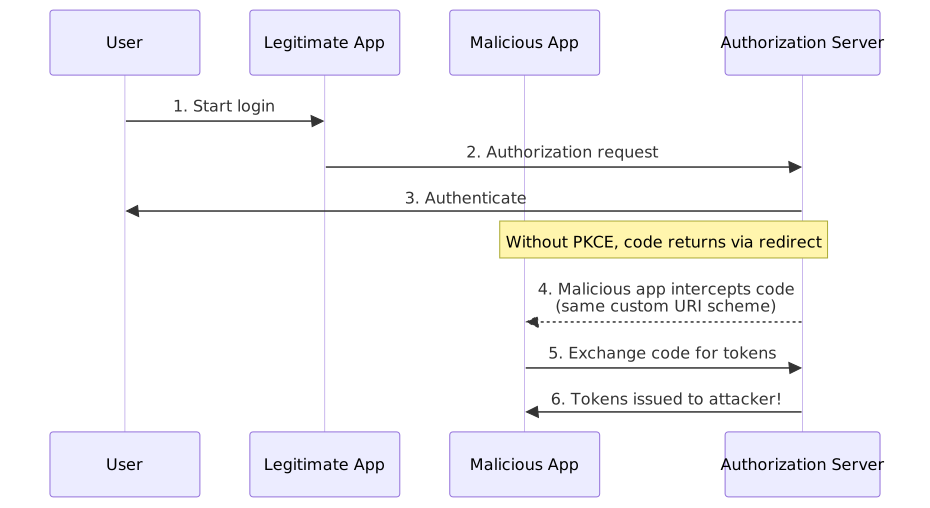
Attack scenario: On mobile platforms, multiple apps can register the same custom URI scheme (com.example.app://). A malicious app intercepts the redirect containing the authorization code and exchanges it for tokens.
With PKCE: The authorization server binds the code to the code_challenge. Without the code_verifier (which only the legitimate app possesses), the malicious app cannot complete the exchange.
Code Verifier Requirements (RFC 7636)
| Requirement | Value |
|---|---|
| Entropy | Minimum 256 bits (32 bytes) |
| Character set | [A-Z] / [a-z] / [0-9] / "-" / "." / "_" / "~" |
| Length | 43-128 characters |
| Generation | Cryptographic random number generator |
Challenge Methods
| Method | Algorithm | Recommendation |
|---|---|---|
S256 |
BASE64URL(SHA256(code_verifier)) |
MUST support; SHOULD use |
plain |
code_challenge = code_verifier |
SHOULD NOT use (fallback only) |
Design rationale: S256 is preferred because even if the code_challenge is leaked (e.g., in browser history), the original code_verifier cannot be derived. With plain, leaking the challenge equals leaking the verifier.
PKCE in OAuth 2.1
OAuth 2.1 draft-15, Section 7.5 (March 2026): “Clients MUST use
code_challengeandcode_verifierand authorization servers MUST enforce their use except under the conditions described in Section 7.5.1. Even in this case, using and enforcingcode_challengeandcode_verifieras described above is still RECOMMENDED.”
OAuth 2.1 makes PKCE mandatory for all clients—public and confidential. This acknowledges that:
- Client secrets can leak (supply chain attacks, compromised dependencies)
- PKCE provides defense-in-depth even when secrets are used
- A single secure pattern simplifies implementation
Client Credentials Flow (Machine-to-Machine)
The Client Credentials grant (RFC 6749 §4.4) is the only flow with no end user: the client is acting on its own behalf, typically a backend service calling another backend service. There is no authorization code, no redirect, no refresh token, and no ID token — there is no user to identify.
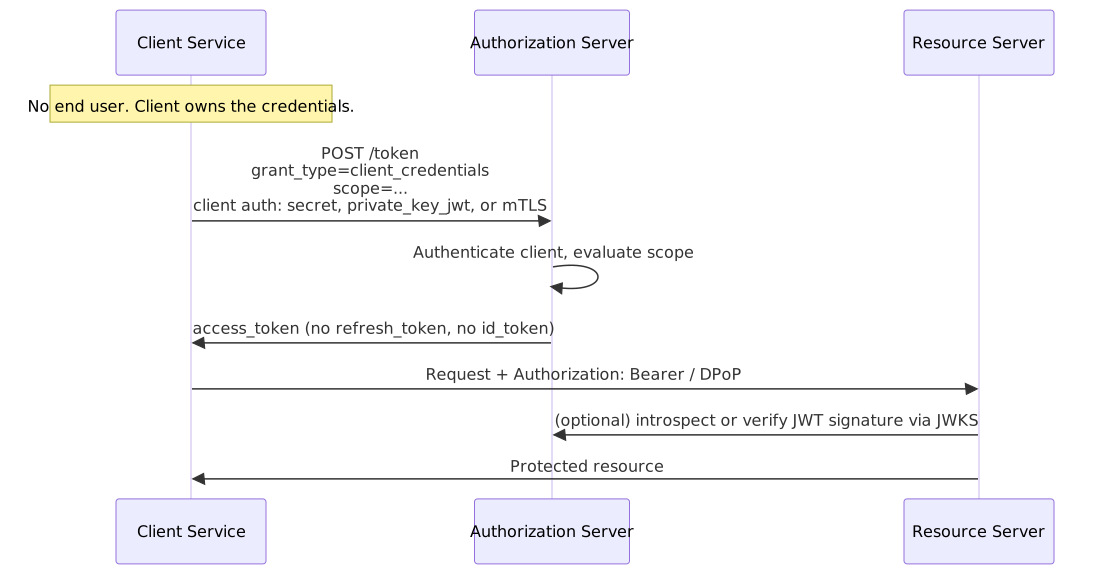
POST /token HTTP/1.1Host: auth.example.comContent-Type: application/x-www-form-urlencodedAuthorization: Basic base64(client_id:client_secret)grant_type=client_credentials&scope=invoices:read invoices:writeWhen to use it
| Use case | Notes |
|---|---|
| Backend service calling another backend’s API | The canonical case. Scopes scope what the service can do, not what users can do. |
| Cron job, batch worker, daemon | Use a private key (private_key_jwt) or mTLS instead of a shared secret when possible. |
| CI / CD pipelines calling deployment APIs | Mint short-lived tokens per pipeline run; never bake long-lived tokens into images. |
What to avoid
Caution
Do not use Client Credentials to act on behalf of an end user. The token has no sub for a human, no consent record, and no scoping to that user. If you need to act for a user, use Authorization Code + PKCE; if the call must be background, exchange a refresh token or use Token Exchange (RFC 8693).
- Refresh tokens MUST NOT be issued for the Client Credentials grant (RFC 6749 §4.4.3). When the access token expires, the client just re-authenticates.
- Prefer
private_key_jwtor mTLS client authentication (RFC 8705) overclient_secret_basic/client_secret_post. Shared secrets sit in env vars and leak through logs, configs, and container images. - Combine with DPoP (RFC 9449) or mTLS sender-constraint so a stolen token cannot be replayed by a different caller.
Device Authorization Grant
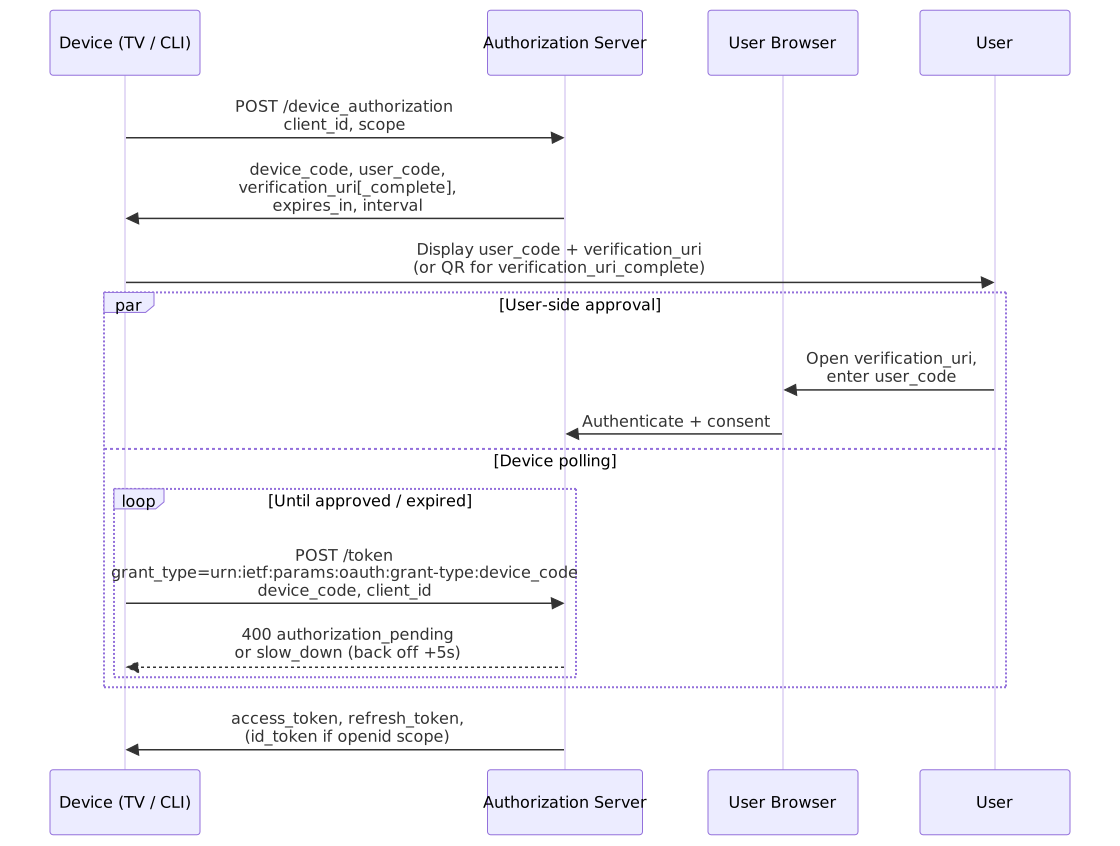
The Device Authorization Grant (RFC 8628) covers input-constrained devices — smart TVs, set-top boxes, CLIs, IoT devices, kiosks — where typing a password or rendering a full login UI is impractical. The user authenticates on a secondary device (phone or laptop) while the device polls for the result.
Step 1: Device authorization request
POST /device_authorization HTTP/1.1Host: auth.example.comContent-Type: application/x-www-form-urlencodedclient_id=CLIENT_ID&scope=openid profile offline_accessStep 2: Authorization server response
{ "device_code": "GmRhmhcxhwAzkoEqiMEg_DnyEysNkuNhszIySk9eS", "user_code": "WDJB-MJHT", "verification_uri": "https://auth.example.com/device", "verification_uri_complete": "https://auth.example.com/device?user_code=WDJB-MJHT", "expires_in": 1800, "interval": 5}The device displays user_code and verification_uri (or a QR code for verification_uri_complete) and starts polling.
Step 3: Polling the token endpoint
POST /token HTTP/1.1Host: auth.example.comContent-Type: application/x-www-form-urlencodedgrant_type=urn:ietf:params:oauth:grant-type:device_code&device_code=GmRhmhcxhwAzkoEqiMEg_DnyEysNkuNhszIySk9eS&client_id=CLIENT_IDThe client MUST respect the interval and MUST back off when it receives slow_down (RFC 8628 §3.5):
| Error | Meaning | Client action |
|---|---|---|
authorization_pending |
User has not yet approved. | Continue polling at the current interval. |
slow_down |
Polling too fast. | Increase the interval by 5 seconds and retry. |
access_denied |
User declined. | Stop polling; surface a “rejected” message. |
expired_token |
device_code lifetime exceeded expires_in. |
Stop polling; restart from step 1 if needed. |
Warning
The Device Code flow is phishable: an attacker can initiate a device flow against a target and trick the victim into approving the attacker’s user_code (consent phishing). Mitigations from RFC 9700 §4.7: show the requesting client name, location, and scopes prominently on the verification page; rate-limit user_code generation; and treat unsolicited approvals with suspicion in account-takeover detection.
OpenID Connect (OIDC) Identity Layer
OIDC extends OAuth 2.0 to provide authentication (proving who the user is) in addition to OAuth’s authorization (proving what the user can access).
ID Token Structure
The ID token is a JWT containing identity claims about the authenticated user:
{ "iss": "https://auth.example.com", "sub": "user_12345", "aud": "CLIENT_ID", "exp": 1704153600, "iat": 1704150000, "auth_time": 1704149900, "nonce": "def456uvw", "acr": "urn:mace:incommon:iap:silver", "amr": ["pwd", "mfa"], "at_hash": "x4Q8HQ2_VFbP...", "name": "Jane Doe", "email": "jane@example.com", "email_verified": true}ID Token Claims
Required claims (per OIDC Core 1.0):
| Claim | Description | Validation |
|---|---|---|
iss |
Issuer identifier (HTTPS URL) | MUST match expected issuer |
sub |
Subject identifier (max 255 chars, locally unique) | Unique user ID within issuer |
aud |
Audience—MUST contain client_id |
Reject if client_id not present |
exp |
Expiration time | Reject if current time > exp |
iat |
Issued at time | Used for clock validation |
Contextually required claims:
| Claim | Description | When Required |
|---|---|---|
nonce |
Replay protection value | MUST be present if sent in request |
auth_time |
Time of authentication | When max_age requested |
acr |
Authentication Context Class Reference | When requested as Essential |
amr |
Authentication Methods References | Indicates methods used (pwd, otp, etc.) |
at_hash |
Access token hash | When token issued with ID token |
azp |
Authorized party | When aud contains multiple values |
ID Token Validation (Mandatory Steps)
import jwt from "jsonwebtoken"import jwksClient from "jwks-rsa"async function validateIdToken(idToken, expectedIssuer, clientId, nonce) { // 1. Decode header to get key ID const decoded = jwt.decode(idToken, { complete: true }) const { kid, alg } = decoded.header // 2. Fetch signing key from JWKS endpoint const client = jwksClient({ jwksUri: `${expectedIssuer}/.well-known/jwks.json` }) const key = await client.getSigningKey(kid) // 3. Verify signature and decode claims const claims = jwt.verify(idToken, key.getPublicKey(), { algorithms: [alg], // Explicitly allowlist algorithm issuer: expectedIssuer, audience: clientId, }) // 4. Validate nonce (replay protection) if (claims.nonce !== nonce) { throw new Error("Nonce mismatch - potential replay attack") } // 5. Validate auth_time if max_age was used if (claims.auth_time && maxAgeUsed) { const authAge = Math.floor(Date.now() / 1000) - claims.auth_time if (authAge > maxAge) { throw new Error("Authentication too old - re-authentication required") } } // 6. Validate at_hash if present (binds ID token to access token) if (claims.at_hash) { const expectedHash = computeAtHash(accessToken, alg) if (claims.at_hash !== expectedHash) { throw new Error("Access token hash mismatch") } } return claims}// Compute at_hash per OIDC Core 3.1.3.6// Hash algorithm is derived from the *bit length* in the JWS alg name// ({RS,ES,HS,PS}{256,384,512} -> sha-{256,384,512}), NOT a binary RS256/everything-else split.function computeAtHash(accessToken, alg) { const bits = alg.match(/(256|384|512)$/)?.[1] if (!bits) throw new Error(`Unsupported alg for at_hash: ${alg}`) const hashAlg = `sha${bits}` const hash = crypto.createHash(hashAlg).update(accessToken).digest() const halfHash = hash.slice(0, hash.length / 2) return halfHash.toString("base64url")}ID Token vs Access Token vs Refresh Token
| Aspect | ID Token | Access Token | Refresh Token |
|---|---|---|---|
| Protocol | OIDC only | OAuth 2.0 / OIDC | OAuth 2.0 / OIDC |
| Purpose | Prove user identity | Authorize API access | Obtain new access tokens |
| Format | Always JWT | JWT or opaque | Typically opaque |
| Audience | Client application | Resource server (API) | Authorization server |
| Validation | Client validates locally | Resource server validates | Auth server only |
| Lifetime | Short (minutes) | Short (5-60 min) | Long (days/weeks) |
| Contains | User identity claims | Scopes, permissions | Token family reference |
Critical distinction: ID tokens prove who the user is (for the client). Access tokens prove what the user can do (for the API). Never use an ID token to call APIs—it’s semantically wrong and often insecure (audience mismatch).
UserInfo Endpoint
The UserInfo endpoint returns claims about the authenticated user:
GET /userinfo HTTP/1.1Host: auth.example.comAuthorization: Bearer <access_token>{ "sub": "user_12345", "name": "Jane Doe", "given_name": "Jane", "family_name": "Doe", "email": "jane@example.com", "email_verified": true, "picture": "https://example.com/jane.jpg"}When to use UserInfo vs ID Token:
- ID Token: Get claims at authentication time (single request)
- UserInfo: Fetch additional claims later, refresh claims without re-authentication
Refresh Tokens and Rotation
Refresh tokens enable long-lived sessions without long-lived access tokens.
Refresh Token Grant
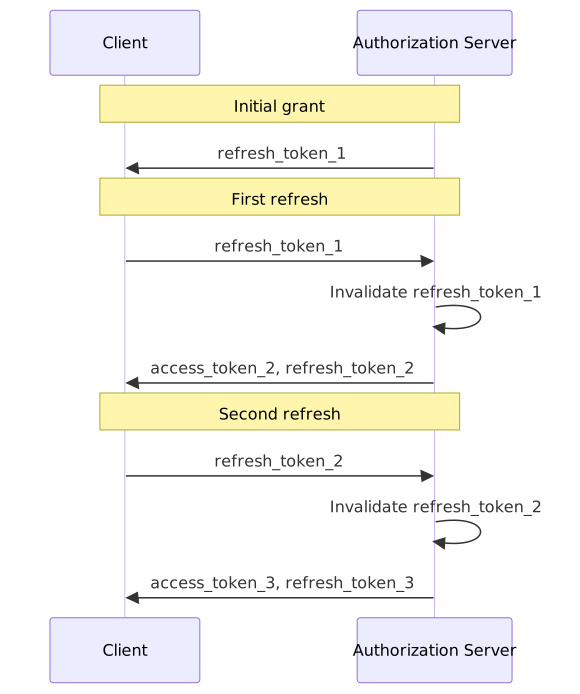
POST /token HTTP/1.1Host: auth.example.comContent-Type: application/x-www-form-urlencodedgrant_type=refresh_token&refresh_token=8xLOxBtZp8&client_id=CLIENT_ID&scope=openid profileResponse (with rotation):
{ "access_token": "new_access_token...", "token_type": "Bearer", "expires_in": 900, "refresh_token": "new_refresh_token", "scope": "openid profile"}Refresh Token Rotation
Rotation issues a new refresh token with each use, invalidating the previous one:
Reuse Detection
If a previously-used refresh token is presented, it indicates token theft:
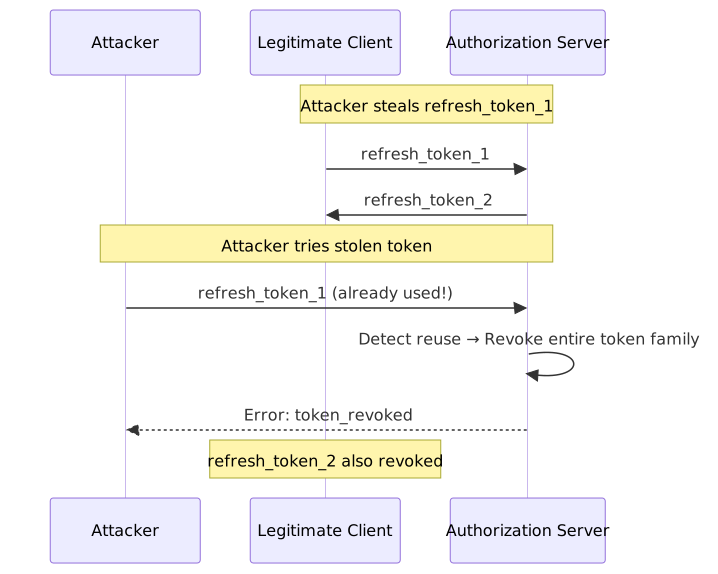
Implementation considerations:
const GRACE_PERIOD_MS = 5000 // 5 seconds for network retriesasync function handleRefreshToken(refreshToken) { const tokenRecord = await db.findRefreshToken(refreshToken) if (!tokenRecord) { throw new OAuthError("invalid_grant", "Unknown refresh token") } // Check if token was already used if (tokenRecord.usedAt) { const timeSinceUse = Date.now() - tokenRecord.usedAt // Grace period for legitimate retries (network failures) if (timeSinceUse < GRACE_PERIOD_MS) { // Return same tokens issued during grace period return tokenRecord.issuedTokens } // Outside grace period - potential theft! await db.revokeTokenFamily(tokenRecord.familyId) throw new OAuthError("invalid_grant", "Token reuse detected") } // Mark as used and issue new tokens await db.markTokenUsed(refreshToken, Date.now()) const newTokens = await issueTokens(tokenRecord.userId, tokenRecord.scopes) await db.storeIssuedTokens(refreshToken, newTokens) return newTokens}Trade-offs of rotation:
| Benefit | Cost |
|---|---|
| Stolen tokens expire faster | Database write on every refresh |
| Reuse detection possible | Network failures can lock out users |
| Limits attacker window | More complex state management |
Alternative: Sender-constrained tokens (DPoP/mTLS) avoid rotation overhead by binding tokens to cryptographic keys.
Token Storage by Platform
Web Applications (Browser-Based)
| Storage | XSS Vulnerable? | Recommendation |
|---|---|---|
localStorage |
Yes | MUST NOT use for tokens |
sessionStorage |
Yes | MUST NOT use for tokens |
| JavaScript memory | No (unless XSS) | RECOMMENDED for access tokens |
HttpOnly cookies |
No | RECOMMENDED for refresh tokens |
Backend-for-Frontend (BFF) Pattern (most secure for SPAs):
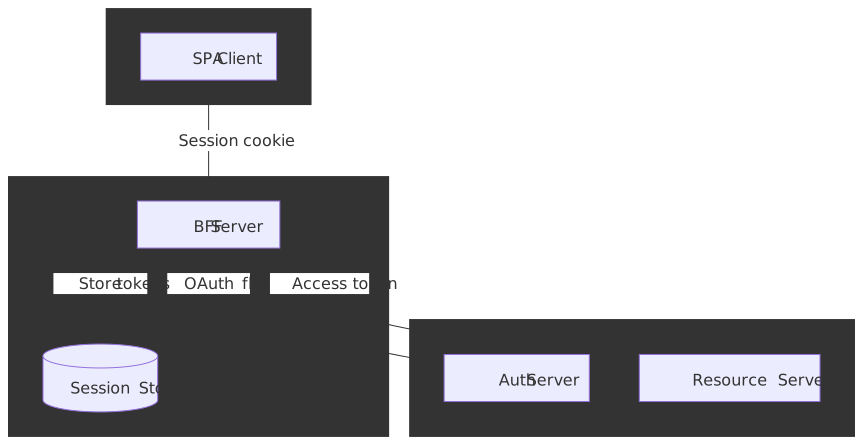
- Browser never sees OAuth tokens
- BFF maintains server-side session
- Session ID in
HttpOnly,Secure,SameSite=Strictcookie - BFF proxies API requests with access token
Mobile Applications
| Platform | Recommended Storage | Notes |
|---|---|---|
| iOS | Keychain Services | Encrypted, hardware-backed |
| Android | EncryptedSharedPreferences | Uses Android Keystore |
| Both | Secure Enclave/TEE | Strongest protection when available |
// iOS: Store refresh token in Keychainimport Securityfunc storeRefreshToken(_ token: String, for userId: String) -> Bool { let query: [String: Any] = [ kSecClass as String: kSecClassGenericPassword, kSecAttrAccount as String: userId, kSecAttrService as String: "oauth-refresh-token", kSecValueData as String: token.data(using: .utf8)!, kSecAttrAccessible as String: kSecAttrAccessibleWhenUnlockedThisDeviceOnly ] // Delete existing item first SecItemDelete(query as CFDictionary) // Add new item let status = SecItemAdd(query as CFDictionary, nil) return status == errSecSuccess}Native Apps (RFC 8252)
RFC 8252 defines OAuth for native applications:
| Requirement | Rationale |
|---|---|
| Use external user-agent (system browser) | Enables SSO, prevents credential theft |
| MUST NOT use embedded WebViews | Host app can inject JS, capture cookies |
| PKCE is mandatory | Multiple apps can claim same URI scheme |
Redirect URI options:
| Type | Format | Platform |
|---|---|---|
| Claimed HTTPS | https://app.example.com/oauth |
iOS Universal Links, Android App Links |
| Loopback | http://127.0.0.1:{port}/callback |
Desktop apps (any port) |
| Private URI scheme | com.example.app:/callback |
Mobile apps |
DPoP: Demonstrating Proof of Possession
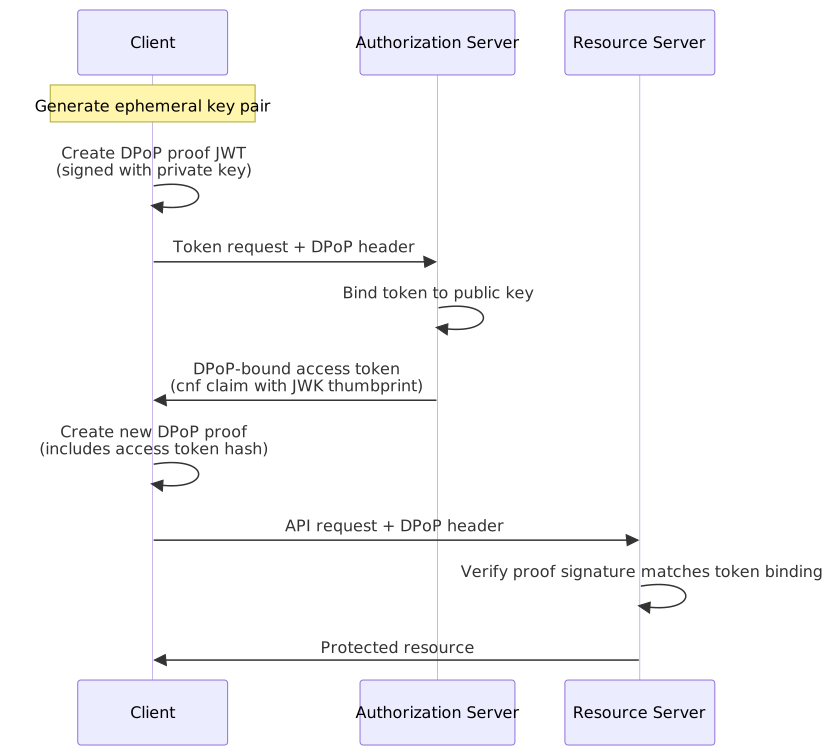
DPoP (RFC 9449) sender-constrains tokens to prevent stolen tokens from being usable by attackers.
How DPoP Works
DPoP Proof JWT Structure
Header:
{ "typ": "dpop+jwt", "alg": "ES256", "jwk": { "kty": "EC", "crv": "P-256", "x": "l8tFrhx-34tV3hRICRDY9zCkDlpBhF42UQUfWVAWBFs", "y": "9VE4jf_Ok_o64tbkMYAPVS-9hQp9A7v9oy_A9C1_2RY" }}Payload (for token request):
{ "jti": "e7d7c7a9-1234-5678-abcd-ef0123456789", "htm": "POST", "htu": "https://auth.example.com/token", "iat": 1704150000}Payload (for resource request):
{ "jti": "f8e8d8b9-2345-6789-bcde-f01234567890", "htm": "GET", "htu": "https://api.example.com/resource", "iat": 1704150100, "ath": "fUHyO2r2Z3DZ53EsNrWBb0xWXoaNy59IiKCAqksmQEo"}DPoP Claims
| Claim | Description | When Required |
|---|---|---|
jti |
Unique identifier (UUID v4) | Always |
htm |
HTTP method | Always |
htu |
HTTP target URI (no query/fragment) | Always |
iat |
Issued at timestamp | Always |
ath |
Access token hash | For resource requests |
nonce |
Server-provided nonce | When required by server |
Security benefit: Even if an attacker steals the access token, they cannot use it without the private key that signed the DPoP proofs.
Security Pitfalls and Mitigations
Authorization Code Interception
Attack: Malicious app intercepts authorization code via shared redirect URI.
Mitigation: PKCE (mandatory in OAuth 2.1).
CSRF via Forged Authorization Response
Attack: Attacker tricks user into completing OAuth flow with attacker’s account.
Mitigation: state parameter—validate it matches the value sent in the request.
ID Token Replay
Attack: Attacker replays captured ID token to authenticate as victim.
Mitigation: nonce parameter—include in request, validate in ID token.
Mix-Up Attack
Attack: When client supports multiple authorization servers, attacker tricks client into sending tokens to wrong server.
Mitigation:
- Validate
issparameter in authorization response (RFC 9207) - Validate
issclaim in ID token matches expected issuer - Use distinct
redirect_uriper authorization server
Open Redirect via redirect_uri
Attack: Attacker crafts authorization request with malicious redirect_uri to steal authorization code.
Mitigation: Exact string matching for redirect_uri validation (no wildcards, no patterns).
// Registration: Store exact URIs onlyconst registeredRedirectUris = ["https://client.example.com/callback", "https://client.example.com/oauth/callback"]// Validation: Exact string matchfunction validateRedirectUri(requestedUri) { // MUST be exact match - no wildcards, patterns, or normalization return registeredRedirectUris.includes(requestedUri)}// MUST NOT allow:// - https://client.example.com/* (wildcard)// - https://*.example.com/callback (subdomain wildcard)// - Pattern matching or regexToken Leakage via Referrer
Attack: Access tokens in URL fragments leak via Referer header.
Mitigation:
- Use Authorization Code flow (not Implicit)
- Set
Referrer-Policy: no-referrerheader - Use
response_mode=form_post(OIDC)
Insufficient Redirect URI Validation
Attack: Authorization server accepts partial URI matches, enabling redirect to attacker-controlled subdomain.
Mitigation: Per RFC 9700 (OAuth Security BCP): “Authorization servers MUST utilize exact string matching” for redirect URI validation.
OAuth 2.1 Key Changes
OAuth 2.1 (currently draft-15, published 2 March 2026 and still on the standards track) consolidates OAuth 2.0 with security best practices from RFC 9700 (January 2025).
Removed Flows
| Flow | Reason for Removal |
|---|---|
Implicit (response_type=token) |
Tokens in URL fragments leak via history, referrer, logs |
| Resource Owner Password Credentials | Violates OAuth’s core principle—never share credentials with third parties |
Mandatory Requirements
| Requirement | OAuth 2.0 | OAuth 2.1 |
|---|---|---|
| PKCE for public clients | RECOMMENDED | MUST (§7.5) |
| PKCE for confidential clients | Not mentioned | MUST (§7.5; RECOMMENDED in §7.5.1 exceptions) |
| Exact redirect URI matching | SHOULD | MUST |
| Bearer tokens in query strings | Allowed | MUST NOT |
| Refresh token sender-constraint or rotation | Not specified | MUST (public clients) |
| HTTPS for all endpoints | SHOULD | MUST (except loopback) |
Migration Checklist
- Implement PKCE for all clients, including confidential
- Remove Implicit flow support; migrate to Authorization Code + PKCE
- Remove ROPC if implemented; migrate to proper redirect flow
- Enforce exact redirect URI matching—no wildcards
- Implement refresh token rotation or DPoP for public clients
- Never send tokens in query strings—use headers or POST body
Beyond OAuth 2.1: Hardening Profiles and Extensions
OAuth 2.1 is the floor; high-assurance deployments — banking, healthcare, government, regulated APIs — layer additional specs on top. The pieces worth knowing:
| Spec | What it does | When to reach for it |
|---|---|---|
| RFC 9068 — JWT Profile for OAuth 2.0 Access Tokens | Standardises JWT access-token shape: typ: "at+jwt" header; required iss, exp, aud, sub, client_id, iat, jti; optional scope, roles, groups, entitlements. |
When you want resource servers to validate access tokens locally via JWKS instead of calling introspection. |
| RFC 9126 — Pushed Authorization Requests (PAR) | Client POSTs the authorization-request parameters to a /par endpoint, gets back a single-use request_uri, and uses that in the redirect. |
When request parameters carry sensitive data (RAR objects, large claims), or when integrity of the request matters. |
| RFC 9101 — JWT-Secured Authorization Request (JAR) | Sign (and optionally encrypt) the authorization request as a JWT (request or request_uri parameter). |
When the channel between client and authorization server cannot be trusted to preserve parameter integrity. |
| JARM — JWT Secured Authorization Response Mode | Returns the authorization response as a signed JWT (response_mode=jwt/query.jwt/fragment.jwt/form_post.jwt), binding iss, aud, exp. |
Closes the same integrity gap as JAR but on the response side; complements JAR/PAR. |
| RFC 9396 — Rich Authorization Requests (RAR) | Replaces coarse scope strings with a structured authorization_details JSON array (type, actions, locations, datatypes, …). |
When scopes are too coarse — payment initiation (“transfer £100 to IBAN X”), per-record consent, fine-grained API authorization. |
| RFC 9449 — DPoP | Sender-constrains tokens via a per-request signed proof JWT bound to a public key (cnf thumbprint). |
Public clients (SPAs, mobile) that need sender-constraint without mTLS infrastructure. Already covered above. |
| RFC 8705 — Mutual-TLS Client Authentication and Certificate-Bound Tokens | Sender-constrains tokens to the TLS client certificate (cnf.x5t#S256). |
Backend / FAPI deployments where you already have a PKI and can terminate mTLS at the edge. |
| RFC 9207 — Authorization Server Issuer Identification | Returns iss in the authorization response so clients can defend against mix-up attacks across multiple authorization servers. |
Always, when you talk to more than one authorization server. Already covered in the callback validation above. |
| FAPI 2.0 Security Profile (OIDF, Final, Feb 2025) | Combines PAR + PKCE + sender-constrained tokens (mTLS or DPoP) + private_key_jwt / mTLS client auth + asymmetric signing into a single profile. |
Open Banking, Open Finance, Open Healthcare, government identity, any “high” assurance API. |
Tip
If you are designing a new high-assurance deployment in 2026, do not hand-pick from this menu. Adopt FAPI 2.0 as the target profile — it bundles PAR, PKCE, sender-constrained tokens, and asymmetric client authentication into a single conformance-tested package, with Conformance Suite certification available.
Conclusion
OAuth 2.0 and OIDC provide a robust framework for authorization and authentication, but secure implementation requires understanding the threat model and applying defense-in-depth:
- Pick the right flow first. Authorization Code + PKCE for any user-facing client; Device Authorization Grant for input-constrained devices; Client Credentials for service-to-service. Implicit and ROPC are gone.
- ID tokens prove identity (for clients); access tokens prove authorization (for APIs)—never confuse them.
- State, nonce, and PKCE work together—all three are required for user-facing flows.
- Token storage must match platform capabilities—HttpOnly cookies (or BFF) for web, Keychain/Keystore for mobile, never
localStorage. - Refresh token rotation or sender-constraining (DPoP / mTLS) is mandatory for public clients in OAuth 2.1; both is better.
- OAuth 2.1 is the floor, not the ceiling. For high-assurance APIs, adopt FAPI 2.0 (PAR + PKCE + sender-constrained tokens + asymmetric client auth) as a single bundle.
The complexity exists because the threat model is real. Authorization code interception, CSRF, replay attacks, and token theft are documented, exploited vulnerabilities. Every security parameter exists because of a specific attack it prevents.
Appendix
Prerequisites
- HTTP fundamentals (cookies, headers, redirects, CORS)
- Cryptographic basics (symmetric vs asymmetric, hashing, JWTs)
- Session management patterns
Terminology
| Term | Definition |
|---|---|
| Authorization Code | Short-lived credential exchanged for tokens; single-use, bound to client and PKCE |
| CSRF | Cross-Site Request Forgery—attack forcing user to execute unwanted actions |
| DPoP | Demonstrating Proof of Possession—mechanism for sender-constraining tokens (RFC 9449) |
| ID Token | JWT containing identity claims about the authenticated user (OIDC) |
| OIDC | OpenID Connect—identity layer on OAuth 2.0 for authentication |
| PKCE | Proof Key for Code Exchange—prevents authorization code interception (RFC 7636) |
| Refresh Token | Long-lived credential for obtaining new access tokens without user interaction |
| Sender-Constraint | Binding a token to the client that requested it, preventing use by others |
Summary
- OAuth 2.0 is authorization (what you can access); OIDC is authentication (who you are).
- Three canonical flows in OAuth 2.1: Authorization Code + PKCE (anything with a browser), Device Authorization Grant (input-constrained devices), Client Credentials (service-to-service). Implicit and ROPC are removed.
stateprevents CSRF;nonceprevents replay; PKCE prevents code interception — use all three on user-facing flows.- ID tokens are for clients; access tokens are for APIs — never interchange them.
- Refresh token rotation detects theft; DPoP / mTLS prevents stolen token use; one of the two is mandatory for public clients.
- Store tokens appropriately: memory or HttpOnly cookies (BFF) for web; Keychain / Keystore for mobile.
- For high-assurance APIs, jump straight to FAPI 2.0 rather than re-deriving the hardening from RFCs.
References
Core specifications:
- RFC 6749: OAuth 2.0 Authorization Framework — core grants and roles.
- RFC 6750: Bearer Token Usage —
Authorization: Bearersemantics. - RFC 7636: PKCE — Proof Key for Code Exchange.
- RFC 8628: OAuth 2.0 Device Authorization Grant — input-constrained devices.
- RFC 9068: JWT Profile for OAuth 2.0 Access Tokens —
at+jwtshape. - OpenID Connect Core 1.0 — identity layer (also ISO/IEC 26131:2024).
- OpenID Connect Discovery 1.0 —
/.well-known/openid-configuration. - OAuth 2.1 Draft 15 — IETF Internet-Draft, 2026-03-02.
Security and hardening:
- RFC 6819: OAuth 2.0 Threat Model — original threat model.
- RFC 9700: OAuth 2.0 Security Best Current Practice — January 2025; updates 6749 / 6750 / 6819.
- RFC 9207: Authorization Server Issuer Identification —
issin authorization response (mix-up defence). - RFC 9449: DPoP — sender-constrained tokens via proof-of-possession JWTs.
- RFC 8705: Mutual-TLS Client Authentication and Certificate-Bound Tokens — mTLS sender-constraint.
- RFC 9126: Pushed Authorization Requests (PAR) — push request parameters via back channel.
- RFC 9101: JWT-Secured Authorization Request (JAR) — sign authorization requests.
- JARM Final — JWT Secured Authorization Response Mode.
- RFC 9396: Rich Authorization Requests (RAR) — structured
authorization_details. - FAPI 2.0 Security Profile (OIDF, Final, Feb 2025) — high-assurance bundle.
Implementation guidance:
- RFC 8252: OAuth for Native Apps (BCP 212) — system browsers, claimed HTTPS, loopback, private URI schemes.
- RFC 7523: JWT Profile for Client Authentication —
private_key_jwt. - RFC 8693: OAuth 2.0 Token Exchange — delegation and impersonation patterns.
- OWASP OAuth2 Cheat Sheet — implementation security guidance.
Footnotes
-
draft-ietf-oauth-v2-1-15 §1.6 (“Differences from OAuth 2.0”) removes the Implicit grant (
response_type=token) and the Resource Owner Password Credentials grant. ↩