JavaScript Error Handling Patterns
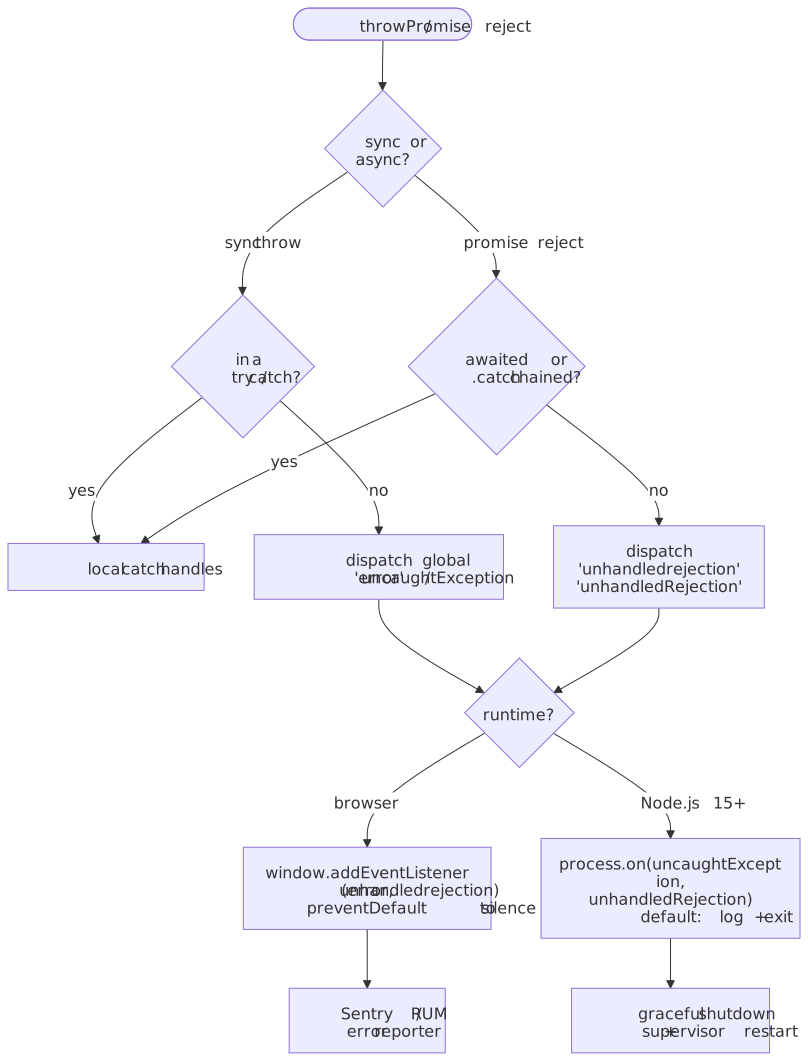
Error handling in JavaScript spans two orthogonal concerns: where failure information lives (a thrown completion versus a value in the return type) and how it propagates (sync stack, microtask queue, worker boundary, render phase, top-level handler). Most production bugs come from confusing the two — wrapping await in try/catch does nothing for a fire-and-forget Promise, and a React ErrorBoundary does not catch the onClick handler one level below it. This article maps the full pipeline: the Error type and its subclasses, Error.cause, AggregateError, AbortError, async stack traces, structured cloning across realms, browser and Node top-level handlers, React 19 boundaries, and the exception-versus-Result trade-off with neverthrow / fp-ts / Effect-TS.
Note
Version context — Claims here are anchored to ECMAScript 2025 (the published 16th edition) plus Stage 4 finished proposals headed for ECMAScript 2026, Node.js 22 LTS, React 19, TypeScript 5.x, neverthrow 8.2.x, and fp-ts 2.16.x. TC39 proposal stages are current as of April 2026.
Mental model
Three orthogonal axes determine how an error behaves at runtime. Pick the right axis before you reach for syntax.
| Axis | Question | Practical consequence |
|---|---|---|
| Channel | Is failure a completion record (throw) or a value in the return type (Result)? | try/catch reaches throws; match / andThen reaches values. They do not see each other. |
| Phase | Is the failure synchronous on the stack, or asynchronous in the microtask queue? | A try around a non-awaited Promise sees nothing. The reaction lands in unhandledrejection instead. |
| Realm | Did the error originate in this realm (iframe / worker / vm context) or another? | instanceof Error lies across realms; structured cloning loses identity; React boundaries do not cross worker scopes. |
Two more sub-rules collapse most of the day-to-day confusion:
- Throwing a non-Error is legal but pathological. ECMA-262 lets
throwaccept any value; the runtime never adds a stack to a thrown string.catchtherefore must defend with a runtime check before reading.message. - The boundary is wherever the engine takes over. Awaiting code is on your stack; the microtask reaction is on the engine’s. The
Promiseconstructor’s executor is on your stack; asetTimeoutcallback inside it is on the engine’s. Reach fortry/catchonly where the stack is yours.
Primitives
The Error type and its subclasses
Error is the base built-in. Per ECMA-262 §20.5 it stores name, message, an [[ErrorData]] internal slot (which is what makes an object actually an error), and an optional cause. The standard subclasses cover the engine’s own throw sites:
| Subclass | Spec section | Typical source |
|---|---|---|
EvalError |
§20.5.5.1 | Reserved; modern engines do not throw it. |
RangeError |
§20.5.5.2 | Array(2 ** 32), Number.prototype.toFixed(101), recursion overflow. |
ReferenceError |
§20.5.5.3 | Reading an undeclared identifier. |
SyntaxError |
§20.5.5.4 | JSON.parse, new Function('bad'), dynamic eval. |
TypeError |
§20.5.5.5 | Calling a non-callable, accessing .x on null, mutating frozen objects. |
URIError |
§20.5.5.6 | decodeURIComponent('%'). |
AggregateError (ES2021) |
§20.5.7 | Promise.any rejection — wraps the array in .errors. |
Beyond the built-ins, browsers expose DOMException (which mimics Error but does not inherit from it pre-2023; treat its .name as the discriminator) and Node adds SystemError and AbortError shapes. Userland subclasses use the standard pattern:
export class HttpError extends Error { override name = "HttpError" constructor( public readonly status: number, message: string, options?: { cause?: unknown }, ) { super(message, options) }}The two correctness gotchas to know:
namedefaults to"Error". Always override it on subclasses orinstanceofchecks downstream still work but log lines lie.Object.setPrototypeOfis no longer needed forextends Errorsince ES2015 / TypeScripttarget: es2017. It is needed when transpiling down to ES5, wheresuper(message)returns a fresh object that loses the prototype link. If your codebase targets modern runtimes, the historical workaround is dead code.
throw, try / catch / finally
ECMA-262 §14.15 defines the structured form:
// ECMA-262 §14.15: TryStatement// try Block Catch | try Block Finally | try Block Catch Finallytry { const result = riskyOperation() return processResult(result)} catch (error) { console.error("Operation failed:", error) return fallbackValue} finally { cleanup() // runs even after return/throw}Execution semantics (per ECMA-262 §14.15.3) follow the completion-record model:
- Evaluate the
tryblock. - On a
ThrowCompletion, the runtime walks up the call stack searching for a matchingcatch. - If found, bind the thrown value to the catch parameter and run the catch block.
- Run
finallyregardless — even whentryorcatchalready returned or threw.
finally overrides outcomes. A return (or throw) inside finally shadows the in-flight completion. This is rarely what you want:
function surprising() { try { throw new Error("Original error") } finally { return "finally wins" // suppresses the throw }}surprising() // "finally wins" — no error reaches the callerPer ECMA-262 §14.14, throw accepts any value — strings, numbers, plain objects, null. Treat that as a footgun, not a feature:
// ECMA-262 allows throwing ANY value// This makes catch blocks fundamentally untypedthrow "Something went wrong" // stringthrow 404 // numberthrow { code: "E_FAIL" } // plain objectthrow null // null — breaks error.message accessthrow new Error("Something went wrong")throw new TypeError("Expected string, got number")Error.cause and chaining
ES2022 added cause (proposal). It replaces the old “wrap message and stash the original on .original” idiom:
try { await fetchUser(id)} catch (cause) { throw new Error(`Cannot load user ${id}`, { cause })}Both Node’s default util.inspect and the V8 console formatter render the chain as Caused by: automatically. Error.cause is preserved across structured cloning (Chrome and Firefox; WebKit’s behaviour is still underspecified) and through Node’s inspect boundaries.
Tip
Always wrap, never swallow. The migration from console.error(e) to throw new Error('high-level message', { cause: e }) is one of the highest-leverage refactors in a legacy codebase — every existing handler gets the original throw site for free, and stack traces compose top-down.
AggregateError and Promise.any
AggregateError (ES2021) bundles multiple errors into one. Its sole built-in source is Promise.any, which rejects only when every input promise has rejected:
try { const fastest = await Promise.any([fetch("/a"), fetch("/b"), fetch("/c")])} catch (e) { if (e instanceof AggregateError) { for (const inner of e.errors) { console.warn("candidate failed:", inner) } }}It is also a useful userland tool: any time a function fans work out and needs to report partial-failure information, throw new AggregateError(errs, "fan-out failed") is more honest than picking one error to surface.
Async / await and Promise rejection propagation
Promises (ES2015) and async / await (ES2017) layer the throw model onto microtasks. Three rules cover the surface:
awaitrethrows. A rejected Promise resumes theasyncfunction with a thrown completion at the await site. Standardtry/catchworks.- A non-awaited, non-
.catch-ed Promise is “unhandled”. The engine firesHostPromiseRejectionTrackerwhich dispatchesunhandledrejection(browser) orunhandledRejection(Node) on the next microtask drain. - The
Promiseconstructor’s executor is sync-throw safe; its async callbacks are not. Athrowin the executor body is converted to a rejection, but athrowinside asetTimeoutinside the executor escapes — there is no handler to catch it on the engine’s stack.
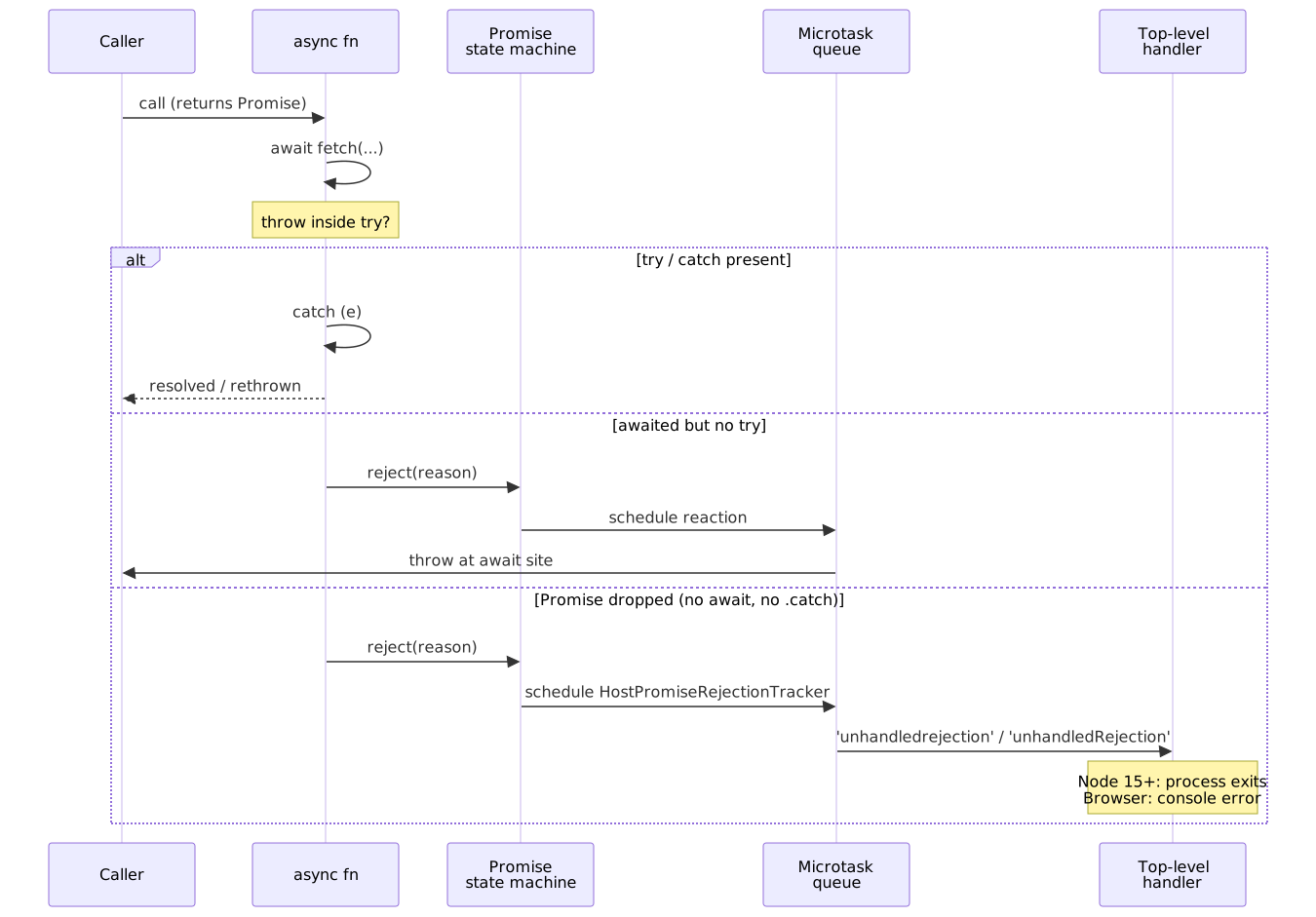
// 1. Sync throw in executor → rejection (caught)new Promise((resolve) => { throw new Error("Sync throw") // becomes rejection})// 2. Async throw inside executor → uncaught exceptionnew Promise((resolve) => { setTimeout(() => { throw new Error("Escapes!") // not catchable from this Promise }, 0)})// 3. Concurrent await: first rejection wins; siblings keep runningconst [a, b] = await Promise.all([ fetch("/a"), // rejects fetch("/b"), // also rejects → handled? no — the second is "lost"])// Use Promise.allSettled when you need every outcomeconst settled = await Promise.allSettled([fetch("/a"), fetch("/b")])ES2025 ships Promise.try (Stage 4, finished 2024-10-09) to collapse the sync-or-async ambiguity at any callback boundary into one rejection path:
// Works for sync throw, async throw, and plain return.await Promise.try(() => maybeSyncOrAsync()).catch(handle)Reach for it whenever you wrap a callback supplied by user code or by a library you do not control — it removes the “sync exception escaped my Promise chain” footgun without an extra try/catch.
TypeScript: catch (e: unknown) and narrowing
Since TypeScript 4.4, the useUnknownInCatchVariables compiler option types catch parameters as unknown rather than any, and strict: true turns it on automatically. The change is correct: ECMA-262 lets anything be thrown, and unknown forces a guard.
try { riskyOperation()} catch (error) { if (error instanceof Error) { console.log(error.message) } else if (typeof error === "string") { console.log(error) } else { console.log("Unknown thrown value:", error) }}The standard narrowing patterns:
export function isError(value: unknown): value is Error { return value instanceof Error}export function asError(value: unknown): Error { if (value instanceof Error) return value if (typeof value === "string") return new Error(value) try { return new Error(JSON.stringify(value)) } catch { return new Error(String(value)) }}export function hasCode<T extends string>( value: unknown, code: T,): value is Error & { code: T } { return value instanceof Error && (value as { code?: unknown }).code === code}The annotation on the catch parameter itself is restricted to unknown or any — TypeScript does not allow you to claim a more specific type at the binding site. Narrow inside the block, do not annotate at the colon.
Error.isError for cross-realm checks
Error.isError reached Stage 4 in 2025 and is included in the ECMAScript 2026 specification. It addresses the cross-realm instanceof footgun:
const iframe = document.createElement("iframe")document.body.appendChild(iframe)const ForeignError = iframe.contentWindow.Errorconst e = new ForeignError("from iframe")e instanceof Error // false — different Error constructorError.isError(e) // true — checks [[ErrorData]] internal slotThe check is an internal-slot test, so subclasses created with class MyError extends Error are still detected, but a plain object that happens to have message and stack is not. Prefer Error.isError over instanceof Error in any code that crosses realms (iframes, workers, vm contexts, Node’s vm.runInNewContext).
Async stack traces
V8 ships zero-cost async stack traces (Chrome 73 / Node.js 12+, default). The engine reconstructs the suspend / resume chain across await (and Promise.all) by walking the resumption metadata it already keeps for the microtask scheduler — there is no per-await capture cost. The DevTools “stitched” stack covers more cases (setTimeout, requestAnimationFrame, raw then callbacks) but only when the inspector is attached.1
Two practical rules:
- For raw
Promise.thenchains, the zero-cost mechanism does not stitch; rely oncauseto carry the original frame. Error.stackTraceLimitdefaults to 10. Bump it temporarily when debugging deep async chains; restore it to keep production overhead bounded.
AbortController, AbortSignal, and AbortError
AbortController is the standard cancellation primitive, plumbed through fetch, Request, EventTarget.addEventListener, Node’s HTTP / FS / streams APIs, and most modern libraries. It throws a DOMException named "AbortError", not a regular Error:
const ctrl = new AbortController()const t = setTimeout(() => ctrl.abort(new DOMException("Slow", "TimeoutError")), 5_000)try { const res = await fetch(url, { signal: ctrl.signal }) return await res.json()} catch (e) { if (e instanceof DOMException && e.name === "AbortError") return null // user cancellation, not a bug if (e instanceof DOMException && e.name === "TimeoutError") { metrics.increment("fetch.timeout") throw e } throw new Error("fetch failed", { cause: e })} finally { clearTimeout(t)}The modern surface to know:
AbortSignal.timeout(ms)returns a signal that aborts with aTimeoutErrorDOMException.AbortSignal.any([s1, s2])composes multiple signals — the first to abort wins.signal.throwIfAborted()is the cooperative-cancellation entry point inside long-running async work.signal.reasoncarries whatever you passed toabort(reason); pass a typed object to distinguish “user clicked cancel” from “request superseded by newer one”.
Treat AbortError as a non-failure — it represents a cooperative outcome, not a bug. Logging it as an error skews dashboards.
Structured cloning and worker error transmission
postMessage between a window and a Worker (or between iframes) runs the HTML structured-clone algorithm. Errors are explicitly clonable as of HTML Living Standard:
| Property | Cloned |
|---|---|
name |
Yes (must); falls back to "Error" if not one of the seven recognised names |
message |
Yes (must) |
stack |
Implementation-defined; preserved by Chromium and Firefox |
cause |
Implementation-defined; preserved by Chromium and Firefox, not WebKit |
AggregateError.errors is recursively cloned. Userland subclasses lose their constructor and arrive on the other side as a plain Error whose name matches the original. If you need richer transport, serialise to a plain object yourself ({ name, message, stack, code, ... }) and reconstruct.
Workers expose three relevant events:
erroron theWorkerinstance fires when the worker throws an uncaught exception. The event is anErrorEventcarryingmessage,filename,lineno, and (in modern engines) the originalErroron.error.messageerrorfires when a posted message cannot be deserialized — useful for catching cross-realm clone failures.unhandledrejectionalso fires onWorkerGlobalScope; install handlers symmetrically with the main thread.
Browser top-level handlers
The browser exposes two global error events on Window (and WorkerGlobalScope):
| Event | Interface | Fires when |
|---|---|---|
error |
ErrorEvent |
A script throws and no handler caught it. |
unhandledrejection |
PromiseRejectionEvent |
A rejected Promise has no handler at microtask drain. |
rejectionhandled |
PromiseRejectionEvent |
A previously unhandled rejection got a handler later (useful for clearing dashboards). |
window.addEventListener("error", (event: ErrorEvent) => { reporter.captureError(event.error ?? new Error(event.message), { src: event.filename, line: event.lineno, }) // event.preventDefault() to suppress the browser's default console output})window.addEventListener("unhandledrejection", (event: PromiseRejectionEvent) => { reporter.captureError(event.reason instanceof Error ? event.reason : new Error(String(event.reason))) // event.preventDefault() to mark as handled — DOMException AbortError typically should be silenced})Two non-obvious points:
- Resource load failures don’t bubble. An
<img>or<script>errorevent reacheswindowonly through capture-phase listeners ({ capture: true }), because the spec says these don’t bubble. window.onerror(the IDL attribute) has a legacy 5-arg signature(message, source, lineno, colno, error)— don’t use it for new code; preferaddEventListener('error', ...).
Node.js top-level handlers
Node’s process events mirror the browser surface, with materially different defaults:
uncaughtException— default behaviour: print stack to stderr and exit with code1. Installing a listener overrides the exit; the docs are explicit that this is “for synchronous cleanup, not recovery”.uncaughtExceptionMonitor— fires beforeuncaughtException, observation only; does not prevent the crash.unhandledRejection— since Node 15.0.0 the default is--unhandled-rejections=throw, which converts the rejection into anuncaughtExceptionand exits. Earlier behaviour (warn) is still selectable but should not ship in production.rejectionHandled— symmetric to the browser, fires when a previously-unhandled rejection gets a handler.
process.on("unhandledRejection", (reason, promise) => { reporter.captureError(reason instanceof Error ? reason : new Error(String(reason))) throw reason // let the process die; supervisor will restart})process.on("uncaughtException", (err, origin) => { reporter.captureError(err, { origin }) // synchronous cleanup only — close logger, flush stdout, then exit void shutdown(1)})The hard rule: never swallow uncaughtException in a long-running process. The state of the heap after an uncaught throw is undefined; the only safe action is to flush, log, and exit. Leave restart to the supervisor (systemd, Kubernetes, PM2, Docker --restart).
Caution
node:domain is documentation-only deprecated (DEP0032). It survives for compatibility but will be removed. The replacement for the “carry context across async boundaries” use case is AsyncLocalStorage; for crash isolation, use a process supervisor and the cluster module. There is no modern equivalent of “catch all errors that originated in this request and continue serving” — that pattern was unsafe by design.
React 19 Error Boundaries
A React Error Boundary is a class component implementing static getDerivedStateFromError(error) (render-phase fallback) and / or componentDidCatch(error, info) (commit-phase logging). It catches errors thrown during render, constructor, and lifecycle of any descendant. It does not catch:
- Event handlers (
onClick,onSubmit, …) — wrap withtry/catch, or trigger a re-render that throws on the next render pass. - Asynchronous code (
setTimeout,fetch.then, raw Promises) — same workaround. - Server-side rendering (use the framework’s SSR error hook).
- Errors inside the boundary’s own render.
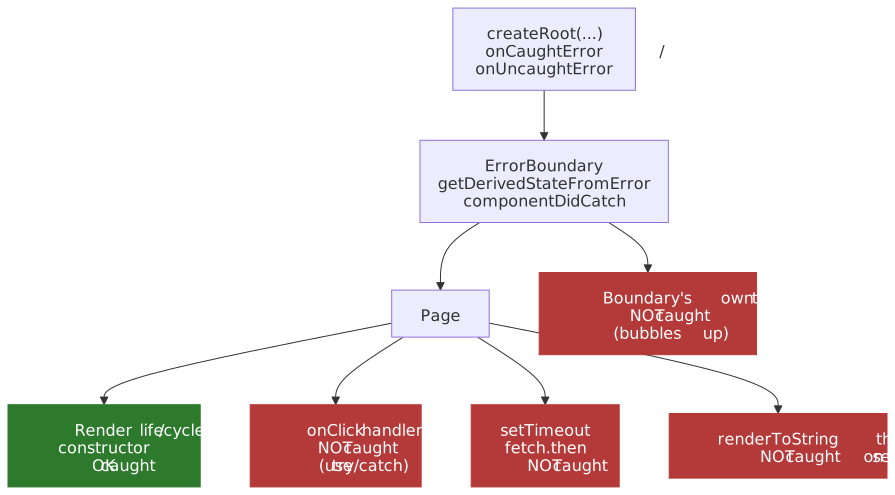
React 19 added two root-level callbacks on createRoot / hydrateRoot for centralised reporting:
import { createRoot } from "react-dom/client"createRoot(document.getElementById("root")!, { onCaughtError: (error, info) => reporter.captureError(error, { caughtBy: info.componentStack }), onUncaughtError: (error, info) => reporter.captureError(error, { uncaught: true }), onRecoverableError: (error) => reporter.captureWarning(error),})onCaughtError fires for errors a boundary handled; onUncaughtError fires for errors no boundary handled (including the boundary’s own throw). They replace the prior pattern of patching console.error to forward errors to your reporter.
For the practical UI, use react-error-boundary — it provides <ErrorBoundary fallbackRender={...} onReset={...}>, useErrorBoundary (to throw async errors back into the boundary), and withErrorBoundary for wrapping. Pair it with route-level boundaries plus a top-level fallback so a crash in one route does not blank the whole app.
Recipes
Wrapping throwing APIs at the boundary
The integration with throwing libraries is one place where try/catch is the only correct tool. Convert at the seam, not in the middle of business logic:
import { Result, ok, err } from "neverthrow"class ParseError extends Error { override name = "ParseError"}export function parseJson<T>(input: string): Result<T, ParseError> { try { return ok(JSON.parse(input) as T) } catch (cause) { return err(new ParseError("invalid JSON", { cause })) }}Inside the boundary the function looks throwing; outside it the function looks Result-returning. Callers compose declaratively without re-running the conversion.
Promise.try for sync-or-async callbacks
Anywhere you accept a callback that might throw synchronously and might return a Promise, route through Promise.try so the rejection path is single:
async function safeRun<T>(fn: () => T | Promise<T>): Promise<Result<T, Error>> { try { return ok(await Promise.try(fn)) } catch (cause) { return err(cause instanceof Error ? cause : new Error(String(cause), { cause })) }}From exceptions to values: the trade-off
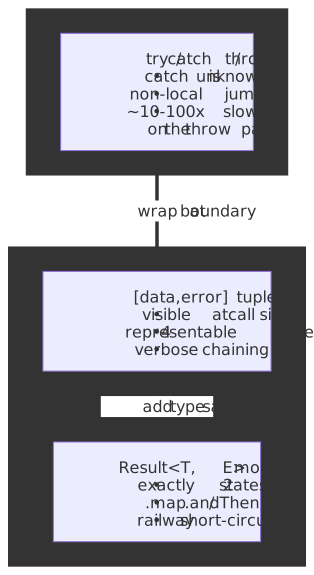
The choice between throw-based and return-based handling is the largest single decision in this design space.
Exception model (try/catch): Failure is a side effect. Functions have two exit paths — return and throw — but only one is in the type. Stack-trace capture and unwinding can be 10×–100× slower than a normal return on the throw path; the empty try block itself has been free in V8 since 6.x (Node 8.3+).23
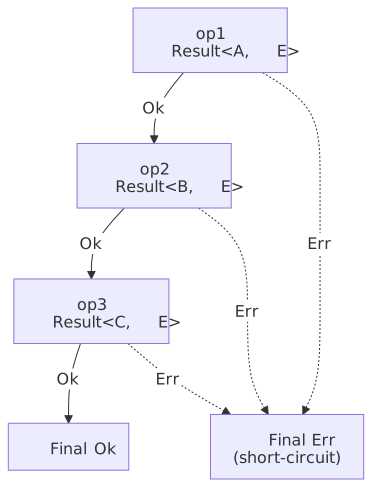
Value model (Result<T, E>): Failure is data. Functions return a discriminated union that forces callers to acknowledge both outcomes. Operations compose via .map (transform success) and .andThen (chain fallible work), with failures short-circuiting subsequent success handlers — Railway Oriented Programming.
| Criterion | try/catch | [data, error] | Result Monad |
|---|---|---|---|
| Type safety | catch receives unknown |
Convention-based | Compiler-enforced |
| Composability | Imperative nesting | Repetitive if (err) |
Fluent chaining |
| Failure forcing | Easy to ignore | Easy to ignore | Linting can enforce |
| Performance | Stack unwinding | Value return | Value return |
| Debugging | Native stack traces | May lose stack context | Errors are values |
Go-style [data, error] tuples
The cheapest “make failure visible at the call site” pattern. Useful for scripts and prototypes; a leaky abstraction at scale.
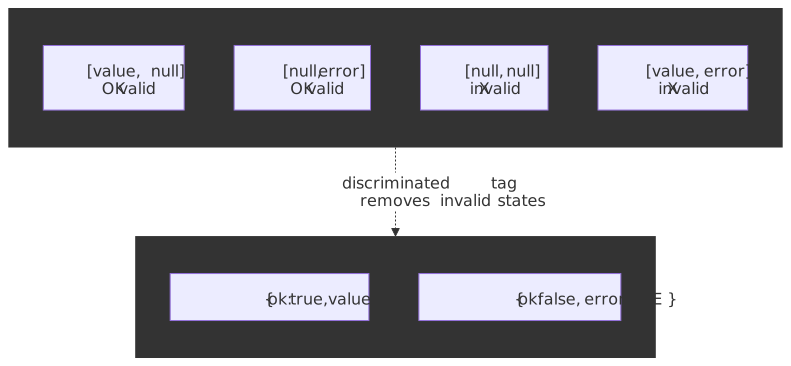
function to<T>(p: Promise<T>): Promise<[T | null, Error | null]> { return p.then((data) => [data, null]).catch((err) => [null, err])}const [user, err] = await to(fetchUser(id))if (err) return nullreturn userWhy it leaks: [T | null, E | null] admits four states, not two. The type system cannot rule out [null, null] or [value, error] without a discriminant.
Result types: neverthrow, fp-ts, Effect-TS
A Result is a discriminated union with exactly two variants:
type Result<T, E> = | { ok: true; value: T } | { ok: false; error: E }This makes invalid states impossible at the type level. Any Err short-circuits the rest of the success track and lands in the final error sink — no recovery handler runs unless one is explicitly chained with .orElse.
| Method | Also Known As | Behavior |
|---|---|---|
.map(fn) |
fmap |
Transform Ok value; Err passes through unchanged |
.andThen(fn) |
chain, flatMap, >>= |
Chain fallible operation; fn returns Result |
.orElse(fn) |
recover |
Transform Err; Ok passes through unchanged |
.match(onOk, onErr) |
fold, cata |
Exit the monad — extract a value by handling both cases |
neverthrow (v8.2.0, released 2025-02-21) is the pragmatic default — method-chaining API familiar to OOP developers, ergonomic ResultAsync, and a companion ESLint rule that fails the build when a Result is dropped:
import { ok, err, Result } from "neverthrow"function parseNumber(s: string): Result<number, string> { const n = parseFloat(s) return Number.isNaN(n) ? err("Invalid number") : ok(n)}const message = parseNumber("10") .map((x) => x * 2) .andThen((x) => (x > 15 ? ok(x) : err("Value too small"))) .match( (value) => `Computation succeeded: ${value}`, (error) => `Computation failed: ${error}`, )Notable v8.x changes versus v7: .orElse() can change the Ok type, safeTry accepts yield* result directly (no .safeUnwrap()), and .orTee() mirrors andTee on the error track (release notes).
fp-ts (v2.16.x, the current line) is the comprehensive functional toolkit; its Either<E, A> is the same shape under different naming (Left / Right). The killer feature there is the pipe() style and the rest of the FP ecosystem (Option, Task, Reader, …).
Important
fp-ts is moving into Effect-TS. Giulio Canti, fp-ts’s creator, has joined the Effect-TS organisation and Effect is positioned as the official migration target. New code that wants the full FP ecosystem (effects, dependency injection, fibers, observability) should start on Effect rather than fp-ts. fp-ts itself remains stable for existing codebases.
| Library | Focus | API Style | Notes |
|---|---|---|---|
| neverthrow | Result types | Method chaining | Pragmatic default; ESLint rule |
| fp-ts | Full FP toolkit | pipe() + free fns |
Comprehensive; steep learning |
| Effect-TS | Effect system | Method + generator | fp-ts successor |
| ts-results | Minimal Result | Method chaining | Lightweight, zero deps |
| oxide.ts | Rust-like | Method chaining | Closer to Rust’s std::result |
| true-myth | Maybe + Result | Method chaining | Good documentation |
Migrating an existing codebase
Convert at the boundary first, expand inward.
import { Result, ok, err, ResultAsync } from "neverthrow"function parseJson<T>(input: string): Result<T, SyntaxError> { try { return ok(JSON.parse(input) as T) } catch (e) { return err(e instanceof SyntaxError ? e : new SyntaxError(String(e))) }}function processUserInput( input: string,): Result<User, ParseError | ValidationError> { return parseJson<UserInput>(input) .mapErr((e) => new ParseError(e.message, { cause: e })) .andThen(validateUser)}Keep try/catch at the entry points — HTTP handlers, CLI commands, message-queue consumers — to catch any throws from code that has not been converted yet. Install eslint-plugin-neverthrow from the start so unconsumed Results are caught at PR time rather than in production.
Anti-patterns
| Anti-pattern | Why it’s wrong | Do this instead |
|---|---|---|
Empty catch |
Errors disappear; observability dies. | Re-throw, log with context, or convert to a typed Result. |
| Throwing strings / numbers / plain objects | No stack trace; instanceof Error lies; structured cloning loses the type. |
throw new Error(...) or a typed subclass. |
Swallowing await in Promise.all |
First rejection wins; sibling rejections become unhandled. | Promise.allSettled for independent work; AbortController to cancel siblings. |
| Using exceptions for control flow (e.g. early-exit loop) | Throw path is one to two orders of magnitude slower than a return; pollutes traces. | Return a sentinel, break, or use find. |
Catching AbortError and reporting it as a failure |
Abort is cooperative cancellation, not a bug. Inflates error budgets. | Branch on error.name === 'AbortError' and treat as expected. |
Silencing unhandledRejection to keep Node alive |
Heap state is undefined; the next request hits corrupted invariants. | Log + flush + exit; let the supervisor restart. |
Using node:domain for crash isolation |
Deprecated; never replaced because the pattern is unsafe by design. | AsyncLocalStorage for context; supervisor for restart. |
Wrapping with new Error(e.message) and dropping e |
Loses stack; loses cause chain; loses subclass identity. |
throw new Error("...", { cause: e }). |
instanceof Error across realms |
Different Error constructor per realm; check returns false for foreign errors. |
Error.isError(e) (ES2026) or a duck-typed guard on name + message. |
| Catching in a React event handler then re-throwing | Throw outside render is invisible to the boundary. | Set state that throws on next render, or use useErrorBoundary’s showBoundary. |
Boundary without componentDidCatch |
You get a fallback UI but no logging; no signal in production. | Log in componentDidCatch and / or onCaughtError. |
Using Promise.any and forgetting AggregateError |
Catching with e.message reads "All promises were rejected"; the inner errors are on e.errors. |
if (e instanceof AggregateError) for (const inner of e.errors) ... |
TC39 trajectory
The headline gaps are partially being closed by the language. The state of play as of April 2026:
| Proposal | Stage | Status |
|---|---|---|
Error.isError |
4 | Finished, in ES2026. Cross-realm error detection. |
Promise.try |
4 | Finished, in ES2025. Unified sync / async error path for callback wrappers. |
| Pipeline operator — Hack pipe | 2 | Topic-token bikeshed (% vs ^ vs #) ongoing. Use Babel for experimentation; do not ship. |
Pattern matching match |
1 | Stage 1 since 2018; the natural Result consumer if it ever ships. |
throw expressions |
2 | TypeScript already supports the syntax. Useful for default-parameter validation and arrow shorthand. |
do expressions |
1 | Block as expression; try { ... } catch { fallback } becomes inline. |
| Try Operator | 0 | Successor to the dropped Safe Assignment Operator (?=). Returns a Result-shaped object. Looking for a TC39 champion; do not wait for it. |
const greet = (name = throw new Error("Required")) => `Hello, ${name}`const fail = () => throw new Error("Not implemented")const value = condition ? result : throw new Error("Failed")Decision framework
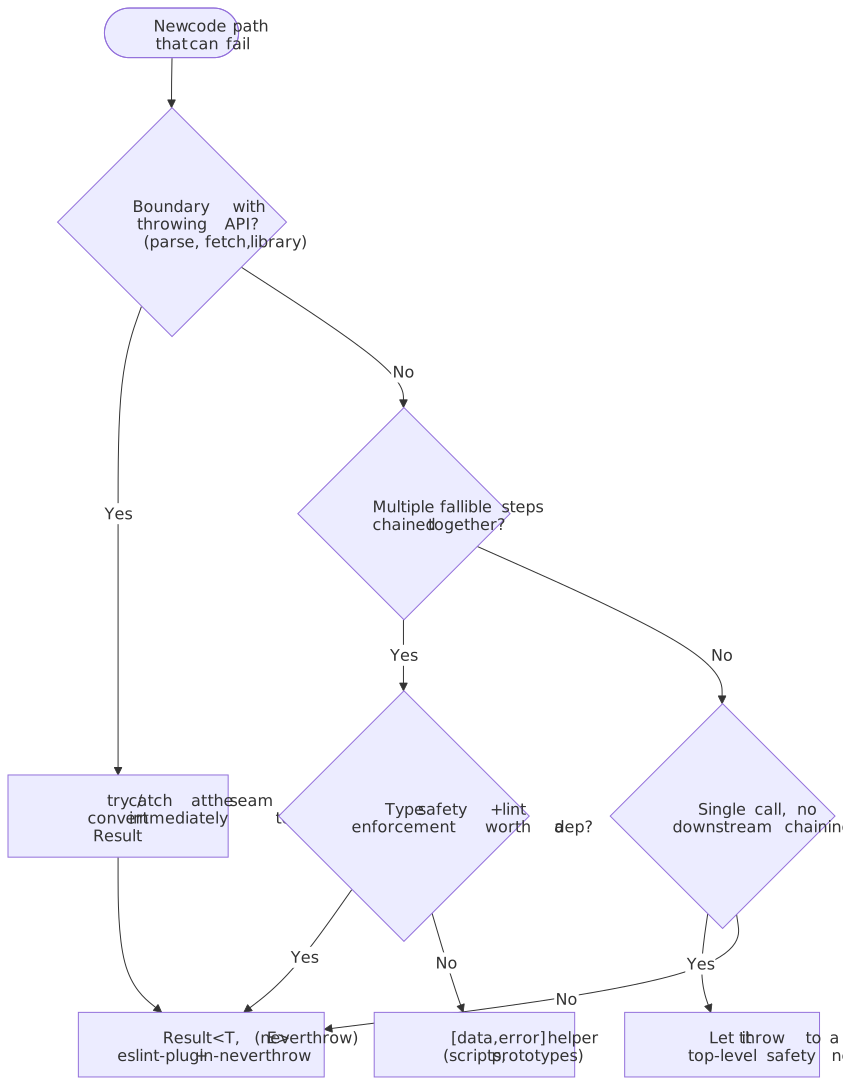
When to use try/catch: API boundaries (parsing, third-party throwing libs), top-level safety nets (HTTP handler, CLI, worker), and React event handlers / async work that must trigger a boundary fallback.
When to use Go-style tuples: scripts, prototypes, or single-call helpers where adding a dependency is more cost than the safety buys.
When to use Result<T, E>: business logic with multiple fallible steps, data-processing pipelines, anything where “forgot to check” would cause a production incident.
When to use Effect-TS / fp-ts: the entire codebase is committed to FP and you want effects, dependency injection, fibers, and observability in one package.
| Scenario | Recommendation |
|---|---|
| Most TypeScript projects | neverthrow — best ergonomics / safety balance |
| Full FP commitment | fp-ts (legacy) → Effect-TS (new code) |
| Minimal bundle size | ts-results (~2 KB) |
| Rust API familiarity | oxide.ts |
Practical takeaways
- Map every code path onto the three axes (channel, phase, realm) before reaching for syntax. The bug is usually that you’re handling the wrong axis.
- Throw
Errorsubclasses withcause, never bare values.Error.isError(ES2026) pluscauseis a complete, cross-realm-safe error story for new code. - Wrap once at the boundary, return
Resulteverywhere inside. The boundary is where the engine takes over: HTTP handler, CLI entry, React error boundary, Workeronmessage, microtask queue. - Treat
AbortErroras success. Cooperative cancellation must not page anyone. - Install both top-level handlers and a process supervisor. Browsers:
error+unhandledrejectionreporting to your RUM. Node: log + flush +process.exit(1); let the supervisor restart. - Use React 19’s
onCaughtError/onUncaughtErroras the single funnel for client-side reporting; pair with route-level<ErrorBoundary>so one route’s crash does not blank the whole app. - Bump
Error.stackTraceLimitonly while debugging. Default 10; production should not pay for deeper captures.
Appendix
Prerequisites
- TypeScript generics, union types, discriminated unions.
- Promise /
async-awaitmechanics; the microtask queue. - React component lifecycle (for the boundary section).
Terminology
| Term | Definition |
|---|---|
[[ErrorData]] internal slot |
The hidden flag that distinguishes a real Error instance from a duck-typed object with name/message. |
| Completion record | ECMA-262 internal record passed up the call stack; ThrowCompletion is what throw produces. |
| Discriminated union | A union type where each variant carries a literal field (tag) enabling type narrowing. |
| Microtask | Job queued on the host’s microtask queue; Promise reactions, queueMicrotask, and mutation observers run here. |
| Monad | An abstraction providing unit (wrap value) and bind (chain operations) satisfying identity and associativity laws. |
| Railway Oriented Programming | Error pattern where success / failure are parallel tracks, with failures bypassing subsequent success handlers. |
| Realm | An isolated execution context (window, iframe, worker, vm) with its own globals and prototype chain. |
| Result / Either | Discriminated union with exactly two variants: success (Ok / Right) and failure (Err / Left). |
ThrowCompletion |
ECMA-262 completion record produced by throw. |
| Topic reference | In Hack pipes, the placeholder (%) representing the value from the previous pipeline step. |
| Zero-cost async stack trace | V8’s reconstruction of the await chain from existing scheduler metadata; no per-await capture overhead. |
References
Specifications
- ECMA-262 (latest editor’s draft) — ES2026, 17th edition
- ECMA-262 (ES2025) — last published yearly snapshot
- ECMA-262 §14.15 —
tryStatement - ECMA-262 §14.14 —
throwStatement - ECMA-262 §20.5 — Error Objects
- HTML Living Standard — Structured serialization
MDN
ErrorError.causeAggregateErrorPromiseAbortController/AbortSignalWindowerrorevent /ErrorEventWindowunhandledrejection/PromiseRejectionEventstructuredClone()
Runtime docs
- Node.js
processevents - Node.js
--unhandled-rejections=throw - Node.js
node:domaindeprecation (DEP0032) - Node.js
AsyncLocalStorage - V8 — Faster async functions and zero-cost stack traces
TypeScript / React
- TypeScript —
useUnknownInCatchVariables - React 19 release notes — root error options
- React Error Boundaries (legacy docs page, still authoritative on the API)
react-error-boundary
TC39 proposals
Error.isError(Stage 4)Promise.try(Stage 4)- Pipeline operator (Stage 2)
- Pattern matching (Stage 1)
throwexpressions (Stage 2)doexpressions (Stage 1)- Try Operator (Stage 0)
Libraries
- neverthrow (v8.2.0)
- eslint-plugin-neverthrow
- fp-ts (v2.16.x)
- Effect-TS
- ts-results
- oxide.ts
Practitioner content
Footnotes
-
V8 — Faster async functions and promises; the “zero-cost” reconstruction works for
awaitandPromise.all, not for rawthenchains. ↩ -
V8 issue tracker and discussion summarised in this Stack Overflow answer —
try/catchceased to deoptimize the enclosing function in V8 6.x. ↩ -
See the Node.js throw-vs-return benchmark thread which decomposes the cost into Error allocation and stack-trace capture; suppressing
Error.captureStackTracecollapses the gap dramatically. ↩