Design a Distributed Key-Value Store
A distributed key-value store offers minimal get/put/delete semantics while hiding partitioning, replication, failure detection, and storage-engine mechanics behind a simple API. This article walks the design space through the Dynamo lineage1 (Amazon Dynamo, Apache Cassandra, Riak)---availability- and partition-tolerance-first systems with tunable consistency---and contrasts with CP alternatives like etcd where linearizability is the product. The focus is the non-obvious mechanisms a senior engineer needs to defend in a design review: how consistent hashing actually places replicas, why R + W > N is necessary but not sufficient, where vector clocks beat last-write-wins, and how an LSM engine’s compaction strategy decides whether your reads will fly or thrash.
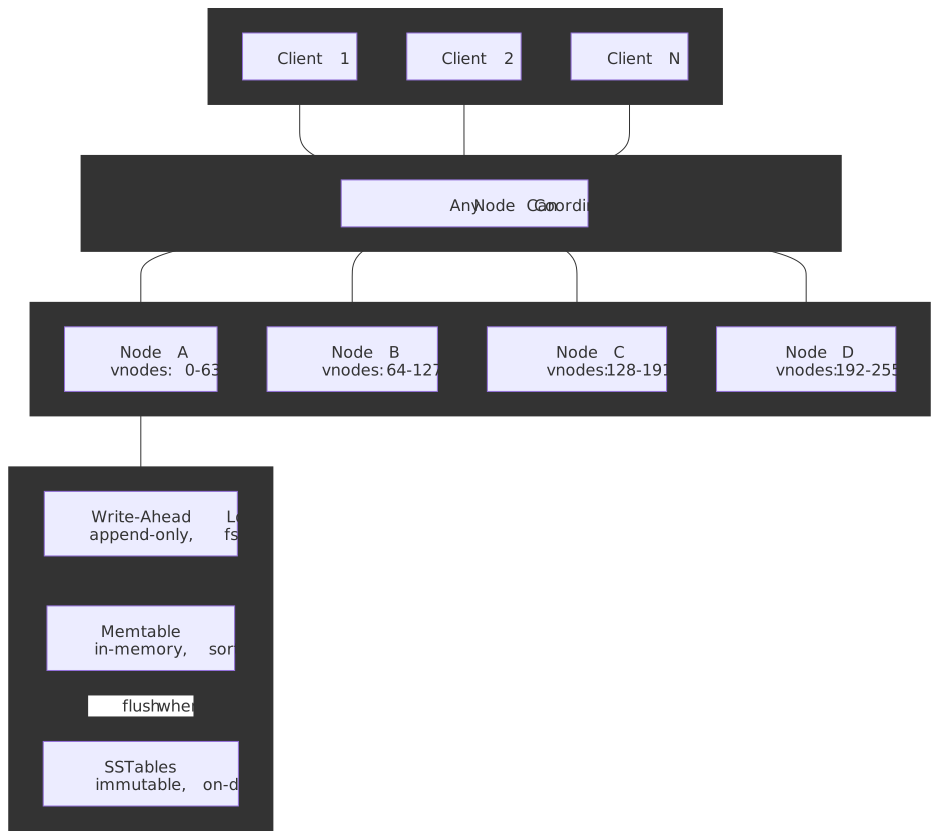
Mental model
A distributed key-value store is fundamentally about choosing where to sit on the CAP spectrum23 and then implementing the mechanisms to deliver that choice end-to-end:
- AP systems (Dynamo, Cassandra, Riak): accept eventual consistency in exchange for always-on availability. Leaderless replication, sloppy / strict quorums, and conflict resolution via vector clocks or LWW.
- CP systems (etcd, Consul, ZooKeeper): unavailable during partitions to preserve linearizability. Leader-based consensus (Raft / Multi-Paxos / ZAB).
Important
CAP is a worst-case partition statement, not a steady-state one. AP systems still offer strong consistency under quorum (R + W > N) when the network is healthy; CP systems still serve reads with low latency when the leader is reachable. The split is about what happens when the network breaks, not about average behavior.
The five mechanisms that recur in every Dynamo-style design:
- Consistent hashing with virtual nodes distributes data so that only
k/nkeys move when topology changes.4 - Quorum replication (
R + W > N) gives the operator a per-call lever between availability and consistency. - Vector clocks or LWW timestamps detect and resolve concurrent writes.
- Gossip + an accrual failure detector propagate cluster membership and suspect liveness without a central coordinator.56
- LSM-tree storage turns random writes into sequential I/O at the cost of read amplification you then claw back with bloom filters and compaction.7
Throughout the article, “the Dynamo paper” refers to the 2007 SOSP paper1; “DynamoDB” refers to the AWS service whose 2022 USENIX ATC paper8 documents how its current architecture has diverged from that paper (notably toward Multi-Paxos-based replication and strong consistency as an option).
Requirements
Functional Requirements
| Requirement | Priority | Notes |
|---|---|---|
put(key, value) |
Core | Store a value, return success/version |
get(key) |
Core | Retrieve value(s), handle conflicts |
delete(key) |
Core | Tombstone-based deletion |
| Range queries | Extended | Only if ordered storage (not covered in AP designs) |
| TTL expiration | Extended | Automatic key expiry |
| Transactions | Out of scope | Requires coordination, changes CAP position |
Non-Functional Requirements
| Requirement | Target | Rationale |
|---|---|---|
| Availability | 99.99% | Writes must succeed even during failures |
| Write latency | p99 < 10ms | Local disk + async replication |
| Read latency | p99 < 5ms | Cache hits, single disk seek |
| Throughput | 100K+ ops/sec per node | LSM-tree optimized for writes |
| Durability | No acknowledged write lost | WAL before acknowledgment |
| Consistency | Tunable (eventual to strong) | Application chooses per-operation |
Scale Estimation
Cluster sizing example for a 10 TB dataset:
Data size: 10 TBReplication factor: 3Total storage needed: 30 TBPer-node capacity: 2 TB (leaving headroom for compaction)Nodes required: 30 TB / 2 TB = 15 nodesTraffic assumptions:- 80% reads, 20% writes- Average value size: 1 KB- Target: 100K ops/sec totalPer-node throughput: 100K / 15 ~ 6,700 ops/sec- Reads: 5,400 ops/sec- Writes: 1,300 ops/secDesign Paths
Path A: AP with Leaderless Replication (Dynamo Model)
Best when:
- Availability is paramount (e-commerce carts, session stores)
- Application can handle conflict resolution
- Writes must succeed even during network partitions
Architecture:
- All nodes are peers—no leader election
- Any node can coordinate any request
- Replication is synchronous to quorum, async to remaining replicas
- Conflicts detected via vector clocks or resolved via LWW
Trade-offs:
- Writes always succeed (to any available quorum)
- No single point of failure
- Application must handle conflicting versions
- Weaker consistency guarantees
Real-world examples: Amazon Dynamo (shopping cart), Riak, Cassandra (with eventual consistency)
Path B: CP with Leader-Based Consensus (Raft/Paxos)
Best when:
- Strong consistency required (configuration stores, coordination)
- Reads must return the latest write
- Can tolerate unavailability during leader election
Architecture:
- Single leader handles all writes
- Raft/Paxos ensures log replication before acknowledgment
- Leader election on failure (typically 1-10 seconds)
Trade-offs:
- Linearizable reads and writes
- Unavailable during leader election
- Write throughput limited by leader
- Simpler conflict model (no concurrent writes)
Real-world examples: etcd (Kubernetes), Consul, ZooKeeper
Path Comparison
| Factor | AP (Dynamo) | CP (Raft) |
|---|---|---|
| Write availability | Always (to quorum) | Unavailable during election |
| Read consistency | Eventual or quorum | Linearizable |
| Conflict handling | Vector clocks/LWW | None (single writer) |
| Latency | Lower (no consensus) | Higher (consensus round-trip) |
| Throughput | Higher (any node writes) | Lower (leader bottleneck) |
| Cluster size | 100s-1000s nodes | 3-7 nodes typical |
| Use case | User data, caches | Config, coordination, locks |
This Article’s Focus
This article focuses on Path A (AP/Dynamo model) because:
- Most key-value workloads prioritize availability over strong consistency
- The techniques (consistent hashing, vector clocks, gossip) are more complex and worth detailed examination
- CP systems (etcd, Consul) have well-documented Raft implementations
For CP key-value store design, see etcd’s architecture documentation and the Raft paper.
High-Level Design
Component Overview
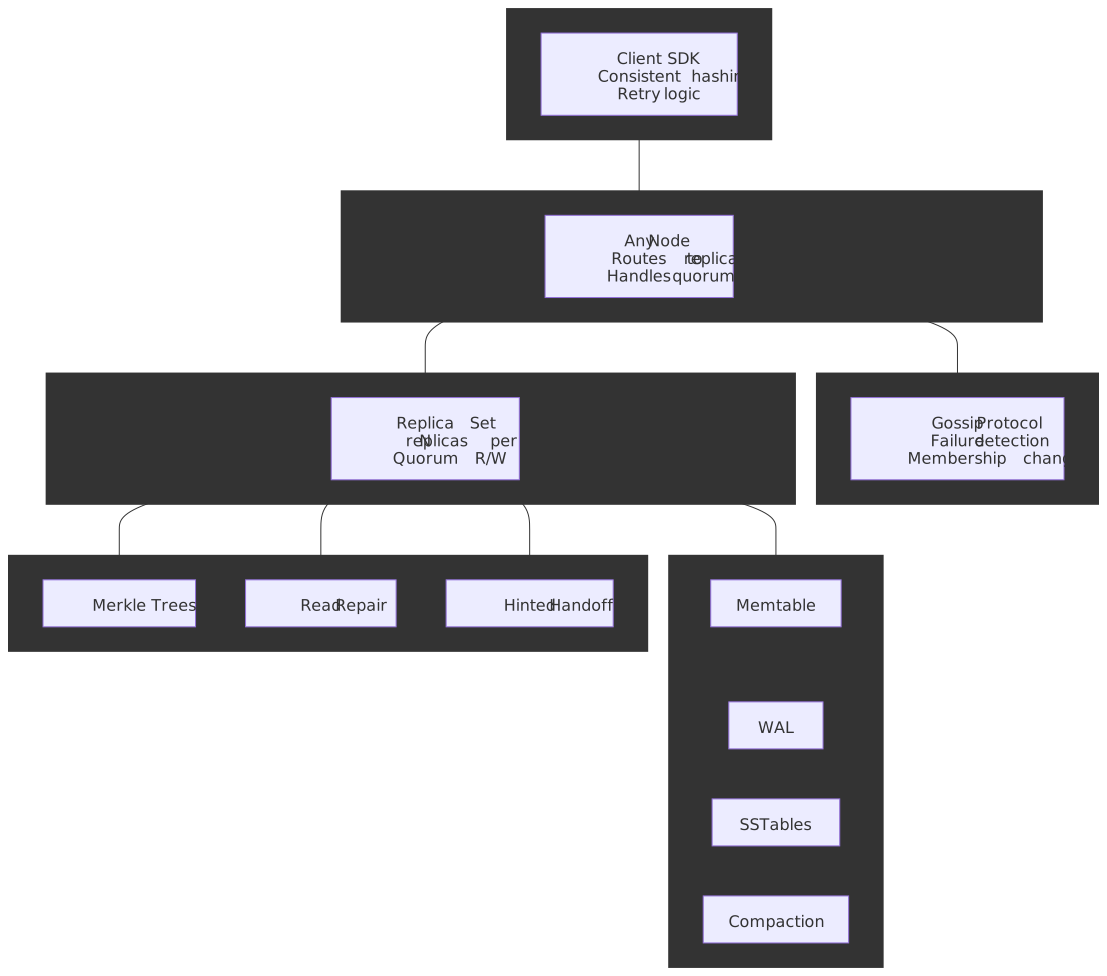
Request Flow
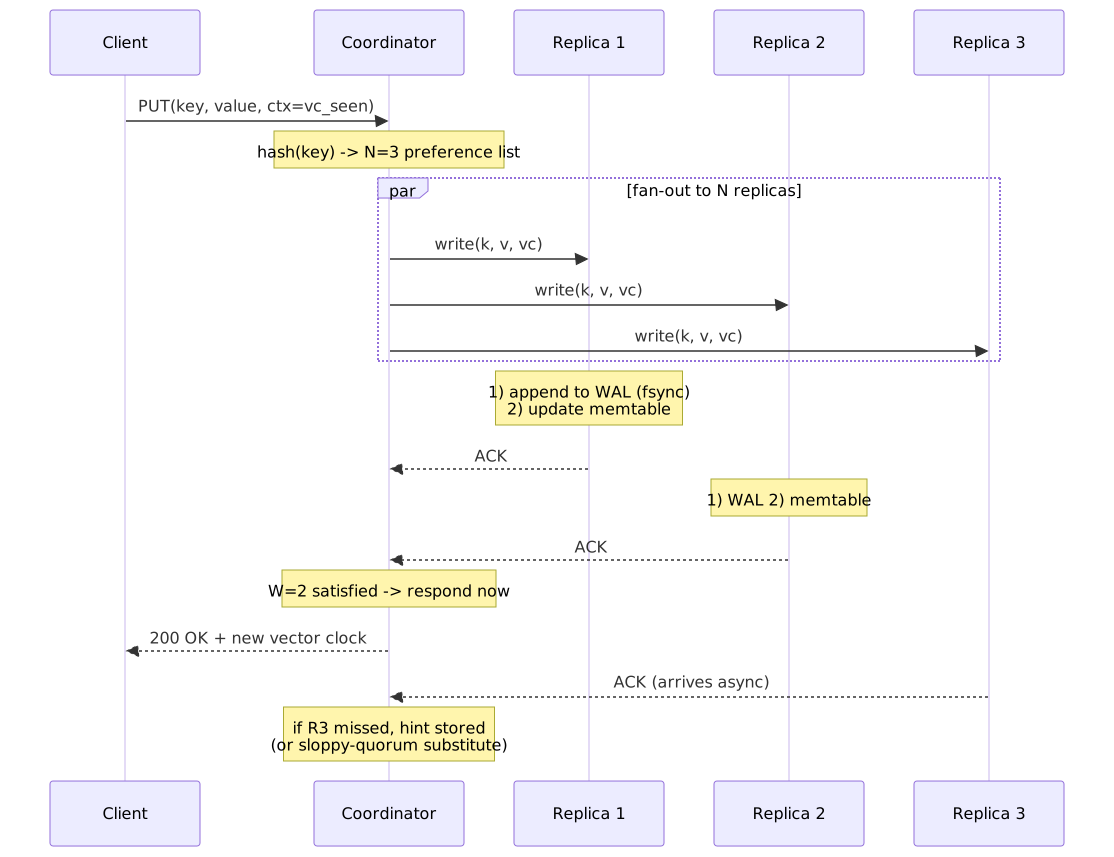
Write path:
- Client SDK hashes key, identifies coordinator node
- Coordinator determines N replica nodes from preference list
- Coordinator sends write to all N replicas in parallel
- Each replica: writes to WAL → updates memtable → acknowledges
- Coordinator waits for W acknowledgments
- Returns success to client (remaining replicas receive async)
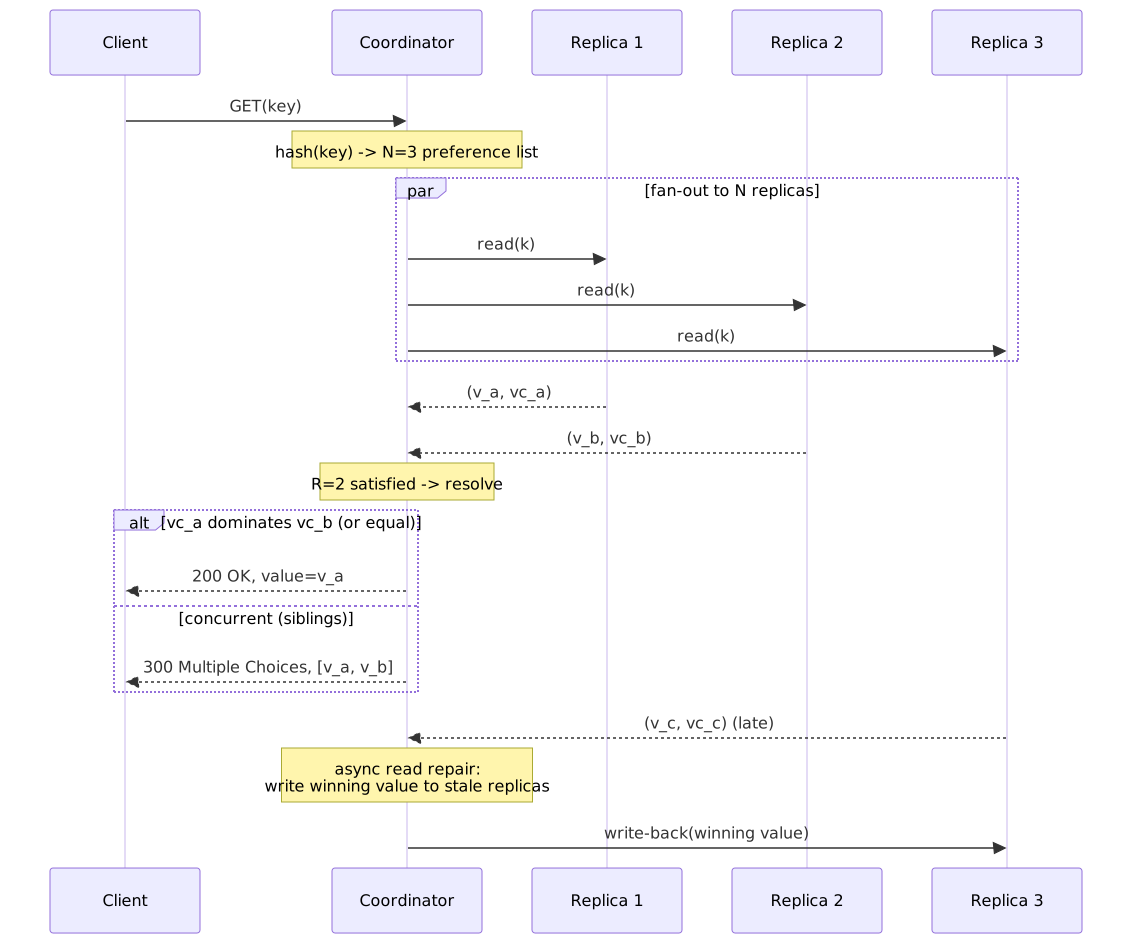
Read path:
- Client SDK hashes key, contacts coordinator
- Coordinator sends read to all N replicas in parallel
- Coordinator waits for R responses
- If versions conflict: return all versions (or resolve via LWW)
- Trigger read repair if replicas diverged
Data Partitioning
Consistent Hashing
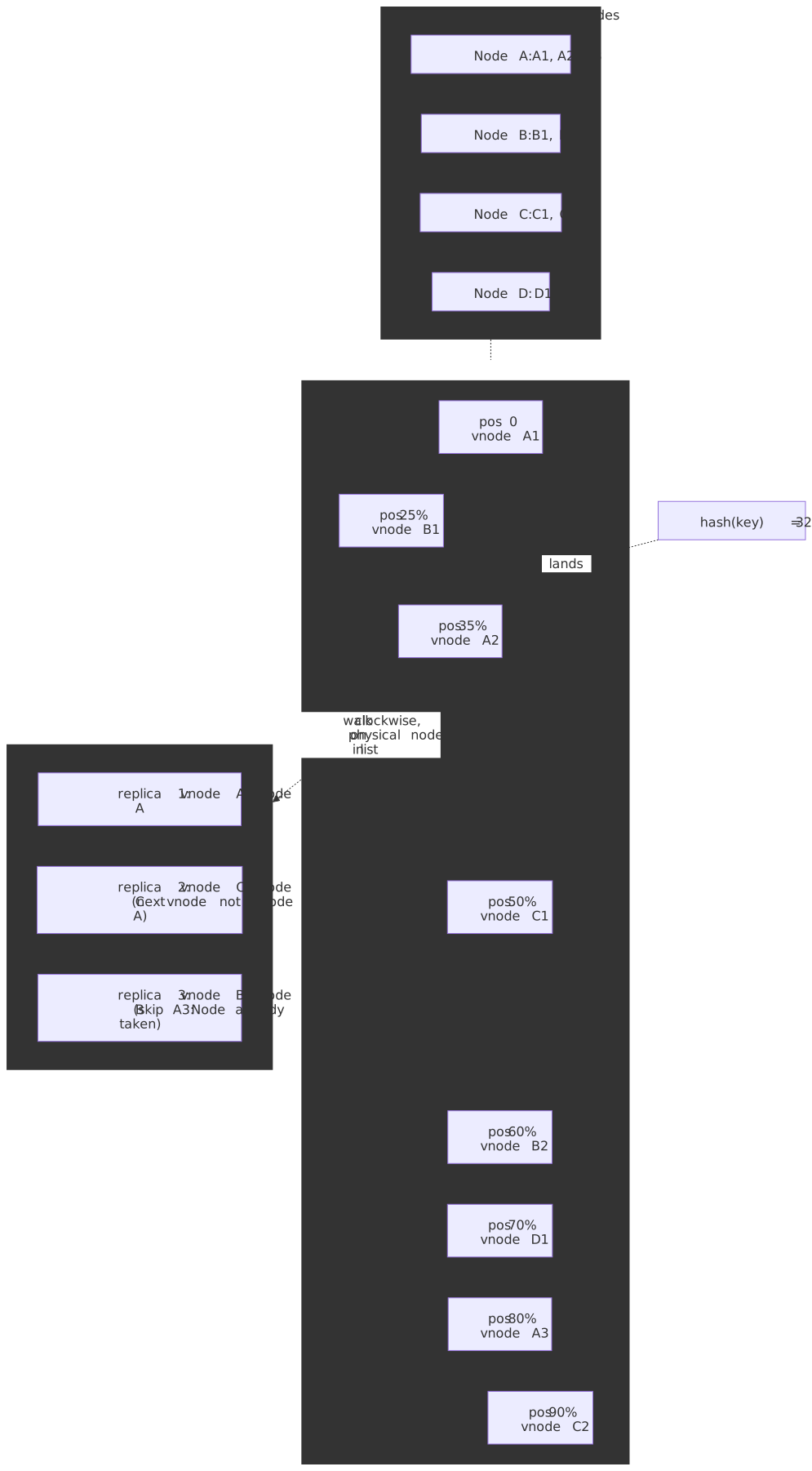
Consistent hashing4 maps both keys and nodes to positions on a hash ring (typically 0 to N distinct physical nodes walked clockwise from its hash position.
Why consistent hashing?
When nodes join or leave, only k = total keys, n = nodes). With naive modulo hashing, nearly all keys would remap.
Traditional: hash(key) % num_nodes -> Node changes cause ~100% key movementConsistent: next_node(hash(key)) -> Node changes cause ~1/n key movementVirtual Nodes (vnodes)
Physical nodes own multiple positions on the ring. Each position is a “virtual node” responsible for a range of the hash space.
Design rationale:
- Load balancing: A single physical node token can create hotspots if keys cluster. Virtual nodes spread load.
- Heterogeneous hardware: Assign more vnodes to powerful machines.
- Faster recovery: When a node fails, its vnodes are distributed across many physical nodes, enabling parallel recovery.
Configuration trade-offs:
| vnodes per node | Pros | Cons |
|---|---|---|
| 1 (legacy) | Fewer ring neighbors, simpler | Uneven distribution, slow rebalancing |
| 16 (modern default) | Good balance, deterministic allocation | Moderate neighbor count |
| 256 (legacy Cassandra) | Fine-grained distribution | High memory overhead, slow streaming |
Cassandra 4.0+ defaults num_tokens to 16 with the replica-aware token allocator (allocate_tokens_for_local_replication_factor) enabled, down from 256 random tokens in 2.0–3.x.9 The reduction improves repair and streaming performance while keeping the distribution balanced. The change is tracked in CASSANDRA-13701.
Replication Strategy
Keys are replicated to N consecutive nodes on the ring (the “preference list”). With virtual nodes, consecutive ring positions may map to the same physical node, so the preference list skips to ensure N distinct physical nodes.
Replication factor selection:
| RF | Fault tolerance | Storage overhead | Typical use |
|---|---|---|---|
| 1 | None | 1x | Caches, ephemeral data |
| 3 | 1 node failure | 3x | Standard production |
| 5 | 2 node failures | 5x | Critical data, cross-DC |
Hot Key and Hot Partition Mitigation
Consistent hashing balances the key space, not the request space. A single very popular key (or a single fat partition under a wide-row schema) still pins all reads/writes to one preference list of N replicas, capping throughput at one machine’s IOPS regardless of cluster size. The mitigations split into client-side and server-side flavours.
Schema-level (Cassandra-style, manual). Add a bucket / salt component to the partition key — (natural_key, bucket) where bucket = hash(payload) mod K or a time-rounded suffix.10 Reads then scatter-gather across K partitions, trading extra coordinator work for parallelism across N × K replicas. Pick K against the observed skew, not the cluster size; oversharding wastes coordinator round-trips on cold keys.
Read-side coalescing and caching. Since the same hot key is being requested concurrently, single-flight the read at the coordinator (or in the client SDK) so R replica reads are issued once per in-flight wave instead of once per client request. A short TTL local cache in front of the coordinator (or a dedicated edge cache like Redis) absorbs the rest.
Adaptive partitioning (managed-service style). DynamoDB’s adaptive capacity and split-for-heat automatically isolate a hot item or a hot partition into its own physical partition with elevated throughput.11 The catch: it cannot fix monotonically increasing keys (e.g., created_at-only partitioning) because splitting still leaves all writes on the newest shard. Self-hosted Dynamo-style stores rarely ship this; they rely on the schema-level fix.
Operational signals. Watch p99 per coordinator/replica, per-table compaction throughput, and per-partition tombstone counts. Cassandra surfaces hot partitions via the MaxPartitionSizeInBytes and tracing subsystems; DynamoDB exposes HotKey insights in CloudWatch Contributor Insights.
Multi-datacenter replication:
Cassandra’s NetworkTopologyStrategy places replicas across racks and datacenters:
Replication settings: dc1: 3 replicas (across 3 racks) dc2: 3 replicas (across 3 racks)Total replicas: 6Rack-aware placement prevents correlated failuresQuorum Reads and Writes
Quorum Formula
For a replication factor N, if R (read replicas) + W (write replicas) > N, the read and write quorums must intersect at at least one node:
R + W > N -> At least one node in the read set acked the writeExample with N=3:- R=2, W=2: Standard quorum (R+W=4 > 3)- R=1, W=3: Write-heavy (all replicas must ack writes)- R=3, W=1: Read-heavy (fast writes, "consistent" reads)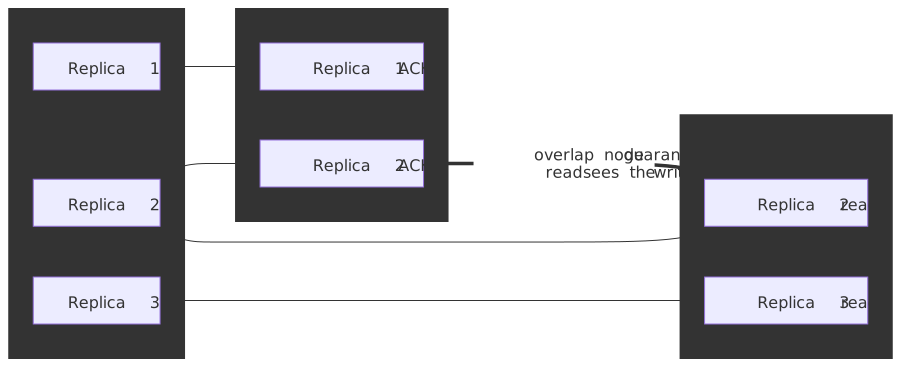
Caution
R + W > N only guarantees the latest acked write is visible. It does not give you linearizability: two clients writing concurrently can both succeed against overlapping but distinct quorums, leaving the system with siblings that are surfaced to the next reader. Conflict resolution (vector clocks or LWW) is what closes that gap.
Consistency Levels (Cassandra Model)
| Level | Nodes contacted | Use case |
|---|---|---|
| ONE | 1 | Lowest latency, highest availability |
| QUORUM | ⌊N/2⌋ + 1 | Standard consistency |
| LOCAL_QUORUM | ⌊local_N/2⌋ + 1 | Cross-DC deployments |
| ALL | N | Strongest consistency, lowest availability |
Operational guidance:
- Use QUORUM for most operations
- Use LOCAL_QUORUM for latency-sensitive cross-DC reads
- Avoid ALL in production (single node failure blocks operations)
- ONE is acceptable for time-series data where some loss is tolerable
Sloppy Quorum and Hinted Handoff
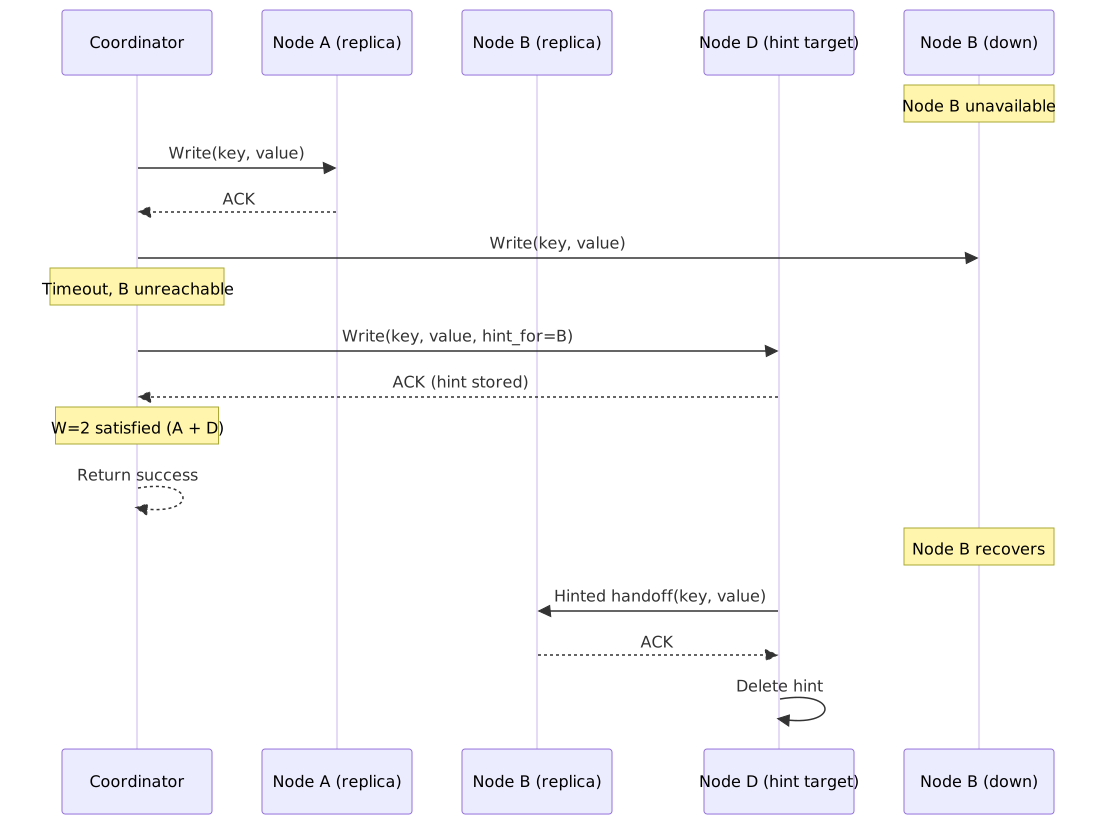
Problem: Strict quorum requires W of the N designated replicas to acknowledge. If one is down and you only have N-1 reachable replicas, a W = N-1 write still works; if W = N, the write fails.
Dynamo’s sloppy quorum: when a designated replica is unreachable, the coordinator writes to the next healthy node on the ring with a “hint” to forward later, and counts that write toward W.1 Availability wins; the trade-off is that the temporary holder is not in the read preference list, so a subsequent read may miss the write.
Important
Cassandra implements hinted handoff but uses strict quorum: hints are stored after the consistency level is satisfied and do not count toward W. The only level that lets a hint substitute for a real replica acknowledgment is CL=ANY, where any node in the cluster (including a hint holder) can satisfy the write.12 In other words, Cassandra’s QUORUM is closer to a strict quorum + best-effort backup than to Dynamo’s classic sloppy quorum.
Hint storage limits. Cassandra defaults max_hint_window to 3 hours (max_hint_window_in_ms = 10800000).12 Hints for replicas down longer than this are discarded; restoring consistency then requires full anti-entropy repair. This bound is what prevents unbounded hint accumulation during long outages — and is also why operators monitor the PendingHintsByEndpoint metric.
Trade-off. Sloppy quorum (Dynamo-style) improves availability but temporarily lifts the quorum guarantee. Strict quorum (Cassandra-style) preserves the guarantee at the cost of failing writes when too few designated replicas are reachable. Pick deliberately; both ship.
Conflict Detection and Resolution
The Concurrent Write Problem
Without a single leader, two clients can write to the same key simultaneously via different coordinators. Both writes may succeed (each reaching W replicas), but replicas now have different values.
Vector Clocks
Vector clocks track causal relationships between versions. Each write increments a (node, counter) pair, and the context a client sends with a write is the version it most recently observed.1
Initial state: {} (empty)Client A writes via Node1: [(Node1, 1)]Client B reads [(Node1, 1)], writes via Node2: [(Node1, 1), (Node2, 1)]Client C reads [(Node1, 1)], writes via Node3: [(Node1, 1), (Node3, 1)]Now we have concurrent versions: V1: [(Node1, 1), (Node2, 1)] - Client B's write V2: [(Node1, 1), (Node3, 1)] - Client C's writeNeither dominates the other -> SIBLINGS (concurrent)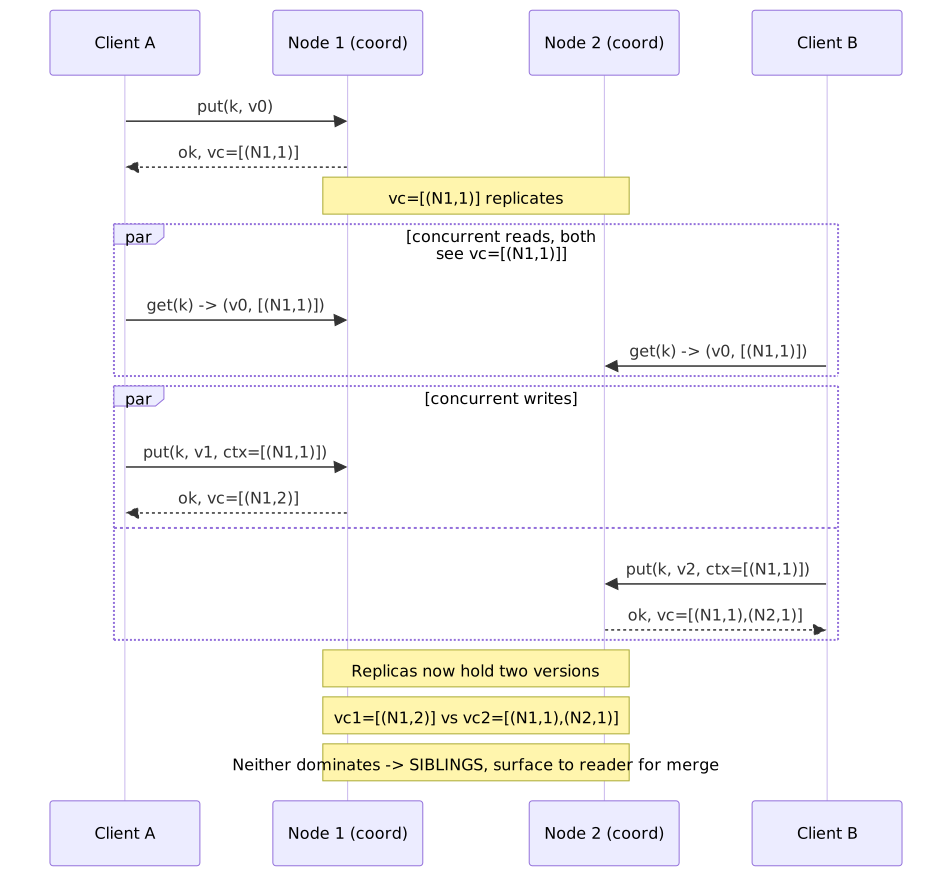
Detecting relationships:
- V1 dominates V2: every
(node, counter)in V2 is ≤ the corresponding entry in V1, and V1 has at least one strictly greater entry. Discard V2. - Concurrent (siblings): neither dominates. Return both versions.
Resolution strategies:
- Application-level merge. Return both versions to the client; the application merges (Dynamo’s classic shopping-cart example takes the union of items, which is why deleted items occasionally reappear under partition).1
- Last-Write-Wins (LWW). Use wall-clock timestamps, discard the older version.
- CRDTs. Use conflict-free data structures (counters, OR-sets, RGAs) that merge automatically; trades data-model flexibility for automatic convergence.13
Vector Clock Truncation
Vector clocks grow unboundedly as more coordinators write to a key. Dynamo truncates at a configurable threshold (the paper reports 10) by dropping the oldest (node, counter) pair based on the auxiliary timestamp it stores per entry.1
Risk: truncation can drop causal history and cause two causally-related versions to look concurrent, generating spurious siblings. Amazon’s paper reports this rarely produced visible problems in practice because most keys have a small set of recurring writers; “rarely” is doing a lot of work here, and Riak eventually moved to dotted version vectors14 to avoid the issue altogether.
Last-Write-Wins (LWW)
Cassandra resolves conflicts with microsecond client- or server-supplied timestamps instead of vector clocks. The cell with the highest timestamp wins; ties are broken by comparing the value bytes lexicographically.15
Write 1: value="A", timestamp=1000Write 2: value="B", timestamp=1001Resolution: value="B" wins (higher timestamp)Advantages. Simpler implementation, no vector-clock growth, constant per-cell metadata, and no sibling-merge plumbing for the application.
Risks. LWW assumes globally comparable timestamps, which assumes well-synced clocks. With NTP-typical skew of ~10 ms across cloud regions a “later” write can lose to an earlier one — silently. Daniel Abadi has called this “the great LWW lie” because the system will discard a more-recent write if its clock is behind.
Mitigation. Run NTP with tight synchronization (target sub-millisecond skew within a DC; ~10 ms cross-DC), prefer server-side timestamps unless you have a strong reason for client-side, and reach for a CRDT or a CP store when you cannot tolerate silent loss.16 Spanner’s TrueTime17 is the canonical example of bounded-skew clocks — it costs a hardware atomic-clock fleet, which is why most KV stores do not adopt it.
Failure Detection
Gossip Protocol
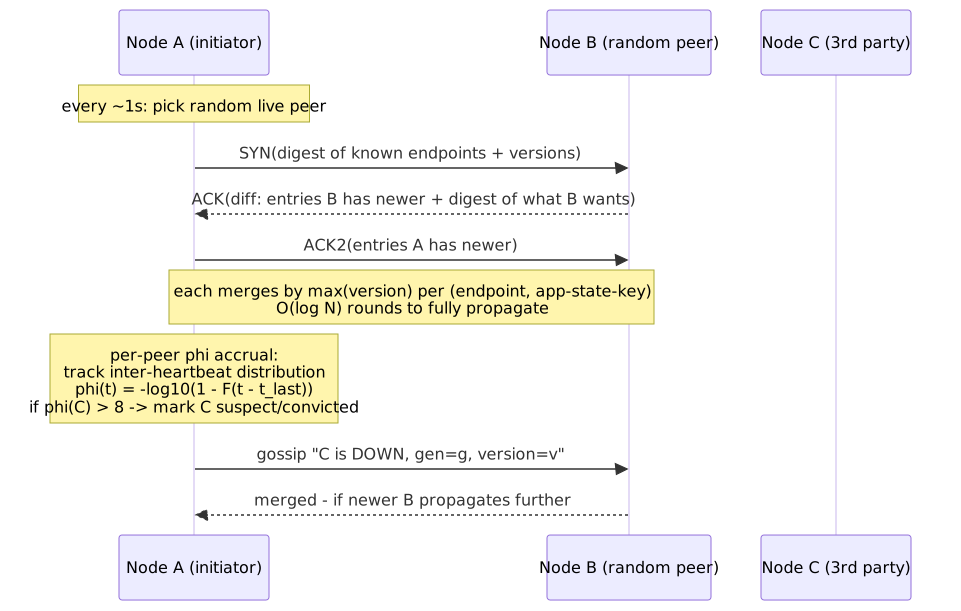
Nodes exchange state information periodically with random peers (epidemic-style). Information propagates exponentially — reaching all nodes in
Gossip protocol details:
- Every second, each node picks one (or a few) random peers.
- They exchange: membership list, heartbeat counters, schema version, application state.
- Merge received state with local state, picking the entry with the higher version per key.
Convergence. With n nodes, gossip reaches all nodes in roughly
Phi Accrual Failure Detector
Rather than a binary alive/dead signal, the φ-accrual detector6 outputs a continuous “suspicion level” (φ) based on the empirical distribution of inter-heartbeat arrival times:
where
Threshold configuration (phi_convict_threshold in cassandra.yaml, default 8):18
| φ threshold | Meaning | Use case |
|---|---|---|
| 5 | Aggressive detection | Low-latency networks |
| 8 | Default | Standard deployments |
| 10-12 | Conservative | AWS/cloud (network congestion) |
At φ = 8 with a 1-second heartbeat, a node has to be unresponsive for roughly 18 seconds before being convicted.19 That sounds slow; in practice it is what keeps a network blip in us-east-1 from cascading into a wave of replica failovers across thousands of nodes.
Why phi accrual over fixed timeout? Fixed timeouts have to be tuned per environment and break when the environment changes (autoscaling, region, time-of-day load). Phi accrual adapts to the observed per-peer distribution, so the same threshold ports across very different latency profiles.
Anti-Entropy Mechanisms
Merkle Trees for Replica Synchronization
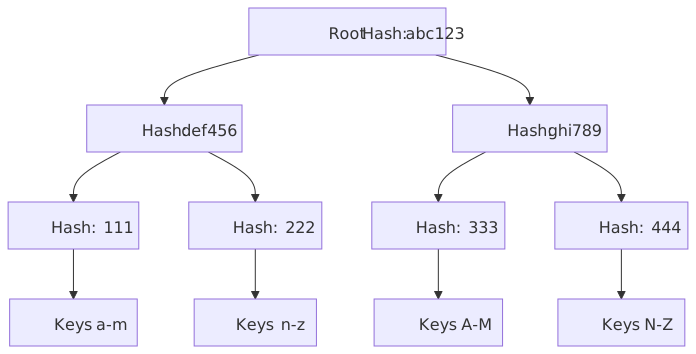
Merkle trees enable efficient comparison of large datasets. Each leaf is a hash of a data range; internal nodes are hashes of children.
Synchronization algorithm:
- Compare root hashes between replicas
- If equal: replicas are identical
- If different: recursively compare child hashes
- Only exchange data for leaf nodes with different hashes
Efficiency: Synchronization is O(log n) comparisons, transferring data proportional to differences rather than total size.
Riak’s implementation: Maintains persistent on-disk Merkle trees, regenerated weekly by default. Real-time updates to trees occur as writes happen.
Read Repair
When a read returns divergent values from replicas, the coordinator triggers repair:
- Determine winning value (latest vector clock or timestamp)
- Asynchronously write winning value to stale replicas
- Return result to client (doesn’t block on repair)
Configuration. Cassandra historically used dclocal_read_repair_chance = 0.1 (10% of reads opportunistically trigger repair). Both read_repair_chance and dclocal_read_repair_chance were removed in Cassandra 4.0 (CASSANDRA-13910); read repair is now controlled at the table level via the read_repair option (BLOCKING or NONE).20
Full Anti-Entropy Repair
Background process that:
- Builds Merkle tree for each token range
- Compares with replica Merkle trees
- Streams missing/divergent data
Frequency. Run within gc_grace_seconds (default 864000 = 10 days in Cassandra)21 to prevent zombie data resurrection: a node missing the original delete will resurrect the row once the tombstone is GC’d elsewhere if it is not repaired in time.
Storage Engine: LSM Tree
Why LSM Tree for Write-Heavy Workloads
LSM (Log-Structured Merge) trees convert random writes to sequential I/O:
- All writes go to in-memory buffer (memtable)
- When full, memtable flushes to immutable on-disk file (SSTable)
- Background compaction merges SSTables
Trade-off comparison:
| Aspect | LSM Tree | B-Tree |
|---|---|---|
| Write amplification | 10-30x (compaction) | 2-4x (page splits) |
| Read amplification | Higher (multiple SSTables) | Lower (single tree) |
| Space amplification | Lower (no fragmentation) | Higher (50-67% page fill) |
| Write throughput | Higher (sequential I/O) | Lower (random I/O) |
| Read latency | Higher (bloom filters help) | Lower (single lookup) |
Write Path Details
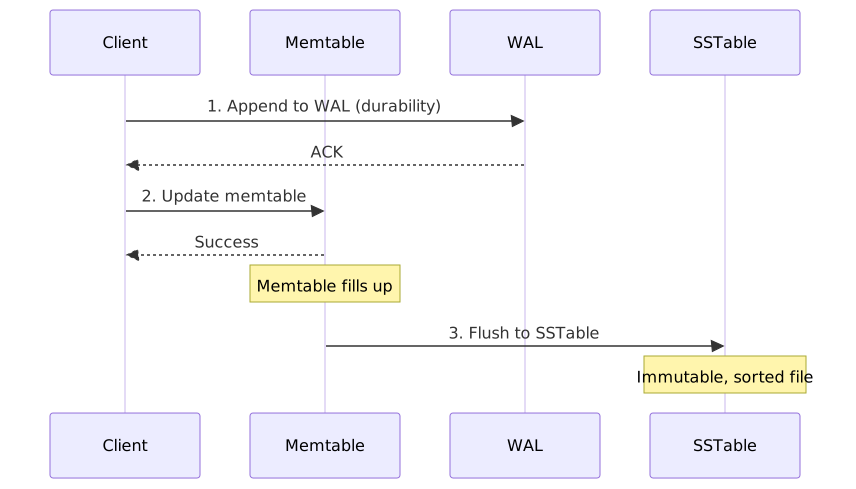
Memtable sizing. Cassandra allocates roughly 1/4 of the JVM heap to memtables by default (memtable_heap_space_in_mb).18 Larger memtables cut flush frequency (fewer SSTables, less compaction pressure) but increase replay time on restart and risk OOM if you also keep a large bloom-filter / row-cache footprint.
Read Path Details
- Check the memtable (in-memory; fastest hit).
- For each SSTable, newest to oldest, consult the bloom filter; skip if it answers “definitely not present”.
- On a “maybe”, read the partition index, then the data block.
- Merge versions across SSTables and return the newest (or surface siblings).
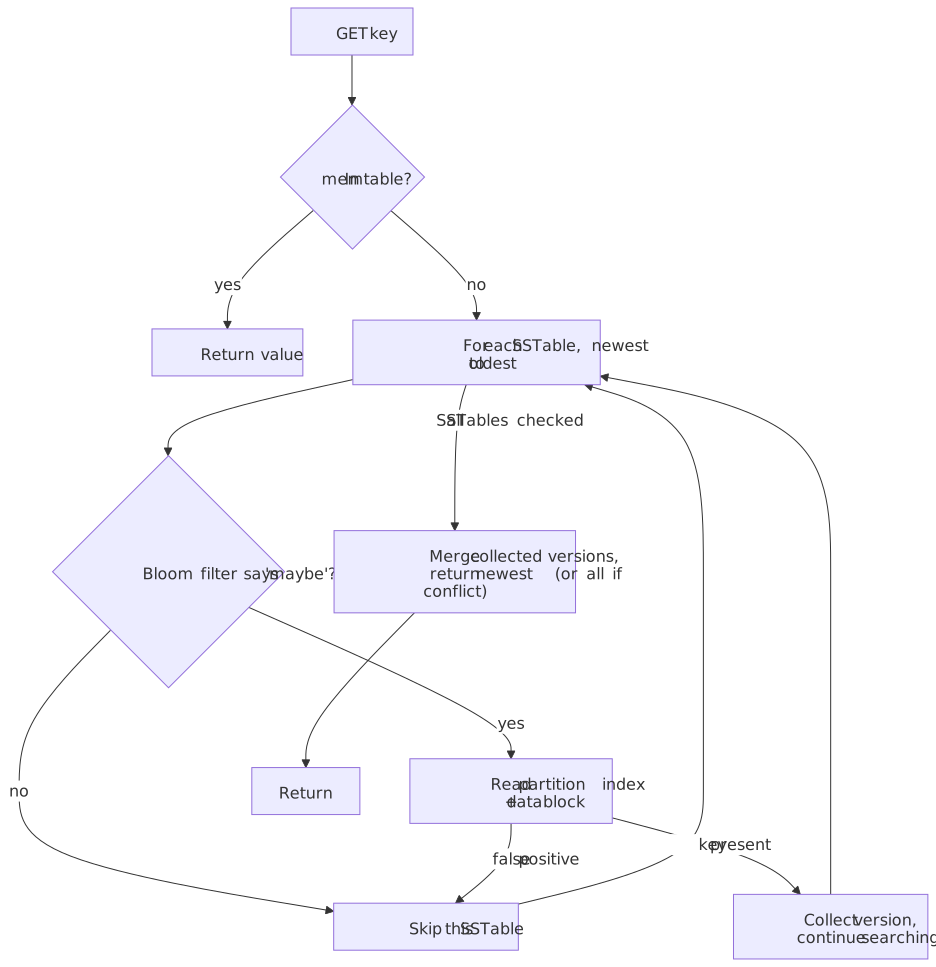
Bloom filter tuning. Cassandra defaults bloom_filter_fp_chance to 0.01 (1% false positive rate), which costs roughly fp_chance cuts false-positive disk reads at the cost of bloom-filter memory; for cold tables you can raise it (e.g., 0.1) and trade a few extra reads for a lot less RAM.
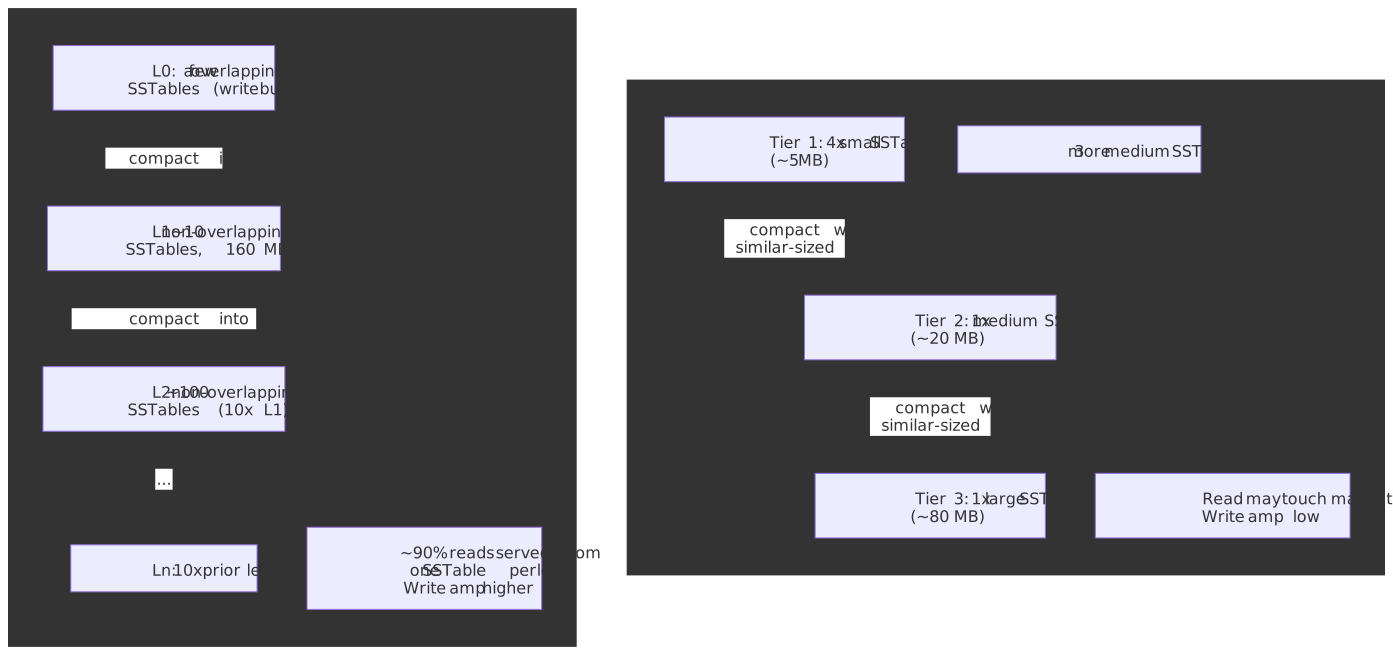
Compaction Strategies
Compaction merges SSTables to:
- Reclaim space from deleted/overwritten keys
- Reduce read amplification (fewer files to check)
- Enforce tombstone expiration
Strategy comparison:
| Strategy | SSTable sizing | Read amp | Write amp | Best for |
|---|---|---|---|---|
| Size-Tiered (STCS) | Variable buckets | Higher | Lower | Write-heavy |
| Leveled (LCS) | Fixed 160MB | Lower | Higher | Read-heavy |
| Time-Window (TWCS) | Time buckets | Moderate | Low | Time-series + TTL |
STCS mechanics. Groups SSTables of similar size into buckets. When a bucket contains min_threshold (default 4) files, they are compacted into one larger file.23 Read amplification grows because a single key can live in multiple tiers; write amplification stays low because each row is rewritten only when its tier compacts.
LCS mechanics. Organizes SSTables into levels (L0, L1, L2, …). Each level holds non-overlapping SSTables of sstable_size_in_mb (default 160 MB), and each level is roughly 10× larger than the previous. The non-overlapping invariant means ~90% of reads touch at most one SSTable per level, dramatically reducing read amplification at the cost of higher write amplification (~10× of STCS in the worst case).24
Note
Cassandra 5.0 (Sep 2024) ships Unified Compaction Strategy (UCS), an adaptive strategy that subsumes STCS, LCS, and TWCS via a single scaling_parameters knob (e.g. T4 mimics STCS, L10 mimics LCS) plus density-based sharding for parallel compactions.25 STCS remains the default in 5.0 for backwards compatibility, but UCS is the recommended target for new tables — it removes the up-front “pick a strategy and live with it” decision that this section documents.
API Design
Core Operations
PUT /kv/{key}Content-Type: application/octet-streamX-Consistency-Level: QUORUMX-Client-Timestamp: 1699900000000<binary value>HTTP/1.1 201 CreatedX-Version: [(node1,5),(node2,3)]GET /kv/{key}X-Consistency-Level: QUORUMHTTP/1.1 200 OKX-Version: [(node1,5),(node2,3)]<binary value>GET /kv/{key}X-Consistency-Level: QUORUMHTTP/1.1 300 Multiple ChoicesContent-Type: multipart/mixed; boundary=siblings--siblingsX-Version: [(node1,5),(node2,3)]<value A>--siblingsX-Version: [(node1,4),(node3,2)]<value B>--siblings--DELETE /kv/{key}X-Consistency-Level: QUORUMHTTP/1.1 204 No ContentPagination for Key Listing
GET /kv?prefix=user:&limit=100&cursor=dXNlcjo1MDA=HTTP/1.1 200 OKContent-Type: application/json{ "keys": ["user:501", "user:502", "..."], "next_cursor": "dXNlcjo2MDA=", "has_more": true}Error Responses
| Status | Meaning |
|---|---|
| 400 | Invalid key (too long, invalid characters) |
| 404 | Key not found |
| 409 | Write conflict (for conditional writes) |
| 503 | Insufficient replicas available for requested consistency |
| 504 | Timeout waiting for replica responses |
Infrastructure Design
Cloud-Agnostic Components
| Component | Purpose | Options |
|---|---|---|
| Compute | Node processes | VMs, containers, bare metal |
| Block storage | SSTable persistence | Local SSD, network SSD |
| Object storage | Backups, cold tier | S3-compatible |
| Load balancer | Client distribution | HAProxy, cloud LB |
| Service discovery | Node membership | Gossip (built-in), Consul |
AWS Reference Architecture
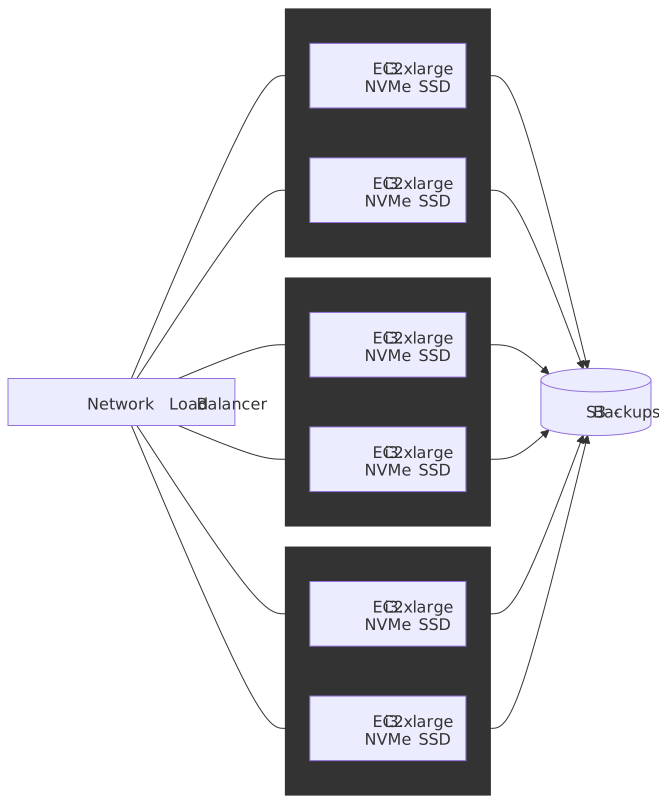
Instance selection (specs per AWS EC2 instance-type docs):
| Instance | Storage | Memory | Use case |
|---|---|---|---|
| i3.xlarge | 1× 950 GB NVMe SSD | 30.5 GB | Standard nodes |
| i3.2xlarge | 1× 1.9 TB NVMe SSD | 61 GB | High-capacity nodes |
| r5.xlarge + gp3 | EBS | 32 GB | Lower cost, higher and noisier latency |
Why i3 / i4i instances? Local NVMe gives consistent sub-millisecond IOPS latency, which dominates p99 in a write-heavy LSM workload. EBS adds a network round-trip and is throttled per volume, so p99 grows under bursts even when the instance has spare CPU. The newer i4i family is the modern recommendation for Cassandra/ScyllaDB and trades the same trade-off with better $/GB.
Managed Alternatives
| Build vs Buy | Option | Trade-off |
|---|---|---|
| Self-hosted | Cassandra, ScyllaDB, Riak | Full control, operational burden |
| Managed | Amazon DynamoDB | No ops, vendor lock-in, cost at scale |
| Managed | Azure Cosmos DB | Multi-model, global distribution |
| Managed | DataStax Astra | Managed Cassandra, Cassandra compatibility |
Note
DynamoDB ≠ Dynamo paper. Despite the name, AWS DynamoDB has diverged significantly from the 2007 Dynamo design. The 2022 USENIX ATC paper “Amazon DynamoDB: A Scalable, Predictably Performant, and Fully Managed NoSQL Database Service”8 documents the current architecture: Multi-Paxos-based replication with a partition leader, strong consistency as a per-request option, transactional API, and an autoadmin control plane. The Dynamo lineage in this article (leaderless, sloppy/strict quorums, vector clocks) maps to Cassandra and Riak today, not to current DynamoDB.
Conclusion
Designing a distributed key-value store requires explicit CAP positioning. This design chose AP (availability + partition tolerance) with tunable consistency, following the Dynamo lineage:
Key architectural decisions:
- Consistent hashing with vnodes for incremental scaling and load distribution.
- Quorum replication (N = 3, R = W = 2 default) for per-call consistency tuning.
- Strict quorum + hinted handoff (Cassandra-style) for availability during transient failures, with sloppy quorum (Dynamo-style) as an alternative when availability outranks consistency.
- LWW timestamps for conflict resolution by default (simpler than vector clocks, but only safe with tightly-synced clocks); vector clocks or CRDTs when silent loss is unacceptable.
- LSM-tree storage for write-optimized performance, with bloom filters and compaction strategy chosen against the read/write mix.
What this design sacrifices:
- Strong consistency (use etcd/Consul if required)
- Range queries (add secondary index or use ordered storage like Bigtable)
- Multi-key transactions (requires coordination, changes CAP position)
When to choose this design:
- Session stores, shopping carts, user preferences
- Cache layers with persistence
- Time-series data (with TWCS compaction)
- Any workload where availability > consistency
Appendix
Prerequisites
- Distributed systems fundamentals: CAP theorem, consistency models
- Storage concepts: B-trees, write-ahead logging, compaction
- Networking: gossip protocols, failure detection
Terminology
| Term | Definition |
|---|---|
| Consistent hashing | Hash function mapping keys and nodes to a ring, minimizing key movement on topology changes |
| Vector clock | List of (node, counter) pairs tracking causal ordering between versions |
| Quorum | Minimum replicas (R or W) that must respond for an operation to succeed |
| Sloppy quorum | Dynamo-style: quorum satisfied by any healthy nodes, including substitutes outside the preference list. Cassandra’s QUORUM is strict — see “Sloppy Quorum” section. |
| Hinted handoff | Temporary storage of writes for unavailable replicas, forwarded on recovery |
| SSTable | Sorted String Table—immutable, sorted key-value file on disk |
| Memtable | In-memory buffer for recent writes, flushed to SSTables periodically |
| Compaction | Background process merging SSTables to reclaim space and reduce read amplification |
| Tombstone | Marker indicating a deleted key, expires after gc_grace_seconds |
| Anti-entropy | Background synchronization to repair replica divergence |
Summary
- Distributed KV stores sit on a CAP spectrum: AP (Dynamo model) vs CP (Raft model)
- Consistent hashing + vnodes enables horizontal scaling with minimal data movement
- Quorum replication (R + W > N) provides tunable consistency
- Conflict resolution via vector clocks (causal tracking) or LWW (timestamp-based)
- Gossip + phi accrual failure detector maintains cluster membership
- LSM-tree storage optimizes write throughput; compaction strategy choice depends on workload
- Sloppy quorum + hinted handoff + Merkle tree repair ensure eventual convergence
References
- Amazon Dynamo Paper (SOSP 2007) — original Dynamo design, sloppy quorum, vector clocks.
- Amazon DynamoDB (USENIX ATC 2022) — current DynamoDB architecture; Multi-Paxos, leader-based.
- Apache Cassandra documentation —
cassandra.yaml, hints, repair, compaction strategies. - Apache Cassandra: dynamo / partitioning architecture — Cassandra’s adaptation of the Dynamo design.
- Google Bigtable Paper (OSDI 2006) — origin of the SSTable format.
- Raft Consensus Paper — leader-based consensus for CP KV stores.
- Redis Cluster Specification — hash-slot partitioning as an alternative to consistent hashing.
- etcd architecture overview — Raft-based KV store.
- Riak documentation — active anti-entropy, dotted version vectors.
- The Log-Structured Merge-Tree (O’Neill et al., 1996) — original LSM-tree paper.
- Karger et al., “Consistent Hashing and Random Trees” (STOC 1997) — foundational consistent-hashing result.
- Hayashibara et al., “The φ Accrual Failure Detector” (SRDS 2004).
- Demers et al., “Epidemic Algorithms for Replicated Database Maintenance” (PODC 1987).
- Shapiro et al., “Conflict-free Replicated Data Types” (INRIA tech report, 2011).
- LSM Tree vs B-Tree Analysis (TiKV) — storage engine trade-offs.
Footnotes
-
DeCandia et al., Dynamo: Amazon’s Highly Available Key-value Store, SOSP 2007. ↩ ↩2 ↩3 ↩4 ↩5 ↩6
-
Brewer, Towards Robust Distributed Systems, PODC 2000 keynote. ↩
-
Gilbert and Lynch, Brewer’s Conjecture and the Feasibility of Consistent, Available, Partition-Tolerant Web Services, SIGACT 2002. ↩
-
Karger et al., Consistent Hashing and Random Trees, STOC 1997. ↩ ↩2
-
Demers et al., Epidemic Algorithms for Replicated Database Maintenance, PODC 1987. ↩ ↩2
-
Hayashibara, Defago, Yared, Katayama, The φ Accrual Failure Detector, SRDS 2004. ↩ ↩2
-
O’Neill et al., The Log-Structured Merge-Tree (LSM-Tree), Acta Informatica 1996. ↩
-
Elhemali et al., Amazon DynamoDB: A Scalable, Predictably Performant, and Fully Managed NoSQL Database Service, USENIX ATC 2022. ↩ ↩2
-
TheLastPickle, The Impacts of Changing the Number of VNodes in Apache Cassandra, 2021. ↩
-
Apache Cassandra docs, Data modeling — partition size guidelines; AWS re:Post, Identifying and Resolving Hot Partition Issues in Amazon Keyspaces. ↩
-
AWS docs, DynamoDB burst and adaptive capacity; AWS Database Blog, Scaling DynamoDB: How partitions, hot keys, and split for heat impact performance. ↩
-
Apache Cassandra docs, Hinted Handoff. ↩ ↩2
-
Shapiro, Preguiça, Baquero, Zawirski, Conflict-free Replicated Data Types, INRIA RR-7687, 2011. ↩
-
Preguiça, Baquero, Almeida et al., Brief Announcement: Efficient Causality Tracking in Distributed Storage Systems with Dotted Version Vectors, DAIS 2012. ↩
-
Apache Cassandra docs, Storage engine: write path. ↩
-
Abadi, The dangers of replication and a solution, 2020 — caveats on LWW under clock skew. ↩
-
Corbett et al., Spanner: Google’s Globally-Distributed Database, OSDI 2012. ↩
-
Apache Cassandra docs,
cassandra.yamlconfiguration. ↩ ↩2 -
Digitalis, Understanding
phi_convict_thresholdin Apache Cassandra. ↩ -
CASSANDRA-13910 — Remove
read_repair_chance/dclocal_read_repair_chance. ↩ -
Apache Cassandra docs, Compaction and tombstones. ↩
-
Apache Cassandra docs, Bloom filters. ↩
-
Apache Cassandra docs, Size-Tiered Compaction Strategy. ↩
-
Apache Cassandra docs, Leveled Compaction Strategy. ↩
-
Apache Cassandra docs, Unified Compaction Strategy (UCS); see also the Apache Cassandra 5.0 UCS feature post. ↩