Sharded Counters
A counter is a single number that goes up. At interview-board scale that is one row, one mutex, one cache key. At production scale it is a hot key that absorbs every retry storm, every viral spike, and every replication queue your storage layer can produce. The fix is mechanical: split the one number across many physical keys, then learn to live with what that buys you and what it costs.
This article is a working reference for senior engineers who already know what a counter is and now have to choose a sharding strategy, an aggregation strategy, and a consistency model that matches a specific business need. It treats the counter problem as three orthogonal axes — shard layout, aggregation timing, and consistency model — and uses production architectures (Firestore, DynamoDB, Netflix, Meta TAO, Twitter Manhattan) as forcing functions for each decision.
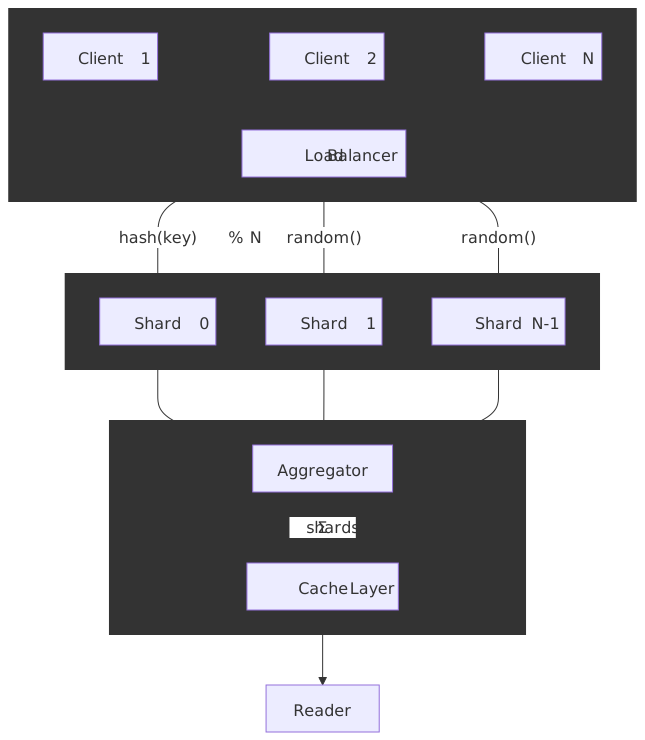
Mental model
Three axes, picked independently, define your counter:
- Shard layout — how a write is mapped to a physical key. Random, hash-based, or time-bucketed.
- Aggregation timing — when N shard values become one displayed total. Synchronous on read, asynchronous in a rollup job, or a hybrid that mixes pre-rollup with a live tail.
- Consistency model — what a reader is guaranteed to see and what the system gives up to provide it. Strong (linearizable) vs. eventual.
A fourth, sometimes-applicable axis is representation: keep an exact integer, accept a probabilistic estimate (HyperLogLog for cardinality, Count-Min Sketch for frequency), or use a convergent replicated data type (CRDT) such as a G-Counter or PN-Counter that lets independent replicas merge their states deterministically without coordination. Each representation changes the cost model — probabilistic structures trade bounded error for sub-linear space; CRDTs trade per-replica state growth for coordination-free writes.
Important
Sharding is a contention fix, not a consistency fix. Splitting one row into N rows does nothing for cross-row atomicity, double-counting under retry, or replication lag. Pick the shard layout for write throughput; pick the aggregation strategy and consistency model for everything else.
Why a single counter melts
A “counter” in any modern database compiles down to a serialized mutation on a single replicated key, and every storage system caps how fast that key can be safely updated.
- Cloud Firestore documents an architectural ceiling around one sustained write per second per document, and the official remediation is the Distributed counters pattern — N shard documents whose values you sum on read.1
- Amazon DynamoDB caps each physical partition at 1,000 WCU/sec and 3,000 RCU/sec. Adaptive capacity rebalances hot partitions but cannot break that ceiling for a single item; the AWS guidance is write sharding by suffixing the partition key.23
- Apache Cassandra is famously linear-scalable for upserts, but its counter columns are not idempotent and require a
read-before-writeround-trip, which collapses throughput by roughly two orders of magnitude relative to ordinary writes and has burned production teams.4 - Redis can sustain ~100K+ ops/sec for
INCRon a single instance with sub-millisecond latency, but it executes commands single-threaded — one key is still served by one CPU core at a time.5
The numbers vary by an order of magnitude, but the shape is the same: per-key throughput is bounded, and once the application crosses that bound the system stops failing gracefully. Writes back up, retries amplify, and the surrounding p99 collapses.
| Storage | Single-key sustained write ceiling | Notes |
|---|---|---|
| Firestore document | ~1/sec sustained | Architectural; pattern is shards subcollection |
| DynamoDB partition | 1,000 WCU/sec (3,000 RCU/sec) | Hard per-partition cap; adaptive capacity helps |
| Cassandra (regular) | ~7K–10K ops/sec/node (workload-dependent) | Linear-scalable horizontally |
| Cassandra (counter) | One-to-two orders of magnitude lower than regular writes | Read-before-write semantics |
| Redis (single key) | ~100K ops/sec | Single-threaded command execution; pipeline helps |
The “linear with shard count” approximation is real but optimistic. You also pay for the read path, the rollup pipeline, and the operational machinery to keep N shards healthy.
Axis 1: Shard layout
Random sharding
Pick a shard uniformly on each write. Trivially uniform with sufficient traffic, no per-write coordination, no rebalance cost.
def increment(counter_id: str, value: int = 1) -> None: shard_id = random.randint(0, NUM_SHARDS - 1) db.increment(f"{counter_id}:shard:{shard_id}", value)- Best for: general-purpose counters where the writer identity is irrelevant and approximate uniformity is “good enough”.
- Buys you: trivial implementation, no skew under high traffic, easy to add shards.
- Costs you: every read fans out to all N shards (no caching shortcut by writer identity), and low-traffic counters skew badly because uniform-at-the-limit is not uniform at low N.
This is the layout Firestore explicitly recommends in its distributed-counter sample.1
Hash-based sharding
Map a stable attribute — user ID, IP, session — to a shard via hash(attr) % N.
def increment(counter_id: str, client_id: str, value: int = 1) -> None: shard_id = hash(client_id) % NUM_SHARDS db.increment(f"{counter_id}:shard:{shard_id}", value)- Best for: per-client rate limiting (each client’s increments stay on one shard, so its own counter is a single read), and any case where the attribute distribution is genuinely flat.
- Buys you: deterministic mapping enables localised reads — the rate-limit decision for one client is one shard read, not N.
- Costs you: any skew in the attribute (Pareto distributions, viral content, celebrity accounts) is preserved exactly. Resharding requires either consistent hashing or an offline migration. Hot shards reappear at scale.
Time-based sharding
Bucket writes by wall-clock window: key:YYYY-MM-DDTHH. The active window is hot; old windows freeze and can be compacted into a single value.
def increment(counter_id: str, value: int = 1) -> None: window = current_window() shard_id = random.randint(0, SHARDS_PER_WINDOW - 1) db.increment(f"{counter_id}:{window}:shard:{shard_id}", value)- Best for: time-series analytics, windowed dashboards, anything where the natural query is “how many in the last X minutes” rather than “how many ever”.
- Buys you: bounded active-shard count, natural compaction story, easy TTL.
- Costs you: cross-window aggregation is non-trivial, and you now depend on time synchronization across writers (clock skew is a category of bug here).
Twitter’s Manhattan exposes a dedicated Timeseries Counters service for exactly this pattern — millions of increments per second for observability metrics, with windowed retention built in.6
Decision matrix: shard layout
| Factor | Random | Hash-based | Time-based |
|---|---|---|---|
| Implementation complexity | Low | Medium | High |
| Write distribution | Even (at scale) | Sensitive to attribute | Even per window |
| Read amortization | None | Per-attribute locality | Per-window caching |
| Resharding cost | Trivial | High (rehash) | Per-window cohort |
| Default fit | General counters | Per-client metrics | Analytics with TTL |
Axis 2: Aggregation timing
Synchronous fan-in
Read all N shards on every query, sum, return. Exact, slow, simple.
def get_count(counter_id: str) -> int: return sum( db.get(f"{counter_id}:shard:{i}") or 0 for i in range(NUM_SHARDS) )- Latency: O(N) database reads per query.
- Accuracy: exact under linearizable single-shard reads.
- Failure mode: any unavailable shard forces a choice — fail the read or return a known-incomplete value. Make this choice explicit; do not let it default into “silently wrong”.
- Use when: N is small, accuracy is non-negotiable, the read rate is low (financial reconciliation, inventory audit).
Asynchronous rollup
A background worker periodically sums all shards into a single cached total. Reads hit cache.
def rollup(counter_id: str) -> None: total = sum_all_shards(counter_id) # O(N) once per interval cache.set(f"{counter_id}:total", total, ttl=2 * ROLLUP_INTERVAL)def get_count(counter_id: str) -> int: cached = cache.get(f"{counter_id}:total") if cached is not None: return cached return sum_all_shards(counter_id) # always-on fallback- Latency: O(1) cache read on the hot path.
- Accuracy: stale by up to one rollup interval (plus rollup duration).
- Failure mode: rollup lag drifts unboundedly when the worker can’t keep up; cache eviction throws traffic onto the slow path; reads can appear non-monotonic if rollup batches process out of order.
- Use when: read rate dominates, staleness on the order of seconds is acceptable (likes, view counts, public dashboards).
Hybrid: pre-rollup plus live tail
Maintain a rolled-up total and an event log of mutations since the last rollup. Reads return pre_rollup + sum(events_since_last_rollup). This is the structure Netflix’s counter abstraction uses for its “Accurate Global Counter” mode.78
- Latency: O(1) typical, O(K) where K is the live tail length.
- Accuracy: bounded by event-log durability and the rollup window.
- Failure mode: dual write/read paths double the operational surface — both the cache and the event log have to be healthy; replay logic has to be idempotent.
- Use when: you need real-time-ish accuracy without paying the synchronous fan-in cost on every read.
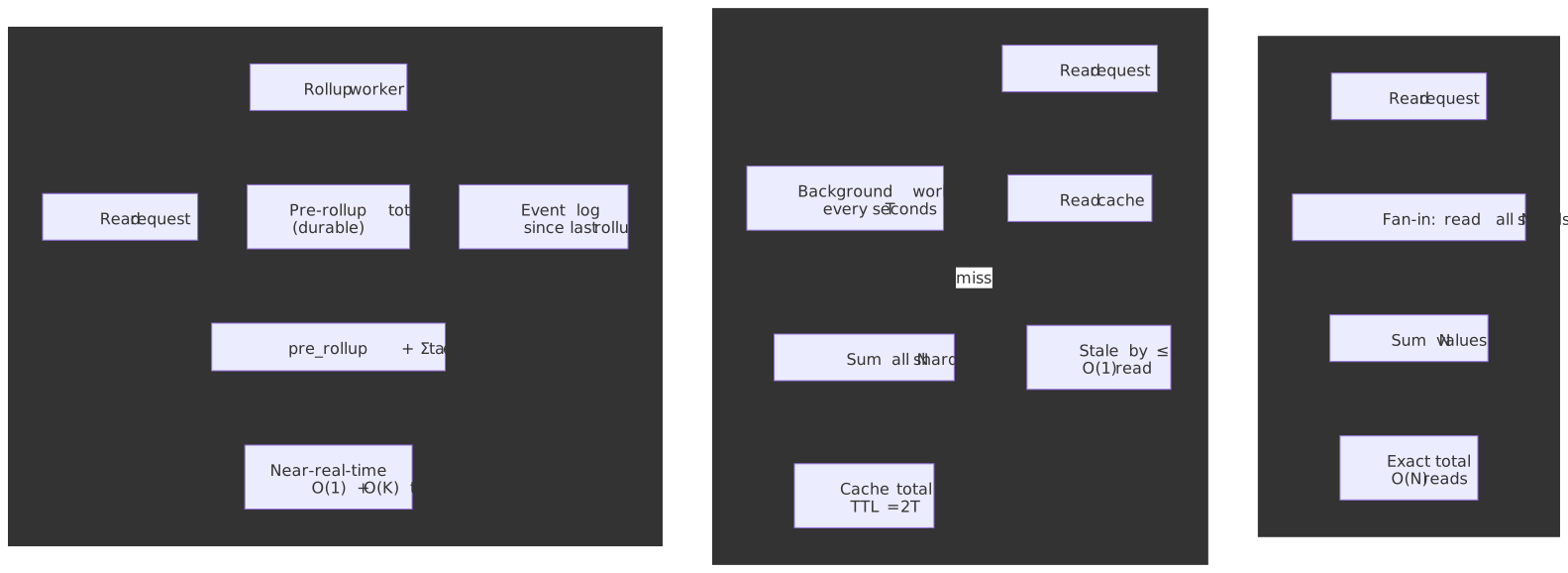
Decision matrix: aggregation
| Factor | Synchronous | Async rollup | Hybrid |
|---|---|---|---|
| Read latency | O(N) shard reads | O(1) cache read | O(1) cache + O(K) tail |
| Accuracy | Exact | Stale by ≤ T | Configurable; near-real-time |
| Operational deps | DB only | DB + cache + worker | DB + cache + event log + worker |
| Best for | Financial | Social metrics | Mixed accuracy/latency requirements |
Axis 3: Consistency model
The third axis is the one that most often gets picked by accident. Write it down.
Strong consistency
Every successful read returns the result of the most recent successful write. Implementations require a write quorum that overlaps with the read quorum and (in practice) consensus — Paxos, Raft, or single-leader replication. The cost is real:
- Write latency is bounded by the slowest required replica acknowledgement.
- Availability degrades during partitions because the system refuses to serve from a minority.
- Read-side caching is constrained — caches must be invalidated synchronously or bypassed for strong reads.
Use when the application semantics literally cannot tolerate a stale or lost increment: bank balance, ledger entry, hard rate-limit enforcement, inventory decrement.
Eventual consistency
Given no further updates, replicas converge. Reads may return stale values. Writes are acknowledged locally and propagated asynchronously. This is the default for almost every social-graph workload because the cost of strong consistency at that scale is unacceptable.
Note
Eventual consistency does not mean “no guarantees”. Useful systems layer per-session monotonicity, read-your-writes, and bounded-staleness guarantees on top of eventual replication. Match the guarantee to the user-visible expectation.
Use when the user-visible value is a count whose absolute correctness has no business meaning at the second-by-second timescale — like counts, view counts, follower counts, public engagement metrics.
Why TAO chose availability
Meta’s TAO is the canonical case. The original 2013 USENIX paper describes TAO as serving the social graph at a billion reads per second and millions of writes per second across geographically distributed clusters, and explicitly states: “It has a minimal API and explicitly favors availability and per-machine efficiency over strong consistency.”9 Meta’s own engineering write-up phrased the same trade-off more bluntly:
For many of our products, TAO losing consistency is a lesser evil than losing availability.10
The reasoning is concrete: a user looking at a like count tolerates a stale number; the same user does not tolerate the app failing to load. Counter design at TAO-scale is downstream of that single editorial decision.
Consistency-by-use-case
| Use case | Consistency | Reason |
|---|---|---|
| Bank balance, ledger | Strong | A lost increment is a financial loss |
| Inventory decrement | Strong | Double-sell risk |
| Hard API quota enforcement | Strong | Quota overshoot has billing or abuse impact |
| Like / view / share counts | Eventual | Staleness is invisible to humans |
| Analytics dashboards | Eventual | Aggregations dominate; staleness expected |
| Soft rate limits / spam scoring | Eventual | False positives matter more than precision |
Probabilistic counting
When the question is “how many distinct things” or “how often does X appear” rather than “what is the exact integer”, probabilistic data structures change the economics by orders of magnitude. The common ones in production are HyperLogLog (cardinality) and Count-Min Sketch (frequency).
HyperLogLog
HyperLogLog estimates the cardinality of a multiset by tracking the maximum number of leading zeros across hashed elements — the intuition is that observing a hash with
The single most useful production property is mergeability: sketches built independently on different shards can be merged into a single sketch without loss of accuracy. This makes HLL the textbook solution for distributed cardinality estimation.
def global_unique_users() -> int: sketches = [node.fetch_hll("users") for node in nodes] return reduce(hll_merge, sketches).estimate()Meta’s HyperLogLog in Presto post is the canonical war story: replacing exact COUNT DISTINCT with APPROX_DISTINCT on internal analytics workloads cut a job that previously needed terabytes of memory and several days down to “12 hours and less than 1 MB of memory” with accuracy bounded by HLL’s standard error.13
When to use: distinct-visitor counting, distinct-query counting, cardinality estimation in any analytics pipeline. When not to use: when downstream code subtracts, divides, or chains many merges (errors compound).
Count-Min Sketch
Count-Min estimates per-item frequency in a stream. A Count-Min sketch is a d × w matrix of counters; every insert hashes the item with d independent hash functions and increments the corresponding cell in each row. Queries return the minimum across the d cells (which minimises overcounting from hash collisions).
The original Cormode/Muthukrishnan paper proved the canonical bound: with the sketch sized as
Like HLL, sketches are linear: CMS(stream_A) + CMS(stream_B) = CMS(stream_A ∪ stream_B). This makes Count-Min the natural choice for distributed heavy-hitter detection (top-K trending items), DDoS pattern detection, and recommendation co-occurrence.
Limitations to internalise:
- One-sided error (always over-estimates) — fine for “is this a heavy hitter?”, broken for any decision that needs an exact count.
- No native delete — subtract operations break the bound. Conservative-update and count-mean variants exist but trade off other properties.
- Tuning
and requires actual workload statistics, not guesses.
When to use which counter
| Requirement | Exact integer | HyperLogLog | Count-Min Sketch |
|---|---|---|---|
| Need an exact value | Yes | No | No |
| Counting distinct items | Expensive | Yes | No |
| Counting item frequency | Yes | No | Yes |
| Must support decrements | Yes | No | No (with caveats) |
| Memory-constrained | No | Yes | Yes |
| Distributed merge | Hard | Trivial | Trivial |
Convergent counters (CRDTs)
When the same logical counter is incremented concurrently in multiple replicas — multi-region active-active, edge clusters, or offline-first clients — coordination on every write is the wrong cost model. Conflict-free Replicated Data Types are the formal answer: data structures whose merge function is associative, commutative, and idempotent (a join-semilattice), so any two replicas that have observed the same set of operations converge to the same state regardless of order or duplication. Shapiro, Preguiça, Baquero, and Zawirski’s 2011 INRIA technical report RR-7506 is the comprehensive catalogue and remains the canonical reference.15
G-Counter (grow-only)
A G-Counter is a vector of per-replica counters: state[i] is the total of all increments performed at replica i. Increment is local — replica i sets state[i] += n. Merge is element-wise max. The aggregate value is Σ state[i]. Because every replica only ever increases its own slot and merge is max per slot, divergence is impossible and concurrent updates never lose work.
def increment(state: dict[str, int], replica_id: str, n: int = 1) -> None: state[replica_id] = state.get(replica_id, 0) + ndef merge(a: dict[str, int], b: dict[str, int]) -> dict[str, int]: return {k: max(a.get(k, 0), b.get(k, 0)) for k in a.keys() | b.keys()}def value(state: dict[str, int]) -> int: return sum(state.values())PN-Counter (positive + negative)
A PN-Counter pairs two G-Counters — P for increments, N for decrements — so the value is Σ P[i] - Σ N[i]. This is the standard CRDT counter when the application needs both directions; storing increments and decrements separately preserves the join-semilattice property (max does not commute with subtraction).
Production: Redis Active-Active CRDB
Redis Enterprise’s Active-Active geo-replicated databases ship CRDT-backed types directly, including a counter type whose semantics match a PN-Counter; conflict resolution under concurrent writes across regions is automatic and lossless rather than last-writer-wins. Redis publishes the Active-Active concepts page and an explicit developing with CRDB counters guide as the operational references.1617 The same engineering team published an SOSP-style overview, Under the hood of Redis CRDTs, describing the operation-based variants used internally.18
Trade-offs
- Buys you: coordination-free writes across replicas; concurrent increments are never lost; merges are deterministic and require no consensus or vector-clock reconciliation.
- Costs you: state size grows with the number of replicas (one counter per replica per logical entity), so high-fan-out edge deployments inflate per-key bytes; reads must aggregate across the per-replica vector; PN-Counters cannot represent the intent of a “set to zero” operation, only the net difference.
- Use when: multi-region active-active, edge or offline-first clients, IoT fleets — anywhere the cost of inter-replica coordination on every write is unacceptable and last-writer-wins would silently drop increments.
Note
CRDT counters and sharded counters compose: a CRDT counter can itself be sharded across keys within a single replica to push past per-key throughput limits, and a sharded counter can use CRDT semantics across regions to eliminate cross-region coordination. The two patterns address different problems — local hot-key contention vs. cross-replica convergence — and can be applied independently.
Production architectures
Firestore distributed counters
Each counter is a parent document with a shards subcollection. Writes hit a uniformly random shard; reads sum the subcollection. The official sample includes a Cloud Function trigger that maintains a total field on the parent document so well-behaved clients read one document instead of N.1
counters/ {counter_id}/ # parent doc with metadata + rollup total shards/ shard-0 { count: 1234 } shard-1 { count: 5678 } ... shard-{N-1} { count: 9012 }The Firebase guide is explicit that you should size shards to match expected writes per second (e.g. 10 shards for ~10 writes/sec), not to peak traffic — over-sharding inflates read cost and Cloud Function invocations linearly.1
DynamoDB write sharding
The AWS pattern is to suffix the partition key with a small random or calculated value (metric#shard-7) on writes, then either fan-in on read or maintain a rollup item.3 Adaptive capacity will rebalance up to the per-partition ceiling but cannot exceed it; once the workload genuinely needs more than 1,000 WCU on a single logical entity, sharding is the only option.
Netflix Distributed Counter Abstraction
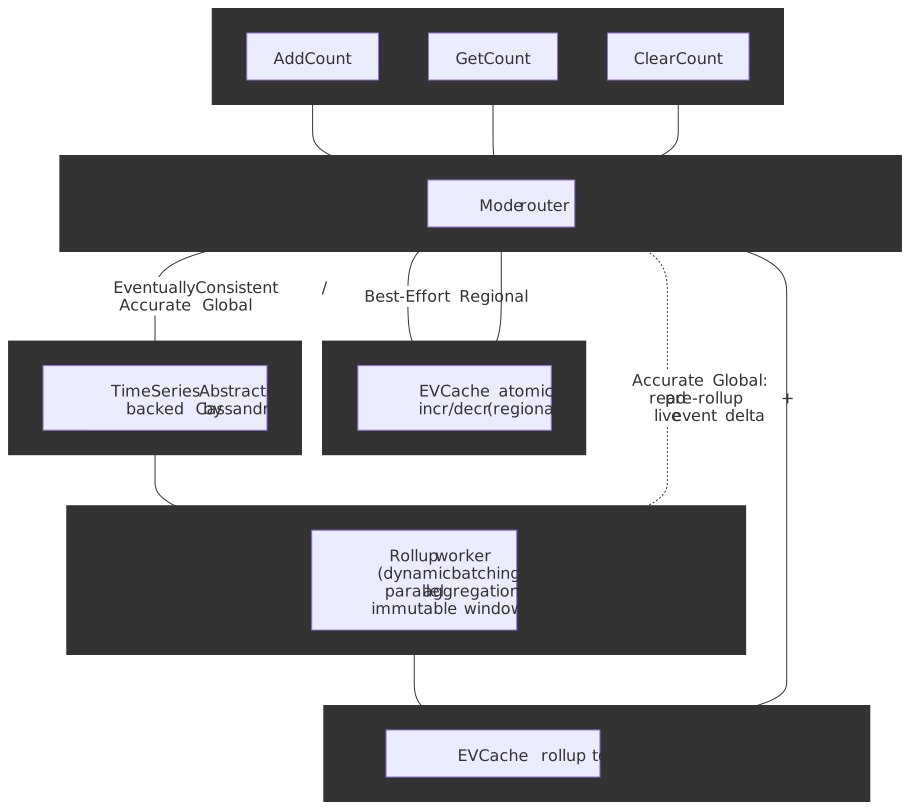
Netflix’s Distributed Counter Abstraction is the most fully-described production counter platform in the public literature. It exposes a uniform AddCount / GetCount / ClearCount API and routes each counter to one of three modes:
| Mode | Backing | Latency | Use case |
|---|---|---|---|
| Best-Effort Regional | EVCache (Memcached) atomic increment, regional only | <1 ms | A/B test metrics, ephemeral counts |
| Eventually Consistent Global | Event log on TimeSeries (Cassandra) + rollup pipeline | single-digit ms | Most production metrics |
| Accurate Global (experimental) | Pre-rollup total + live event delta | low double-digit ms | Business-critical accurate counts |
The whole platform sustains around 75K requests/second globally with single-digit millisecond p99 on the API, processing billions of events per day.78 The notable design choices are an immutable event log as the source of truth (so any rollup can be recomputed and any counter can be replayed), and a “rollup circulation” mechanism where frequently accessed counters stay warm while cold counters get on-demand rollups on first read.
Twitter Manhattan and Timeseries Counters
Twitter’s Manhattan is the multi-tenant key-value backend behind much of the engagement surface. Manhattan ships pluggable storage engines (an LSM-tree variant for write-heavy data, a B-tree for read-heavy, a read-only batch-load engine) and an opt-in strong-consistency service via a CAS API on top of an otherwise eventually-consistent core. Crucially, Twitter built a dedicated Timeseries Counters service on top of Manhattan that handles “millions of increments per second” for observability, which is the canonical Twitter-scale time-bucketed counter implementation.6
A separate component, GraphJet, handles real-time recommendation graph state — each server ingests up to one million graph edges per second and maintains a temporally-partitioned bipartite interaction graph in memory.19 GraphJet is not a counter, but it lives on the same write path and is a useful reference point for “in-memory, partitioned-by-time” structures.
Meta TAO
TAO is the social-graph store that fronts MySQL and serves the read-mostly engagement workload at Meta. Its scale, per the USENIX paper, is roughly a billion reads per second and millions of writes per second across geographically distributed clusters. Counter-shaped data — likes, friends, comments — uses TAO’s assoc_count API and rides on the same eventual-consistency core. The hot-spot mitigation that matters here is request coalescing at the cache tier (multiple concurrent reads for the same key fold into one upstream lookup) and consistent-hashing-driven cache placement so that loss of a single cache box does not produce a thundering herd.910
Failure modes
The operational failures that recur across teams, in rough order of frequency:
Over-sharding
Symptom: 1,000 shards on a counter that does 5 writes/second. Reads are 200× slower than necessary; rollup jobs do 1,000 reads to compute a number that hasn’t changed since last interval; storage and indexing overhead multiplies.
Fix: size shards to the target sustained write rate, not the peak you imagined. Start with max(1, p99_writes_per_second / per_key_ceiling) and scale up only when retry rate or write p99 actually crosses your SLA.
Under-sharding
Symptom: a viral post lands on a single-shard counter; write contention causes exponential backoff at the storage layer; retries amplify; users see failed increments.
Fix: monitor write p99 and retry rate per logical counter, not just aggregate. Pre-shard hot-class counters (celebrity accounts, top content) ahead of demand. Use database adaptive features (DynamoDB adaptive capacity) where they exist, but treat them as a tail mitigation, not a substitute for sharding.
Unbounded rollup lag
Symptom: rollup interval is 60s, write rate is 2× what it was at design, the rollup now takes 90s to complete. Cache freshness drifts unboundedly; readers see stale values that get older every cycle; backpressure on the rollup queue eventually OOMs the worker.
Fix: monitor time_since_last_successful_rollup per counter, alert when it exceeds N × interval. Scale rollup workers horizontally. Implement explicit backpressure — drop, sample, or shed events when the lag breaches a threshold rather than letting the queue grow.
Cache treated as storage
Symptom: read path assumes the cached rollup is always present; cache eviction or restart causes the read path to fail open as “no count available”.
Fix: every read path must have a synchronous fan-in fallback that is exercised in production (chaos test it). Monitor fallback rate; if it exceeds 0.1% the cache is misbehaving and the alert should fire on the cache, not on the application.
Aggregate-only metrics hiding hot shards
Symptom: average write latency across all shards looks fine; in reality 1 of 100 shards is at 99% CPU and the rest are at 1%. Mean-of-shards is a lying metric; you only see the failure when the bad shard times out.
Fix: alert on per-shard p99, not on the mean. Use the max across shards as the primary SLI for the counter.
Choosing your approach
The decision tree is small. Walk it explicitly for every new counter rather than copy-pasting the previous one’s configuration.
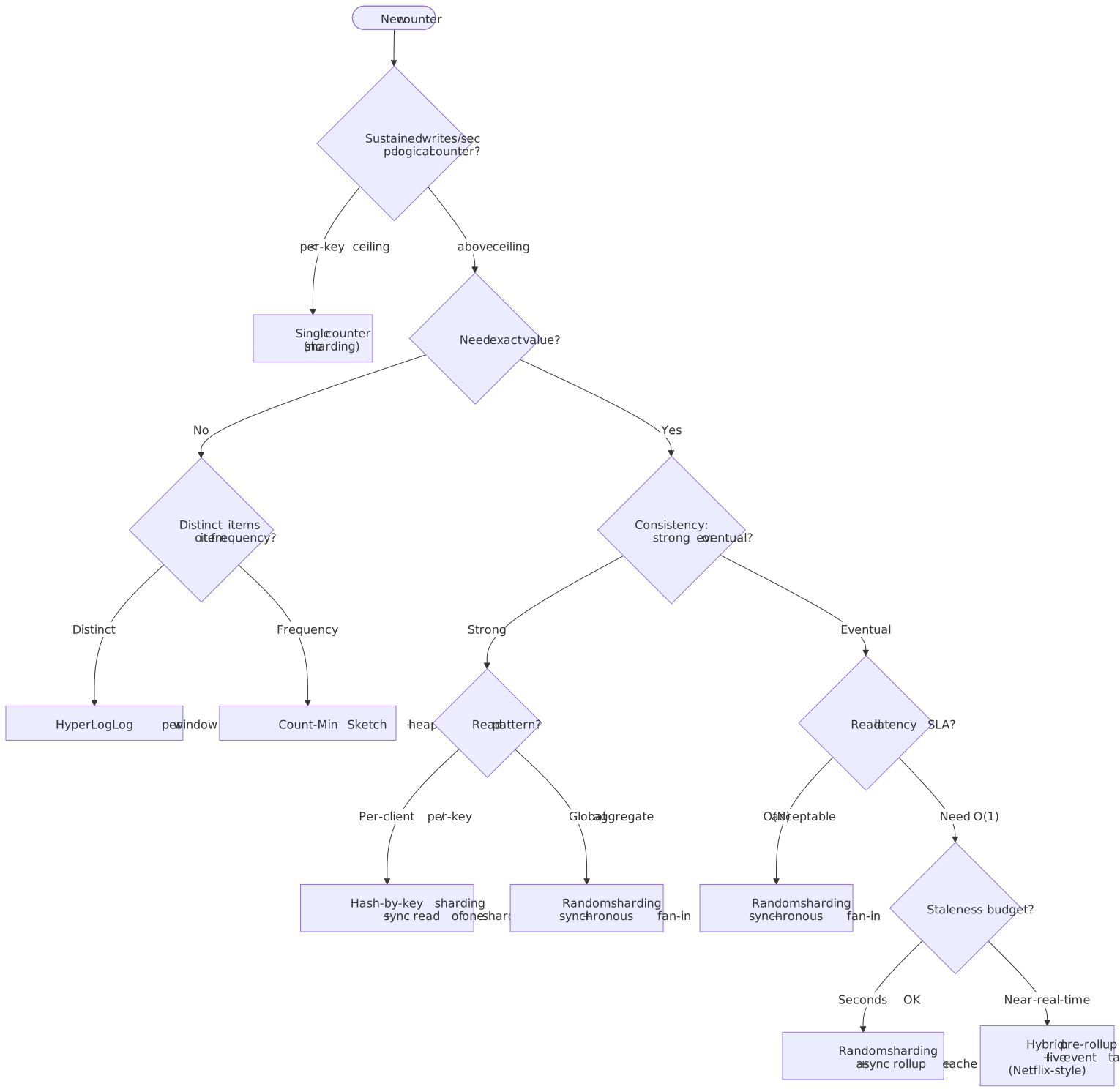
Common patterns
| Scenario | Recommended approach |
|---|---|
| Social media metrics (likes, views) | Random sharding + async rollup + cache |
| Strict API rate limiting | Hash-by-client sharding + sync read of single shard |
| Unique visitor counting | HyperLogLog per time window |
| Top-K popular items | Count-Min Sketch + min-heap |
| Financial ledger | Single linearizable counter; do not shard |
| Real-time analytics dashboards | Time-bucketed sharding + batch rollup |
| Mixed accuracy/latency requirements | Hybrid (pre-rollup + live event tail) like Netflix |
| Active-active multi-region counter | PN-Counter CRDT (e.g. Redis Active-Active) per logical key |
Scaling order of operations
- Baseline: one counter, no sharding, monitor write p99 and retry rate.
- Shard horizontally when write p99 crosses SLA. Start small (
N = expected_writes_per_second / per_key_ceiling), grow as needed. - Rollup + cache when read fan-in latency crosses SLA, not before. The rollup is operational debt; do not take it on speculatively.
- Hybrid (event log + rollup + tail) only when both staleness and latency are simultaneously unacceptable.
- Probabilistic structures when the question is cardinality or frequency at a scale where exact counting no longer fits in memory or time.
- Regional or per-DC counters when the global aggregation cost dominates and approximate global views with per-region accuracy are acceptable.
Takeaways
- Sharding solves write contention, nothing else. Pick aggregation timing and consistency separately.
- Storage-engine ceilings are real and predictable: Firestore ~1/sec per doc, DynamoDB 1,000 WCU/sec per partition, Cassandra counters two orders of magnitude slower than ordinary writes. Design to those numbers, not to the headline benchmark.
- Eventual consistency is a feature for engagement counters and a footgun for anything resembling money. The TAO engineering write-up — “losing consistency is a lesser evil than losing availability” — is a stance, not a default.
- HyperLogLog and Count-Min Sketch turn impossible counting problems into bounded-error counting problems. Keep them in the toolbox; reach for them the moment exact counting hits a memory or time wall.
- For active-active multi-region or edge deployments, reach for a PN-Counter CRDT before reinventing conflict resolution. Coordination-free convergence is the property to optimise for; per-replica state growth is the price.
- Most production failures of sharded counters are operational, not algorithmic: over-sharding, missing fallback paths, mean-of-shards alerting, and unbounded rollup lag. Monitor per-shard, alert on lag, exercise the fallback.
Appendix
Prerequisites
- Distributed-systems fundamentals: replication, partitioning, consensus, consistency models.
- Working knowledge of hash functions and probabilistic data structures.
- Familiarity with caching patterns (write-through, write-behind, cache-aside, request coalescing).
Terminology
- Hot key: a single key receiving disproportionate traffic, exhausting its per-key throughput budget.
- Write contention: concurrent writers serialized on the same physical resource, paying coordination overhead.
- Fan-out / fan-in: writes spreading across N shards / reads aggregating across N shards.
- Rollup: periodic background aggregation of shard values into a single cached total.
- Cardinality: count of distinct elements in a multiset.
- HyperLogLog (HLL): probabilistic cardinality estimation, mergeable.
- Count-Min Sketch (CMS): probabilistic frequency estimation with one-sided (over-) error.
- CRDT (Conflict-free Replicated Data Type): a data structure whose merge function is associative, commutative, and idempotent so independent replicas converge without coordination. G-Counter (grow-only) and PN-Counter (positive + negative) are the canonical counter shapes.
- Eventual consistency: replicas converge to the same value in the absence of new updates; reads may transiently lag.
- Linearizability: every read observes the most recent write, globally; the strongest consistency level commonly implemented.
References
Footnotes
-
Distributed counters — Firebase / Cloud Firestore documentation. Architectural ceiling and the canonical sharded-counter pattern. ↩ ↩2 ↩3 ↩4
-
DynamoDB burst and adaptive capacity — AWS documentation. Per-partition limits (1,000 WCU/sec, 3,000 RCU/sec) and adaptive capacity behaviour. ↩
-
Best practices for designing and using partition keys: Use sharding to distribute workloads — AWS documentation. Suffix-based write sharding pattern. ↩ ↩2
-
Cassandra counter columns: Nice in theory, hazardous in practice — Ably engineering, 2020. Read-before-write semantics and production performance impact. ↩
-
Redis benchmarks — Redis documentation. Single-instance throughput and the impact of pipelining and threading. ↩
-
Manhattan, our real-time, multi-tenant distributed database for Twitter scale — Twitter Engineering, 2014. Storage engines, consistency model, Timeseries Counters service. ↩ ↩2
-
Netflix’s Distributed Counter Abstraction — Netflix Tech Blog, 2024. Three counting modes, EVCache + TimeSeries on Cassandra, rollup pipeline, 75K RPS. ↩ ↩2
-
Inside Netflix’s Distributed Counter — InfoQ, 2024. Independent confirmation of the throughput and latency numbers. ↩ ↩2
-
Bronson et al., TAO: Facebook’s Distributed Data Store for the Social Graph (USENIX ATC 2013). Scale numbers and the explicit availability-over-consistency stance. ↩ ↩2
-
TAO: The power of the graph — Engineering at Meta, 2013. Source of the “lesser evil” quote. ↩ ↩2
-
Flajolet, Fusy, Gandouet, Meunier, HyperLogLog: the analysis of a near-optimal cardinality estimation algorithm (DMTCS, 2007). Original 1.5 KB / 2% error / >10⁹ result. ↩
-
Heule, Nunkesser, Hall, HyperLogLog in Practice: Algorithmic Engineering of a State of the Art Cardinality Estimation Algorithm (EDBT 2013). HLL++ improvements adopted by most modern implementations. ↩
-
HyperLogLog in Presto: Faster cardinality estimation — Engineering at Meta, 2018. The “12 hours, <1 MB” production result. ↩
-
Cormode, Muthukrishnan, An Improved Data Stream Summary: The Count-Min Sketch and its Applications (Journal of Algorithms, 2005). Formal accuracy bounds and parameter sizing. ↩
-
Shapiro, Preguiça, Baquero, Zawirski, A comprehensive study of Convergent and Commutative Replicated Data Types (INRIA RR-7506, 2011). G-Counter, PN-Counter, and the join-semilattice formalism. ↩
-
Active-Active geo-distribution — Redis documentation. CRDB architecture and conflict resolution model. ↩
-
Develop applications with Active-Active counters — Redis documentation. Counter type semantics under concurrent multi-region writes. ↩
-
Diving into CRDTs — Redis Blog. Operation-based CRDT variants used in Redis Enterprise. ↩
-
Sharma et al., GraphJet: Real-Time Content Recommendations at Twitter (VLDB 2016). Per-server ingest throughput and bipartite-graph design. ↩