Design a Social Feed (Facebook/Instagram)
A social feed at Facebook or Instagram scale is fundamentally three problems wedged together: distribute new posts to the right followers, rank the resulting candidate set so the most relevant items surface first, and serve the result in well under a second across hundreds of millions of concurrent sessions. None of the three is independently hard; the friction is that every reasonable solution to one makes the other two worse. This article walks through the production-tested decomposition that Facebook (Multifeed), Instagram (1000-model recommendation stack), and Twitter (Redis timeline cache) converged on, and the trade-offs that make it work.
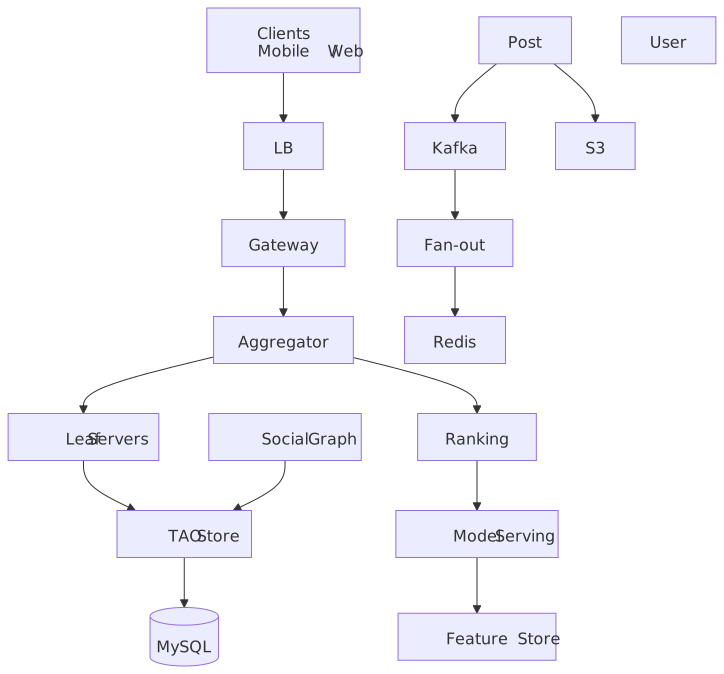
Abstract
Three interconnected problems define the system: content distribution (getting posts into follower feeds), personalised ranking (ordering relevance), and low-latency retrieval (sub-second loads). The architecture below is a synthesis of public Meta, Instagram, and Twitter engineering descriptions; specific scale numbers are date-stamped throughout because production architectures evolve quickly.
Core architectural decisions:
| Decision | Choice | Rationale |
|---|---|---|
| Fan-out strategy | Hybrid push/pull | Push pre-computes feeds for typical accounts; pull avoids write storms for high-follower accounts. The per-producer push-vs-pull decision was formalised in Yahoo Research’s Feeding Frenzy (SIGMOD 2010). |
| Content storage | TAO-style graph store | Objects + associations fit social data and admit single-shard queries on (id1, atype) association lists (TAO paper, USENIX ATC ‘13). |
| Feed ranking | Multi-stage ML funnel | Inventory → lightweight Pass 0 → heavy multitask NN → contextual rerank (News Feed ranking, 2021). |
| Caching | Two-tier (leader/follower) with leases | Followers absorb reads; leaders serialise invalidations; lease-get throttles thundering herds (Scaling Memcache, NSDI ‘13). |
| Consistency | Eventual (~minutes); strong for writer’s own writes | Acceptable for social content; Meta’s Polaris reports ~10 nines (99.99999999%) cache consistency within 5 minutes for TAO-class caches. |
Key trade-offs accepted:
- Eventual consistency for follower feeds — most users tolerate a few seconds to minutes of staleness; the writer always sees their own write through read-after-write routing.
- Higher write amplification for typical users in exchange for O(1) reads.
- A second code path for high-follower accounts in exchange for bounded write fan-out.
- Periodic ranker retraining (model staleness between deploys) in exchange for training cost and stability.
What this design optimises:
- p99 feed load well under one second globally.
- No data loss for user-generated posts (durable persistence before fan-out).
- Personalised ranking with thousands of features per candidate (transparency.meta.com).
- Linear horizontal scaling of stateless tiers; sharded scaling of stateful ones.
Requirements
Functional Requirements
| Requirement | Priority | Notes |
|---|---|---|
| Home feed generation | Core | Aggregated posts from followed accounts. |
| Post creation | Core | Text, images, video, with privacy scope. |
| Feed ranking | Core | Personalised relevance ordering. |
| Real-time feed updates | Core | New posts surface without full refresh. |
| Engagement actions | Core | Like, comment, share, save. |
| Following/followers | Core | Asymmetric directed social graph. |
| Feed pagination | Core | Cursor-based infinite scroll. |
| Post visibility | Extended | Public, friends-only, custom audience. |
| Stories / ephemeral content | Extended | 24-hour expiring content. |
| Algorithmic vs. chronological toggle | Extended | User-selectable feed type. |
Non-Functional Requirements
| Requirement | Target | Rationale |
|---|---|---|
| Availability | 99.99% (4 nines) | Revenue-critical; user retention. |
| Feed load latency | p99 < 500 ms | Above this, scroll fluidity degrades. |
| Post publish latency | p99 < 2 s | Acceptable for async fan-out. |
| Feed freshness | < 1 minute | Balance between freshness and cost. |
| Ranking model latency | p99 < 100 ms | Real-time personalisation budget. |
| Data durability | 11 nines | No user content loss (mirrors S3 SLO). |
Scale Estimation
These are illustrative numbers in the Facebook/Instagram class. Treat them as design inputs rather than published numbers from any specific platform.
Users:
- Monthly Active Users (MAU): ≈ 2 billion.
- Daily Active Users (DAU): ≈ 1 billion.
- Peak concurrent users: ≈ 200 million.
Traffic:
- Feed loads per user per day: ≈ 20.
- Daily feed requests: 1 B × 20 = 20 B/day ≈ 230 K RPS average.
- Peak multiplier (3×) → ≈ 700 K RPS.
- Posts per user per day (mean, heavy power-law tail): ≈ 0.5.
- Daily posts: 500 M/day ≈ 5.8 K posts/sec.
Storage:
- Average post metadata: ≈ 2 KB.
- Average media per post (after compression, CDN-served): ≈ 500 KB.
- Daily metadata: 500 M × 2 KB ≈ 1 TB/day.
- Daily media: 500 M × 500 KB ≈ 250 TB/day.
- Social graph edges: 2 B users × 500 mean connections ≈ 1 trillion edges.
- Graph storage at ≈ 100 B/edge: ≈ 100 TB.
Fan-out estimation:
- Mean follower count: 500.
- Posts requiring fan-out: 500 M/day.
- Naive push writes: 500 M × 500 = 2.5 × 10¹¹ writes/day.
- Without celebrity carve-out: top 1% (20 M users) × ≈ 50 K followers × 0.5 posts ≈ 5 × 10¹⁴ writes/day — operationally infeasible.
Important
The “infeasible” number is the load-bearing argument for hybrid fan-out. Any single-strategy design either burns RAM on dead writes or burns CPU on read-time aggregation. Hybrid is not an optimisation; it is the only design that survives the long tail.
Design Paths
Path A: Fan-out on Write (Push Model)
Best when:
- Follower distribution is roughly uniform (no celebrities).
- Reads dominate writes.
- Real-time freshness is critical.
- Operational simplicity is preferred over storage efficiency.
Architecture:
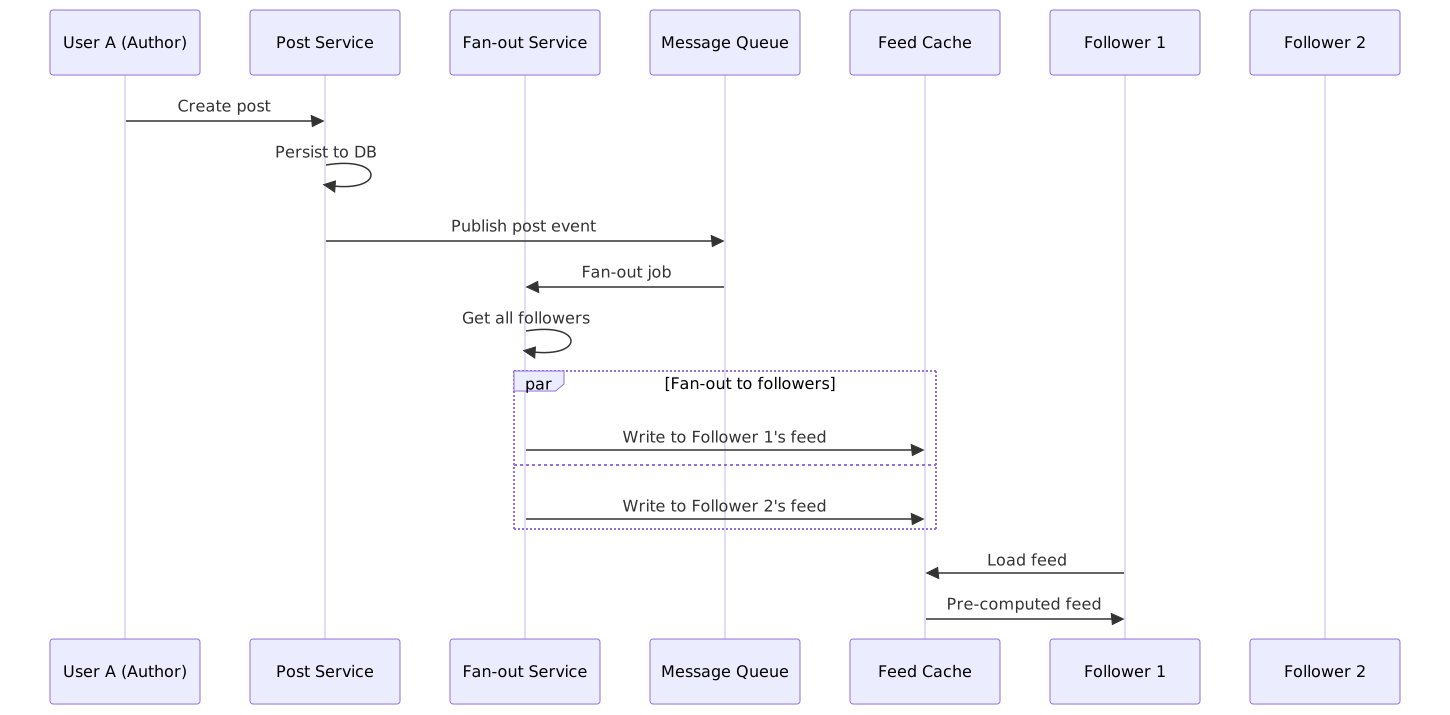
Key characteristics:
- Pre-computed feeds in Redis or Memcached.
- O(1) feed reads, O(followers) writes per post.
- Feed cache stores post IDs in time- or score-sorted order.
Trade-offs:
| Pro | Con |
|---|---|
| Single cache lookup on read. | Write amplification scales with follower count. |
| Predictable, low read latency. | Storage cost from duplicating post references across feeds. |
| Simple feed retrieval logic. | Delivery is delayed by fan-out lag for very high-follower accounts. |
Production reference. Twitter’s home-timeline service is the canonical large push-fanout deployment. As of 2014, the Timeline Service ran across roughly 10,000 Redis instances totalling about 105 TB of RAM and serving ≈ 39 M QPS, with each user’s home timeline capped at 800 tweets to bound memory (Yao Yue talk, summarised on High Scalability; cap detail in antirez’s Twitter internals notes). To fit the timeline encoding into RAM, Twitter built a “Hybrid List” data structure that was upstreamed into Redis as the now-standard quicklist. By 2017, Twitter’s cache fleet had been re-segmented and reported ranges of 10–50 M QPS across hundreds-to-thousands of instances per cluster (Twitter Engineering, 2017). The full pipeline behind the cache: tweets are persisted to Twitter’s Manhattan KV store, then a Heron topology (the post-Storm streaming engine) consumes the write log and runs the fan-out, writing the new tweet id into each follower’s pre-computed Redis timeline.
Path B: Fan-out on Read (Pull Model)
Best when:
- Many high-follower accounts exist (write storms would dominate).
- Writes dominate reads.
- Storage cost is the primary constraint.
- Read latency budget can tolerate aggregation work.
Architecture:
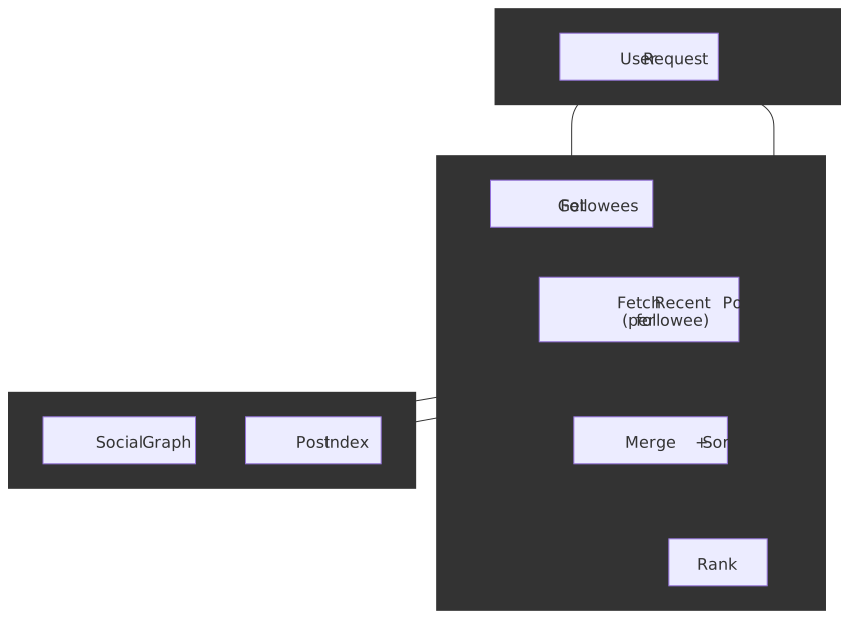
Key characteristics:
- No write amplification per post.
- Feed computed on demand from author indices.
- Read complexity is O(followees × posts/followee) before pruning.
Trade-offs:
| Pro | Con |
|---|---|
| No write amplification. | Higher read latency. |
| Always uses the freshest content. | More compute and IO per request. |
| Lower storage requirements. | Complex ranking is harder to amortise per read. |
Production reference. Facebook’s Multifeed is a pull-style read path: when a user requests their feed, an aggregator queries every leaf in a replica, retrieves potential candidates, then ranks and filters down to roughly 45 items. The aggregator/leaf separation was operationalised by 2010 (the family is sometimes called “Aggregator-Leaf-Tailer”) and Facebook published the disaggregated redesign in March 2015, reporting ≈ 40 % reduction in total memory + CPU consumption versus the prior co-located layout.
Path C: Hybrid Model (Industry Standard)
Best when:
- Follower distribution has a heavy tail (most users small, some accounts very large).
- Both reads and writes need to be optimised.
- Some additional system complexity is acceptable.
- Facebook/Instagram/Twitter scale.
Architecture:
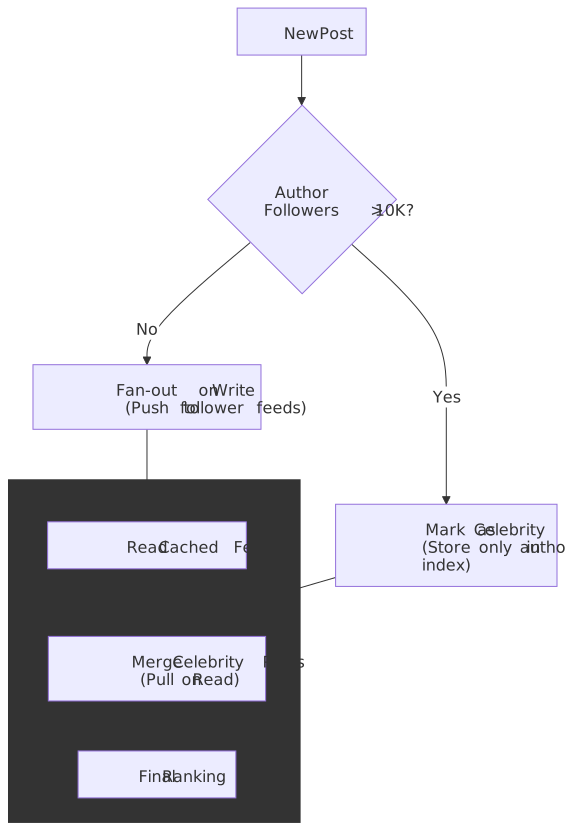
Key characteristics:
- Threshold-based routing on follower count (commonly described in the 10 K – 100 K range; the actual number is per-platform and unpublished).
- Pre-computed feeds plus on-demand celebrity merging at read time.
- A graceful fallback: if the cached feed degrades, the read path can fall back toward pull.
Trade-offs:
| Pro | Con |
|---|---|
| Optimal latency for the typical user. | Two fan-out code paths to build and operate. |
| Bounds write amplification for celebrities. | More complex feed-read logic (cache + pull merge). |
| Threshold can be tuned per cohort. | Edge cases when accounts cross the threshold. |
Production reference. Twitter’s current home timeline is hybrid: regular accounts push through the Heron fan-out into per-follower Redis timelines; very high-follower accounts skip write fan-out and are merged into the requester’s timeline at read time, with Manhattan as the durable source of truth (Manhattan deployments at scale; Twitter infrastructure 2017). The theoretical underpinning is older: Yahoo’s Feeding Frenzy proved that the global cost-minimising policy is a per-producer/consumer decision driven by the producer’s update rate vs. the consumer’s view rate — exactly the celebrity-vs-typical split, generalised. Discord’s large-server architecture is structurally similar but uses a different substrate: each guild is a single Elixir process on the BEAM VM, and “relays” sit between the guild process and per-user session processes — each relay handling fan-out to up to ~15,000 sessions, with “passive” connections skipped to cut fan-out work by roughly 90 % when users are not viewing the guild (Maxjourney: Pushing Discord’s Limits). The shared idea across these systems is the same: avoid quadratic broadcast cost by routing the long tail through a pull-style merge.
Path Comparison
| Factor | Fan-out Write | Fan-out Read | Hybrid |
|---|---|---|---|
| Read latency | Low (single cache lookup) | Higher (aggregate + rank) | Low for typical, moderate for heavy |
| Write cost | O(followers) | O(1) | O(followers) below threshold; O(1) above |
| Celebrity handling | Infeasible at scale | Native | Carved out |
| Storage cost | High (duplicated refs) | Low | Medium |
| Operational complexity | Low | Medium | High |
| Production examples | Twitter (push tier today) | Facebook Multifeed | Twitter overall, Instagram, Discord |
This Article’s Focus
The rest of this article goes deep on Path C (Hybrid) because:
- It is the architecture every modern high-scale feed has converged to.
- Reasoning about why it exists is the best way to understand fan-out trade-offs.
- The mechanics (graph store, ranker funnel, cache leasing) are reusable building blocks.
High-Level Design
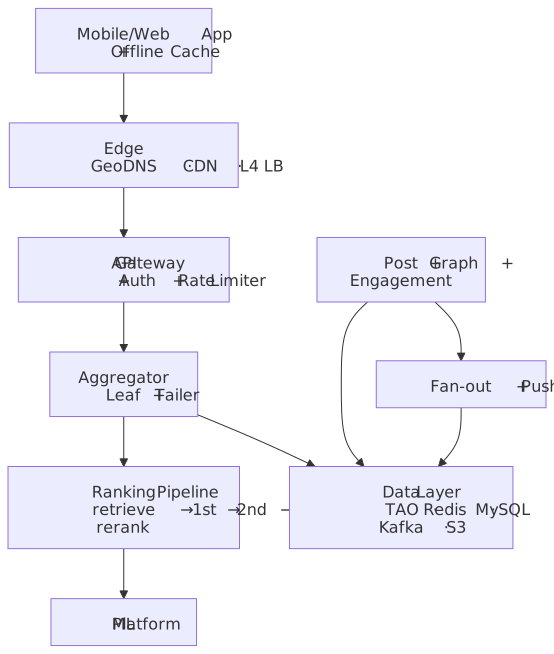
Component Overview
Feed Generation Service (Multifeed)
The feed-generation layer follows Facebook’s Multifeed shape with disaggregated tiers:
Aggregator tier:
- CPU-intensive query fan-out and ranking.
- Stateless and horizontally scalable.
- Issues parallel queries to leaf servers and merges results.
- Calls into the ranking service / model server for scoring.
Leaf tier:
- Memory-intensive; stores in-RAM indices of recent author actions.
- Indexes posts by author, sorted by time.
- Sharded by author user_id so that an author’s posts live on a single leaf.
Tailer:
- Real-time pipeline (e.g. Kafka) that updates leaf indices as posts are created.
- Owns index rebuild from persistent storage on startup or after loss.
Why disaggregate. In Multifeed’s pre-2015 layout, aggregator and leaf code shared a host. CPU-bound aggregation contended with memory-bound leaf indices; servers had to be over-provisioned on whichever resource was tightest. Splitting them into separate pools allowed independent scaling and reduced total memory + CPU consumption by ≈ 40 %, and let Facebook tune CPU-to-RAM ratios per tier instead of per host (2015 redesign post).
Design decisions:
| Decision | Choice | Rationale |
|---|---|---|
| Tier separation | Disaggregated aggregator / leaf | Independent scaling, ≈ 40 % efficiency gain. |
| Leaf sharding | By author user_id |
Co-locates an author’s posts for range queries. |
| Index structure | Time-sorted skiplist / sorted run | Fast time-range queries, O(log n) inserts. |
| Memory management | LRU eviction, flash overflow | Keep hot recent posts in RAM; spill cold to SSD. |
Social Graph Service (TAO-style)
The social graph (follows, friends, blocks) and content relationships sit behind a TAO-style API (TAO paper, USENIX ATC ‘13). TAO is a thin caching layer on top of sharded MySQL that exposes a graph API and aggressively caches association lists; the published deployment serves on the order of a billion reads per second and millions of writes per second.
Data model:
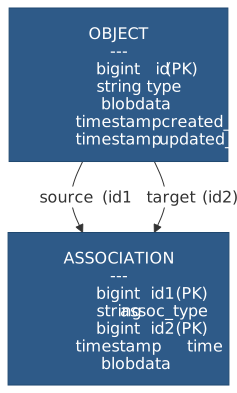
- Objects — typed nodes identified by a 64-bit
id:(id) → (otype, key→value). Examples: user, post, comment, page. - Associations — typed directed edges keyed on
(id1, atype, id2):(id1, atype, id2) → (time, key→value). The 32-bittimefield is the secondary sort key.
Why this shape.
- Two storage shapes (objects, associations) keep the schema and the cache key space small.
- Associations are stored on the shard owning
id1, so the most common access pattern — “give meid1’s associations of typeatype, ordered by recency” — is single-shard. - The
time-ordered association list is exactly what a feed retrieval needs: latest posts by author, latest likes by user, etc.
Fan-out Service
Owns post distribution to follower feeds.
Routing logic:
interface FanoutRouter { routePost(post: Post, author: User): FanoutStrategy}type FanoutStrategy = | { type: "push"; followers: string[] } | { type: "pull"; authorId: string } | { type: "hybrid"; pushTo: string[]; markForPull: boolean }Threshold-based routing (illustrative):
- Authors with < 10 K followers: full push fan-out.
- Authors with 10 K – 1 M followers: hybrid — push to active followers, mark post for read-time pull for the rest.
- Authors with > 1 M followers: pull-only — index the post on the author’s timeline and merge into followers’ feeds at read time.
Note
The exact threshold values used at Facebook, Instagram, or Twitter are not publicly documented. Treat the numbers above as design defaults. What is documented: the shape — a single follower-count threshold is the standard switch.
Ranking Service
The ranker is structured as a multi-stage funnel that progressively narrows the candidate set to fit a tight serving budget. Meta has published two such funnels in detail:
- Facebook News Feed (2021): Inventory → Pass 0 (lightweight model, ≈ 500 candidates) → Pass 1 (heavy multitask neural network) → Pass 2 (contextual reranking for diversity and integrity), evaluating thousands of signals per candidate (News Feed ranking, 2021; Transparency Center).
- Instagram Explore (2023): Sourcing (retrieval) → early-stage ranking (lightweight) → late-stage ranking (multi-task multi-label, MTML) → final blending and policy filters, with retrieval relying on two-tower neural networks and approximate nearest-neighbour search (Scaling Instagram Explore, 2023). By 2025, the platform was operating ≈ 1,000 models across surfaces (Journey to 1000 models).
- Pinterest Home Feed: Retrieval (graph-walk candidates from Pixie, an in-memory random-walk service over a 7 B-node Pin/board graph) → unified two-tower pre-ranker on a root-leaf inference fleet → heavy ranker (Scorpion) → final blend; per-user candidate queues are materialised in HBase by the Smartfeed worker so the read path stays cheap.
- LinkedIn: many feed candidate sources (jobs, companies, people-you-may-know, profile-also-viewed) are powered by Browsemaps, a horizontal item-to-item collaborative-filtering platform — co-occurrences computed offline on Hadoop, served online via a key-value store. Heavy ranking on top is described in LiRank.
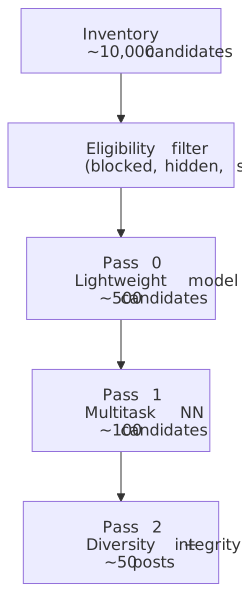
Why a funnel. The most expensive model is the most accurate, but you cannot afford to run it on every candidate. A funnel lets you spend a sub-millisecond budget per item early (cheap features, simple model), reserve the milliseconds-per-item budget for a small, already-good slate, and apply the most expensive policy logic only on the final ≈ 50 items the user will actually see.
API Design
Feed Endpoints
Get Home Feed
Endpoint: GET /api/v1/feed
Query Parameters:
| Parameter | Type | Description |
|---|---|---|
| cursor | string | Pagination cursor (opaque) |
| limit | int | Items per page (default: 20, max: 50) |
| refresh | boolean | Force fresh feed generation |
Response (200 OK):
{ "posts": [ { "id": "post_abc123", "author": { "id": "user_456", "username": "johndoe", "displayName": "John Doe", "avatarUrl": "https://cdn.example.com/avatars/456.jpg", "isVerified": true }, "content": { "type": "image", "text": "Beautiful sunset!", "media": [ { "id": "media_789", "type": "image", "url": "https://cdn.example.com/posts/789.jpg", "thumbnailUrl": "https://cdn.example.com/posts/789_thumb.jpg", "width": 1080, "height": 1350, "altText": "Sunset over the ocean" } ] }, "engagement": { "likeCount": 1542, "commentCount": 89, "shareCount": 23, "viewCount": 12450, "isLiked": false, "isSaved": false }, "ranking": { "score": 0.89, "reason": "friend_interaction" }, "createdAt": "2024-02-03T10:30:00Z", "visibility": "public" } ], "pagination": { "nextCursor": "eyJ0IjoxNzA2ODg2NDAwfQ", "hasMore": true }, "meta": { "feedType": "ranked", "generatedAt": "2024-02-03T12:00:00Z" }}Create Post
Endpoint: POST /api/v1/posts
Request:
{ "content": { "text": "Hello world!", "mediaIds": ["upload_123", "upload_456"] }, "visibility": "public", "allowComments": true, "allowSharing": true, "location": { "latitude": 37.7749, "longitude": -122.4194, "name": "San Francisco, CA" }}Response (201 Created):
{ "id": "post_new789", "author": { "id": "user_123", "username": "currentuser" }, "content": { "text": "Hello world!", "media": [...] }, "createdAt": "2024-02-03T12:05:00Z", "visibility": "public", "fanoutStatus": "pending"}Real-time Feed Updates
For real-time updates of feed-level events (new post available, engagement counts), this design uses Server-Sent Events (SSE) because feed updates are unidirectional (server → client) and SSE inherits HTTP/2 multiplexing, native browser auto-reconnect, and proxy/CDN compatibility.
Endpoint: GET /api/v1/feed/stream
Event types:
event: new_postdata: {"postId": "post_xyz", "authorId": "user_456", "preview": "Check out..."}event: engagement_updatedata: {"postId": "post_abc", "likeCount": 1543, "commentCount": 90}event: post_removeddata: {"postId": "post_old", "reason": "author_deleted"}Tip
Real-world Meta apps don’t use SSE for the long-lived mobile connection. They use MQTT over a persistent TCP connection for messaging and notification delivery — a binary publish/subscribe protocol designed for unreliable mobile networks and battery-constrained devices (Building Facebook Messenger, Engineering at Meta, 2011). For a feed-update fan-in into a web client, SSE is a pragmatic choice; for a mobile app, MQTT is what production sends down the wire.
Engagement Endpoints
Like / Unlike Post
Endpoint: POST /api/v1/posts/{id}/like
Response (200 OK):
{ "liked": true, "likeCount": 1543, "timestamp": "2024-02-03T12:10:00Z"}Get Comments
Endpoint: GET /api/v1/posts/{id}/comments
Query Parameters:
| Parameter | Type | Description |
|---|---|---|
| cursor | string | Pagination cursor |
| limit | int | Comments per page (default: 20) |
| sort | string | ”top” (engagement), “newest”, “oldest” |
Response (200 OK):
{ "comments": [ { "id": "comment_123", "author": { "id": "user_789", "username": "commenter", "avatarUrl": "..." }, "text": "Great post!", "likeCount": 45, "replyCount": 3, "isLiked": false, "createdAt": "2024-02-03T10:35:00Z", "replies": [] } ], "pagination": { "nextCursor": "...", "hasMore": true }, "totalCount": 89}Error Responses
| Code | Error | When |
|---|---|---|
| 400 | INVALID_CONTENT |
Post content violates rules |
| 401 | UNAUTHORIZED |
Missing or invalid token |
| 403 | FORBIDDEN |
User blocked or content restricted |
| 404 | POST_NOT_FOUND |
Post doesn’t exist or is deleted |
| 429 | RATE_LIMITED |
Too many requests |
| 503 | FEED_UNAVAILABLE |
Feed generation temporarily unavailable |
Rate limits (illustrative):
| Endpoint | Limit | Window |
|---|---|---|
| Feed load | 60 | per minute |
| Post creation | 10 | per hour |
| Like/comment | 100 | per minute |
| Media upload | 50 | per hour |
Data Modelling
TAO Schema (Objects and Associations)
Objects Table
CREATE TABLE objects ( id BIGINT PRIMARY KEY, type VARCHAR(50) NOT NULL, data BLOB, created_at TIMESTAMP DEFAULT CURRENT_TIMESTAMP, updated_at TIMESTAMP DEFAULT CURRENT_TIMESTAMP ON UPDATE CURRENT_TIMESTAMP, INDEX idx_type_created (type, created_at));Object types:
| Type | Data fields |
|---|---|
| user | username, display_name, avatar_url, bio, follower_count |
| post | author_id, content, visibility, like_count, comment_count |
| comment | post_id, author_id, text, like_count |
| media | post_id, url, type, dimensions, alt_text |
Associations Table
CREATE TABLE associations ( id1 BIGINT NOT NULL, assoc_type VARCHAR(50) NOT NULL, id2 BIGINT NOT NULL, time BIGINT NOT NULL, data BLOB, PRIMARY KEY (id1, assoc_type, id2), INDEX idx_id1_type_time (id1, assoc_type, time DESC));Association types:
| Type | id1 | id2 | data |
|---|---|---|---|
| follows | follower_id | followee_id | created_at |
| authored | user_id | post_id | - |
| liked | user_id | post_id | created_at |
| commented | user_id | comment_id | - |
| tagged | post_id | user_id | - |
Sharding strategy:
- Shard on
id1(the source object). - Co-locates a user’s follows, likes, and authored posts on a single shard.
- Single-shard query for the most common pattern: “give me
id1’satypeassociations sorted by recency.”
Feed Cache Schema (Redis)
ZADD feed:{user_id} {score} {post_id}ZREMRANGEBYRANK feed:{user_id} 0 -501HSET feed:meta:{user_id} last_generated 1706886400000 version 42 type "ranked"ZADD celebrity_posts:{author_id} {timestamp} {post_id}ZADD user:engaged:{user_id} {timestamp} {post_id}EXPIRE user:engaged:{user_id} 604800Per-feed caps (the trim above keeps the last 500 entries) directly mirror Twitter’s published 800-tweet timeline cap; the precise number is a memory-vs-pagination-depth knob (antirez notes).
Post Index (Leaf Servers)
In-memory index structure on leaf servers:
interface PostIndex { authorIndex: Map<UserId, SortedSet<PostId, Timestamp>> visibilityIndex: Map<Visibility, Set<PostId>> recentPosts: SortedSet<PostId, Timestamp>}interface SortedSet<K, S> { add(key: K, score: S): void range(start: S, end: S, limit: number): K[] remove(key: K): void}MySQL Persistent Storage
CREATE TABLE users ( id BIGINT PRIMARY KEY AUTO_INCREMENT, username VARCHAR(50) UNIQUE NOT NULL, display_name VARCHAR(100), email VARCHAR(255) UNIQUE NOT NULL, password_hash VARCHAR(255) NOT NULL, avatar_url TEXT, bio TEXT, follower_count INT DEFAULT 0, following_count INT DEFAULT 0, post_count INT DEFAULT 0, is_verified BOOLEAN DEFAULT FALSE, is_celebrity BOOLEAN DEFAULT FALSE, created_at TIMESTAMP DEFAULT CURRENT_TIMESTAMP, INDEX idx_username (username), INDEX idx_email (email)) ENGINE=InnoDB;CREATE TABLE posts ( id BIGINT PRIMARY KEY AUTO_INCREMENT, author_id BIGINT NOT NULL, content_text TEXT, content_type ENUM('text', 'image', 'video', 'link') NOT NULL, visibility ENUM('public', 'friends', 'private') DEFAULT 'public', like_count INT DEFAULT 0, comment_count INT DEFAULT 0, share_count INT DEFAULT 0, view_count INT DEFAULT 0, is_deleted BOOLEAN DEFAULT FALSE, created_at TIMESTAMP DEFAULT CURRENT_TIMESTAMP, updated_at TIMESTAMP DEFAULT CURRENT_TIMESTAMP ON UPDATE CURRENT_TIMESTAMP, INDEX idx_author_created (author_id, created_at DESC), INDEX idx_created (created_at DESC), FOREIGN KEY (author_id) REFERENCES users(id)) ENGINE=InnoDB;CREATE TABLE follows ( follower_id BIGINT NOT NULL, followee_id BIGINT NOT NULL, created_at TIMESTAMP DEFAULT CURRENT_TIMESTAMP, PRIMARY KEY (follower_id, followee_id), INDEX idx_followee (followee_id), FOREIGN KEY (follower_id) REFERENCES users(id), FOREIGN KEY (followee_id) REFERENCES users(id)) ENGINE=InnoDB;CREATE TABLE post_likes ( user_id BIGINT NOT NULL, post_id BIGINT NOT NULL, created_at TIMESTAMP DEFAULT CURRENT_TIMESTAMP, PRIMARY KEY (user_id, post_id), INDEX idx_post (post_id), FOREIGN KEY (user_id) REFERENCES users(id), FOREIGN KEY (post_id) REFERENCES posts(id)) ENGINE=InnoDB;Database Selection Matrix
| Data type | Store | Rationale |
|---|---|---|
| Social graph | TAO (MySQL-backed) | Optimised for graph queries, association lists |
| User profiles | MySQL | ACID, moderate scale |
| Posts | MySQL + TAO cache | Durability + fast graph queries |
| Feed cache | Redis | Sub-ms reads; sorted sets fit ranked feeds |
| Post index | Leaf servers (memory) | Ultra-fast candidate retrieval |
| Media | S3 + CDN | Cost-effective, globally distributed |
| ML features | Feature store | Consistent features for training and serving |
| Analytics | ClickHouse | Time-series, large-aggregation queries |
Low-Level Design
Feed Generation Algorithm
Candidate Retrieval
class CandidateRetriever { private readonly leafClient: LeafClient private readonly taoClient: TAOClient private readonly redis: RedisCluster async getCandidates(userId: string): Promise<CandidateSet> { const followees = await this.taoClient.getAssociations(userId, "follows", { limit: 5000 }) const postPromises = followees.map((followee) => this.leafClient.getAuthorPosts(followee.id2, { since: Date.now() - 7 * 24 * 60 * 60 * 1000, limit: 50, }), ) const postsByAuthor = await Promise.all(postPromises) const celebrityFollowees = followees.filter((f) => f.data.isCelebrity) const celebrityPosts = await this.getCelebrityPosts(celebrityFollowees.map((f) => f.id2)) const allPosts = [...postsByAuthor.flat(), ...celebrityPosts] const eligible = await this.filterEligible(userId, allPosts) return { candidates: eligible, source: { fromCache: postsByAuthor.length, fromCelebrity: celebrityPosts.length, }, } } private async filterEligible(userId: string, posts: Post[]): Promise<Post[]> { const [blocked, hidden, seen] = await Promise.all([ this.taoClient.getAssociations(userId, "blocks"), this.redis.smembers(`hidden:${userId}`), this.redis.smembers(`seen:${userId}`), ]) const blockedSet = new Set(blocked.map((b) => b.id2)) const hiddenSet = new Set(hidden) const seenSet = new Set(seen) return posts.filter( (post) => !blockedSet.has(post.authorId) && !hiddenSet.has(post.id) && !seenSet.has(post.id) && this.checkVisibility(userId, post), ) }}Multi-Stage Ranking
class FeedRanker { private readonly featureStore: FeatureStore private readonly modelServer: ModelServer async rank(userId: string, candidates: Post[]): Promise<RankedPost[]> { const stage1 = await this.firstPassRank(userId, candidates) const top500 = stage1.slice(0, 500) const stage2 = await this.secondPassRank(userId, top500) const top100 = stage2.slice(0, 100) const final = await this.finalRerank(userId, top100) return final.slice(0, 50) } private async firstPassRank(userId: string, candidates: Post[]): Promise<RankedPost[]> { const features = candidates.map((post) => ({ postId: post.id, recency: this.computeRecency(post.createdAt), authorAffinity: this.getAuthorAffinity(userId, post.authorId), contentType: post.contentType, engagementVelocity: this.getEngagementVelocity(post), })) const scores = features.map( (f) => 0.3 * f.recency + 0.4 * f.authorAffinity + 0.2 * f.engagementVelocity + 0.1 * this.contentTypeBoost(f.contentType), ) return this.sortByScore(candidates, scores) } private async secondPassRank(userId: string, candidates: Post[]): Promise<RankedPost[]> { const features = await this.featureStore.getBatch( candidates.map((c) => ({ userId, postId: c.id, authorId: c.authorId, })), ) const scores = await this.modelServer.predict("feed_ranking_v2", features) return this.sortByScore(candidates, scores) } private async finalRerank(userId: string, candidates: RankedPost[]): Promise<RankedPost[]> { const diversified = this.applyDiversity(candidates, { maxPerAuthor: 2, contentTypeMix: { image: 0.4, video: 0.3, text: 0.3 }, maxAds: 3, }) const filtered = await this.applyIntegrityFilters(diversified) return filtered } private applyDiversity(posts: RankedPost[], rules: DiversityRules): RankedPost[] { const result: RankedPost[] = [] const authorCounts = new Map<string, number>() const typeCounts = new Map<string, number>() for (const post of posts) { const authorCount = authorCounts.get(post.authorId) || 0 if (authorCount >= rules.maxPerAuthor) continue const typeCount = typeCounts.get(post.contentType) || 0 const typeRatio = typeCount / (result.length + 1) const maxRatio = rules.contentTypeMix[post.contentType] || 0.5 if (typeRatio > maxRatio && result.length > 10) continue result.push(post) authorCounts.set(post.authorId, authorCount + 1) typeCounts.set(post.contentType, typeCount + 1) } return result }}The narrowing factors above (≈ 500 / ≈ 100 / ≈ 50) are deliberate proxies for the Meta-published structure — Pass 0 outputs roughly 500 candidates per request before the heavy multitask network runs (Engineering at Meta, 2021; Transparency Center).
Dedup, freshness, and integrity live in the rerank stage, not the heavy ranker. Three concerns share that budget:
- Dedup — the
seenset in candidate retrieval drops items already impressed in the last N days;applyDiversitycaps per-author and per-content-type density so a single creator cannot monopolise the slate. Near-duplicate detection (same image hash, same article URL across reposts) is typically a separate retrieval-time filter against a rolling content fingerprint. - Freshness vs. ranking — pure recency wins on novelty but loses on relevance, while pure relevance starves new content. Production rerankers add a recency boost (decay function on
createdAt) and reserve a small slate quota for unseen-and-recent items so the feed does not stagnate around the user’s strongest historical affinities. - Integrity / abuse —
applyIntegrityFiltersruns after the heavy ranker so spam, policy violations, and known low-quality patterns can never appear regardless of model score. Meta’s Transparency Center enumerates the categories applied at this stage; the engineering invariant is that integrity is a hard filter, not a soft signal mixed into the score.
Fan-out Pipeline
class FanoutService { private readonly CELEBRITY_THRESHOLD = 10_000 private readonly BATCH_SIZE = 1000 async fanoutPost(post: Post, author: User): Promise<FanoutResult> { const followerCount = author.followerCount if (followerCount < this.CELEBRITY_THRESHOLD) { return this.pushFanout(post, author) } else if (followerCount < 1_000_000) { return this.hybridFanout(post, author) } else { return this.pullOnly(post, author) } } private async pushFanout(post: Post, author: User): Promise<FanoutResult> { const followers = await this.getFollowers(author.id) const batches = this.chunk(followers, this.BATCH_SIZE) let written = 0 for (const batch of batches) { const pipeline = this.redis.pipeline() for (const followerId of batch) { pipeline.zadd(`feed:${followerId}`, post.createdAt.getTime(), post.id) pipeline.zremrangebyrank(`feed:${followerId}`, 0, -501) } await pipeline.exec() written += batch.length this.metrics.increment("fanout.writes", batch.length) } return { strategy: "push", followersReached: written, duration: Date.now() - post.createdAt.getTime(), } } private async hybridFanout(post: Post, author: User): Promise<FanoutResult> { const activeFollowers = await this.getActiveFollowers(author.id, 7) const pushResult = await this.pushToFollowers(post, activeFollowers) await this.redis.zadd(`celebrity_posts:${author.id}`, post.createdAt.getTime(), post.id) await this.redis.expire(`celebrity_posts:${author.id}`, 7 * 24 * 60 * 60) return { strategy: "hybrid", pushed: pushResult.count, markedForPull: author.followerCount - activeFollowers.length, } } private async pullOnly(post: Post, author: User): Promise<FanoutResult> { await this.redis.zadd(`celebrity_posts:${author.id}`, post.createdAt.getTime(), post.id) await this.leafClient.indexPost(post) return { strategy: "pull", indexed: true, } }}Cache Consistency (TAO + Lease Pattern)
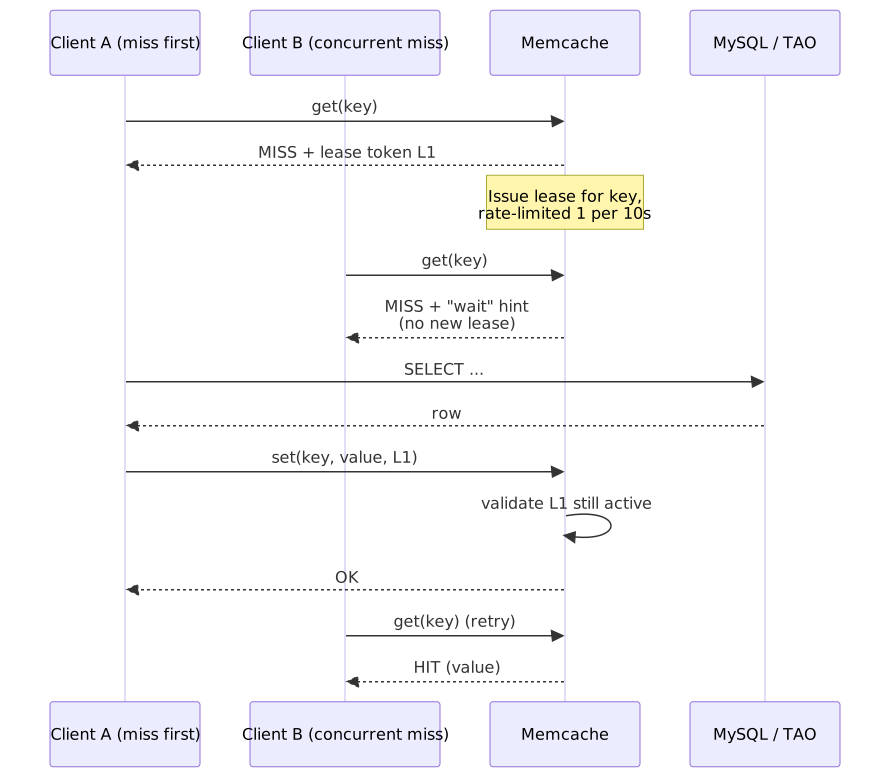
TAO uses a two-tier cache (regional follower caches in front of a per-region leader cache) and serialises writes through the leader so invalidations can be ordered. Two operational hazards make the naive read-through dangerous:
- Thundering herd. When a hot key expires or is evicted, every concurrent reader cache-misses simultaneously and stampedes the database.
- Stale set. Two readers can race: reader A reads a stale value and starts to set it back into the cache; meanwhile a writer invalidates the key; reader A’s set arrives last and reinstates the stale value.
Facebook’s memcache lease mechanism addresses both with one tool — a 64-bit lease token returned with the miss:
- Memcache hands out a lease for a key at most once every 10 seconds; the second concurrent miss receives a “wait” hint and retries instead of stampeding the DB.
- A
setonly succeeds if the client presents a still-valid lease token. Any concurrentdeletefor that key invalidates outstanding leases, so a reader that raced a writer cannot reinstate stale data.
class TAOCache { private readonly leaseTimeout = 10_000 async get(id1: string, assocType: string): Promise<Association[] | null> { const followerResult = await this.followerCache.get(this.cacheKey(id1, assocType)) if (followerResult) { this.metrics.increment("cache.hit.follower") return followerResult } const leaderResult = await this.leaderCache.get(this.cacheKey(id1, assocType)) if (leaderResult) { this.metrics.increment("cache.hit.leader") await this.followerCache.set(this.cacheKey(id1, assocType), leaderResult, { ttl: 300 }) return leaderResult } return this.fetchWithLease(id1, assocType) } private async fetchWithLease(id1: string, assocType: string): Promise<Association[]> { const leaseKey = `lease:${id1}:${assocType}` const acquired = await this.redis.set(leaseKey, "1", "NX", "PX", this.leaseTimeout) if (!acquired) { await this.sleep(100) return this.get(id1, assocType) } try { const data = await this.mysql.query( `SELECT * FROM associations WHERE id1 = ? AND assoc_type = ? ORDER BY time DESC`, [id1, assocType], ) await Promise.all([ this.leaderCache.set(this.cacheKey(id1, assocType), data, { ttl: 3600 }), this.followerCache.set(this.cacheKey(id1, assocType), data, { ttl: 300 }), ]) return data } finally { await this.redis.del(leaseKey) } } async invalidate(id1: string, assocType: string): Promise<void> { const key = this.cacheKey(id1, assocType) await Promise.all([this.followerCache.del(key), this.leaderCache.del(key)]) }}Note
Meta’s Polaris service (2022) measures TAO-class cache consistency end-to-end and reports ≈ 10 nines (99.99999999%) of writes converging within five minutes. The number is best read as: leasing handles the common case, asynchronous monitoring catches the rare-but-real residual, and an out-of-band repair loop forces convergence.
Engagement Counter (Eventual Consistency)
Engagement counts (likes, comments) are the canonical hot-key write path: a single popular post can take tens of thousands of like increments per second across replicas. The standard pattern is write-behind with in-process aggregation — increment the counter immediately in Redis for read consistency, batch the durable updates to MySQL on a fixed flush interval (DDIA, Ch. 11 — Stream Processing, “Materialised views and write-behind”).
class EngagementService { private readonly FLUSH_INTERVAL = 5000 private pendingUpdates = new Map<string, EngagementDelta>() async incrementLike(postId: string): Promise<void> { await this.redis.hincrby(`post:${postId}`, "like_count", 1) this.bufferUpdate(postId, { likes: 1 }) } private bufferUpdate(postId: string, delta: EngagementDelta): void { const existing = this.pendingUpdates.get(postId) || { likes: 0, comments: 0, shares: 0, } this.pendingUpdates.set(postId, { likes: existing.likes + (delta.likes || 0), comments: existing.comments + (delta.comments || 0), shares: existing.shares + (delta.shares || 0), }) } @Scheduled(FLUSH_INTERVAL) async flushToMySQL(): Promise<void> { const updates = new Map(this.pendingUpdates) this.pendingUpdates.clear() const queries = Array.from(updates.entries()).map(([postId, delta]) => this.mysql.query( `UPDATE posts SET like_count = like_count + ?, comment_count = comment_count + ?, share_count = share_count + ? WHERE id = ?`, [delta.likes, delta.comments, delta.shares, postId], ), ) await Promise.all(queries) }}Warning
Write-behind makes counters approximate during incidents. If a process crashes between the Redis increment and the next flush, the in-memory delta is lost. Production deployments persist the delta to an append-only log (e.g. Kafka) before acknowledging the user’s request, then have the flusher consume from the log idempotently.
Frontend Considerations
Feed Virtualisation
Infinite scroll with rich media demands list virtualisation; a feed with thousands of in-DOM nodes will lose hit-test latency and tank scroll FPS.
interface VirtualFeedConfig { containerHeight: number estimatedItemHeight: number overscan: number}class VirtualFeed { private heightCache = new Map<string, number>() private offsetCache: number[] = [] calculateVisibleRange(scrollTop: number, posts: Post[]): { start: number; end: number } { let start = this.binarySearchOffset(scrollTop - this.config.overscan * 300) let accumulatedHeight = this.offsetCache[start] || 0 let end = start while ( end < posts.length && accumulatedHeight < scrollTop + this.config.containerHeight + this.config.overscan * 300 ) { accumulatedHeight += this.getItemHeight(posts[end]) end++ } return { start, end } } private getItemHeight(post: Post): number { if (this.heightCache.has(post.id)) { return this.heightCache.get(post.id)! } let estimate = 100 if (post.content.media?.length > 0) { estimate += 400 } if (post.content.text?.length > 200) { estimate += 50 } return estimate } onItemRendered(postId: string, actualHeight: number): void { this.heightCache.set(postId, actualHeight) this.rebuildOffsetCache() }}Optimistic Engagement Updates
class FeedStore { private posts = new Map<string, Post>() private pendingLikes = new Set<string>() async likePost(postId: string): Promise<void> { const post = this.posts.get(postId) if (!post || this.pendingLikes.has(postId)) return this.pendingLikes.add(postId) this.updatePost(postId, { engagement: { ...post.engagement, likeCount: post.engagement.likeCount + 1, isLiked: true, }, }) this.notifySubscribers(postId) try { await this.api.likePost(postId) } catch (error) { this.updatePost(postId, { engagement: { ...post.engagement, likeCount: post.engagement.likeCount, isLiked: false, }, }) this.notifySubscribers(postId) } finally { this.pendingLikes.delete(postId) } }}Real-time Feed Updates
class FeedStreamManager { private eventSource: EventSource | null = null private reconnectAttempt = 0 connect(userId: string): void { this.eventSource = new EventSource(`/api/v1/feed/stream?userId=${userId}`) this.eventSource.addEventListener("new_post", (event) => { const data = JSON.parse(event.data) this.onNewPost(data) }) this.eventSource.addEventListener("engagement_update", (event) => { const data = JSON.parse(event.data) this.onEngagementUpdate(data) }) this.eventSource.onerror = () => { this.scheduleReconnect() } } private onNewPost(data: NewPostEvent): void { this.feedStore.setPendingPosts(data.count) this.ui.showNewPostsIndicator() } private onEngagementUpdate(data: EngagementUpdateEvent): void { this.feedStore.updateEngagement(data.postId, data) } loadNewPosts(): void { const pending = this.feedStore.getPendingPosts() this.feedStore.prependPosts(pending) this.feedStore.clearPendingPosts() this.ui.scrollToTop() }}Tip
Don’t auto-insert new posts into the visible scroll position. Surface a “New posts” indicator and prepend on user click — auto-insertion at the top causes layout shifts and breaks the user’s scroll context.
Prefetching Strategy
class FeedPrefetcher { private readonly PREFETCH_THRESHOLD = 5 onScroll(visibleRange: { start: number; end: number }, totalPosts: number): void { const postsRemaining = totalPosts - visibleRange.end if (postsRemaining < this.PREFETCH_THRESHOLD && !this.loading) { this.prefetchNextPage() } } private async prefetchNextPage(): Promise<void> { this.loading = true try { const cursor = this.feedStore.getNextCursor() const response = await this.api.getFeed({ cursor, limit: 20 }) this.feedStore.appendPosts(response.posts) this.feedStore.setNextCursor(response.pagination.nextCursor) } finally { this.loading = false } }}Infrastructure
Cloud-Agnostic Components
| Component | Purpose | Options |
|---|---|---|
| API Gateway | Auth, rate limiting | Kong, Envoy, Nginx |
| Graph Store | Social graph | Custom TAO-like, Neo4j, DGraph |
| KV Cache | Feed cache, sessions | Redis, KeyDB, Dragonfly |
| Message Queue | Fan-out, events | Kafka, Pulsar, NATS |
| Relational DB | Users, posts | MySQL, PostgreSQL, CockroachDB |
| Object Store | Media files | MinIO, Ceph, S3-compatible |
| ML Serving | Ranking models | TensorFlow Serving, Triton, Seldon |
| Feature Store | ML features | Feast, Tecton, custom |
AWS Reference Architecture
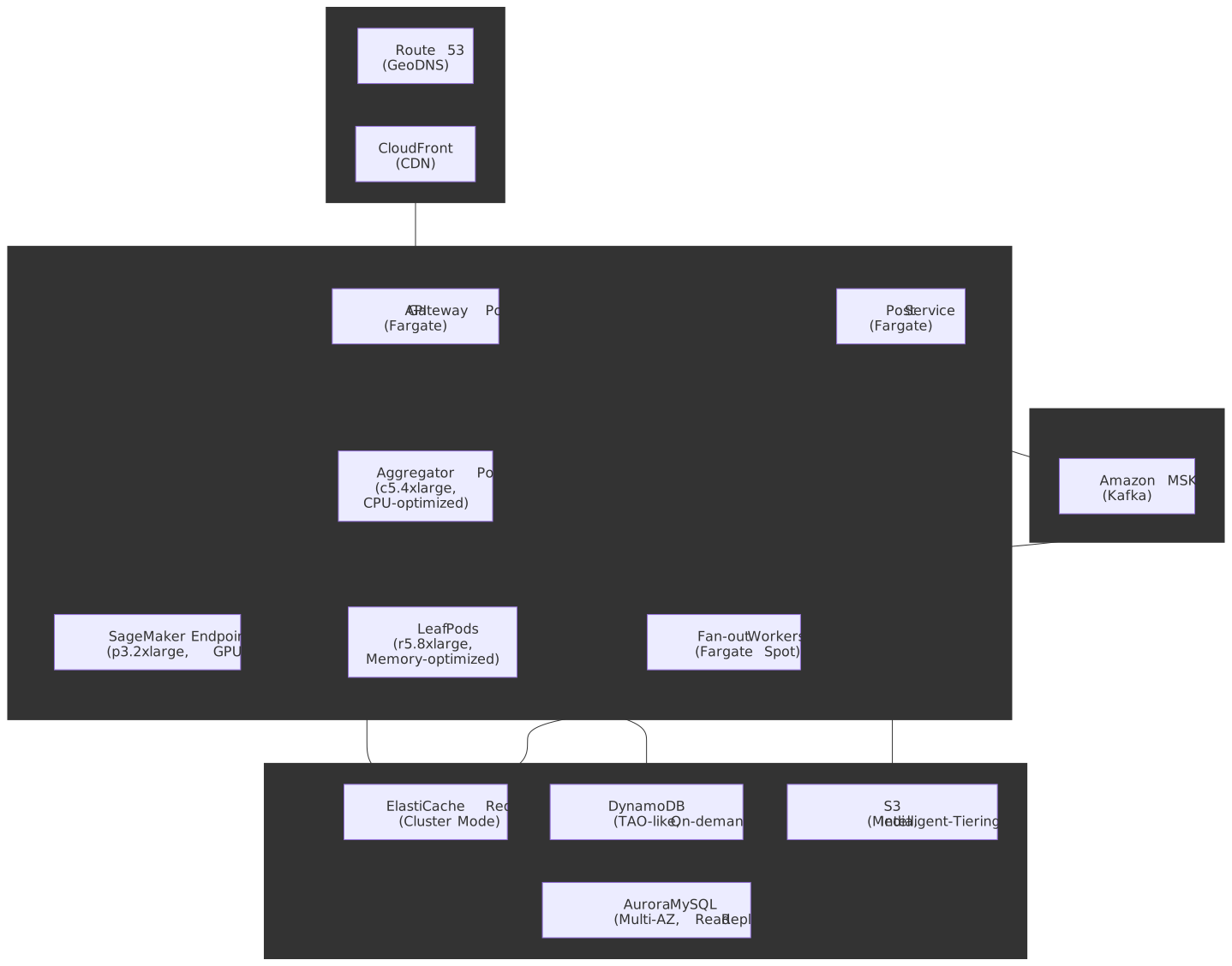
Service configurations (illustrative):
| Service | Configuration | Rationale |
|---|---|---|
| Aggregator | c5.4xlarge (16 vCPU, 32 GB) | CPU-bound ranking computation |
| Leaf | r5.8xlarge (32 vCPU, 256 GB) | Memory-intensive index storage |
| Fan-out workers | Fargate Spot | Cost-effective async processing |
| ElastiCache Redis | r6g.2xlarge cluster mode | Sub-ms feed cache reads |
| Aurora MySQL | db.r6g.4xlarge Multi-AZ | Durability; read replicas for scale |
| DynamoDB | On-demand mode | TAO-style graph store, auto-scaling |
| SageMaker | p3.2xlarge (1 GPU) | Neural network inference |
Multi-Region Deployment
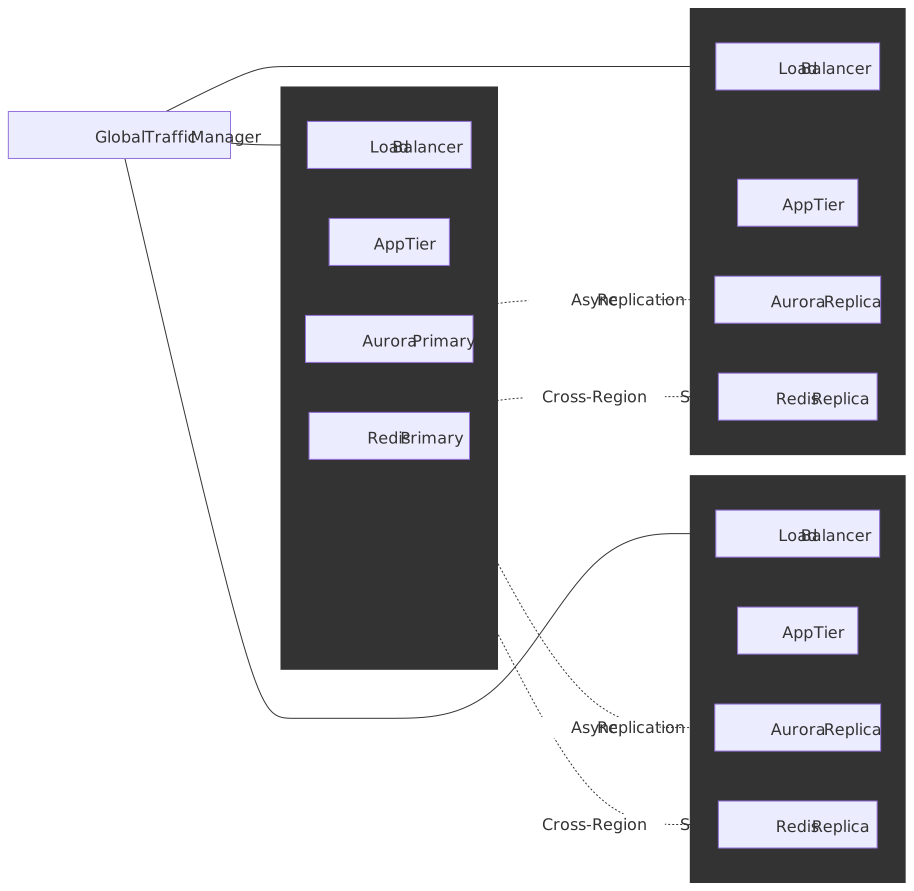
Multi-region considerations:
- Single primary region for writes; reads served locally from per-region replicas.
- Cross-region replication lag in the 50–200 ms range is normal for asynchronous replication and acceptable for social-feed staleness.
- Read-after-write needs sticky routing of the writer back to the primary for a short window, otherwise the writer can read a stale follower replica.
- Failover to a secondary region should be planned and rehearsed; the primary’s loss of write availability is the dominant tail risk.
Failure Modes
| Failure | Detection | Mitigation |
|---|---|---|
| Fan-out worker lag (queue depth) | Kafka consumer lag, fan-out latency p99 | Auto-scale workers; degrade to “feed slightly stale” instead of refusing. |
| Hot key on a celebrity’s post | Per-key request rate, leaf CPU | Lease-get to single-flight; replicate hot keys; rate-limit per-author. |
| Leaf shard loss | Leaf health checks, query failure rate | Replica failover; rebuild from MySQL via Tailer; serve degraded results. |
| Ranking model regression | Calibration / NE drift, online A/B metrics | Pin previous model; roll forward only when calibration recovers. |
| Feed cache stampede after eviction | Cache miss rate spike, DB load | Lease-get; staggered TTLs with jitter; serve stale during refresh. |
| Cross-region replication lag | Replica lag metric, read-after-write hits | Route writers and their reads to primary briefly; hide stale data in UI. |
| Engagement counter loss on crash | Reconciliation diff Redis ↔ MySQL | Persist deltas to Kafka before ack; idempotent flusher consumes the log. |
| Celebrity post visibility lag | Pull-merge latency at read time | Pre-warm celebrity post indices; serve while merging asynchronously. |
Conclusion
Designing a social feed at this scale is less about discovering a clever algorithm and more about acknowledging which trade-off you cannot avoid:
- Sub-second feed reads require pre-computation, which requires write amplification.
- Bounded write amplification requires a pull-style escape valve for high-follower accounts.
- Personalisation at this latency requires a multi-stage funnel so the heaviest model only sees a handful of items.
- Cache correctness under invalidations and stampedes requires explicit coordination — TAO’s leasing is one production-grade answer.
- Eventual consistency is the operational reality; the engineering work is bounding how eventual.
Known limitations of the design above:
- Sub-minute eventual consistency for follower feeds.
- Pull-merged celebrity posts pay a small additional read-time cost.
- Periodic ranker retraining means model staleness between deploys.
- Two fan-out paths and a multi-tier cache add operational surface.
Future enhancements:
- Real-time ranker updates from streaming features (online learning) for short-feedback-loop signals.
- Federated or on-device personalisation for privacy-sensitive ranking signals.
- Graph neural networks for richer content/audience embeddings during retrieval.
- Edge-resident feed assembly for further read-latency reductions on mobile.
Appendix
Prerequisites
- Distributed systems fundamentals (caching, sharding, replication).
- ML basics (training vs serving, feature engineering).
- Graph storage concepts.
- Message queue patterns (pub/sub, fan-out).
Terminology
| Term | Definition |
|---|---|
| Fan-out | Distributing a post to multiple follower feeds. |
| TAO | Facebook’s distributed graph store (The Associations and Objects). |
| Aggregator | Service that queries and combines data from multiple sources. |
| Leaf server | Memory-intensive server holding indexed recent activity. |
| Tailer | Stream consumer that updates leaf indices as posts arrive. |
| Candidate retrieval | First stage of ranking — gathering potential items. |
| Affinity | Strength of relationship between user and content/author. |
| Lease (memcache) | A token issued on a cache miss that arbitrates concurrent writes and rate-limits stampedes. |
Summary
- Hybrid fan-out (push for typical, pull for high-follower accounts) is the only design that survives the long tail of follower distributions.
- TAO-style graph storage with objects + associations admits efficient, single-shard recency queries on association lists.
- Multi-stage ML ranking (≈ billions → ~500 → ~50) lets the heaviest model run on only the items that survive cheap pre-filters.
- Two-tier regional caching with leasing (per Memcache NSDI ‘13) handles invalidations and stampedes; Polaris reports the residual at ≈ 10 nines.
- Eventual consistency (~minutes) is acceptable for social feeds; engagement counts use write-behind with a durable log to bound loss.
- The architecture absorbs ~700 K RPS feed loads through stateless aggregator scaling, sharded leaf storage, and cache-first reads.
References
Real-world implementations:
- Serving Facebook Multifeed: Efficiency, Performance Gains Through Redesign (2015) — Disaggregated aggregator/leaf, ≈ 40 % efficiency gain.
- TAO: The Power of the Graph (2013) — Facebook’s graph store overview.
- News Feed ranking, powered by machine learning (2021) — ML ranking funnel and signals.
- Cache made consistent — Polaris (2022) — 10-nines cache consistency monitoring.
- Scaling Instagram Explore Recommendations (2023) — Two-tower retrieval + late-stage MTML.
- Journey to 1000 models: Scaling Instagram’s recommendation system (2025) — Model registry + funnel at scale.
- Building Facebook Messenger (2011) — MQTT for mobile real-time delivery.
- Maxjourney: Pushing Discord’s Limits with a Million+ Online Users — Elixir/BEAM relays for large-server fan-out.
- How Twitter Uses Redis to Scale (2014, summarised) — 105 TB / 39 M QPS / 10 K+ instances; 800-tweet timeline cap.
- The Infrastructure Behind Twitter: Scale (2017) — Updated cache fleet sizing.
Academic / primary papers:
- TAO: Facebook’s Distributed Data Store for the Social Graph — USENIX ATC ‘13
- Scaling Memcache at Facebook — NSDI ‘13
- Feeding Frenzy: Selectively Materializing Users’ Event Feeds — Silberstein et al., SIGMOD ‘10 — formal push/pull/hybrid analysis on Yahoo’s PNUTS.
- Twitter Heron: Stream Processing at Scale — SIGMOD ‘15 — Twitter’s post-Storm streaming engine; powers timeline fan-out.
- Strong consistency in Manhattan — Twitter’s KV store of record for tweets and timelines.
- Pixie: A System for Recommending 3+ Billion Items to 200+ Million Users in Real-Time — WWW ‘18 — Pinterest’s graph-walk candidate generator.
- Building a smarter home feed (Smartfeed) — Pinterest Engineering — HBase-backed per-user candidate queues.
- Modernizing Home Feed Pre-Ranking Stage — Pinterest Engineering — unified two-tower pre-ranker on a root-leaf inference fleet.
- The Browsemaps: Collaborative Filtering at LinkedIn — RSWeb ‘14 — Hadoop-batch / KV-served item-to-item CF platform.
- LiRank: Industrial Large Scale Ranking Models — LinkedIn’s ranking framework.
Books:
- Kleppmann, Designing Data-Intensive Applications — Ch. 1 on home-timeline fan-out as the canonical example; Ch. 11 on stream-based write-behind.
Related articles in this site:
- Design Real-Time Chat and Messaging — WebSocket / MQTT-based messaging.
- Design a Notification System — Multi-channel notification delivery.