Frontend Data Fetching Patterns and Caching
Server state is not application state. It lives elsewhere, can become stale at any time, and arrives over a lossy channel. The browser stack now offers half a dozen transports (REST, GraphQL, Connect, gRPC-Web, tRPC, JSON-RPC, SSE, WebSocket, WebTransport), two cache layers (the HTTP cache the browser already runs and the application cache a library puts on top), and a fast-evolving rendering model (Suspense, the use() hook, React Server Components, streamed responses). The standard data-fetching libraries — TanStack Query, SWR, Apollo Client, Relay, RTK Query — converge on the same small set of patterns to bridge those layers. This article walks the stack from the wire up: choosing a transport, what the browser cache already does for free, how request deduplication and stale-while-revalidate actually work, when to reach for a normalized cache, how Suspense and RSC change the fetch model, when streaming pays off, how to push from the server, how to prefetch without waterfalls, and how retries differ for idempotent vs side-effecting calls — with the citations and library defaults you need to defend a choice in code review.
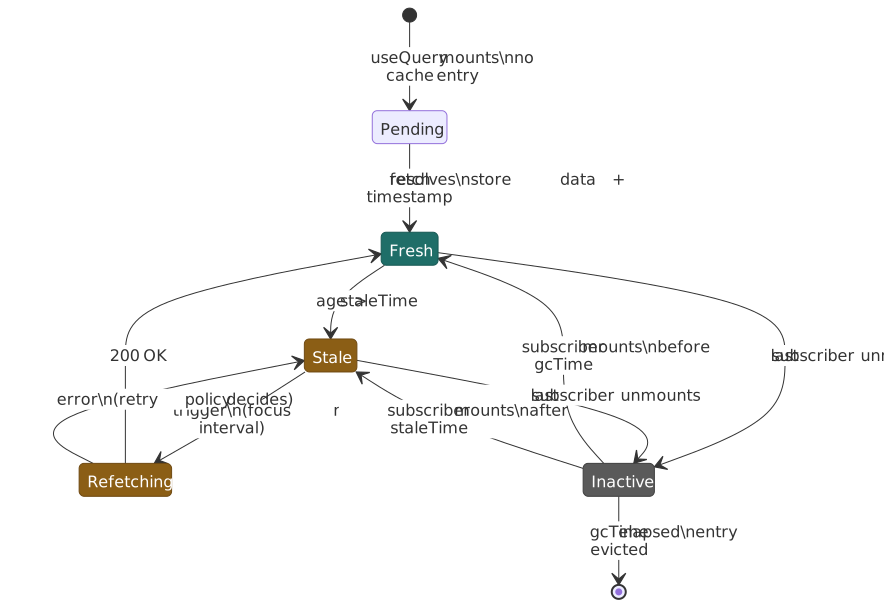
Mental model
Frontend data fetching is the management of three tensions:
- Freshness vs latency. Serve cached data immediately or wait for the network?
- Correctness vs complexity. Normalize entities for consistency, or store one copy per query and accept duplication?
- Memory vs liveness. Keep cache entries alive for instant revisits, or evict aggressively to bound footprint?
Five patterns recur across every mature library:
- Request deduplication. Multiple subscribers to the same key share one in-flight promise, so a render that calls
useUser(123)from five components produces one network call. - Stale-while-revalidate. Serve the cached value, then refresh in the background if it is past its freshness window.
- Cache shape. Either store one entry per query (per-query cache) or one entry per entity ID with queries holding references (normalized cache).
- Invalidation. Time-based, mutation-based, or tag-based — invalidation is the hardest part of caching, and most libraries solve it by refetching, not by patching.
- Garbage collection. When no component subscribes to a key, evict it after a configurable timeout so the cache does not grow unbounded.
The library defaults you will run into in 2026 (verified against current docs):
| Library | staleTime (default) |
Dedup default | Default retries | Cache shape |
|---|---|---|---|---|
| TanStack Query v5 | 0 (always stale) |
per-key, in-flight | 3, exponential min(1000 · 2^i, 30_000) ms |
per-query |
| SWR (Vercel) | n/a (uses dedup window) | dedupingInterval defaults to 2000 ms |
shouldRetryOnError: true (no default errorRetryCount, ~5 s base) |
per-query |
| Apollo Client | n/a (cache-first) | queryDeduplication: true |
0 (configure via RetryLink) |
normalized by __typename:id |
| RTK Query | n/a (subscriber-driven) | per endpoint + serialized arg | 0 (opt-in via retry() wrapper, default 5 attempts when used) |
per-query, tag-based |
The rest of this article walks each pattern from first principles, then surfaces where the libraries disagree and why.
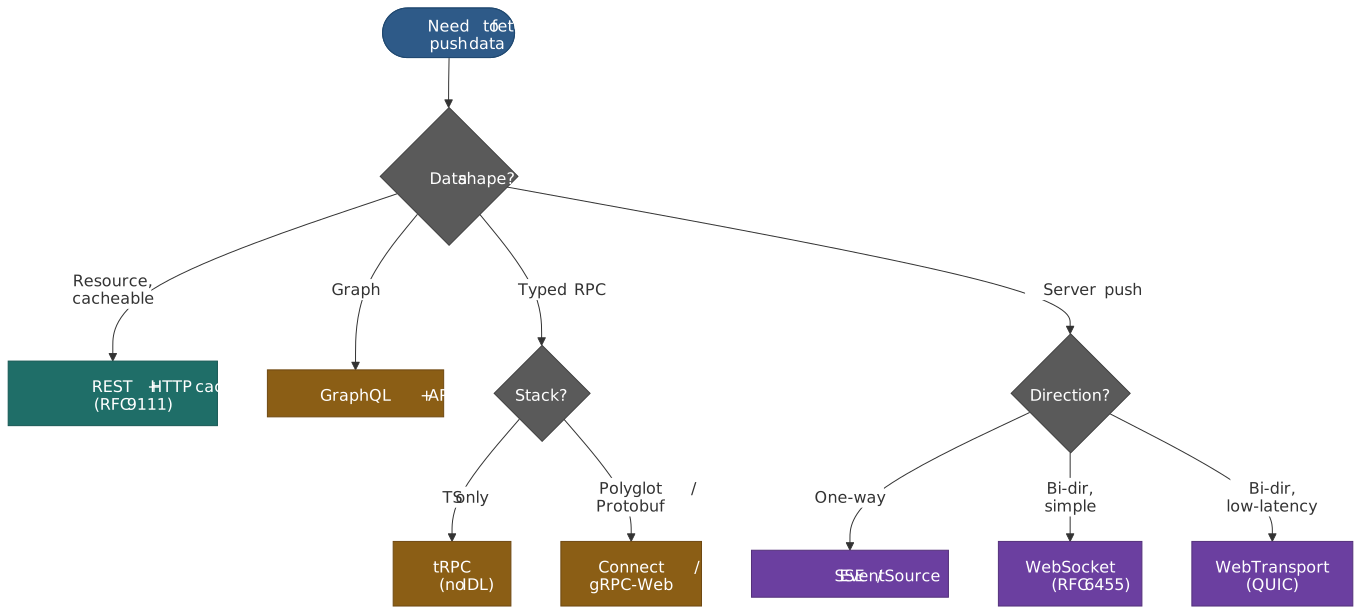
Choosing a transport
Before talking about caches, pick the wire format. The browser side now has five viable families, and they push different amounts of work onto the cache layer above them.
REST over fetch
The default. Resource-oriented URLs, HTTP verbs with the semantics defined in RFC 9110 §9, a body shape negotiated per endpoint, and the entire HTTP cache surface (RFC 9111) for free. The WHATWG Fetch standard specifies the request/response model the browser exposes — cache, credentials, mode, redirect, referrerPolicy, and signal are the knobs that matter for any client.
REST’s strengths are exactly that the network already understands it: CDNs cache GET responses, conditional requests collapse them to 304s, If-None-Match does not need a single line of application code. Its weakness is that the response shape is fixed per endpoint, so non-trivial UIs either over-fetch or fan out into N round trips.
GraphQL and persisted queries
GraphQL collapses the round-trip count by letting the client describe the exact subset of the graph it needs, with the server resolving the union per request. The GraphQL specification (current October 2021 edition) defines the type system, query language, and execution semantics; later working drafts add @defer and @stream for incremental delivery.
The two operational footguns are payload size (queries can be large, and they ride on every request) and HTTP cacheability (every operation is a POST to /graphql by default, so neither browser nor CDN can cache it). Persisted queries solve both. With Apollo’s Automatic Persisted Queries (APQ), the client first sends only a SHA-256 hash in extensions.persistedQuery.sha256Hash; on cache miss the server returns PersistedQueryNotFound, the client retries with the full query, and the mapping is stored for next time1. Because the hash is short and stable, hashed queries can ride a GET request and become CDN-cacheable2. Relay, by contrast, persists at compile time: the Relay compiler writes an <id, query> map at build, the runtime sends only the doc_id, and the server uses a static safelist — which doubles as the security model.
gRPC-Web and Connect
Native gRPC needs HTTP/2 trailers and streaming framing the browser does not expose, so grpc-web runs through a translating proxy (Envoy, the gRPC-Web Go proxy, or a sidecar) that re-frames trailers into the body. It supports unary and server-streaming, but client-streaming and bidirectional-streaming are not supported in browsers because the Fetch API cannot write a request body incrementally on every browser3.
Connect (Buf) is the protocol that drops the proxy: it speaks plain HTTP/1.1, HTTP/2, or HTTP/3 with Content-Type: application/proto or application/json, and the same connect-web client can also speak gRPC and gRPC-Web by config. Errors come back as HTTP statuses with a JSON body, so they are debuggable in the network panel; bidirectional streams need duplex: 'half' (or full once standardized) on the underlying Request.
tRPC
tRPC is the typed-RPC option for full-stack TypeScript. There is no IDL and no codegen step — the server router’s types are imported by the client over the type system, so appRouter.user.byId.query({ id: 1 }) is type-checked end-to-end. Under the hood it batches over POST /trpc/<path>?batch=1. Trade-off: fastest to ship in a TS monorepo, but no polyglot story, no schema-anchored contract for non-TS consumers, and (by default) no HTTP caching because everything is POST.
JSON-RPC 2.0
JSON-RPC 2.0 is the bare-bones option: a single POST with { jsonrpc: "2.0", method, params, id } and a corresponding response. It is the lingua franca of Ethereum nodes, language-server protocols, and many internal tools, but on the browser side it is a strict downgrade from REST or Connect — the spec does not define HTTP-level errors, batching is optional, and no caching falls out for free.
Quick comparison
| Transport | Codegen / IDL | Browser cache friendly | Streaming | Best fit |
|---|---|---|---|---|
| REST | OpenAPI optional | Yes (RFC 9111) | Body via Streams API only | Resource-oriented, public, CDN-fronted APIs |
| GraphQL + APQ | SDL + codegen | Yes (with persisted GET) | @defer / @stream (incr.) |
Graph-shaped UIs, normalized client cache |
| gRPC-Web | .proto + codegen |
No | Server-stream only in browser | Internal services already on Protobuf |
| Connect | .proto + codegen |
Partial (JSON GET) | Server + bidi (with duplex) |
Polyglot RPC without a translating proxy |
| tRPC | None (TS inference) | No (POST batch) | Subscriptions over WS | TS-only monorepos |
| JSON-RPC 2.0 | None (informal) | No (single POST) | Out of scope | Existing JSON-RPC ecosystems (nodes, LSP, etc.) |
Tip
Transport choice and cache shape are linked: GraphQL’s response shape is what makes Apollo and Relay’s normalized caches possible at all, while REST’s resource URL is what the browser HTTP cache keys on. Picking a transport that fights the cache layer above it is how you end up reinventing both.
HTTP caching: the layer underneath
The browser has its own cache, governed by RFC 9111 (HTTP Caching, June 2022), which obsoleted RFC 7234 with clarifications and no breaking semantics4. Application caches sit on top of (or, more often, route around) it. Knowing what the browser already does is the difference between layering caches usefully and double-caching by accident.
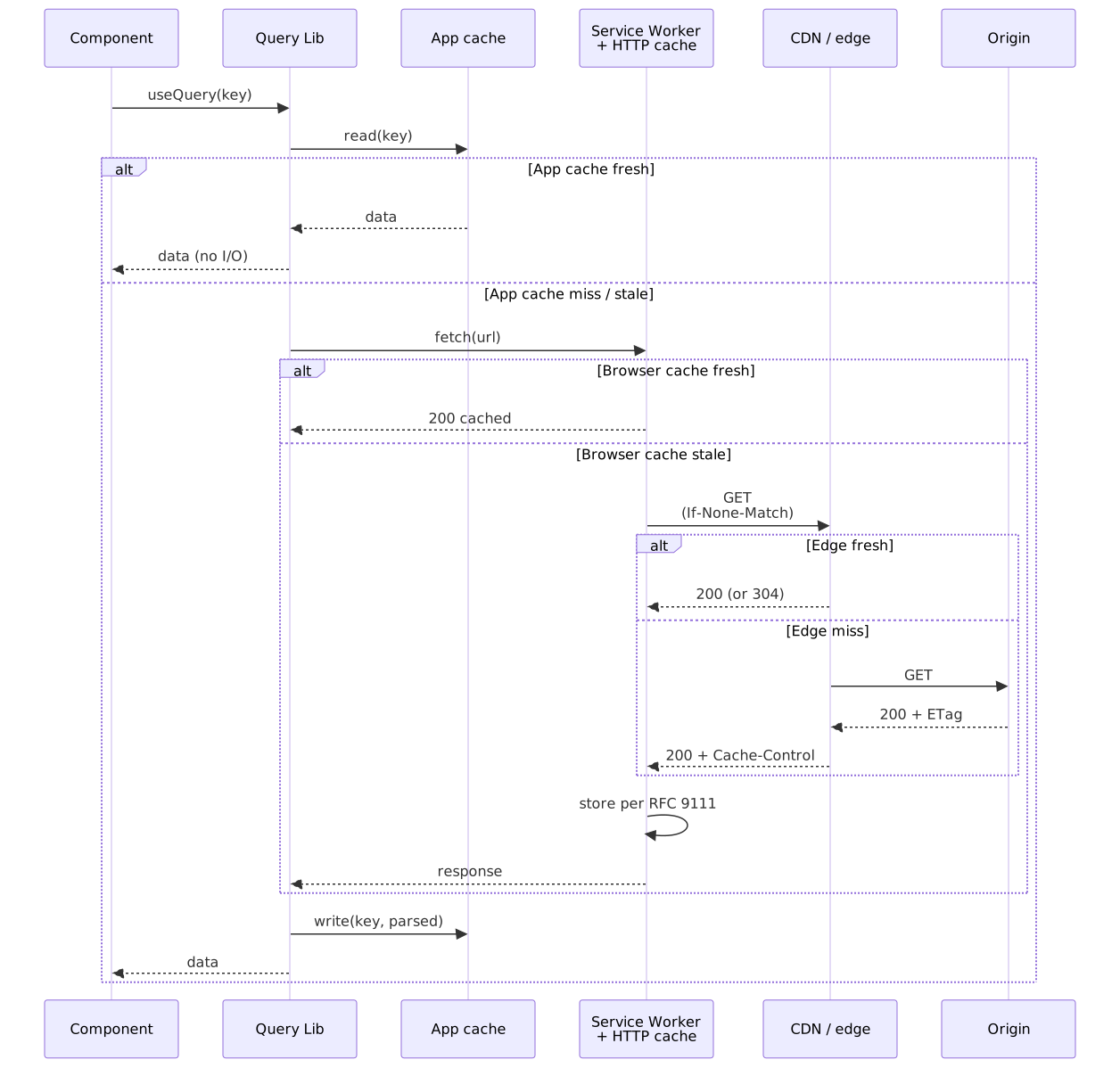
Two transport-level details shape what the upper layers can do. First, both HTTP/2 (RFC 9113) and HTTP/3 (RFC 9114) multiplex many requests over one connection, so the old “make endpoints chunky to avoid round-trip cost” advice no longer pays off — many small GETs on one connection are competitive with one fat POST, and they cache better. Second, HTTP/2 still suffers TCP head-of-line blocking when one stream stalls; HTTP/3 over QUIC removes it per-stream, which is why a slow image no longer freezes a JSON fetch on the same connection.
Cache-Control directives that matter
| Directive | Meaning | Use case |
|---|---|---|
max-age=N |
Response is fresh for N seconds | Static assets, API responses with a known TTL |
no-cache |
Cache may store, but must revalidate on every reuse | HTML shells, dashboards that must reflect changes |
no-store |
Do not store at all | Authenticated, user-specific responses |
private |
Only the user-agent cache may store | User-specific data, not CDN-cacheable |
public |
Any shared cache may store | Static assets, public read-only APIs |
s-maxage=N |
Freshness for shared caches; overrides max-age for them |
Edge TTL distinct from browser TTL |
stale-while-revalidate=N |
Serve stale up to N seconds while revalidating in background | RFC 5861 extension for async refresh5 |
Note
no-cache does not mean “do not cache”. It means “store, but revalidate before reuse”. The directive that prevents storage is no-store. RFC 9111 §5.2.2.4 spells this out explicitly.
Conditional requests and validators
When a cached response is stale, browsers issue a conditional request to learn whether the cached representation is still valid:
GET /api/users/123 HTTP/1.1If-None-Match: "abc123"The server answers either 304 Not Modified (use the cached body) or 200 OK with a fresh body and a new validator. RFC 9110 §13 defines the validator semantics6:
- Strong ETag (
"abc123") — byte-for-byte identical representation. Required for range requests. - Weak ETag (
W/"abc123") — semantically equivalent, allowing minor variations such as whitespace. - Last-Modified — second-resolution timestamp. Strictly weaker than ETag because changes within the same second collide.
The reason you see ETags everywhere despite Last-Modified being simpler is that one-second resolution is too coarse for systems that mutate frequently — two writes in the same second look identical to a Last-Modified-only validator.
Browser-level stale-while-revalidate
Cache-Control: max-age=600, stale-while-revalidate=30 instructs intermediaries to:
- Treat the response as fresh for 600 s.
- From 600 s to 630 s, return the cached response immediately and revalidate in the background.
- After 630 s, block on revalidation.
This works without any JavaScript — but it lives at the HTTP layer, with no signal back to the application about which subscribers are waiting on what. Library-level SWR (the pattern, not the package) layers a per-key state machine on top, with knobs for “refetch on window focus” or “refetch on reconnect” that the HTTP cache cannot express. See the dedicated SWR section below.
Request deduplication
Without deduplication, a page that mounts five components calling useUser(123) issues five identical requests. Deduplication promises that, while a request is in flight, all subscribers share the same promise — the network sees one request and the cache sees one write.
The promise-memoization pattern
The mechanism is straightforward: store the in-flight promise keyed by request identity, and return it to all callers until it settles.
const inflight = new Map<string, Promise<unknown>>()export async function deduplicated<T>( key: string, fetcher: () => Promise<T>,): Promise<T> { const existing = inflight.get(key) if (existing) return existing as Promise<T> const promise = fetcher().finally(() => { inflight.delete(key) }) inflight.set(key, promise) return promise}The cached value is the promise, not the response. All callers await the same promise, so success and failure both fan out to every subscriber. That is usually what you want: if the API is down, every consumer should observe the failure together.
How each library does it
- TanStack Query deduplicates by the serialized query key while a fetch is in flight. There is no time window; once the fetch settles, the next subscriber drives whatever policy the key is configured with7.
- SWR uses a time-based window.
dedupingIntervaldefaults to 2000 ms8; subscribers within that window share the same promise even after it settles, which makes SWR feel “eventually consistent” rather than strictly deduplicated. - Apollo Client deduplicates by query document + variables. The behaviour is controlled by the top-level
queryDeduplicationoption (defaulttrue)9; an in-flightwatchQuerywill satisfy any other identicalwatchQueryissued before it resolves, before the request hits the link chain. - RTK Query deduplicates per endpoint + serialized argument. The cache entry is created by the first subscription and reference-counted — the entry stays alive while at least one subscriber exists, then enters a
keepUnusedDataForcountdown that defaults to 60 s10.
Edge cases
- Mutations racing in-flight queries. TanStack Query’s
invalidateQuerieswaits for in-flight queries on the same key to settle before refetching. SWR’smutate(key)cancels in-flight requests for that key. Apollo’s mutationupdatecallback runs after the mutation completes, before any refetch, so cache writes happen in a deterministic order. - Shared error fan-out. Because all subscribers await the same promise, a single 500 propagates to every subscriber’s error boundary. This usually matches intent, but it does mean that a single component’s
<ErrorBoundary>decision affects components it does not own. - SSR and per-request scope. Server-rendered apps must construct a new query client per request — otherwise one user’s cached
User:1leaks into the next user’s request. TanStack Query’s SSR guide and Apollo’s per-request cache pattern both make this explicit.
Application-level caching
Application caches store fetched data in JavaScript memory, separate from the browser’s HTTP cache. They power instant UI updates, optimistic mutations, and fine-grained per-key control. The first design decision is shape.
Per-query vs normalized
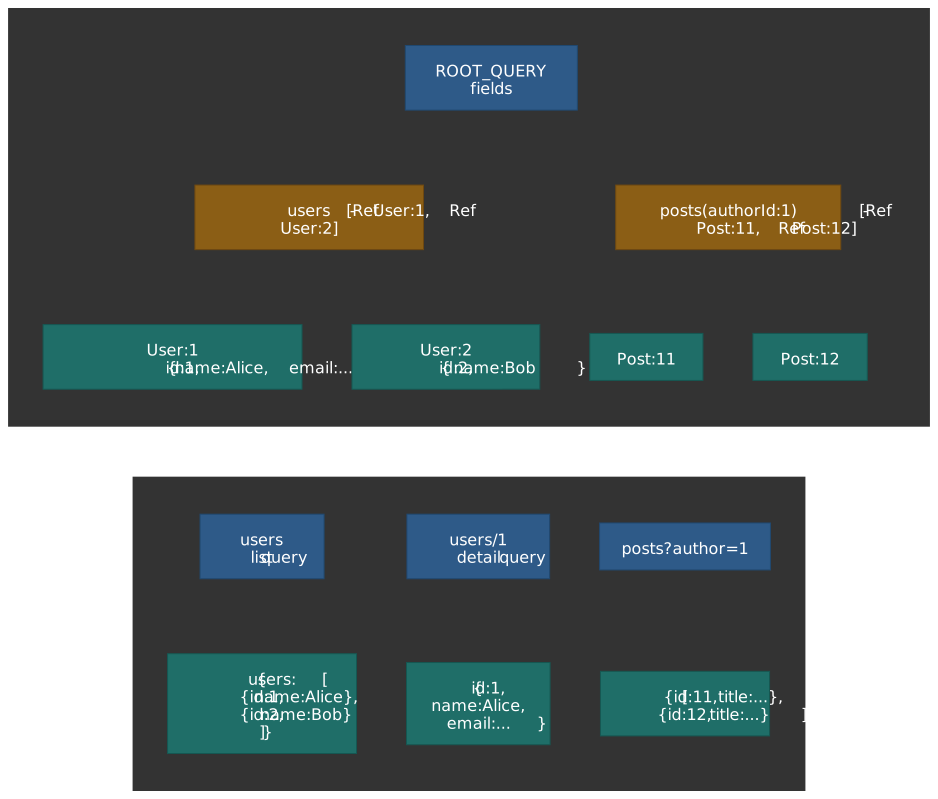
Per-query cache (TanStack Query, SWR, RTK Query). Each query key maps to one entry containing the response payload. The same User { id: 123 } may exist in five entries — list, detail, two relationship lists, one search result — and each is its own copy.
const cache = new Map([ ['users', { data: [user1, user2], updatedAt: 1739999990 }], ['users/1', { data: user1, updatedAt: 1739999991 }], ['posts?author=1', { data: [post1, post2], updatedAt: 1739999992 }],])Trade-off: simple mental model, no schema required, easy to reason about. But updating a single user requires invalidating every key that contains that user — which the cache doesn’t know about, so you do it explicitly via tags or key patterns.
Normalized cache (Apollo Client, Relay). Entities are stored once, keyed by __typename:id (Apollo’s default11) or a custom keyFields policy. Queries store references, not values. Mutations that update User:123 immediately update every query that references it.
const cache = { 'User:1': { __typename: 'User', id: 1, name: 'Alice' }, 'User:2': { __typename: 'User', id: 2, name: 'Bob' }, 'Post:11': { __typename: 'Post', id: 11, author: { __ref: 'User:1' } }, ROOT_QUERY: { 'users': [{ __ref: 'User:1' }, { __ref: 'User:2' }], 'posts({"authorId":1})': [{ __ref: 'Post:11' }], },}Trade-off: automatic consistency, smaller in-memory footprint at scale, near-zero invalidation work after well-formed mutations. Cost: every entity needs a stable identity, paginated lists need an explicit merge policy, and cache-write debugging is harder because the cache is a graph, not a tree.
| Decision factor | Per-query cache | Normalized cache |
|---|---|---|
| Same entity in many queries | Duplicated, manual invalidation | Single source of truth |
| Schema discipline required | Low | High (stable IDs everywhere) |
| Pagination / list merging | Built-in helpers | Custom merge per field |
| Mutation → many UI updates | Refetch / setQueryData fan-out | Automatic via reference graph |
| Debugging cache writes | Read one entry | Walk the reference graph |
| Sweet spot | REST + clean query keys | GraphQL with disciplined IDs |
Tip
Reach for normalization when (a) you have GraphQL (the schema gives you the IDs for free), or (b) the same entity appears in many places and mutation fan-out is expensive to wire by hand. For most REST apps, the per-query cache plus tag-based invalidation is the cheaper default.
Cache invalidation
The cache cannot know that the server changed unless something tells it. Three families of solutions exist:
Time-based. Mark data stale after N seconds. TanStack Query’s staleTime defaults to 0 — every read is considered stale and triggers a background refetch on the next configured trigger12. SWR’s refreshInterval polls. Time-based invalidation is simple but imprecise: data may be obsolete instantly or stable for hours.
Mutation-based. After a mutation succeeds, mark related queries stale or refetch them.
const queryClient = useQueryClient()const updateUser = useMutation({ mutationFn: api.updateUser, onSuccess: (_, variables) => { queryClient.invalidateQueries({ queryKey: ['users'] }) queryClient.invalidateQueries({ queryKey: ['users', variables.id] }) },})Tag-based. Queries declare what they provide, mutations declare what they invalidate, and the framework wires the dependency graph for you. This is RTK Query’s primary mechanism13.
const api = createApi({ baseQuery: fetchBaseQuery({ baseUrl: '/api' }), tagTypes: ['User'], endpoints: (builder) => ({ getUsers: builder.query({ query: () => 'users', providesTags: (result) => result ? [...result.map(({ id }) => ({ type: 'User' as const, id })), { type: 'User', id: 'LIST' }] : [{ type: 'User', id: 'LIST' }], }), updateUser: builder.mutation({ query: ({ id, ...body }) => ({ url: `users/${id}`, method: 'PUT', body }), invalidatesTags: (_result, _error, { id }) => [{ type: 'User', id }], }), }),})Tags are explicit and predictable. They are also a place to make subtle mistakes: if a mutation forgets to invalidate a tag, no warning fires — the UI just stays stale until something else triggers a refetch.
Garbage collection
Without bounded eviction, caches grow with usage. Each library encodes a different policy:
- TanStack Query —
gcTime(formerlycacheTimebefore v514) defaults to 5 minutes. A query becomes inactive when it has zero subscribers; aftergcTimeof inactivity the entry is removed.staleTimeandgcTimeare independent — longstaleTimedoes not extendgcTime. - SWR — no explicit GC. Cache entries persist for the lifetime of the cache provider;
dedupingIntervalcontrols reuse, not eviction. For long-lived sessions this is something you size by configuring a custom cache provider or scoping the<SWRConfig>. - Apollo Client — manual:
cache.evict({ id: 'User:123' })removes an entry, thencache.gc()sweeps unreachable references. There is no automatic time-based GC. - RTK Query —
keepUnusedDataFor(default 60 s) starts after the last subscriber unmounts; if a new subscriber arrives before the timer fires, the cache entry survives.
Memory ceilings
Browser memory caps are smaller than they appear, especially on mobile, and the limits are not formally specified. Use these as planning estimates, not contracts:
| Surface | Practical ceiling | Source |
|---|---|---|
| Desktop Chrome (64-bit) JS heap | ~4 GB per renderer process | Chromium issue 41133247 — design ceiling, not practically reachable |
| Desktop Firefox JS heap | Similar GB range, version-dependent | SpiderMonkey GC docs |
| Mobile Safari per-page memory | ~200–400 MB before the tab is killed | iOS Safari does not publish a number; widely reported empirical range, with crashes appearing as silent reloads, not exceptions |
| Per-page measurement | performance.measureUserAgentSpecificMemory() (Chromium-only) |
MDN — Cross-Origin Isolation required; Safari does not implement it as of 2026 |
Caution
Mobile Safari does not throw a JavaScript error when it hits the limit — the page is killed and reloaded. Plan for an LRU eviction policy in any app that holds large normalized caches on mobile.
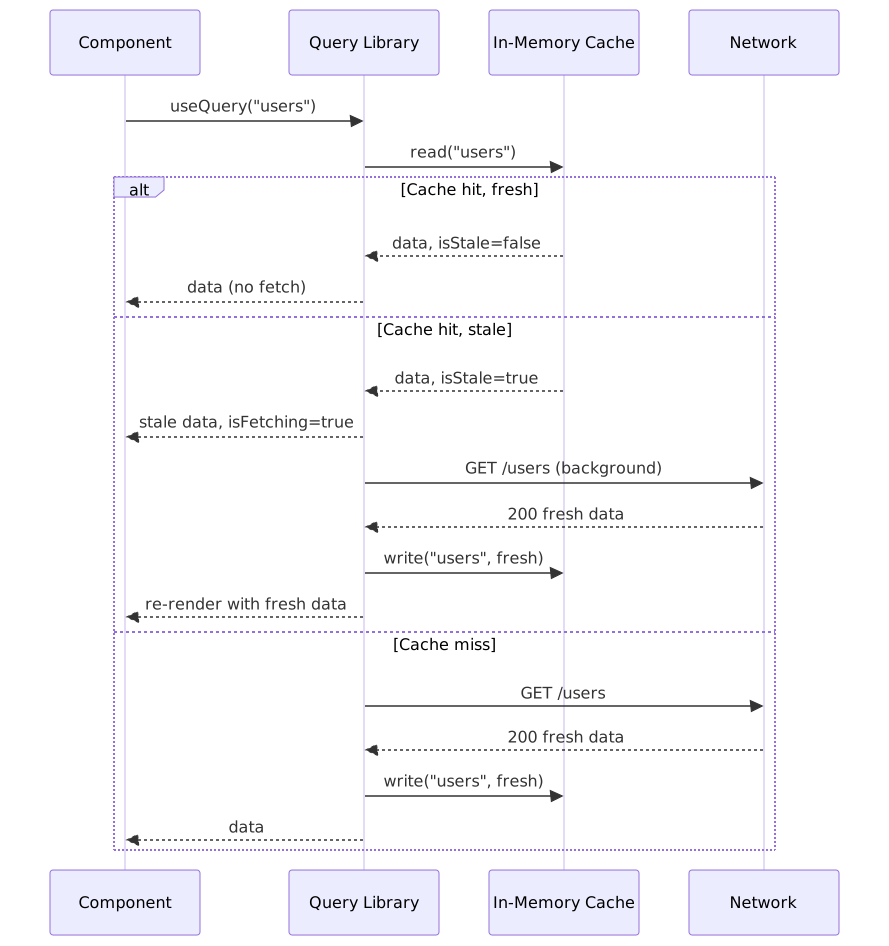
Stale-while-revalidate: the application pattern
The HTTP-level stale-while-revalidate directive (RFC 5861) is one mechanism. The application-level SWR pattern — a state machine per query key with revalidation triggers and isFetching state — is a different, finer-grained mechanism implemented inside the library.
Implementation in TanStack Query
const { data, isStale, isFetching } = useQuery({ queryKey: ['users'], queryFn: fetchUsers, staleTime: 60_000, refetchOnWindowFocus: true, refetchOnMount: true,})data is always the cached value (stale or fresh). isStale reflects whether the entry is past its staleTime. isFetching is true while a background fetch is in flight. There is no “loading” state for a stale read — by design, the user sees content first.
Revalidation triggers across libraries
| Trigger | TanStack Query | SWR | Apollo |
|---|---|---|---|
| Component mount | refetchOnMount |
revalidateOnMount / revalidateIfStale |
fetchPolicy |
| Window focus | refetchOnWindowFocus |
revalidateOnFocus (default true) |
manual |
| Network reconnect | refetchOnReconnect |
revalidateOnReconnect (default true) |
manual |
| Polling interval | refetchInterval |
refreshInterval |
pollInterval |
Window-focus revalidation is the trigger most teams forget. Users frequently switch tabs; when they come back, the data they see was last fetched minutes ago. Focus-triggered revalidation is the difference between “stale until refresh” and “current within seconds” with no user action.
Suspense, transitions, and the use() hook
React 19 collapsed the long-running “Suspense for data fetching” experiment into a stable model: components throw promises, the nearest <Suspense> boundary catches them and shows a fallback, and the use() hook is the single API that reads a promise (or a context) inside render.
The mental shift is small but consequential: the component no longer owns “loading state” — the boundary does. Three rules fall out:
use()may be called conditionally, unlike the rules-of-hooks pre-19 hooks. It is meant to read a promise that the parent has already kicked off, not to start one inside render15.- Promises must be cached. A new promise on every render re-suspends forever. Either pass a stable promise from a parent (an RSC, a router loader, or a query library) or memoise via TanStack Query’s
useSuspenseQuery, which dedupes by key. - Errors propagate to the nearest Error Boundary.
use()does not surface atry/catchpath; you wrap with an Error Boundary or attach.catchto the underlying promise15.
function UserCard({ id }: { id: string }) { const user = useSuspenseQuery({ queryKey: ['user', id], queryFn: () => api.user(id) }).data return <article>{user.name}</article>}export default function Page({ params }: { params: { id: string } }) { return ( <ErrorBoundary fallback={<Failure />}> <Suspense fallback={<Skeleton />}> <UserCard id={params.id} /> </Suspense> </ErrorBoundary> )}Transitions: keep the current screen interactive
useTransition and useDeferredValue mark state updates as non-urgent so React keeps the previous UI interactive while the new tree suspends. Without a transition, switching tabs in a Suspense-driven UI hard-replaces the screen with the fallback. Inside startTransition, React keeps the old tree visible until the new one’s data resolves16.
const [isPending, startTransition] = useTransition()function selectTab(next: Tab) { startTransition(() => setTab(next))}Boundary granularity is a performance lever
One Suspense boundary at the page root means the whole page blocks on the slowest fetch. Many small boundaries means parts stream in independently. The right grain is “one boundary per independent skeleton” — a sidebar, a detail panel, a chart — not “one per query”.
Important
useSuspenseQuery (TanStack Query) and useReadQuery / usePreloadedQuery (Relay) are the wrappers that play correctly with Suspense — they treat the cache as the promise source. Don’t hand-roll a useState(promise) and pass it to use(); you will spend the next week chasing render loops.
React Server Components and server-side fetching
React Server Components (RSC) push data fetching into the same async render pass that produces the HTML, so the network round-trips happen on the server (next to the data) and only serialised UI lands in the browser. Three things change for the data-fetching layer:
Per-request automatic deduplication
In an RSC tree, React memoises identical fetch calls within the same request — five components calling fetch('/api/me') issue one request, regardless of which Suspense boundary they sit under. Memoisation is per render, not across users, and it is unaffected by cache: 'no-store'. This is the server analogue of TanStack Query’s request dedup, and it is why you can mostly stop passing data through props in an RSC app.
Cache vs memoisation are different layers
Next.js 15 (and Next.js 16) made the two layers explicit and changed the default of fetch from force-cache to no-store, so server-side fetch is uncached unless you opt in17. Per-request memoisation still applies; the on-disk Data Cache does not. Opt back in with fetch(url, { cache: 'force-cache', next: { revalidate: 60, tags: ['user'] } }), then invalidate with revalidateTag('user') after a server action mutates state.
Tag-based invalidation across the boundary
Server-side tag invalidation (revalidateTag, revalidatePath) is the missing half of optimistic updates: a server action mutates the database, calls revalidateTag('orders'), and any RSC tree referencing that tag re-renders on the next navigation or refresh. The client-side cache (TanStack Query, RTK Query) still has to invalidate its own keys; the two graphs are independent and have to be wired together — usually via the Server Action’s return value triggering queryClient.invalidateQueries.
Caution
Do not put per-user data into a force-cache server fetch unless you scope the cache key. RSC’s data cache is per-route + per-input; if the input is “the current user’s auth header”, you must include that in the cache key explicitly or the cache will leak between users.
Streaming responses
Streaming overlaps the network round-trip with the parse and render: bytes arrive incrementally, the parser produces partial trees, and the user sees content before the whole response is in. Two layers cooperate.
The Streams API
The WHATWG Streams standard gives fetch a .body of type ReadableStream<Uint8Array>, which can be transformed (pipeThrough(TextDecoderStream())) and consumed asynchronously:
const res = await fetch('/api/feed/stream')const reader = res.body!.pipeThrough(new TextDecoderStream()).getReader()for (;;) { const { value, done } = await reader.read() if (done) break emit(value)}Anything that can produce bytes incrementally on the server — NDJSON, JSON Lines, SSE-without-an-EventSource, custom binary frames — flows through the same API. AbortSignal cancels the body stream cleanly, so a navigation away closes the underlying socket.
RSC streaming and progressive Suspense flush
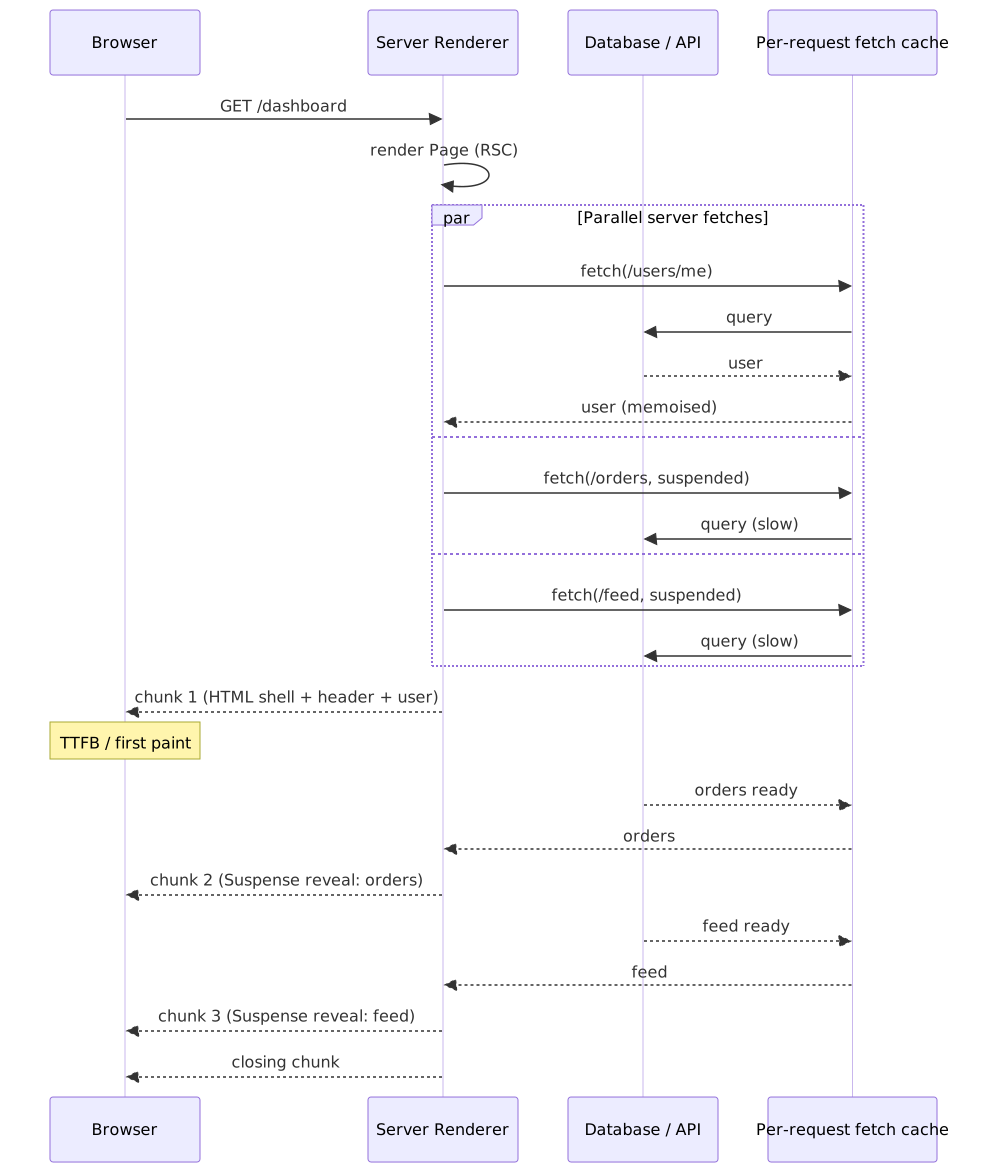
When an RSC tree contains multiple Suspense boundaries, the server sends the shell first, then a chunk per boundary as its data resolves. The browser parses each chunk, the React runtime swaps the fallback for the resolved subtree, and TTFB stays decoupled from the slowest fetch. The trade-off is honest: streamed responses cannot set Content-Length, cannot be cached as a single byte range, and intermediaries that buffer (some old proxies, some logging middleware) defeat the benefit.
GraphQL has the equivalent at the field level: the @defer and @stream directives let the server flush part of a response now and the rest later, on a single multipart/mixed HTTP response. Apollo Client and Relay both implement the directives end-to-end.
Optimistic updates with rollback
SWR addresses read latency. Optimistic updates address write latency. They compose, but they solve different problems — and an optimistic update is the one place where the cache becomes a partially-correct mirror of the server, so the rollback path matters as much as the happy path.
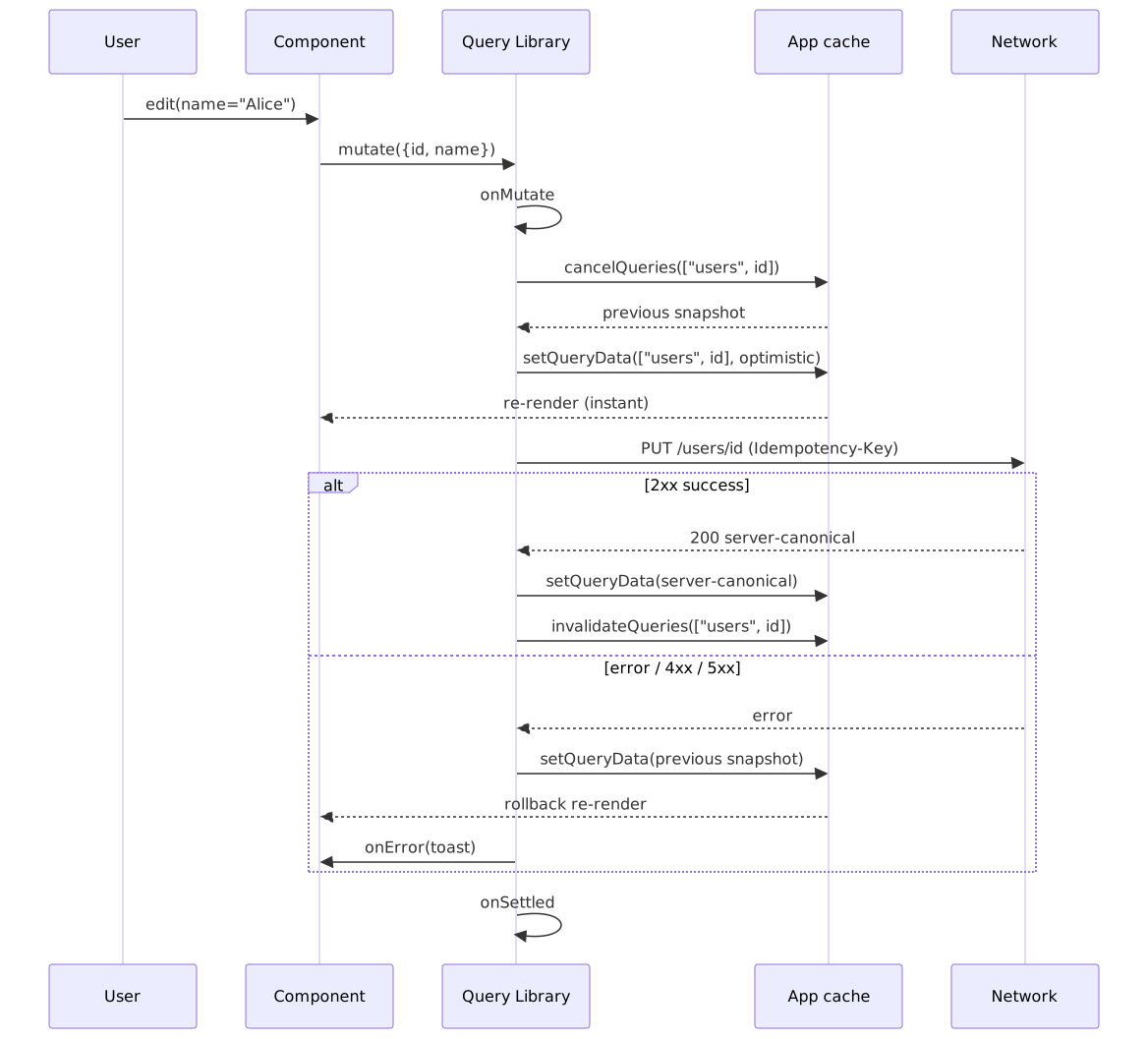
const queryClient = useQueryClient()const updateUser = useMutation({ mutationFn: api.updateUser, onMutate: async (newUser) => { await queryClient.cancelQueries({ queryKey: ['users', newUser.id] }) const previous = queryClient.getQueryData(['users', newUser.id]) queryClient.setQueryData(['users', newUser.id], newUser) return { previous } }, onError: (_err, newUser, context) => { queryClient.setQueryData(['users', newUser.id], context?.previous) }, onSettled: (_data, _err, newUser) => { queryClient.invalidateQueries({ queryKey: ['users', newUser.id] }) },})Three operational notes the docs underplay:
- Always cancel in-flight reads first. Without
cancelQueries, a refetch that resolves afteronMutatewrites will overwrite the optimistic value with stale server data — the UI flickers, then “corrects” to the wrong number. - Snapshot is per-key. If a mutation writes to several keys, snapshot each one in
onMutate, restore each one inonError. A singlepreviousis the most common rollback bug. - Always send an
Idempotency-Key. Optimistic mutations have a higher retry rate (offline → reconnect, navigation cancellation, transient 5xx) and the rollback path will not save you from a duplicate side effect at the server. See the idempotency section below.
For mutations with low success-rate variance, the simpler “show a spinner, write through, then refetch” path is often the right default; reach for optimistic only when latency-to-paint actually drives the metric you are moving.
Pagination
Pagination affects both API design and cache structure. The choice between cursor and offset has performance implications you cannot retrofit later.
Cursor (keyset) vs offset
Offset — GET /api/posts?offset=100&limit=20. The database scans through the first 100 rows and discards them. Time grows linearly with offset depth, and any insertions or deletions between page reads cause duplicates or gaps.
Cursor (also called keyset or seek pagination) — GET /api/posts?cursor=eyJpZCI6MTIzfQ&limit=20. The cursor encodes a position in an indexed sort, so the database seeks directly to the row and reads forward. Performance is constant in the page depth, and concurrent inserts/deletes do not skip or duplicate items18. The trade-off is no random “jump to page 50” — pagination becomes strictly forward/backward.
The performance gap is order-of-magnitude, not marginal. The exact numbers depend on the index, table width, and storage, but the shape is consistent across implementations:
| Offset depth | Offset query (illustrative) | Cursor query |
|---|---|---|
| 0 | a few ms | a few ms |
| 10 000 | tens of ms | a few ms |
| 100 000 | hundreds of ms | a few ms |
| 1 000 000 | seconds | a few ms |
Use offset for small admin tables where users genuinely jump pages; use cursor for everything that scales.
Infinite scroll with TanStack Query
import { useInfiniteQuery } from '@tanstack/react-query'export function useInfinitePosts() { return useInfiniteQuery({ queryKey: ['posts'], queryFn: ({ pageParam }) => fetchPosts({ cursor: pageParam }), initialPageParam: undefined as string | undefined, getNextPageParam: (lastPage) => lastPage.nextCursor, getPreviousPageParam: (firstPage) => firstPage.prevCursor, })}Pages are stored as an array in a single cache entry, not as separate keys. That keeps cursor lineage local to one query and avoids the orphaned-page problem you get when individual pages live under separate keys.
Apollo: list merging needs an explicit policy
A normalized cache cannot guess how to merge two paginated responses — appending vs interleaving vs replacing are all valid. Apollo requires an explicit merge per paginated field:
const cache = new InMemoryCache({ typePolicies: { Query: { fields: { posts: { keyArgs: ['authorId'], merge(existing = { edges: [] }, incoming) { return { ...incoming, edges: [...existing.edges, ...incoming.edges], } }, }, }, }, },})Without merge, Apollo replaces the whole list per response and you lose pagination accumulation entirely. The Apollo team intentionally chose explicitness here: a silent default would hide list semantics that vary per use case.
Real-time channels
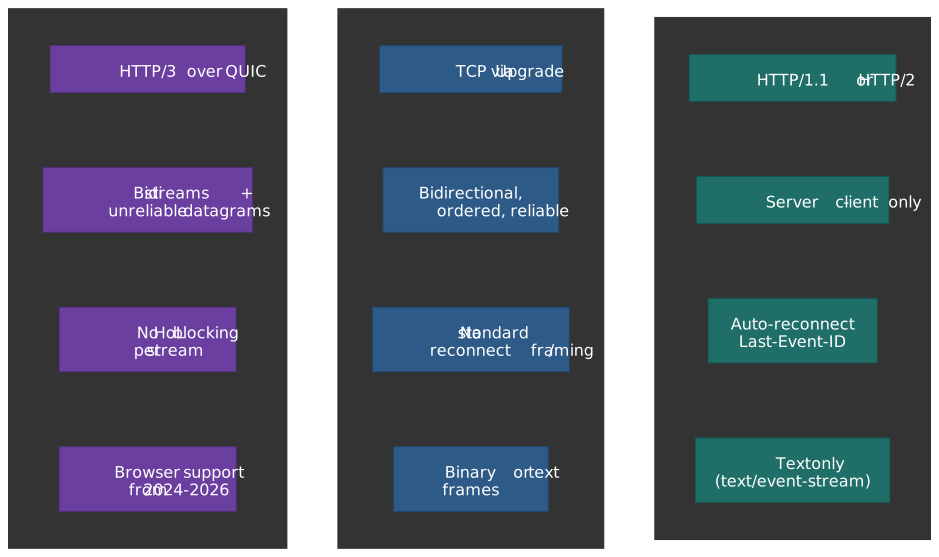
Three browser-native push channels coexist in 2026, and they are not interchangeable. Pick by direction and delivery semantics, not by perceived modernness.
Server-Sent Events
EventSource is defined in the HTML living standard. The wire format is text/event-stream: line-oriented data: / event: / id: records terminated by a blank line. It is server-to-client only, automatically reconnects on transport failure, and replays from Last-Event-ID if the server honours the header. It rides ordinary HTTP/1.1 or HTTP/2, so corporate proxies, load balancers, and CDNs handle it without special configuration. The cost is binary content — text only — and the historical six-connection-per-origin cap on HTTP/1.1, which HTTP/2 multiplexing solves.
const es = new EventSource('/api/notifications')es.onmessage = (e) => render(JSON.parse(e.data))es.addEventListener('order', (e) => updateOrder(JSON.parse(e.data)))WebSocket
RFC 6455 defines the protocol: HTTP Upgrade to a single TCP connection, then framed binary or text messages in either direction. WebSockets are bidirectional, ordered, and reliable, with no application-level reconnect, no message replay, and no built-in heartbeat — every production deployment ends up reinventing those, usually badly. Use WebSocket when you need low-ceremony bidirectional messaging (chat, presence, collaborative editing) and have a server-side framework that already solved the hard parts (Phoenix Channels, Socket.IO, Ably, Liveblocks).
WebTransport
WebTransport is the new option, layered on HTTP/3 over QUIC. As of 2026 it is a W3C Working Draft (current charter targets a stable spec in Q2 2026)19 with shipping support in Chrome (since 97), Firefox, and Safari (from 26.4). The API exposes both reliable bidirectional streams (similar to WebSocket but multiple in parallel, with no shared head-of-line blocking) and unreliable datagrams (similar to UDP, ideal for input streams in games or low-latency telemetry). Use it when packet loss is realistic and one stalled stream cannot be allowed to freeze the channel.
Selection matrix
| Need | SSE | WebSocket | WebTransport |
|---|---|---|---|
| Server → client only, simple | Yes | Overkill | Overkill |
| Bidirectional chat / presence | No | Yes | Yes |
| Many parallel streams, no head-of-line blocking | No | No (one TCP) | Yes (QUIC) |
| Best-effort datagrams (input, telemetry) | No | No | Yes |
| Resume after disconnect with replay | Built-in (Last-Event-ID) |
DIY | DIY |
| Behind every corporate proxy in the world | Yes | Mostly | Newer; varies |
Note
WebSocket is not the default just because the others are less familiar. SSE is strictly simpler, replays on reconnect for free, and is the better answer to “I need to push notifications and it’s all server-to-client”. Reach for WebSocket only when you actually need the client-to-server channel.
Prefetch and preload
Latency you do not pay is the cheapest latency. Five strategies, applied at different stages.
Resource hints: preload and prefetch
A <link rel="preload"> tag tells the browser to fetch a resource needed for the current navigation with high priority and store it in the HTTP cache for the page. A <link rel="prefetch"> tag tells the browser to fetch a resource needed for a probable future navigation with idle priority. They are blunt — they live in HTML, do not understand application cache keys — but for your largest hero image, font, or data file they remove a serial round-trip with one tag.
Library-level prefetching
TanStack Query’s queryClient.prefetchQuery({ queryKey, queryFn }) fills the cache without subscribing a component to it; SWR’s mutate(key, fetcher, false) does the same. Pair with router events to prefetch the next page’s queries on link hover or focus:
function NavLink({ to, queryKey, queryFn }: Props) { const qc = useQueryClient() return ( <Link to={to} onMouseEnter={() => qc.prefetchQuery({ queryKey, queryFn, staleTime: 30_000 })} onFocus={() => qc.prefetchQuery({ queryKey, queryFn, staleTime: 30_000 })} /> )}Compiler-driven prefetching: Relay
Relay turns prefetching into a build-time guarantee. With @preloadable queries, the compiler generates a small PreloadableConcreteRequest reference that lets a router call loadQuery(env, ConcreteRef, vars) before the component mounts; the component then reads via usePreloadedQuery, never seeing a loading state in the happy path. Combined with persisted IDs, the prefetch request is a tiny GET with a stable URL — caches see it, CDNs serve it, and the runtime never falls into a loading branch20.
Router-driven prefetching
Next.js, TanStack Router, Remix, and React Router all support prefetching the data for a route on link hover, viewport entry, or eager (immediately). Next.js’s <Link prefetch> runs the loader RSC, which warms both the per-request fetch cache and the client router cache. TanStack Router exposes per-route loader functions that the router prefetches by policy.
Server push and 103 Early Hints
103 Early Hints lets an origin send Link: <url>; rel=preload headers before the final response is ready, so the browser can start fetching critical sub-resources during the server-think time. It does not require HTTP/2 push (which is being phased out) and is the canonical replacement.
Warning
Aggressive prefetching costs the user’s data plan. Always gate prefetch on connection.saveData, connection.effectiveType !== '2g', and similar Network Information API hints; on metered networks, hover-prefetch is a regression, not an optimisation.
Errors, retries, and idempotency
Network requests fail. The question is which failures to retry, with what schedule, and which mutations are safe to retry at all.
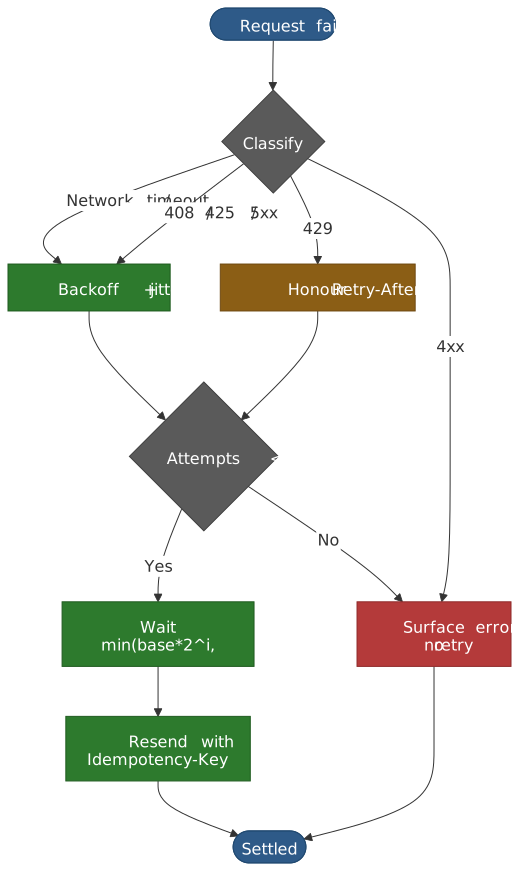
Exponential backoff with jitter
The canonical backoff schedule is exponential delay capped at a ceiling, with random jitter to spread retries across clients. Without jitter, every client retries on the same beat after an outage, recreating the load spike that took the system down21.
function backoff(attempt: number, baseMs = 1_000, capMs = 30_000): number { const exp = Math.min(baseMs * 2 ** attempt, capMs) return Math.random() * exp}The “full jitter” variant above (uniform random across [0, exp]) is what AWS recommends for most workloads; it spreads retries broadest at the cost of slightly higher mean latency.
Which statuses to retry
| Status | Retry? | Why |
|---|---|---|
| Network / timeout | Yes (with backoff) | Likely transient |
408 Request Timeout |
Yes | Server says it gave up waiting; resend |
425 Too Early |
Yes | Server cannot process replayed early data; retry without 0-RTT |
429 Too Many |
Yes, honour Retry-After | Without honouring the hint, retries make rate-limit recovery slower |
500–504 |
Yes | Server-side transient failure |
400 / 422 |
No | Request is malformed or semantically invalid; retry will keep failing |
401 / 403 |
No (refresh token first) | Auth is the problem; retry the request only after refreshing credentials |
404 |
No | Resource does not exist |
const { data } = useQuery({ queryKey: ['users'], queryFn: fetchUsers, retry: (failureCount, error: { status?: number }) => { if (error.status && error.status >= 400 && error.status < 500 && error.status !== 408 && error.status !== 429) { return false } return failureCount < 3 }, retryDelay: (i) => Math.min(1000 * 2 ** i, 30_000),})Library defaults at a glance
| Library | Default retries on error | Default backoff |
|---|---|---|
| TanStack Query | 3 (client) / 0 (server) |
Exponential, min(1000 · 2^i, 30_000) ms12 |
| SWR | unlimited unless errorRetryCount is set, on by default |
Exponential around errorRetryInterval (5 s baseline)8 |
| Apollo Client | 0 unless RetryLink is added |
Configurable via RetryLink |
| RTK Query | 0 unless retry() wraps the base query (then 5)22 |
Constant interval; configurable |
Warning
SWR’s default error-retry behaviour is on, not off. If you do not want infinite retries on a hard failure (e.g. a permanent 500 on a backend you control), set shouldRetryOnError: false or errorRetryCount explicitly.
Idempotency for safe retries
Retrying a non-idempotent request risks duplicate side effects: two charges, two orders, two emails. The IETF Idempotency-Key header — currently draft-ietf-httpapi-idempotency-key-header-07 (October 2025), an active Working Group draft, not yet an RFC23 — standardizes the contract that Stripe and Adyen have used for years.
export async function createPayment(amount: number) { const idempotencyKey = crypto.randomUUID() const res = await fetch('/api/payments', { method: 'POST', headers: { 'Content-Type': 'application/json', 'Idempotency-Key': idempotencyKey, }, body: JSON.stringify({ amount }), }) return res.json()}The contract: client generates a unique key per logical operation, server stores key → response, retries with the same key return the stored response without re-executing the side effect. Stripe24 and Adyen25 both implement this; PayPal, Square, and most modern payments APIs do too.
Circuit breaker
When a dependency is failing, retries amplify the problem. A circuit breaker fails fast for a cooldown window once failure rate crosses a threshold, then sends a single trial request to test recovery.
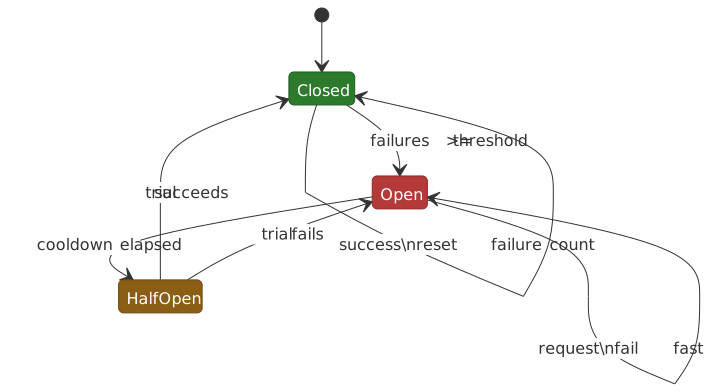
type State = 'closed' | 'open' | 'half-open'export class CircuitBreaker { private failures = 0 private openedAt: number | null = null private state: State = 'closed' constructor(private threshold = 5, private cooldownMs = 30_000) {} async execute<T>(fn: () => Promise<T>): Promise<T> { if (this.state === 'open') { if (Date.now() - (this.openedAt ?? 0) > this.cooldownMs) { this.state = 'half-open' } else { throw new Error('circuit breaker open') } } try { const result = await fn() this.onSuccess() return result } catch (err) { this.onFailure() throw err } } private onSuccess() { this.failures = 0 this.state = 'closed' } private onFailure() { this.failures++ if (this.failures >= this.threshold) { this.state = 'open' this.openedAt = Date.now() } }}A real implementation tracks a sliding-window failure rate (Hystrix26, resilience4j27) rather than a raw count, so brief blips do not trip the circuit, and a single late-arriving error does not keep it open. On the client, breakers are most useful guarding non-critical optional features (recommendations, presence) where degrading silently is preferable to a stalled UI.
Library comparison
TanStack Query (v5)
Per-query cache with subscriber-driven garbage collection, no schema requirements, and a small core API.
staleTimedefaults to0,gcTimeto5 minutes,retryto3on the client;retryDelayis exponential capped at30_000ms12.cacheTimewas renamed togcTimein v5 (2023); this is the most common v4→v5 migration trip-wire14.- Framework-agnostic core with bindings for React, Vue, Solid, and Svelte28.
- Devtools and SSR/hydration paths are first-class.
Strength: best-in-class for REST and mixed REST/GraphQL applications, great defaults for the majority of cases. Limitation: no normalized cache, so cross-query consistency requires explicit invalidation.
SWR (Vercel)
Minimal API focused on the stale-while-revalidate primitive.
dedupingIntervaldefaults to 2000 ms;revalidateOnFocusandrevalidateOnReconnectdefault totrue8.shouldRetryOnErrordefaults totruewith exponential backoff arounderrorRetryInterval(~5 s base). There is no default cap on retries; seterrorRetryCountto bound them.- ~4 KB gzipped (current 2.x), one of the smallest serious data-fetching libraries.
Strength: low surface area, low bundle cost, sensible defaults for typical client apps. Limitation: thinner than TanStack Query for complex coordination (mutation hooks, cancellation semantics, granular cache control).
Apollo Client
Normalized cache + GraphQL client.
InMemoryCachekeys entities by__typename:id(or_id) by default; per-type overrides viakeyFieldsintypePolicies11.queryDeduplicationdefaults totrueand is set on theApolloClient, not onHttpLink9.RetryLinkis the official path for retries; it is opt-in and configurable per-link.cache.evict+cache.gc()are the manual GC pair; there is no automatic time-based eviction.
Strength: automatic consistency through normalization, deep GraphQL feature support (subscriptions, defer/stream, @client directives). Limitation: GraphQL-shaped, larger bundle (~47 KB gzipped current), and the cache becomes hard to reason about once merge policies and field reads stack up.
RTK Query
Built on Redux Toolkit; tag-based invalidation; per-endpoint cache configuration.
keepUnusedDataFordefaults to 60 s10.- Retries are opt-in via the
retry()wrapper; defaultmaxRetriesis 5 when used; bail per-response withretry.fail()22. - Per-endpoint config keeps endpoint behaviour explicit and easily code-split.
Strength: cleanest fit for apps already on Redux; explicit invalidation graph; very predictable behaviour. Limitation: Redux dependency adds boilerplate for non-Redux apps; no normalized cache, so the tag graph has to be designed carefully.
Relay
Compiler-first, normalized GraphQL client. Different shape from the others — schema-anchored at build time.
- Records are normalized in a flat store keyed by Data ID; objects implementing the
Nodeinterface use theiridfield, others get a path-derived “client ID”29. - Persisted queries via the Relay compiler (
--persist-output); the runtime sends only thedoc_id, the server safelist is the security model[^relay-persisted]. @preloadablequeries plusloadQuery/usePreloadedQuerygive compiler-driven prefetching with no loading state in the happy path.- First-class fragments and connections (
@connection, list pagination contracts) — the cache understands lists at the schema level.
Strength: best-in-class consistency, compiler-checked queries, and cache layout that scales to Facebook-class graphs. Limitation: schema and codegen discipline are non-negotiable; the learning curve is the steepest of the bunch.
Decision matrix
| Factor | TanStack Query | SWR | Apollo Client | Relay | RTK Query |
|---|---|---|---|---|---|
| Bundle (gzipped) | ~13 KB | ~4 KB | ~47 KB | ~30 KB | ~13 KB + Redux deps |
| Cache shape | per-query | per-query | normalized (__typename:id) |
normalized (Node.id) |
per-query, tag-driven |
| Default retries | 3 client, 0 server |
on (no cap) | 0 (RetryLink opt-in) |
0 (per-network-layer) |
0 (5 with retry() wrap) |
| Mutation invalidation | invalidateQueries / setQueryData |
mutate(key) |
normalized + update |
declarative + store updaters | tag graph |
| GraphQL | via plugin | via plugin | native | native (compiler-bound) | via plugin |
| Compiler | none | none | optional codegen | required (relay-compiler) |
none |
| Best fit | most REST + GraphQL apps | small-surface apps | GraphQL-heavy apps | large GraphQL apps with strict schemas | Redux apps |
Practical defaults
The shortest answer to “which library should I use” is rarely interesting; the shortest answer to “which defaults should I change today” usually is.
- Pick the transport before the library. REST + browser cache for public, resource-shaped data; GraphQL with persisted queries when the UI is graph-shaped; Connect when you want typed RPC without a translating proxy; SSE for one-way push; WebSocket only when you need bidirectional, low-ceremony messaging; WebTransport when packet-level latency matters.
- Set
staleTimedeliberately. TanStack Query’s0default is correct for many surfaces, but anything above60_000for read-heavy data dramatically reduces background traffic with no visible impact. - Bound SWR retries. SWR retries forever by default. Set
errorRetryCount(orshouldRetryOnError: falsefor known-permanent failures) before shipping to production. - Pick one cache shape per app. Mixing per-query and normalized caches in the same app — say, RTK Query plus Apollo — multiplies cognitive load with no real upside. Choose based on whether the data model is graph-shaped.
- Treat the RSC fetch cache and the client cache as two graphs. Server actions invalidate one with
revalidateTag; client mutations invalidate the other withinvalidateQueries. Wire both, or one will lie. - One Suspense boundary per independent skeleton. Page-level boundaries undo the streaming win; per-component boundaries fragment the loading UI. Match boundaries to the chunks your designer drew on the wireframe.
- Always cache the promise you pass to
use(). A new promise per render re-suspends forever. UseuseSuspenseQuery,usePreloadedQuery, or pass a promise from a stable parent. - Use cursor pagination by default. Use offset only when product requires “jump to page N”.
- Always use Idempotency-Key for non-idempotent retries. Generate it client-side (a
crypto.randomUUID()per logical operation), keep it stable across retries, and never reuse one across operations. - Honour
Retry-Afteron 429. Most retry libraries ignore it unless you wire it up. - Gate prefetch on Network Information.
connection.saveDataandconnection.effectiveTypeexist for a reason; ignoring them turns an optimisation into a regression on metered links. - Scope SSR caches per request. Fresh client per request is the only safe default; sharing one across requests is how you leak
User:1from one user to the next.
Appendix
Glossary
- Stale data — cached data past its configured freshness window, still usable but eligible for revalidation.
- GC (Garbage Collection) — automatic removal of unused cache entries.
- Normalized cache — cache structure where entities are stored once by ID and queries hold references.
- Deduplication — collapsing multiple identical in-flight requests into a single network call.
- Idempotent — operation that produces the same observable effect regardless of how many times it is executed.
- Circuit breaker — failure-isolation pattern that fails fast for a cooldown window once a failure rate threshold is crossed.
- Persisted query — GraphQL operation registered ahead of time so the client sends only an ID; APQ derives the ID dynamically (Apollo), Relay persists it at compile time.
- RSC (React Server Components) — components that execute on the server, fetch data inline with their render, and stream serialised UI to the browser.
- Suspense boundary — the React component that catches a thrown promise and renders a fallback until the promise resolves.
- SSE / EventSource — HTML living standard for one-way, line-delimited push from server to browser, with built-in reconnect.
- HoL blocking — head-of-line blocking; one stalled stream stops everything behind it. Removed per-stream in HTTP/3 / QUIC.
- Prefetch — fetching a resource in advance of the navigation that will need it.
Further reading
Specifications
- RFC 9110 — HTTP Semantics (idempotent method definitions, validators, conditional requests at §13)
- RFC 9111 — HTTP Caching (obsoletes RFC 7234)
- RFC 9112 — HTTP/1.1, RFC 9113 — HTTP/2, RFC 9114 — HTTP/3
- RFC 5861 — Cache-Control extensions for stale content
- RFC 8297 — 103 Early Hints
- RFC 6455 — The WebSocket Protocol
- WHATWG Fetch standard
- WHATWG Streams standard
- HTML Living Standard — Server-Sent Events
- W3C WebTransport
- GraphQL specification
- JSON-RPC 2.0
- draft-ietf-httpapi-idempotency-key-header (Working Group draft)
Framework and React docs
Library documentation
- TanStack Query — Important defaults and SSR guide
- SWR — API options
- Apollo Client — Cache configuration, APQ, Persisted queries
- Relay — Persisted Queries and Runtime architecture
- RTK Query — Cache behavior and Customizing queries
- tRPC docs, Connect protocol,
grpc-webdesign
Engineering references
- AWS Builders’ Library — Timeouts, retries, and backoff with jitter
- Markus Winand — Use The Index, Luke! Paging Through Results
- MDN — HTTP Caching
- MDN — HTTP Conditional Requests
- Netflix Hystrix — How it Works (canonical client-side circuit-breaker design)
Footnotes
-
Apollo Server — Automatic Persisted Queries. Defines the SHA-256 hash flow,
PersistedQueryNotFoundretry, and theextensions.persistedQueryenvelope. ↩ -
apollo-link-persisted-queries.useGETForHashedQueries: trueflips hashed operations toGETso a CDN can cache them. ↩ -
The state of gRPC in the browser — gRPC blog. Documents the proxy model, the unary/server-stream support matrix, and the missing client/bidi streaming support. ↩
-
RFC 9111 history — published 2022-06, obsoletes RFC 7234. ↩
-
RFC 5861 — HTTP Cache-Control Extensions for Stale Content. Defines
stale-while-revalidateandstale-if-error. ↩ -
RFC 9110 §8.8 — Validator fields and §13 Conditional Requests. ↩
-
SWR API options.
dedupingIntervalis2000andrevalidateOnFocus/revalidateOnReconnectaretrueby default. ↩ ↩2 ↩3 -
Apollo Client —
ApolloClientoptions.queryDeduplicationdefaults totrueand is set on the client, not onHttpLink. ↩ ↩2 -
Apollo — Configuring the cache. The default identifier is
__typename:id(or_id); customize via the per-typekeyFieldspolicy. The legacydataIdFromObjectis deprecated in favour ofkeyFields. ↩ ↩2 -
TanStack Query — Important defaults.
staleTimedefaults to0,gcTimeto 5 minutes (300_000 ms), and the client-sideretrydefaults to3with the exponentialretryDelay. On the server (isRestoringpaths)retrydefaults to0. ↩ ↩2 ↩3 -
Migrating to TanStack Query v5.
cacheTimewas renamed togcTimefor clarity. ↩ ↩2 -
use— React reference. Defines the conditional-call exception, the Suspense and Error Boundary contracts, and the “promise must be created by a Suspense-aware framework” guidance. ↩ ↩2 -
useTransition— React reference. The current React docs spell out the “old UI stays interactive while the new tree suspends” guarantee and howisPendingreflects the in-flight transition. ↩ -
Next.js 15 release notes and the caching guide.
fetchis uncached by default;GETroute handlers are uncached by default; client router cachestaleTimedefaults to0. ↩ -
Markus Winand — Use The Index, Luke! Paging Through Results. The canonical write-up of why keyset/seek wins at depth. ↩
-
W3C WebTransport Working Group charter, 2026. Tracks the editor’s draft and the move toward Recommendation. ↩
-
Relay — Persisted Queries and the
@preloadabledirective. The compiler emits the concrete request reference; the runtime usesloadQuery/usePreloadedQuery. ↩ -
AWS Builders’ Library — Timeouts, retries, and backoff with jitter. The thundering-herd argument for jitter, with measurements. ↩
-
RTK Query — Customizing queries: Retrying on Error. The
retryutility wraps a base query and defaultsmaxRetriesto 5; bail out per response withretry.fail(). ↩ ↩2 -
draft-ietf-httpapi-idempotency-key-header-07. Standards Track, expires 2026-04-18; check the IETF datatracker for newer revisions. ↩
-
Netflix Hystrix — How it Works. Hystrix is in maintenance mode but the design notes are still the canonical reference for client-side circuit breakers. ↩
-
resilience4j CircuitBreaker docs. The current JVM-world reference implementation. ↩
-
TanStack Query — React adapter. The same core powers the Vue, Solid, and Svelte adapters. ↩
-
Relay — Runtime architecture. Documents the normalized record store, Data IDs, and
publish/lookup/notify. ↩