Real-Time Sync Client
Client-side architecture for real-time data synchronization: transport protocols, connection management, conflict resolution, and state reconciliation patterns used by Figma, Notion, Discord, and Linear.
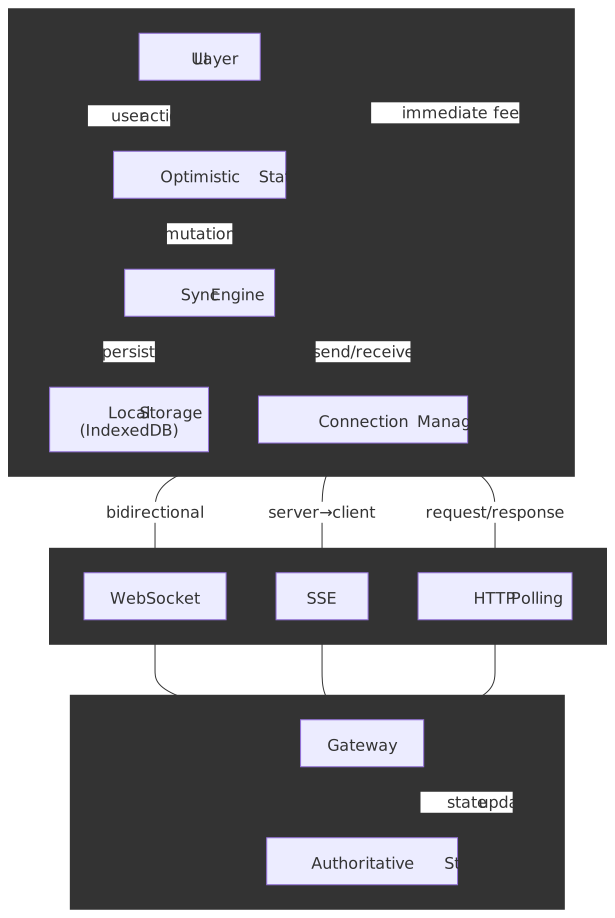
Abstract
Real-time sync is bidirectional state convergence between client and server under network uncertainty. The core tension: users expect instant feedback, but the server is the source of truth.
Mental model:
- Optimistic local state — Apply mutations immediately; rollback on server rejection
- Transport selection — WebSocket for bidirectional low-latency; SSE for server-push simplicity; polling as fallback
- Connection resilience — Exponential backoff with jitter; heartbeats detect stale connections; reconnect without data loss
- Conflict resolution — Last-write-wins at property level (Figma), Operational Transform for text (Google Docs), CRDTs for offline-first (Notion, Linear)
- State reconciliation — Server acknowledgments; re-apply pending local mutations on top of authoritative state
- Presence — Ephemeral metadata (cursors, typing indicators) via heartbeat or CRDT broadcast
The approach depends on data shape, offline requirements, and acceptable consistency latency.
The Challenge
Why Real-Time Sync Is Hard
Real-time sync violates the request-response model that HTTP assumes. Three constraints create tension:
- Latency vs. Consistency — Users expect instant feedback, but network round-trips are unavoidable
- Offline vs. Conflicts — Offline edits require local storage, which creates divergent state that must merge
- Scale vs. Complexity — Millions of connections require infrastructure that single-server models cannot provide
Browser Constraints
| Resource | Limit | Impact |
|---|---|---|
| WebSocket connections per profile | ~255 in Chrome, ~200 in Firefox | Shared across all tabs and origins; the HTTP/1.1 6/origin cap does not apply to WebSocket sockets |
| SSE connections per origin (HTTP/1.1) | 6 | Shared across all tabs; HTTP/2 multiplexes streams over a single TCP connection so the cap effectively disappears |
| Main thread budget | 16 ms/frame | Long sync operations cause UI jank |
| IndexedDB quota | Up to ~60% of disk per origin (Chrome), ~10% (Firefox) | Large local caches can hit QuotaExceededError |
The 6-per-origin connection cap that frustrates HTTP/1.1 polling does not apply to WebSocket — Chromium counts WebSocket sockets against a separate global pool (source). Multiple tabs sharing the same origin are still capped, just much higher than naive readings of the WebSocket / EventSource specs imply.
Note
WebSockets historically blocked the back/forward cache (bfcache). As of 2024 Chromium will evict the page from bfcache and close the WebSocket on entry instead of refusing to cache. Best practice is still to close connections explicitly on pagehide (event.persisted === true) and reopen on pageshow, so other tabs do not accumulate idle sockets and so reconnection logic owns the lifecycle.
Device and Network Profiles
| Scenario | Latency | Constraints |
|---|---|---|
| Desktop + fiber | 10–50ms | Full WebSocket, generous caching |
| Mobile + LTE | 50–200ms | Battery drain from radio wake; bundle updates |
| Mobile + 3G | 200–500ms | Aggressive local caching; defer non-critical sync |
| Offline | N/A | Queue mutations locally; replay on reconnect |
Cellular radio “tail time” keeps the antenna active for seconds after each transmission. Batch messages to minimize battery impact.
Transport Protocols
WebSocket (RFC 6455)
WebSocket provides full-duplex communication over a single TCP connection. After an HTTP handshake, frames flow bidirectionally with minimal overhead.
Protocol characteristics:
| Property | Value |
|---|---|
| Direction | Bidirectional |
| Frame overhead | 2–14 bytes (after handshake) |
| Data types | Text (UTF-8), binary |
| Auto-reconnect | No (must implement) |
| Compression | Per-message DEFLATE (RFC 7692) |
Handshake:
GET /chat HTTP/1.1Host: server.example.comUpgrade: websocketConnection: UpgradeSec-WebSocket-Key: dGhlIHNhbXBsZSBub25jZQ==Sec-WebSocket-Version: 13The server responds with 101 Switching Protocols, and the connection upgrades to WebSocket framing.
Design reasoning: RFC 6455 chose HTTP-compatible handshake so WebSocket traffic traverses proxies and firewalls that allow HTTP. The Sec-WebSocket-Key prevents cross-protocol attacks by requiring the server to prove it understands WebSocket.
Limitations:
- No backpressure — If the server sends faster than the client processes, messages buffer in memory until the browser crashes or discards data. The non-standard, Chromium-only
WebSocketStream(shipped to stable in Chrome 124) integrates with the Streams API to expose per-message backpressure; cross-browser, the only path to backpressure today is WebTransport over HTTP/3. - No multiplexing — Each logical channel requires a separate connection or application-level multiplexing. RFC 8441 lets WebSocket ride a single HTTP/2 stream, which sidesteps the per-origin TCP cost but does not provide multiplexing across logical channels.
- Connection limits — A single origin can open dozens of WebSocket sockets in modern browsers, but they share a global per-profile pool (~255 in Chrome, ~200 in Firefox). Application-level fan-in (one socket multiplexed across components) is almost always the right design.
When to use: Chat, collaborative editing, gaming, financial tickers — any scenario requiring low-latency bidirectional communication.
Server-Sent Events (SSE)
SSE is server-to-client push over HTTP. The server holds an open connection and streams events as text/event-stream.
Event format:
event: messagedata: {"user":"alice","text":"hello"}id: 12345retry: 3000: keep-alive comment| Field | Purpose |
|---|---|
event |
Event type name (triggers named listeners) |
data |
Payload (UTF-8 only) |
id |
Resume token for reconnection |
retry |
Reconnection delay in milliseconds |
Design reasoning: SSE uses HTTP, so it works through any proxy or firewall that allows HTTP. The id field enables resumption: on reconnect, the browser sends Last-Event-ID, and the server can replay missed events.
Advantages over WebSocket:
- Built-in reconnection with configurable delay
- Works through restrictive corporate proxies
- Simpler server implementation (any HTTP server)
Limitations:
- Server-to-client only — the client uses an ordinary
fetch/XMLHttpRequestPOST for uplink. - UTF-8 text only — no binary frames. Encode with base64 or switch to WebSocket / WebTransport if you need bytes.
- Over HTTP/1.1 the 6-per-origin TCP cap applies; HTTP/2 multiplexes streams over one TCP connection so the cap effectively disappears.
When to use: Live feeds, notifications, dashboards — scenarios where the server pushes and the client occasionally posts.
Long Polling
Long polling simulates push by having the client hold an open HTTP request until the server has data or timeout.
Flow:
- Client sends
GET /events?since=12345 - Server holds connection until new data exists or 30s timeout
- Server responds with data (or empty on timeout)
- Client immediately sends next request
Design reasoning: Long polling works everywhere HTTP works. Before WebSocket existed, this was the only reliable cross-browser push mechanism. It remains useful for restrictive networks or legacy browser support.
Trade-offs:
| Aspect | Long Polling | WebSocket | SSE |
|---|---|---|---|
| Latency | Medium (one RTT per message) | Low | Low |
| Overhead | Full HTTP headers per response | 2 bytes/frame | ~5 bytes/event |
| Firewall compatibility | Excellent | Sometimes blocked | Excellent |
| Implementation complexity | Low | Medium | Low |
When to use: Fallback when WebSocket and SSE fail; infrequent updates where latency is acceptable.
WebTransport (Future-Forward)
WebTransport is the modern successor to WebSocket, layered on HTTP/3 (QUIC). It provides multiple unidirectional/bidirectional streams over a single connection, optional unreliable datagrams, and proper per-stream backpressure via the Streams API.
| Property | WebTransport |
|---|---|
| Transport | HTTP/3 (QUIC over UDP) |
| Streams per session | Many; reliable + unreliable |
| Backpressure | Native (Streams API) |
| Head-of-line blocking | None at transport (per-stream HOLB) |
| Browser availability | Chromium stable; Firefox behind a flag |
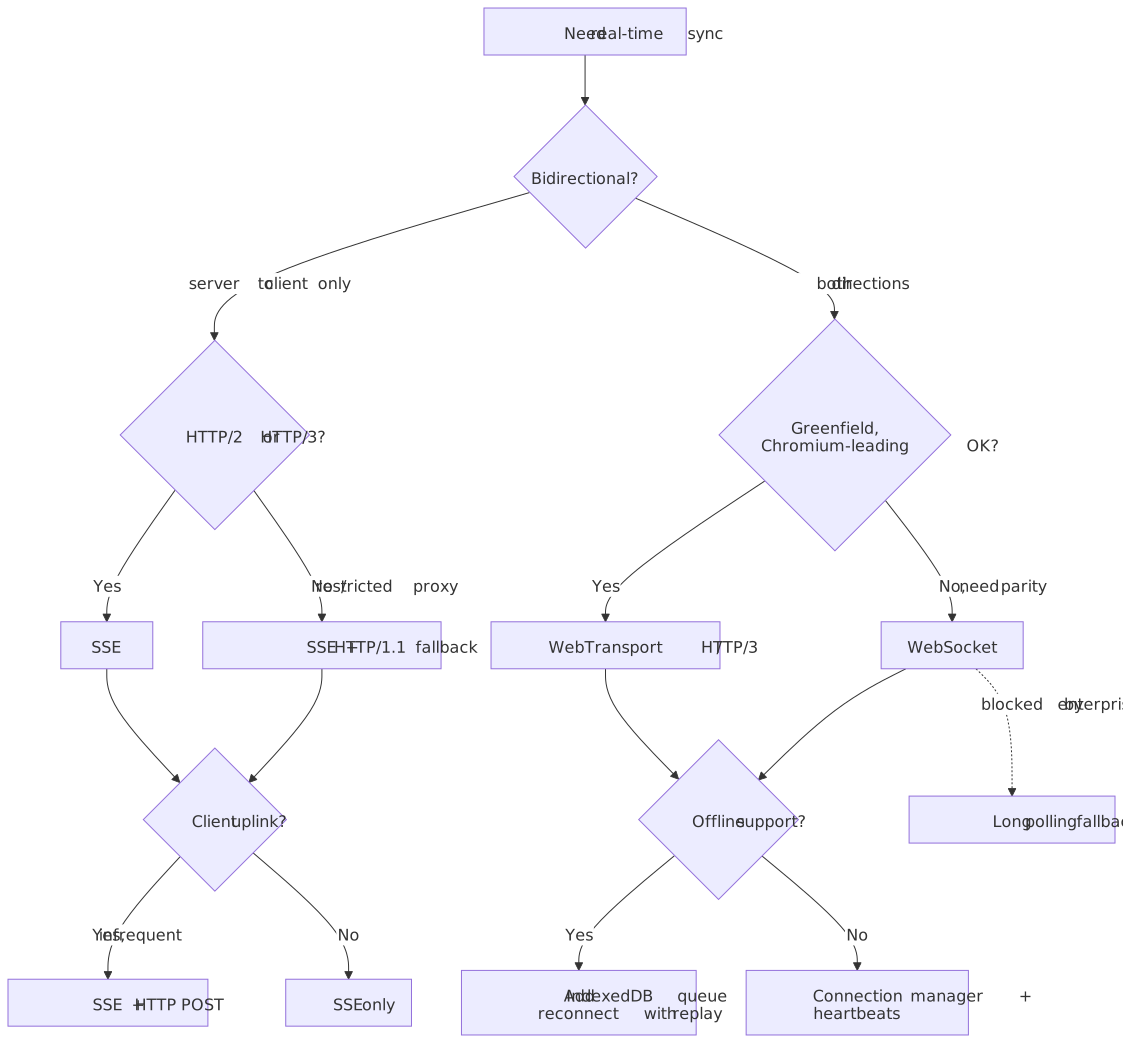
For greenfield real-time apps that need binary, multiplexed, backpressured channels and can tolerate Chromium-leading availability, WebTransport is the strategically right choice. WebSocket remains the safe default for cross-browser parity.
Decision Framework
Connection Management
A long-lived sync connection is a small state machine: open, heartbeat, drop, back off, retry. The same loop drives WebSocket, SSE, and long-polling clients — only the transport-specific signals (handshake, error, Last-Event-ID) differ.
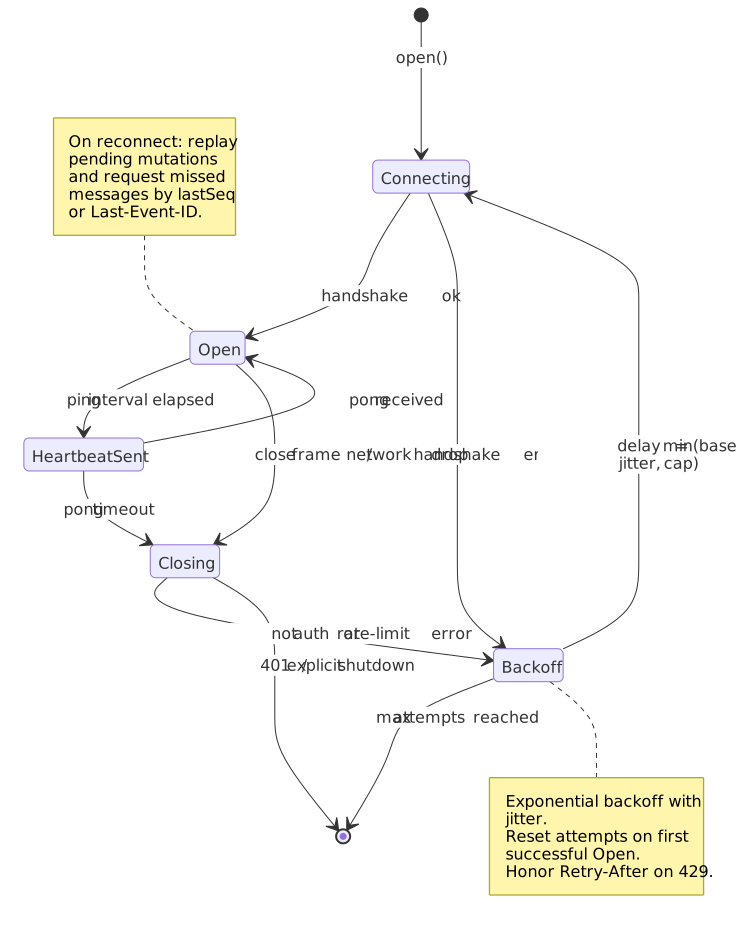
Reconnection with Exponential Backoff
Network disconnections are inevitable. Naive immediate retry causes thundering herd problems when servers recover. Exponential backoff with jitter spreads reconnection attempts.
// Types and constantstype ReconnectionOptions = { initialDelay?: number maxDelay?: number multiplier?: number jitter?: number maxAttempts?: number}class ReconnectionManager { private currentDelay: number private attempts = 0 constructor(private options: Required<ReconnectionOptions>) { this.currentDelay = options.initialDelay } // Core logic: calculate next delay with jitter getNextDelay(): number | null { if (this.attempts >= this.options.maxAttempts) { return null // Give up } const jitterRange = this.currentDelay * this.options.jitter const jitter = Math.random() * jitterRange * 2 - jitterRange const delay = Math.min(this.currentDelay + jitter, this.options.maxDelay) this.currentDelay = Math.min(this.currentDelay * this.options.multiplier, this.options.maxDelay) this.attempts++ return delay } reset(): void { this.currentDelay = this.options.initialDelay this.attempts = 0 }}// Usageconst manager = new ReconnectionManager({ initialDelay: 1000, maxDelay: 30000, multiplier: 2, jitter: 0.1, maxAttempts: 10,})Design reasoning:
- Exponential growth caps at a maximum (30s typical) to prevent infinite waits
- Jitter (±10%) desynchronizes clients that disconnected at the same time
- Attempt limit prevents infinite loops against a permanently down service
Production considerations:
| Error Type | Retry Strategy |
|---|---|
| Network timeout | Full backoff |
| 5xx server error | Full backoff |
| 401 Unauthorized | Do not retry; re-authenticate |
| 429 Rate Limited | Honor Retry-After header |
| DNS failure | Backoff with longer max delay |
Heartbeat and Connection Health
TCP keep-alives are insufficient for application-level connection health. A dead connection may not trigger a TCP reset for minutes. Application heartbeats detect stale connections faster.
// WebSocket wrapper with heartbeattype HeartbeatOptions = { interval: number // How often to send ping timeout: number // How long to wait for pong}class HeartbeatConnection { private pingTimer: number | null = null private pongTimer: number | null = null private ws: WebSocket constructor( url: string, private options: HeartbeatOptions, ) { this.ws = new WebSocket(url) this.ws.onopen = () => this.startHeartbeat() this.ws.onmessage = (e) => this.handleMessage(e) this.ws.onclose = () => this.stopHeartbeat() } // Core heartbeat logic private startHeartbeat(): void { this.pingTimer = window.setInterval(() => { this.ws.send(JSON.stringify({ type: "ping", ts: Date.now() })) this.pongTimer = window.setTimeout(() => { // No pong received - connection is dead this.ws.close(4000, "Heartbeat timeout") }, this.options.timeout) }, this.options.interval) } private handleMessage(event: MessageEvent): void { const data = JSON.parse(event.data) if (data.type === "pong") { if (this.pongTimer) clearTimeout(this.pongTimer) return } // Handle application messages... } private stopHeartbeat(): void { if (this.pingTimer) clearInterval(this.pingTimer) if (this.pongTimer) clearTimeout(this.pongTimer) }}Typical values:
| Setting | Value | Reasoning |
|---|---|---|
| Ping interval | 15–30s | Balance between detection speed and bandwidth |
| Pong timeout | 5–10s | Allow for network jitter |
| Missed pings before disconnect | 2–3 | Avoid false positives from single dropped packet |
State Recovery on Reconnect
Reconnection without state recovery loses messages sent during disconnection. Two patterns handle this:
1. Sequence-based recovery:
// Track last acknowledged sequenceinterface Message { seq: number payload: unknown}class SequenceRecovery { private lastAckedSeq = 0 private pendingMessages: Message[] = [] send(payload: unknown): void { const msg: Message = { seq: this.pendingMessages.length + this.lastAckedSeq + 1, payload, } this.pendingMessages.push(msg) this.ws.send(JSON.stringify(msg)) } // On reconnect, request replay from last ack onReconnect(): void { this.ws.send( JSON.stringify({ type: "resume", lastSeq: this.lastAckedSeq, }), ) } onAck(seq: number): void { this.lastAckedSeq = seq this.pendingMessages = this.pendingMessages.filter((m) => m.seq > seq) } onServerReplay(messages: Message[]): void { // Server sends missed messages since lastSeq for (const msg of messages) { this.handleMessage(msg) } }}2. Event sourcing recovery (SSE):
SSE’s Last-Event-ID header automatically requests replay:
const eventSource = new EventSource("/events")eventSource.onmessage = (event) => { // event.lastEventId contains the id from the server // On reconnect, browser automatically sends Last-Event-ID header processEvent(JSON.parse(event.data))}Design reasoning: Sequence numbers are simpler but require server-side storage of recent messages. Event sourcing naturally fits event logs but requires the server to support replay from arbitrary points.
Message Handling
Ordering Guarantees
Out-of-order delivery happens when:
- Multiple WebSocket connections exist (load balancing)
- Server processes messages in parallel
- Network path changes mid-stream
Strategies:
| Strategy | Complexity | Guarantee |
|---|---|---|
| Single connection, FIFO | Low | Total order |
| Sequence numbers per sender | Medium | Per-sender order |
| Vector clocks | High | Causal order |
| Accept disorder | None | Eventual consistency |
For most applications, per-sender ordering suffices:
// Per-sender message orderingtype SenderId = stringclass OrderedMessageHandler { private lastSeq = new Map<SenderId, number>() private pending = new Map<SenderId, Map<number, unknown>>() handle(senderId: SenderId, seq: number, payload: unknown): void { const expected = (this.lastSeq.get(senderId) ?? 0) + 1 if (seq === expected) { // In order - process and check pending this.process(payload) this.lastSeq.set(senderId, seq) this.processPending(senderId) } else if (seq > expected) { // Out of order - buffer const senderPending = this.pending.get(senderId) ?? new Map() senderPending.set(seq, payload) this.pending.set(senderId, senderPending) } // seq < expected means duplicate - ignore } private processPending(senderId: SenderId): void { const senderPending = this.pending.get(senderId) if (!senderPending) return let next = (this.lastSeq.get(senderId) ?? 0) + 1 while (senderPending.has(next)) { this.process(senderPending.get(next)) senderPending.delete(next) this.lastSeq.set(senderId, next) next++ } } private process(payload: unknown): void { // Application-specific processing }}Deduplication
Retries and reconnection can deliver the same message multiple times. Idempotency keys prevent duplicate processing:
// Time-bounded deduplicationconst DEDUP_WINDOW_MS = 5 * 60 * 1000 // 5 minutesclass Deduplicator { private processed = new Map<string, number>() // id -> timestamp isDuplicate(messageId: string): boolean { this.cleanup() if (this.processed.has(messageId)) { return true } this.processed.set(messageId, Date.now()) return false } private cleanup(): void { const cutoff = Date.now() - DEDUP_WINDOW_MS for (const [id, ts] of this.processed) { if (ts < cutoff) { this.processed.delete(id) } } }}// Usageconst dedup = new Deduplicator()function handleMessage(msg: { id: string; payload: unknown }): void { if (dedup.isDuplicate(msg.id)) { return // Already processed } processPayload(msg.payload)}Trade-offs:
| Window Size | Memory | Risk |
|---|---|---|
| 1 minute | Low | May miss slow retries |
| 5 minutes | Medium | Covers most retry scenarios |
| 1 hour | High | Handles extended outages |
Optimistic Updates
Optimistic updates show changes immediately while the server processes asynchronously. If the server rejects, rollback to previous state. The lifecycle has three branches: success (clear pending), validation failure (restore snapshot, surface error), and network failure (keep pending, retry with backoff).
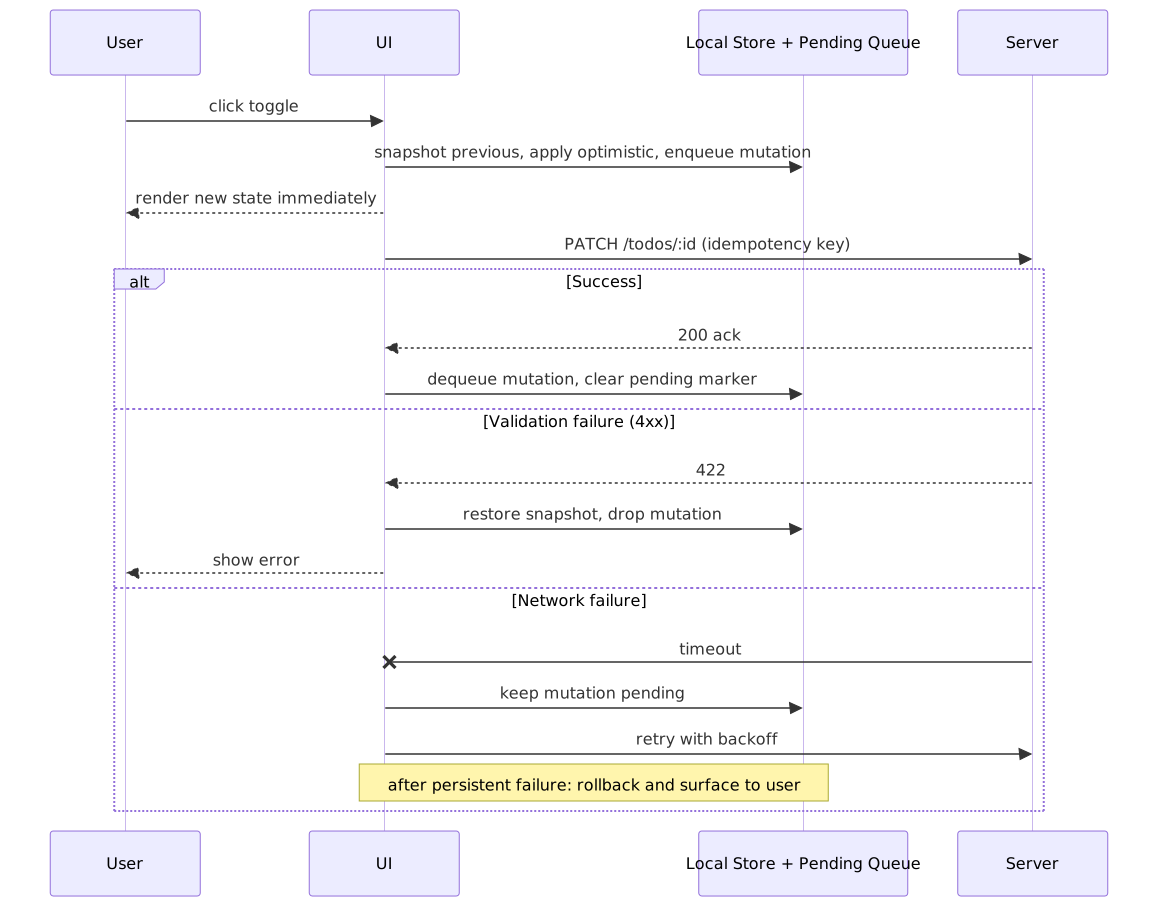
Pattern Implementation
// Optimistic update with rollbacktype Todo = { id: string; text: string; completed: boolean }type TodoStore = { todos: Todo[] pendingUpdates: Map<string, { previous: Todo; current: Todo }>}const store: TodoStore = { todos: [], pendingUpdates: new Map() }async function toggleTodo(id: string): Promise<void> { const todo = store.todos.find((t) => t.id === id) if (!todo) return // 1. Save previous state const previous = { ...todo } // 2. Apply optimistic update const updated = { ...todo, completed: !todo.completed } store.todos = store.todos.map((t) => (t.id === id ? updated : t)) store.pendingUpdates.set(id, { previous, current: updated }) // 3. Notify UI (immediate feedback) renderTodos() try { // 4. Send to server await fetch(`/api/todos/${id}`, { method: "PATCH", body: JSON.stringify({ completed: updated.completed }), headers: { "Idempotency-Key": `toggle-${id}-${Date.now()}` }, }) // 5. Success - remove from pending store.pendingUpdates.delete(id) } catch (error) { // 6. Failure - rollback store.todos = store.todos.map((t) => (t.id === id ? store.pendingUpdates.get(id)!.previous : t)) store.pendingUpdates.delete(id) renderTodos() showError("Failed to update todo") }}// TanStack Query equivalentconst mutation = useMutation({ mutationFn: (todo: Todo) => updateTodo(todo), onMutate: async (newTodo) => { await queryClient.cancelQueries({ queryKey: ["todos"] }) const previous = queryClient.getQueryData(["todos"]) queryClient.setQueryData(["todos"], (old: Todo[]) => old.map((t) => (t.id === newTodo.id ? newTodo : t))) return { previous } }, onError: (err, newTodo, context) => { queryClient.setQueryData(["todos"], context?.previous) }, onSettled: () => { queryClient.invalidateQueries({ queryKey: ["todos"] }) },})When Optimistic Updates Break
| Scenario | Problem | Mitigation |
|---|---|---|
| Concurrent edits | Two users edit same item | Server conflict resolution; merge or reject |
| Validation failure | Server rejects invalid data | Client-side validation before optimistic apply |
| Network partition | User thinks action succeeded | Queue mutations; replay on reconnect |
| Race conditions | Stale read before write | Version vectors; conditional updates |
React 19 useOptimistic:
The hook signature is useOptimistic(state, updateFn) where updateFn(currentState, optimisticValue) returns the next optimistic state. The dispatch function must run inside an Action (startTransition or a form action); React automatically reverts to state once the transition settles (React docs).
import { useOptimistic, startTransition } from 'react';function TodoItem({ todo, onUpdate }: { todo: Todo; onUpdate: (t: Todo) => Promise<void> }) { const [optimisticTodo, applyOptimistic] = useOptimistic( todo, (current, completed: boolean) => ({ ...current, completed }), ); function toggle() { const nextCompleted = !optimisticTodo.completed; startTransition(async () => { applyOptimistic(nextCompleted); await onUpdate({ ...todo, completed: nextCompleted }); }); } const isPending = optimisticTodo.completed !== todo.completed; return ( <li style={{ opacity: isPending ? 0.5 : 1 }}> <input type="checkbox" checked={optimisticTodo.completed} onChange={toggle} /> {todo.text} </li> );}Important
useOptimistic only stays in its optimistic state for the lifetime of the surrounding transition. If you need the optimistic value to survive across renders independent of an async action, manage it with useState plus your own rollback path.
Conflict Resolution
When multiple clients edit the same data, conflicts arise. The resolution strategy depends on data shape and acceptable complexity.
Last-Write-Wins (LWW)
Each write carries a timestamp; the latest timestamp wins. Simple but loses data from concurrent edits.
Used by: Cassandra, DynamoDB, Figma (at property level)
type LWWRegister<T> = { value: T timestamp: number clientId: string}function merge<T>(local: LWWRegister<T>, remote: LWWRegister<T>): LWWRegister<T> { if (remote.timestamp > local.timestamp) { return remote } if (remote.timestamp === local.timestamp) { // Tiebreaker: lexicographic client ID comparison return remote.clientId > local.clientId ? remote : local } return local}Figma’s approach: LWW at property level, not object level. Two users editing different properties of the same shape (e.g., color vs. position) both succeed. Only same-property edits conflict.
Design reasoning: Figma rejected Operational Transform as “overkill”—their data model is a tree of objects with properties, not a linear text document. Property-level LWW is simpler and sufficient for design files.
Clock skew problem: LWW assumes synchronized clocks. NTP skew of 0.5+ seconds can cause “earlier” writes to win. Mitigations:
- Use server timestamps (single source of truth)
- Hybrid logical clocks (HLC) combining physical time with logical counters
- Version vectors for causal ordering
Operational Transformation (OT)
OT transforms operations based on concurrent operations to preserve user intent. Designed for linear sequences (text documents).
Used by: Google Docs, Microsoft Office Online
Example:
Initial: "abc"User A: Insert "X" at position 2 → "abXc"User B: Delete position 1 → "ac" (concurrent with A)Without transformation: Apply A's insert to B's result: "aXc" (wrong - X at wrong position)With transformation: Transform A's operation: Insert at 2 becomes Insert at 1 (because B deleted before position 2) Result: "aXc" becomes correct// Simplified OT for texttype Insert = { type: "insert"; pos: number; char: string }type Delete = { type: "delete"; pos: number }type Op = Insert | Deletefunction transform(op1: Op, op2: Op): Op { // Transform op1 assuming op2 has been applied if (op1.type === "insert" && op2.type === "insert") { if (op1.pos <= op2.pos) { return op1 // op1 is before op2, no change } return { ...op1, pos: op1.pos + 1 } // Shift right } if (op1.type === "insert" && op2.type === "delete") { if (op1.pos <= op2.pos) { return op1 } return { ...op1, pos: op1.pos - 1 } // Shift left } if (op1.type === "delete" && op2.type === "insert") { if (op1.pos < op2.pos) { return op1 } return { ...op1, pos: op1.pos + 1 } } if (op1.type === "delete" && op2.type === "delete") { if (op1.pos < op2.pos) { return op1 } if (op1.pos > op2.pos) { return { ...op1, pos: op1.pos - 1 } } // Same position - op1 is a no-op (already deleted) return { type: "insert", pos: -1, char: "" } // No-op sentinel } return op1}// OT requires central server for operation orderingclass OTClient { private pending: Op[] = [] private serverVersion = 0 applyLocal(op: Op): void { this.pending.push(op) this.sendToServer(op, this.serverVersion) } onServerAck(ackVersion: number): void { this.serverVersion = ackVersion this.pending.shift() // Remove acknowledged operation } onServerOp(op: Op): void { // Transform all pending operations against server operation for (let i = 0; i < this.pending.length; i++) { this.pending[i] = transform(this.pending[i], op) } this.applyToDocument(op) this.serverVersion++ }}Trade-offs:
| Aspect | Advantage | Disadvantage |
|---|---|---|
| Consistency | Strong (immediate) | Requires central server |
| Complexity | Intent-preserving | O(n²) worst case; hard to implement correctly |
| Latency | Low (operations, not state) | Server bottleneck under load |
CRDTs (Conflict-Free Replicated Data Types)
CRDTs are data structures whose merge operation is commutative, associative, and idempotent, so any two replicas that have seen the same set of operations — in any order, with arbitrary duplication — converge to the same state without coordination (Shapiro et al., 2011).
Used by: Notion (offline pages), Linear (issue descriptions via Yjs), Figma (loosely inspired, not strictly), Automerge, Yjs.
Common CRDT types:
| Type | Use Case | Example |
|---|---|---|
| G-Counter | Grow-only counter | Page view counts |
| PN-Counter | Increment/decrement | Inventory stock |
| LWW-Register | Single value | User status |
| OR-Set | Add/remove set | Tags, members |
| RGA/LSEQ | Ordered text | Collaborative documents |
// G-Counter CRDTtype NodeId = stringclass GCounter { private counts = new Map<NodeId, number>() constructor(private nodeId: NodeId) {} increment(): void { const current = this.counts.get(this.nodeId) ?? 0 this.counts.set(this.nodeId, current + 1) } value(): number { let sum = 0 for (const count of this.counts.values()) { sum += count } return sum } // Merge is commutative, associative, idempotent merge(other: GCounter): void { for (const [nodeId, count] of other.counts) { const current = this.counts.get(nodeId) ?? 0 this.counts.set(nodeId, Math.max(current, count)) } } serialize(): Record<NodeId, number> { return Object.fromEntries(this.counts) }}Tombstone problem: Deletes in many CRDTs leave a tombstone (metadata indicating “this id was removed”) that must be retained until every replica has observed it. In long-lived offline scenarios tombstones can accumulate without bound. Mitigations:
- Coordinated garbage collection — only safe to drop a tombstone once every replica has observed it (hard in peer-to-peer; tractable behind a central server).
- Time-based expiry — simple, but a long-disconnected replica can resurrect deleted items.
- Periodic snapshot compaction — periodically rebuild a snapshot that omits acknowledged tombstones, then ship the snapshot as the new baseline.
Design reasoning: CRDTs trade memory for simplicity. No conflict resolution logic needed—the math guarantees convergence. This makes them ideal for offline-first apps where merge timing is unpredictable.
Decision Matrix
| Factor | LWW | OT | CRDT |
|---|---|---|---|
| Complexity | Low | High | Medium |
| Offline support | Poor | None | Excellent |
| Memory overhead | Low | Low | High (tombstones) |
| Central server required | No | Yes | No |
| Best for | Key-value, properties | Text documents | Offline-first, P2P |
State Reconciliation
When client and server state diverge, reconciliation brings them back in sync without losing pending local changes.
Client-Side Prediction with Server Reconciliation
Originally from game development (Gambetta’s series is the canonical reference), this pattern applies local changes immediately but treats server state as authoritative. When the server acknowledges input #N, the client resets to the server snapshot and replays inputs N+1, N+2, … on top.
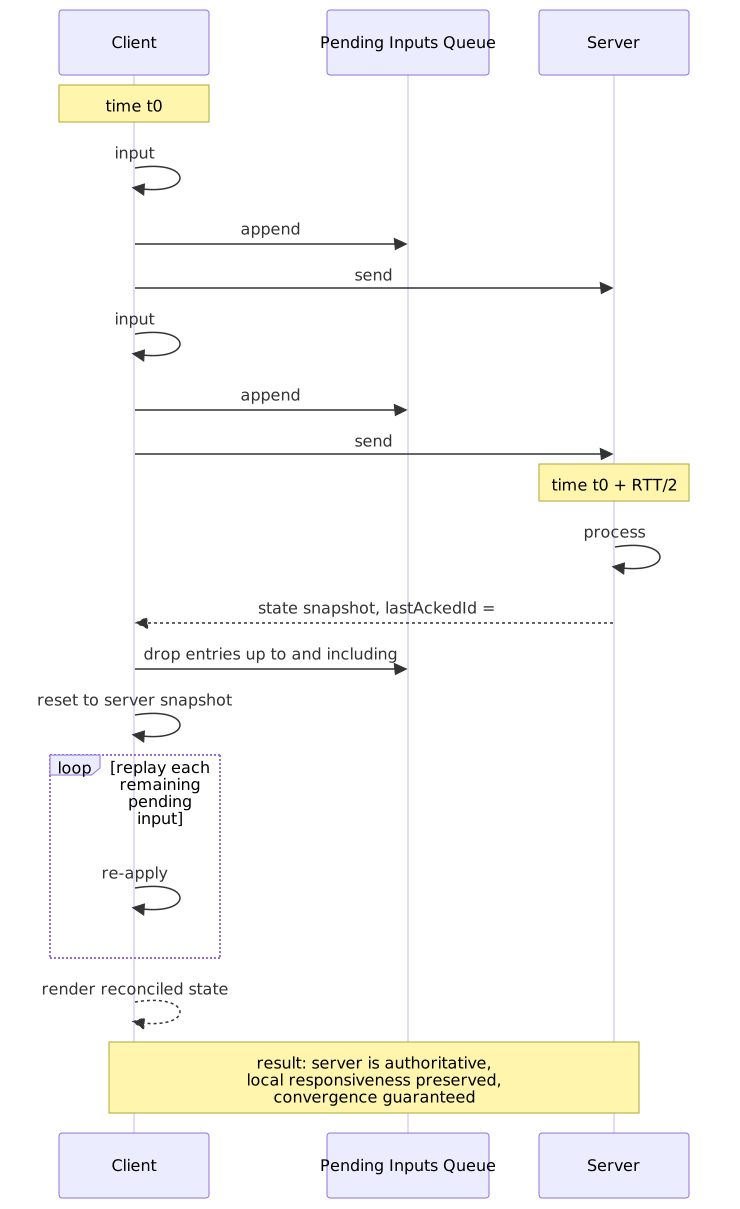
// State reconciliation with pending input replaytype Input = { id: string; action: string; params: unknown }type State = { /* application state */}class ReconciliationEngine { private pendingInputs: Input[] = [] private localState: State private lastAckedInputId: string | null = null applyInput(input: Input): void { // 1. Apply locally for immediate feedback this.localState = this.applyToState(this.localState, input) // 2. Track as pending this.pendingInputs.push(input) // 3. Send to server this.sendToServer(input) } onServerUpdate(serverState: State, lastAckedId: string): void { // 1. Remove acknowledged inputs const ackIndex = this.pendingInputs.findIndex((i) => i.id === lastAckedId) if (ackIndex !== -1) { this.pendingInputs = this.pendingInputs.slice(ackIndex + 1) } // 2. Start from authoritative server state let reconciledState = serverState // 3. Re-apply pending (unacknowledged) inputs for (const input of this.pendingInputs) { reconciledState = this.applyToState(reconciledState, input) } // 4. Update local state this.localState = reconciledState // 5. Re-render this.render() } private applyToState(state: State, input: Input): State { // Application-specific state transition return state } private sendToServer(input: Input): void { // WebSocket send } private render(): void { // Update UI }}Why this works: The server is always right. Local state is a prediction that will be corrected. By re-applying pending inputs on top of server state, we maintain responsiveness while converging to truth.
Smooth vs. snap reconciliation:
- Snap: Immediately apply server correction (can cause visual jitter)
- Smooth: Interpolate toward server state over multiple frames (better UX for games/animations, more complex)
Full State Sync
For simpler applications, fetch full state on reconnect and discard local state:
// Simple full state sync on reconnectasync function reconnect(): Promise<void> { const state = await fetch("/api/state").then((r) => r.json()) store.setState(state) render()}// With local mutation queueasync function reconnectWithQueue(): Promise<void> { // 1. Fetch server state const serverState = await fetch("/api/state").then((r) => r.json()) // 2. Replay queued mutations for (const mutation of localQueue) { try { await fetch("/api/mutate", { method: "POST", body: JSON.stringify(mutation), }) } catch { // Handle permanent failure } } // 3. Fetch final state (includes replayed mutations) const finalState = await fetch("/api/state").then((r) => r.json()) store.setState(finalState) localQueue.clear() render()}Presence
Presence tracks ephemeral user state: who’s online, cursor positions, typing indicators.
Design Considerations
| Aspect | Consideration |
|---|---|
| Persistence | Not needed—presence is ephemeral |
| Update frequency | Cursors: 20–60 Hz; typing: on change; online: 15–30s heartbeat |
| Bandwidth | Throttle cursor updates; batch presence changes |
| Cleanup | Automatic on disconnect; timeout for crashed clients |
Implementation Patterns
Heartbeat-based online status:
// Heartbeat presenceconst HEARTBEAT_INTERVAL = 15000 // 15 secondsconst TIMEOUT_THRESHOLD = 45000 // 3 missed heartbeatsclass PresenceManager { private users = new Map<string, { lastSeen: number; metadata: unknown }>() private heartbeatTimer: number | null = null start(userId: string, metadata: unknown): void { this.heartbeatTimer = window.setInterval(() => { this.ws.send( JSON.stringify({ type: "presence", userId, metadata, timestamp: Date.now(), }), ) }, HEARTBEAT_INTERVAL) } onPresenceUpdate(userId: string, metadata: unknown): void { this.users.set(userId, { lastSeen: Date.now(), metadata }) this.pruneStale() this.render() } private pruneStale(): void { const now = Date.now() for (const [userId, data] of this.users) { if (now - data.lastSeen > TIMEOUT_THRESHOLD) { this.users.delete(userId) } } } stop(): void { if (this.heartbeatTimer) clearInterval(this.heartbeatTimer) } getOnlineUsers(): string[] { return Array.from(this.users.keys()) }}Cursor sharing:
// Throttled cursor sharingtype CursorPosition = { x: number; y: number; userId: string }class CursorPresence { private cursors = new Map<string, CursorPosition>() private throttledSend: (pos: CursorPosition) => void constructor( private ws: WebSocket, private userId: string, ) { // Throttle to 30 updates per second max this.throttledSend = throttle((pos: CursorPosition) => { ws.send(JSON.stringify({ type: "cursor", ...pos })) }, 33) } onLocalMove(x: number, y: number): void { this.throttledSend({ x, y, userId: this.userId }) } onRemoteCursor(cursor: CursorPosition): void { this.cursors.set(cursor.userId, cursor) this.renderCursors() } onUserLeave(userId: string): void { this.cursors.delete(userId) this.renderCursors() } private renderCursors(): void { // Render remote cursors with user labels }}function throttle<T extends (...args: unknown[]) => void>(fn: T, ms: number): T { let lastCall = 0 return ((...args: Parameters<T>) => { const now = Date.now() if (now - lastCall >= ms) { lastCall = now fn(...args) } }) as T}Phoenix Presence (CRDT-based)
Phoenix Channels uses a CRDT-based presence system that automatically syncs across cluster nodes:
- Each presence update is a CRDT merge operation
- No single point of failure
- Automatic cleanup when connections close
- Built-in conflict resolution for presence metadata
Design reasoning: Presence is inherently distributed (users connect to different servers). CRDT semantics guarantee all nodes converge to the same view without coordination.
Real-World Implementations
Figma: Multiplayer Design
Scale: Millions of concurrent editors
Architecture:
- Client/server with WebSocket; one centralized multiplayer service per file is the authority.
- File state lives in memory on that service for speed; periodic checkpoints to durable storage capture full snapshots.
- A persistent journal (transaction log) records every mutation between checkpoints, so a crash can replay forward from the last snapshot without losing accepted edits.
Conflict resolution: Property-level LWW. Two simultaneous changes to different properties of the same object both succeed; only same-property conflicts compare timestamps. Figma describes the design as “inspired by CRDTs” rather than a true CRDT — the central server is the source of truth, which sidesteps the offline-merge cases CRDTs were invented to handle.
Why not OT? Figma’s data model is a tree of objects with properties, not linear text. OT is optimized for character-level text operations. Property-level LWW is simpler and sufficient.
Fractional indexing for ordered sequences: Children in a tree are positioned by an arbitrary-precision fraction (encoded as a string) between their two neighbors. Inserting between A ("a0") and B ("a1") is just allocating a new fraction in between ("a0V"). No global reindexing required.
Sources: How Figma’s multiplayer technology works, Realtime editing of ordered sequences, and Making multiplayer more reliable.
Notion: Offline-First
Challenge: Block-based architecture where pages reference blocks that reference other blocks. Opening a page requires the full transitive closure of referenced blocks; a missing block means broken content.
Architecture:
- SQLite is used as a persistent local store on native clients (and IndexedDB on the web), evolved from a best-effort cache into a durable backing store specifically for Offline Mode.
- Pages explicitly marked Available offline are migrated to a CRDT-backed representation so concurrent edits merge automatically; non-text properties (e.g. database
select) can still surface merge conflicts. - Each client tracks a
lastDownloadedTimestampper offline page; on reconnect it compares with the server’slastUpdatedTimeand pulls only pages that have moved. - Local mutations queue in an
offline_actiontable; the sync layer reconciles those actions with authoritative state when the client comes back online.
Design decision: If a page might be missing transitively required data, Notion refuses to render it rather than show partial content. Missing data is worse UX than “unavailable offline.”
Source: How we made Notion available offline and The data model behind Notion’s flexibility.
Linear: Local-First Sync
Architecture:
- A normalized object graph lives in memory, modeled with MobX for fine-grained reactivity, and is mirrored to IndexedDB as the local source of truth.
- Mutations are wrapped in client transactions, persisted locally, then sent to the server. The server assigns a total order of transactions and broadcasts deltas — Linear is centralized, not peer-to-peer, and does not run Operational Transformation.
- For most fields (status, assignee, priority, comments) the server’s totally ordered LWW write is the resolution. Linear adopted CRDTs (Yjs) specifically for issue descriptions because that is the rich-text surface where two writers genuinely overlap on the same characters.
- Search is instant because every issue in the workspace is already in JavaScript memory; the search box is a filter over an array, not an API call.
Why it works: Issue trackers have bounded data per workspace (unlike open-ended documents). Full client-side data plus a centralized total order enables instant interactions without paying the conceptual tax of full peer-to-peer CRDT.
Competitive advantage: “Snappiness” is Linear’s primary differentiator from Jira. Local-first makes every interaction feel instant.
Sources: Scaling the Linear Sync Engine (Linear) and the reverse-engineered architecture write-up endorsed by Linear’s CTO.
Discord: Message Delivery at Scale
Scale: Trillions of messages, millions of concurrent connections
Architecture:
- Gateway infrastructure in Elixir on the BEAM VM, designed around lightweight processes and message passing.
- A single GenServer per guild (server) acts as the central router for that guild; one session process per connected user receives the fan-out.
- For very large guilds, intermediate relay processes split the fan-out tree, and the Manifold library batches PIDs by remote node to keep cross-node message passing scalable.
- Hot reference data (member rosters) lives in ETS so multiple processes can read without copying into the heap and without piling pressure on the GC.
- Storage evolution: MongoDB → Cassandra (2017) → ScyllaDB (2022). The migration to ScyllaDB was paired with a Rust-based “data services” layer that does request coalescing and consistent-hash routing keyed by
channel_id, shielding the database from hot partitions.
Message fanout:
- User sends message.
- Guild process receives it and resolves the recipient set.
- Guild process (optionally via relays) hands off to every connected member’s session process.
- Each session process forwards over its WebSocket to that device.
Sources: How Discord stores trillions of messages and How Discord scaled Elixir to 5,000,000 concurrent users.
Slack: Real-Time at Enterprise Scale
Scale: Tens of millions of channels per host, 500ms message delivery worldwide
Architecture:
- Channel Servers (CS): Stateful, in-memory servers holding channel history (~16M channels per host)
- Gateway Servers (GS): Maintain WebSocket connections, deployed across regions
- CHARMs: Consistent hash ring managers ensuring CS replacement within 20 seconds
Reliability guarantees:
- Messages have strong guarantees around arrival
- Ordered and delivered exactly once
- All messages are persisted
- Idempotency keys prevent duplicates
- Kafka for durable queuing + Redis for fast in-flight job data
Source: Slack Engineering Blog
Browser Constraints Deep Dive
Main Thread Budget
The main thread has 16ms per frame for 60fps. Real-time sync operations compete with rendering:
| Operation | Typical Cost | Mitigation |
|---|---|---|
| JSON.parse (1KB) | 0.1–0.5ms | Stream parsing for large payloads |
| JSON.parse (100KB) | 5–50ms | Web Worker |
| IndexedDB write | 1–10ms | Batch writes; requestIdleCallback |
| DOM update (100 items) | 5–20ms | Virtual lists; batched updates |
Offload to Web Workers:
// Main threadconst worker = new Worker("sync-worker.js")worker.postMessage({ type: "parse", data: rawJson })worker.onmessage = (e) => { // Parsed data ready updateState(e.data)}// sync-worker.jsself.onmessage = (e) => { if (e.data.type === "parse") { const parsed = JSON.parse(e.data.data) self.postMessage(parsed) }}Memory Management
Browser-imposed quotas vary by vendor and shift between releases. Treat the numbers below as orders-of-magnitude — always probe at runtime via navigator.storage.estimate() before you trust a budget.
| Browser | WebSocket send-buffer (bufferedAmount) practical ceiling |
IndexedDB quota (per origin) |
|---|---|---|
| Chrome | ~1 GB before tab eviction | Up to ~60 % of disk; pool capped per origin |
| Firefox | ~500 MB | ~10 % of disk per group |
| Safari | ~256 MB | ~1 GB before user prompt |
WebSocket backpressure (experimental):
// Chrome 124+ WebSocketStream with backpressureconst ws = new WebSocketStream("wss://example.com")const { readable, writable } = await ws.openedconst reader = readable.getReader()while (true) { const { value, done } = await reader.read() if (done) break // Backpressure: read() naturally pauses when we can't keep up await processMessage(value)}Storage Quotas
// Handle quota exceeded gracefullyasync function cacheData(key: string, value: unknown): Promise<void> { const db = await openDB("cache", 1) try { await db.put("data", { key, value, timestamp: Date.now() }) } catch (e) { if (e.name === "QuotaExceededError") { // Evict oldest entries const all = await db.getAll("data") all.sort((a, b) => a.timestamp - b.timestamp) // Delete oldest 20% const toDelete = all.slice(0, Math.ceil(all.length * 0.2)) for (const item of toDelete) { await db.delete("data", item.key) } // Retry await db.put("data", { key, value, timestamp: Date.now() }) } else { throw e } }}Mobile and Offline Considerations
Battery Optimization
| Strategy | Impact | Implementation |
|---|---|---|
| Batch updates | High | Buffer messages for 1–5s before send |
| Adaptive polling | Medium | Increase interval on cellular |
| Binary protocols | Medium | MessagePack, Protocol Buffers |
| Sync on Wi-Fi only | High | Defer large sync until Wi-Fi detected |
// Network-aware sync strategytype ConnectionType = "wifi" | "cellular" | "none"function getConnectionType(): ConnectionType { const connection = (navigator as unknown as { connection?: { type: string } }).connection if (!connection) return "wifi" // Assume best return connection.type === "wifi" ? "wifi" : "cellular"}class NetworkAwareSync { private batchBuffer: unknown[] = [] private flushTimer: number | null = null send(message: unknown): void { this.batchBuffer.push(message) const delay = getConnectionType() === "cellular" ? 2000 : 100 if (!this.flushTimer) { this.flushTimer = window.setTimeout(() => { this.flush() }, delay) } } private flush(): void { if (this.batchBuffer.length === 0) return this.ws.send( JSON.stringify({ type: "batch", messages: this.batchBuffer, }), ) this.batchBuffer = [] this.flushTimer = null }}// Detect network type changesnavigator.connection?.addEventListener("change", () => { adjustSyncStrategy(getConnectionType())})Offline Queue
// Persistent offline mutation queueimport { openDB, IDBPDatabase } from "idb"type Mutation = { id: string action: string payload: unknown timestamp: number}class OfflineQueue { private db: IDBPDatabase | null = null async init(): Promise<void> { this.db = await openDB("offline-queue", 1, { upgrade(db) { db.createObjectStore("mutations", { keyPath: "id" }) }, }) } async enqueue(mutation: Omit<Mutation, "id" | "timestamp">): Promise<void> { const item: Mutation = { ...mutation, id: crypto.randomUUID(), timestamp: Date.now(), } await this.db!.add("mutations", item) } async flush(): Promise<void> { const mutations = await this.db!.getAll("mutations") mutations.sort((a, b) => a.timestamp - b.timestamp) for (const mutation of mutations) { try { await this.sendToServer(mutation) await this.db!.delete("mutations", mutation.id) } catch (e) { // Stop on first failure; retry later break } } } private async sendToServer(mutation: Mutation): Promise<void> { const response = await fetch("/api/mutate", { method: "POST", headers: { "Content-Type": "application/json", "Idempotency-Key": mutation.id, }, body: JSON.stringify(mutation), }) if (!response.ok) { throw new Error(`Server error: ${response.status}`) } } async getPendingCount(): Promise<number> { return (await this.db!.getAll("mutations")).length }}// Usage with online/offline detectionconst queue = new OfflineQueue()await queue.init()window.addEventListener("online", () => queue.flush())Background Sync (Service Worker)
// Service Worker background syncself.addEventListener("sync", (event: SyncEvent) => { if (event.tag === "sync-mutations") { event.waitUntil(syncMutations()) }})async function syncMutations(): Promise<void> { const db = await openDB("offline-queue", 1) const mutations = await db.getAll("mutations") for (const mutation of mutations) { try { await fetch("/api/mutate", { method: "POST", headers: { "Content-Type": "application/json", "Idempotency-Key": mutation.id, }, body: JSON.stringify(mutation), }) await db.delete("mutations", mutation.id) } catch { // Will retry on next sync event return } }}// Register from main threadnavigator.serviceWorker.ready.then((registration) => { return registration.sync.register("sync-mutations")})Failure Modes and Edge Cases
Common Failure Scenarios
| Scenario | Symptom | Detection | Recovery |
|---|---|---|---|
| Network partition | Messages queued, no acks | Heartbeat timeout | Reconnect with sequence recovery |
| Server restart | WebSocket close event | close event handler |
Exponential backoff reconnect |
| Message loss | Missing sequence numbers | Gap detection | Request replay from server |
| Duplicate delivery | Same message twice | Idempotency key check | Skip processing |
| Clock skew | LWW picks wrong winner | N/A (hard to detect) | Use server timestamps or HLC |
| Thundering herd | Server overload on recovery | Server-side monitoring | Jittered backoff |
| Split brain | Divergent state | Consensus protocol | CRDT convergence or manual resolve |
Testing Checklist
- Rapid connect/disconnect cycles (10x in 1 second)
- Slow network simulation (3G, 500ms latency)
- Large payloads (10MB+ messages)
- Many concurrent tabs (hit connection limits)
- Device sleep/wake cycles
- Offline for extended periods (1+ hours)
- Server restart during active session
- Network type change (Wi-Fi to cellular)
- Clock adjustment during session
Conclusion
Real-time sync client architecture balances three tensions: latency vs. consistency, offline support vs. conflict complexity, and simplicity vs. reliability. The right approach depends on your data model and user expectations:
- Property-level LWW (Figma) for structured objects where concurrent edits to different properties should both succeed.
- OT (Google Docs) for text documents requiring strong consistency and intent preservation through a central server.
- CRDTs (Notion offline pages, Linear issue descriptions, Yjs/Automerge) for surfaces where two writers can edit the same characters concurrently or while offline.
- Centralized total-order LWW (Linear core, Slack messages) for everything else where a single coordinator can assign order cheaply.
- Full state sync for simpler applications where complexity isn’t justified.
Connection management is non-negotiable: exponential backoff with jitter, heartbeats for health detection, and sequence-based recovery for message continuity. Optimistic updates with rollback provide the instant feedback users expect while maintaining server authority.
The production systems that get this right—Figma, Linear, Discord, Slack—invest heavily in the sync layer because it defines the core user experience. A 100ms delay feels instant; a 500ms delay feels sluggish; anything over 1s feels broken.
Appendix
Prerequisites
- WebSocket API fundamentals
- Async JavaScript (Promises, async/await)
- State management patterns
- Basic distributed systems concepts (consensus, eventual consistency)
Terminology
| Term | Definition |
|---|---|
| CRDT | Conflict-Free Replicated Data Type—data structures that merge without coordination |
| OT | Operational Transformation—algorithm that transforms concurrent operations to preserve intent |
| LWW | Last-Write-Wins—conflict resolution using timestamps |
| Optimistic update | Applying changes locally before server confirmation |
| Reconciliation | Process of merging divergent client and server state |
| Presence | Ephemeral user state (online status, cursor position) |
| Heartbeat | Periodic signal to detect connection health |
| Tombstone | Marker indicating deleted item (in CRDTs) |
| Vector clock | Logical timestamp tracking causal ordering across nodes |
| Idempotency | Property where repeated operations have same effect as single execution |
Summary
- Transport selection: WebSocket for bidirectional low-latency; SSE for server-push simplicity; polling as fallback
- Connection resilience: Exponential backoff with jitter prevents thundering herd; heartbeats detect stale connections
- Message handling: Sequence numbers for ordering; idempotency keys for deduplication
- Optimistic updates: Apply locally, rollback on server rejection—users expect instant feedback
- Conflict resolution: LWW for simple cases; OT for text; CRDTs for offline-first
- State reconciliation: Server is authoritative; re-apply pending local mutations on top of server state
- Presence: Ephemeral, doesn’t need persistence; throttle high-frequency updates (cursors)
References
Specifications:
- RFC 6455: The WebSocket Protocol - Authoritative WebSocket specification
- RFC 7692: Compression Extensions for WebSocket - Per-message DEFLATE compression
- RFC 8441: Bootstrapping WebSockets with HTTP/2 - WebSocket multiplexing over HTTP/2
- WHATWG HTML Living Standard: Server-sent events - SSE specification
Official Documentation:
- MDN: WebSocket API - Browser WebSocket implementation
- MDN: Server-Sent Events - SSE usage guide
- MDN: IndexedDB - Client-side storage for offline support
Production Engineering Blogs:
- Figma: How multiplayer technology works - Property-level LWW, fractional indexing
- Figma: Making multiplayer more reliable - Checkpointing, write-ahead log
- Notion: How we made Notion available offline - CRDT-based offline sync
- Linear: Scaling the sync engine - Local-first architecture
- Discord: How Discord stores trillions of messages - Gateway architecture, storage evolution
- Slack: Real-time messaging - Channel servers, consistency guarantees
Research and Theory:
- CRDT.tech - Comprehensive CRDT resources
- Martin Kleppmann: CRDTs and the Quest for Distributed Consistency - CRDT fundamentals
- Gabriel Gambetta: Client-Side Prediction and Server Reconciliation - Game networking patterns applicable to real-time apps