Distributed Consensus
Consensus is the problem of getting N machines to agree on a single value
even when some of them crash, the network drops or reorders messages, and
local clocks drift. Every replicated database, every leader-elected control
plane, and every blockchain you operate solves a version of it. This article
walks the design space top-down: why consensus is provably impossible in the
fully asynchronous model, how Paxos and Raft escape that result with
partial-synchrony assumptions, what Zab and Multi-Paxos do differently for
log replication, what changes when participants can lie (BFT), and where the
production failure modes actually live (almost always: disk
fsync, partition healing, and quorum sizing).
Mental model
Five ideas you need before reading anything else:
- Consensus = atomic broadcast. Single-value agreement and totally ordered broadcast are equivalent reductions of one another in the asynchronous-with-failures model1. Every “consensus protocol” you actually deploy — Multi-Paxos, Raft, Zab — is really an atomic broadcast that decides one log entry at a time.
- Safety holds always; liveness only sometimes. Real protocols guarantee correctness (no two replicas commit different values for the same slot) under any network behaviour, but only guarantee progress when the network is “well-behaved enough” — typically the partial synchrony assumption of Dwork, Lynch, and Stockmeyer (1988).
- Quorum intersection is the load-bearing primitive. If every
decision is taken by some quorum
Qand any two quorums share at least one node, no committed value is ever lost. Majorities are the easiest way to satisfy this — but Flexible Paxos showed they are not the only way. - A leader is an optimisation, not a requirement. Classical Paxos is
leaderless and symmetric; Raft, Zab, Multi-Paxos, ViewstampedReplication,
and PBFT all elect a leader to amortise the prepare phase across many
decisions. Leaders cut steady-state messages from
O(n)round-trips per value to one, at the cost of a more complex view-change. - Crash-fault and Byzantine-fault costs are different. Tolerating
fcrashes needs2f + 1nodes; toleratingfByzantine nodes (lying, colluding, equivocating) needs3f + 12. The factor of two on the bound is the headline cost of moving from trusted-operator to adversarial environments.
| Protocol | Failure model | Min nodes for f faults |
Steady-state messages per value | Production examples |
|---|---|---|---|---|
| Paxos / Multi-Paxos | Crash, async | 2f + 1 |
O(n) after stable leader |
Spanner, Chubby, DynamoDB3 |
| Raft | Crash, async | 2f + 1 |
O(n) after stable leader |
etcd, Consul, CockroachDB, TiKV |
| Zab | Crash + primary order | 2f + 1 |
O(n) after stable primary |
ZooKeeper |
| Viewstamped Replication | Crash, async | 2f + 1 |
O(n) after stable primary |
Original VR, MongoDB-style designs |
| PBFT | Byzantine, partial sync | 3f + 1 |
O(n²) per slot |
Hyperledger Fabric (variants) |
| HotStuff / DiemBFT | Byzantine, partial sync | 3f + 1 |
O(n) per phase4 |
Diem/Aptos, Espresso |
Note
“Paxos” refers to many things in the literature: the original single-decree Synod protocol, Multi-Paxos with a stable leader, Fast Paxos, Generalised Paxos, EPaxos, and Flexible Paxos. Whenever the distinction matters this article uses the precise name.
Why consensus is hard: FLP and its escape hatches
The Fischer–Lynch–Paterson theorem (1985) proves that in a fully
asynchronous message-passing system where even one process may crash,
no deterministic protocol can guarantee that consensus terminates in every
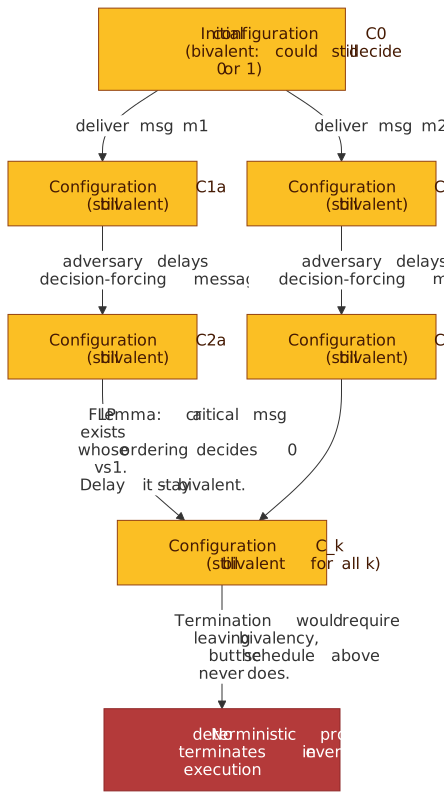
execution. The proof (FLP §3, Lemmas 2–3) is constructive: it builds an
adversarial scheduler that keeps the system perpetually “bivalent” — able
to decide either 0 or 1 — by carefully delaying the single message
whose ordering would force the decision. Termination, not safety, is what
FLP takes from you.
Three load-bearing assumptions in the FLP model are what real systems relax:
- Fully asynchronous network. Messages can be delayed arbitrarily but not lost. Partial synchrony — where the network is async only for bounded periods — is the standard escape hatch.
- Deterministic protocol. No randomness allowed. Adding coin flips
changes the picture: Ben-Or (1983) showed an
asynchronous Byzantine agreement protocol that terminates with
probability
1, even though any single round may fail. - At least one crash. Without crashes, even synchronous voting is trivial.
The three practical escape hatches
1. Partial synchrony. Assume the network is asynchronous most of the time but eventually behaves synchronously long enough for the protocol to make progress. Safety holds always; liveness holds eventually. This is the DLS model and the foundation under every leader-based protocol you actually run. In Raft and Multi-Paxos this assumption shows up as the election timeout: if the leader fails to heartbeat within a bounded window, followers assume “the network has been async long enough” and start a new view.
2. Randomisation. Use random coin flips (or a verifiable random function) to break adversarial schedules. Ben-Or’s protocol, Rabin’s shared-coin protocol, and modern random-leader BFT protocols (Algorand-style) all sit in this branch.
3. Failure detectors. Treat “is node X alive?” as an oracle. Even
an unreliable oracle suffices: Chandra and Toueg (1996)
showed that the eventually-weak detector class ◇W is enough for
consensus given a majority of correct processes, and
Chandra–Hadzilacos–Toueg (1996) proved that the
eventual-leader detector Ω is the weakest failure detector that
solves consensus. Implementing Ω in practice is what every Raft
heartbeat loop is doing.
Important
FLP is not “consensus is impossible.” It is “no protocol can give you a worst-case bound on termination under fully adversarial scheduling.” Real networks are not adversarially scheduled, so timeouts are enough in practice — but the result is what forces every production protocol to expose a tunable: election timeout, heartbeat interval, lease TTL.
Paxos: the foundation
Lamport’s Part-Time Parliament (TOCS 1998, originally submitted in 1990) is the classical consensus algorithm. It is not historically the first — Oki and Liskov’s Viewstamped Replication (PODC 1988) arrived a year earlier and provides the same guarantees with a primary-backup framing — but Paxos is the one whose framework other protocols mostly build on. Lamport’s later Paxos Made Simple is the readable presentation; the original is deliberately allegorical.
Roles and the two phases
Paxos splits the protocol into three roles, usually colocated on the same physical nodes:
- Proposers initiate proposals.
- Acceptors vote on them.
- Learners observe what was decided.
Each consensus round is identified by a globally unique, monotonically
increasing proposal number n (often a (round, node-id) pair so
that ties break deterministically).
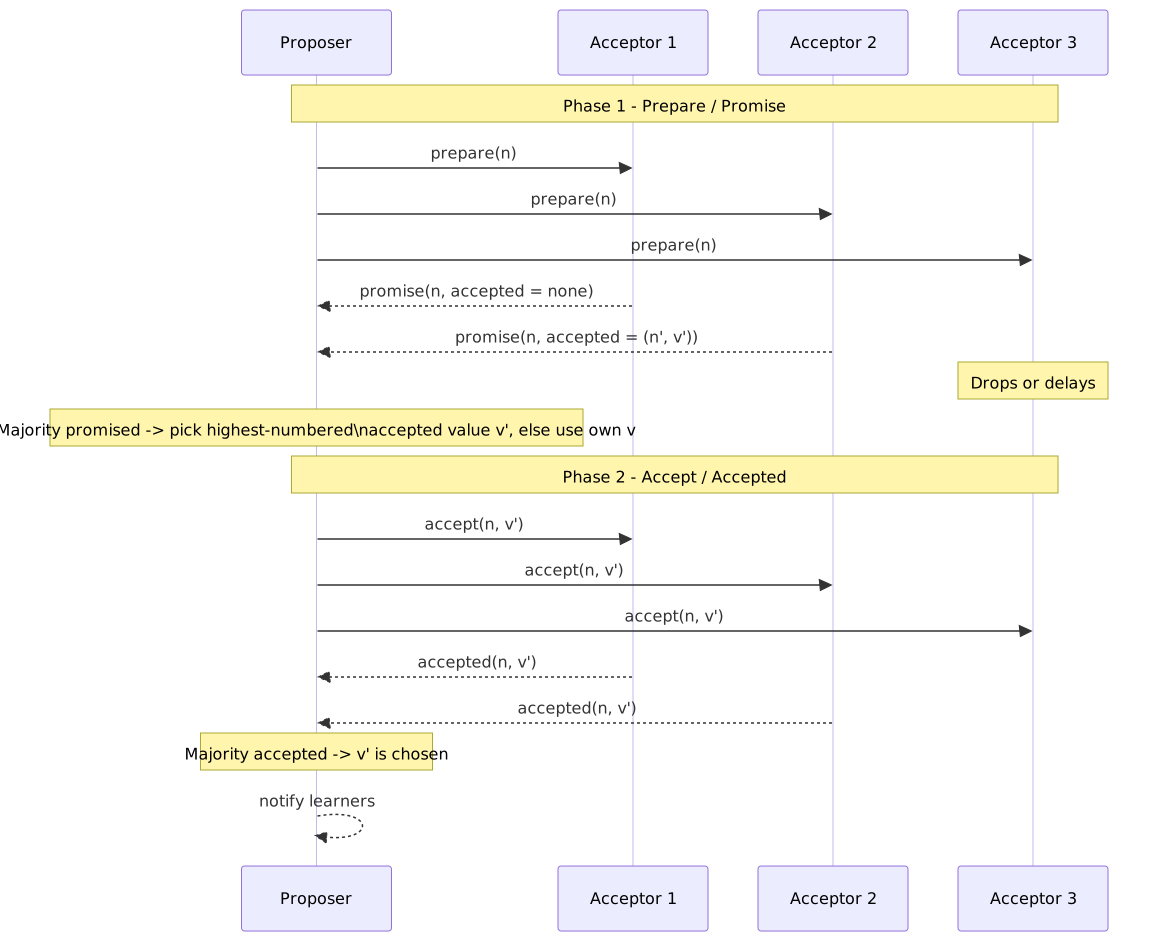
Phase 1 — Prepare / Promise. A proposer picks a fresh n and sends
prepare(n) to a majority of acceptors. Each acceptor either ignores
the prepare (because it has already promised something ≥ n) or
responds with promise(n, accepted) carrying the highest-numbered
value it has previously accepted, if any. Once the proposer hears from a
majority it knows two things: no acceptor in that majority will accept
any older proposal, and if the slot already has an outcome it will be
the value carried by the highest-numbered promise.
Phase 2 — Accept / Accepted. The proposer sends accept(n, v) —
where v is the highest-numbered accepted value from Phase 1, or its
own value if the slot was empty — to (at least) the same majority. An
acceptor that has not promised to a higher proposal accepts and replies.
Once a majority accepts, the value is chosen. Any subsequent prepare
with a larger n that touches that majority will discover the chosen
value and propagate it.
The whole correctness argument rides on quorum intersection: every two majorities share at least one acceptor, so the highest-numbered accepted value follows the proposer through Phase 1 and cannot be overwritten.
Why “Paxos Made Simple” still produces hard implementations
Single-decree Paxos is concise. Real systems need Multi-Paxos — agreement on a sequence of slots — plus catch-up, snapshotting, leader stability, and reconfiguration. The team that built Google’s Chubby service described the gap bluntly:
There are significant gaps between the description of the Paxos algorithm and the needs of a real-world system.
The gaps they listed (and that every implementor still hits) are:
- Liveness under contention. Two competing proposers can livelock, each invalidating the other’s prepare. Multi-Paxos elects a stable distinguished proposer; protocols like Mencius rotate the role.
- Disk durability. Every promise and accept must hit stable storage before the acceptor replies. fsync latency, not network RTT, ends up bounding throughput.
- Catch-up. A fallen-behind acceptor needs to replay missed slots without holding up new proposals.
- Reconfiguration. Adding or removing acceptors. Lamport revisited this in Reconfigurable State Machines in 2009; production systems instead borrow Raft-style mechanisms (see below).
- Fast Paxos and friends. Fast Paxos saves a round
trip in the common case at the cost of needing larger quorums (at
least
⌈3n/4⌉) — an early example of the quorum-vs-latency knob that Flexible Paxos later generalised.
Multi-Paxos: a stable leader
Basic Paxos pays two round-trips per decided value. Multi-Paxos pins a distinguished proposer and runs Phase 1 once for an entire window of sequence numbers. Each new value then needs only Phase 2: a single round-trip from leader to majority. If the leader fails, a new leader must run Phase 1 against the same range to recover any partially committed slots before proposing fresh ones.
The cost is the operational complexity of leader leases, lease renewal under skew, and disambiguating “I am no longer leader” from “my proposal is just slow.” Most production “Paxos” systems are really Multi-Paxos with a leader-lease optimisation on top.
Cheap Paxos and leaderless variants
Two more Paxos variants matter for the design space, even though almost no one runs them in plain form:
- Cheap Paxos (Lamport & Massa, DSN 2004) keeps
f + 1“main” acceptors that handle the steady state andf“auxiliary” acceptors that only participate when a main acceptor is unavailable. The total node count is still2f + 1, but the auxiliaries can be small / cheap (a witness VM, a phone) — the design is the ancestor of every “witness” and “tiebreaker” replica that modern systems ship with. - EPaxos (Egalitarian Paxos) (Moraru, Andersen, Kaminsky, SOSP
2013) is the canonical leaderless multi-decree variant.
Any replica can propose, and non-conflicting commands commit in a
single round-trip via a “fast quorum” of size
⌊3f/2⌋ + 1. Conflicting commands fall back to a two-round slow path that establishes a dependency order. EPaxos’s appeal is geographic load-spreading (no leader bottleneck), but the dependency tracking is notoriously fiddly to implement correctly — recent work (EPaxos Revisited, NSDI 2021) identified long-standing recovery bugs in the original protocol. Almost every production “EPaxos-flavoured” system ships a substantially modified variant.
Flexible Paxos: quorums revisited
The classical proof requires every two quorums to intersect. Howard, Malkhi, and Spiegelman’s Flexible Paxos (OPODIS 2016) showed that this is overconservative: only the Phase 1 quorum of any round must intersect with the Phase 2 quorum of every previous round. Two Phase 2 quorums in the same round may be disjoint.
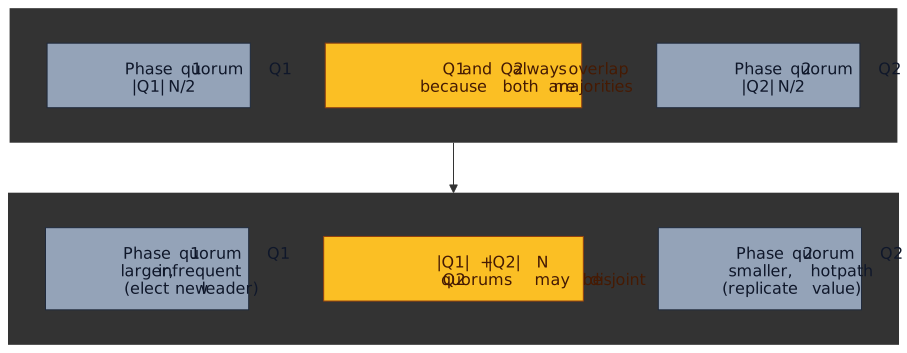
The practical consequence: you can shrink the hot-path Phase 2 quorum (faster commits, lower throughput-floor) by paying with a larger Phase 1 quorum (slower, infrequent leader changes). Heidi Howard’s blog walks the design space; CockroachDB’s Quorum Leases applies similar reasoning to read-only quorums.
Zab and ZooKeeper
ZooKeeper does not run Paxos. It runs Zab (ZooKeeper Atomic Broadcast), introduced in Junqueira, Reed, and Serafini’s DSN 2011 paper. Zab is a primary-order atomic broadcast protocol optimised for ZooKeeper’s use case — coordination primitives backed by a hierarchical znode tree.
The differences from Multi-Paxos that matter in practice:
- Explicit primary, not symmetric proposers. All writes go through the primary; the primary’s transactions commit in the order it proposes them.
- Prefix property. If transaction
mis delivered, every transaction the primary proposed beforemhas been delivered. This is stronger than what multi-decree Paxos gives you across leader changes, where two distinguished proposers might interleave decisions for adjacent slots. - Recovery first, then activation. A new primary cannot accept client requests until it has pushed its committed prefix to a quorum.
ZooKeeper trades that primary-order guarantee for a slightly larger recovery cost; in exchange you get a small, well-tested coordination kernel that almost every Hadoop-era system bolted on top of.
Note
The classic example was Apache Kafka, which used ZooKeeper for broker metadata, controller election, and consumer offsets. KRaft (Kafka’s self-managed Raft quorum, KIP-833) was marked production-ready in Kafka 3.3.1 (October 2022), ZooKeeper mode was deprecated in 3.5, and ZooKeeper support was fully removed in Kafka 4.0 (March 2025). New Kafka clusters are KRaft-only.
Raft: designed for understandability
Raft (USENIX ATC 2014) is a deliberate redesign of Multi-Paxos with one explicit goal — being easier to teach, prove, and implement. The paper opens with that as the thesis:
Our approach was unusual in that our primary goal was understandability: could we define a consensus algorithm for practical systems and describe it in a way that is significantly easier to learn than Paxos?
Raft buys understandability with three opinionated decisions:
| Paxos | Raft | Pay-off |
|---|---|---|
| Any node can propose | Only the current leader proposes | One source of truth for log order |
| Acceptors may have gaps in their accepted slots | Followers’ logs are strict prefixes of the leader’s | Easier recovery; leader pushes one log forward |
| Symmetric reasoning | Three explicit roles (Follower, Candidate, Leader) | Implementations are state machines, not graphs |
State machine and election
Each Raft node is in one of three roles: Follower, Candidate, or Leader. Time is divided into terms — Raft’s logical clock — each of which has at most one leader.
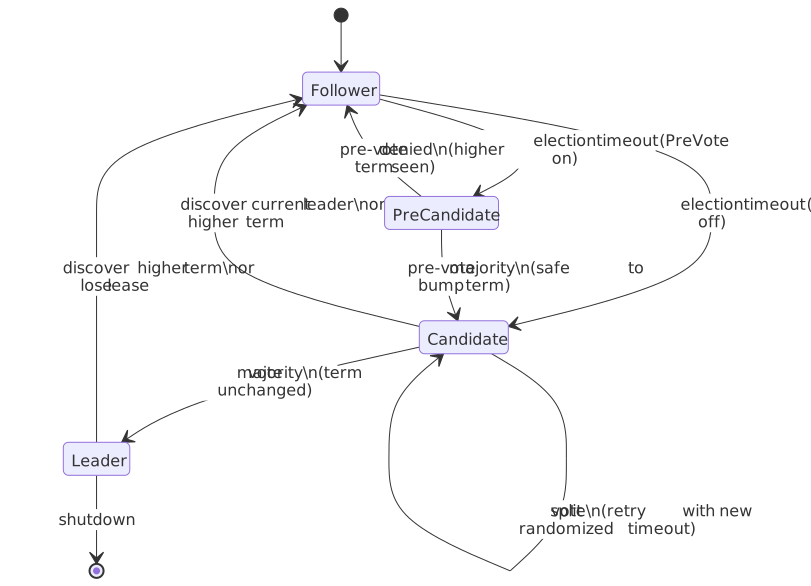
A follower that does not hear from the leader within its election timeout transitions to candidate, increments its term, votes for itself, and asks every peer for a vote. A candidate wins if it collects votes from a majority for the same term. Two refinements that every production implementation enables:
- Randomised timeouts. Each node draws its election timeout from a small range (the paper uses 150–300 ms as a study setting). Different timeouts make split votes statistically rare.
- Vote restriction. A node only grants a vote if the candidate’s log is at least as up-to-date — same term with a longer log, or a higher last-log term. Combined with the leader-completeness invariant, this is what guarantees no committed entry is ever lost across leader changes.
- PreVote. Before bumping its term, a candidate runs a non-binding
pre-election to check it would actually win. Without PreVote, a node
that was network-partitioned and came back with an inflated term
forces the legitimate leader to step down even though the cluster was
healthy. PreVote was introduced in §9.6 of Ongaro’s
dissertation and is exposed as
--pre-votein etcd and the equivalent flag in TiKV’sraft-rs.
Log replication and the safety invariants
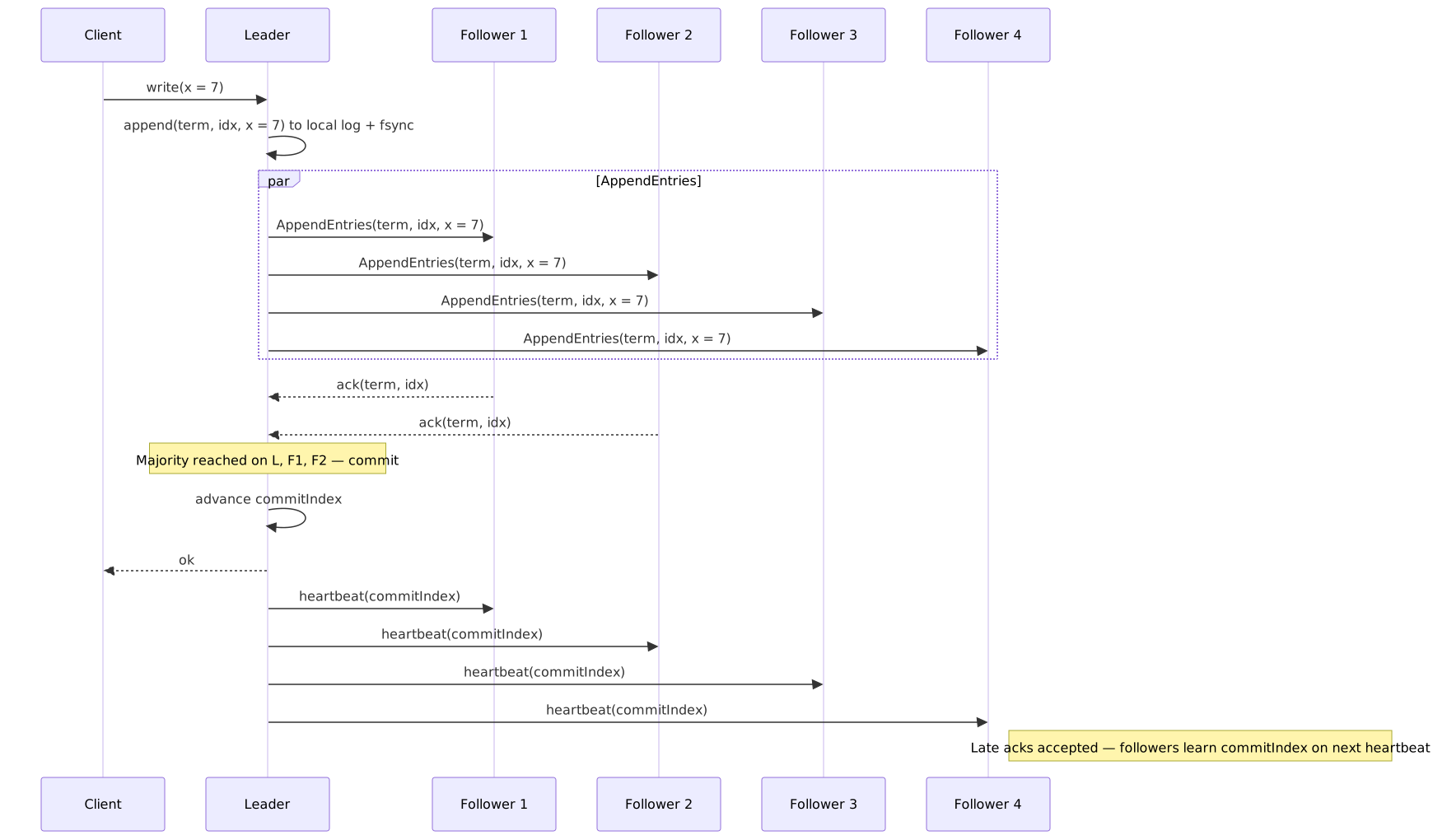
The leader receives client writes, appends them to its local log, and
sends AppendEntries RPCs to every follower. A follower acknowledges
once the entry is on its disk; the leader advances its commitIndex
once a majority — counting itself — has acknowledged. Followers learn
the new commit index on the next heartbeat or AppendEntries.
The Raft paper identifies five named safety properties that a correct implementation must preserve:
- Election Safety — at most one leader per term.
- Leader Append-Only — a leader never overwrites or deletes entries in its own log; it only appends.
- Log Matching — if two logs contain an entry with the same index and term, the logs are identical in all preceding entries.
- Leader Completeness — if an entry is committed in some term, it appears in the log of every leader of all higher-numbered terms.
- State Machine Safety — if a node has applied an entry at a given index, no other node ever applies a different entry at the same index.
Together those five buy the same end-to-end guarantee as Multi-Paxos.
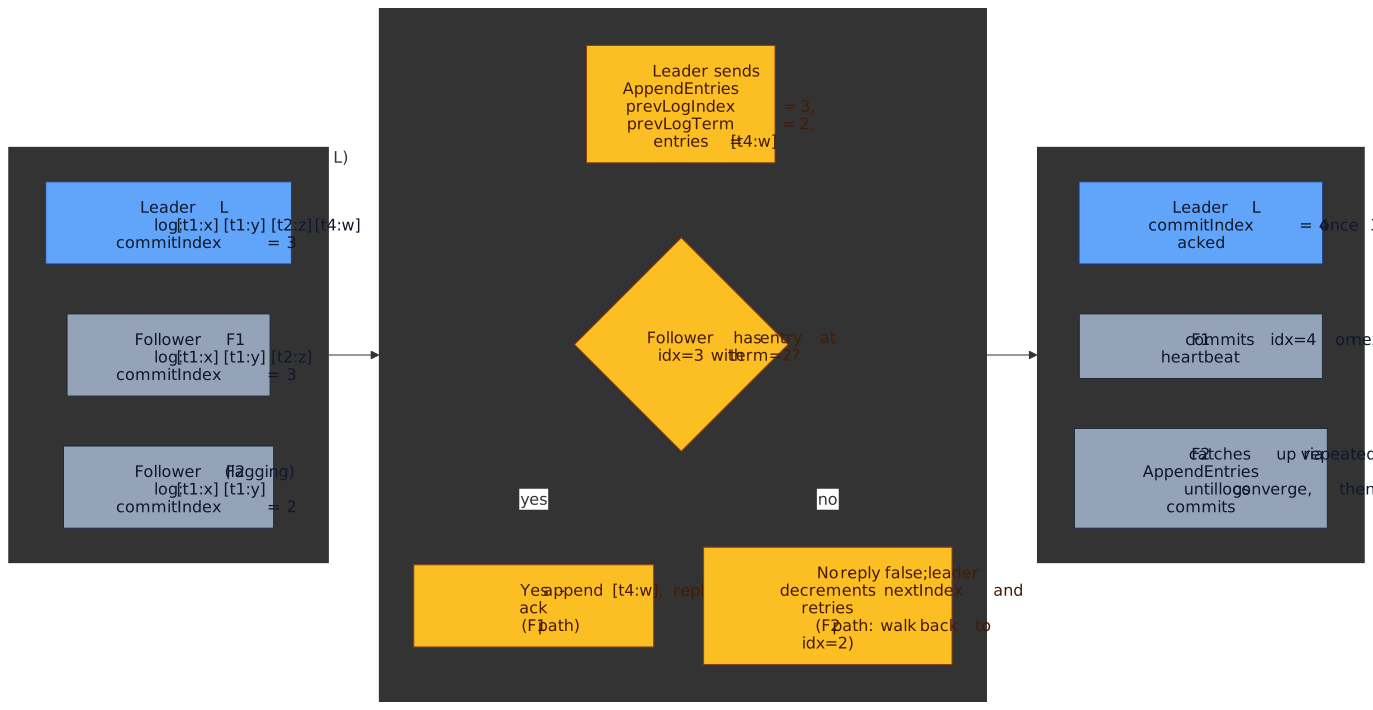
“Log Matching” is the workhorse: the consistency check on each
AppendEntries (the leader includes the index and term of the entry
before the new one) lets a follower detect divergence in O(1) and
forces the leader to walk back nextIndex until logs agree.
Important
A leader can only mark entries from its current term as committed by counting acks. Entries from prior terms become committed only indirectly — by being the prefix of a current-term entry that reaches quorum. Raft §5.4.2 calls this out as the consequence of Figure 8: a leader that naively commits a replicated-but-not-current-term entry can have it overwritten by a future leader.
Linearizable reads without paying a Raft round
Naively, a linearizable read needs a fresh consensus round to confirm the leader is still the leader. That doubles read latency. Two optimisations are now standard:
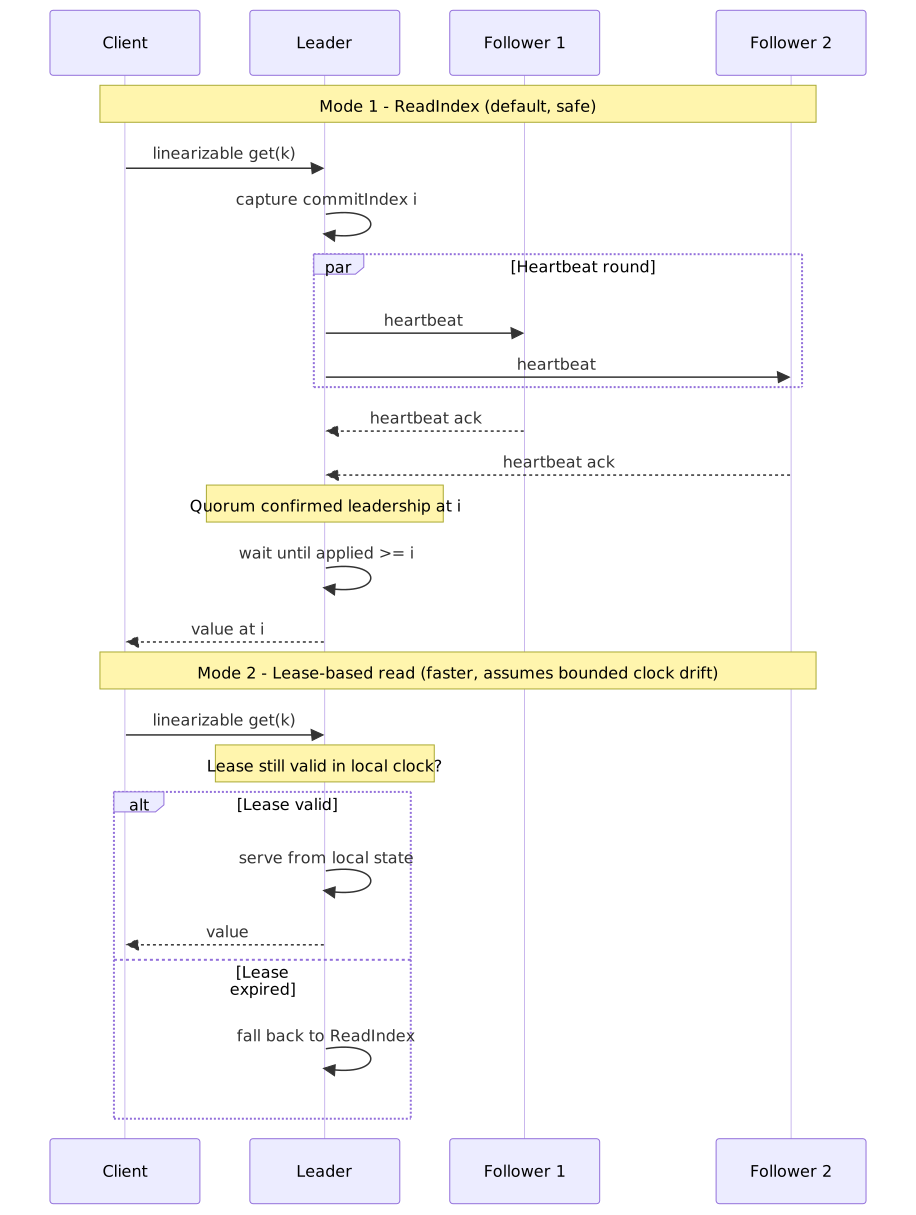
- ReadIndex (Raft thesis §6.4, default in etcd). The
leader records its current
commitIndex, sends a heartbeat, and waits for quorum acks. Once it confirms it is still leader, it serves the read from local state at that index. No new log entry, but still one round-trip of network confirmation. - Lease-based reads. While the leader holds a valid heartbeat
lease, it serves linearizable reads with no network round-trip at
all. Safety relies on bounded clock drift between leader and
followers — a much stronger assumption than ReadIndex needs. etcd
exposes this as
ReadOnlyLeaseBasedand explicitly warns about clock-skew sensitivity.
CockroachDB pushes this further: every range has a leaseholder that serves linearizable reads from local state. By default the leaseholder is colocated with the Raft leader5; a lease-transfer machinery keeps them together so that the read-serving replica is always the one driving the consensus group, avoiding an extra hop.
Membership changes
Adding or removing nodes is the second-classic Raft footgun. Naively
swapping Cold for Cnew allows two disjoint majorities to exist
simultaneously and commit conflicting values. The original Raft paper
solves this with joint consensus: enter a transitional configuration
Cold,new that requires a majority of both committees, then commit
Cnew. The Raft thesis chapter 4 introduces a simpler single-server
membership change — only one node added or removed at a time, so
the old and new majorities always intersect. That algorithm had a known
liveness/safety bug across leader changes; the fix is for a leader to
commit a no-op from its current term before processing any membership
change6.
Most production Raft implementations use the single-server variant plus
a non-voting Learner / staging role. etcd added Learners in
v3.4: the new node receives AppendEntries like a
follower but does not count toward quorum or vote until the operator
promotes it. That eliminates the most common reconfiguration outage,
which is adding a slow new member and pushing the cluster onto a
quorum that includes a node still snapshotting its initial state.
Raft in production: etcd
etcd is the most widely deployed Raft implementation. It backs Kubernetes (every cluster keeps API-server state in etcd), CoreDNS service discovery, M3DB, and any number of internal control planes. It graduated to a CNCF top-level project in November 2020.
The performance envelope is dominated by two things:
- fsync latency. Every Raft entry must be on the leader’s disk
before the leader counts its own ack, and on each follower’s disk
before the follower acks. etcd’s hardware guidance is uncompromising:
the Prometheus metric
wal_fsync_duration_secondsshould keep its 99th percentile under 10 ms in production7. - Heartbeat / election timing. etcd’s defaults are
heartbeat-interval = 100 msandelection-timeout = 1000 ms. The tuning guide requireselection-timeout ≥ 10 × RTTbetween members; cross-region clusters typically runheartbeat-interval ≈ RTTand election timeouts of several seconds.
Warning
The most common Kubernetes-control-plane outage is “etcd cluster on
shared/network-attached storage starts seeing P99 fsync above 10 ms,
which causes the leader to miss its heartbeat window, which triggers
an unnecessary election, which forces a snapshot to catch the
followers up, which makes fsync worse.” Alert on
etcd_disk_wal_fsync_duration_seconds p99, not just averages, and
isolate etcd from noisy neighbours on the same disk.
Quorum systems
Quorum overlap is the engine that makes everything in this article work. Beyond the Paxos and Raft majorities, two ideas are worth knowing:
Read/write quorums
The classical Gifford weighted voting result says a
replicated register is linearizable if every read intersects every write
— that is, R + W > N. The same arithmetic is the foundation under
Dynamo-style stores (Cassandra, DynamoDB,
Riak), where R, W, and N are exposed to the client per operation:
| Configuration | R |
W |
Trade-off |
|---|---|---|---|
| Read-heavy | 1 |
N |
Fast reads, slow and partition-sensitive writes |
| Write-heavy | N |
1 |
Fast writes, expensive reads |
| Balanced | ⌈(N+1)/2⌉ |
⌈(N+1)/2⌉ |
Equal latency; what consensus systems do |
Consensus systems fix R = W = ⌈(N+1)/2⌉ because they need
linearizability across slots, not just per register. Dynamo-style
systems give up that cross-slot ordering in exchange for per-operation
tunability.
Witnesses and learners
Two-node consensus is impossible (no majority survives any failure), but real deployments still need to tolerate one failure on a budget. The standard answer is a witness node: it participates in elections and log durability for metadata only, no data. Microsoft Azure Storage uses witnesses in stretch deployments, etcd Learners are the Raft equivalent on the read path, and several Paxos implementations expose “non-voting members” with similar semantics.
Byzantine fault tolerance
Crash-fault tolerance assumes failed nodes simply stop responding.
Byzantine fault tolerance (BFT) assumes failed nodes can do anything —
send conflicting messages to different peers (equivocate), forge votes,
collude with each other, or selectively delay messages. The 1982
Byzantine Generals paper proved the basic lower
bound: tolerating f Byzantine faults requires N ≥ 3f + 1.
| Scenario | Fault model | Why |
|---|---|---|
| Private datacenter | Crash | Nodes are run by the same operator; no incentive to lie |
| Multi-tenant cloud | Crash | Hypervisor isolates tenants; control plane is trusted |
| Public blockchain | Byzantine | Untrusted participants with economic incentives to cheat |
| Cross-org consortium | Byzantine | Operators do not fully trust each other |
| Critical / military | Byzantine | Adversary may compromise a subset of nodes |
The intuition for 3f + 1: with at most f Byzantine nodes, you cannot
distinguish “f honest replicas are silent” from “f Byzantine
replicas are lying.” To make any decision safely you must hear from
2f + 1 replicas, of which at least f + 1 are honest, so the cluster
must contain at least 3f + 1 nodes total.
PBFT
Castro and Liskov’s Practical Byzantine Fault Tolerance (OSDI 1999) was the first protocol to make BFT cheap enough to deploy on commodity hardware. It runs in a partial-synchrony model and has three phases per request once a stable primary exists:
- Pre-prepare. Primary assigns a sequence number and broadcasts the request.
- Prepare. Replicas that accept the proposal broadcast a
preparemessage; once a node sees2f + 1matching prepares (its own counts), it knows the request will not be reordered. - Commit. Replicas broadcast
commit; on2f + 1matching commits, the request is delivered.
A separate view-change runs whenever a primary is suspected, with quadratic message complexity — every replica broadcasts its view-change message to every other replica.
The all-to-all fan-out is what limits PBFT to small committees — past
roughly 20–30 nodes, the O(n²) message volume drowns useful
throughput.
HotStuff and the modern BFT family
HotStuff (PODC 2019) is the headline modern BFT protocol. Its two contributions:
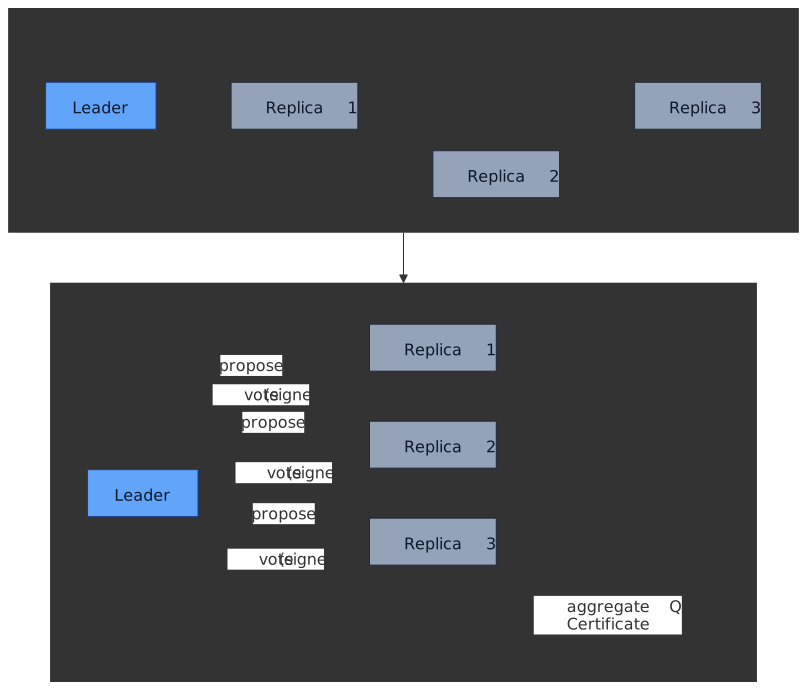
- Linear authenticator complexity per phase. Replicas send their
votes to the leader; the leader aggregates them into a single
threshold-signed Quorum Certificate (QC). Each phase therefore
costs
O(n)authenticators instead of PBFT’sO(n²). - Three-chain commit. A block is committed once it is the third in an unbroken chain of QCs (Prepare, Pre-commit, Commit). The same three-phase structure also handles view-changes — there is no separate quadratic view-change protocol, which is the headline difference from PBFT.
HotStuff is the basis of LibraBFT (then DiemBFT, now Aptos), and several modern proof-of-stake L1 chains pick up the same QC-based design. Tendermint, used in the Cosmos ecosystem, predates HotStuff and shares the leader-aggregated QC idea but couples block production tightly with consensus rounds.
Caution
Do not pay BFT prices for crash-fault problems. A 5-node etcd cluster
tolerates two crashes with 2f + 1 and O(n) messages; a BFT
equivalent needs 7 nodes and several times the message traffic. BFT is
the right answer for adversarial environments, not for “we want to be
extra safe.”
Consensus in production: choosing a system
| System | Protocol | Data model | Consistency | Best fit |
|---|---|---|---|---|
| ZooKeeper | Zab | Hierarchical (znodes) | Linearizable | Coordination primitives, locks, leader leases |
| etcd | Raft | Flat KV | Linearizable | Kubernetes, control planes, service registry |
| Consul | Raft + Serf | Flat KV | Strong (Raft) for KV, eventual for membership | Service discovery, multi-DC mesh |
| CockroachDB | MultiRaft | SQL | Serializable (per-key linearizable) | Distributed OLTP, multi-region apps |
| TiKV | MultiRaft | KV / SQL via TiDB | Snapshot isolation / Serializable | HTAP, large-scale KV |
| Spanner | Multi-Paxos + TrueTime | SQL | External consistency (linearizable transactions) | Globally distributed transactional store |
etcd: the Kubernetes substrate
etcd is the boring, reliable Raft store that backs Kubernetes’ API server. The defaults assume a 3- or 5-node cluster on dedicated SSDs in a single datacenter. The Kubernetes operations guide recommends:
- 3 nodes for most clusters; 5 nodes for production where surviving two simultaneous failures matters.
- Always odd. A 4-node cluster tolerates the same one failure as a 3-node cluster but pays for an extra ack on every write.
- Stay below 7. Raft write latency is set by the slowest member of the quorum; more replicas means a higher tail.
The watch API is what makes etcd fit Kubernetes: controllers WATCH a
prefix and react to incremental changes without polling. Watch storms
from misbehaving controllers (resyncing entire collections, no
backoff) are the most common etcd-side cause of API-server
unavailability.
Consul: Raft for catalog, gossip for membership
Consul splits its consistency story by data type. The KV store and
service catalog use HashiCorp’s Raft library —
linearizable, per-datacenter. Membership and failure detection use
Serf, a SWIM-style gossip protocol that propagates state in O(log N) rounds. The reasoning is straightforward: service registration
needs strong consistency so that two clients agree on which instance to
talk to, but liveness signals are fundamentally probabilistic and can
tolerate eventual delivery.
Multi-datacenter Consul keeps one Raft cluster per DC and uses WAN gossip to exchange catalog snapshots — explicit acknowledgement that running a single Raft group across the WAN is not viable.
CockroachDB: MultiRaft and Parallel Commits
CockroachDB shards its keyspace into ranges, each defaulting to 512 MiB8, and runs an independent Raft group per range. The “MultiRaft” naming is from CockroachDB itself; TiKV uses the same pattern. Per-range Raft has two consequences:
- Each range has its own leader / leaseholder. Different ranges can put their leaseholders on different nodes, so write load spreads naturally across the cluster instead of bottlenecking on a single Raft leader.
- Cross-range transactions need a separate concurrency-control layer. CockroachDB layers a transactional protocol on top: write intents (provisional values) on the affected ranges via Raft, then a transaction record that flips the intents to committed. Parallel Commits removes one Raft round from the commit latency by writing the transaction record in parallel with the intents — the price is that recovery must be able to reconstruct whether the transaction committed by inspecting intents.
Spanner: Multi-Paxos plus TrueTime
Spanner is the only widely deployed system that gets globally distributed linearizable transactions. It uses Multi-Paxos within each Paxos group (a few replicas per data shard) and relies on TrueTime — Google’s GPS- and atomic-clock-disciplined time service — to bound clock uncertainty. Transactions wait out the uncertainty interval before reporting commit, so external observers see a strictly increasing commit-time order.
The Spanner architecture is covered in depth in Consistency models and the CAP theorem; this article only treats it as the existence proof that consensus + disciplined time = global linearizability.
Common production pitfalls
1. Disk fsync latency causes phantom elections
The dominant Raft outage pattern is not network partition. It is the storage stack: the leader fails to sync its WAL within the heartbeat window, follower heartbeats time out, an election runs, the new leader inherits the same disk problem, and the cluster oscillates.
- Monitor
wal_fsync_duration_secondsandbackend_commit_duration_secondsp99, not means. - Use dedicated NVMe with predictable latency. Network-attached storage almost always violates the [10 ms p99 fsync floor][etcd-fsync] under load.
- Cap concurrent etcd snapshots; a defragmentation that runs while Kubernetes is creating thousands of objects will starve fsync.
2. Even-numbered or 2-node clusters
A 2-node Raft cluster cannot survive any failure (quorum is 2). A 4-node cluster tolerates the same one failure as a 3-node cluster but pays for an extra ack per write. Always use 3, 5, or 7. If you need geographic redundancy without paying for three full datacenters, use a 3-node Raft group with one witness replica in the third site (data goes to the two production sites; the witness votes on elections only).
3. Cross-region clusters with default timeouts
election-timeout = 1000 ms works in a single datacenter where RTT is
sub-millisecond. Across regions, a 60 ms RTT can blow that budget on
two slow heartbeats and trigger spurious elections. The
etcd tuning rule is election-timeout ≥ 10 × RTT; for a
US-East-to-EU round trip that means at least 800 ms — and you probably
want PreVote enabled to avoid disruptive resets when partitions heal.
4. Reading stale data from followers
Load-balancing reads across followers without the lease or ReadIndex machinery breaks read-your-writes. Either:
- Read from the leader (or CockroachDB leaseholder) to get linearizability for free, or
- Use ReadIndex / lease-based reads, or
- Explicitly opt into bounded staleness with a stale-read API
(
AS OF SYSTEM TIMEin CockroachDB,WithSerializable()on the etcd v3 client (oretcdctl get --consistency=s), follower reads in TiKV).
The wrong fix — pushing reads to followers without changing the consistency contract — is the single most common cause of “intermittent stale-data bug” tickets in distributed databases.
5. Confusing crash-fault and Byzantine-fault budgets
A 5-node Raft cluster tolerates two crashes (2f + 1). A 5-node BFT
cluster tolerates one Byzantine fault (3f + 1, so f = 1). Mixing
the formulas — sizing a BFT cluster as if 2f + 1 worked — silently
breaks safety. Always state the fault model first, then compute the
quorum.
Practical takeaways
- Pick the smallest plausible model. Crash-fault
2f + 1is enough for any single-operator deployment. Reach for BFT only when you genuinely do not trust a subset of operators. - Almost every “consensus problem” in your stack is really log replication. Reach for Raft (etcd, Consul) or Multi-Paxos (Spanner, Chubby) before you think about anything more exotic.
- The hot path is dominated by disk fsync, not network latency. Pin your consensus group to dedicated NVMe and alert on p99 fsync.
- Read latency is a separate problem from write consensus. Use ReadIndex or lease-based reads to avoid paying a Raft round per read; use follower reads with explicit staleness when reads dominate.
- The choice between ZooKeeper, etcd, Consul, and a MultiRaft database is mostly an ecosystem decision (Hadoop vs Kubernetes vs HashiCorp vs SQL workload), not a correctness one.
- Treat election timeouts, lease durations, and quorum sizes as load-bearing operational parameters. They embed your assumption about partial synchrony; defaults that work at single-DC RTTs do not work cross-region.
Appendix
Prerequisites
- Distributed-systems basics: CAP and PACELC, network partitions, replication.
- Consistency models: linearizability, sequential consistency, serializability, eventual consistency.
- Networking primitives: RTT, TCP retransmits, message ordering guarantees.
Glossary
- Term / view / ballot. Logical clock identifying a single leadership epoch. “Term” in Raft, “view” in PBFT/HotStuff/VR, “ballot” or “round” in Paxos.
- Quorum. Minimum number of nodes that must participate in a decision such that any two quorums share at least one node.
- Linearizable. Operations appear to take effect at some point between their invocation and response — the strongest single-object consistency model.
- Liveness. The system eventually decides.
- Safety. The system never decides incorrectly (no two replicas commit conflicting values).
- External consistency. Spanner’s name for linearizability across multi-object transactions.
- Atomic broadcast. Total-order broadcast to all replicas; equivalent to consensus.
Summary
- FLP rules out deterministic consensus in fully async systems with even one crash. Real systems escape via partial synchrony, randomness, or failure detectors.
- Paxos is the foundational protocol; Multi-Paxos pins a stable leader; Flexible Paxos shows quorums need only intersect across phases.
- Raft trades generality for understandability and is what every modern crash-fault production system actually runs.
- Zab gives ZooKeeper its primary-order broadcast; Kafka has now moved off ZooKeeper to its own KRaft.
- PBFT made BFT practical at small committee sizes; HotStuff pulled the per-phase cost down to linear and reused the same three-chain structure for view-change.
- Production failure modes are dominated by disk fsync latency, cross-region timeout misconfiguration, and reading stale data from followers.
References
- Fischer, Lynch, Paterson — Impossibility of Distributed Consensus with One Faulty Process (JACM 1985).
- Dwork, Lynch, Stockmeyer — Consensus in the Presence of Partial Synchrony (JACM 1988).
- Ben-Or — Another advantage of free choice: Completely asynchronous agreement protocols (PODC 1983).
- Chandra, Toueg — Unreliable Failure Detectors for Reliable Distributed Systems (JACM 1996).
- Chandra, Hadzilacos, Toueg — The Weakest Failure Detector for Solving Consensus (JACM 1996).
- Lamport — The Part-Time Parliament (TOCS 1998).
- Lamport — Paxos Made Simple (2001).
- Oki, Liskov — Viewstamped Replication (PODC 1988).
- Chandra, Griesemer, Redstone — Paxos Made Live (PODC 2007).
- Howard, Malkhi, Spiegelman — Flexible Paxos: Quorum Intersection Revisited (OPODIS 2016).
- Lamport — Fast Paxos (Distributed Computing 2006).
- Lamport, Massa — Cheap Paxos (DSN 2004).
- Moraru, Andersen, Kaminsky — There Is More Consensus in Egalitarian Parliaments (SOSP 2013).
- Tollman, Park, Ports — EPaxos Revisited (NSDI 2021).
- Junqueira, Reed, Serafini — Zab: High-performance broadcast for primary-backup systems (DSN 2011).
- Ongaro, Ousterhout — In Search of an Understandable Consensus Algorithm (USENIX ATC 2014).
- Ongaro — Consensus: Bridging Theory and Practice (Stanford PhD dissertation, 2014).
- Lamport, Shostak, Pease — The Byzantine Generals Problem (TOPLAS 1982).
- Castro, Liskov — Practical Byzantine Fault Tolerance (OSDI 1999).
- Yin, Malkhi, Reiter, Gueta, Abraham — HotStuff: BFT Consensus with Linearity and Responsiveness (PODC 2019).
- Corbett et al. — Spanner: Google’s Globally-Distributed Database (OSDI 2012).
- Elhemali et al. — Amazon DynamoDB: A Scalable, Predictably Performant, and Fully Managed NoSQL Database Service (USENIX ATC 2022).
- etcd documentation — Tuning, hardware, learner, and API-guarantees pages.
- Kafka KIP-833 and Kafka 4.0 release notes.
Footnotes
-
§6 of Chandra & Toueg, Unreliable Failure Detectors for Reliable Distributed Systems, JACM 1996, proves Atomic Broadcast and Consensus are equivalent in asynchronous systems with failure detectors. ↩
-
Lamport, Shostak, Pease, The Byzantine Generals Problem — TOPLAS 1982 — establishes the
N ≥ 3f + 1bound for Byzantine agreement. ↩ -
Elhemali et al., Amazon DynamoDB — USENIX ATC 2022 — describes Multi-Paxos within each partition’s replication group. ↩
-
Yin et al., HotStuff — PODC 2019 §1 — linear authenticator complexity per phase via threshold-signed quorum certificates. ↩
-
Cockroach Labs documentation, Reads and Writes in CockroachDB: “the leaseholder is the same replica as the Raft leader, except during lease transfers.” A background process actively rebalances leases to keep the two colocated. ↩
-
Diego Ongaro, Bug in single-server membership changes (raft-dev mailing list, 2015), describes both the safety hole and the “leader must commit a no-op from its current term first” fix. ↩
-
etcd hardware recommendations and etcd FAQ state that
wal_fsync_duration_secondsp99 should stay below 10 ms in production; the Red Hat performance guide reproduces the same number for OpenShift’s etcd nodes. ↩ -
CockroachDB docs, Range / Shard: “A range is 512 MiB or smaller by default.” ↩