Circuit Breaker Patterns for Resilient Systems
A circuit breaker wraps every dependency call so that a slow or failing dependency stops being able to consume the caller’s resources. The point is mechanical: convert slow failures into fast failures so caller threads, sockets, and connection pool slots are returned promptly. This article works through the state machine, the detection and isolation choices, the configuration math behind production incidents (Shopify Semian, Netflix Hystrix), and the modern critique — from Marc Brooker and the AWS Builders’ Library — that argues the pattern is the wrong answer for most cell-based and sharded architectures and should be replaced by adaptive concurrency control.
Why the pattern exists
Without a circuit breaker, a slow dependency cascades upward. The mechanism is easy to derive from Little’s Law ((L = \lambda W)): if requested-arrival-rate (\lambda) holds steady but per-request hold-time (W) jumps, the in-flight count (L) grows until the caller exhausts threads, file descriptors, or connection-pool slots. The caller becomes slow, which makes its callers slow, and so on.
Database degrades to 10s response timeService A├─ Pool: 100 worker threads├─ Per-request hold time was 50 ms, now 10 s (200×)└─ New steady-state capacity: 100 threads / 10 s ≈ 10 req/s (down from ~2,000 req/s before)Service A's callers now wait on Service A → cascade upstream.Naive retries make the picture worse. A 3× retry budget triples load on a dependency that is already failing under its current load, deepening the failure1:
Healthy: 100 req/s offered, 100 req/s succeedFailing: 100 req/s offered × 3 retries = 300 req/s offered → more failures → more retries → metastable failure modeThe standard reference for that metastable feedback loop is Marc Brooker’s Metastability and Distributed Systems. Circuit breakers are one mechanism for breaking the loop; token-bucketed retry throttling is another, and the two compose.
State machine
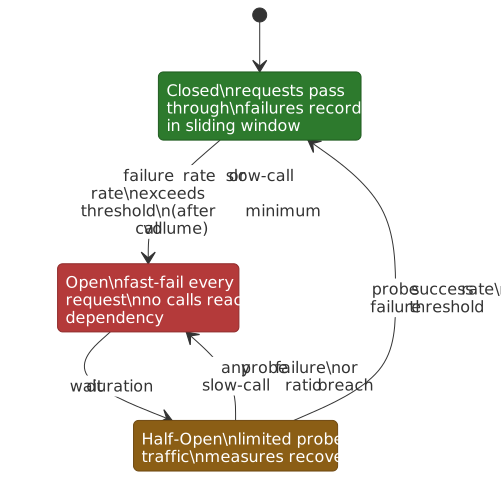
The breaker is a finite state machine. The three normal states — Closed, Open, Half-Open — were introduced in Michael Nygard’s Release It!2, which remains the canonical software reference for the pattern (Nygard adapted it from electrical fuse design). Resilience4j adds three operational overrides on top — METRICS_ONLY, DISABLED, FORCED_OPEN — that are convenience hooks for ops, not part of the steady-state machine3. Older libraries usually stop at the three normal states.
Closed
Requests pass through. Each outcome is recorded in a sliding window. The breaker only evaluates the failure rate when the window has accumulated minimumNumberOfCalls outcomes — Resilience4j defaults this to 100, which prevents a cold breaker from tripping on the first one or two failures during warm-up3.
type WindowedStats = { failures: number total: number}function recordOutcome(stats: WindowedStats, success: boolean): WindowedStats { return { failures: stats.failures + (success ? 0 : 1), total: stats.total + 1, }}function shouldTrip(stats: WindowedStats, minCalls: number, threshold: number): boolean { if (stats.total < minCalls) return false return stats.failures / stats.total >= threshold}Volume threshold matters operationally. A breaker that can open on 2-of-2 failures will flap on every blip — both Hystrix and Resilience4j ship a minimum-volume gate by default.
Open
Every call is rejected without touching the dependency. Resilience4j throws CallNotPermittedException; Hystrix routes to the fallback. The point is to (a) preserve caller resources while the dependency is unhealthy and (b) give the dependency time to recover without retry-storm pressure.
The breaker stays Open for waitDurationInOpenState (Resilience4j defaults to 60 s; Hystrix to 5 s; tune for the dependency’s typical recovery time)34.
Half-Open
After the wait expires, the breaker admits a bounded number of probe requests. The classic Hystrix design admitted a single probe; Resilience4j admits permittedNumberOfCallsInHalfOpenState (default 10) and re-evaluates the failure rate on that probe set3.
A single probe is a noisy signal — one network blip and the breaker re-trips for another full wait window. Multiple probes give a small but useful statistical sample.
Important
Probe timeouts must be much shorter than normal request timeouts. This is the single most common circuit-breaker misconfiguration; the next section walks through Shopify’s worked example.
Per-request flow
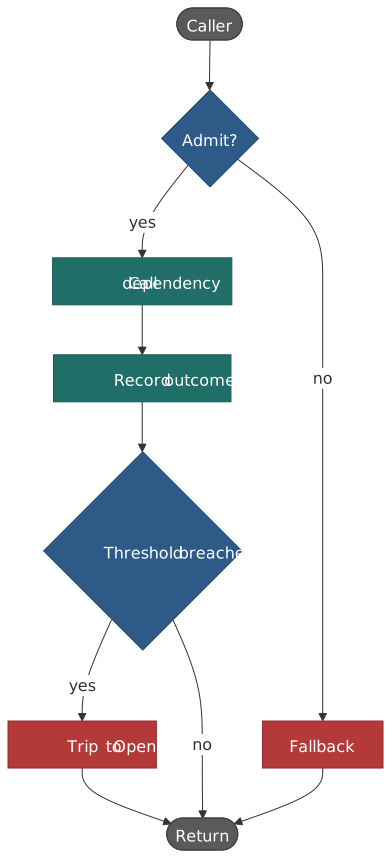
The runtime view of the breaker. Every call passes through the admission decision (state + permit), then either invokes the dependency and updates the window or skips straight to the fallback.
Detection strategies
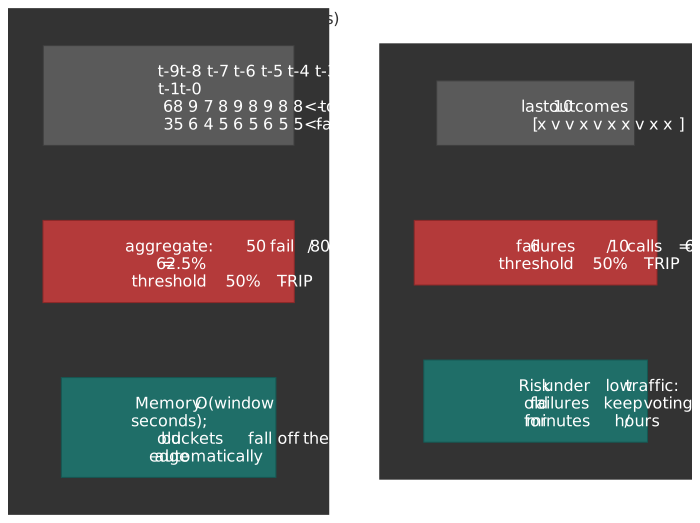
Count-based sliding window
Track outcomes from the last N calls in a circular array. Resilience4j stores three integers per measurement (failed / slow / total counts) and one long for total duration, and maintains a pre-aggregated total so snapshot retrieval is O(1)3.
Window size: 10Failure threshold: 50%Outcomes: [✓ ✗ ✓ ✗ ✗ ✗ ✓ ✗ ✗ ✓] → 6/10 failures = 60% → tripBest when call rate is roughly steady. A risk: under low traffic the window can span minutes or hours, so old failures keep voting on the present.
Time-based sliding window
Aggregate per-second buckets covering the last N seconds. Memory is O(window seconds) regardless of call volume; per-call work is O(1)3.
Window: 10s Threshold: 50%Calls in window: 100 Failures: 60 → 60% → tripBest when traffic is bursty or follows a daily curve. The minimum-call gate still applies, otherwise a low-traffic minute can trip the breaker on a 1-of-2 sample.
Resilience4j configuration in one place
CircuitBreakerConfig config = CircuitBreakerConfig.custom() .slidingWindowType(SlidingWindowType.COUNT_BASED) // or TIME_BASED .slidingWindowSize(100) // default 100 .minimumNumberOfCalls(20) // default 100; lower for low-traffic paths .failureRateThreshold(50) // default 50% .slowCallRateThreshold(50) // default 100% .slowCallDurationThreshold(Duration.ofSeconds(2)) // default 60s .waitDurationInOpenState(Duration.ofSeconds(30)) // default 60s .permittedNumberOfCallsInHalfOpenState(10) // default 10 .automaticTransitionFromOpenToHalfOpenEnabled(true) .recordExceptions(IOException.class, TimeoutException.class) .ignoreExceptions(BusinessException.class) .build();Defaults sourced from the Resilience4j CircuitBreaker config table3. Note that defaults are tuned for high-traffic services; for low-traffic paths you almost always want minimumNumberOfCalls well below 100.
Slow-call detection
Resilience4j can trip on the rate of slow calls before they fail outright. A database under load typically responds slowly before timing out, so opening on slowness preserves caller resources earlier in the failure curve3.
Isolation models
Isolation determines whether a slow dependency can hold the caller’s threads.
Thread-pool isolation (Hystrix default)
Each HystrixCommand ran on a dedicated ThreadPoolExecutor. Calls were submitted as Futures and the parent thread blocked on Future.get(timeout), so timeouts could be enforced even when the underlying client library ignored interrupts5.
The cost, measured by Netflix on a single API instance running one command at 60 rps:
| Percentile | Overhead vs. direct call |
|---|---|
| p50 (and lower) | 0 ms (no measurable cost) |
| p90 | ~3 ms |
| p99 | ~9 ms |
“Netflix, in designing this system, decided to accept the cost of this overhead in exchange for the benefits it provides and deemed it minor enough to not have major cost or performance impact.” — Hystrix Wiki: How it Works
Netflix ran each API instance with 40+ thread pools at 5–20 threads each (mostly 10), and that instance shape served ~10 billion HystrixCommand invocations per day5. The trade-offs:
- Strong isolation — slow dependency A can’t steal threads earmarked for B.
- Hard timeout enforcement —
Future.get(timeout)interrupts the wait even if the client library doesn’t cooperate (the underlying thread may still be hot, but the caller is freed). - Concurrency cap — the pool size doubles as a per-dependency bulkhead.
…against:
- ~3–9 ms overhead at p90/p99.
- Pool sizing becomes an operational discipline, not a config detail.
- Memory: O(pools × pool size) threads.
Semaphore isolation
A counter limits concurrency; the call runs on the caller’s thread.
class Semaphore { private permits: number constructor(maxConcurrent: number) { this.permits = maxConcurrent } async execute<T>(fn: () => Promise<T>): Promise<T> { if (this.permits <= 0) throw new Error("CallNotPermitted") this.permits-- try { return await fn() } finally { this.permits++ } }}Pros: no handoff cost, sub-millisecond overhead, trivial to reason about. Cons: no enforced timeout — if the call hangs, the calling thread hangs with it; an upstream Thread.interrupt() is the only escape, and most HTTP clients don’t honour it5.
Hystrix exposes both via execution.isolation.strategy=THREAD|SEMAPHORE. Netflix recommends thread isolation by default and semaphores only for “extremely high-volume” calls — typically in-memory caches that return in sub-millisecond times — where the per-call thread cost dominates the call itself5.
When to pick which
| Factor | Thread pool | Semaphore |
|---|---|---|
| Dependency reliability | Unreliable; may hang | Reliable; predictable latency |
| Timeout enforcement | Required | Network-layer timeout is sufficient |
| Per-call latency budget | Can absorb 3–9 ms | Sub-millisecond required |
| Volume per dependency | < 1k req/s/instance | > 1k req/s/instance |
| Call type | Network I/O | In-process / in-memory |
Bulkhead vs. circuit breaker
These are separate roles that compose:
- Bulkhead — caps concurrent calls (a thread pool, a semaphore, a connection pool). Limits the blast radius when one dependency goes wrong.
- Circuit breaker — measures dependency health and decides when to stop calling.
A bulkhead alone won’t stop the slow dependency from filling its 20 reserved threads with hung requests; a circuit breaker alone won’t stop a healthy dependency from monopolising a shared pool. The combination — a per-dependency bulkhead inside a per-dependency breaker — is the standard production layout.
Scoping: per-service or per-host?
Per-service (one breaker per logical dependency)
Simple and easy to reason about. The drawback shows up under client-side load balancing: one bad backend instance is diluted by the healthy ones, so the global failure rate may stay below the threshold even when ~33% of requests are failing.
3 backend instances, 1 unhealthyPer-service breaker observes: ~33% failures (below typical 50% threshold)Result: breaker stays Closed, 33% of requests fail continuouslyPer-host (one breaker per backend instance)
Each instance carries its own breaker, fed by per-instance metrics. A single bad host trips its own breaker; traffic shifts to the healthy hosts via the load balancer.
The cost is operational: more breaker state to manage, tighter coupling with service discovery, and per-host health to surface in dashboards. Most production systems combine the two — per-host breakers for instance-level failures and a per-service breaker as a backstop for service-wide outages.
Tip
If your service mesh (Envoy, Istio, Linkerd) already does outlier detection and per-endpoint ejection, that mechanism is closer to a per-host breaker than to anything in the application library. Don’t double up; pick the layer.
The Shopify Semian case study
Shopify’s Your Circuit Breaker is Misconfigured (Feb 2020) is the canonical worked example of how a “correct-looking” circuit-breaker config can keep your service in a permanent oscillation. Semian has been running in Shopify production since October 20146; this post is the operational lesson learned along the way.
The setup: a single Rails worker with 2 threads, talking to 42 Redis instances each protected by its own circuit. Initial config:
Semian.register( :redis_cache, bulkhead: true, circuit_breaker: true, error_threshold: 3, # 3 errors in window → Open error_timeout: 2, # 2 s in Open before Half-Open success_threshold: 2, # 2 consecutive Half-Open successes → Close half_open_resource_timeout: 0.25, # same as service timeout)When all 42 Redis instances are unhealthy, the worker spends most of its time waiting for the per-call 250 ms timeout. Plugging the parameters into the Circuit Breaker Equation — which models steady-state utilization for the half-open / open oscillation — the worker needs 263% extra utilization to keep up. That’s impossible (a worker only has 100% to give), so the system enters permanent overload7.
The fix is two parameters:
- half_open_resource_timeout: 0.25+ half_open_resource_timeout: 0.050 # p99 of healthy Redis is 50 ms- error_timeout: 2+ error_timeout: 30 # spend more time Open per cycleRequired additional utilization drops from 263% to 4%7.
The general lesson, in Simon Eskildsen’s words:
“When we started introducing circuit breakers (and bulkheads, another resiliency concept) to production at Shopify in 2014 we severely underestimated how difficult they are to configure.”
Concretely:
- Half-open probe timeout must be much shorter than the normal call timeout. Set it from the dependency’s healthy p99, not from the user-facing SLA. Hystrix has no equivalent knob7.
success_threshold≥ 2 prevents a single lucky probe from re-closing a still-broken circuit during partial outages.- Don’t share
error_timeoutandhalf_open_resource_timeoutdefaults across all dependencies. A 50 ms p99 cache and a 2 s p99 third-party API need different numbers.
Real-world implementations
Hystrix (Netflix; deprecated)
Hystrix shipped the patterns most modern libraries copy: command wrapping, thread-pool isolation, request collapsing, request caching. Defaults still worth knowing4:
| Property | Default |
|---|---|
circuitBreaker.requestVolumeThreshold |
20 |
circuitBreaker.errorThresholdPercentage |
50 |
circuitBreaker.sleepWindowInMilliseconds |
5,000 |
metrics.rollingStats.timeInMilliseconds |
10,000 |
Hystrix went into maintenance mode in November 2018; the project README recommends Resilience4j for new code, and Spring Cloud removed the Hystrix Dashboard in 3.1. Netflix continues to run it inside existing services but invests in adaptive approaches (see “Adaptive concurrency”, below) for new work.
Resilience4j (current JVM standard)
Lightweight, decorator-based, designed for Java 8 functional composition. Six states (CLOSED, OPEN, HALF_OPEN, METRICS_ONLY, DISABLED, FORCED_OPEN) with the special states reserved for operational overrides (toggles, force-open during deploys, etc.)3.
Key improvements over Hystrix:
- Configurable half-open probe count (Hystrix only allowed one).
- Slow-call detection — the breaker can open on the latency curve, not just the error curve.
- No mandatory thread pool — pair with a Resilience4j
Bulkheadif you want one. - First-class reactive operators (Reactor, RxJava).
A worked example with slowCallRateThreshold is in the detection-strategies section above.
Polly (.NET)
Polly v8 reorganised the library around a ResiliencePipeline, with CircuitBreakerStrategyOptions taking FailureRatio, SamplingDuration, MinimumThroughput, and BreakDuration8. Microsoft’s resilience extensions (Microsoft.Extensions.Resilience and Microsoft.Extensions.Http.Resilience) wrap Polly v8 as the standard IHttpClientFactory integration; the older Microsoft.Extensions.Http.Polly is deprecated.
var options = new CircuitBreakerStrategyOptions<HttpResponseMessage>{ FailureRatio = 0.5, SamplingDuration = TimeSpan.FromSeconds(30), MinimumThroughput = 20, BreakDuration = TimeSpan.FromSeconds(15), BreakDurationGenerator = static args => ValueTask.FromResult(TimeSpan.FromSeconds(Math.Min(60, 5 * args.FailureCount))),};BreakDurationGenerator is a useful addition — it lets the open-state duration grow with consecutive failures, which is closer to TCP-style exponential backoff than to a fixed sleepWindow.
Sony gobreaker (Go)
A small, idiomatic Go library. The Settings struct in v29:
settings := gobreaker.Settings{ Name: "external-service", MaxRequests: 3, // permitted half-open probes (default 1) Interval: 10 * time.Second, // closed-state count reset cycle Timeout: 30 * time.Second, // open-state duration (default 60s) ReadyToTrip: func(counts gobreaker.Counts) bool { return counts.Requests >= 3 && float64(counts.TotalFailures)/float64(counts.Requests) >= 0.6 }, OnStateChange: func(name string, from, to gobreaker.State) { log.Printf("breaker %s: %s -> %s", name, from, to) },}cb := gobreaker.NewCircuitBreaker[ResponseT](settings)result, err := cb.Execute(func() (ResponseT, error) { return callExternalService()})Two design choices worth noting: ReadyToTrip is a callback (you author the trip predicate), and v2 uses generics so Execute returns the concrete result type instead of interface{}.
Shopify Semian (Ruby)
Already covered in the case-study section above. The two distinguishing features are half_open_resource_timeout (per-half-open call timeout, separate from the normal service timeout) and success_threshold (consecutive successes required to re-close), both of which Hystrix lacks7.
Akka / Pekko (JVM, actor-model)
Apache Pekko (the post-fork continuation of Akka) ships a CircuitBreaker whose surface is deliberately small: maxFailures, callTimeout, and resetTimeout10. Both raised exceptions and calls that exceed callTimeout count as failures. Half-Open admits a single probe — closer to Hystrix’s original design than to Resilience4j — so it carries the same noisy-signal risk discussed earlier. Use it when you are already inside Pekko (the integration with Future / actor semantics is the value); reach for Resilience4j on the JVM when you need slow-call detection or a multi-probe Half-Open.
Service-mesh data plane (Envoy, Istio, Linkerd)
Envoy implements two independent mechanisms that are usually grouped under “circuit breaking” in mesh docs:
circuit_breakers— hard concurrency limits per upstream cluster (and perRoutingPriority). Defaults:max_connections,max_pending_requests, andmax_requestsare 1024;max_retriesis 3. Excess requests are rejected and counted inupstream_cx_overflow/upstream_rq_pending_overflow11. This is closer to a bulkhead than to a Hystrix-style breaker — there is no error-rate trip and no Half-Open phase.outlier_detection— passive per-host health checking. The defaultconsecutive_5xxis 5, the analysisintervalis 10 s,base_ejection_timeis 30 s, andmax_ejection_percentis 10%12. Hosts that breach the threshold are ejected from the load-balancing pool forbase_ejection_time × consecutive_ejection_count. This is a per-host breaker — implemented at the proxy rather than the application library.
Istio exposes both through DestinationRule.trafficPolicy (connectionPool, outlierDetection); Linkerd’s outlier detection is on by default for retryable failures. The practical implication is the same one called out earlier: if the data plane already runs outlier detection, do not also run a per-host application breaker on the same hop — pick one layer or you will trip on every transient blip and confuse runbooks.
Limitations: where circuit breakers fall short
Circuit breakers were specified for an architecture where “the dependency” is a single thing that is either up or down. Modern services almost never look like that — they are sharded, cell-based, or partitioned, and partial failure is the expected operating mode.
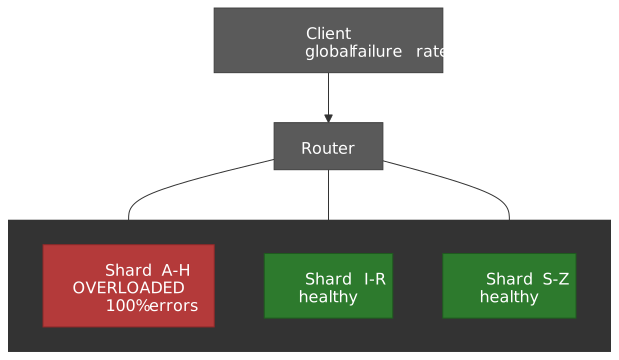
Marc Brooker’s Will circuit breakers solve my problems? puts the problem precisely:
“Modern distributed systems are designed to partially fail, continuing to provide service to some clients even if they can’t please everybody. Circuit breakers are designed to turn partial failures into complete failures.”
The same point shows up in the AWS Builders’ Library entry on Timeouts, retries and backoff with jitter, which warns that circuit breakers introduce modal behaviour — distinct “retrying” and “not retrying” states — that is hard to test and that can substantially extend recovery time once the dependency is healthy again.
There are three reasonable responses, none of them magic:
- Tighter coupling — make the client aware of the service’s sharding so it can run a per-shard breaker. Trades a layering violation for an accurate trip decision.
- Server-side feedback — the service tells the client which subset is overloaded (e.g. via
Retry-After, gRPCRESOURCE_EXHAUSTEDwith a partition tag, or 503 with a token bucket). Now the client can flip a much more localised mini-breaker. - Use circuit breakers only on the retry path. Brooker’s preferred shape: leave first-try traffic alone (it already has minimum amplification) and use the breaker to gate the retries, which are the actual amplification source13.
The honest framing is: a global circuit breaker is correct for a single-tenant, non-sharded dependency (a database master, a third-party API, a leader election service). It is at best a coarse approximation for anything sharded.
Modern alternative: adaptive concurrency control
Static thresholds — “trip at 50% errors over 100 calls” — assume the operator can predict the right number. They drift as traffic patterns change. The newer line of work, started inside Netflix, replaces the static knob with a feedback loop modelled on TCP congestion control.
Netflix’s Performance Under Load describes the approach implemented in Netflix/concurrency-limits. The library treats a service’s concurrent-request limit the same way TCP treats its congestion window: probe upward when latency is stable, contract aggressively when latency rises. Three algorithms ship in the box:
| Algorithm | Inspired by | Behaviour |
|---|---|---|
VegasLimit |
TCP Vegas | Compares sampleRTT to minRTT; the ratio estimates queue depth. Stable, low-latency-friendly. |
Gradient2Limit |
TCP Gradient | Tracks the change in RTT; corrects for measurement bias and drift. Default for new deployments. |
AIMDLimit |
Classic TCP | Additive increase, multiplicative decrease. Simple and predictable. |
The result is a load-shedding mechanism rather than a binary trip. Excess traffic is rejected at the edge with 429 Too Many Requests; the limit auto-tunes so the service runs near the saturation knee instead of either floor or ceiling. Netflix uses it for prioritised load shedding (live requests preempt prefetch).
Tip
If you are choosing today and your dependencies are inside your own organisation, look at adaptive concurrency before reaching for a circuit breaker. They solve overlapping problems, but the adaptive approach has fewer parameters to misconfigure and degrades gracefully under partial failure.
Configuration guidance
Tuning parameters
| Parameter | Too low → | Too high → | Useful starting point |
|---|---|---|---|
| Failure-rate threshold | Flapping on transient blips | Slow detection of real failures | 40–60% for typical services; lower for critical paths |
| Minimum-call volume | Trips on small samples | Late detection on low-traffic paths | 10–20 for low-traffic; 100 (Resilience4j default) for high-traffic |
| Wait-in-open duration | Probes during ongoing failure | Slow recovery | 5–60 s, sized to the dependency’s expected recovery time |
| Half-open probe count | Single noisy signal can re-trip | Real load on a recovering dependency | 3–10 |
| Half-open call timeout | False negatives from network jitter | Worker time wasted on probes | Healthy p99 of the dependency, not the SLA timeout |
Error classification
Not every exception is a dependency failure:
| Error type | Count as failure? | Why |
|---|---|---|
| 5xx server error | Yes | Dependency-side fault |
| Timeout / connection refused | Yes | Dependency unresponsive |
| 4xx client error | No | Caller-side fault — counting it lets bad clients trip the breaker for everyone |
CallNotPermittedException from a downstream breaker |
No | Already handled; counting it creates a feedback loop |
Domain “expected” exceptions (e.g. NotFoundException in a search path) |
No | Business logic, not infrastructure failure |
Resilience4j models this as recordExceptions / ignoreExceptions plus optional recordFailurePredicate and ignoreExceptionPredicate3:
CircuitBreakerConfig.custom() .recordExceptions(IOException.class, TimeoutException.class) .ignoreExceptions(BusinessException.class) .recordFailurePredicate(t -> t instanceof HttpException h && h.statusCode() >= 500) .build();Fallback strategies
When the breaker is Open, the caller still has to return something:
| Strategy | Best for | Caveat |
|---|---|---|
| Cached / stale read | Read paths, idempotent, non-critical data | The cache and the dependency must not share the same failure domain |
| Default value | Feature flags, configuration, soft preferences | Must be safe to under-serve |
| Degraded UI | Optional features (recommendations, related items) | Must be designed end-to-end, not just at the call site |
| Alternative service | Read replicas, secondary regions | Must verify the alternative is on a different failure domain |
| Fail fast (return 503) | Operations where stale or default data is dangerous (payments, balances) | Caller must handle the 503; surface it cleanly |
Caution
A fallback that depends on the same failure mode as the primary is worse than no fallback at all — it adds latency to the inevitable failure and hides the real signal. If your “fallback” reads from the same database cluster as the primary, it isn’t a fallback.
The AWS Builders’ Library essay Avoiding fallback in distributed systems goes further: at AWS scale, most fallbacks Jacob Gabrielson reviewed turned out to be net-negative. They almost always run a code path that has less test coverage and more dependencies than the primary, they hide the failure from monitoring, and the fallback path itself fails under the same load conditions that triggered the primary failure. The default should be “fail fast and surface the error”; a fallback is only justified when its dependency graph is provably disjoint from the primary’s and the fallback path is exercised under load in pre-production14.
Composition with retries, bulkheads, hedging, and load shedding
The composition order is not cosmetic — it determines what each policy sees and counts.
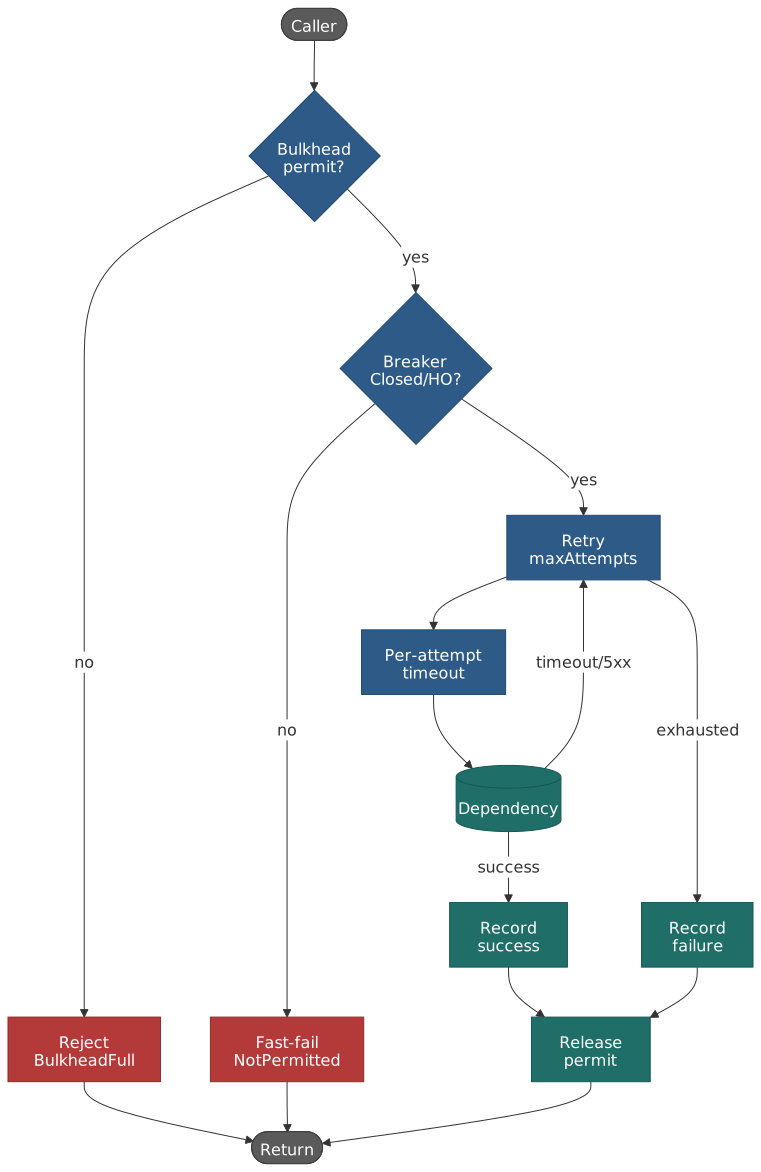
With retries
Order matters. The idiomatic ordering is circuit breaker → retry → timeout → call:
async function callWithResilience<T>(fn: () => Promise<T>): Promise<T> { return circuitBreaker.execute(() => retry.execute(() => timeout.execute(fn, 5_000), { maxAttempts: 3, backoff: { type: "exponential", base: 100, jitter: "full" }, }), )}Why this order:
- The breaker sees the final outcome — n retries that all fail count as one failure, not n. That keeps the failure-rate threshold meaningful.
- The retry observes timeouts, not breaker rejections — it would otherwise hammer an open breaker.
- Use full jitter on the retry backoff so a fleet of clients that all opened their circuits at once doesn’t synchronously probe the recovering dependency1.
With bulkheads
A per-dependency bulkhead inside a per-dependency breaker is the standard production layout:
Caller → [Bulkhead permit] → [Circuit breaker] → Dependency ↓ ↓ caps concurrent stops trying when calls to N recent failure rate exceeds thresholdWithout the bulkhead, an Open breaker still leaks: the first batch of slow requests before the breaker opens can saturate the caller’s thread pool. Without the breaker, the bulkhead just queues requests against an unhealthy dependency until the queue itself becomes the failure surface.
With hedging
Hedging — the technique from Dean and Barroso’s The Tail at Scale — sends a second request to a different replica after the original has been outstanding longer than (typically) the healthy p95, then takes whichever response arrives first15. gRPC supports it as a built-in retry policy variant16. It is not a substitute for a circuit breaker; the two solve different problems and need different rules of engagement:
| Mechanism | Trigger | Goal | Amplification |
|---|---|---|---|
| Retry | Failure (timeout, 5xx) | Recover from transient errors | Up to N×, concentrated on already-failing dependency |
| Hedge | Slow response (e.g. > p95) | Mask tail-latency outliers | Bounded by the hedge fraction (typically ≤ 5%) |
| Circuit breaker | Recent failure / slow rate | Stop calling an unhealthy dependency | Reduces amplification by short-circuiting |
Hedging belongs inside the breaker (don’t hedge into an Open dependency) and outside the per-attempt timeout (each leg has its own deadline). Tied requests — the variant where the duplicates can cancel each other server-side — are the production-safe form when the work is expensive15. Skip hedging for non-idempotent operations; skip it for any path where the second attempt could double-charge, double-publish, or otherwise have side effects.
With load shedding
Three different roles, three different layers:
- Rate limiter — protects against caller abuse. Lives at the edge.
- Circuit breaker / adaptive concurrency — protects the caller from a slow callee. Lives near the dependency client.
- Load shedder — protects the callee from caller overload. Lives inside the service. Google SRE’s Addressing cascading failures is the reference treatment — the breaker’s job ends at “stop calling”; the callee still has to actively shed traffic and prefer fast 503s over deep queueing17.
They compose; they don’t substitute.
Observability
Metrics worth shipping
| Metric | Description | Alert threshold |
|---|---|---|
circuit_state (gauge by name) |
Closed / Open / Half-Open | Alert on Open ≥ N minutes |
circuit_failure_rate |
Rolling failure rate | Warn at 30%, page at 50% |
circuit_slow_call_rate |
Rolling slow-call rate | Tied to dependency SLA |
circuit_state_transitions_total (counter) |
Transition events | Alert on transition rate, not just state |
circuit_calls_in_half_open |
Probes admitted this window | Reflects recovery testing |
circuit_buffered_calls |
Calls queued at the bulkhead | Alert on growing queue |
Resilience4j exposes these via Micrometer; Hystrix had its own dashboard; Polly v8 emits them through Microsoft.Extensions.Resilience enrichment.
Alert on transitions, not just state
Multiple Closed → Open → Closed transitions per minute are the classic flapping signal — either the threshold sits right on top of the steady-state failure rate, or there’s an intermittent issue that the breaker is partially masking. Alert on the transition rate, not just on state == Open.
Sample alert payload
Alert: payments-service circuit breaker openedFailure rate: 62% threshold: 50%Window: 100 calls / 60sPrevious Closed duration: 4h32mProbable cause: payments-service degraded (see Grafana link)Runbook: https://wiki/runbooks/payments-circuit-openCommon pitfalls
1. The breaker that never opens
The volume threshold is set high (Resilience4j’s default minimumNumberOfCalls=100) and the path traffic is low. The breaker is theoretical — it cannot accumulate enough samples to evaluate. Fix: tune minimumNumberOfCalls per path, or switch to a time-based window with a small minimum.
2. Half-open thundering herd
Many instances opened their breakers at roughly the same time. When waitDurationInOpenState expires, they all probe the recovering dependency simultaneously and re-trip. Fix: jitter the wait duration:
Duration baseWait = Duration.ofSeconds(30);long jitterMs = ThreadLocalRandom.current().nextLong(0, 5_000);Duration actualWait = baseWait.plus(Duration.ofMillis(jitterMs));This is the same logic as exponential backoff with full jitter for retries — and for the same reason1.
3. Cascading “fast failure” looks like success
When breaker A is Open and returns a 50 ms CallNotPermitted to its caller, the caller sees a fast response. If the caller’s own breaker counts only timeouts and 5xx as failures, the upstream breaker stays Closed and keeps offering load that A keeps fast-failing. Fix: propagate a distinct error class (UpstreamCircuitOpen) or a header so callers can decide whether to count it.
4. Sunny-day-only testing
The breaker only matters during failure. The cheapest way to validate it is FORCED_OPEN (Resilience4j) or a chaos hook that injects timeouts in staging:
circuitBreaker.transitionToForcedOpenState();assertThat(callWithFallback().isFromFallback()).isTrue();assertThat(meterRegistry.counter("circuit.calls", "kind", "not_permitted").count()).isPositive();5. Cold-start trip
A breaker with no history opens on its first failures. Fix: minimumNumberOfCalls ≥ 10 (much higher than 1) and let the application warm before exposing to traffic.
6. Sharing one breaker across read and write paths
The Azure pattern documentation explicitly recommends separate breakers per operation type. A failing write endpoint shouldn’t take read traffic offline; conversely, slow analytical reads shouldn’t open the breaker for hot transactional writes.
7. A breaker without a per-call timeout
A breaker measures outcomes. If the underlying call has no enforced timeout — semaphore isolation with an HTTP client that ignores Thread.interrupt(), or an async call whose cancellation is cooperative and never honoured — the breaker has no failures to count. Calls hang, threads accumulate, and the breaker stays Closed because nothing has formally failed yet. Always pair the breaker with a per-call deadline (Resilience4j’s slowCallDurationThreshold, an HTTP client timeout, a gRPC deadline). The failure must be observable to the breaker, not just to the human reading the dashboard.
8. A fallback that hides the failure
Counted-as-success fallback paths suppress the very signal the breaker exists to surface. If your fallback returns cachedRecommendations and the call is recorded as success, your breaker — and your dashboards — will say the dependency is fine while users see stale data. Either record the fallback invocation distinctly (circuit_fallback_total counter, separate from success), or design the fallback to fail visibly when the staleness budget is exhausted. AWS’s Avoiding fallback is the long-form treatment of this anti-pattern14.
Practical takeaways
- The pattern fixes one specific problem: callers waiting on slow callees. If your problem is anything else (overload, retry storms, tail latency), the breaker is at best adjacent.
- Pick the thinnest implementation that gives you a per-dependency probe count, slow-call detection, and per-half-open timeout. Today that means Resilience4j on the JVM, Polly v8 on .NET, gobreaker on Go.
- Set the half-open call timeout from the dependency’s healthy p99, never from the user-facing SLA. Shopify’s 263% → 4% example is the reference data point.
- Chain it:
breaker → retry → timeout → call, with a per-dependency bulkhead behind the breaker. - For sharded or cell-based services, default to per-host or per-shard breakers; a global breaker on a sharded service either misses the failure or amplifies it.
- For new internal services, evaluate adaptive concurrency (Netflix
concurrency-limits, Polly’s rate-limiter strategy, or Envoy’s adaptive concurrency filter) before adding a static-threshold breaker. They compose, but the adaptive approach has fewer dials to get wrong.
Appendix
Prerequisites
- Distributed-systems fundamentals: cascading failure, metastability, queue dynamics.
- Concurrency primitives: thread pools, semaphores, futures, interrupts.
- Familiarity with retry / backoff and idempotency.
Glossary
- Breaker — the circuit-breaker object or library instance.
- Trip — Closed → Open transition.
- Half-open probe — request admitted while the breaker is testing recovery.
- Sliding window — count- or time-based view of recent outcomes.
- Bulkhead — concurrency cap that bounds blast radius.
- Adaptive concurrency — feedback-driven concurrency limit, replaces static thresholds.
References
- Brooker, Marc. Will circuit breakers solve my problems? — the cell-based / sharded critique.
- Brooker, Marc. Fixing retries with token buckets and circuit breakers — using the breaker only on the retry path.
- Brooker, Marc. Metastability and Distributed Systems — the feedback-loop problem the breaker is meant to interrupt.
- AWS Builders’ Library. Timeouts, retries and backoff with jitter.
- AWS Builders’ Library. Avoiding fallback in distributed systems (Jacob Gabrielson).
- Azure Architecture Center. Circuit Breaker pattern.
- Dean, Jeffrey and Barroso, Luiz André. The Tail at Scale, CACM 2013 — hedged and tied requests.
- Envoy Proxy. Circuit breakers and Outlier detection.
- Google SRE Book. Addressing cascading failures (Ch. 22).
- gRPC. Request hedging.
- Eskildsen, Simon. Napkin Problem 11 — Circuit Breakers.
- Fowler, Martin. Circuit Breaker.
- Netflix. Hystrix Wiki — How it Works and Configuration.
- Netflix. Performance Under Load and
concurrency-limits. - Nygard, Michael. Release It! Design and Deploy Production-Ready Software (Pragmatic Bookshelf, 1st ed. 2007; 2nd ed. 2018) — origin of the circuit-breaker pattern in software.
- Pekko (Akka). Circuit Breaker.
- Polly project. Circuit breaker resilience strategy.
- Resilience4j. CircuitBreaker documentation.
- Shopify Engineering. Your Circuit Breaker is Misconfigured.
- Shopify. Semian on GitHub.
- Sony. gobreaker on GitHub.
Footnotes
-
AWS Builders’ Library, Timeouts, retries and backoff with jitter (Marc Brooker). ↩ ↩2 ↩3
-
Nygard, M., Release It! Design and Deploy Production-Ready Software, Pragmatic Bookshelf — 1st ed. 2007 (Ch. 5, “Stability Patterns”) and 2nd ed. 2018. ↩
-
Resilience4j, CircuitBreaker docs. All quoted defaults are from the configuration table on that page. ↩ ↩2 ↩3 ↩4 ↩5 ↩6 ↩7 ↩8 ↩9 ↩10
-
Netflix, Hystrix Wiki — Configuration. ↩ ↩2
-
Netflix, Hystrix Wiki — How it Works. ↩ ↩2 ↩3 ↩4
-
Shopify, Semian README — “running in production at Shopify since October 2014”. ↩
-
Shopify Engineering, Your Circuit Breaker is Misconfigured, Feb 18 2020. ↩ ↩2 ↩3 ↩4
-
Apache Pekko, Circuit Breaker. The same API surface (
maxFailures,callTimeout,resetTimeout) is mirrored in Akka and Akka.NET. ↩ -
Envoy Proxy, Circuit breakers (cluster v3 API). ↩
-
Envoy Proxy, Outlier detection architecture overview. ↩
-
Brooker, Fixing retries with token buckets and circuit breakers. ↩
-
Gabrielson, J., AWS Builders’ Library, Avoiding fallback in distributed systems. ↩ ↩2
-
Dean, J. and Barroso, L. A., The Tail at Scale, Communications of the ACM, Feb 2013. ↩ ↩2
-
gRPC, Request hedging. ↩
-
Google SRE Book, Addressing cascading failures (Ch. 22). ↩