Search Algorithms: Linear, Binary, and Graph Traversal
Pick the right search algorithm by reading two cues — how the data is organised, and what the search must return. This guide walks every common option (linear, binary, jump, interpolation, exponential, BFS, DFS, bidirectional BFS, Dijkstra, A*) with TypeScript implementations, complexity bounds, and the trade-off that decides each one.
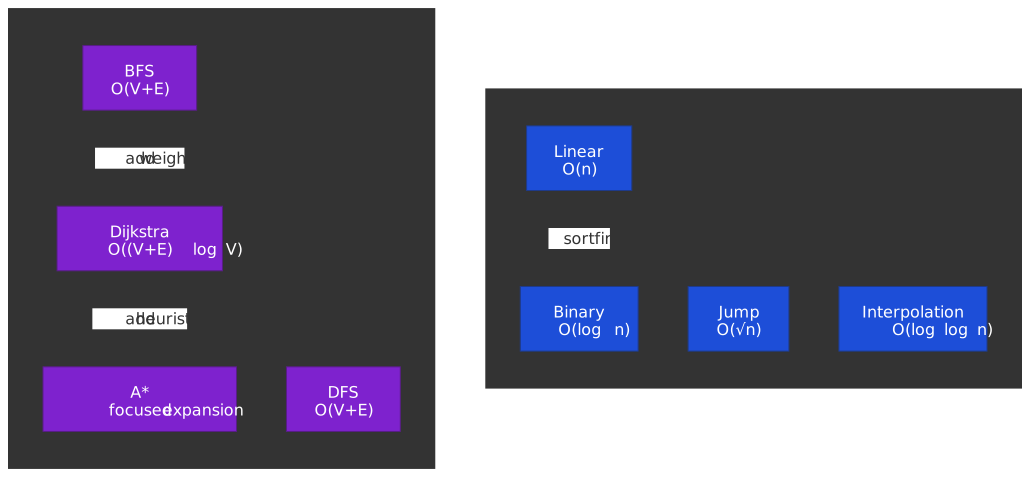
Mental model
Two factors determine which search algorithm wins on a given problem: how the data is organised and what the search goal is. Everything below is a specialisation of those two axes.
Core trade-offs to internalize:
| Trade-off | Left Choice | Right Choice | When to pick right |
|---|---|---|---|
| Preprocessing vs Query | Linear (no prep, O(n)) | Binary (O(n log n) prep, O(log n)) | Multiple queries |
| Space vs Optimality | DFS (O(depth) space) | BFS (O(width) space) | Need shortest path |
| Guaranteed vs Average | Binary (O(log n) always) | Interpolation (O(log log n) avg) | Uniform data distribution |
| Uninformed vs Informed | Dijkstra (explores all) | A* (guided by heuristic) | Good heuristic available |
Key insight: The “best” algorithm is the one that exploits your data’s structure. Sorted data enables binary search. Known goals enable heuristic guidance. Uniform distribution enables interpolation. The worst case is searching unstructured data for an unknown target—that’s always O(n).
Core Concepts
Why These Trade-offs Exist
Every search algorithm makes a fundamental bargain. Understanding why these trade-offs exist helps you choose correctly.
Time vs Space: Binary search achieves O(log n) by eliminating half the search space each step—but this only works if elements are sorted, meaning either O(n log n) preprocessing or maintaining a sorted structure on insert. Hash tables achieve O(1) average by trading O(n) space for direct addressing. The trade-off exists because faster access requires either more memory or more upfront organization.
Preprocessing vs Query Time: This trade-off optimizes for different access patterns. Linear search’s O(n) query with zero preprocessing beats binary search for single queries (sorting costs O(n log n)). But for k queries, binary search wins when k × O(log n) + O(n log n) < k × O(n), which holds for roughly k > log n queries. Real systems make this choice constantly—databases build indexes (preprocessing) to speed queries.
Completeness vs Optimality: BFS (Breadth-First Search) explores level-by-level, guaranteeing the shortest path in unweighted graphs. DFS (Depth-First Search) explores depth-first, using O(depth) space vs BFS’s O(width). BFS is complete (finds a solution if one exists) and optimal (finds shortest). DFS is complete but not optimal. The trade-off exists because shortest-path guarantees require tracking all paths at each distance level.
Guaranteed vs Average Performance: Binary search’s O(log n) is worst-case—it never degrades. Interpolation search achieves O(log log n) average on uniformly distributed data by guessing where the target likely is, but degrades to O(n) when the guess is wrong (skewed data). Average-case algorithms bet on data properties; worst-case algorithms make no assumptions.
The Search Problem Taxonomy
Search problems vary along two axes: data structure and search goal.
| Data Structure | Algorithms | Key Constraint |
|---|---|---|
| Unsorted Array | Linear Search | Requires scanning or an auxiliary index |
| Sorted Array | Binary, Jump, Interpolation, Exp. | Requires sorted order |
| Graph | BFS, DFS, Dijkstra, A* | Edge relationships |
| Hash Table | Direct lookup | O(n) extra space |
| String | KMP, Boyer-Moore, Rabin-Karp | Pattern matching |
| Search Goal | Best Algorithm(s) | Why |
|---|---|---|
| Exact element | Binary (sorted), Hash | O(log n) or O(1) |
| All matches | Linear + collect | Must scan all |
| Shortest path (unw) | BFS | Level-order guarantees minimum hops |
| Shortest path (w) | Dijkstra, A* | Priority queue processes minimum distance |
| Any path | DFS | Memory efficient, finds first path |
| Cycle detection | DFS + recursion stack | Back edge indicates cycle |
Linear Search Algorithms
1. Linear Search (Sequential Search)
Philosophy: Check every element one by one until you find the target or reach the end.
function linearSearch<T>(arr: T[], target: T): number { for (let i = 0; i < arr.length; i++) { if (arr[i] === target) { return i } } return -1 // Not found}// Variant: Find all occurrencesfunction linearSearchAll<T>(arr: T[], target: T): number[] { const indices: number[] = [] for (let i = 0; i < arr.length; i++) { if (arr[i] === target) { indices.push(i) } } return indices}// Variant: With custom comparatorfunction linearSearchCustom<T>(arr: T[], predicate: (item: T) => boolean): number { for (let i = 0; i < arr.length; i++) { if (predicate(arr[i])) { return i } } return -1}| Property | Value |
|---|---|
| Time | O(n) worst/avg, O(1) best |
| Space | O(1) |
| Prerequisite | None (works on unsorted) |
| Use case | Small arrays, unsorted data |
Optimizations:
- Sentinel search: Add target at the end to eliminate bounds checking — described in Knuth, The Art of Computer Programming, vol. 3 §6.1
- Move-to-front: Move found element to front for better subsequent searches
- Early termination: For sorted arrays, stop when element > target
// Sentinel optimizationfunction sentinelLinearSearch(arr: number[], target: number): number { const n = arr.length const last = arr[n - 1] arr[n - 1] = target // Place sentinel let i = 0 while (arr[i] !== target) { i++ } arr[n - 1] = last // Restore last element if (i < n - 1 || arr[n - 1] === target) { return i } return -1}Practical applications:
- Small datasets: When n < 100, the simplicity outweighs binary search overhead
- Unsorted data: When sorting cost (O(n log n)) exceeds search cost
- Single search: When you search once, sorting isn’t worth it
- Custom predicates: Finding first element matching complex conditions
- Linked lists: No random access available, making binary search impossible
- Database table scans: When no index exists (full table scan)
- Log file searching: Searching through unsorted log entries
- Configuration validation: Checking for specific settings in config files
2. Jump Search (Block Search)
Philosophy: Jump ahead by fixed steps, then linear search within the block.
function jumpSearch(arr: number[], target: number): number { const n = arr.length const blockSize = Math.floor(Math.sqrt(n)) let step = blockSize let prev = 0 // Jump to find the block while (arr[Math.min(step, n) - 1] < target) { prev = step step += blockSize if (prev >= n) return -1 } // Linear search within the block while (arr[prev] < target) { prev++ if (prev === Math.min(step, n)) return -1 } if (arr[prev] === target) return prev return -1}| Property | Value |
|---|---|
| Time | O(√n) |
| Space | O(1) |
| Prerequisite | Sorted array |
| Use case | When binary search is expensive (disk seeks) |
Key insight: Optimal jump size is √n — minimising worst-case probes balances jumps with the trailing linear scan (Knuth, TAOCP vol. 3 §6.2.1). Fewer jumps than binary search, useful when backward jumps are costly.
Practical applications:
- Disk-based searches: Minimizing expensive disk seeks (sequential reads are cheaper than random access)
- Large sorted files: Log files, sorted database dumps where random access is slow
- Embedded systems: When division operations (required for binary search) are expensive
- Cache-optimized searching: Better cache locality than binary search for certain hardware
- Network packet inspection: Searching through ordered packet streams
- Time-series data: Searching through chronologically sorted sensor data
Binary Search and Variations
3. Binary Search (Classic)
Philosophy: Divide the search space in half by comparing the middle element. Repeat on the appropriate half.
// Iterative implementationfunction binarySearch(arr: number[], target: number): number { let left = 0 let right = arr.length - 1 while (left <= right) { const mid = left + Math.floor((right - left) / 2) if (arr[mid] === target) { return mid } else if (arr[mid] < target) { left = mid + 1 } else { right = mid - 1 } } return -1 // Not found}// Recursive implementationfunction binarySearchRecursive( arr: number[], target: number, left: number = 0, right: number = arr.length - 1,): number { if (left > right) return -1 const mid = left + Math.floor((right - left) / 2) if (arr[mid] === target) return mid if (arr[mid] < target) { return binarySearchRecursive(arr, target, mid + 1, right) } return binarySearchRecursive(arr, target, left, mid - 1)}| Property | Value |
|---|---|
| Time | O(log n) |
| Space | O(1) iterative, O(log n) recursive |
| Prerequisite | Sorted array |
| Use case | Large sorted datasets |
Critical implementation details:
- Avoid integer overflow: Use
left + (right - left) / 2instead of(left + right) / 2 - Bounds: Use
left <= rightnotleft < right - Update carefully:
left = mid + 1andright = mid - 1(notmid)
Common binary search bugs:
// ❌ WRONG: Integer overflow (in languages with fixed-size integers)const mid = Math.floor((left + right) / 2)// ✅ CORRECTconst mid = left + Math.floor((right - left) / 2)// ❌ WRONG: Infinite loop when target not foundwhile (left < right) { // ... left = mid // or right = mid}// ✅ CORRECTwhile (left <= right) { // ... left = mid + 1 // or right = mid - 1}Practical applications:
- Database indexes: B-tree and B+ tree searches in SQL databases
- System libraries:
bsearch()in C stdlib,Arrays.binarySearch()in Java - Version control: Finding the commit that introduced a bug (git bisect)
- Dictionary/spell checkers: Looking up words in sorted dictionaries
- File systems: Searching directory entries in sorted file systems
- Network routing tables: IP address lookup in routing tables
- E-commerce: Price range searches in sorted product catalogs
- Auto-complete: Prefix matching in sorted suggestion lists
4. Binary Search Variations
A. Lower Bound (First Occurrence)
Find the first position where target can be inserted to maintain sorted order (or first occurrence).
function lowerBound(arr: number[], target: number): number { let left = 0 let right = arr.length while (left < right) { const mid = left + Math.floor((right - left) / 2) if (arr[mid] < target) { left = mid + 1 } else { right = mid // Don't eliminate mid, it could be the answer } } return left}// Find first occurrencefunction findFirstOccurrence(arr: number[], target: number): number { const idx = lowerBound(arr, target) if (idx < arr.length && arr[idx] === target) { return idx } return -1}B. Upper Bound (Last Occurrence + 1)
Find the first position where element is greater than target.
function upperBound(arr: number[], target: number): number { let left = 0 let right = arr.length while (left < right) { const mid = left + Math.floor((right - left) / 2) if (arr[mid] <= target) { left = mid + 1 } else { right = mid } } return left}// Find last occurrencefunction findLastOccurrence(arr: number[], target: number): number { const idx = upperBound(arr, target) - 1 if (idx >= 0 && arr[idx] === target) { return idx } return -1}// Count occurrences in O(log n)function countOccurrences(arr: number[], target: number): number { const first = lowerBound(arr, target) const last = upperBound(arr, target) return last - first}C. Search in Rotated Sorted Array
Handle arrays that are sorted but rotated at some pivot.
Note
The implementation below assumes distinct elements. With duplicates, the arr[left] <= arr[mid] test stops uniquely identifying the sorted half (e.g. [1, 0, 1, 1, 1]), and worst-case time degrades to O(n). The standard fix is to advance left and decrement right while the boundary values are equal — see LeetCode 81: Search in Rotated Sorted Array II.
function searchRotated(arr: number[], target: number): number { let left = 0 let right = arr.length - 1 while (left <= right) { const mid = left + Math.floor((right - left) / 2) if (arr[mid] === target) return mid // Determine which half is sorted if (arr[left] <= arr[mid]) { // Left half is sorted if (target >= arr[left] && target < arr[mid]) { right = mid - 1 } else { left = mid + 1 } } else { // Right half is sorted if (target > arr[mid] && target <= arr[right]) { left = mid + 1 } else { right = mid - 1 } } } return -1}Practical applications:
- Range queries: Finding all elements in [a, b] using lower and upper bounds
- Database queries:
WHERE value >= x AND value < yin indexed columns - Time-series data: Finding all events in a time range
- Log analysis: Finding log entries in a timestamp range
- Load balancers: Consistent hashing ring lookups (rotated array searches)
- Circular buffers: Searching in ring buffers with wrap-around
5. Interpolation Search
Philosophy: Like binary search, but guess the position based on value distribution (interpolation). Under the assumption of uniformly distributed data, interpolation search achieves O(log log n) average-case performance — proved for uniformly drawn keys by Perl, Itai & Avni (1978), Interpolation search — a log log N search, with the bound generalised to broader distributions by Willard (1985). On adversarial or skewed data the algorithm degrades to O(n) (Wikipedia summary).
function interpolationSearch(arr: number[], target: number): number { let left = 0 let right = arr.length - 1 while (left <= right && target >= arr[left] && target <= arr[right]) { if (left === right) { return arr[left] === target ? left : -1 } // Interpolate position const pos = left + Math.floor(((target - arr[left]) * (right - left)) / (arr[right] - arr[left])) if (arr[pos] === target) { return pos } else if (arr[pos] < target) { left = pos + 1 } else { right = pos - 1 } } return -1}| Property | Value |
|---|---|
| Time | O(log log n) avg, O(n) worst |
| Space | O(1) |
| Prerequisite | Sorted array, uniform distribution |
| Use case | Large uniformly distributed sorted data |
When to use: Data is uniformly distributed (phone book, dictionary). Can be much faster than binary search.
Practical applications:
- Phone directories: Uniformly distributed names (know ‘M’ is near the middle)
- Dictionary lookups: Word lookups where distribution is relatively uniform
- Large numeric databases: Evenly distributed numeric keys (employee IDs, timestamps)
- IP address routing: Searching through sorted IP ranges
- Scientific datasets: Uniformly sampled measurements
- Geographic data: Searching coordinates or uniformly distributed location codes
6. Exponential Search
Philosophy: Find the range where the element exists by exponentially increasing the bound, then binary search. Originally analysed by Bentley & Yao (1976), An almost optimal algorithm for unbounded searching, which shows the technique is within a constant factor of the information-theoretic lower bound for unbounded sorted search.
function exponentialSearch(arr: number[], target: number): number { const n = arr.length // If target is at first position if (arr[0] === target) return 0 // Find range for binary search by repeated doubling let bound = 1 while (bound < n && arr[bound] < target) { bound *= 2 } // Binary search in the found range [bound/2, min(bound, n-1)] const left = Math.floor(bound / 2) const right = Math.min(bound, n - 1) return binarySearchRange(arr, target, left, right)}function binarySearchRange(arr: number[], target: number, left: number, right: number): number { while (left <= right) { const mid = left + Math.floor((right - left) / 2) if (arr[mid] === target) return mid if (arr[mid] < target) left = mid + 1 else right = mid - 1 } return -1}| Property | Value |
|---|---|
| Time | O(log n) |
| Space | O(1) |
| Prerequisite | Sorted unbounded/infinite array |
| Use case | Unbounded searches |
Key advantage: Better than binary search when target is near the beginning (finds range in O(log k) where k is position).
Practical applications:
- Infinite/unbounded lists: Searching in streams or very large arrays where size is unknown
- Version searches: Finding the right version in a version control system
- Cache hierarchies: Searching through cache levels (L1, L2, L3, RAM, disk)
- Network packet buffers: Searching in dynamically growing buffers
- Log files: Searching recent logs where target is likely near the end
- Pagination APIs: Finding data in APIs with infinite scroll/pagination
Graph Search Algorithms
Graphs represent relationships between entities. Search algorithms explore these relationships to find paths, connected components, or specific nodes.
Graph Representation
// Adjacency List (most common)type Graph = Map<number, number[]>function createGraph(edges: [number, number][]): Graph { const graph = new Map<number, number[]>() for (const [u, v] of edges) { if (!graph.has(u)) graph.set(u, []) if (!graph.has(v)) graph.set(v, []) graph.get(u)!.push(v) // For undirected graph, also add: graph.get(v)!.push(u) } return graph}// Example: Social network, web pages, road networks7. Breadth-First Search (BFS)
Philosophy: Explore level by level - visit all neighbors before moving to the next level. Uses a queue (FIFO).
function bfs(graph: Graph, start: number): void { const visited = new Set<number>() const queue: number[] = [start] visited.add(start) while (queue.length > 0) { const node = queue.shift()! // Dequeue console.log(node) // Process node for (const neighbor of graph.get(node) || []) { if (!visited.has(neighbor)) { visited.add(neighbor) queue.push(neighbor) // Enqueue } } }}// Find shortest path in unweighted graphfunction bfsShortestPath(graph: Graph, start: number, end: number): number[] | null { const visited = new Set<number>() const queue: [number, number[]][] = [[start, [start]]] visited.add(start) while (queue.length > 0) { const [node, path] = queue.shift()! if (node === end) return path for (const neighbor of graph.get(node) || []) { if (!visited.has(neighbor)) { visited.add(neighbor) queue.push([neighbor, [...path, neighbor]]) } } } return null // No path found}// Level-order traversal with distance trackingfunction bfsWithDistance(graph: Graph, start: number): Map<number, number> { const distances = new Map<number, number>() const queue: [number, number][] = [[start, 0]] distances.set(start, 0) while (queue.length > 0) { const [node, dist] = queue.shift()! for (const neighbor of graph.get(node) || []) { if (!distances.has(neighbor)) { distances.set(neighbor, dist + 1) queue.push([neighbor, dist + 1]) } } } return distances}| Property | Value |
|---|---|
| Time | O(V + E) where V=vertices, E=edges |
| Space | O(V) for visited set + queue |
| Completeness | Yes (finds solution if exists) |
| Optimality | Yes (shortest path in unweighted) |
| Use case | Shortest path, level-order |
Key characteristics:
- Guaranteed shortest path in unweighted graphs
- Level-by-level exploration
- Memory intensive (stores entire frontier)
- FIFO queue data structure
Practical applications:
- Social networks: Finding friends within N degrees of separation (LinkedIn connections)
- Web crawlers: Crawling websites level by level or expanding a frontier outward from a seed set
- GPS navigation: Shortest path in unweighted road networks (equal segment lengths)
- Network broadcasting: Packet routing to all nodes (flooding algorithms)
- Puzzle solving: Shortest solution in games (Rubik’s cube, sliding puzzles)
- Garbage collection: Tracing reachable objects in memory
- Peer-to-peer networks: Finding nodes in DHT (Distributed Hash Tables)
- Recommendation systems: Finding similar users/items within distance k
- Image processing: Flood fill algorithm (paint bucket tool)
- Network analysis: Finding connected components
8. Depth-First Search (DFS)
Philosophy: Explore as deep as possible before backtracking. Uses a stack (LIFO) or recursion.
// Recursive DFSfunction dfsRecursive(graph: Graph, node: number, visited: Set<number> = new Set()): void { if (visited.has(node)) return visited.add(node) console.log(node) // Process node for (const neighbor of graph.get(node) || []) { dfsRecursive(graph, neighbor, visited) }}// Iterative DFS using explicit stackfunction dfsIterative(graph: Graph, start: number): void { const visited = new Set<number>() const stack: number[] = [start] while (stack.length > 0) { const node = stack.pop()! if (visited.has(node)) continue visited.add(node) console.log(node) // Process node // Add neighbors in reverse order for same order as recursive const neighbors = graph.get(node) || [] for (let i = neighbors.length - 1; i >= 0; i--) { if (!visited.has(neighbors[i])) { stack.push(neighbors[i]) } } }}// Find path using DFSfunction dfsPath( graph: Graph, start: number, end: number, visited: Set<number> = new Set(), path: number[] = [],): number[] | null { visited.add(start) path.push(start) if (start === end) return path for (const neighbor of graph.get(start) || []) { if (!visited.has(neighbor)) { const result = dfsPath(graph, neighbor, end, visited, path) if (result) return result } } path.pop() // Backtrack return null}// Detect cycle in directed graphfunction hasCycleDFS(graph: Graph): boolean { const visited = new Set<number>() const recStack = new Set<number>() // Nodes in current path function dfs(node: number): boolean { visited.add(node) recStack.add(node) for (const neighbor of graph.get(node) || []) { if (!visited.has(neighbor)) { if (dfs(neighbor)) return true } else if (recStack.has(neighbor)) { return true // Back edge found - cycle detected } } recStack.delete(node) // Remove from recursion stack return false } for (const node of graph.keys()) { if (!visited.has(node)) { if (dfs(node)) return true } } return false}// Topological sort using DFSfunction topologicalSort(graph: Graph): number[] { const visited = new Set<number>() const stack: number[] = [] function dfs(node: number): void { visited.add(node) for (const neighbor of graph.get(node) || []) { if (!visited.has(neighbor)) { dfs(neighbor) } } stack.push(node) // Add after visiting all descendants } for (const node of graph.keys()) { if (!visited.has(node)) { dfs(node) } } return stack.reverse()}| Property | Value |
|---|---|
| Time | O(V + E) |
| Space | O(V) for visited + O(h) stack depth |
| Completeness | Yes (in finite graphs) |
| Optimality | No (may not find shortest) |
| Use case | Cycle detection, topological sort, maze solving |
Key characteristics:
- Memory efficient compared to BFS (only stores path)
- LIFO stack data structure (or call stack with recursion)
- Does not guarantee shortest path
- Better for decision trees (backtracking problems)
DFS vs BFS comparison:
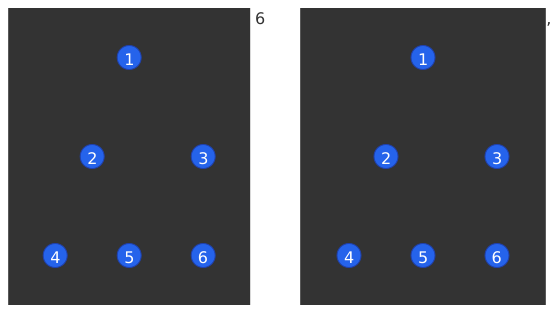
Peak memory follows the same split: BFS holds the entire frontier at the current level ([1], [2, 3], [3, 4, 5], …), so memory scales with the tree’s width. DFS only holds the current root-to-leaf path ([1, 2, 4], [1, 2, 5], [1, 3, 6], …), so memory scales with the tree’s height.
Practical applications:
- Maze solving: Finding any path through a maze (not necessarily shortest)
- Cycle detection: Detecting deadlocks in resource allocation graphs
- Topological sorting: Task scheduling with dependencies (build systems, course prerequisites)
- Connected components: Finding isolated subgraphs in social networks
- Path finding: Finding any valid path (not shortest) in games
- Sudoku solvers: Backtracking through possible solutions
- Web crawling: Deep crawling of website hierarchies
- File system traversal: Recursively listing all files in directories
- Dependency resolution: Package managers (npm, pip) resolving dependencies
- Syntax analysis: Compiler parsers traversing abstract syntax trees
- Game AI: Exploring game trees (minimax algorithm)
9. Bidirectional Search
Philosophy: Run BFS from both start and end simultaneously until they meet. Reduces search space from O(b^d) to O(b^(d/2)) when both endpoints are known and the graph allows reverse traversal — see Russell & Norvig, Artificial Intelligence: A Modern Approach, §3.4.6.
function bidirectionalSearch(graph: Graph, start: number, end: number): number[] | null { if (start === end) return [start] // BFS from start const visitedStart = new Map<number, number>([[start, -1]]) const queueStart: number[] = [start] // BFS from end (for undirected graph or if we have reverse edges) const visitedEnd = new Map<number, number>([[end, -1]]) const queueEnd: number[] = [end] while (queueStart.length > 0 || queueEnd.length > 0) { // Expand from start if (queueStart.length > 0) { const intersect = bfsStep(graph, queueStart, visitedStart, visitedEnd) if (intersect !== null) { return reconstructPath(visitedStart, visitedEnd, intersect) } } // Expand from end if (queueEnd.length > 0) { const intersect = bfsStep(graph, queueEnd, visitedEnd, visitedStart) if (intersect !== null) { return reconstructPath(visitedStart, visitedEnd, intersect) } } } return null // No path found}function bfsStep( graph: Graph, queue: number[], visited: Map<number, number>, otherVisited: Map<number, number>,): number | null { const node = queue.shift()! for (const neighbor of graph.get(node) || []) { // Found intersection if (otherVisited.has(neighbor)) { return neighbor } if (!visited.has(neighbor)) { visited.set(neighbor, node) queue.push(neighbor) } } return null}function reconstructPath( visitedStart: Map<number, number>, visitedEnd: Map<number, number>, intersect: number,): number[] { // Build path from start to intersect const pathStart: number[] = [] let node: number | undefined = intersect while (node !== undefined) { pathStart.unshift(node) node = visitedStart.get(node) if (node === -1) break } // Build path from intersect to end const pathEnd: number[] = [] node = visitedEnd.get(intersect) while (node !== undefined && node !== -1) { pathEnd.push(node) node = visitedEnd.get(node) } return [...pathStart, ...pathEnd]}| Property | Value |
|---|---|
| Time | O(b^(d/2)) where b=branching factor, d=depth |
| Space | O(b^(d/2)) |
| Optimality | Yes (for unweighted graphs) |
| Use case | When both start and end are known |
Key insight: Reduces search space from O(b^d) to O(b^(d/2)). For b=10, d=6: reduces from 1,000,000 to 2,000 nodes.
Practical applications:
- Social networks: Finding connection path between two specific people
- Route planning: Finding shortest path when destination is known (GPS navigation)
- Puzzle solving: Solving from both initial and goal states
- Word ladders: Finding transformation path between two words (e.g., “COLD” → “WARM”)
- Wikipedia game: Finding shortest link path between two articles
10. Dijkstra’s Algorithm (Weighted Graph Search)
Philosophy: Find shortest path in weighted graph using a priority queue (greedy approach).
interface Edge { to: number weight: number}type WeightedGraph = Map<number, Edge[]>function dijkstra(graph: WeightedGraph, start: number): Map<number, number> { const distances = new Map<number, number>() const visited = new Set<number>() // Teaching shortcut: sorted array used as the priority queue. // Swap in a binary heap to reach the usual O((V + E) log V) complexity. const pq: [number, number][] = [[0, start]] distances.set(start, 0) while (pq.length > 0) { // Get node with minimum distance pq.sort((a, b) => a[0] - b[0]) const [currentDist, node] = pq.shift()! if (visited.has(node)) continue visited.add(node) for (const { to: neighbor, weight } of graph.get(node) || []) { const newDist = currentDist + weight const oldDist = distances.get(neighbor) ?? Infinity if (newDist < oldDist) { distances.set(neighbor, newDist) pq.push([newDist, neighbor]) } } } return distances}// Dijkstra with path reconstructionfunction dijkstraWithPath( graph: WeightedGraph, start: number, end: number,): { distance: number; path: number[] } | null { const distances = new Map<number, number>() const previous = new Map<number, number>() const visited = new Set<number>() const pq: [number, number][] = [[0, start]] distances.set(start, 0) while (pq.length > 0) { pq.sort((a, b) => a[0] - b[0]) const [currentDist, node] = pq.shift()! if (node === end) { // Reconstruct path const path: number[] = [] let current: number | undefined = end while (current !== undefined) { path.unshift(current) current = previous.get(current) } return { distance: currentDist, path } } if (visited.has(node)) continue visited.add(node) for (const { to: neighbor, weight } of graph.get(node) || []) { const newDist = currentDist + weight const oldDist = distances.get(neighbor) ?? Infinity if (newDist < oldDist) { distances.set(neighbor, newDist) previous.set(neighbor, node) pq.push([newDist, neighbor]) } } } return null // No path found}| Property | Value |
|---|---|
| Time | O((V + E) log V) with min-heap |
| Space | O(V) |
| Optimality | Yes (for non-negative weights) |
| Use case | Shortest path in weighted graphs |
Critical constraint: Does NOT work with negative edge weights — use Bellman-Ford instead. With a binary heap, Dijkstra runs in O((V + E) log V); with a Fibonacci heap (amortised O(1) decrease-key), it improves to O(E + V log V) — the Fredman–Tarjan bound that is tight for the comparison-based shortest-path problem.
Practical applications:
- GPS navigation: Finding shortest route considering road lengths, traffic
- Network routing: OSPF protocol uses Dijkstra for shortest path routing
- Flight planning: Cheapest flights considering prices as weights
- Telecommunications: Optimal routing in communication networks
- Robot motion planning: Finding shortest path with movement costs
- Game pathfinding: Weighted terrain (walking through mud = higher cost)
- Supply chain optimization: Minimizing shipping costs
- Resource allocation: Optimal resource distribution in networks
11. A* Search Algorithm (Heuristic Search)
Philosophy: Like Dijkstra, but uses a heuristic to guide search toward the goal. More efficient than Dijkstra when a good heuristic is available.
interface Point { x: number y: number}// Manhattan distance heuristic (for grid-based maps)function manhattanDistance(a: Point, b: Point): number { return Math.abs(a.x - b.x) + Math.abs(a.y - b.y)}// Euclidean distance heuristicfunction euclideanDistance(a: Point, b: Point): number { return Math.sqrt((a.x - b.x) ** 2 + (a.y - b.y) ** 2)}function astar( graph: WeightedGraph, start: number, end: number, heuristic: (node: number) => number,): { distance: number; path: number[] } | null { const gScore = new Map<number, number>() // Actual cost from start const fScore = new Map<number, number>() // gScore + heuristic const previous = new Map<number, number>() const visited = new Set<number>() // Priority queue: [fScore, node] const pq: [number, number][] = [[heuristic(start), start]] gScore.set(start, 0) fScore.set(start, heuristic(start)) while (pq.length > 0) { // Get node with lowest fScore pq.sort((a, b) => a[0] - b[0]) const [, current] = pq.shift()! if (current === end) { // Reconstruct path const path: number[] = [] let node: number | undefined = end while (node !== undefined) { path.unshift(node) node = previous.get(node) } return { distance: gScore.get(end)!, path } } if (visited.has(current)) continue visited.add(current) for (const { to: neighbor, weight } of graph.get(current) || []) { const tentativeG = gScore.get(current)! + weight if (tentativeG < (gScore.get(neighbor) ?? Infinity)) { previous.set(neighbor, current) gScore.set(neighbor, tentativeG) const f = tentativeG + heuristic(neighbor) fScore.set(neighbor, f) pq.push([f, neighbor]) } } } return null}// Grid-based A* (common for games)function astarGrid( grid: number[][], // 0 = walkable, 1 = obstacle start: Point, end: Point,): Point[] | null { const rows = grid.length const cols = grid[0].length const toKey = (p: Point) => `${p.x},${p.y}` const fromKey = (key: string): Point => { const [x, y] = key.split(",").map(Number) return { x, y } } const gScore = new Map<string, number>() const fScore = new Map<string, number>() const previous = new Map<string, string>() const visited = new Set<string>() const startKey = toKey(start) const endKey = toKey(end) const pq: [number, string][] = [[manhattanDistance(start, end), startKey]] gScore.set(startKey, 0) fScore.set(startKey, manhattanDistance(start, end)) const directions = [ [0, 1], [1, 0], [0, -1], [-1, 0], ] // Right, Down, Left, Up while (pq.length > 0) { pq.sort((a, b) => a[0] - b[0]) const [, currentKey] = pq.shift()! if (currentKey === endKey) { // Reconstruct path const path: Point[] = [] let key: string | undefined = endKey while (key !== undefined) { path.unshift(fromKey(key)) key = previous.get(key) } return path } if (visited.has(currentKey)) continue visited.add(currentKey) const current = fromKey(currentKey) for (const [dx, dy] of directions) { const neighbor = { x: current.x + dx, y: current.y + dy } // Check bounds and obstacles if ( neighbor.x < 0 || neighbor.x >= rows || neighbor.y < 0 || neighbor.y >= cols || grid[neighbor.x][neighbor.y] === 1 ) { continue } const neighborKey = toKey(neighbor) const tentativeG = gScore.get(currentKey)! + 1 // Assume weight 1 if (tentativeG < (gScore.get(neighborKey) ?? Infinity)) { previous.set(neighborKey, currentKey) gScore.set(neighborKey, tentativeG) const h = manhattanDistance(neighbor, end) const f = tentativeG + h fScore.set(neighborKey, f) pq.push([f, neighborKey]) } } } return null}| Property | Value |
|---|---|
| Time | O(E) best case, exponential worst |
| Space | O(V) |
| Optimality | Yes (with admissible heuristic) |
| Use case | Pathfinding with known goal |
Heuristic requirements (A* optimality conditions):
- Admissible: never overestimates actual remaining cost (h(n) ≤ h*(n)). Sufficient for optimality in tree search.
- Consistent / monotonic: h(n) ≤ cost(n, n’) + h(n’) for every successor (triangle inequality), and h(goal) = 0. Every consistent heuristic is admissible.
Important
In graph search (the closed-set form used in production code, including the implementation above), admissibility alone is not enough — A* may revisit nodes through a cheaper path and lose optimality unless the heuristic is consistent or the algorithm re-opens closed nodes when a shorter path is found. Dechter & Pearl (1985) is the canonical reference; see also Russell & Norvig, AIMA §3.5. In practice, design for consistent heuristics — Manhattan distance on a 4-connected grid with unit moves and Euclidean distance under unrestricted movement are both consistent.
A* vs Dijkstra:
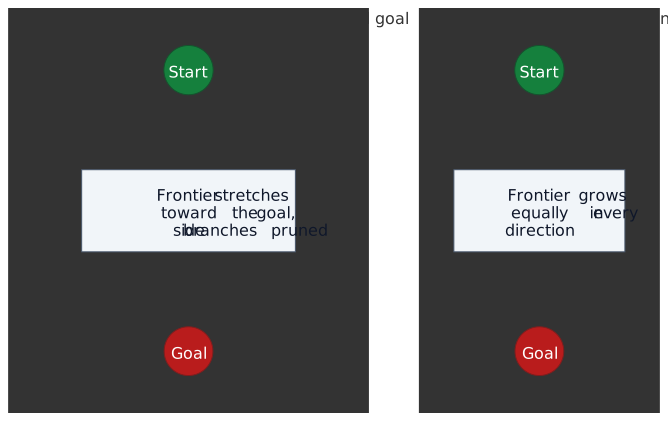
Practical applications:
- Video game pathfinding: NPC movement, RTS unit pathfinding (StarCraft, Age of Empires)
- Robotics: Motion planning for autonomous robots, drones
- Google Maps: Route planning with traffic predictions (heuristic = straight-line distance)
- Puzzle solving: 15-puzzle, 8-puzzle (heuristic = Manhattan distance)
- AI planning: Optimal action sequences in state spaces
- Network routing: QoS routing with latency predictions
- Warehouse automation: Robot navigation in warehouses (Amazon fulfillment centers)
- Game AI: Chess engines (heuristic = board evaluation), pathfinding in open worlds
Specialized Search Algorithms
12. Ternary Search (for Unimodal Functions)
Philosophy: Find maximum/minimum of unimodal function by dividing into three parts.
// Find maximum of unimodal functionfunction ternarySearchMax(f: (x: number) => number, left: number, right: number, epsilon: number = 1e-9): number { while (right - left > epsilon) { const mid1 = left + (right - left) / 3 const mid2 = right - (right - left) / 3 if (f(mid1) < f(mid2)) { left = mid1 } else { right = mid2 } } return (left + right) / 2}// For discrete arrays (unimodal peak finding)function findPeakElement(arr: number[]): number { let left = 0 let right = arr.length - 1 while (left < right) { const mid = left + Math.floor((right - left) / 2) if (arr[mid] < arr[mid + 1]) { left = mid + 1 // Peak is on the right } else { right = mid // Peak is on the left or at mid } } return left}| Property | Value |
|---|---|
| Time | O(log n) |
| Space | O(1) |
| Prerequisite | Unimodal function (single peak/valley) |
| Use case | Optimization problems |
Practical applications:
- Mathematical optimization: Finding maximum profit, minimum cost in convex/concave functions
- Machine learning: Finding optimal learning rate, hyperparameter tuning
- Signal processing: Finding peak frequency in unimodal distributions
- Physics simulations: Finding equilibrium points
- Resource allocation: Finding optimal allocation in convex cost functions
13. Binary Search on Answer
Philosophy: Binary search on the solution space rather than the array itself.
// Example: Find minimum capacity to ship packages in D daysfunction shipWithinDays(weights: number[], days: number): number { // Can we ship with given capacity? function canShip(capacity: number): boolean { let daysNeeded = 1 let currentLoad = 0 for (const weight of weights) { if (currentLoad + weight > capacity) { daysNeeded++ currentLoad = weight if (daysNeeded > days) return false } else { currentLoad += weight } } return true } // Binary search on capacity let left = Math.max(...weights) // Minimum possible let right = weights.reduce((a, b) => a + b, 0) // Maximum possible while (left < right) { const mid = left + Math.floor((right - left) / 2) if (canShip(mid)) { right = mid // Try smaller capacity } else { left = mid + 1 // Need larger capacity } } return left}// Example: Find square rootfunction sqrt(x: number, precision: number = 1e-6): number { let left = 0 let right = x while (right - left > precision) { const mid = (left + right) / 2 if (mid * mid <= x) { left = mid } else { right = mid } } return left}Practical applications:
- Capacity planning: Server capacity, bandwidth allocation
- Resource optimization: Minimum resources to complete tasks
- Rate limiting: Finding optimal rate limits
- Competitive programming: Common technique for optimization problems
Search Algorithm Comparison
Quick Reference Table
| Algorithm | Data Structure | Time | Space | Prerequisite | Optimal Path |
|---|---|---|---|---|---|
| Linear Search | Array | O(n) | O(1) | None | N/A |
| Binary Search | Sorted Array | O(log n) | O(1) | Sorted | N/A |
| Jump Search | Sorted Array | O(√n) | O(1) | Sorted | N/A |
| Interpolation Search | Sorted Array | O(log log n) | O(1) | Sorted + uniform | N/A |
| Exponential Search | Sorted Array | O(log n) | O(1) | Sorted | N/A |
| BFS | Graph | O(V + E) | O(V) | None | Yes (unweighted) |
| DFS | Graph | O(V + E) | O(h) | None | No |
| Bidirectional BFS | Graph | O(b^(d/2)) | O(b^(d/2)) | None | Yes (unweighted) |
| Dijkstra | Weighted Graph | O((V+E) log V) | O(V) | Non-negative weights | Yes |
| A* | Weighted Graph | O(E) | O(V) | Good heuristic | Yes (admissible h) |
| Ternary Search | Function | O(log n) | O(1) | Unimodal | N/A |
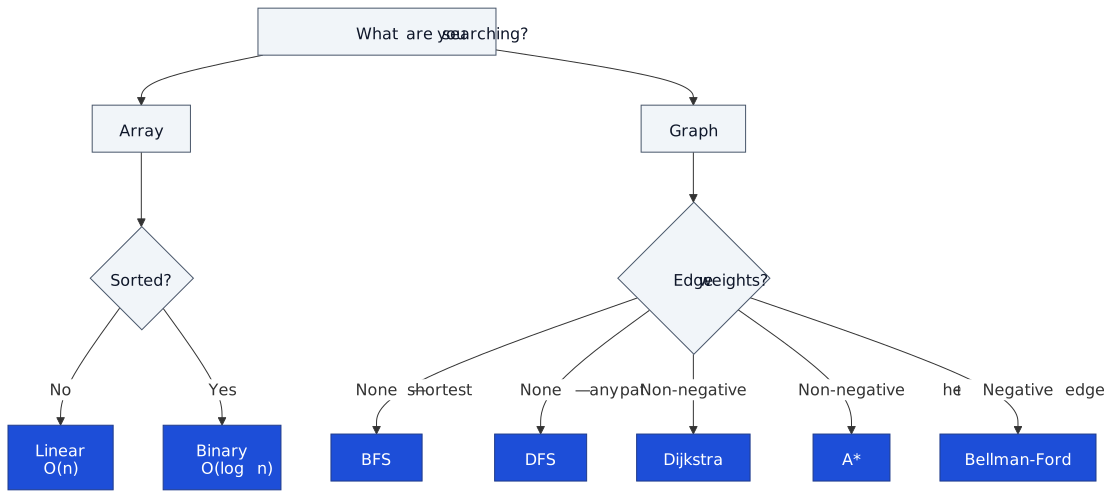
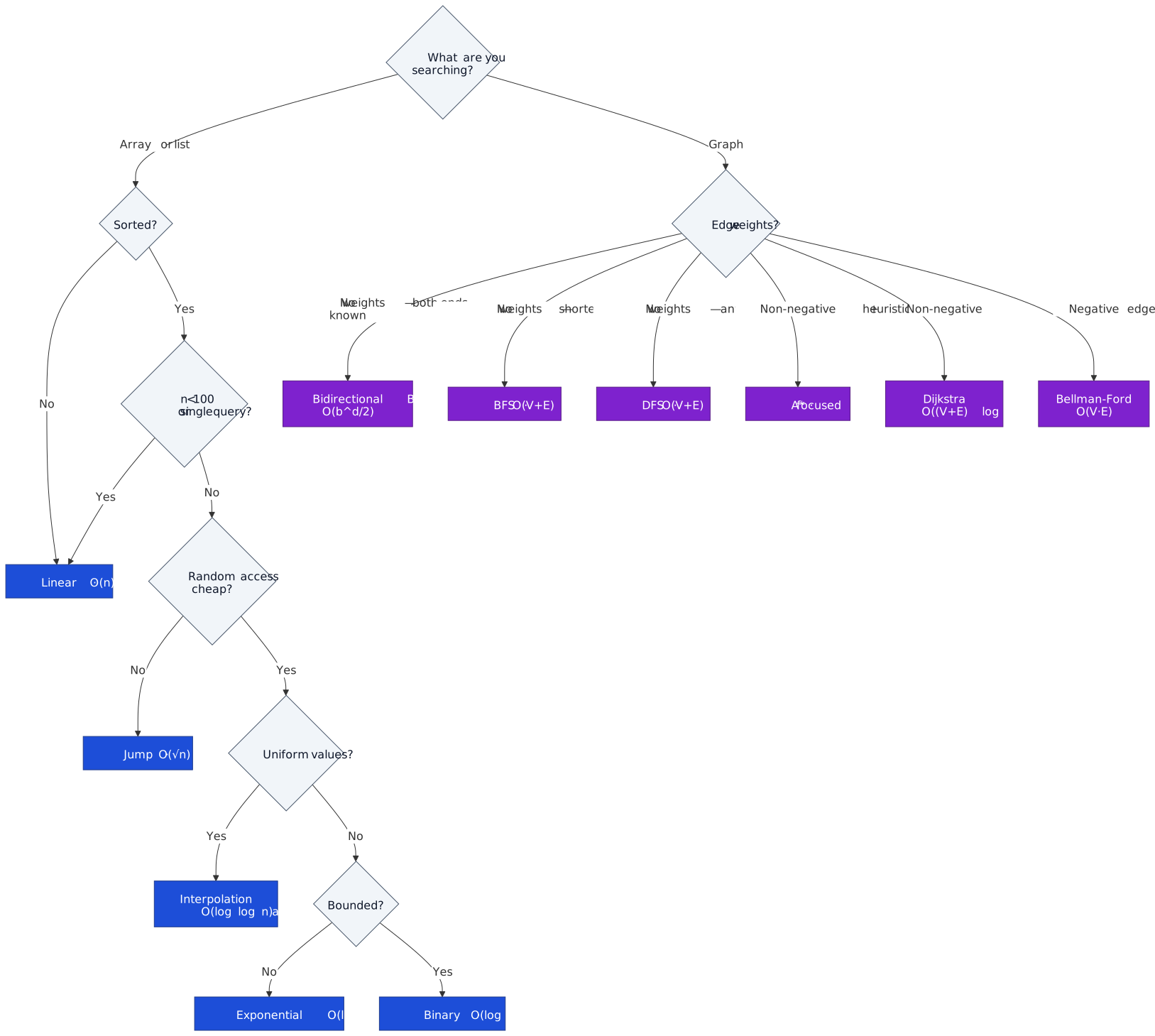
Decision Tree: Which Search to Use?
Practical Usage Guide: When to Use Each Algorithm
Linear Search: The Universal Fallback
Use when:
- Array is unsorted and sorting is too expensive
- Very small datasets (n < 100)
- Single search query (sorting overhead not justified)
- Need custom predicate (not simple equality)
- Working with linked lists (no random access)
Real-world examples:
// 1. Finding first user matching complex criteriafunction findUser(users: User[], predicate: (u: User) => boolean): User | undefined { return users.find(predicate) // Linear search with custom predicate}// 2. Configuration file searchconst setting = configLines.find((line) => line.startsWith("DEBUG="))// 3. Form validationconst hasError = formFields.some((field) => !field.isValid())Binary Search: The Sorted Array Champion
Use when:
- Array is sorted or can be sorted once
- Multiple search queries justify sorting cost
- Need O(log n) guarantees
- Working with large sorted datasets
Real-world examples:
// 1. Finding user by sorted IDfunction findUserById(users: User[], id: number): User | undefined { // Assumes users are sorted by id const idx = binarySearch( users.map((u) => u.id), id, ) return idx >= 0 ? users[idx] : undefined}// 2. Finding version compatibilityfunction findCompatibleVersion(versions: string[], targetVersion: string): string { // Binary search through sorted semantic versions}// 3. Range queries on sorted datafunction findUsersInAgeRange(users: User[], minAge: number, maxAge: number): User[] { const startIdx = lowerBound( users.map((u) => u.age), minAge, ) const endIdx = upperBound( users.map((u) => u.age), maxAge, ) return users.slice(startIdx, endIdx)}// 4. Git bisect (finding bug-introducing commit)// Binary search through commit history to find where bug was introducedAvoid when:
- Data is unsorted and won’t be searched multiple times
- Array changes frequently (sorting overhead on every change)
BFS: The Shortest Path Finder
Use when:
- Need shortest path in unweighted graph
- Level-order traversal needed
- All solutions at same depth should be found
- Memory is not severely constrained
Real-world examples:
// 1. Social network degrees of separationfunction degreesOfSeparation(userId1: string, userId2: string, friends: Map<string, string[]>): number { const distances = bfsWithDistance(friends, userId1) return distances.get(userId2) ?? -1}// 2. Web crawler (respecting depth limits)function crawlWebsite(startUrl: string, maxDepth: number): Set<string> { const visited = new Set<string>() const queue: [string, number][] = [[startUrl, 0]] while (queue.length > 0) { const [url, depth] = queue.shift()! if (depth > maxDepth || visited.has(url)) continue visited.add(url) const links = extractLinks(url) links.forEach((link) => queue.push([link, depth + 1])) } return visited}// 3. Finding minimum moves in puzzlefunction minMovesToSolve(initialState: PuzzleState, goalState: PuzzleState): number { // BFS to find shortest solution}// 4. Network broadcastingfunction broadcastMessage(startNode: number, network: Graph): void { // BFS ensures message reaches all nodes in minimum hops}DFS: The Explorer and Detector
Use when:
- Finding any path (not necessarily shortest)
- Memory is constrained (prefer stack depth over queue width)
- Detecting cycles
- Topological sorting
- Backtracking problems
Real-world examples:
// 1. Detecting circular dependenciesfunction hasCircularDependency(packages: Map<string, string[]>): boolean { return hasCycleDFS(packages)}// 2. Build order determinationfunction determineBuildOrder(dependencies: Map<string, string[]>): string[] { return topologicalSort(dependencies)}// 3. Maze generationfunction generateMaze(width: number, height: number): Maze { // DFS to create maze with single solution path}// 4. File system traversalfunction findAllFiles(dirPath: string): string[] { const files: string[] = [] function dfs(path: string): void { const entries = fs.readdirSync(path) for (const entry of entries) { const fullPath = path + "/" + entry if (fs.statSync(fullPath).isDirectory()) { dfs(fullPath) // Recurse into directory } else { files.push(fullPath) } } } dfs(dirPath) return files}// 5. Decision tree explorationfunction evaluateDecisionTree(node: DecisionNode): Result { // DFS through possible decisions, backtracking when needed}Dijkstra: The Weighted Pathfinder
Use when:
- Need shortest path in weighted graph
- All edge weights are non-negative
- Want shortest path from source to all nodes
- No good heuristic available for A*
Real-world examples:
// 1. Route planning with trafficfunction findFastestRoute( start: Location, end: Location, roadNetwork: WeightedGraph, // Weight = travel time): Route { const result = dijkstraWithPath(roadNetwork, start, end) return result?.path ?? []}// 2. Network packet routing (OSPF protocol)function computeRoutingTable(router: number, network: WeightedGraph): Map<number, number> { return dijkstra(network, router) // Shortest path to all destinations}// 3. Cheapest flight itineraryfunction findCheapestFlights( origin: string, destination: string, flights: WeightedGraph, // Weight = price): number { const distances = dijkstra(flights, origin) return distances.get(destination) ?? Infinity}A*: The Guided Pathfinder
Use when:
- Need shortest path AND have a good heuristic
- Want faster search than Dijkstra
- Goal is known in advance
- Can estimate remaining cost accurately
Real-world examples:
// 1. Game pathfinding (RTS, RPG)function findPathForUnit(unit: Unit, target: Point, gameMap: Grid): Point[] { const heuristic = (node: Point) => manhattanDistance(node, target) return astarGrid(gameMap, unit.position, target) ?? []}// 2. GPS navigation with straight-line heuristicfunction findRoute(start: Point, end: Point, roadMap: WeightedGraph): Point[] { const heuristic = (node: number) => { const nodePos = getPosition(node) return euclideanDistance(nodePos, end) } return astar(roadMap, start, end, heuristic)?.path ?? []}// 3. Puzzle solvers (15-puzzle, Rubik's cube)function solvePuzzle(initial: PuzzleState, goal: PuzzleState): Move[] { const heuristic = (state: PuzzleState) => manhattanDistanceHeuristic(state, goal) // A* finds optimal solution efficiently}// 4. Robot motion planningfunction planRobotPath(robot: Robot, target: Point, obstacles: Obstacle[]): Path { // A* with heuristic considering both distance and obstacle avoidance}Advanced Topics
Hash-Based Search (O(1) Average)
While not traditionally classified as a “search algorithm,” hash tables provide the fastest average-case search:
// Hash table for O(1) lookupconst userMap = new Map<string, User>()// O(1) searchconst user = userMap.get(userId)// When to use:// - Exact key lookup needed// - No range queries needed// - Memory for hash table available// - Fast average case more important than worst-case guaranteeTrade-offs:
- Pros: O(1) average case, simple to use
- Cons: O(n) worst case, no ordered traversal, extra memory
Informed vs Uninformed Search
Uninformed (blind) search: No knowledge of goal location
- Linear Search, Binary Search, BFS, DFS, Dijkstra
Informed search: Uses heuristics/domain knowledge
- A*, Greedy Best-First Search, Beam Search
Key insight: Informed search can be exponentially faster with good heuristics, but requires domain knowledge.
Parallel Graph Search
// Parallel BFS (conceptual)async function parallelBFS(graph: Graph, start: number): Promise<void> { const visited = new Set<number>([start]) let frontier = [start] while (frontier.length > 0) { // Process current level in parallel const nextFrontier = await Promise.all( frontier.map(async (node) => { const neighbors = graph.get(node) || [] return neighbors.filter((n) => !visited.has(n)) }), ) // Flatten and deduplicate frontier = [...new Set(nextFrontier.flat())] frontier.forEach((node) => visited.add(node)) }}Practical use: Large-scale graph processing (Google’s Pregel, Apache Giraph)
Memory-Efficient Graph Search
Iterative Deepening DFS (IDDFS):
- Combines DFS space efficiency with BFS completeness — formalised by Korf (1985), Depth-first iterative-deepening: an optimal admissible tree search.
- Runs DFS with increasing depth limits.
- Time: O(b^d) on a tree with branching factor b, dominated by the deepest iteration; space: O(d) where d is the depth.
function iddfs(graph: Graph, start: number, target: number): boolean { for (let maxDepth = 0; maxDepth < Infinity; maxDepth++) { const visited = new Set<number>() if (dfsLimited(graph, start, target, maxDepth, visited)) { return true } } return false}function dfsLimited(graph: Graph, node: number, target: number, depth: number, visited: Set<number>): boolean { if (node === target) return true if (depth === 0) return false visited.add(node) for (const neighbor of graph.get(node) || []) { if (!visited.has(neighbor)) { if (dfsLimited(graph, neighbor, target, depth - 1, visited)) { return true } } } return false}Use case: Large graphs where BFS queue won’t fit in memory.
Conclusion
Search algorithms are fundamentally about exploiting structure. The more you know about your data, the faster you can find what you’re looking for.
For arrays: Sorted data unlocks logarithmic search. If you only search once, sorting isn’t worth it. If you search repeatedly, build an index (sort, hash, or tree).
For graphs: The choice between BFS and DFS depends on what you’re optimizing. BFS guarantees shortest paths but uses O(width) memory. DFS uses O(depth) memory but may not find optimal paths. When edges have weights, Dijkstra extends BFS; when you have a good heuristic, A* focuses the search.
In practice: Theoretical complexity is a starting point, not the final answer. Cache effects, branch prediction, and constant factors matter. Profile with real data. And remember: hash tables exist—O(1) average lookup often beats clever algorithms for point queries.
Appendix
Prerequisites
- Big-O notation: Familiarity with time and space complexity analysis
- Basic data structures: Arrays, linked lists, stacks, queues, hash tables
- Graph fundamentals: Vertices, edges, adjacency lists, directed vs undirected graphs
- Recursion: Understanding of recursive function calls and the call stack
Terminology
| Term | Definition |
|---|---|
| Admissible | A heuristic that never overestimates the cost to reach the goal (A* requirement) |
| BFS | Breadth-First Search—explores all neighbors before moving to the next level |
| Branching factor | Average number of successors per node (b) |
| Complete | An algorithm that is guaranteed to find a solution if one exists |
| Consistent | A heuristic where h(n) ≤ cost(n,n’) + h(n’) for every edge (triangle inequality) |
| DFS | Depth-First Search—explores as deep as possible before backtracking |
| IDDFS | Iterative Deepening DFS—combines DFS space efficiency with BFS completeness |
| Lower bound | First position where an element can be inserted while maintaining sorted order |
| Optimal | An algorithm that is guaranteed to find the best (e.g., shortest) solution |
| Upper bound | First position where an element is strictly greater than the target |
Summary
- Linear search O(n): Only option for unsorted data; optimal for small arrays or single queries
- Binary search O(log n): Standard for sorted arrays; watch for integer overflow in mid calculation
- BFS O(V+E): Guarantees shortest path in unweighted graphs; level-order exploration
- DFS O(V+E): Memory efficient (O(depth) vs O(width)); use for cycle detection, topological sort
- Dijkstra O((V+E) log V): Shortest path for non-negative weighted graphs; greedy with priority queue
- A* O(E) best: Dijkstra + heuristic guidance; expands far fewer nodes when the heuristic is strong, optimal under an admissible heuristic in tree search and a consistent heuristic in graph search
References
Foundational Texts:
- Introduction to Algorithms (CLRS), 4th Edition - Cormen, Leiserson, Rivest, Stein. Chapters 22-24 cover graph algorithms; Chapter 12 covers binary search trees.
Algorithm-Specific Sources:
- Hart, Nilsson, Raphael (1968), A Formal Basis for the Heuristic Determination of Minimum Cost Paths, IEEE TSSC 4(2):100-107 — the original A* paper, with optimality proofs over admissible heuristics.
- Dechter & Pearl (1985), Generalized Best-First Search Strategies and the Optimality of A* — corrects the original optimality claim; demonstrates the role of consistency in graph search.
- A* Search Algorithm — Wikipedia — history, optimality conditions, and variants.
- Dijkstra’s Algorithm — Wikipedia — original 1959 paper reference, complexity analysis with different heap implementations.
- Perl, Itai & Avni (1978), Interpolation search — a log log N search — original O(log log n) proof for uniform keys.
- Bentley & Yao (1976), An almost optimal algorithm for unbounded searching — the foundational analysis of exponential search.
- Korf (1985), Depth-first iterative-deepening: an optimal admissible tree search — formal treatment of IDDFS and IDA*.
Standards and RFCs:
- RFC 2328: OSPF Version 2 - Section 16 details Dijkstra’s algorithm in network routing context.
Practical Implementations:
- Git Bisect Documentation - Binary search applied to version control for bug finding.
- Amit’s A* Pages - Comprehensive guide to pathfinding in games, heuristic design, and optimization techniques.
- Red Blob Games: Introduction to A* - Interactive visualizations of BFS, Dijkstra, and A*.