Design a Social Feed (Facebook/Instagram)
A comprehensive system design for social feed generation and ranking covering fan-out strategies, ML-powered ranking, graph-based storage, and caching at scale. This design addresses sub-second feed delivery for billions of users with personalized content ranking, handling the “celebrity problem” where a single post can require millions of fan-out operations.

Abstract
Social feed systems solve three interconnected problems: efficient content distribution (getting posts to followers), personalized ranking (showing the most relevant content first), and low-latency retrieval (sub-second feed loads at massive scale).
Core architectural decisions:
| Decision | Choice | Rationale |
|---|---|---|
| Fan-out strategy | Hybrid push/pull | Push for regular users, pull for celebrities (>10K followers) |
| Content storage | TAO-like graph store | Objects + associations model fits social data naturally |
| Feed ranking | Multi-stage ML funnel | Billions → hundreds → ~50 candidates through progressive filtering |
| Caching | Two-tier regional | Followers handle reads, leaders maintain consistency |
| Consistency | Eventual (~1 min) | Acceptable for social content; strong only for engagement counts |
Key trade-offs accepted:
- Eventual consistency for feed updates (fresh-enough is good enough)
- Higher write amplification for regular users (pre-computed feeds)
- Complex hybrid logic for celebrity handling
- ML model staleness (hourly retraining) in exchange for training efficiency
What this design optimizes:
- p99 feed load < 500ms globally
- Zero data loss for user-generated content
- Personalized ranking with 1000+ signals
- Linear horizontal scaling to billions of users
Requirements
Functional Requirements
| Requirement | Priority | Notes |
|---|---|---|
| Home feed generation | Core | Aggregated posts from followed users |
| Post creation | Core | Text, images, videos with privacy settings |
| Feed ranking | Core | Personalized relevance ordering |
| Real-time feed updates | Core | New posts appear without full refresh |
| Engagement actions | Core | Like, comment, share, save |
| Following/followers | Core | Asymmetric social graph |
| Feed pagination | Core | Infinite scroll with cursor-based loading |
| Post visibility | Extended | Public, friends-only, custom lists |
| Stories/ephemeral content | Extended | 24-hour expiring content |
| Algorithmic vs. chronological toggle | Extended | User preference for feed type |
Non-Functional Requirements
| Requirement | Target | Rationale |
|---|---|---|
| Availability | 99.99% (4 nines) | Revenue-critical, user retention |
| Feed load latency | p99 < 500ms | User experience threshold |
| Post publish latency | p99 < 2s | Acceptable for async processing |
| Feed freshness | < 1 minute | Balance between freshness and efficiency |
| Ranking model latency | p99 < 100ms | Real-time personalization requirement |
| Data durability | 99.999999% | No user content loss |
Scale Estimation
Users:
- Monthly Active Users (MAU): 2 billion
- Daily Active Users (DAU): 1 billion (50% of MAU)
- Peak concurrent users: 200 million (20% of DAU)
Traffic:
- Feed loads per user per day: 20
- Daily feed requests: 1B × 20 = 20 billion/day = 230K RPS
- Peak multiplier: 3× → 700K RPS
- Posts per user per day: 0.5 average (power law distribution)
- Daily posts: 500 million posts/day = 5.8K posts/second
Storage:
- Average post size: 2KB (metadata, excluding media)
- Media per post: 500KB average (after compression, CDN-served)
- Daily post storage: 500M × 2KB = 1TB/day (metadata)
- Daily media storage: 500M × 500KB = 250TB/day
- Social graph edges: 2B users × 500 avg connections = 1 trillion edges
- Graph storage: 1T edges × 100 bytes = 100TB
Fan-out estimation:
- Average followers: 500
- Posts requiring fan-out: 500M/day
- Fan-out writes: 500M × 500 = 250 billion writes/day
- Celebrity optimization: Top 1% (20M users) average 50K followers
- Without optimization: 20M × 50K × 0.5 posts = 500 trillion writes/day (impossible)
Design Paths
Path A: Fan-out on Write (Push Model)
Best when:
- Uniform follower distribution (no celebrities)
- Read-heavy workload (reads >> writes)
- Real-time feed freshness is critical
- Simpler operational model preferred
Architecture:
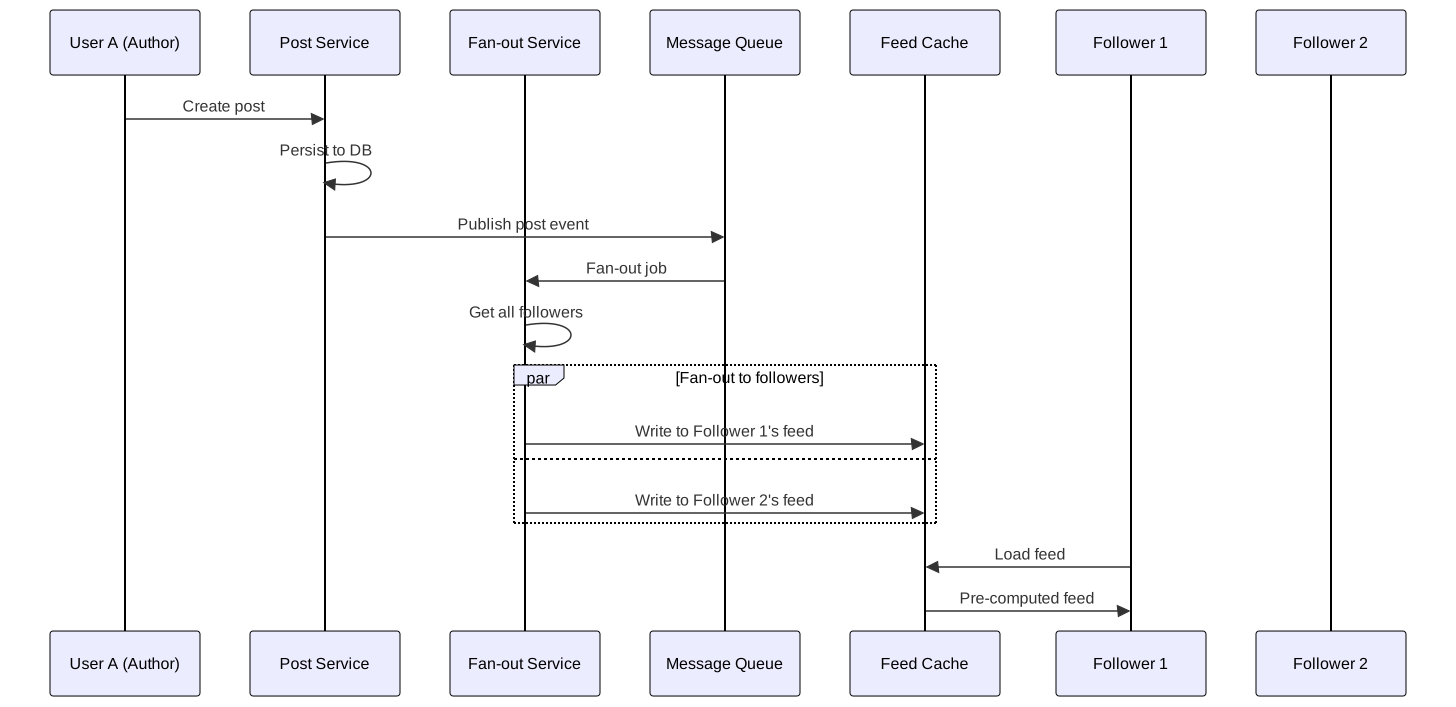
Key characteristics:
- Pre-computed feeds in Redis/Memcached
- O(1) feed reads, O(followers) writes
- Feed cache stores post IDs in sorted order
Trade-offs:
- ✅ Extremely fast feed reads (single cache lookup)
- ✅ Simple feed retrieval logic
- ✅ Predictable read latency
- ❌ Massive write amplification for celebrities
- ❌ High storage cost (duplicate post references)
- ❌ Delayed delivery during fan-out processing
Real-world example: Twitter historically used this approach, storing up to 800 tweets per timeline in Redis. At 39M QPS with 105TB RAM across 10,000+ Redis instances, this works for most users but requires special handling for high-follower accounts.
Path B: Fan-out on Read (Pull Model)
Best when:
- Celebrity-heavy platform (many high-follower users)
- Write-heavy workload
- Storage cost is a primary concern
- Acceptable higher read latency
Architecture:

Key characteristics:
- No write amplification
- Feed computed on demand
- Read complexity: O(followees × posts_per_user)
Trade-offs:
- ✅ No write amplification
- ✅ Always fresh content
- ✅ Lower storage requirements
- ❌ Higher read latency (aggregation required)
- ❌ More compute per request
- ❌ Harder to apply complex ranking
Real-world example: Facebook moved to this approach in 2007. The Multifeed system fetches tens of thousands of potential updates per user, then ranks and filters to ~45 items. This requires sophisticated indexing and caching to maintain sub-second latency.
Path C: Hybrid Model (Industry Standard)
Best when:
- Mixed follower distribution (most users small, some celebrities)
- Need to optimize both reads and writes
- Can handle additional system complexity
- Facebook/Instagram/Twitter scale
Architecture:

Key characteristics:
- Threshold-based routing (typically 10K followers)
- Pre-computed feeds + on-demand celebrity merging
- Best of both worlds for common cases
Trade-offs:
- ✅ Optimal latency for typical users (pre-computed)
- ✅ Handles celebrities without write explosion
- ✅ Flexible threshold tuning
- ❌ Two code paths to maintain
- ❌ More complex feed read logic
- ❌ Edge cases around threshold (users crossing 10K)
Real-world example: Discord uses this approach: direct fan-out for small servers, Kafka-based distribution for large servers (100+ members). Instagram similarly uses hybrid fan-out with ML-based feed generation.
Path Comparison
| Factor | Fan-out Write | Fan-out Read | Hybrid |
|---|---|---|---|
| Read latency | ~10ms | ~200ms | ~50ms |
| Write latency | O(followers) | O(1) | O(followers) for small |
| Celebrity handling | Impossible | Native | Optimized |
| Storage cost | High | Low | Medium |
| Complexity | Low | Medium | High |
| Production examples | Twitter (pre-2015) | Facebook Multifeed | Instagram, Discord |
This Article’s Focus
This article focuses on Path C (Hybrid) because:
- Represents modern production architectures at Facebook/Instagram scale
- Demonstrates trade-off thinking essential for system design
- Handles the full spectrum from regular users to celebrities
- Balances latency, storage, and operational complexity
High-Level Design
Component Overview

Feed Generation Service (Multifeed)
The feed generation layer follows Facebook’s Multifeed architecture with disaggregated tiers:
Aggregator Tier:
- CPU-intensive query processing and ranking
- Stateless, horizontally scalable
- Queries multiple leaf servers in parallel
- Applies ML ranking models to candidates
Leaf Tier:
- Memory-intensive, stores recent action indices
- Indexes posts by author, sorted by time
- Maintains in-memory structures for fast retrieval
- Sharded by user ID
Tailer:
- Real-time data pipeline from Kafka
- Updates leaf indices as posts are created
- Handles index rebuilding from persistent storage
Design decisions:
| Decision | Choice | Rationale |
|---|---|---|
| Tier separation | Disaggregated aggregator/leaf | 40% efficiency gain, independent scaling |
| Leaf sharding | By author user_id | Co-locates author’s posts for range queries |
| Index structure | Time-sorted skip list | Fast range queries with O(log n) insert |
| Memory management | LRU eviction, flash overflow | Balance hot data in RAM, cold on SSD |
Social Graph Service (TAO-like)
Manages the social graph (follows, friends, blocks) and content relationships:
Data model:
- Objects: Users, posts, comments, pages (nodes)
- Associations: Follows, likes, comments, tags (edges)
Design characteristics:
- Two tables only: objects and associations
- Associations stored on source object’s shard
- Enables single-shard queries for common patterns

Fan-out Service
Handles post distribution to follower feeds:
Routing logic:
interface FanoutRouter { routePost(post: Post, author: User): FanoutStrategy}
type FanoutStrategy = | { type: "push"; followers: string[] } | { type: "pull"; authorId: string } | { type: "hybrid"; pushTo: string[]; markForPull: boolean }Threshold-based routing:
- Authors with < 10K followers: Full push fan-out
- Authors with 10K-1M followers: Hybrid (push to active followers, pull for rest)
- Authors with > 1M followers: Pull only (mark post for read-time merging)
Ranking Service
Multi-stage funnel progressively narrows candidates:

API Design
Feed Endpoints
Get Home Feed
Endpoint: GET /api/v1/feed
Query Parameters:
| Parameter | Type | Description |
|---|---|---|
| cursor | string | Pagination cursor (opaque) |
| limit | int | Items per page (default: 20, max: 50) |
| refresh | boolean | Force fresh feed generation |
Response (200 OK):
{ "posts": [ { "id": "post_abc123", "author": { "id": "user_456", "username": "johndoe", "displayName": "John Doe", "avatarUrl": "https://cdn.example.com/avatars/456.jpg", "isVerified": true }, "content": { "type": "image", "text": "Beautiful sunset! 🌅", "media": [ { "id": "media_789", "type": "image", "url": "https://cdn.example.com/posts/789.jpg", "thumbnailUrl": "https://cdn.example.com/posts/789_thumb.jpg", "width": 1080, "height": 1350, "altText": "Sunset over the ocean" } ] }, "engagement": { "likeCount": 1542, "commentCount": 89, "shareCount": 23, "viewCount": 12450, "isLiked": false, "isSaved": false }, "ranking": { "score": 0.89, "reason": "friend_interaction" }, "createdAt": "2024-02-03T10:30:00Z", "visibility": "public" } ], "pagination": { "nextCursor": "eyJ0IjoxNzA2ODg2NDAwfQ", "hasMore": true }, "meta": { "feedType": "ranked", "generatedAt": "2024-02-03T12:00:00Z" }}Create Post
Endpoint: POST /api/v1/posts
Request:
{ "content": { "text": "Hello world!", "mediaIds": ["upload_123", "upload_456"] }, "visibility": "public", "allowComments": true, "allowSharing": true, "location": { "latitude": 37.7749, "longitude": -122.4194, "name": "San Francisco, CA" }}Response (201 Created):
{ "id": "post_new789", "author": { "id": "user_123", "username": "currentuser" }, "content": { "text": "Hello world!", "media": [...] }, "createdAt": "2024-02-03T12:05:00Z", "visibility": "public", "fanoutStatus": "pending"}Real-time Feed Updates (SSE)
Endpoint: GET /api/v1/feed/stream
Event Types:
event: new_postdata: {"postId": "post_xyz", "authorId": "user_456", "preview": "Check out..."}
event: engagement_updatedata: {"postId": "post_abc", "likeCount": 1543, "commentCount": 90}
event: post_removeddata: {"postId": "post_old", "reason": "author_deleted"}Engagement Endpoints
Like/Unlike Post
Endpoint: POST /api/v1/posts/{id}/like
Response (200 OK):
{ "liked": true, "likeCount": 1543, "timestamp": "2024-02-03T12:10:00Z"}Get Comments
Endpoint: GET /api/v1/posts/{id}/comments
Query Parameters:
| Parameter | Type | Description |
|---|---|---|
| cursor | string | Pagination cursor |
| limit | int | Comments per page (default: 20) |
| sort | string | ”top” (engagement), “newest”, “oldest” |
Response (200 OK):
{ "comments": [ { "id": "comment_123", "author": { "id": "user_789", "username": "commenter", "avatarUrl": "..." }, "text": "Great post!", "likeCount": 45, "replyCount": 3, "isLiked": false, "createdAt": "2024-02-03T10:35:00Z", "replies": [] } ], "pagination": { "nextCursor": "...", "hasMore": true }, "totalCount": 89}Error Responses
| Code | Error | When |
|---|---|---|
| 400 | INVALID_CONTENT | Post content violates rules |
| 401 | UNAUTHORIZED | Missing or invalid token |
| 403 | FORBIDDEN | User blocked or content restricted |
| 404 | POST_NOT_FOUND | Post doesn’t exist or is deleted |
| 429 | RATE_LIMITED | Too many requests |
| 503 | FEED_UNAVAILABLE | Feed generation temporarily unavailable |
Rate limits:
| Endpoint | Limit | Window |
|---|---|---|
| Feed load | 60 | per minute |
| Post creation | 10 | per hour |
| Like/comment | 100 | per minute |
| Media upload | 50 | per hour |
Data Modeling
TAO Schema (Objects and Associations)
Objects Table
CREATE TABLE objects ( id BIGINT PRIMARY KEY, type VARCHAR(50) NOT NULL, data BLOB, created_at TIMESTAMP DEFAULT CURRENT_TIMESTAMP, updated_at TIMESTAMP DEFAULT CURRENT_TIMESTAMP ON UPDATE CURRENT_TIMESTAMP, INDEX idx_type_created (type, created_at));Object types:
| Type | Data Fields |
|---|---|
| user | username, display_name, avatar_url, bio, follower_count |
| post | author_id, content, visibility, like_count, comment_count |
| comment | post_id, author_id, text, like_count |
| media | post_id, url, type, dimensions, alt_text |
Associations Table
CREATE TABLE associations ( id1 BIGINT NOT NULL, assoc_type VARCHAR(50) NOT NULL, id2 BIGINT NOT NULL, time BIGINT NOT NULL, data BLOB, PRIMARY KEY (id1, assoc_type, id2), INDEX idx_id1_type_time (id1, assoc_type, time DESC));Association types:
| Type | id1 | id2 | Data |
|---|---|---|---|
| follows | follower_id | followee_id | created_at |
| authored | user_id | post_id | - |
| liked | user_id | post_id | created_at |
| commented | user_id | comment_id | - |
| tagged | post_id | user_id | - |
Sharding strategy:
- Shard by id1 (source object)
- Co-locates user’s follows, likes, authored posts
- Enables single-shard queries for common patterns
Feed Cache Schema (Redis)
# Pre-computed feed (sorted set)# Score = ranking score or timestampZADD feed:{user_id} {score} {post_id}
# Keep last 500 posts per feedZREMRANGEBYRANK feed:{user_id} 0 -501
# Feed metadata (hash)HSET feed:meta:{user_id} last_generated 1706886400000 version 42 type "ranked"
# Celebrity posts index (for pull-based merging)ZADD celebrity_posts:{author_id} {timestamp} {post_id}
# User's recent engagement (for ranking features)ZADD user:engaged:{user_id} {timestamp} {post_id}EXPIRE user:engaged:{user_id} 604800 # 7 daysPost Index (Leaf Servers)
In-memory index structure on leaf servers:
interface PostIndex { // Posts by author, sorted by time (descending) authorIndex: Map<UserId, SortedSet<PostId, Timestamp>>
// Posts by visibility for filtering visibilityIndex: Map<Visibility, Set<PostId>>
// Recent posts global index (for trending) recentPosts: SortedSet<PostId, Timestamp>}
interface SortedSet<K, S> { add(key: K, score: S): void range(start: S, end: S, limit: number): K[] remove(key: K): void}MySQL Persistent Storage
-- Users tableCREATE TABLE users ( id BIGINT PRIMARY KEY AUTO_INCREMENT, username VARCHAR(50) UNIQUE NOT NULL, display_name VARCHAR(100), email VARCHAR(255) UNIQUE NOT NULL, password_hash VARCHAR(255) NOT NULL, avatar_url TEXT, bio TEXT, follower_count INT DEFAULT 0, following_count INT DEFAULT 0, post_count INT DEFAULT 0, is_verified BOOLEAN DEFAULT FALSE, is_celebrity BOOLEAN DEFAULT FALSE, -- >10K followers created_at TIMESTAMP DEFAULT CURRENT_TIMESTAMP, INDEX idx_username (username), INDEX idx_email (email)) ENGINE=InnoDB;
-- Posts tableCREATE TABLE posts ( id BIGINT PRIMARY KEY AUTO_INCREMENT, author_id BIGINT NOT NULL, content_text TEXT, content_type ENUM('text', 'image', 'video', 'link') NOT NULL, visibility ENUM('public', 'friends', 'private') DEFAULT 'public', like_count INT DEFAULT 0, comment_count INT DEFAULT 0, share_count INT DEFAULT 0, view_count INT DEFAULT 0, is_deleted BOOLEAN DEFAULT FALSE, created_at TIMESTAMP DEFAULT CURRENT_TIMESTAMP, updated_at TIMESTAMP DEFAULT CURRENT_TIMESTAMP ON UPDATE CURRENT_TIMESTAMP, INDEX idx_author_created (author_id, created_at DESC), INDEX idx_created (created_at DESC), FOREIGN KEY (author_id) REFERENCES users(id)) ENGINE=InnoDB;
-- Social graph (follow relationships)CREATE TABLE follows ( follower_id BIGINT NOT NULL, followee_id BIGINT NOT NULL, created_at TIMESTAMP DEFAULT CURRENT_TIMESTAMP, PRIMARY KEY (follower_id, followee_id), INDEX idx_followee (followee_id), FOREIGN KEY (follower_id) REFERENCES users(id), FOREIGN KEY (followee_id) REFERENCES users(id)) ENGINE=InnoDB;
-- Engagement (likes, saves)CREATE TABLE post_likes ( user_id BIGINT NOT NULL, post_id BIGINT NOT NULL, created_at TIMESTAMP DEFAULT CURRENT_TIMESTAMP, PRIMARY KEY (user_id, post_id), INDEX idx_post (post_id), FOREIGN KEY (user_id) REFERENCES users(id), FOREIGN KEY (post_id) REFERENCES posts(id)) ENGINE=InnoDB;Database Selection Matrix
| Data Type | Store | Rationale |
|---|---|---|
| Social graph | TAO (MySQL-backed) | Optimized for graph queries, association lists |
| User profiles | MySQL | ACID, moderate scale |
| Posts | MySQL + TAO cache | Durability + fast graph queries |
| Feed cache | Redis | Sub-ms reads, sorted sets for ranking |
| Post index | Leaf servers (memory) | Ultra-fast candidate retrieval |
| Media | S3 + CDN | Cost-effective, globally distributed |
| ML features | Feature store | Consistent features for training/serving |
| Analytics | ClickHouse | Time-series, aggregations |
Low-Level Design
Feed Generation Algorithm
Candidate Retrieval
12 collapsed lines
class CandidateRetriever { private readonly leafClient: LeafClient private readonly taoClient: TAOClient private readonly redis: RedisCluster
async getCandidates(userId: string): Promise<CandidateSet> { // 1. Get user's followees const followees = await this.taoClient.getAssociations(userId, "follows", { limit: 5000 })
// 2. Fetch recent posts from each followee (parallel) const postPromises = followees.map((followee) => this.leafClient.getAuthorPosts(followee.id2, { since: Date.now() - 7 * 24 * 60 * 60 * 1000, // 7 days limit: 50, }), )
const postsByAuthor = await Promise.all(postPromises)
// 3. Fetch celebrity posts for pull-based merging const celebrityFollowees = followees.filter((f) => f.data.isCelebrity) const celebrityPosts = await this.getCelebrityPosts(celebrityFollowees.map((f) => f.id2))
// 4. Merge and deduplicate const allPosts = [...postsByAuthor.flat(), ...celebrityPosts]
// 5. Apply eligibility filters const eligible = await this.filterEligible(userId, allPosts)
return { candidates: eligible, source: { fromCache: postsByAuthor.length, fromCelebrity: celebrityPosts.length, }, } }
private async filterEligible(userId: string, posts: Post[]): Promise<Post[]> { // Filter out: blocked authors, hidden posts, already seen const [blocked, hidden, seen] = await Promise.all([ this.taoClient.getAssociations(userId, "blocks"), this.redis.smembers(`hidden:${userId}`), this.redis.smembers(`seen:${userId}`), ])
const blockedSet = new Set(blocked.map((b) => b.id2)) const hiddenSet = new Set(hidden) const seenSet = new Set(seen)
return posts.filter( (post) => !blockedSet.has(post.authorId) && !hiddenSet.has(post.id) && !seenSet.has(post.id) && this.checkVisibility(userId, post), ) }}Multi-Stage Ranking
15 collapsed lines
class FeedRanker { private readonly featureStore: FeatureStore private readonly modelServer: ModelServer
async rank(userId: string, candidates: Post[]): Promise<RankedPost[]> { // Stage 1: First-pass lightweight ranking const stage1 = await this.firstPassRank(userId, candidates) const top500 = stage1.slice(0, 500)
// Stage 2: Second-pass neural network const stage2 = await this.secondPassRank(userId, top500) const top100 = stage2.slice(0, 100)
// Stage 3: Final reranking with diversity const final = await this.finalRerank(userId, top100)
return final.slice(0, 50) }
private async firstPassRank(userId: string, candidates: Post[]): Promise<RankedPost[]> { // Lightweight features (can compute in-process) const features = candidates.map((post) => ({ postId: post.id, recency: this.computeRecency(post.createdAt), authorAffinity: this.getAuthorAffinity(userId, post.authorId), contentType: post.contentType, engagementVelocity: this.getEngagementVelocity(post), }))
// Simple linear model for speed const scores = features.map( (f) => 0.3 * f.recency + 0.4 * f.authorAffinity + 0.2 * f.engagementVelocity + 0.1 * this.contentTypeBoost(f.contentType), )
return this.sortByScore(candidates, scores) }
private async secondPassRank(userId: string, candidates: Post[]): Promise<RankedPost[]> { // Fetch rich features from feature store const features = await this.featureStore.getBatch( candidates.map((c) => ({ userId, postId: c.id, authorId: c.authorId, })), )
// Neural network scoring const scores = await this.modelServer.predict("feed_ranking_v2", features)
return this.sortByScore(candidates, scores) }
private async finalRerank(userId: string, candidates: RankedPost[]): Promise<RankedPost[]> { // Apply diversity rules const diversified = this.applyDiversity(candidates, { maxPerAuthor: 2, contentTypeMix: { image: 0.4, video: 0.3, text: 0.3 }, maxAds: 3, })
// Apply integrity filters (misinformation, policy violations) const filtered = await this.applyIntegrityFilters(diversified)
return filtered }
private applyDiversity(posts: RankedPost[], rules: DiversityRules): RankedPost[] { const result: RankedPost[] = [] const authorCounts = new Map<string, number>() const typeCounts = new Map<string, number>()
for (const post of posts) { const authorCount = authorCounts.get(post.authorId) || 0 if (authorCount >= rules.maxPerAuthor) continue
// Check content type distribution const typeCount = typeCounts.get(post.contentType) || 0 const typeRatio = typeCount / (result.length + 1) const maxRatio = rules.contentTypeMix[post.contentType] || 0.5 if (typeRatio > maxRatio && result.length > 10) continue
result.push(post) authorCounts.set(post.authorId, authorCount + 1) typeCounts.set(post.contentType, typeCount + 1) }
return result }}Fan-out Pipeline
20 collapsed lines
class FanoutService { private readonly CELEBRITY_THRESHOLD = 10_000 private readonly BATCH_SIZE = 1000
async fanoutPost(post: Post, author: User): Promise<FanoutResult> { const followerCount = author.followerCount
if (followerCount < this.CELEBRITY_THRESHOLD) { return this.pushFanout(post, author) } else if (followerCount < 1_000_000) { return this.hybridFanout(post, author) } else { return this.pullOnly(post, author) } }
private async pushFanout(post: Post, author: User): Promise<FanoutResult> { // Get all followers const followers = await this.getFollowers(author.id)
// Process in batches to avoid memory pressure const batches = this.chunk(followers, this.BATCH_SIZE) let written = 0
for (const batch of batches) { const pipeline = this.redis.pipeline()
for (const followerId of batch) { // Add to follower's feed with timestamp score pipeline.zadd(`feed:${followerId}`, post.createdAt.getTime(), post.id) // Trim to max 500 posts pipeline.zremrangebyrank(`feed:${followerId}`, 0, -501) }
await pipeline.exec() written += batch.length
// Emit progress for monitoring this.metrics.increment("fanout.writes", batch.length) }
return { strategy: "push", followersReached: written, duration: Date.now() - post.createdAt.getTime(), } }
private async hybridFanout(post: Post, author: User): Promise<FanoutResult> { // Get active followers (engaged in last 7 days) const activeFollowers = await this.getActiveFollowers(author.id, 7)
// Push to active followers only const pushResult = await this.pushToFollowers(post, activeFollowers)
// Mark post for pull-based retrieval by inactive followers await this.redis.zadd(`celebrity_posts:${author.id}`, post.createdAt.getTime(), post.id) await this.redis.expire(`celebrity_posts:${author.id}`, 7 * 24 * 60 * 60)
return { strategy: "hybrid", pushed: pushResult.count, markedForPull: author.followerCount - activeFollowers.length, } }
private async pullOnly(post: Post, author: User): Promise<FanoutResult> { // Only index for pull-based retrieval await this.redis.zadd(`celebrity_posts:${author.id}`, post.createdAt.getTime(), post.id)
// Update author's post index await this.leafClient.indexPost(post)
return { strategy: "pull", indexed: true, } }}Cache Consistency (TAO Pattern)
TAO uses a two-tier caching architecture with leasing for consistency:
15 collapsed lines
class TAOCache { private readonly leaseTimeout = 10_000 // 10 seconds
async get(id1: string, assocType: string): Promise<Association[] | null> { // Try follower cache first const followerResult = await this.followerCache.get(this.cacheKey(id1, assocType))
if (followerResult) { this.metrics.increment("cache.hit.follower") return followerResult }
// Try leader cache const leaderResult = await this.leaderCache.get(this.cacheKey(id1, assocType))
if (leaderResult) { this.metrics.increment("cache.hit.leader") // Populate follower cache await this.followerCache.set(this.cacheKey(id1, assocType), leaderResult, { ttl: 300 }) return leaderResult }
// Cache miss - fetch from MySQL with lease return this.fetchWithLease(id1, assocType) }
private async fetchWithLease(id1: string, assocType: string): Promise<Association[]> { const leaseKey = `lease:${id1}:${assocType}`
// Try to acquire lease const acquired = await this.redis.set(leaseKey, "1", "NX", "PX", this.leaseTimeout)
if (!acquired) { // Another request is fetching - wait and retry await this.sleep(100) return this.get(id1, assocType) }
try { // Fetch from MySQL const data = await this.mysql.query( `SELECT * FROM associations WHERE id1 = ? AND assoc_type = ? ORDER BY time DESC`, [id1, assocType], )
// Populate both cache tiers await Promise.all([ this.leaderCache.set(this.cacheKey(id1, assocType), data, { ttl: 3600 }), this.followerCache.set(this.cacheKey(id1, assocType), data, { ttl: 300 }), ])
return data } finally { // Release lease await this.redis.del(leaseKey) } }
async invalidate(id1: string, assocType: string): Promise<void> { // Delete from both tiers const key = this.cacheKey(id1, assocType) await Promise.all([this.followerCache.del(key), this.leaderCache.del(key)]) }}Engagement Counter (Eventual Consistency)
Engagement counts (likes, comments) use write-behind pattern for efficiency:
12 collapsed lines
class EngagementService { private readonly FLUSH_INTERVAL = 5000 // 5 seconds private pendingUpdates = new Map<string, EngagementDelta>()
async incrementLike(postId: string): Promise<void> { // Immediate Redis increment for read consistency await this.redis.hincrby(`post:${postId}`, "like_count", 1)
// Buffer MySQL update this.bufferUpdate(postId, { likes: 1 }) }
private bufferUpdate(postId: string, delta: EngagementDelta): void { const existing = this.pendingUpdates.get(postId) || { likes: 0, comments: 0, shares: 0, }
this.pendingUpdates.set(postId, { likes: existing.likes + (delta.likes || 0), comments: existing.comments + (delta.comments || 0), shares: existing.shares + (delta.shares || 0), }) }
// Periodic flush to MySQL @Scheduled(FLUSH_INTERVAL) async flushToMySQL(): Promise<void> { const updates = new Map(this.pendingUpdates) this.pendingUpdates.clear()
const queries = Array.from(updates.entries()).map(([postId, delta]) => this.mysql.query( `UPDATE posts SET like_count = like_count + ?, comment_count = comment_count + ?, share_count = share_count + ? WHERE id = ?`, [delta.likes, delta.comments, delta.shares, postId], ), )
await Promise.all(queries) }}Frontend Considerations
Feed Virtualization
For infinite scroll with thousands of potential posts:
15 collapsed lines
interface VirtualFeedConfig { containerHeight: number estimatedItemHeight: number overscan: number // Extra items above/below viewport}
class VirtualFeed { private heightCache = new Map<string, number>() private offsetCache: number[] = []
calculateVisibleRange(scrollTop: number, posts: Post[]): { start: number; end: number } { // Binary search for start index let start = this.binarySearchOffset(scrollTop - this.config.overscan * 300)
// Calculate end based on viewport let accumulatedHeight = this.offsetCache[start] || 0 let end = start
while ( end < posts.length && accumulatedHeight < scrollTop + this.config.containerHeight + this.config.overscan * 300 ) { accumulatedHeight += this.getItemHeight(posts[end]) end++ }
return { start, end } }
private getItemHeight(post: Post): number { // Check cache first if (this.heightCache.has(post.id)) { return this.heightCache.get(post.id)! }
// Estimate based on content type let estimate = 100 // Base height if (post.content.media?.length > 0) { estimate += 400 // Image/video } if (post.content.text?.length > 200) { estimate += 50 // Long text }
return estimate }
// Called after actual render to update height cache onItemRendered(postId: string, actualHeight: number): void { this.heightCache.set(postId, actualHeight) this.rebuildOffsetCache() }}Optimistic Engagement Updates
10 collapsed lines
class FeedStore { private posts = new Map<string, Post>() private pendingLikes = new Set<string>()
async likePost(postId: string): Promise<void> { const post = this.posts.get(postId) if (!post || this.pendingLikes.has(postId)) return
// Optimistic update this.pendingLikes.add(postId) this.updatePost(postId, { engagement: { ...post.engagement, likeCount: post.engagement.likeCount + 1, isLiked: true, }, })
// Re-render immediately this.notifySubscribers(postId)
try { await this.api.likePost(postId) } catch (error) { // Rollback on failure this.updatePost(postId, { engagement: { ...post.engagement, likeCount: post.engagement.likeCount, isLiked: false, }, }) this.notifySubscribers(postId) } finally { this.pendingLikes.delete(postId) } }}Real-time Feed Updates
12 collapsed lines
class FeedStreamManager { private eventSource: EventSource | null = null private reconnectAttempt = 0
connect(userId: string): void { this.eventSource = new EventSource(`/api/v1/feed/stream?userId=${userId}`)
this.eventSource.addEventListener("new_post", (event) => { const data = JSON.parse(event.data) this.onNewPost(data) })
this.eventSource.addEventListener("engagement_update", (event) => { const data = JSON.parse(event.data) this.onEngagementUpdate(data) })
this.eventSource.onerror = () => { this.scheduleReconnect() } }
private onNewPost(data: NewPostEvent): void { // Show "New posts available" indicator instead of auto-inserting // This prevents jarring scroll position changes this.feedStore.setPendingPosts(data.count) this.ui.showNewPostsIndicator() }
private onEngagementUpdate(data: EngagementUpdateEvent): void { // Update counts in place (non-disruptive) this.feedStore.updateEngagement(data.postId, data) }
loadNewPosts(): void { // User clicked "Show new posts" const pending = this.feedStore.getPendingPosts() this.feedStore.prependPosts(pending) this.feedStore.clearPendingPosts() this.ui.scrollToTop() }}Prefetching Strategy
10 collapsed lines
class FeedPrefetcher { private readonly PREFETCH_THRESHOLD = 5 // Posts from bottom
onScroll(visibleRange: { start: number; end: number }, totalPosts: number): void { const postsRemaining = totalPosts - visibleRange.end
if (postsRemaining < this.PREFETCH_THRESHOLD && !this.loading) { this.prefetchNextPage() } }
private async prefetchNextPage(): Promise<void> { this.loading = true
try { const cursor = this.feedStore.getNextCursor() const response = await this.api.getFeed({ cursor, limit: 20 })
// Add to store but don't re-render yet this.feedStore.appendPosts(response.posts) this.feedStore.setNextCursor(response.pagination.nextCursor) } finally { this.loading = false } }}Infrastructure
Cloud-Agnostic Components
| Component | Purpose | Options |
|---|---|---|
| API Gateway | Auth, rate limiting | Kong, Envoy, Nginx |
| Graph Store | Social graph | Custom TAO-like, Neo4j, DGraph |
| KV Cache | Feed cache, sessions | Redis, KeyDB, Dragonfly |
| Message Queue | Fan-out, events | Kafka, Pulsar, NATS |
| Relational DB | Users, posts | MySQL, PostgreSQL, CockroachDB |
| Object Store | Media files | MinIO, Ceph, S3-compatible |
| ML Serving | Ranking models | TensorFlow Serving, Triton, Seldon |
| Feature Store | ML features | Feast, Tecton, custom |
AWS Reference Architecture

Service configurations:
| Service | Configuration | Rationale |
|---|---|---|
| Aggregator | c5.4xlarge (16 vCPU, 32GB) | CPU-bound ranking computation |
| Leaf | r5.8xlarge (32 vCPU, 256GB) | Memory-intensive index storage |
| Fan-out workers | Fargate Spot | Cost-effective async processing |
| ElastiCache Redis | r6g.2xlarge cluster mode | Sub-ms feed cache reads |
| Aurora MySQL | db.r6g.4xlarge Multi-AZ | Durability, read replicas for scale |
| DynamoDB | On-demand mode | TAO-like graph store, auto-scaling |
| SageMaker | p3.2xlarge (1 GPU) | Neural network inference |
Multi-Region Deployment

Multi-region considerations:
- Primary region for all writes (US-East)
- Read replicas in each region for local read latency
- Redis cross-region replication for feed cache
- ~50-100ms replication lag acceptable for social content
- Failover to secondary region if primary unavailable
Conclusion
This design provides a social feed system with:
- Sub-500ms feed generation via hybrid fan-out and pre-computed caches
- Personalized ranking using multi-stage ML funnel (1000+ signals)
- Infinite scalability through disaggregated architecture and sharding
- Celebrity handling via pull-based merging avoiding write explosion
- Eventual consistency acceptable for social content (strong for engagement)
Key architectural decisions:
- Hybrid fan-out balances latency (push) with scalability (pull)
- TAO-like graph store optimizes social relationship queries
- Multi-stage ranking funnel enables complex ML without latency impact
- Two-tier caching with leasing prevents thundering herd
Known limitations:
- ~1 minute eventual consistency for feed updates
- Pull-based celebrity posts may have slightly higher latency
- ML model staleness between hourly retraining windows
- Complex operational model with multiple specialized tiers
Future enhancements:
- Real-time ML model serving for instant personalization
- Federated learning for privacy-preserving ranking
- Graph neural networks for improved content understanding
- Edge-based feed generation for reduced latency
Appendix
Prerequisites
- Distributed systems fundamentals (caching, sharding, replication)
- ML basics (training vs. serving, feature engineering)
- Graph database concepts
- Message queue patterns (pub/sub, fan-out)
Terminology
| Term | Definition |
|---|---|
| Fan-out | Distributing a post to multiple follower feeds |
| TAO | Facebook’s graph store (The Associations and Objects) |
| Aggregator | Service that queries and combines data from multiple sources |
| Leaf server | Memory-intensive server storing indexed data |
| Candidate retrieval | First stage of ranking - gathering potential items |
| Affinity | Strength of relationship between user and content/author |
| Leasing | Cache coordination pattern to prevent thundering herd |
Summary
- Hybrid fan-out (push for regular users, pull for celebrities) balances write amplification with read latency
- TAO-like graph storage with objects and associations models social data naturally and enables efficient graph queries
- Multi-stage ML ranking (billions → hundreds → 50) enables sophisticated personalization without latency impact
- Two-tier regional caching with followers and leaders maintains consistency while providing sub-ms reads
- Eventual consistency (~1 minute) is acceptable for social content; engagement counts use write-behind pattern
- Scale to 700K RPS feed loads with disaggregated aggregator/leaf architecture
References
Real-World Implementations:
- Serving Facebook Multifeed: Efficiency, Performance Gains Through Redesign - Disaggregated architecture achieving 40% efficiency gains
- TAO: The Power of the Graph - Facebook’s distributed graph store handling 1B+ reads/second
- How Machine Learning Powers Facebook’s News Feed Ranking - ML-based ranking at scale
- Cache Made Consistent - Achieving 10 nines cache consistency at Meta
- Journey to 1000 Models: Scaling Instagram’s Recommendation System - Instagram’s ML platform
- How Twitter Uses Redis to Scale - Twitter’s 105TB Redis deployment
Academic Papers:
- TAO: Facebook’s Distributed Data Store for the Social Graph - USENIX ATC 2013
- Scaling Memcache at Facebook - NSDI 2013
- LiRank: Industrial Large Scale Ranking Models - LinkedIn’s ranking framework
Related Articles:
- Design Real-Time Chat and Messaging - WebSocket-based messaging
- Design a Notification System - Multi-channel notification delivery