Design a Distributed File System
A comprehensive system design for a distributed file system like GFS or HDFS covering metadata management, chunk storage, replication strategies, consistency models, and failure handling. This design addresses petabyte-scale storage with high throughput for batch processing workloads while maintaining fault tolerance across commodity hardware.

Abstract
Distributed file systems solve the problem of storing and accessing files that exceed single-machine capacity while providing fault tolerance and high throughput. The core architectural tension is between metadata scalability (how many files can the system track) and data throughput (how fast can clients read/write).
Core architectural decisions:
| Decision | Choice | Rationale |
|---|---|---|
| Metadata management | Single master | Simplifies placement, enables global optimization |
| Chunk size | 64-128 MB | Amortizes metadata overhead, optimizes for large files |
| Replication | 3 replicas, rack-aware | Survives rack failure, balances write bandwidth |
| Consistency | Relaxed (defined regions) | Enables concurrent appends, simplifies implementation |
| Write model | Append-only preferred | Eliminates random write complexity, enables atomic appends |
Key trade-offs accepted:
- Single master limits metadata operations to ~10K ops/sec (sufficient for batch workloads)
- Large chunks waste space for small files and create hotspots
- Relaxed consistency requires application-level handling of duplicates
What this design optimizes:
- High throughput for large sequential reads/writes (100s MB/s per client)
- Automatic failure recovery with minimal data loss
- Linear storage scaling to petabytes
Requirements
Functional Requirements
| Requirement | Priority | Notes |
|---|---|---|
| File creation/deletion | Core | Hierarchical namespace |
| Large file read | Core | Multi-GB to TB files, sequential access |
| Large file write | Core | Streaming writes, immutable after close |
| Record append | Core | Multiple clients appending concurrently |
| Snapshot | Extended | Point-in-time copy for backups |
| Namespace operations | Extended | Rename, move, permissions |
| Small file support | Extended | Not optimized, but functional |
Non-Functional Requirements
| Requirement | Target | Rationale |
|---|---|---|
| Availability | 99.9% (3 nines) | Batch processing tolerates brief outages |
| Read throughput | 100+ MB/s per client | Saturate network, not disk |
| Write throughput | 50+ MB/s per client | Pipeline limits write speed |
| Append latency | p99 < 100ms | Real-time log ingestion |
| Durability | 99.9999% | Data survives multiple simultaneous failures |
| Recovery time | < 10 min for node failure | Re-replication must not overwhelm cluster |
Scale Estimation
Cluster size (large deployment):
- Nodes: 1,000-5,000 chunk servers
- Storage per node: 12 × 4TB disks = 48TB raw
- Total raw capacity: 50,000 × 48TB = 2.4 PB per 50 nodes, scaling to 240 PB at 5,000 nodes
- Usable capacity (3x replication): ~80 PB at 5,000 nodes
Files and chunks:
- Files: 10 million (typical large deployment)
- Average file size: 1 GB
- Chunks per file: 1 GB / 64 MB = 16 chunks
- Total chunks: 160 million
- Metadata per chunk: ~150 bytes (GFS design)
- Total metadata: 160M × 150B = 24 GB (fits in master memory)
Traffic:
- Concurrent clients: 10,000
- Read-heavy workload: 90% reads, 10% writes
- Aggregate read throughput: 10,000 × 100 MB/s = 1 TB/s cluster-wide
- Aggregate write throughput: 1,000 × 50 MB/s = 50 GB/s cluster-wide
Metadata operations:
- File opens per second: 5,000-10,000
- Chunk location lookups: 50,000-100,000 per second (batch prefetch)
Design Paths
Path A: Single Master (GFS Model)
Best when:
- Metadata operations are not the bottleneck (batch processing)
- Simplicity and operational ease are priorities
- Global optimization of chunk placement is valuable
- File count is under 100 million
Architecture:

Key characteristics:
- All metadata in single master’s memory
- Chunk locations not persisted—rebuilt from heartbeats on startup
- Operation log replicated to shadow masters
- Clients cache chunk locations, reducing master load
Trade-offs:
- ✅ Simple design, easy to reason about
- ✅ Global knowledge enables optimal placement
- ✅ Single point for consistency
- ❌ Memory limits file count (~100M files with 64GB RAM)
- ❌ Master CPU limits metadata ops (~10K ops/sec)
- ❌ Single point of failure (mitigated by shadows)
Real-world example: Google File System (2003-2010) used this model. Clusters grew to several thousand chunk servers and hundreds of terabytes before metadata limits became problematic. Google eventually replaced GFS with Colossus for exabyte-scale needs.
Path B: Federated Masters (HDFS Federation)
Best when:
- Multiple independent workloads share infrastructure
- File count exceeds single-master memory limits
- Namespace isolation is desirable
- Gradual scaling without re-architecture is needed
Architecture:

Key characteristics:
- Each NameNode manages independent namespace
- Block pools are isolated per NameNode
- DataNodes serve all NameNodes
- No coordination between NameNodes
Trade-offs:
- ✅ Scales metadata horizontally
- ✅ Namespace isolation for multi-tenancy
- ✅ Incremental scaling
- ❌ No cross-namespace operations (hardlinks, moves)
- ❌ Uneven namespace utilization requires manual balancing
- ❌ Client must know which NameNode to contact
Real-world example: HDFS Federation was introduced in Hadoop 2.0 (2012). Yahoo deployed clusters with multiple NameNodes managing separate namespaces for different teams.
Path C: Distributed Metadata (Colossus/Tectonic Model)
Best when:
- Exabyte-scale storage is required
- Billions of files are expected
- Multi-tenancy with strong isolation is critical
- Team has expertise in distributed databases
Architecture:

Key characteristics:
- Metadata in distributed database (BigTable, Spanner)
- Curators are stateless, scale horizontally
- Custodians handle background operations
- D servers are simple storage targets
Trade-offs:
- ✅ Exabyte scale, billions of files
- ✅ No single point of failure
- ✅ True horizontal scaling
- ❌ Complex multi-layer architecture
- ❌ Higher latency for metadata operations
- ❌ Requires distributed database expertise
Real-world example: Google Colossus (2010+) stores exabytes of data across Google’s infrastructure. Facebook Tectonic (2021) consolidated multiple storage systems into one, reducing data warehouse clusters by 10x.
Path Comparison
| Factor | Single Master | Federation | Distributed |
|---|---|---|---|
| Files | ~100M | ~1B (sum of namespaces) | Unlimited |
| Metadata ops/sec | 10K | 10K × N namespaces | 100K+ |
| Complexity | Low | Medium | High |
| Cross-namespace ops | N/A | No | Yes |
| Operational burden | Low | Medium | High |
| Best for | Most deployments | Large enterprises | Hyperscalers |
This Article’s Focus
This article focuses on Path A (Single Master) because:
- It’s the foundational model (GFS, early HDFS)
- Sufficient for 95% of deployments (up to 100M files)
- Simpler to understand and operate
- Concepts transfer to federated/distributed models
Path B (Federation) is covered briefly in the scaling section. Path C (Distributed) requires a separate article on metadata-at-scale architectures.
High-Level Design
Component Overview

Master Server
Manages all filesystem metadata and coordinates cluster operations.
Responsibilities:
- Namespace management (directory tree, file metadata)
- File-to-chunk mapping
- Chunk replica placement decisions
- Lease management for write coordination
- Garbage collection of orphaned chunks
- Re-replication of under-replicated chunks
Design decisions:
| Decision | Choice | Rationale |
|---|---|---|
| Metadata storage | In-memory | Sub-millisecond lookups, 64GB supports 100M files |
| Persistence | Operation log + checkpoints | Fast recovery, crash consistency |
| Chunk locations | Not persisted | Rebuilt from heartbeats in 30-60 seconds |
| Failover | Manual + shadow masters | Simplicity; automatic adds complexity |
Memory layout (per 64GB master):
| Data | Size | Count Supported |
|---|---|---|
| Namespace tree | ~200 bytes/file | 100M files = 20GB |
| File→chunk mapping | ~100 bytes/file | 100M files = 10GB |
| Chunk metadata | ~64 bytes/chunk | 500M chunks = 32GB |
| Total | ~62GB | 100M files, 500M chunks |
Chunk Server
Stores chunks as local files and serves read/write requests.
Responsibilities:
- Store chunks as Linux files on local disks
- Serve read requests directly to clients
- Accept writes and forward in pipeline
- Report chunk inventory via heartbeat
- Compute and verify checksums
- Participate in re-replication
Design decisions:
| Decision | Choice | Rationale |
|---|---|---|
| Chunk storage | Local filesystem (ext4/xfs) | Leverage OS buffer cache, simple |
| Checksumming | 32KB blocks, CRC32C | Detect corruption before serving |
| Heartbeat interval | 3 seconds | Balance failure detection vs overhead |
| Chunk report | Piggyback on heartbeat | Reduce message count |
Disk layout:
/data/├── disk1/│ ├── chunks/│ │ ├── chunk_abc123.dat # 64MB chunk data│ │ ├── chunk_abc123.crc # Checksums (2KB for 64MB)│ │ └── chunk_def456.dat│ └── meta/│ └── chunk_inventory.db # Local SQLite for chunk metadata├── disk2/│ └── chunks/└── disk12/ └── chunks/Client Library
Provides file system interface and handles complexity of distributed operations.
Responsibilities:
- Translate file operations to master/chunk server RPCs
- Cache chunk locations (reduces master load 100x)
- Buffer writes for efficiency
- Handle retries and failover
- Implement record append semantics
Design decisions:
| Decision | Choice | Rationale |
|---|---|---|
| Location cache | LRU, 10K entries, 10min TTL | Reduces master load by 100x |
| Write buffer | 64MB (one chunk) | Batch small writes |
| Retry policy | Exponential backoff, 3 retries | Handle transient failures |
| Checksum verification | On read | Catch corruption early |
API Design
Master Server API
File Operations
Create File:
CreateFile(path: string, replication: int) → FileHandle- Validates path, creates namespace entry
- Does not allocate chunks (lazy allocation)
- Returns handle with initial chunk locations
Open File:
OpenFile(path: string, mode: READ|WRITE|APPEND) → FileHandle- For writes: grants lease to client
- Returns current chunk locations
Delete File:
DeleteFile(path: string) → void- Marks file as deleted in namespace
- Actual chunk deletion via garbage collection (72-hour delay)
Chunk Operations
Get Chunk Locations:
GetChunkLocations(file: FileHandle, chunkIndex: int) → ChunkInfoResponse:
{ "chunkId": "chunk_abc123", "version": 42, "replicas": [ { "server": "cs1.example.com:9000", "rack": "rack1" }, { "server": "cs4.example.com:9000", "rack": "rack2" }, { "server": "cs7.example.com:9000", "rack": "rack3" } ], "primary": "cs1.example.com:9000", "leaseExpiry": "2024-02-03T10:05:00Z"}Add Chunk:
AddChunk(file: FileHandle) → ChunkInfo- Allocates new chunk ID
- Selects replica locations (rack-aware)
- Grants lease to one replica as primary
Chunk Server API
Read Chunk:
ReadChunk(chunkId: string, offset: int, length: int) → bytes- Verifies checksum before returning data
- Returns error if checksum fails (client retries other replica)
Write Chunk:
WriteChunk(chunkId: string, offset: int, data: bytes, replicas: []Server) → void- Accepts data, writes to disk
- Forwards to next replica in pipeline
- Returns success only when all replicas confirm
Append Chunk:
AppendChunk(chunkId: string, data: bytes) → (offset: int, error)- Primary determines offset
- Broadcasts to replicas
- Returns offset where data was appended
- If chunk doesn’t have space, returns
ChunkFullerror
Client API (User-Facing)
class DistributedFileSystem: def create(path: str, replication: int = 3) -> File def open(path: str, mode: str = "r") -> File def delete(path: str) -> None def rename(src: str, dst: str) -> None def list(path: str) -> List[FileInfo] def mkdir(path: str) -> None def exists(path: str) -> bool
class File: def read(size: int = -1) -> bytes def write(data: bytes) -> int def append(data: bytes) -> int # Returns offset def seek(offset: int) -> None def close() -> NoneData Modeling
Master Metadata Structures
Namespace (in-memory tree):
type NamespaceNode struct { Name string IsDirectory bool Children map[string]*NamespaceNode // For directories FileInfo *FileMetadata // For files Parent *NamespaceNode
// Access control Owner string Group string Permissions uint16}
type FileMetadata struct { FileID uint64 Size int64 Replication int ChunkSize int64 // Usually 64MB Chunks []ChunkHandle CreatedAt time.Time ModifiedAt time.Time}Chunk mapping (in-memory hash table):
type ChunkHandle uint64
type ChunkMetadata struct { Handle ChunkHandle Version uint64 // Incremented on each mutation Replicas []ChunkServerID // Current replica locations Primary ChunkServerID // Current lease holder LeaseExpiry time.Time}
// Global map: O(1) lookupvar chunkTable map[ChunkHandle]*ChunkMetadataOperation Log Format
Persistent, append-only log for crash recovery:
[Timestamp][OpType][OpData]
Example entries:[1706900000][CREATE_FILE]["/logs/2024/app.log", replication=3][1706900001][ADD_CHUNK][fileId=12345, chunkHandle=67890, version=1][1706900002][UPDATE_REPLICAS][chunkHandle=67890, replicas=[cs1,cs4,cs7]][1706900003][DELETE_FILE]["/tmp/old_file.dat"]Compaction:
- Checkpoint: Serialize full in-memory state to disk
- Truncate log entries before checkpoint
- Frequency: Every 1M operations or 1 hour
Chunk Server Local Storage
Chunk file format:
chunk_<handle>.dat:[Data: 64MB or less]
chunk_<handle>.meta:{ "handle": 67890, "version": 42, "size": 67108864, "checksums": [ {"offset": 0, "crc32c": "a1b2c3d4"}, {"offset": 32768, "crc32c": "e5f6g7h8"}, ... // One per 32KB block ], "createdAt": "2024-02-03T10:00:00Z"}Heartbeat Protocol
Chunk server → Master (every 3 seconds):
{ "serverId": "cs1.example.com:9000", "timestamp": 1706900000, "diskUsage": { "total": 48000000000000, "used": 32000000000000, "available": 16000000000000 }, "chunkReports": [ { "handle": 67890, "version": 42, "size": 67108864 }, { "handle": 67891, "version": 15, "size": 33554432 } ], "corruptChunks": [67892], "load": { "readOps": 150, "writeOps": 20, "networkBytesIn": 1073741824, "networkBytesOut": 5368709120 }}Master → Chunk server (response):
{ "commands": [ { "type": "DELETE", "chunks": [67893, 67894] }, { "type": "REPLICATE", "chunk": 67895, "target": "cs5.example.com:9000" }, { "type": "REPORT_FULL", "reason": "version_mismatch" } ]}Low-Level Design
Write Operation Flow
Standard Write
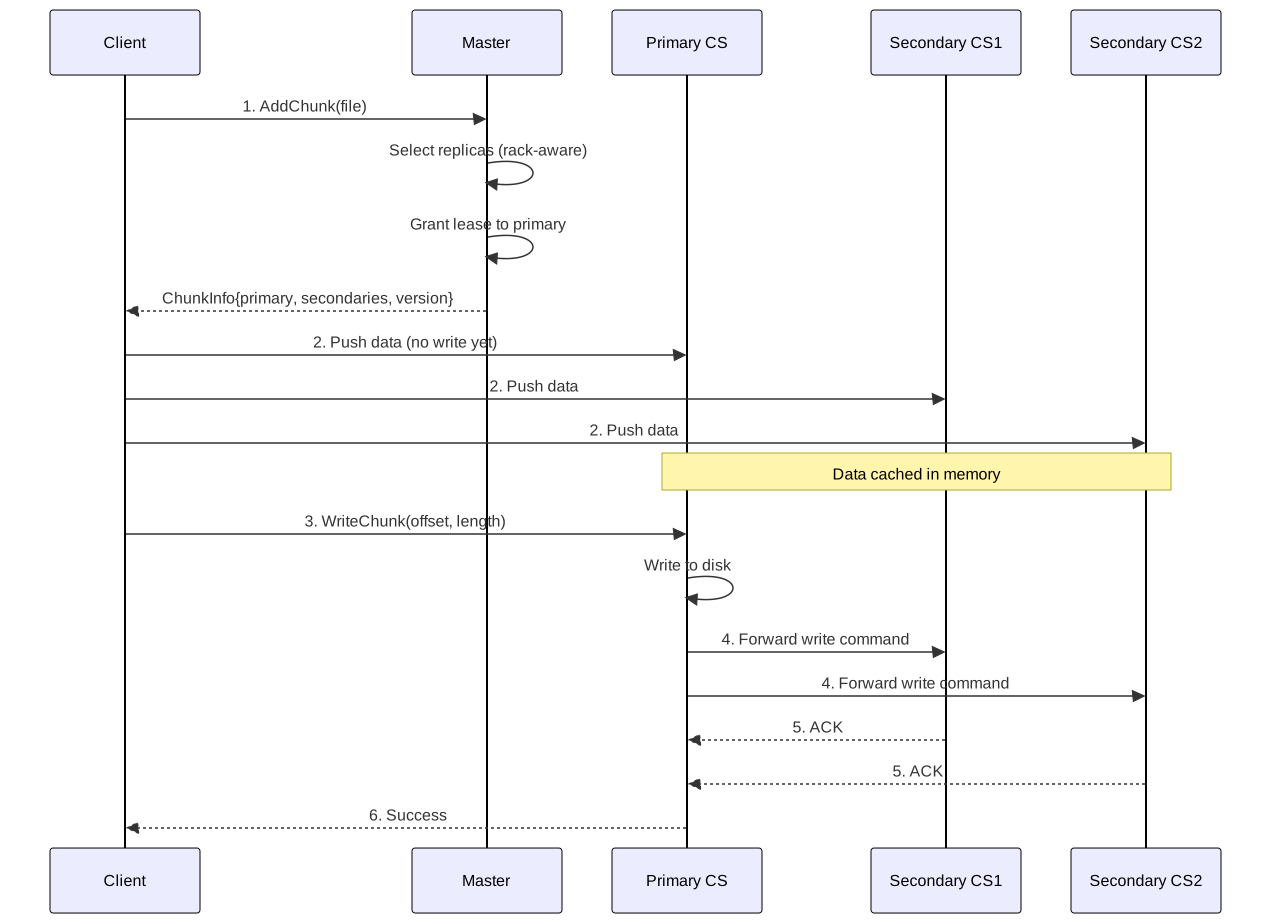
Why separate data push from write command:
- Data flows directly to all replicas (parallel, saturates network)
- Write command is small, serializes at primary
- Primary controls ordering for concurrent writes
- If replica fails, retry is cheap (data already pushed)
Record Append
Atomic append is the key differentiator from traditional file systems:
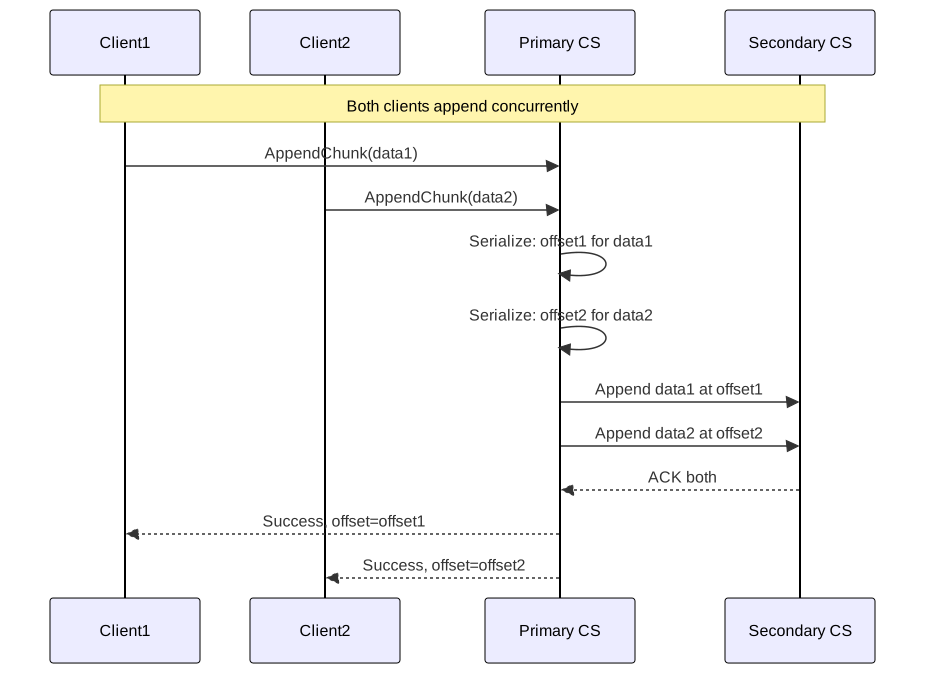
Append semantics:
- At-least-once guarantee: If append returns success, data is durably stored
- Atomicity: Each append is all-or-nothing (no partial appends)
- Ordering: Primary determines global order
- Duplicates possible: If primary fails after writing but before ACK, client retries → duplicate record
Handling append failures:
If replica fails during append:1. Primary returns failure to client2. Client retries (may retry different chunk if padding needed)3. Some replicas may have the data, some may not4. Result: "defined" region followed by "inconsistent" paddingConsistency Model
GFS-style distributed file systems use a relaxed consistency model:
| After Operation | Consistent | Defined |
|---|---|---|
| Write (single client) | Yes | Yes |
| Write (concurrent clients) | Yes | No (interleaved) |
| Record Append (success) | Yes | Yes (at some offset) |
| Record Append (failure) | No | No |
Definitions:
- Consistent: All replicas have identical data
- Defined: Data reflects exactly one client’s write
Application implications:
- Writers should use record append, not random writes
- Readers must handle:
- Duplicate records (use unique IDs + deduplication)
- Partial records (use checksums in records)
- Inconsistent regions (validate before processing)
Example: Log file with concurrent appenders:
[Record 1: app_id=A, seq=1, checksum=valid] ← Defined[Record 2: app_id=B, seq=1, checksum=valid] ← Defined[Padding: zeros or garbage] ← Inconsistent (skip)[Record 3: app_id=A, seq=2, checksum=valid] ← Defined[Record 1: app_id=A, seq=1, checksum=valid] ← Duplicate (skip)Replica Placement Algorithm
Goals:
- Survive rack failure
- Distribute load
- Minimize cross-rack traffic for writes
Algorithm (for 3 replicas):
def select_replicas(num_replicas: int, client_rack: str) -> List[Server]: replicas = []
# First replica: prefer client's rack (if client is a chunk server) # or select least-loaded server if client_is_chunk_server and has_capacity(client_rack): replicas.append(select_server(client_rack)) else: replicas.append(select_least_loaded_server())
# Second replica: different rack rack2 = select_different_rack(replicas[0].rack) replicas.append(select_server(rack2))
# Third replica: same rack as second (minimize cross-rack writes) replicas.append(select_server(rack2, exclude=replicas[1]))
return replicas
def select_server(rack: str, exclude: Server = None) -> Server: candidates = [s for s in rack.servers if s != exclude and s.available_space > THRESHOLD and s.recent_creates < RATE_LIMIT]
# Balance by available space and recent activity return weighted_random(candidates, weight=available_space)Write bandwidth analysis:
| Replica Placement | Cross-Rack Transfers |
|---|---|
| All same rack | 0 |
| Spread across 3 racks | 2 |
| 1 rack + 2 another rack | 1 |
The third approach (1 + 2) balances reliability and bandwidth.
Failure Handling
Chunk Server Failure

Re-replication throttling:
- Limit: 10 MB/s per source server
- Reason: Prevent recovery traffic from impacting production reads
- Trade-off: Slower recovery vs. sustained availability
Master Failure
Recovery process:
- Shadow master detection: Monitoring detects primary failure
- Promotion: Operator (or automated system) promotes shadow
- Log replay: Shadow applies any uncommitted log entries
- Chunk reports: Wait for chunk servers to report (30-60 seconds)
- Resume operations: Master accepts client requests
Recovery time breakdown:
| Phase | Duration |
|---|---|
| Detection | 10-30 seconds |
| Promotion decision | Manual: minutes, Auto: seconds |
| Log replay | Seconds (incremental) |
| Chunk reports | 30-60 seconds |
| Total | 1-5 minutes |
Data Corruption Detection
Checksum verification:
BLOCK_SIZE = 32 * 1024 # 32KB
def write_chunk(chunk_id: str, data: bytes): # Compute checksums for each 32KB block checksums = [] for i in range(0, len(data), BLOCK_SIZE): block = data[i:i+BLOCK_SIZE] checksums.append(crc32c(block))
# Write data and checksums atomically write_file(f"{chunk_id}.dat", data) write_file(f"{chunk_id}.crc", checksums)
def read_chunk(chunk_id: str, offset: int, length: int) -> bytes: data = read_file(f"{chunk_id}.dat", offset, length) checksums = read_file(f"{chunk_id}.crc")
# Verify each block for i in range(offset // BLOCK_SIZE, (offset + length) // BLOCK_SIZE + 1): block = data[i*BLOCK_SIZE:(i+1)*BLOCK_SIZE] if crc32c(block) != checksums[i]: raise CorruptionError(chunk_id, i)
return dataCorruption handling:
- Chunk server reports corruption to master
- Master marks chunk as corrupt
- Master initiates re-replication from healthy replica
- Chunk server deletes corrupt chunk
Garbage Collection
Lazy deletion design:
DELETE /path/file→ File renamed to hidden name (.deleted_<timestamp>_<filename>)- After 72 hours: Master removes file metadata
- During heartbeat: Master tells chunk servers to delete orphaned chunks
Why 72-hour delay:
- Allows recovery from accidental deletion
- Batches deletion operations
- Reduces master load
Orphan detection:
def garbage_collect(): # Collect all chunks referenced by files referenced_chunks = set() for file in all_files(): referenced_chunks.update(file.chunks)
# On each heartbeat, check chunk server's inventory for chunk_id in chunk_server.reported_chunks: if chunk_id not in referenced_chunks: # Tell chunk server to delete commands.append(DeleteChunk(chunk_id))Frontend Considerations
While distributed file systems are primarily backend infrastructure, client-facing considerations exist:
Batch Processing Integration
MapReduce/Spark data locality:
def get_input_splits(file_path: str) -> List[InputSplit]: """Return splits with location hints for scheduler.""" splits = [] for chunk in file.chunks: locations = master.get_chunk_locations(chunk) splits.append(InputSplit( chunk_id=chunk.id, offset=0, length=chunk.size, # Scheduler prefers these hosts preferred_locations=[loc.host for loc in locations] )) return splitsData locality statistics:
| Locality Level | Typical Rate | Impact |
|---|---|---|
| Node-local | 70-90% | Zero network for read |
| Rack-local | 95-99% | Low network overhead |
| Off-rack | 1-5% | Full network cost |
CLI and Admin Tools
Essential operations:
# File operationsdfs put local_file.txt /hdfs/path/file.txtdfs get /hdfs/path/file.txt local_file.txtdfs ls /hdfs/path/dfs rm /hdfs/path/file.txt
# Admin operationsdfs fsck /path              # Check file system healthdfs balancer                # Rebalance data across serversdfs report                  # Cluster utilization reportdfs safemode enter|leave    # Maintenance mode
Monitoring Dashboard Metrics
Key metrics for operators:
| Metric | Warning Threshold | Critical Threshold |
|---|---|---|
| Under-replicated blocks | > 100 | > 1000 |
| Corrupt blocks | > 0 | > 10 |
| Dead nodes | > 0 | > N × 0.05 |
| Capacity used | > 70% | > 85% |
| Pending replications | > 10000 | > 100000 |
| Master heap usage | > 70% | > 85% |
Infrastructure
Cloud-Agnostic Components
| Component | Purpose | Options |
|---|---|---|
| Master storage | Operation log, checkpoints | Local SSD, NFS, cloud block storage |
| Chunk storage | Data storage | Local HDD/SSD arrays |
| Network | Data transfer | 10-100 Gbps, leaf-spine topology |
| Monitoring | Health, metrics | Prometheus, Grafana, Datadog |
| Configuration | Cluster config | ZooKeeper, etcd, Consul |
Hardware Recommendations
Master server (per server):
| Component | Specification | Rationale |
|---|---|---|
| CPU | 32+ cores | Metadata operations are CPU-bound |
| Memory | 128-256 GB | All metadata in RAM |
| Storage | 2× NVMe SSD (RAID 1) | Operation log durability |
| Network | 25 Gbps | Heartbeat + client traffic |
Chunk server (per server):
| Component | Specification | Rationale |
|---|---|---|
| CPU | 8-16 cores | I/O bound, not CPU bound |
| Memory | 64-128 GB | OS buffer cache |
| Storage | 12-24× 4-16 TB HDD | Cost-effective bulk storage |
| Network | 25-100 Gbps | Saturate disk throughput |
Capacity Planning
Cluster sizing formula:
Raw capacity needed = Data size × Replication factor = 100 PB × 3 = 300 PB
Servers needed = Raw capacity / Capacity per server = 300 PB / 48 TB = 6,250 servers
Network capacity = Expected throughput × Headroom = 1 TB/s × 2 = 2 TB/s aggregate = ~200 servers at 10 Gbps each (network limited)AWS Reference Architecture

Instance selection:
| Role | Instance | vCPUs | Memory | Storage | Network |
|---|---|---|---|---|---|
| Master | i3en.12xlarge | 48 | 384 GB | 4× 7.5TB NVMe | 50 Gbps |
| Chunk Server | d3en.12xlarge | 48 | 192 GB | 12× 14TB HDD | 50 Gbps |
Cost comparison (300 servers, 3-year reserved):
| Component | Monthly Cost |
|---|---|
| d3en.12xlarge × 297 | ~$400K |
| i3en.12xlarge × 3 | ~$8K |
| Network (inter-AZ) | ~$50K |
| Total | ~$460K/month |
Alternative: Self-hosted on-prem often 60-70% cheaper for sustained workloads.
Conclusion
This design provides a distributed file system capable of:
- Petabyte-scale storage across thousands of commodity servers
- 100+ MB/s throughput per client for large sequential operations
- Fault tolerance surviving simultaneous disk, server, and rack failures
- Atomic record append enabling concurrent producers without coordination
Key architectural decisions:
- Single master with in-memory metadata enables global optimization but limits scale to ~100M files
- Large chunks (64-128 MB) optimize for batch processing but penalize small files
- Relaxed consistency trades simplicity for application-level complexity (deduplication, checksums)
- Append-only design eliminates random write complexity
Known limitations:
- Single master is metadata bottleneck (addressed by federation or distributed metadata)
- Large chunks waste space for small files (addressed by tiered storage)
- No strong consistency for concurrent writes (acceptable for batch workloads)
When to use alternatives:
| Requirement | Better Choice |
|---|---|
| Many small files (millions of < 1MB) | Object storage (S3, MinIO) |
| POSIX semantics required | CephFS, Lustre |
| Real-time random reads | Key-value stores (Cassandra, DynamoDB) |
| Exabyte scale | Colossus-style distributed metadata |
Appendix
Prerequisites
- Storage fundamentals (RAID, replication, erasure coding)
- Distributed systems basics (consensus, failure detection)
- Networking (TCP, datacenter topology)
Terminology
| Term | Definition |
|---|---|
| Chunk | Fixed-size unit of file data (64-128 MB), called “block” in HDFS |
| Master | Server managing metadata, called “NameNode” in HDFS |
| Chunk Server | Server storing chunk data, called “DataNode” in HDFS |
| Lease | Time-limited grant to a client for write operations |
| Operation Log | Append-only journal of metadata changes for recovery |
| Checkpoint | Snapshot of in-memory metadata state |
| Rack-aware | Placement strategy considering physical rack topology |
| Re-replication | Process of copying chunks to restore replication factor |
Summary
- Architecture: Single master manages metadata in-memory; chunk servers store data as local files
- Chunk size: 64-128 MB balances metadata overhead against small file efficiency
- Replication: 3 replicas across 2 racks survives rack failure with one cross-rack write
- Consistency: Relaxed model with atomic record append; applications handle duplicates
- Write flow: Data pushed in parallel, write command serialized at primary
- Failure handling: Heartbeat detection, re-replication throttled to preserve production traffic
References
Original Papers:
- The Google File System - Ghemawat, Gobioff, Leung (SOSP 2003)
- HDFS Architecture Guide - Apache Hadoop Documentation
Production Systems:
- A Peek Behind Colossus, Google’s File System - Google Cloud Blog (2021)
- Consolidating Facebook Storage Infrastructure with Tectonic - Meta Engineering (2021)
- HDFS Federation - Apache Hadoop
- HDFS High Availability with QJM - Apache Hadoop
- HDFS Erasure Coding - Apache Hadoop
Architecture Analysis:
- MIT 6.824: GFS Lecture - MIT Distributed Systems Course
- GFS FAQ - MIT PDOS
Related Concepts:
- Erasure coding vs replication - Trade-offs for fault tolerance in distributed storage
- Consistent hashing - Data distribution pattern used in many distributed systems