Design Instagram: Photo Sharing at Scale
A photo-sharing social platform at Instagram scale handles 1+ billion photos uploaded daily, serves feeds to 500M+ daily active users, and delivers sub-second playback for Stories. This design covers the image upload pipeline, feed generation with fan-out strategies, Stories architecture, and the recommendation systems that power Explore—focusing on the architectural decisions that enable Instagram to process 95M+ daily uploads while maintaining real-time feed delivery.

Abstract
Instagram’s architecture addresses three fundamental challenges:
-
Write amplification vs. read latency: A single post from a user with 10M followers could generate 10M timeline cache writes. The hybrid fan-out strategy (push for regular users, pull for celebrities) bounds write amplification while keeping read latency under 100ms.
-
Ephemeral vs. persistent content: Stories (24-hour TTL) and posts (permanent) require different storage strategies. Stories use aggressive client-side caching with TTL sync; posts use tiered storage with CDN caching.
-
Cold start vs. engagement optimization: New users need immediate value (trending content); returning users need personalized feeds. The Explore system runs 1000+ ML models simultaneously, using Two Towers neural networks for candidate retrieval and multi-task ranking for final selection.
Core mechanisms:
- Hybrid fan-out: Push to followers’ timeline caches for users with <10K followers; merge celebrity content at read time
- Image processing pipeline: Generate 6+ resolution variants synchronously; apply filters via GPU shaders
- Stories architecture: 24-hour TTL with aggressive prefetch; target <200ms load time
- Feed ranking: 100K+ dense features processed by neural networks; models fine-tuned hourly
- MQTT for real-time: Powers DMs, notifications, and presence with 6-8% less power than HTTP
Requirements
Functional Requirements
| Requirement | Priority | Notes |
|---|---|---|
| Photo/video upload | Core | Multiple resolutions, filters, up to 10 items per post |
| Feed (home timeline) | Core | Ranked, personalized, infinite scroll |
| Stories | Core | 24-hour ephemeral, ring UI, reply capability |
| Follow/unfollow | Core | Social graph management |
| Likes and comments | Core | Real-time counts, threaded comments |
| Direct messages | Core | Real-time chat, media sharing |
| Explore page | Core | Content discovery, personalized recommendations |
| Search | Core | Users, hashtags, locations |
| Notifications | Core | Likes, comments, follows, DM alerts |
| Reels | Extended | Short-form video (separate video pipeline) |
| Shopping | Out of scope | E-commerce integration |
| Ads | Out of scope | Separate ad-tech stack |
Non-Functional Requirements
| Requirement | Target | Rationale |
|---|---|---|
| Upload availability | 99.9% | Brief maintenance acceptable |
| Feed availability | 99.99% | Core engagement driver |
| Feed load latency | p99 < 500ms | User experience threshold |
| Stories load latency | p99 < 200ms | Tap-and-swipe UX requires instant response |
| Image processing time | < 10s | User waits for upload confirmation |
| DM delivery latency | p99 < 500ms | Real-time conversation expectation |
| Notification delivery | < 2s | Engagement driver |
| Feed freshness | < 30s for non-celebrities | Balance freshness vs. ranking quality |
Scale Estimation
Instagram-scale baseline (2025):
Monthly active users: 3 billionDaily active users: 500M+Photos uploaded daily: 95M-100M (conservative estimate)
Upload traffic:- 100M uploads/day = ~1,150 uploads/second average- Peak: 3x average = ~3,500 uploads/second- Average image size: 2MB (after client compression)- Daily upload ingestion: ~200TB/day
Storage per image:- Original: 2MB- Resolutions: 1080p, 640p, 320p, 150p (thumbnail) × 2 (square + original aspect)- Total variants: ~8 files- Average total per image: ~5MB (compressed variants)- Daily storage growth: ~500TB/day
Feed reads:- 500M DAU × 20 feed opens/day = 10B feed reads/day- = ~115K feed reads/second average- Peak: 350K+ reads/second
Social graph:- Average followers per user: ~150- Celebrity accounts (>1M followers): ~50,000- Graph edges: billionsCDN efficiency:
Without CDN: All reads from originWith 95% cache hit rate (power-law distribution):- 5% cache misses = 17.5K requests/second to origin- Popular content served entirely from edgeDesign Paths
Path A: Push-First Fan-out
Best when:
- Smaller scale (<100M users)
- Read latency is critical
- Most users have similar follower counts (no extreme outliers)
Architecture:
On post creation, push the post ID to every follower’s timeline cache. Reads are O(1) cache lookups.
Trade-offs:
- ✅ Extremely fast reads (pre-computed timelines)
- ✅ Simple read path (single cache lookup)
- ❌ Massive write amplification for popular accounts
- ❌ Wasted writes for inactive followers
- ❌ Storage explosion (N copies per post where N = followers)
Real-world example: Twitter (2010-2012) used pure push model initially. A single Bieber tweet caused 10M+ cache writes.
Path B: Pull-Only Fan-out
Best when:
- Read latency tolerance is higher
- Storage cost is primary concern
- Feed freshness can be slightly stale
Architecture:
On feed request, query the social graph for followed users, fetch their recent posts, merge and rank.
Trade-offs:
- ✅ No write amplification
- ✅ Minimal storage (posts stored once)
- ✅ Always fresh (computed at read time)
- ❌ High read latency (multiple DB queries)
- ❌ Expensive computation per request
- ❌ Difficult to rank effectively (limited time for ML)
Real-world example: Early Facebook News Feed used pull model; abandoned due to latency issues at scale.
Path C: Hybrid Fan-out (Instagram Model)
Best when:
- Massive scale with power-law follower distribution
- Sub-second read latency required
- Celebrity accounts exist (>1M followers)
Architecture:
- Regular users (<10K followers): Push to followers’ timeline caches on post
- Celebrity accounts (>10K followers): Store posts separately; merge at read time
- Inactive users: Skip fan-out; compute on demand if they return
Trade-offs:
- ✅ Bounded write amplification (max 10K writes per post)
- ✅ Fast reads for most users (cache + small merge)
- ✅ Handles celebrity scale without storage explosion
- ❌ Two code paths to maintain
- ❌ Merge logic adds complexity
- ❌ Celebrity posts have slight latency penalty
Real-world example: Instagram and Twitter (post-2012) use hybrid models. Instagram’s feed team explicitly tuned the threshold based on write cost analysis.
Path Comparison
| Factor | Push-First | Pull-Only | Hybrid |
|---|---|---|---|
| Read latency | O(1) | O(following × posts) | O(1) + O(celebrities) |
| Write amplification | O(followers) | O(1) | O(min(followers, 10K)) |
| Storage per post | O(followers) | O(1) | O(min(followers, 10K)) |
| Code complexity | Low | Low | Medium |
| Freshness | Immediate | Immediate | Immediate (regular), slight delay (celebrity merge) |
| Best scale | <100M users | <10M users | Billions |
This Article’s Focus
This article focuses on Path C (Hybrid Fan-out) because:
- Instagram’s scale (3B MAU) requires bounding write amplification
- Celebrity accounts (Ronaldo: 600M+ followers) would otherwise cause catastrophic write storms
- The hybrid model is well-documented in Instagram engineering posts
High-Level Design
Component Overview

Service Responsibilities
| Service | Responsibility | Data Store | Key Operations |
|---|---|---|---|
| Upload Service | Media ingestion, validation, processing | S3, PostgreSQL | Resize, filter, generate variants |
| Post Service | Post CRUD, metadata management | PostgreSQL | Create, update, delete, soft-delete |
| Feed Service | Timeline generation, ranking | Redis, PostgreSQL | Fan-out, merge, rank |
| Stories Service | Ephemeral content management | Redis (TTL), S3 | Create, expire, ring ordering |
| Social Service | Follow graph management | Cassandra | Follow, unfollow, follower lists |
| Search Service | User/hashtag/location search | Elasticsearch | Index, query, autocomplete |
| Explore Service | Content discovery, recommendations | ML platform | Candidate retrieval, ranking |
| DM Service | Real-time messaging | Cassandra, Redis | Send, receive, sync |
| Notification Service | Push and in-app notifications | PostgreSQL, Redis | Queue, dedupe, deliver |
Image Upload Service
Upload Flow
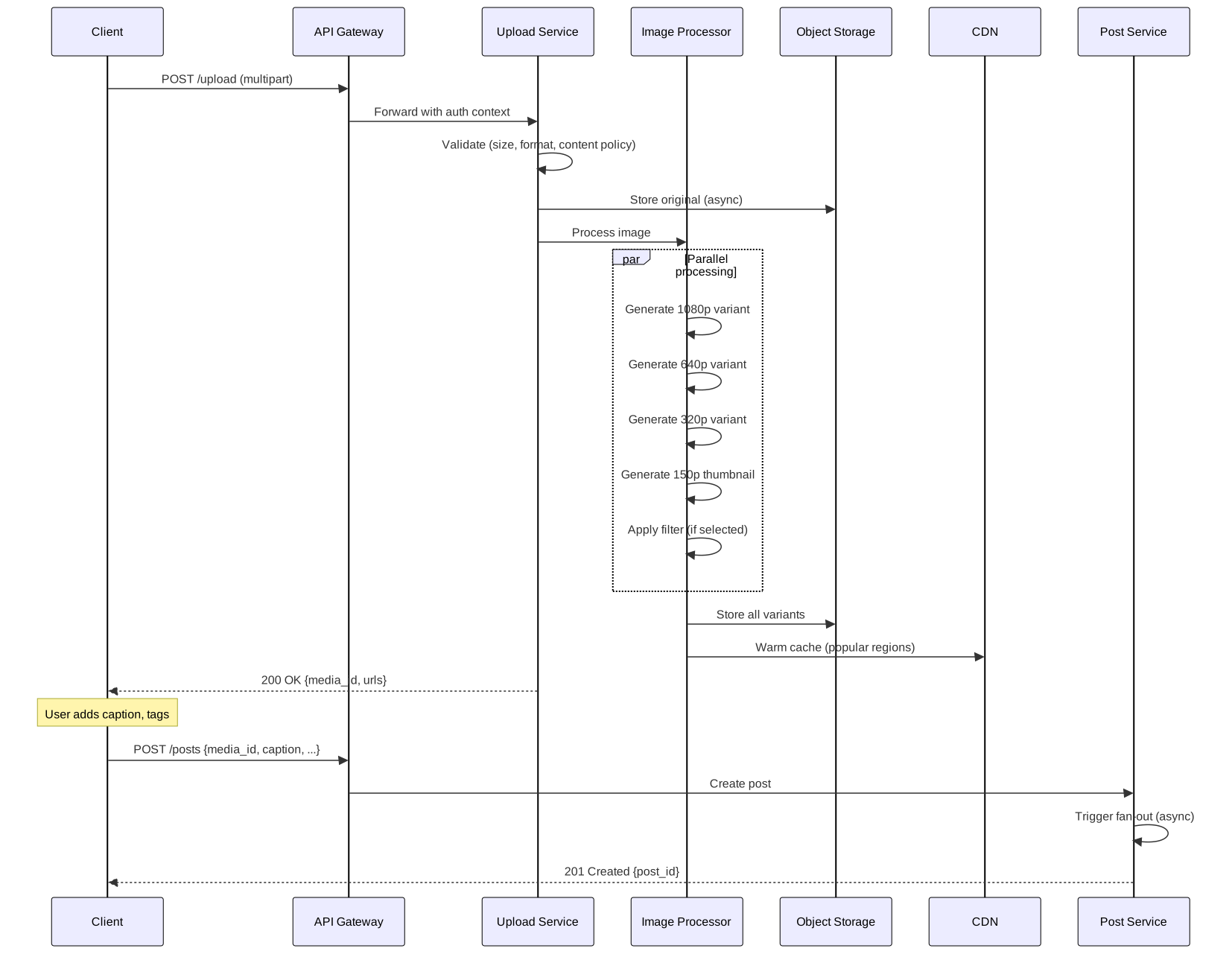
Image Processing Pipeline
Input validation:
- Maximum file size: 30MB (client-side compression typically yields 2-5MB)
- Supported formats: JPEG, PNG, HEIC (converted to JPEG)
- Minimum resolution: 320px (smaller images upscaled)
- Maximum resolution: 1080px width (larger images downscaled)
Resolution variants generated:
| Variant | Dimensions | Use Case |
|---|---|---|
| Original | Up to 1080px | Full-screen view |
| Large | 1080 × 1080 | Feed (high-DPI devices) |
| Medium | 640 × 640 | Feed (standard devices) |
| Small | 320 × 320 | Grid view, thumbnails |
| Thumbnail | 150 × 150 | Notifications, search results |
Filter processing:
Instagram applies filters using GPU shaders (GPUImage framework on mobile, server-side for web uploads).
Filter = Color LUT + Adjustments + Blending- LUT (Look-Up Table): 3D color mapping- Adjustments: Brightness, contrast, saturation, warmth- Blending: Vignette, frame overlaysProcessing time budget:
| Operation | Target | Notes |
|---|---|---|
| Upload to storage | < 2s | Depends on connection |
| Generate variants | < 3s | Parallel processing |
| Filter application | < 1s | GPU-accelerated |
| CDN propagation | < 5s | Edge cache warming |
| Total | < 10s | User-perceived upload time |
Storage Strategy
Object storage layout:
s3://instagram-media/ /{user_id}/ /{media_id}/ original.jpg # Raw upload 1080.jpg # Full resolution 640.jpg # Medium 320.jpg # Small 150.jpg # Thumbnail metadata.json # EXIF, dimensions, filter appliedCDN caching rules:
| Content Type | Cache Duration | Cache Key |
|---|---|---|
| Original | 1 year | {media_id}/original |
| Variants | 1 year | {media_id}/{size} |
| Profile pictures | 1 hour | {user_id}/profile |
| Stories media | 24 hours | {story_id}/media |
Storage tiering (power-law optimization):
Hot tier (SSD): Last 7 days of uploads, frequently accessedWarm tier (HDD): 7 days - 1 year, moderate accessCold tier (archive): > 1 year, rare access
Migration policy:- Content accessed > 10x/day stays hot- Content accessed < 1x/week moves to warm- Content not accessed in 90 days moves to coldFeed Generation Service
Hybrid Fan-out Implementation

Timeline Cache Structure
Redis data model:
# Timeline cache (sorted set by timestamp)ZADD timeline:{user_id} {timestamp} {post_id}
# Keep last 800 posts per timelineZREMRANGEBYRANK timeline:{user_id} 0 -801
# Post metadata cache (hash)HSET post:{post_id}  author_id "{user_id}"  media_url "{cdn_url}"  caption "{text}"  like_count {count}  created_at {timestamp}
# Celebrity posts (separate sorted set per celebrity)ZADD celebrity:{user_id}:posts {timestamp} {post_id}
Timeline composition at read:
def get_feed(user_id, cursor=None, limit=20): # 1. Get cached timeline posts cached_posts = redis.zrevrange( f"timeline:{user_id}", start=cursor or 0, end=(cursor or 0) + limit * 2 # Fetch extra for ranking )
# 2. Get followed celebrities celebrities = get_followed_celebrities(user_id)
# 3. Fetch recent celebrity posts (last 24h) celebrity_posts = [] for celeb_id in celebrities: posts = redis.zrevrangebyscore( f"celebrity:{celeb_id}:posts", max=now(), min=now() - 86400, # 24 hours limit=5 ) celebrity_posts.extend(posts)
# 4. Merge and rank all_posts = cached_posts + celebrity_posts ranked_posts = ranking_service.rank(user_id, all_posts)
return ranked_posts[:limit]Feed Ranking
Instagram’s ranking system uses deep neural networks with 100K+ features.
Signal categories:
| Category | Signals | Weight (approx) |
|---|---|---|
| Relationship | DM history, profile visits, comments, tags | High |
| Interest | Content type engagement, hashtag affinity | High |
| Timeliness | Post age, time since last seen | Medium |
| Popularity | Like velocity, comment rate, share count | Medium |
| Creator | Posting frequency, content quality score | Low |
Ranking model architecture:
Input: User embeddings + Post embeddings + Context features ↓Feature extraction (100K+ dense features) ↓Multi-task neural network ↓Outputs: - P(like) - P(comment) - P(save) - P(share) - P(time_spent > 10s) ↓Weighted combination → Final scoreModel training:
- Trained on billions of engagement events
- Fine-tuned hourly with recent interactions
- A/B tested continuously (10+ experiments running at any time)
Consistency and Pagination
Consistency model:
| Operation | Consistency | Rationale |
|---|---|---|
| Own post visibility | Strong (immediate) | User expects to see own post |
| Follower timeline update | Eventual (< 30s) | Acceptable delay for feed freshness |
| Like/comment counts | Eventual (< 5s) | Tolerable for social proof |
| Unfollow propagation | Strong (immediate) | Privacy expectation |
Cursor-based pagination:
// RequestGET /feed?cursor=eyJ0cyI6MTY0...&limit=20
// Response{ "posts": [...], "next_cursor": "eyJ0cyI6MTY0...", "has_more": true}
// Cursor structure (base64-encoded){ "ts": 1640000000, // Timestamp of last item "pid": "abc123", // Post ID (for tie-breaking) "v": 2 // Cursor version (for migrations)}Why cursor-based (not offset-based):
- Timeline changes between requests (new posts arrive)
- Offset pagination causes duplicates or missed posts
- Cursor is stable: “posts older than X” always returns consistent results
Stories Service
Architecture
Stories have fundamentally different requirements than feed posts:
| Property | Posts | Stories |
|---|---|---|
| Lifetime | Permanent | 24 hours |
| Load time target | < 500ms | < 200ms |
| Caching strategy | CDN + Redis | Aggressive prefetch |
| Ranking | Complex ML | Recency + engagement |

Story Ring Ordering
The “Stories ring” (horizontal tray at top) orders accounts by engagement signals:
Ordering factors:
- Accounts with unseen stories (always first)
- DM interaction frequency
- Profile visit frequency
- Comment/like history
- Story view history (accounts you consistently view)
Data model:
# Story metadata (expires with TTL)SETEX story:{story_id} 86400 '{  "author_id": "123",  "media_url": "https://...",  "created_at": 1640000000,  "viewers": [],  "reply_enabled": true}'
# User's active stories (sorted set, auto-cleanup)ZADD user:{user_id}:stories {created_at} {story_id}ZREMRANGEBYSCORE user:{user_id}:stories -inf {now - 86400}
# Story ring ordering per viewerZADD user:{viewer_id}:story_ring {engagement_score} {author_id}
Prefetch Strategy
Client-side behavior:
On app open:1. Fetch story ring ordering (lightweight API call)2. Prefetch first 3 story authors' media (background)3. As user views stories, prefetch next 2 authors ahead
On story view:1. Preload all segments of current story2. Preload first segment of next story3. Mark current story as viewed (async)Why aggressive prefetch:
- Stories UX is tap-tap-tap: any loading spinner breaks flow
- Media is small (compressed images/short videos)
- Users view multiple stories in sequence: sequential access pattern
TTL and Expiration
Server-side:
- Redis keys set with 24-hour TTL
- Background job cleans up S3 media at TTL+1 hour (grace period for in-flight views)
Client-side:
- Local cache respiration synced with server TTL
- Client computes
ttl_remaining = story.created_at + 86400 - now() - Evict from local cache when TTL expires
Direct Messages Service
Architecture
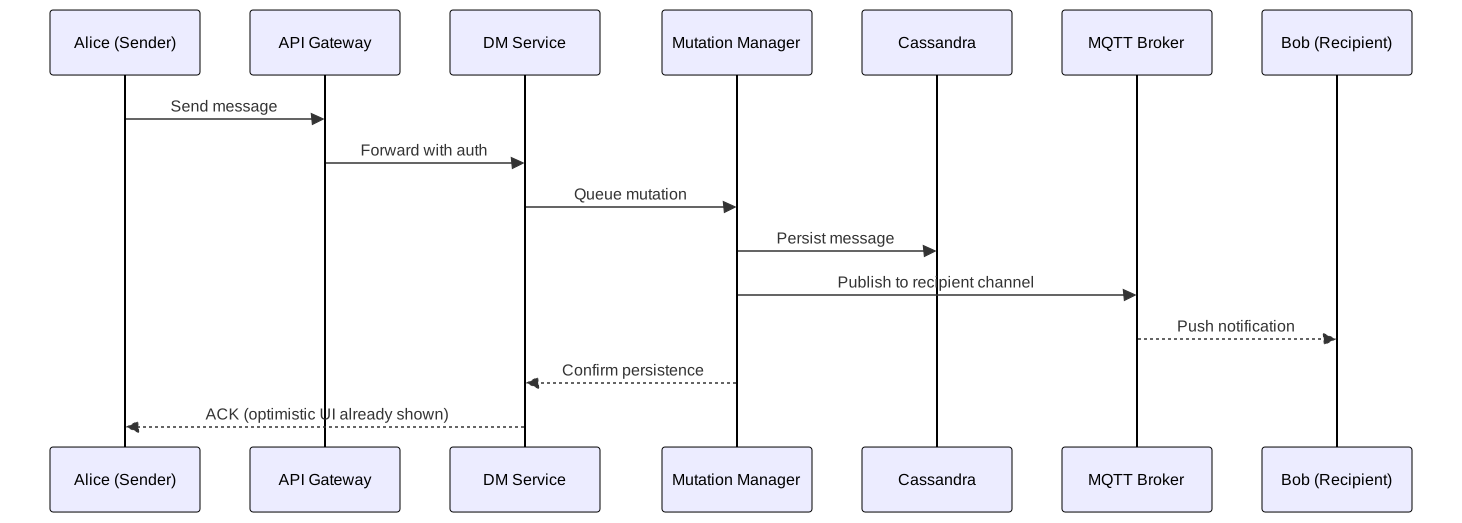
Instagram DMs handle real-time messaging with E2E encryption support.
MQTT for Real-time
Instagram chose MQTT over WebSockets for mobile optimization:
| Property | MQTT | WebSocket |
|---|---|---|
| Protocol overhead | 2 bytes minimum | 2-14 bytes |
| Power consumption | 6-8% lower | Higher (keep-alive) |
| Reconnection | Built-in session resumption | Manual implementation |
| QoS levels | At-most-once, at-least-once, exactly-once | Manual |
MQTT topic structure:
# User's DM inbox (subscribe on connect)/u/{user_id}/inbox
# Thread-specific updates/t/{thread_id}/messages
# Typing indicators/t/{thread_id}/typingDirect’s Mutation Manager (DMM)
Instagram’s engineering team built a dedicated mutation manager for DMs to handle:
- Optimistic UI: Show sent message immediately, reconcile with server response
- Offline support: Queue messages when offline, sync when reconnected
- Ordering guarantees: Preserve message order even with network jitter
- Retry logic: Automatic retry with exponential backoff
Client-side queue:
interface QueuedMessage { localId: string // Client-generated UUID threadId: string content: string timestamp: number status: "pending" | "sent" | "failed" retryCount: number}
// Persisted to IndexedDB/SQLite// Survives app restartsCassandra Data Model
DMs use Cassandra for high write throughput and partition-local queries.
-- Thread metadataCREATE TABLE threads ( thread_id UUID PRIMARY KEY, participant_ids SET<UUID>, created_at TIMESTAMP, last_message_at TIMESTAMP, last_message_preview TEXT);
-- Messages partitioned by threadCREATE TABLE messages ( thread_id UUID, message_id TIMEUUID, sender_id UUID, content TEXT, media_url TEXT, created_at TIMESTAMP, PRIMARY KEY (thread_id, message_id)) WITH CLUSTERING ORDER BY (message_id DESC);
-- User's inbox (materialized view for fast inbox loading)CREATE TABLE user_inbox ( user_id UUID, thread_id UUID, last_message_at TIMESTAMP, unread_count INT, PRIMARY KEY (user_id, last_message_at)) WITH CLUSTERING ORDER BY (last_message_at DESC);Explore and Recommendations
System Scale
Instagram’s Explore recommendation system:
- Serves hundreds of millions of daily visitors
- Chooses from billions of content options in real-time
- Runs 1,000+ ML models simultaneously
Three-Stage Recommendation Pipeline

Two Towers Model (Retrieval)
Architecture:
User Tower: Item Tower:[User features] [Item features] ↓ ↓ Dense layers Dense layers ↓ ↓User embedding (128d) Item embedding (128d) ↓ ↓ └────── Dot product ──────────┘ ↓ Similarity scoreUser features:
- Account-level embeddings (topical interests)
- Recent engagement history
- Social graph signals
- Demographic signals (age bucket, region)
Item features:
- Content embeddings (visual + text)
- Creator features
- Engagement statistics
- Content category
Multi-Task Ranking
The late-stage ranker predicts multiple objectives simultaneously:
Outputs:- P(like) weight: 1.0- P(comment) weight: 2.0 (higher engagement)- P(save) weight: 3.0 (strong intent signal)- P(share) weight: 3.0- P(follow) weight: 5.0 (acquisition metric)- P(hide) weight: -10.0 (negative signal)
Final score = Σ(weight × probability)Model Training
Continual learning:
- Models fine-tuned hourly with new engagement data
- Base model retrained weekly with full dataset
- Feature store updated in real-time
Scale:
- 1,000+ models running in production
- Custom ML infrastructure (PyTorch-based)
- GPU clusters for inference at <100ms p99
API Design
Photo Upload
POST /api/v1/media/uploadContent-Type: multipart/form-data
Request:- file: <binary>- media_type: "image" | "video"- filter_id: "clarendon" | "gingham" | ... (optional)
Response (200 OK):{ "media_id": "abc123", "urls": { "1080": "https://cdn.instagram.com/abc123/1080.jpg", "640": "https://cdn.instagram.com/abc123/640.jpg", "320": "https://cdn.instagram.com/abc123/320.jpg", "150": "https://cdn.instagram.com/abc123/150.jpg" }, "expires_at": "2024-01-02T00:00:00Z" // Media must be posted within 24h}Create Post
POST /api/v1/posts
Request:{ "media_ids": ["abc123", "def456"], // Up to 10 for carousel "caption": "Summer vibes 🌴", "location_id": "loc_789", // Optional "tagged_users": ["user_111"], // Optional "alt_text": "Beach sunset" // Accessibility}
Response (201 Created):{ "post_id": "post_xyz", "permalink": "https://instagram.com/p/xyz", "created_at": "2024-01-01T12:00:00Z"}
Errors:- 400: Invalid media_id (expired or not found)- 400: Caption too long (> 2200 characters)- 403: Tagged user has blocked you- 429: Rate limited (> 25 posts/day)Feed
GET /api/v1/feed?cursor={cursor}&limit=20
Response (200 OK):{ "posts": [ { "post_id": "post_xyz", "author": { "user_id": "user_123", "username": "photographer", "profile_pic_url": "https://...", "is_verified": true }, "media": [ { "type": "image", "url": "https://cdn.instagram.com/...", "width": 1080, "height": 1080, "alt_text": "Beach sunset" } ], "caption": "Summer vibes 🌴", "like_count": 1234, "comment_count": 56, "created_at": "2024-01-01T12:00:00Z", "viewer_has_liked": false, "viewer_has_saved": false } ], "next_cursor": "eyJ0cyI6MTY0...", "has_more": true}Stories
GET /api/v1/stories/feed
Response (200 OK):{ "story_ring": [ { "user_id": "user_123", "username": "friend1", "profile_pic_url": "https://...", "has_unseen": true, "latest_story_ts": "2024-01-01T11:00:00Z" } ], "stories": { "user_123": [ { "story_id": "story_abc", "media_url": "https://...", "media_type": "image", "created_at": "2024-01-01T11:00:00Z", "expires_at": "2024-01-02T11:00:00Z", "seen": false, "reply_enabled": true } ] }}Direct Messages
POST /api/v1/direct/threads/{thread_id}/messages
Request:{ "text": "Hey, nice photo!", "reply_to_story_id": "story_abc" // Optional}
Response (201 Created):{ "message_id": "msg_xyz", "thread_id": "thread_123", "created_at": "2024-01-01T12:00:00Z", "status": "sent"}Data Modeling
PostgreSQL Schema (Core Entities)
-- UsersCREATE TABLE users ( id BIGINT PRIMARY KEY, username VARCHAR(30) UNIQUE NOT NULL, email VARCHAR(255) UNIQUE, phone VARCHAR(20) UNIQUE, full_name VARCHAR(100), bio TEXT, profile_pic_url TEXT, is_private BOOLEAN DEFAULT false, is_verified BOOLEAN DEFAULT false, follower_count INT DEFAULT 0, following_count INT DEFAULT 0, post_count INT DEFAULT 0, created_at TIMESTAMPTZ DEFAULT NOW(), updated_at TIMESTAMPTZ DEFAULT NOW());
CREATE INDEX idx_users_username ON users(username);
-- PostsCREATE TABLE posts ( id BIGINT PRIMARY KEY, author_id BIGINT NOT NULL REFERENCES users(id), caption TEXT, location_id BIGINT REFERENCES locations(id), like_count INT DEFAULT 0, comment_count INT DEFAULT 0, is_archived BOOLEAN DEFAULT false, created_at TIMESTAMPTZ DEFAULT NOW(), deleted_at TIMESTAMPTZ);
CREATE INDEX idx_posts_author ON posts(author_id, created_at DESC);
-- Post Media (supports carousel)CREATE TABLE post_media ( id BIGINT PRIMARY KEY, post_id BIGINT NOT NULL REFERENCES posts(id), media_type VARCHAR(10) NOT NULL, -- 'image', 'video' url TEXT NOT NULL, width INT, height INT, alt_text TEXT, position SMALLINT DEFAULT 0, created_at TIMESTAMPTZ DEFAULT NOW());
CREATE INDEX idx_post_media_post ON post_media(post_id);
-- CommentsCREATE TABLE comments ( id BIGINT PRIMARY KEY, post_id BIGINT NOT NULL REFERENCES posts(id), author_id BIGINT NOT NULL REFERENCES users(id), parent_id BIGINT REFERENCES comments(id), -- For replies content TEXT NOT NULL, like_count INT DEFAULT 0, created_at TIMESTAMPTZ DEFAULT NOW(), deleted_at TIMESTAMPTZ);
CREATE INDEX idx_comments_post ON comments(post_id, created_at DESC);
-- Likes (polymorphic)CREATE TABLE likes ( id BIGINT PRIMARY KEY, user_id BIGINT NOT NULL REFERENCES users(id), target_type VARCHAR(10) NOT NULL, -- 'post', 'comment', 'story' target_id BIGINT NOT NULL, created_at TIMESTAMPTZ DEFAULT NOW(), UNIQUE(user_id, target_type, target_id));
CREATE INDEX idx_likes_target ON likes(target_type, target_id);Cassandra Schema (Social Graph)
-- Follows (partitioned by follower for "who do I follow" queries)CREATE TABLE follows ( follower_id UUID, following_id UUID, created_at TIMESTAMP, PRIMARY KEY (follower_id, following_id));
-- Followers (partitioned by following for "who follows me" queries)CREATE TABLE followers ( following_id UUID, follower_id UUID, created_at TIMESTAMP, PRIMARY KEY (following_id, follower_id));
-- Activity feed (for "activity" tab)CREATE TABLE activity ( user_id UUID, activity_id TIMEUUID, actor_id UUID, activity_type TEXT, -- 'like', 'comment', 'follow', 'mention' target_type TEXT, target_id UUID, created_at TIMESTAMP, PRIMARY KEY (user_id, activity_id)) WITH CLUSTERING ORDER BY (activity_id DESC);ID Generation (Instagram’s Approach)
Instagram’s famous sharding and ID generation system:
-- PL/pgSQL function for globally unique, time-sorted IDsCREATE OR REPLACE FUNCTION instagram_id() RETURNS BIGINT AS $$DECLARE epoch BIGINT := 1314220021721; -- Custom epoch (Sep 2011) seq_id BIGINT; now_millis BIGINT; shard_id INT := 1; -- Set per logical shard result BIGINT;BEGIN SELECT nextval('instagram_id_seq') % 1024 INTO seq_id; SELECT FLOOR(EXTRACT(EPOCH FROM NOW()) * 1000) INTO now_millis;
result := (now_millis - epoch) << 23; -- 41 bits for timestamp result := result | (shard_id << 10); -- 13 bits for shard result := result | (seq_id); -- 10 bits for sequence
RETURN result;END;$$ LANGUAGE PLPGSQL;ID structure (64 bits):
| Bits | Purpose | Range |
|---|---|---|
| 41 | Milliseconds since epoch | ~69 years |
| 13 | Shard ID | 8,192 shards |
| 10 | Sequence | 1,024 IDs/ms/shard |
Why this matters:
- IDs are time-sorted: no separate timestamp index needed
- IDs encode shard: routing without lookup
- IDs are unique across shards: no coordination needed
Infrastructure
Cloud-Agnostic Concepts
| Component | Purpose | Requirements |
|---|---|---|
| Object Storage | Media files | High durability, CDN integration |
| Relational DB | Users, posts, metadata | ACID, sharding support |
| Wide-column DB | Social graph, activity | High write throughput, partition-local queries |
| Cache | Timeline, hot data | Sub-ms latency, cluster support |
| Message Queue | Async processing | At-least-once delivery, partitioning |
| Search Index | Discovery | Full-text, faceted search |
| CDN | Media delivery | Global PoPs, cache efficiency |
| Push Gateway | Real-time notifications | MQTT/WebSocket support |
AWS Reference Architecture
| Component | Service | Configuration |
|---|---|---|
| API Gateway | ALB + API Gateway | Auto-scaling, WAF protection |
| Compute | EKS (Kubernetes) | Spot instances for workers |
| Primary DB | RDS PostgreSQL | Multi-AZ, read replicas |
| Social Graph | Amazon Keyspaces or self-managed Cassandra | Multi-region |
| Cache | ElastiCache Redis Cluster | Cluster mode, 6+ nodes |
| Object Storage | S3 + CloudFront | Intelligent tiering |
| Message Queue | Amazon MSK (Kafka) or SQS | For fan-out workers |
| Search | OpenSearch Service | 3+ data nodes |
| Push | Amazon MQ (MQTT) or IoT Core | Managed MQTT broker |
Multi-Region Deployment

Instagram’s Migration (AWS → Facebook)
Instagram migrated from AWS to Facebook’s data centers in 2014:
Before (AWS):
- 12 PostgreSQL instances (Quadruple Extra-Large memory)
- 12 read replicas
- 6 Memcached instances
- S3 for media storage
After (Facebook infrastructure):
- 1 Facebook server ≈ 3 Amazon servers (efficiency)
- Shared infrastructure with Facebook
- Private fiber network between data centers
- No service disruption during migration (8 engineers, ~1 year)
Frontend Considerations
Feed Virtualization
Instagram’s feed is an infinite scroll of variable-height items:
// Virtualized list configurationconst FeedList = () => { return ( <VirtualizedList data={posts} renderItem={({ item }) => <PostCard post={item} />} estimatedItemSize={600} // Average post height overscanCount={3} // Render 3 items above/below viewport onEndReached={loadMore} onEndReachedThreshold={0.5} /> );};Why virtualization:
- Feed can have 1000+ posts
- Each post has heavy media (images/video)
- Without virtualization: memory explosion, jank
Image Loading Strategy
// Progressive image loadingconst PostImage = ({ post }) => { const [loaded, setLoaded] = useState(false);
return ( <div className="post-image"> {/* Blur placeholder (tiny, inline) */} <img src={post.thumbnail_blur} // 10x10 base64 className={loaded ? 'hidden' : 'blur'} />
{/* Full image (lazy loaded) */} <img src={post.media_url} loading="lazy" onLoad={() => setLoaded(true)} className={loaded ? 'visible' : 'hidden'} /> </div> );};Stories Ring Interaction
// Horizontal scroll with snap pointsconst StoriesRing = ({ stories }) => { return ( <div className="stories-ring" style={{ display: 'flex', overflowX: 'scroll', scrollSnapType: 'x mandatory', WebkitOverflowScrolling: 'touch' // Smooth iOS scroll }}> {stories.map(story => ( <div key={story.id} style={{ scrollSnapAlign: 'start' }} > <StoryAvatar story={story} /> </div> ))} </div> );};Optimistic Updates
// Like button with optimistic UIconst LikeButton = ({ post }) => { const [optimisticLiked, setOptimisticLiked] = useState(post.viewer_has_liked); const [optimisticCount, setOptimisticCount] = useState(post.like_count);
const handleLike = async () => { // Optimistic update (immediate feedback) setOptimisticLiked(!optimisticLiked); setOptimisticCount(prev => optimisticLiked ? prev - 1 : prev + 1);
try { await api.toggleLike(post.id); } catch (error) { // Rollback on failure setOptimisticLiked(post.viewer_has_liked); setOptimisticCount(post.like_count); showError('Failed to like post'); } };
return ( <button onClick={handleLike}> <HeartIcon filled={optimisticLiked} /> <span>{formatCount(optimisticCount)}</span> </button> );};Conclusion
Instagram’s architecture demonstrates several key principles for building photo-sharing platforms at scale:
Architectural decisions:
-
Hybrid fan-out bounds write amplification while maintaining sub-second feed loads. The 10K follower threshold is tuned based on write cost analysis.
-
Separate storage strategies for ephemeral (Stories) vs. persistent (Posts) content optimize for their different access patterns and lifetime requirements.
-
Three-stage recommendation pipeline (retrieval → early ranking → late ranking) enables personalization across billions of content items with <100ms latency.
-
MQTT for real-time provides significant power and bandwidth savings over HTTP polling, critical for mobile-first platforms.
Optimizations this design achieves:
- Feed load: p99 < 500ms through cached timelines + celebrity merge
- Stories load: p99 < 200ms through aggressive prefetch
- Upload processing: < 10s for immediate user feedback
- Global delivery: 95%+ CDN cache hit rate exploiting power-law distribution
Known limitations:
- Hybrid fan-out requires maintaining two code paths
- Celebrity threshold (10K) is a tunable but imperfect heuristic
- Ranking model hourly retraining introduces slight staleness
- Multi-region eventual consistency means brief windows of inconsistency
Alternative approaches not chosen:
- Pure push (write amplification at celebrity scale)
- Pure pull (read latency unacceptable)
- Single-region (latency for global users)
Appendix
Prerequisites
- Distributed systems fundamentals (CAP theorem, eventual consistency)
- Database concepts (sharding, replication, indexing)
- Caching strategies (write-through, write-behind, cache invalidation)
- CDN and content delivery concepts
- Basic ML concepts (embeddings, neural networks)
Summary
- Hybrid fan-out (push for <10K followers, pull for celebrities) bounds write amplification while keeping reads fast
- Image processing pipeline generates 6+ variants synchronously; filters use GPU shaders
- Stories architecture uses 24-hour TTL with aggressive prefetch for <200ms load times
- Feed ranking uses 100K+ features with neural networks; models fine-tuned hourly
- Explore recommendation runs 1000+ ML models; Two Towers for retrieval, multi-task ranking for final selection
- MQTT powers real-time features (DMs, notifications) with 6-8% less power than HTTP
References
- Sharding & IDs at Instagram - Original ID generation design
- What Powers Instagram - Early architecture overview
- Migrating from AWS to Facebook - Infrastructure migration case study
- Making Direct Messages Reliable and Fast - DM architecture details
- Scaling Instagram’s Explore Recommendations - Recommendation system architecture
- Journey to 1000 Models - ML infrastructure at scale
- Instagram Video Processing and Encoding Reduction - Video pipeline optimization
- Introducing mcrouter - Caching infrastructure
- Powered by AI: Instagram’s Explore Recommender System - Two Towers model details