Design a Distributed Key-Value Store
A distributed key-value store provides simple get/put semantics while handling the complexities of partitioning, replication, and failure recovery across a cluster of machines. This design explores the architectural decisions behind systems like Amazon Dynamo, Apache Cassandra, and Riak—AP systems that prioritize availability and partition tolerance over strong consistency. We also contrast with CP alternatives like etcd for scenarios requiring linearizability.

Abstract
A distributed key-value store is fundamentally about choosing where to sit on the CAP spectrum and then implementing the mechanisms to deliver that choice consistently:
- AP systems (Dynamo, Cassandra, Riak): Accept eventual consistency in exchange for always-on availability. Use leaderless replication, sloppy quorums, and conflict resolution (vector clocks or LWW).
- CP systems (etcd, Consul, ZooKeeper): Sacrifice availability during partitions to guarantee linearizability. Use leader-based consensus (Raft/Paxos).
The core mechanisms are:
- Consistent hashing with virtual nodes distributes data and enables incremental scaling (only k/n keys move when adding a node)
- Quorum replication (R + W > N) provides tunable consistency-availability tradeoffs
- Vector clocks or LWW timestamps detect and resolve concurrent writes
- Gossip protocols propagate cluster membership and failure detection
- LSM-tree storage optimizes for write-heavy workloads with background compaction
Requirements
Functional Requirements
| Requirement | Priority | Notes |
|---|---|---|
put(key, value) | Core | Store a value, return success/version |
get(key) | Core | Retrieve value(s), handle conflicts |
delete(key) | Core | Tombstone-based deletion |
| Range queries | Extended | Only if ordered storage (not covered in AP designs) |
| TTL expiration | Extended | Automatic key expiry |
| Transactions | Out of scope | Requires coordination, changes CAP position |
Non-Functional Requirements
| Requirement | Target | Rationale |
|---|---|---|
| Availability | 99.99% | Writes must succeed even during failures |
| Write latency | p99 < 10ms | Local disk + async replication |
| Read latency | p99 < 5ms | Cache hits, single disk seek |
| Throughput | 100K+ ops/sec per node | LSM-tree optimized for writes |
| Durability | No acknowledged write lost | WAL before acknowledgment |
| Consistency | Tunable (eventual to strong) | Application chooses per-operation |
Scale Estimation
Cluster sizing example for 10TB dataset:
Data size: 10 TBReplication factor: 3Total storage needed: 30 TB
Per-node capacity: 2 TB (leaving headroom for compaction)Nodes required: 30 TB / 2 TB = 15 nodes
Traffic assumptions:- 80% reads, 20% writes- Average value size: 1 KB- Target: 100K ops/sec total
Per-node throughput: 100K / 15 ≈ 6,700 ops/sec- Reads: 5,400 ops/sec- Writes: 1,300 ops/secDesign Paths
Path A: AP with Leaderless Replication (Dynamo Model)
Best when:
- Availability is paramount (e-commerce carts, session stores)
- Application can handle conflict resolution
- Writes must succeed even during network partitions
Architecture:
- All nodes are peers—no leader election
- Any node can coordinate any request
- Replication is synchronous to quorum, async to remaining replicas
- Conflicts detected via vector clocks or resolved via LWW
Trade-offs:
- Writes always succeed (to any available quorum)
- No single point of failure
- Application must handle conflicting versions
- Weaker consistency guarantees
Real-world examples: Amazon Dynamo (shopping cart), Riak, Cassandra (with eventual consistency)
Path B: CP with Leader-Based Consensus (Raft/Paxos)
Best when:
- Strong consistency required (configuration stores, coordination)
- Reads must return the latest write
- Can tolerate unavailability during leader election
Architecture:
- Single leader handles all writes
- Raft/Paxos ensures log replication before acknowledgment
- Leader election on failure (typically 1-10 seconds)
Trade-offs:
- Linearizable reads and writes
- Unavailable during leader election
- Write throughput limited by leader
- Simpler conflict model (no concurrent writes)
Real-world examples: etcd (Kubernetes), Consul, ZooKeeper
Path Comparison
| Factor | AP (Dynamo) | CP (Raft) |
|---|---|---|
| Write availability | Always (to quorum) | Unavailable during election |
| Read consistency | Eventual or quorum | Linearizable |
| Conflict handling | Vector clocks/LWW | None (single writer) |
| Latency | Lower (no consensus) | Higher (consensus round-trip) |
| Throughput | Higher (any node writes) | Lower (leader bottleneck) |
| Cluster size | 100s-1000s nodes | 3-7 nodes typical |
| Use case | User data, caches | Config, coordination, locks |
This Article’s Focus
This article focuses on Path A (AP/Dynamo model) because:
- Most key-value workloads prioritize availability over strong consistency
- The techniques (consistent hashing, vector clocks, gossip) are more complex and worth detailed examination
- CP systems (etcd, Consul) have well-documented Raft implementations
For CP key-value store design, see etcd’s architecture documentation and the Raft paper.
High-Level Design
Component Overview

Request Flow
Write path:
- Client SDK hashes key, identifies coordinator node
- Coordinator determines N replica nodes from preference list
- Coordinator sends write to all N replicas in parallel
- Each replica: writes to WAL → updates memtable → acknowledges
- Coordinator waits for W acknowledgments
- Returns success to client (remaining replicas receive async)
Read path:
- Client SDK hashes key, contacts coordinator
- Coordinator sends read to all N replicas in parallel
- Coordinator waits for R responses
- If versions conflict: return all versions (or resolve via LWW)
- Trigger read repair if replicas diverged
Data Partitioning
Consistent Hashing
Consistent hashing maps both keys and nodes to positions on a hash ring (typically 0 to 2^128-1 using MD5 or 2^64-1 using xxHash). A key is stored on the first N nodes clockwise from its hash position.
Why consistent hashing?
When nodes join or leave, only k/n keys need to move (k = total keys, n = nodes). With naive modulo hashing, nearly all keys would remap.
Traditional: hash(key) % num_nodes → Node changes cause ~100% key movementConsistent: next_node(hash(key)) → Node changes cause ~1/n key movementVirtual Nodes (vnodes)
Physical nodes own multiple positions on the ring. Each position is a “virtual node” responsible for a range of the hash space.
Design rationale:
- Load balancing: A single physical node token can create hotspots if keys cluster. Virtual nodes spread load.
- Heterogeneous hardware: Assign more vnodes to powerful machines.
- Faster recovery: When a node fails, its vnodes are distributed across many physical nodes, enabling parallel recovery.
Configuration trade-offs:
| vnodes per node | Pros | Cons |
|---|---|---|
| 1 (legacy) | Fewer ring neighbors, simpler | Uneven distribution, slow rebalancing |
| 16 (modern default) | Good balance, deterministic allocation | Moderate neighbor count |
| 256 (legacy Cassandra) | Fine-grained distribution | High memory overhead, slow streaming |
Cassandra 3.x+ defaults to 16 vnodes with deterministic token allocation, down from 256 random tokens in earlier versions. The reduction improves repair and streaming performance while maintaining adequate distribution.
Replication Strategy
Keys are replicated to N consecutive nodes on the ring (the “preference list”). With virtual nodes, consecutive ring positions may map to the same physical node, so the preference list skips to ensure N distinct physical nodes.
Replication factor selection:
| RF | Fault tolerance | Storage overhead | Typical use |
|---|---|---|---|
| 1 | None | 1x | Caches, ephemeral data |
| 3 | 1 node failure | 3x | Standard production |
| 5 | 2 node failures | 5x | Critical data, cross-DC |
Multi-datacenter replication:
Cassandra’s NetworkTopologyStrategy places replicas across racks and datacenters:
Replication settings: dc1: 3 replicas (across 3 racks) dc2: 3 replicas (across 3 racks)
Total replicas: 6Rack-aware placement prevents correlated failuresQuorum Reads and Writes
Quorum Formula
For a replication factor N, if R (read replicas) + W (write replicas) > N, reads will see the latest write:
R + W > N → Overlap guarantees at least one replica has latest write
Example with N=3:- R=2, W=2: Standard quorum (R+W=4 > 3)- R=1, W=3: Write-heavy (all replicas must ack writes)- R=3, W=1: Read-heavy (fast writes, consistent reads)Why this works: With W=2 and R=2 on N=3 replicas, a write reaches at least 2 nodes. A subsequent read contacts at least 2 nodes. Since 2+2 > 3, at least one node in the read set participated in the write.
Consistency Levels (Cassandra Model)
| Level | Nodes contacted | Use case |
|---|---|---|
| ONE | 1 | Lowest latency, highest availability |
| QUORUM | ⌊N/2⌋ + 1 | Standard consistency |
| LOCAL_QUORUM | ⌊local_N/2⌋ + 1 | Cross-DC deployments |
| ALL | N | Strongest consistency, lowest availability |
Operational guidance:
- Use QUORUM for most operations
- Use LOCAL_QUORUM for latency-sensitive cross-DC reads
- Avoid ALL in production (single node failure blocks operations)
- ONE is acceptable for time-series data where some loss is tolerable
Sloppy Quorum and Hinted Handoff
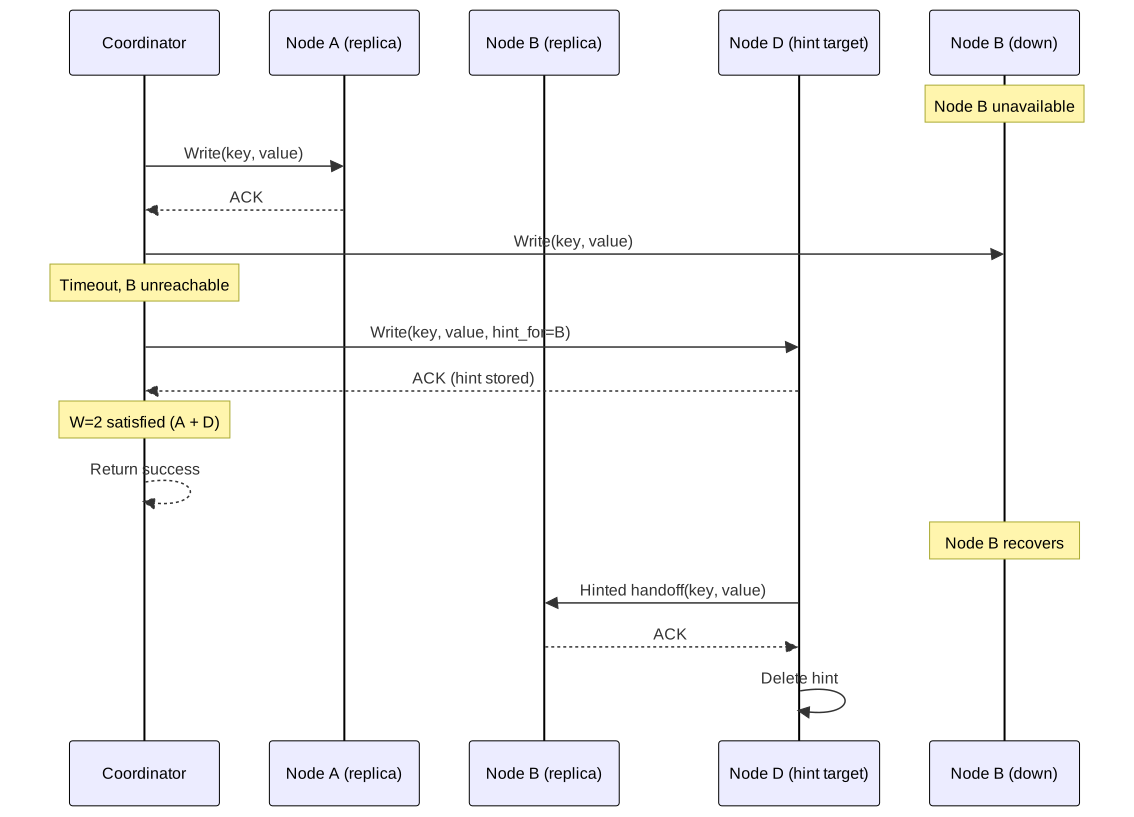
Problem: Strict quorum requires specific replica nodes. If one is down, writes fail.
Sloppy quorum solution: Write to any N healthy nodes from an extended preference list. If the designated replica is down, write to the next available node with a “hint” to forward later.
Hint storage limits:
Cassandra defaults to 3 hours (max_hint_window_in_ms). Hints older than this are discarded, requiring full repair to restore consistency. This prevents unbounded hint growth during extended outages.
Trade-off: Sloppy quorum improves availability but temporarily violates the quorum guarantee. During the hint window, reads may miss recent writes if they don’t contact the hint-holding node.
Conflict Detection and Resolution
The Concurrent Write Problem
Without a single leader, two clients can write to the same key simultaneously via different coordinators. Both writes may succeed (each reaching W replicas), but replicas now have different values.
Vector Clocks
Vector clocks track causal relationships between versions. Each write increments a (node, counter) pair.
Initial state: {} (empty)
Client A writes via Node1: [(Node1, 1)]Client B reads [(Node1, 1)], writes via Node2: [(Node1, 1), (Node2, 1)]Client C reads [(Node1, 1)], writes via Node3: [(Node1, 1), (Node3, 1)]
Now we have concurrent versions: V1: [(Node1, 1), (Node2, 1)] - Client B's write V2: [(Node1, 1), (Node3, 1)] - Client C's write
Neither dominates the other → CONFLICTDetecting relationships:
- V1 dominates V2: Every (node, counter) in V2 is ≤ the corresponding entry in V1
- Concurrent: Neither dominates → conflict, return both versions
Resolution strategies:
- Application-level: Return both versions to client, let application merge (Amazon shopping cart: union of items)
- Last-Write-Wins (LWW): Use wall-clock timestamps, discard older version
- CRDTs: Use conflict-free data structures that merge automatically
Vector Clock Truncation
Vector clocks grow unboundedly as more nodes participate in writes. Dynamo truncates at ~10 entries, removing the oldest (node, counter) pair based on timestamp.
Risk: Truncation can lose causality information, potentially treating causally-related versions as concurrent. In practice, Amazon reported this rarely caused problems because most keys have limited writer diversity.
Last-Write-Wins (LWW)
Cassandra uses LWW with microsecond timestamps instead of vector clocks:
Write 1: value="A", timestamp=1000Write 2: value="B", timestamp=1001
Resolution: value="B" wins (higher timestamp)Advantages:
- Simpler implementation
- No vector clock growth
- Constant metadata size
Risks:
- Requires synchronized clocks (NTP)
- Clock skew can cause “older” writes to win
- Concurrent writes with same timestamp: arbitrary winner (lowest value bytes)
Mitigation: Use NTP with tight synchronization (< 1ms skew). Cassandra’s commitlog_sync_period_in_ms and client timestamps can be tuned for clock precision requirements.
Failure Detection
Gossip Protocol
Nodes exchange state information periodically with random peers. Information propagates exponentially—reaching all nodes in O(log n) rounds.
Gossip protocol details:
- Every second, each node picks a random peer
- Exchanges: membership list, heartbeat counters, application state
- Merges received state with local state (higher version wins)
Convergence: With n nodes, gossip reaches all nodes in approximately log₂(n) rounds. A 1,000-node cluster converges in ~10 seconds.
Phi Accrual Failure Detector
Rather than binary alive/dead, phi accrual calculates a “suspicion level” (φ) based on heartbeat arrival times:
φ = -log₁₀(1 - F(time_since_last_heartbeat))
where F is the cumulative distribution of observed heartbeat intervalsThreshold configuration:
| φ threshold | Meaning | Use case |
|---|---|---|
| 5 | Aggressive detection | Low-latency networks |
| 8 | Default | Standard deployments |
| 10-12 | Conservative | AWS/cloud (network congestion) |
At φ = 8, a node can be unresponsive for ~18 seconds before being marked dead. This prevents false positives from transient network issues.
Why phi accrual over fixed timeout?
Fixed timeouts must be tuned per-environment. Phi accrual adapts to observed network characteristics—the same threshold works across different latency profiles.
Anti-Entropy Mechanisms
Merkle Trees for Replica Synchronization
Merkle trees enable efficient comparison of large datasets. Each leaf is a hash of a data range; internal nodes are hashes of children.

Synchronization algorithm:
- Compare root hashes between replicas
- If equal: replicas are identical
- If different: recursively compare child hashes
- Only exchange data for leaf nodes with different hashes
Efficiency: Synchronization is O(log n) comparisons, transferring data proportional to differences rather than total size.
Riak’s implementation: Maintains persistent on-disk Merkle trees, regenerated weekly by default. Real-time updates to trees occur as writes happen.
Read Repair
When a read returns divergent values from replicas, the coordinator triggers repair:
- Determine winning value (latest vector clock or timestamp)
- Asynchronously write winning value to stale replicas
- Return result to client (doesn’t block on repair)
Configuration: Cassandra historically used dclocal_read_repair_chance = 0.1 (10% of reads trigger repair). Version 4.0+ uses table-level settings.
Full Anti-Entropy Repair
Background process that:
- Builds Merkle tree for each token range
- Compares with replica Merkle trees
- Streams missing/divergent data
Frequency: Run within gc_grace_seconds (default 10 days in Cassandra) to prevent zombie data resurrection from tombstones.
Storage Engine: LSM Tree
Why LSM Tree for Write-Heavy Workloads
LSM (Log-Structured Merge) trees convert random writes to sequential I/O:
- All writes go to in-memory buffer (memtable)
- When full, memtable flushes to immutable on-disk file (SSTable)
- Background compaction merges SSTables
Trade-off comparison:
| Aspect | LSM Tree | B-Tree |
|---|---|---|
| Write amplification | 10-30x (compaction) | 2-4x (page splits) |
| Read amplification | Higher (multiple SSTables) | Lower (single tree) |
| Space amplification | Lower (no fragmentation) | Higher (50-67% page fill) |
| Write throughput | Higher (sequential I/O) | Lower (random I/O) |
| Read latency | Higher (bloom filters help) | Lower (single lookup) |
Write Path Details
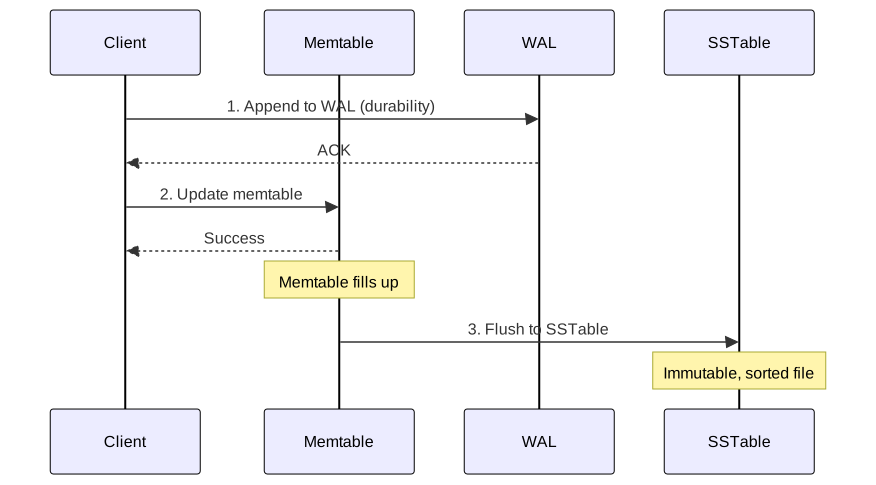
Memtable sizing: Cassandra allocates 1/4 of heap to memtables by default. Larger memtables reduce flush frequency but increase recovery time after crashes.
Read Path Details
- Check memtable (in-memory, fast)
- Check each SSTable from newest to oldest
- Use bloom filters to skip SSTables that definitely don’t contain the key
- Merge results if key exists in multiple SSTables
Bloom filter tuning: False positive rate vs. memory trade-off. Cassandra defaults to 1% FP rate, using ~10 bits per key.
Compaction Strategies
Compaction merges SSTables to:
- Reclaim space from deleted/overwritten keys
- Reduce read amplification (fewer files to check)
- Enforce tombstone expiration
Strategy comparison:
| Strategy | SSTable sizing | Read amp | Write amp | Best for |
|---|---|---|---|---|
| Size-Tiered (STCS) | Variable buckets | Higher | Lower | Write-heavy |
| Leveled (LCS) | Fixed 160MB | Lower | Higher | Read-heavy |
| Time-Window (TWCS) | Time buckets | Moderate | Low | Time-series + TTL |
STCS mechanics: Groups SSTables of similar size into buckets. When bucket has 4+ files (min_threshold), compact into one larger file.
LCS mechanics: Organizes SSTables into levels (L0, L1, L2…). Each level is 10x larger than previous. Compaction ensures 90% of reads touch at most one SSTable per level.
API Design
Core Operations
PUT /kv/{key}Content-Type: application/octet-streamX-Consistency-Level: QUORUMX-Client-Timestamp: 1699900000000
<binary value>
Response:201 CreatedX-Version: [(node1,5),(node2,3)]GET /kv/{key}X-Consistency-Level: QUORUM
Response (single version):200 OKX-Version: [(node1,5),(node2,3)]<binary value>
Response (conflict):300 Multiple ChoicesContent-Type: multipart/mixed
--boundaryX-Version: [(node1,5),(node2,3)]<value A>--boundaryX-Version: [(node1,4),(node3,2)]<value B>DELETE /kv/{key}X-Consistency-Level: QUORUM
Response:204 No ContentPagination for Key Listing
GET /kv?prefix=user:&limit=100&cursor=dXNlcjo1MDA=
Response:200 OK{ "keys": ["user:501", "user:502", ...], "next_cursor": "dXNlcjo2MDA=", "has_more": true}Error Responses
| Status | Meaning |
|---|---|
| 400 | Invalid key (too long, invalid characters) |
| 404 | Key not found |
| 409 | Write conflict (for conditional writes) |
| 503 | Insufficient replicas available for requested consistency |
| 504 | Timeout waiting for replica responses |
Infrastructure Design
Cloud-Agnostic Components
| Component | Purpose | Options |
|---|---|---|
| Compute | Node processes | VMs, containers, bare metal |
| Block storage | SSTable persistence | Local SSD, network SSD |
| Object storage | Backups, cold tier | S3-compatible |
| Load balancer | Client distribution | HAProxy, cloud LB |
| Service discovery | Node membership | Gossip (built-in), Consul |
AWS Reference Architecture

Instance selection:
| Instance | Storage | Memory | Use case |
|---|---|---|---|
| i3.xlarge | 950GB NVMe | 30.5GB | Standard nodes |
| i3.2xlarge | 1.9TB NVMe | 61GB | High-capacity nodes |
| r5.xlarge + gp3 | EBS | 32GB | Lower cost, higher latency |
Why i3 instances? Local NVMe provides consistent sub-millisecond latency. EBS adds network variability and higher p99 latencies.
Managed Alternatives
| Build vs Buy | Option | Trade-off |
|---|---|---|
| Self-hosted | Cassandra, ScyllaDB, Riak | Full control, operational burden |
| Managed | Amazon DynamoDB | No ops, vendor lock-in, cost at scale |
| Managed | Azure Cosmos DB | Multi-model, global distribution |
| Managed | DataStax Astra | Managed Cassandra, Cassandra compatibility |
DynamoDB note: Despite the name, DynamoDB’s architecture differs significantly from the Dynamo paper. It uses Paxos-based replication with a leader, offering strong consistency as an option. The 2022 USENIX paper details these differences.
Conclusion
Designing a distributed key-value store requires explicit CAP positioning. This design chose AP (availability + partition tolerance) with tunable consistency, following the Dynamo model:
Key architectural decisions:
- Consistent hashing with vnodes for incremental scaling and load distribution
- Quorum replication (N=3, R=2, W=2 default) for configurable consistency
- Sloppy quorum + hinted handoff to maintain availability during failures
- LWW timestamps for conflict resolution (simpler than vector clocks, requires NTP)
- LSM-tree storage for write-optimized performance with bloom filters for reads
What this design sacrifices:
- Strong consistency (use etcd/Consul if required)
- Range queries (add secondary index or use ordered storage like Bigtable)
- Multi-key transactions (requires coordination, changes CAP position)
When to choose this design:
- Session stores, shopping carts, user preferences
- Cache layers with persistence
- Time-series data (with TWCS compaction)
- Any workload where availability > consistency
Appendix
Prerequisites
- Distributed systems fundamentals: CAP theorem, consistency models
- Storage concepts: B-trees, write-ahead logging, compaction
- Networking: gossip protocols, failure detection
Terminology
| Term | Definition |
|---|---|
| Consistent hashing | Hash function mapping keys and nodes to a ring, minimizing key movement on topology changes |
| Vector clock | List of (node, counter) pairs tracking causal ordering between versions |
| Quorum | Minimum replicas (R or W) that must respond for an operation to succeed |
| Sloppy quorum | Quorum satisfied by any available nodes, not necessarily designated replicas |
| Hinted handoff | Temporary storage of writes for unavailable replicas, forwarded on recovery |
| SSTable | Sorted String Table—immutable, sorted key-value file on disk |
| Memtable | In-memory buffer for recent writes, flushed to SSTables periodically |
| Compaction | Background process merging SSTables to reclaim space and reduce read amplification |
| Tombstone | Marker indicating a deleted key, expires after gc_grace_seconds |
| Anti-entropy | Background synchronization to repair replica divergence |
Summary
- Distributed KV stores sit on a CAP spectrum: AP (Dynamo model) vs CP (Raft model)
- Consistent hashing + vnodes enables horizontal scaling with minimal data movement
- Quorum replication (R + W > N) provides tunable consistency
- Conflict resolution via vector clocks (causal tracking) or LWW (timestamp-based)
- Gossip + phi accrual failure detector maintains cluster membership
- LSM-tree storage optimizes write throughput; compaction strategy choice depends on workload
- Sloppy quorum + hinted handoff + Merkle tree repair ensure eventual convergence
References
- Amazon Dynamo Paper (2007) - Original Dynamo design, quorum protocols, vector clocks
- DynamoDB USENIX ATC’22 Paper - How DynamoDB differs from Dynamo
- Apache Cassandra Architecture - Dynamo-inspired design, consistency levels
- Google Bigtable Paper (2006) - CP alternative, SSTable format origin
- Raft Consensus Paper - Leader-based consensus for CP systems
- Redis Cluster Specification - Hash slot approach vs consistent hashing
- etcd Tuning Guide - Raft-based KV store configuration
- Riak Documentation - Active anti-entropy, Merkle trees
- LSM Tree vs B-Tree Analysis (TiKV) - Storage engine tradeoffs