Design Search Autocomplete: Prefix Matching at Scale
A system design for search autocomplete (typeahead) covering prefix data structures, ranking algorithms, distributed architecture, and sub-100ms latency requirements. This design addresses the challenge of returning relevant suggestions within the user’s typing cadence—typically under 100ms—while handling billions of queries daily.

Abstract
Search autocomplete is a prefix-completion problem where every millisecond matters—users expect suggestions before they finish typing. The core mental model:
- Data structure choice determines latency floor: Tries provide O(p) prefix lookup where p is prefix length, independent of corpus size. Finite State Transducers (FST) compress this further for in-memory serving.
- Pre-computed top-K eliminates runtime ranking: Store the top 5-10 suggestions at each trie node. Query becomes pure traversal, no sorting.
- Freshness requires a dual-path architecture: Weekly batch rebuilds for stable rankings + streaming hot updates for trending queries.
- Client-side debouncing is mandatory: Without 300ms debounce, typing “javascript” generates 10 requests in 1 second. With debounce: 1 request.
- Personalization adds latency: Generic suggestions serve from cache in <5ms. Personalized suggestions require user context lookup, adding 10-50ms.
The fundamental tradeoff: latency vs. relevance. Pre-computed suggestions are fast but stale. Real-time ranking is relevant but slow. Production systems layer both.
Requirements
Functional Requirements
| Requirement | Priority | Notes |
|---|---|---|
| Return suggestions for partial query | Core | Primary feature |
| Rank by relevance (popularity, freshness) | Core | Not just alphabetical |
| Support trending/breaking queries | Core | News events, viral content |
| Personalized suggestions | Extended | Based on user history |
| Spell correction / fuzzy matching | Extended | Handle typos |
| Multi-language support | Extended | Unicode, RTL scripts |
Out of scope: Full document search (separate system), voice input, image search.
Non-Functional Requirements
| Requirement | Target | Rationale |
|---|---|---|
| Latency | P99 < 100ms | User typing cadence ~150ms between keystrokes |
| Availability | 99.99% | User-facing, affects search engagement |
| Throughput | 500K QPS peak | Based on scale estimation below |
| Suggestion freshness | < 1 hour for trending | Breaking news must surface quickly |
| Consistency | Eventual (< 5 min) | Acceptable for suggestions |
Scale Estimation
Assumptions (Google-scale reference):
- Daily Active Users (DAU): 1 billion
- Searches per user per day: 5
- Characters per search: 20 average
- Autocomplete triggers: Every 2-3 characters after minimum prefix
Traffic calculation:
Queries/day = 1B users × 5 searches × (20 chars / 3 chars per trigger) = 1B × 5 × 7 triggers = 35 billion autocomplete requests/day
QPS average = 35B / 86,400 = ~405K QPSQPS peak (3x) = ~1.2M QPSStorage calculation:
Unique queries to index: ~1 billion (estimated from query logs)Average query length: 25 bytesMetadata per query (score, timestamp): 16 bytesRaw storage: 1B × 41 bytes = 41 GB
Trie overhead (pointers, node structure): 3-5xTrie storage: ~150-200 GB per replicaBandwidth:
Request size: ~50 bytes (prefix + metadata)Response size: ~500 bytes (10 suggestions with metadata)
Ingress: 1.2M QPS × 50 bytes = 60 MB/sEgress: 1.2M QPS × 500 bytes = 600 MB/sDesign Paths
Path A: Trie-Based with Pre-computed Rankings
Best when:
- Suggestion corpus is bounded (millions, not billions of unique queries)
- Latency is critical (<50ms P99)
- Ranking signals are relatively stable (popularity-based)
Architecture:
- In-memory tries sharded by prefix range
- Top-K suggestions pre-computed at each node during indexing
- Weekly full rebuilds + hourly delta updates
Key characteristics:
- Query is pure traversal: O(p) where p = prefix length
- No runtime ranking computation
- Memory-intensive: entire trie must fit in RAM
Trade-offs:
- ✅ Sub-10ms query latency achievable
- ✅ Predictable, consistent performance
- ✅ Simple query path (no scoring logic)
- ❌ High memory footprint (~200GB per shard replica)
- ❌ Freshness limited by rebuild frequency
- ❌ Personalization requires separate lookup
Real-world example: LinkedIn’s Cleo serves generic typeahead in <1ms using pre-computed tries. Network-personalized suggestions take 15ms due to additional context lookups.
Path B: Inverted Index with Completion Suggester
Best when:
- Corpus is large and dynamic (e-commerce catalogs, document search)
- Need flexibility for different query types (prefix, fuzzy, phrase)
- Already running Elasticsearch/OpenSearch infrastructure
Architecture:
- Elasticsearch completion suggester using FST (Finite State Transducers)
- Edge n-gram tokenization for flexible matching
- Real-time indexing via Kafka
Key characteristics:
- FST provides compact in-memory representation
- Supports fuzzy matching and context filtering
- Index updates are near real-time
Trade-offs:
- ✅ Flexible query types (prefix, infix, fuzzy)
- ✅ Real-time updates without full rebuild
- ✅ Built-in sharding and replication
- ❌ Higher latency than pure trie (10-50ms typical)
- ❌ Index size 15-17x larger with edge n-gram analyzer
- ❌ Operational complexity of Elasticsearch cluster
Real-world example: Amazon product search uses inverted indexes with extensive metadata (ratings, sales rank) for ranking. Handles dynamic catalog updates in near real-time.
Path Comparison
| Factor | Path A: Trie | Path B: Inverted Index |
|---|---|---|
| Query latency | <10ms | 10-50ms |
| Memory efficiency | Lower (pointer overhead) | Higher (FST compression) |
| Update latency | Hours (batch) | Seconds (streaming) |
| Fuzzy matching | Requires separate structure | Native support |
| Sharding complexity | Manual prefix-based | Built-in (Elasticsearch) |
| Operational overhead | Custom infrastructure | Managed service available |
| Best for | High-QPS generic suggestions | Dynamic catalogs, flexible queries |
This Article’s Focus
This article focuses on Path A (Trie-Based) because:
- It represents the canonical autocomplete architecture used by Google, Twitter, and LinkedIn for their primary suggestion services
- It demonstrates fundamental prefix data structures that underpin even inverted-index implementations
- Sub-10ms latency is achievable, which Path B cannot match
Path B implementation details are covered in the “Elasticsearch Alternative” section under Low-Level Design.
High-Level Design
Component Overview
| Component | Responsibility | Technology |
|---|---|---|
| API Gateway | Rate limiting, authentication, routing | Kong, AWS API Gateway |
| Shard Router | Route prefix to correct trie shard | Custom service |
| Trie Service | Serve suggestions from in-memory trie | Custom service (Go/Rust) |
| Ranking Service | Re-rank with personalization signals | Custom service |
| Redis Cache | Cache hot prefixes and user history | Redis Cluster |
| Trie Builder | Build/update tries from query logs | Spark/Flink |
| Kafka | Stream query logs and trending signals | Apache Kafka |
| Object Storage | Store serialized trie snapshots | S3, HDFS |
Request Flow
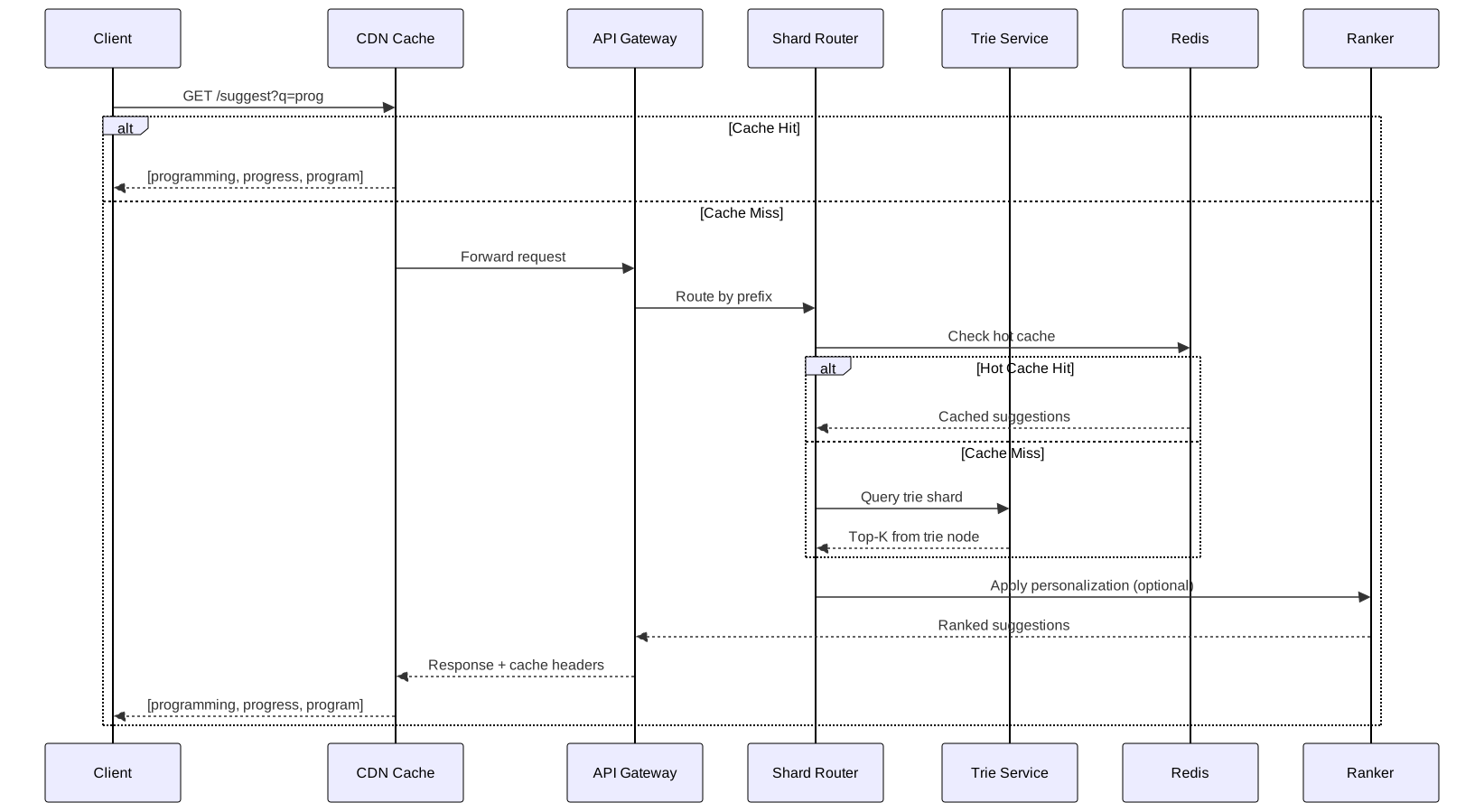
Sharding Strategy
Prefix-based sharding routes queries by first character(s):
Shard 1: a-f (covers ~25% of queries)Shard 2: g-m (covers ~20% of queries)Shard 3: n-s (covers ~35% of queries - 's' is most common)Shard 4: t-z (covers ~20% of queries)Why prefix-based over hash-based:
- Data locality: Related queries (“system”, “systems”, “systematic”) on same shard
- Prefix routing: Query “sys” deterministically routes to shard 3
- Range queries: Can aggregate suggestions across prefix ranges
Handling hotspots:
English letter frequency is uneven. The prefix “s” alone accounts for ~10% of queries. Solutions:
- Finer granularity: Split “s” into “sa-se”, “sf-sm”, “sn-sz”
- Dynamic rebalancing: Shard Map Manager monitors load and adjusts ranges
- Replication: More replicas for hot shards
API Design
Suggestion Endpoint
GET /api/v1/suggestions?q={prefix}&limit={n}&lang={code}Request Parameters:
| Parameter | Type | Required | Default | Description |
|---|---|---|---|---|
q | string | Yes | - | Query prefix (min 2 chars) |
limit | int | No | 10 | Max suggestions (1-20) |
lang | string | No | en | Language code (ISO 639-1) |
user_id | string | No | - | For personalized suggestions |
context | string | No | - | Search context (web, images, news) |
Response (200 OK):
{ "query": "prog", "suggestions": [ { "text": "programming", "score": 0.95, "type": "query", "metadata": { "category": "technology", "trending": false } }, { "text": "progress", "score": 0.87, "type": "query", "metadata": { "category": "general", "trending": false } }, { "text": "program download", "score": 0.82, "type": "query", "metadata": { "category": "technology", "trending": true } } ], "took_ms": 8, "cache_hit": false}Error Responses:
| Status | Condition | Response |
|---|---|---|
| 400 | Prefix too short (<2 chars) | {"error": "prefix_too_short", "min_length": 2} |
| 429 | Rate limit exceeded | {"error": "rate_limited", "retry_after": 60} |
| 503 | Service overloaded | {"error": "service_unavailable"} |
Rate Limits:
- Anonymous: 100 requests/minute per IP
- Authenticated: 1000 requests/minute per user
- Burst: 20 requests/second max
Response Optimization
Compression: Enable gzip for responses >1KB. Typical 10-suggestion response compresses from 500 bytes to ~200 bytes.
Cache Headers:
Cache-Control: public, max-age=300ETag: "a1b2c3d4"Vary: Accept-Encoding, Accept-LanguagePagination: Not applicable—autocomplete returns bounded set (≤20). If more results needed, user should submit full search.
Data Modeling
Trie Node Structure
interface TrieNode { children: Map<string, TrieNode> // Character -> child node isEndOfWord: boolean topSuggestions: Suggestion[] // Pre-computed top-K frequency: number // Aggregate frequency for this prefix}
interface Suggestion { text: string // Full query text score: number // Normalized relevance score [0, 1] frequency: number // Raw query count lastUpdated: number // Unix timestamp trending: boolean // Recently spiking metadata: { category?: string language: string }}Storage Schema
Query Log (Kafka topic: query-logs):
{ "query": "programming tutorials", "timestamp": 1706918400, "user_id": "u123", // Hashed, optional "session_id": "s456", "result_clicked": true, "position_clicked": 2, "locale": "en-US", "platform": "web"}Aggregated Query Stats (Redis Hash):
HSET query:programming tutorials frequency 1542389 last_seen 1706918400 trending 0 category technologyTrie Snapshot (S3/HDFS):
s3://autocomplete-data/tries/ └── 2024-02-03/ ├── shard-a-f.trie.gz (50GB compressed) ├── shard-g-m.trie.gz (40GB compressed) ├── shard-n-s.trie.gz (60GB compressed) ├── shard-t-z.trie.gz (40GB compressed) └── manifest.jsonDatabase Selection
| Data | Store | Rationale |
|---|---|---|
| Live trie | In-memory (custom) | Sub-ms traversal required |
| Hot prefix cache | Redis Cluster | <1ms lookups, TTL support |
| Query logs | Kafka → S3 | Streaming ingestion, durable storage |
| Trie snapshots | S3/HDFS | Large files, versioned, cross-region replication |
| User history | DynamoDB/Cassandra | Key-value access pattern, high write throughput |
| Trending signals | Redis Sorted Set | Real-time top-K with scores |
Low-Level Design
Trie Implementation
Design decision: Hash map vs. array children
| Approach | Lookup | Memory | Best for |
|---|---|---|---|
| Array[26] | O(1) | 26 pointers/node | Dense tries, ASCII only |
| Array[128] | O(1) | 128 pointers/node | Full ASCII |
| HashMap | O(1) avg | Variable | Sparse tries, Unicode |
Chosen: HashMap because:
- Unicode support required (multi-language)
- Most nodes have <5 children (sparse)
- Modern hash maps have near-constant lookup
8 collapsed lines
package autocomplete
import ( "sort" "sync")
const TopK = 10
type TrieNode struct { children map[rune]*TrieNode isEnd bool topSuggestions []Suggestion mu sync.RWMutex}
type Suggestion struct { Text string Score float64 Frequency int64 Trending bool}
func (t *TrieNode) Search(prefix string) []Suggestion { t.mu.RLock() defer t.mu.RUnlock()
node := t for _, char := range prefix { child, exists := node.children[char] if !exists { return nil // No suggestions for this prefix } node = child } // Return pre-computed top-K at this node return node.topSuggestions}
func (t *TrieNode) Insert(word string, score float64) { t.mu.Lock() defer t.mu.Unlock() // ... insertion logic with top-K update propagation}16 collapsed lines
// BuildTopK propagates top-K suggestions up the trie// Called during index build, not at query timefunc (t *TrieNode) BuildTopK() { // Post-order traversal: build children first for _, child := range t.children { child.BuildTopK() }
// Collect all suggestions from children + this node var candidates []Suggestion if t.isEnd { candidates = append(candidates, t.topSuggestions...) } for _, child := range t.children { candidates = append(candidates, child.topSuggestions...) }
// Keep top K by score sort.Slice(candidates, func(i, j int) bool { return candidates[i].Score > candidates[j].Score }) if len(candidates) > TopK { candidates = candidates[:TopK] } t.topSuggestions = candidates}Why pre-compute top-K at each node:
Without pre-computation, returning suggestions for prefix “p” requires traversing the entire subtree (potentially millions of nodes). With pre-computed top-K:
- Query time: O(p) where p = prefix length
- No subtree traversal
- Predictable latency regardless of prefix popularity
Trade-off: Index build time increases (must propagate top-K up), but query time drops from O(p + n) to O(p).
Ranking Algorithm
Scoring formula:
Score = w1 × Popularity + w2 × Freshness + w3 × Trending + w4 × PersonalizationDefault weights (generic suggestions):
| Signal | Weight | Calculation |
|---|---|---|
| Popularity | 0.5 | log(frequency) / log(max_frequency) |
| Freshness | 0.2 | 1 - (days_since_last_search / 30) |
| Trending | 0.2 | 1.0 if spiking else 0.0 |
| Personalization | 0.1 | 1.0 if in user history else 0.0 |
Trending detection:
A query is “trending” if its frequency in the last hour exceeds 3× its average hourly frequency over the past week.
5 collapsed lines
import redisfrom datetime import datetime, timedelta
r = redis.Redis()
def is_trending(query: str) -> bool: now = datetime.utcnow() hour_key = f"freq:{query}:{now.strftime('%Y%m%d%H')}"
# Current hour frequency current = int(r.get(hour_key) or 0)
# Average hourly frequency over past week total = 0 for i in range(1, 169): # 168 hours = 1 week past_hour = now - timedelta(hours=i) past_key = f"freq:{query}:{past_hour.strftime('%Y%m%d%H')}" total += int(r.get(past_key) or 0)
9 collapsed lines
avg = total / 168 return current > 3 * avg if avg > 0 else current > 100
# Example usage in ranking servicedef rank_suggestions(suggestions, user_id=None): for s in suggestions: s.trending = is_trending(s.text) s.score = calculate_score(s, user_id) return sorted(suggestions, key=lambda x: x.score, reverse=True)Elasticsearch Alternative (Path B)
For teams preferring managed infrastructure, Elasticsearch’s completion suggester provides a viable alternative:
Index mapping:
3 collapsed lines
{ "mappings": { "properties": { "suggest": { "type": "completion", "analyzer": "simple", "preserve_separators": true, "preserve_position_increments": true, "max_input_length": 50, "contexts": [ { "name": "category", "type": "category" }, { "name": "location", "type": "geo", "precision": 4 } ] }, "query_text": { "type": "text" },6 collapsed lines
"frequency": { "type": "long" } } }}Query:
{ "suggest": { "query-suggest": { "prefix": "prog", "completion": { "field": "suggest", "size": 10, "skip_duplicates": true, "fuzzy": { "fuzziness": 1 }, "contexts": { "category": ["technology"] } } } }}Performance characteristics:
- Latency: 10-30ms typical (vs. <10ms for custom trie)
- Fuzzy matching: Built-in with configurable edit distance
- Index size: 15-17× larger with edge n-gram analyzer
- Operational: Managed service available (AWS OpenSearch, Elastic Cloud)
When to choose Elasticsearch:
- Already running ES for document search
- Need fuzzy matching without additional infrastructure
- Corpus changes frequently (near real-time indexing)
- Team lacks expertise for custom trie infrastructure
Frontend Considerations
Debouncing Strategy
Problem: Without debouncing, typing “javascript” at normal speed (150ms between keystrokes) generates 10 API requests in 1.5 seconds.
Solution: Debounce with 300ms delay—only send request after 300ms of no typing.
5 collapsed lines
import { useState, useCallback, useRef, useEffect } from "react"
const DEBOUNCE_MS = 300const MIN_PREFIX_LENGTH = 2
export function useAutocomplete() { const [query, setQuery] = useState("") const [suggestions, setSuggestions] = useState<string[]>([]) const [isLoading, setIsLoading] = useState(false) const abortControllerRef = useRef<AbortController | null>(null) const timeoutRef = useRef<number | null>(null)
const fetchSuggestions = useCallback(async (prefix: string) => { // Cancel previous request abortControllerRef.current?.abort() abortControllerRef.current = new AbortController()
setIsLoading(true) try { const response = await fetch(`/api/v1/suggestions?q=${encodeURIComponent(prefix)}&limit=10`, { signal: abortControllerRef.current.signal, }) const data = await response.json() setSuggestions(data.suggestions.map((s: any) => s.text)) } catch (error) { if (error.name !== "AbortError") { console.error("Autocomplete error:", error) } } finally { setIsLoading(false) } }, [])
const handleInputChange = useCallback(16 collapsed lines
(value: string) => { setQuery(value)
// Clear pending debounce if (timeoutRef.current) { clearTimeout(timeoutRef.current) }
// Don't fetch for short prefixes if (value.length < MIN_PREFIX_LENGTH) { setSuggestions([]) return }
// Debounce the API call timeoutRef.current = setTimeout(() => { fetchSuggestions(value) }, DEBOUNCE_MS) }, [fetchSuggestions], )
// Cleanup on unmount useEffect(() => { return () => { timeoutRef.current && clearTimeout(timeoutRef.current) abortControllerRef.current?.abort() } }, [])
return { query, suggestions, isLoading, handleInputChange }}Key implementation details:
- AbortController: Cancel in-flight requests when user types more
- Minimum prefix: Don’t fetch for 1-character prefixes (too broad)
- Cleanup: Clear timeouts and abort requests on unmount
Keyboard Navigation
Autocomplete dropdowns must support keyboard navigation for accessibility (WCAG 2.1 compliance):
| Key | Action |
|---|---|
| ↓ / ↑ | Navigate suggestions |
| Enter | Select highlighted suggestion |
| Escape | Close dropdown |
| Tab | Select and move to next field |
ARIA attributes required:
<input role="combobox" aria-expanded="true" aria-controls="suggestions-list" aria-activedescendant="suggestion-2" /><ul id="suggestions-list" role="listbox"> <li id="suggestion-0" role="option">programming</li> <li id="suggestion-1" role="option">progress</li> <li id="suggestion-2" role="option" aria-selected="true">program</li></ul>Optimistic UI Updates
For frequently-typed prefixes, show cached suggestions immediately while fetching fresh results:
const handleInputChange = (value: string) => { // Show cached results immediately (optimistic) const cached = localCache.get(value) if (cached) { setSuggestions(cached) }
// Fetch fresh results in background fetchSuggestions(value).then((fresh) => { setSuggestions(fresh) localCache.set(value, fresh) })}Indexing Pipeline
Pipeline Architecture

Batch vs. Streaming Updates
| Aspect | Batch (Weekly) | Streaming (Real-time) |
|---|---|---|
| Latency | Hours | Seconds |
| Completeness | Full corpus | Incremental deltas |
| Compute cost | Higher | Lower |
| Use case | Stable rankings | Trending queries |
Dual-path approach:
- Weekly batch: Complete trie rebuild from all query logs
- Hourly hot updates: Merge trending queries into existing trie
- Real-time streaming: Update trending flags and frequency counters
Aggregation Job
10 collapsed lines
from pyspark.sql import SparkSessionfrom pyspark.sql.functions import col, count, max as spark_max, when
spark = SparkSession.builder.appName("QueryAggregation").getOrCreate()
# Read query logs from S3query_logs = spark.read.parquet("s3://query-logs/2024/02/")
# Filter and aggregateaggregated = ( query_logs .filter(col("query").isNotNull()) .filter(col("query") != "") .filter(~col("query").rlike(r"[^\w\s]")) # Remove special chars .groupBy("query") .agg( count("*").alias("frequency"), spark_max("timestamp").alias("last_seen"), # Trending: frequency in last 24h > 3x avg when( col("recent_freq") > 3 * col("avg_freq"), True ).otherwise(False).alias("trending") ) .filter(col("frequency") >= 10) # Min frequency threshold .orderBy(col("frequency").desc()))
# Normalize scoresmax_freq = aggregated.agg(spark_max("frequency")).collect()[0][0]scored = aggregated.withColumn( "score", col("frequency") / max_freq * 0.5 + # Popularity when(col("trending"), 0.2).otherwise(0.0) # Trending boost)
# Write output for trie builderscored.write.parquet("s3://autocomplete-data/aggregated/2024-02-03/")Trie Serialization
For efficient storage and loading, tries are serialized to a compact binary format:
8 collapsed lines
package autocomplete
import ( "encoding/gob" "compress/gzip" "os")
func (t *TrieNode) Serialize(path string) error { file, err := os.Create(path) if err != nil { return err } defer file.Close()
gzWriter := gzip.NewWriter(file) defer gzWriter.Close()
encoder := gob.NewEncoder(gzWriter) return encoder.Encode(t)}
func LoadTrie(path string) (*TrieNode, error) { file, err := os.Open(path) if err != nil { return nil, err } defer file.Close()
gzReader, err := gzip.NewReader(file) if err != nil { return nil, err } defer gzReader.Close()
var trie TrieNode decoder := gob.NewDecoder(gzReader) if err := decoder.Decode(&trie); err != nil { return nil, err3 collapsed lines
} return &trie, nil}Compression ratios:
| Format | Size | Load Time |
|---|---|---|
| Raw (JSON) | 200 GB | 10 min |
| Gob | 80 GB | 4 min |
| Gob + Gzip | 30 GB | 6 min |
Chosen: Gob + Gzip for storage efficiency. Load time overhead acceptable for weekly rebuilds.
Caching Strategy
Multi-Layer Cache
| Layer | TTL | Hit Rate | Latency |
|---|---|---|---|
| Browser | 1 hour | 30-40% | 0ms |
| CDN/Edge | 5 min | 50-60% | <5ms |
| Redis (hot prefixes) | 10 min | 80-90% | <2ms |
| Trie (in-memory) | N/A | 100% | <10ms |
Browser Caching
HTTP/1.1 200 OKCache-Control: public, max-age=3600ETag: "v1-abc123"Vary: Accept-Encoding- 1-hour TTL balances freshness and hit rate
- ETag enables conditional requests for stale cache revalidation
Varyheader ensures proper cache keying by encoding
CDN Configuration
# Cloudflare Page Rulesrules: - match: "/api/v1/suggestions*" actions: cache_level: cache_everything edge_cache_ttl: 300 # 5 minutes browser_cache_ttl: 3600 # 1 hour cache_key: include_query_string: trueCache key design:
Include full query string in cache key. /suggestions?q=prog and /suggestions?q=progress must cache separately.
Redis Hot Prefix Cache
5 collapsed lines
import redisimport json
r = redis.Redis(cluster=True)
def get_suggestions(prefix: str) -> list | None: """Check Redis cache first, fall back to trie.""" cache_key = f"suggest:{prefix}"
# Try cache cached = r.get(cache_key) if cached: return json.loads(cached)
# Cache miss - query trie suggestions = query_trie(prefix)
# Cache hot prefixes (high frequency) if is_hot_prefix(prefix): r.setex(cache_key, 600, json.dumps(suggestions)) # 10 min TTL
return suggestions
def is_hot_prefix(prefix: str) -> bool: """Prefix is hot if queried >1000 times in last hour.""" freq_key = f"freq:{prefix}:{current_hour()}" return int(r.get(freq_key) or 0) > 1000Infrastructure
Cloud-Agnostic Architecture
| Component | Requirement | Open Source | Managed |
|---|---|---|---|
| Compute | Low-latency, auto-scaling | Kubernetes | EKS, GKE |
| Cache | Sub-ms reads, clustering | Redis | ElastiCache, MemoryStore |
| Message Queue | High throughput, durability | Kafka | MSK, Confluent Cloud |
| Object Storage | Durable, versioned | MinIO | S3, GCS |
| Stream Processing | Real-time aggregation | Flink, Spark | Kinesis, Dataflow |
AWS Reference Architecture

Service configuration:
| Service | Configuration | Cost Estimate |
|---|---|---|
| ECS Fargate | 10 tasks × 16 vCPU, 32GB RAM | $8,000/month |
| ElastiCache | r6g.xlarge × 6 nodes (cluster) | $2,500/month |
| CloudFront | 1TB egress/day | $1,500/month |
| S3 | 500GB storage | $12/month |
| EMR | m5.xlarge × 10 (weekly job) | $200/month |
Total estimated cost: ~$12,000/month for 500K QPS capacity
Deployment Strategy
Blue-green deployment for trie updates:
- Build new trie version in offline cluster
- Load into “green” service instances
- Smoke test green cluster
- Switch load balancer to green
- Keep blue running for 1 hour (rollback capability)
- Terminate blue
Rolling updates for code changes:
8 collapsed lines
# ECS Service DefinitionapiVersion: ecs/v1kind: Servicemetadata: name: trie-servicespec: desiredCount: 10 deploymentConfiguration: maximumPercent: 150 minimumHealthyPercent: 100 deploymentController: type: ECS healthCheckGracePeriodSeconds: 60 loadBalancers: - containerName: trie containerPort: 8080 targetGroupArn: !Ref TargetGroupMonitoring and Evaluation
Key Metrics
| Metric | Target | Alert Threshold |
|---|---|---|
| P50 latency | <20ms | >50ms |
| P99 latency | <100ms | >200ms |
| Error rate | <0.01% | >0.1% |
| Cache hit rate (CDN) | >50% | <30% |
| Cache hit rate (Redis) | >80% | <60% |
| Trie memory usage | <80% | >90% |
Business Metrics
| Metric | Definition | Target |
|---|---|---|
| Suggestion CTR | Clicks on suggestions / Total suggestions shown | >30% |
| Mean Reciprocal Rank (MRR) | 1/position of clicked suggestion | >0.5 |
| Query completion rate | Searches using suggestion / Total searches | >40% |
| Keystrokes saved | Avg chars typed before selecting suggestion | >50% |
Observability Stack
monitors: - name: Autocomplete P99 Latency type: metric alert query: "avg(last_5m):p99:autocomplete.latency{*} > 100" message: "P99 latency exceeded 100ms threshold"
- name: Trie Service Error Rate type: metric alert query: "sum(last_5m):sum:autocomplete.errors{*}.as_rate() / sum:autocomplete.requests{*}.as_rate() > 0.001" message: "Error rate exceeded 0.1%"
- name: Cache Hit Rate Drop type: metric alert query: "avg(last_15m):autocomplete.cache.hit_rate{layer:redis} < 0.6" message: "Redis cache hit rate below 60%"Conclusion
This design delivers sub-100ms autocomplete at scale through:
- Pre-computed top-K suggestions at each trie node, eliminating runtime ranking
- Prefix-based sharding with dynamic rebalancing for even load distribution
- Multi-layer caching (browser → CDN → Redis → trie) achieving >90% cache hit rate
- Dual-path indexing combining weekly batch rebuilds with streaming hot updates
Key tradeoffs accepted:
- Memory over compute: ~200GB RAM per shard for O(p) query latency
- Staleness over freshness: 1-hour maximum for non-trending suggestions
- Generic over personalized: Personalization adds 10-50ms latency
Known limitations:
- Fuzzy matching requires additional infrastructure (not in core trie)
- Cross-language suggestions need separate tries per language
- Cold start after deployment requires pre-warming from snapshots
Alternative approaches not chosen:
- Pure inverted index: Higher latency (10-50ms vs <10ms)
- Machine learning ranking: Adds latency, diminishing returns for autocomplete
- Real-time personalization: Latency cost outweighs relevance benefit for most use cases
Appendix
Prerequisites
- Distributed systems fundamentals (sharding, replication, consistency)
- Data structures: tries, hash maps, sorted sets
- Basic understanding of caching strategies (TTL, cache invalidation)
- Familiarity with stream processing concepts (Kafka, event sourcing)
Terminology
| Term | Definition |
|---|---|
| Trie | Tree structure for prefix-based string storage and retrieval |
| FST | Finite State Transducer—compressed automaton for term dictionaries |
| Top-K | Pre-computed list of K highest-scoring suggestions at a trie node |
| QAC | Query Auto-Completion—suggesting queries, not documents |
| MRR | Mean Reciprocal Rank—evaluation metric for ranked results |
| Edge n-gram | Tokenization that generates prefixes at index time |
| Fan-out | Pattern of distributing data/computation across multiple nodes |
Summary
- Trie with pre-computed top-K provides O(p) query latency independent of corpus size
- Prefix-based sharding enables horizontal scaling with data locality benefits
- 300ms client debouncing reduces API calls by 90%+ without perceived latency
- Multi-layer caching (browser, CDN, Redis) handles >90% of traffic before hitting trie services
- Weekly batch + streaming hot updates balances freshness with stability
- P99 < 100ms is achievable with proper caching and pre-computation
References
- LinkedIn Engineering: Cleo - Open Source Typeahead - Production architecture serving <1ms generic suggestions
- Twitter Engineering: Typeahead.js - Client-side typeahead library design
- Microsoft Research: Personalized Query Auto-Completion - Personalization impact on MRR (+9.42%)
- Elasticsearch: Autocomplete Search - Completion suggester and edge n-gram comparison
- Mike McCandless: FSTs in Lucene - Finite State Transducer internals
- Bing Search Blog: Autosuggest Deep Dive - Parallel processing for suggestions
- CSS-Tricks: Debouncing and Throttling - Client-side optimization patterns