Design an Issue Tracker (Jira/Linear)
A comprehensive system design for an issue tracking and project management tool covering API design for dynamic workflows, efficient kanban board pagination, drag-and-drop ordering without full row updates, concurrent edit handling, and real-time synchronization. This design addresses the challenges of project-specific column configurations while maintaining consistent user-defined ordering across views.

Abstract
Issue tracking systems solve three interconnected problems: flexible workflows (each project defines its own statuses and transitions), efficient ordering (issues maintain user-defined positions without expensive reindexing), and concurrent editing (multiple users can update the same issue simultaneously).
Core architectural decisions:
| Decision | Choice | Rationale |
|---|---|---|
| Ordering algorithm | Fractional indexing (LexoRank) | O(1) insertions without row updates |
| API style | GraphQL with REST fallback | Flexible field selection for varied board views |
| Pagination | Per-column cursor-based | Ensures all columns load incrementally |
| Concurrency | Optimistic locking with version field | Low conflict rate in practice |
| Real-time sync | WebSocket + last-write-wins | Sub-200ms propagation, simple conflict model |
| Workflow storage | Polymorphic per-project | Projects own their status definitions |
Key trade-offs accepted:
- Denormalized board state in Redis for fast reads, with async consistency
- LexoRank strings grow unbounded, requiring periodic rebalancing
- Last-write-wins may lose concurrent edits (acceptable for most fields)
What this design optimizes:
- Drag-and-drop reordering updates exactly one row
- Board loads show issues across all columns immediately
- Workflow changes don’t require schema migrations
Requirements
Functional Requirements
| Requirement | Priority | Notes |
|---|---|---|
| Create/edit/delete issues | Core | Title, description, assignee, type, priority |
| Project-specific workflows | Core | Custom statuses and transitions per project |
| Kanban board view | Core | Drag-drop between columns and within columns |
| Issue ordering within columns | Core | Persist user-defined order |
| Real-time updates | Core | See changes from other users immediately |
| Search and filter | Core | Full-text search, JQL-style queries |
| Comments and activity | Extended | Threaded comments, activity timeline |
| Attachments | Extended | File upload and preview |
| Sprints/iterations | Extended | Time-boxed groupings |
| Custom fields | Extended | Project-specific metadata |
Non-Functional Requirements
| Requirement | Target | Rationale |
|---|---|---|
| Availability | 99.9% (3 nines) | User-facing, productivity critical |
| Board load time | p99 < 500ms | Must feel instant |
| Issue update latency | p99 < 200ms | Drag-drop must be responsive |
| Real-time propagation | p99 < 300ms | Collaborative editing feel |
| Search latency | p99 < 100ms | Autocomplete responsiveness |
| Concurrent users per board | 100 | Team collaboration scenario |
Scale Estimation
Users:
- Total users: 10M (Jira-scale)
- Daily Active Users (DAU): 2M (20%)
- Peak concurrent users: 500K
Projects and Issues:
- Projects: 1M
- Issues per project (active): 1,000 avg, 100,000 max
- Total issues: 1B
- Issues per board view: 200-500 typical
Traffic:
- Board loads: 2M DAU × 10 loads/day = 20M/day = ~230 RPS
- Issue updates: 2M DAU × 20 updates/day = 40M/day = ~460 RPS
- Peak multiplier: 3x → 700 RPS board loads, 1,400 RPS updates
Storage:
- Issue size: 5KB avg (metadata + description)
- Total issue storage: 1B × 5KB = 5TB
- Attachments: 50TB (separate object storage)
- Activity log: 20TB (append-only)
Design Paths
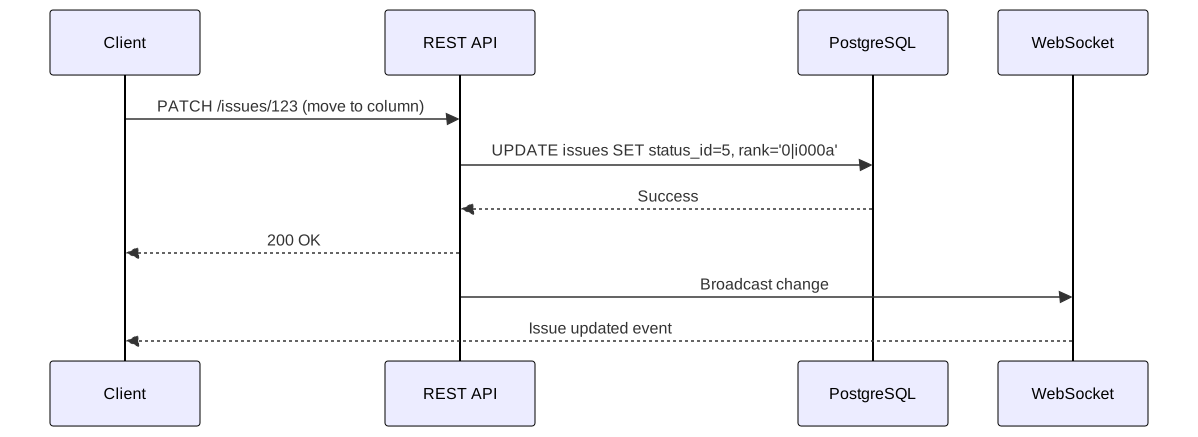
Path A: Server-Authoritative with REST API
Best when:
- Team familiar with REST patterns
- Simpler infrastructure requirements
- Offline support not critical
- Moderate real-time requirements
Architecture:
Trade-offs:
- ✅ Simple mental model
- ✅ Standard tooling and caching
- ✅ Easy to debug
- ❌ Over-fetching/under-fetching without careful design
- ❌ Multiple round trips for complex operations
- ❌ Real-time requires separate WebSocket layer
Real-world example: Jira Cloud uses REST API with LexoRank for ordering and WebSocket for real-time updates.
Path B: Local-First with Sync Engine
Best when:
- Offline support is critical
- Sub-100ms UI responsiveness required
- Team can invest in sync infrastructure
- Users on unreliable networks
Architecture:

Trade-offs:
- ✅ Instant UI response (local-first)
- ✅ Full offline support
- ✅ Minimal network traffic (deltas only)
- ❌ Complex sync logic
- ❌ Conflict resolution complexity
- ❌ Larger client-side footprint
Real-world example: Linear loads all issues into IndexedDB on startup, achieving 0ms search latency. Their sync engine uses last-write-wins for most fields with CRDTs for rich text descriptions.
Path C: GraphQL with Optimistic Updates
Best when:
- Varied client needs (web, mobile, integrations)
- Complex data relationships
- Need flexibility without over-fetching
- Subscriptions for real-time
Architecture:
mutation MoveIssue($input: MoveIssueInput!) { moveIssue(input: $input) { issue { id status { id name } rank updatedAt } }}
subscription OnBoardUpdate($boardId: ID!) { boardUpdated(boardId: $boardId) { issue { id status { id } rank } action }}Trade-offs:
- ✅ Flexible queries for different views
- ✅ Built-in subscriptions for real-time
- ✅ Single endpoint simplifies client
- ❌ Caching more complex
- ❌ Rate limiting harder
- ❌ Learning curve for teams
Real-world example: Linear uses GraphQL for all API operations—the same schema powers their web app, mobile app, and public API.
Path Comparison
| Factor | REST | Local-First | GraphQL |
|---|---|---|---|
| Implementation complexity | Low | High | Medium |
| UI responsiveness | Medium | Excellent | Good |
| Offline support | Limited | Native | Limited |
| Client flexibility | Low | Low | High |
| Real-time complexity | Separate | Built-in | Built-in |
| Caching | Simple | Complex | Medium |
This Article’s Focus
This article focuses on Path C (GraphQL with REST fallback) because:
- Flexible field selection suits varied board configurations
- Subscriptions provide native real-time support
- REST endpoints can coexist for webhooks and simple integrations
- Most modern issue trackers (Linear, Notion) use this approach
High-Level Design
Component Overview

Issue Service
Handles core issue CRUD operations and ordering.
Responsibilities:
- Create, read, update, delete issues
- Rank calculation for ordering
- Status transitions with workflow validation
- Optimistic locking for concurrent updates
Key design decisions:
| Decision | Choice | Rationale |
|---|---|---|
| Primary key | UUID | Distributed ID generation, no coordination |
| Ordering | LexoRank string | O(1) reordering without cascading updates |
| Versioning | Monotonic version field | Optimistic locking for concurrent edits |
Project Service
Manages project configuration including workflows.
Responsibilities:
- Project CRUD
- Workflow definition per project
- Status and transition management
- Board configuration (columns, filters)
Design decision: Each project owns its workflow definition. Statuses are project-scoped, not global. This allows teams to customize without affecting others.
Board Service
Optimizes board view queries by maintaining denormalized state.
Responsibilities:
- Cache board state in Redis
- Compute issue counts per column
- Handle board-level operations (collapse column, set WIP limits)
Why separate service: Board queries require joining issues, statuses, and users. Denormalizing into Redis achieves sub-50ms board loads.
Workflow Service
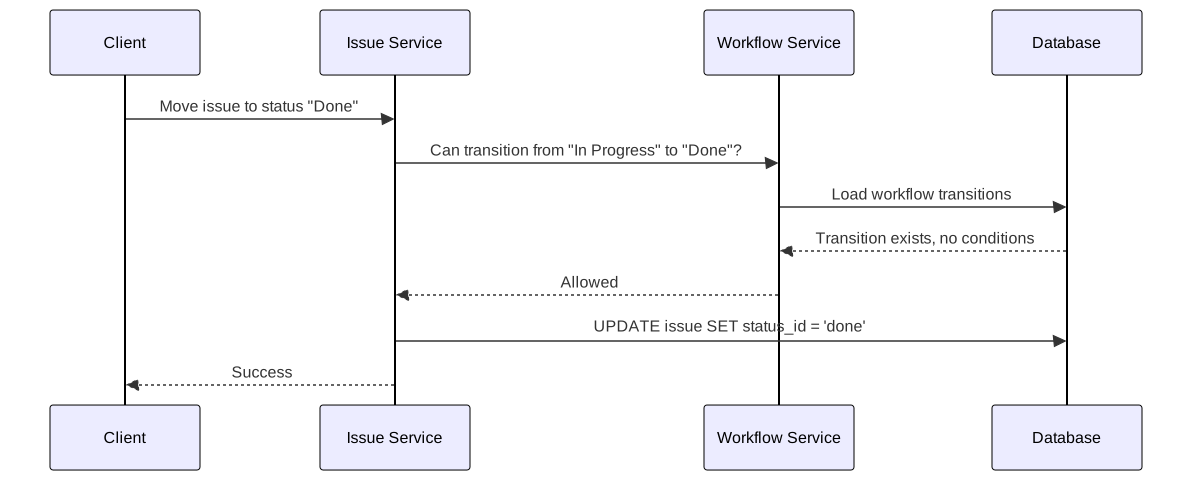
Enforces workflow rules and transitions.
Responsibilities:
- Validate status transitions
- Execute transition side effects (webhooks, automations)
- Maintain workflow history
Transition validation flow:
API Design
GraphQL Schema (Core Types)
type Issue { id: ID! key: String! # e.g., "PROJ-123" title: String! description: String status: Status! assignee: User reporter: User! priority: Priority! issueType: IssueType! rank: String! # LexoRank for ordering version: Int! # Optimistic locking project: Project! comments(first: Int, after: String): CommentConnection! activity(first: Int, after: String): ActivityConnection! createdAt: DateTime! updatedAt: DateTime!}
type Status { id: ID! name: String! category: StatusCategory! # TODO, IN_PROGRESS, DONE color: String! position: Int! # Column order}
type Project { id: ID! key: String! name: String! workflow: Workflow! statuses: [Status!]! issueTypes: [IssueType!]!}
type Workflow { id: ID! name: String! statuses: [Status!]! transitions: [Transition!]!}
type Transition { id: ID! name: String! fromStatus: Status toStatus: Status! conditions: [TransitionCondition!]}
enum StatusCategory { TODO IN_PROGRESS DONE}
enum Priority { LOWEST LOW MEDIUM HIGH HIGHEST}Board Query with Per-Column Pagination
The key challenge: fetch issues across multiple columns where each column can have different numbers of issues.
Naive approach (problematic):
# BAD: Fetches all issues, client groups by statusquery { issues(projectId: "proj-1", first: 100) { nodes { id status { id } } }}# Problem: If 90 issues are in "To Do", other columns appear emptyPer-column pagination approach:
type BoardColumn { status: Status! issues(first: Int!, after: String): IssueConnection! totalCount: Int!}
type Board { id: ID! project: Project! columns: [BoardColumn!]!}
query GetBoard($projectId: ID!, $issuesPerColumn: Int!) { board(projectId: $projectId) { columns { status { id name color } totalCount issues(first: $issuesPerColumn) { nodes { id key title assignee { id name avatar } priority rank } pageInfo { hasNextPage endCursor } } } }}Response structure:
{ "data": { "board": { "columns": [ { "status": { "id": "status-1", "name": "To Do", "color": "#grey" }, "totalCount": 45, "issues": { "nodes": [ /* first 20 issues */ ], "pageInfo": { "hasNextPage": true, "endCursor": "cursor-abc" } } }, { "status": { "id": "status-2", "name": "In Progress", "color": "#blue" }, "totalCount": 12, "issues": { "nodes": [ /* first 12 issues - no more pages */ ], "pageInfo": { "hasNextPage": false, "endCursor": "cursor-xyz" } } }, { "status": { "id": "status-3", "name": "Done", "color": "#green" }, "totalCount": 89, "issues": { "nodes": [ /* first 20 issues */ ], "pageInfo": { "hasNextPage": true, "endCursor": "cursor-def" } } } ] } }}Load more for specific column:
query LoadMoreIssues($statusId: ID!, $after: String!) { column(statusId: $statusId) { issues(first: 20, after: $after) { nodes { id key title rank } pageInfo { hasNextPage endCursor } } }}Issue Mutations
Move Issue (status change + reorder):
input MoveIssueInput { issueId: ID! toStatusId: ID! rankAfterId: ID # Issue to position after (null = top) rankBeforeId: ID # Issue to position before (null = bottom) version: Int! # For optimistic locking}
type MoveIssuePayload { issue: Issue error: MoveIssueError}
type MoveIssueError { code: MoveIssueErrorCode! message: String!}
enum MoveIssueErrorCode { ISSUE_NOT_FOUND INVALID_TRANSITION VERSION_CONFLICT PERMISSION_DENIED}
mutation MoveIssue($input: MoveIssueInput!) { moveIssue(input: $input) { issue { id status { id name } rank version updatedAt } error { code message } }}Update Issue:
input UpdateIssueInput { issueId: ID! title: String description: String assigneeId: ID priority: Priority version: Int!}
mutation UpdateIssue($input: UpdateIssueInput!) { updateIssue(input: $input) { issue { id title description assignee { id name } priority version updatedAt } error { code message } }}Real-time Subscriptions
type BoardEvent { issue: Issue! action: BoardAction! previousStatusId: ID # For status changes previousRank: String # For reorders}
enum BoardAction { CREATED UPDATED MOVED DELETED}
subscription OnBoardChange($projectId: ID!) { boardChanged(projectId: $projectId) { issue { id key title status { id } rank assignee { id name } version } action previousStatusId }}REST API Fallback
For webhooks and simple integrations:
Move Issue:
PATCH /api/v1/issues/{issueId}/moveContent-Type: application/jsonIf-Match: "version-5"
{ "statusId": "status-3", "rankAfterId": "issue-456", "rankBeforeId": null}Response:
HTTP/1.1 200 OKETag: "version-6"
{ "id": "issue-123", "key": "PROJ-123", "status": { "id": "status-3", "name": "Done" }, "rank": "0|i002bc", "version": 6, "updatedAt": "2024-02-03T10:00:00Z"}Error Responses:
| Code | Error | When |
|---|---|---|
| 400 | INVALID_TRANSITION | Workflow doesn’t allow this status change |
| 404 | NOT_FOUND | Issue or target status doesn’t exist |
| 409 | VERSION_CONFLICT | Version mismatch (concurrent edit) |
| 412 | PRECONDITION_FAILED | ETag mismatch |
Data Modeling
Core Schema (PostgreSQL)
-- Projects with embedded workflow referenceCREATE TABLE projects ( id UUID PRIMARY KEY DEFAULT gen_random_uuid(), key VARCHAR(10) UNIQUE NOT NULL, -- e.g., "PROJ" name VARCHAR(255) NOT NULL, description TEXT, owner_id UUID NOT NULL REFERENCES users(id), created_at TIMESTAMPTZ DEFAULT NOW(), updated_at TIMESTAMPTZ DEFAULT NOW());
-- Statuses are project-scopedCREATE TABLE statuses ( id UUID PRIMARY KEY DEFAULT gen_random_uuid(), project_id UUID NOT NULL REFERENCES projects(id) ON DELETE CASCADE, name VARCHAR(100) NOT NULL, category VARCHAR(20) NOT NULL, -- 'todo', 'in_progress', 'done' color VARCHAR(7) DEFAULT '#808080', position INT NOT NULL, -- Column order is_initial BOOLEAN DEFAULT FALSE, -- Default for new issues UNIQUE (project_id, name));
CREATE INDEX idx_statuses_project ON statuses(project_id, position);
-- Workflow transitions define allowed status changesCREATE TABLE workflow_transitions ( id UUID PRIMARY KEY DEFAULT gen_random_uuid(), project_id UUID NOT NULL REFERENCES projects(id) ON DELETE CASCADE, from_status_id UUID REFERENCES statuses(id) ON DELETE CASCADE, -- NULL = any to_status_id UUID NOT NULL REFERENCES statuses(id) ON DELETE CASCADE, name VARCHAR(100) NOT NULL, opsbar_sequence INT DEFAULT 10, -- UI ordering UNIQUE (project_id, from_status_id, to_status_id));
-- Issue types (Epic, Story, Task, Bug)CREATE TABLE issue_types ( id UUID PRIMARY KEY DEFAULT gen_random_uuid(), project_id UUID NOT NULL REFERENCES projects(id) ON DELETE CASCADE, name VARCHAR(50) NOT NULL, icon VARCHAR(50), color VARCHAR(7), UNIQUE (project_id, name));
-- Issues with LexoRank orderingCREATE TABLE issues ( id UUID PRIMARY KEY DEFAULT gen_random_uuid(), project_id UUID NOT NULL REFERENCES projects(id), issue_type_id UUID NOT NULL REFERENCES issue_types(id), status_id UUID NOT NULL REFERENCES statuses(id),
-- Issue key: computed from project key + sequence issue_number INT NOT NULL,
title VARCHAR(500) NOT NULL, description TEXT,
assignee_id UUID REFERENCES users(id), reporter_id UUID NOT NULL REFERENCES users(id),
priority VARCHAR(20) DEFAULT 'medium',
-- LexoRank for ordering within status -- Format: "0|hzzzzz" (bucket | alphanumeric) rank VARCHAR(255) NOT NULL,
-- Optimistic locking version INT DEFAULT 1,
created_at TIMESTAMPTZ DEFAULT NOW(), updated_at TIMESTAMPTZ DEFAULT NOW(),
UNIQUE (project_id, issue_number));
-- Primary query: issues by status, ordered by rankCREATE INDEX idx_issues_board ON issues(project_id, status_id, rank);
-- Secondary: issues by assigneeCREATE INDEX idx_issues_assignee ON issues(assignee_id, updated_at DESC);
-- Issue key lookupCREATE INDEX idx_issues_key ON issues(project_id, issue_number);
-- CommentsCREATE TABLE comments ( id UUID PRIMARY KEY DEFAULT gen_random_uuid(), issue_id UUID NOT NULL REFERENCES issues(id) ON DELETE CASCADE, author_id UUID NOT NULL REFERENCES users(id), body TEXT NOT NULL, created_at TIMESTAMPTZ DEFAULT NOW(), updated_at TIMESTAMPTZ DEFAULT NOW());
CREATE INDEX idx_comments_issue ON comments(issue_id, created_at);
-- Activity log (append-only)CREATE TABLE activity_log ( id UUID PRIMARY KEY DEFAULT gen_random_uuid(), issue_id UUID NOT NULL REFERENCES issues(id) ON DELETE CASCADE, user_id UUID NOT NULL REFERENCES users(id), action_type VARCHAR(50) NOT NULL, -- 'status_change', 'assignment', etc. old_value JSONB, new_value JSONB, created_at TIMESTAMPTZ DEFAULT NOW());
CREATE INDEX idx_activity_issue ON activity_log(issue_id, created_at DESC);Database Selection Rationale
| Data Type | Store | Rationale |
|---|---|---|
| Issues, Projects | PostgreSQL | ACID, complex queries, JOIN capability |
| Board cache | Redis | Sub-ms reads, TTL for staleness |
| Search index | Elasticsearch | Full-text search, faceted filtering |
| Activity log | PostgreSQL → Kafka | Append-only, stream processing |
| Attachments | S3 | Cost-effective blob storage |
Denormalized Board Cache (Redis)
Why cache: Board queries join issues, statuses, and users. Caching avoids expensive JOINs on every load.
Structure:
# Board metadataHSET board:{project_id}:meta columns_json "[{\"status_id\":\"s1\",\"name\":\"To Do\"}...]" total_issues 156 last_updated 1706886400000
# Per-column issue list (sorted set by rank)ZADD board:{project_id}:column:{status_id} {rank_score} {issue_id}
# Issue card data (hash - denormalized for fast read)HSET issue:{issue_id}:card key "PROJ-123" title "Implement login" status_id "status-2" assignee_id "user-456" assignee_name "Alice" priority "high" rank "0|i000ab" version 5Cache invalidation strategy:
- Write-through: Update cache immediately after DB write
- TTL: 5 minutes as safety net
- Pub/Sub: Broadcast invalidation to all service instances
Low-Level Design: LexoRank Ordering
Why LexoRank?
Traditional integer-based ordering has a fundamental problem:
Before: [A:1, B:2, C:3, D:4]Insert X between B and C:After: [A:1, B:2, X:3, C:4, D:5] ← Must update C, DWith N items and frequent reorders, this is O(N) updates per operation.
LexoRank solution: Use lexicographically sortable strings where you can always find a value between any two existing values.
Before: [A:"aaa", B:"bbb", C:"ccc"]Insert X between B and C:After: [A:"aaa", B:"bbb", X:"bbc", C:"ccc"] ← Only X updatedLexoRank Format
Jira’s LexoRank uses the format: bucket|value
0|hzzzzz│ └─ Alphanumeric value (base-36)└── Bucket (0, 1, or 2)Bucket rotation: Three buckets enable rebalancing without locking. While bucket 0 rebalances, new operations use bucket 1.
Rank Calculation Algorithm
15 collapsed lines
// Simplified LexoRank implementationconst LEXORANK_CHARS = "0123456789abcdefghijklmnopqrstuvwxyz"const BASE = LEXORANK_CHARS.length // 36
interface LexoRank { bucket: number value: string}
function parseLexoRank(rank: string): LexoRank { const [bucket, value] = rank.split("|") return { bucket: parseInt(bucket), value }}
function formatLexoRank(rank: LexoRank): string { return `${rank.bucket}|${rank.value}`}
function getMidpoint(a: string, b: string): string { // Ensure same length by padding with '0's const maxLen = Math.max(a.length, b.length) const aPadded = a.padEnd(maxLen, "0") const bPadded = b.padEnd(maxLen, "0")
// Convert to numbers (treating as base-36) let result = "" let carry = 0
for (let i = maxLen - 1; i >= 0; i--) { const aVal = LEXORANK_CHARS.indexOf(aPadded[i]) const bVal = LEXORANK_CHARS.indexOf(bPadded[i]) const sum = aVal + bVal + carry const mid = Math.floor(sum / 2) carry = sum % 2 result = LEXORANK_CHARS[mid] + result }
// If a and b are adjacent, extend with midpoint if (result === aPadded) { result += LEXORANK_CHARS[Math.floor(BASE / 2)] // 'i' }
return result.replace(/0+$/, "") // Trim trailing zeros}
function calculateNewRank(before: string | null, after: string | null, bucket: number = 0): string { if (!before && !after) { // First item - use middle of range return formatLexoRank({ bucket, value: "i" }) }
if (!before) { // Insert at top - find value before 'after' const afterRank = parseLexoRank(after!) const newValue = getMidpoint("0", afterRank.value) return formatLexoRank({ bucket, value: newValue }) }
if (!after) { // Insert at bottom - find value after 'before' const beforeRank = parseLexoRank(before) const newValue = getMidpoint(beforeRank.value, "z") return formatLexoRank({ bucket, value: newValue }) }
// Insert between two items const beforeRank = parseLexoRank(before) const afterRank = parseLexoRank(after) const newValue = getMidpoint(beforeRank.value, afterRank.value) return formatLexoRank({ bucket, value: newValue })}Rebalancing Strategy
LexoRank strings grow as items are repeatedly inserted between adjacent values:
Initial: "i"After 1: "ii"After 2: "iii"...After 50: "iiiiiiiiiiiiiiiiiiiiiiiiiiiiiiiiiiiiiiiiiiiiiiiiii"Jira’s rebalancing thresholds:
- Rank length > 64 chars → Schedule rebalance within 12 hours
- Second trigger within 12 hours → Immediate rebalance
- Rank length > 254 chars → Disable ranking until complete
Rebalancing algorithm:
5 collapsed lines
async function rebalanceColumn(projectId: string, statusId: string): Promise<void> { // 1. Lock column for writes (or use different bucket) const lockKey = `rebalance:${projectId}:${statusId}` await redis.set(lockKey, "1", "EX", 300) // 5 min lock
try { // 2. Fetch all issues ordered by current rank const issues = await db.query( ` SELECT id, rank FROM issues WHERE project_id = $1 AND status_id = $2 ORDER BY rank `, [projectId, statusId], )
// 3. Assign evenly-spaced new ranks const newBucket = (parseInt(issues[0]?.rank?.split("|")[0] || "0") + 1) % 3 const step = Math.floor(BASE / (issues.length + 1))
const updates = issues.map((issue, index) => { const position = step * (index + 1) const newValue = position.toString(36).padStart(6, "0") return { id: issue.id, newRank: `${newBucket}|${newValue}`, } })
// 4. Batch update await db.transaction(async (tx) => { for (const { id, newRank } of updates) { await tx.query("UPDATE issues SET rank = $1 WHERE id = $2", [newRank, id]) } })
// 5. Invalidate cache await invalidateBoardCache(projectId) } finally { await redis.del(lockKey) }}Low-Level Design: Concurrent Edit Handling
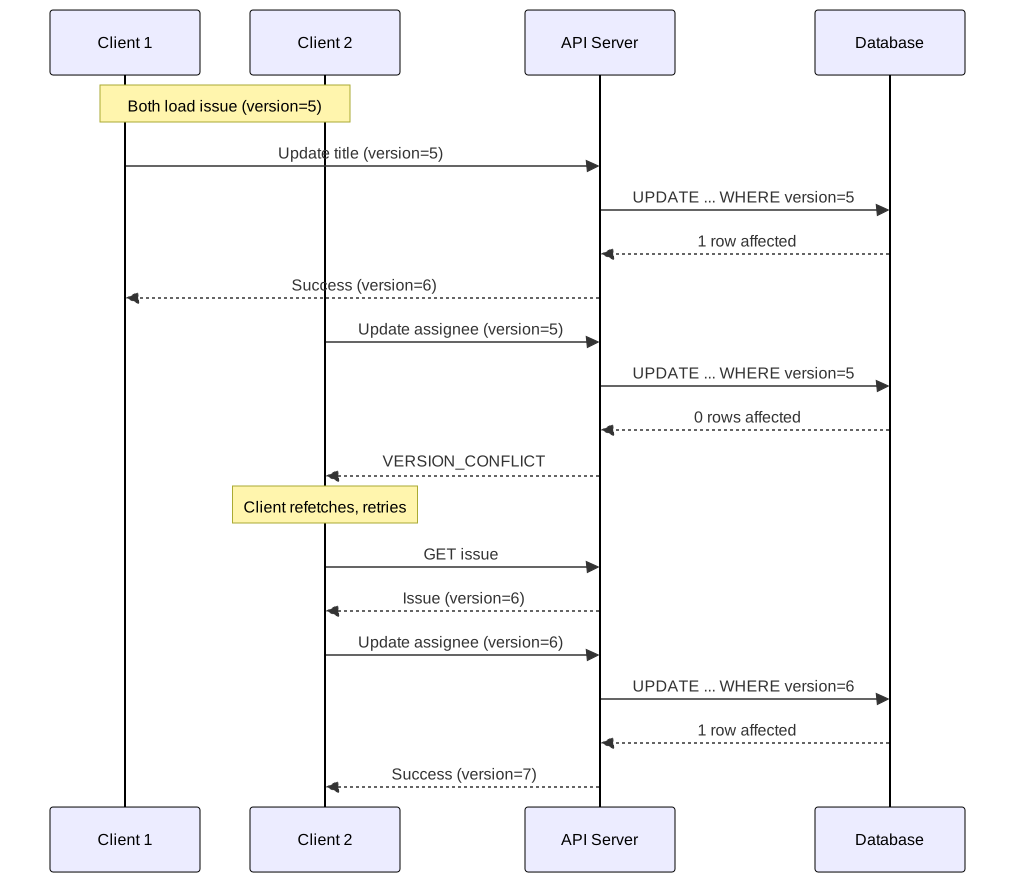
Optimistic Locking Flow
Implementation
20 collapsed lines
interface UpdateIssueInput { issueId: string title?: string description?: string assigneeId?: string version: number}
interface UpdateResult { success: boolean issue?: Issue error?: { code: string; message: string }}
async function updateIssue(input: UpdateIssueInput): Promise<UpdateResult> { const { issueId, version, ...updates } = input
// Build dynamic UPDATE query const setClause = Object.entries(updates) .filter(([_, v]) => v !== undefined) .map(([k, _], i) => `${toSnakeCase(k)} = $${i + 3}`) .join(", ")
const values = Object.values(updates).filter((v) => v !== undefined)
const result = await db.query( ` UPDATE issues SET ${setClause}, version = version + 1, updated_at = NOW() WHERE id = $1 AND version = $2 RETURNING * `, [issueId, version, ...values], )
if (result.rowCount === 0) { // Check if issue exists const exists = await db.query("SELECT version FROM issues WHERE id = $1", [issueId])
if (exists.rowCount === 0) { return { success: false, error: { code: "NOT_FOUND", message: "Issue not found" }, } }
const currentVersion = exists.rows[0].version return { success: false, error: { code: "VERSION_CONFLICT", message: `Version mismatch. Expected ${version}, current is ${currentVersion}`, }, } }
// Broadcast change await publishBoardEvent(result.rows[0].project_id, { action: "UPDATED", issue: result.rows[0], })
return { success: true, issue: result.rows[0] }}Conflict Resolution Strategies
| Strategy | Use Case | Trade-off |
|---|---|---|
| Last-Write-Wins | Most fields (title, assignee, priority) | May lose edits, but simple |
| Field-Level Merge | Non-conflicting field updates | More complex, preserves more |
| Manual Resolution | Description (rich text) | Best fidelity, worst UX |
| CRDT | Concurrent rich text editing | Complex, best for collaboration |
Field-level merge example:
// Client 1 updates title (version 5 → 6)// Client 2 updates assignee (version 5 → conflict)// Instead of rejecting, merge if fields don't overlap
async function mergeUpdate(input: UpdateIssueInput, currentIssue: Issue): Promise<UpdateResult> { const { version, ...updates } = input
// Find which fields changed since client's version const changedFields = await getChangedFieldsSince(input.issueId, version, currentIssue.version)
// Check for conflicts const conflictingFields = Object.keys(updates).filter((f) => changedFields.includes(f))
if (conflictingFields.length > 0) { return { success: false, error: { code: "FIELD_CONFLICT", message: `Conflicting fields: ${conflictingFields.join(", ")}`, }, } }
// No conflicts - apply update to latest version return updateIssue({ ...input, version: currentIssue.version, })}Move Operation (Status + Rank)
Moving an issue involves two atomic changes: status and rank.
10 collapsed lines
interface MoveIssueInput { issueId: string toStatusId: string rankAfterId?: string rankBeforeId?: string version: number}
async function moveIssue(input: MoveIssueInput): Promise<UpdateResult> { const { issueId, toStatusId, rankAfterId, rankBeforeId, version } = input
return db.transaction(async (tx) => { // 1. Lock and fetch current issue const issue = await tx.query("SELECT * FROM issues WHERE id = $1 FOR UPDATE", [issueId])
if (!issue.rows[0]) { return { success: false, error: { code: "NOT_FOUND", message: "Issue not found" } } }
if (issue.rows[0].version !== version) { return { success: false, error: { code: "VERSION_CONFLICT", message: "Concurrent modification" }, } }
const currentIssue = issue.rows[0]
// 2. Validate transition const transitionValid = await validateTransition(tx, currentIssue.project_id, currentIssue.status_id, toStatusId)
if (!transitionValid) { return { success: false, error: { code: "INVALID_TRANSITION", message: "Workflow does not allow this transition" }, } }
// 3. Calculate new rank let newRank: string
if (rankAfterId) { const afterIssue = await tx.query("SELECT rank FROM issues WHERE id = $1", [rankAfterId]) const beforeIssue = rankBeforeId ? await tx.query("SELECT rank FROM issues WHERE id = $1", [rankBeforeId]) : null
newRank = calculateNewRank(afterIssue.rows[0]?.rank, beforeIssue?.rows[0]?.rank) } else if (rankBeforeId) { const beforeIssue = await tx.query("SELECT rank FROM issues WHERE id = $1", [rankBeforeId]) newRank = calculateNewRank(null, beforeIssue.rows[0]?.rank) } else { // Default: bottom of column const lastInColumn = await tx.query( ` SELECT rank FROM issues WHERE project_id = $1 AND status_id = $2 ORDER BY rank DESC LIMIT 1 `, [currentIssue.project_id, toStatusId], )
newRank = calculateNewRank(lastInColumn.rows[0]?.rank, null) }
// 4. Update issue const result = await tx.query( ` UPDATE issues SET status_id = $1, rank = $2, version = version + 1, updated_at = NOW() WHERE id = $3 RETURNING * `, [toStatusId, newRank, issueId], )
// 5. Log activity await tx.query( ` INSERT INTO activity_log (issue_id, user_id, action_type, old_value, new_value) VALUES ($1, $2, 'status_change', $3, $4) `, [ issueId, getCurrentUserId(), JSON.stringify({ status_id: currentIssue.status_id }), JSON.stringify({ status_id: toStatusId }), ], )
// 6. Broadcast (after commit) setImmediate(() => { publishBoardEvent(currentIssue.project_id, { action: "MOVED", issue: result.rows[0], previousStatusId: currentIssue.status_id, }) })
return { success: true, issue: result.rows[0] } })}Low-Level Design: Workflow and Status Management
Workflow Data Model
Each project has its own workflow, defined by statuses and transitions.

Fetching Workflow Configuration
query GetProjectWorkflow($projectId: ID!) { project(id: $projectId) { workflow { statuses { id name category color position } transitions { id name fromStatus { id } toStatus { id } } } }}Response structure:
{ "project": { "workflow": { "statuses": [ { "id": "s1", "name": "To Do", "category": "TODO", "color": "#808080", "position": 1 }, { "id": "s2", "name": "In Progress", "category": "IN_PROGRESS", "color": "#0052cc", "position": 2 }, { "id": "s3", "name": "In Review", "category": "IN_PROGRESS", "color": "#8777d9", "position": 3 }, { "id": "s4", "name": "Done", "category": "DONE", "color": "#36b37e", "position": 4 } ], "transitions": [ { "id": "t1", "name": "Start Progress", "fromStatus": { "id": "s1" }, "toStatus": { "id": "s2" } }, { "id": "t2", "name": "Submit for Review", "fromStatus": { "id": "s2" }, "toStatus": { "id": "s3" } }, { "id": "t3", "name": "Approve", "fromStatus": { "id": "s3" }, "toStatus": { "id": "s4" } }, { "id": "t4", "name": "Reject", "fromStatus": { "id": "s3" }, "toStatus": { "id": "s2" } }, { "id": "t5", "name": "Reopen", "fromStatus": { "id": "s4" }, "toStatus": { "id": "s1" } } ] } }}Workflow Mutation API
# Add a new statusmutation AddStatus($input: AddStatusInput!) { addStatus(input: $input) { status { id name category position } }}
# Add a transitionmutation AddTransition($input: AddTransitionInput!) { addTransition(input: $input) { transition { id name fromStatus { id } toStatus { id } } }}
# Reorder statuses (columns)mutation ReorderStatuses($input: ReorderStatusesInput!) { reorderStatuses(input: $input) { statuses { id position } }}Client-Side Workflow Validation
To provide instant feedback, clients cache workflow rules:
10 collapsed lines
interface WorkflowCache { statuses: Map<string, Status> transitions: Map<string, Set<string>> // fromStatusId → Set<toStatusId>}
class WorkflowValidator { private cache: WorkflowCache
constructor(workflow: Workflow) { this.cache = { statuses: new Map(workflow.statuses.map((s) => [s.id, s])), transitions: new Map(), }
// Build transition map for (const t of workflow.transitions) { const fromId = t.fromStatus?.id || "*" // null = any status if (!this.cache.transitions.has(fromId)) { this.cache.transitions.set(fromId, new Set()) } this.cache.transitions.get(fromId)!.add(t.toStatus.id) } }
canTransition(fromStatusId: string, toStatusId: string): boolean { // Check specific transition if (this.cache.transitions.get(fromStatusId)?.has(toStatusId)) { return true } // Check wildcard (from any status) if (this.cache.transitions.get("*")?.has(toStatusId)) { return true } return false }
getAvailableTransitions(fromStatusId: string): Status[] { const specific = this.cache.transitions.get(fromStatusId) || new Set() const wildcard = this.cache.transitions.get("*") || new Set() const available = new Set([...specific, ...wildcard])
return Array.from(available) .map((id) => this.cache.statuses.get(id)!) .filter(Boolean) }}Frontend Considerations
Board State Management
Normalized data structure:
interface BoardState { // Entities by ID issues: Record<string, Issue> statuses: Record<string, Status> users: Record<string, User>
// Ordering columnOrder: string[] // Status IDs in display order issueOrder: Record<string, string[]> // statusId → issueIds in rank order
// Pagination columnCursors: Record<string, string | null> columnHasMore: Record<string, boolean>
// UI state draggingIssueId: string | null dropTargetColumn: string | null dropTargetIndex: number | null}Why normalized:
- Moving an issue updates two arrays, not nested objects
- React reference equality works for memoization
- Easier to apply real-time updates
Optimistic Updates for Drag-and-Drop
20 collapsed lines
function useMoveIssue() { const [boardState, setBoardState] = useState<BoardState>(initialState) const pendingMoves = useRef<Map<string, { previousState: BoardState }>>(new Map())
const moveIssue = async (issueId: string, toStatusId: string, toIndex: number) => { const issue = boardState.issues[issueId] const fromStatusId = issue.statusId
// 1. Save previous state for rollback const previousState = structuredClone(boardState) pendingMoves.current.set(issueId, { previousState })
// 2. Optimistic update setBoardState((state) => { const newState = { ...state }
// Remove from old column newState.issueOrder = { ...state.issueOrder, [fromStatusId]: state.issueOrder[fromStatusId].filter((id) => id !== issueId), }
// Add to new column at index const newColumnOrder = [...(state.issueOrder[toStatusId] || [])] newColumnOrder.splice(toIndex, 0, issueId) newState.issueOrder[toStatusId] = newColumnOrder
// Update issue status newState.issues = { ...state.issues, [issueId]: { ...issue, statusId: toStatusId }, }
return newState })
// 3. Server request const rankAfterId = toIndex > 0 ? boardState.issueOrder[toStatusId]?.[toIndex - 1] : null const rankBeforeId = boardState.issueOrder[toStatusId]?.[toIndex] || null
try { const result = await api.moveIssue({ issueId, toStatusId, rankAfterId, rankBeforeId, version: issue.version, })
if (!result.success) { throw new Error(result.error?.message || "Move failed") }
// 4. Update with server-assigned rank and version setBoardState((state) => ({ ...state, issues: { ...state.issues, [issueId]: { ...state.issues[issueId], ...result.issue }, }, }))
pendingMoves.current.delete(issueId) } catch (error) { // 5. Rollback on failure const pending = pendingMoves.current.get(issueId) if (pending) { setBoardState(pending.previousState) pendingMoves.current.delete(issueId) } toast.error("Failed to move issue. Please try again.") } }
return { boardState, moveIssue }}Real-time Update Handling
15 collapsed lines
function useBoardSubscription(projectId: string) { const [boardState, setBoardState] = useState<BoardState>(initialState)
useEffect(() => { const subscription = graphqlClient .subscribe({ query: BOARD_CHANGED_SUBSCRIPTION, variables: { projectId }, }) .subscribe({ next: ({ data }) => { const event = data.boardChanged
setBoardState((state) => { // Skip if this is our own optimistic update if (pendingMoves.current.has(event.issue.id)) { return state }
switch (event.action) { case "MOVED": return handleRemoteMove(state, event) case "UPDATED": return handleRemoteUpdate(state, event) case "CREATED": return handleRemoteCreate(state, event) case "DELETED": return handleRemoteDelete(state, event) default: return state } }) }, })
return () => subscription.unsubscribe() }, [projectId])
return boardState}
function handleRemoteMove(state: BoardState, event: BoardEvent): BoardState { const { issue, previousStatusId } = event const newState = { ...state }
// Remove from previous column if (previousStatusId && state.issueOrder[previousStatusId]) { newState.issueOrder = { ...state.issueOrder, [previousStatusId]: state.issueOrder[previousStatusId].filter((id) => id !== issue.id), } }
// Add to new column in correct position based on rank const currentColumnOrder = state.issueOrder[issue.statusId] || [] const insertIndex = findInsertIndex(currentColumnOrder, issue.rank, state.issues)
const newColumnOrder = [...currentColumnOrder] newColumnOrder.splice(insertIndex, 0, issue.id) newState.issueOrder[issue.statusId] = newColumnOrder
// Update issue data newState.issues = { ...state.issues, [issue.id]: issue, }
return newState}Column Virtualization
For boards with many issues per column, virtualize the issue list:
10 collapsed lines
import { useVirtualizer } from '@tanstack/react-virtual';
function VirtualizedColumn({ statusId, issueIds}: { statusId: string; issueIds: string[]}) { const parentRef = useRef<HTMLDivElement>(null);
const virtualizer = useVirtualizer({ count: issueIds.length, getScrollElement: () => parentRef.current, estimateSize: () => 80, // Estimated card height overscan: 5 // Render 5 extra items for smooth scrolling });
return ( <div ref={parentRef} className="column-scroll-container"> <div style={{ height: `${virtualizer.getTotalSize()}px`, position: 'relative' }} > {virtualizer.getVirtualItems().map((virtualItem) => ( <div key={virtualItem.key} style={{ position: 'absolute', top: 0, left: 0, width: '100%', transform: `translateY(${virtualItem.start}px)` }} > <IssueCard issueId={issueIds[virtualItem.index]} /> </div> ))} </div> </div> );}Infrastructure
Cloud-Agnostic Components
| Component | Purpose | Options |
|---|---|---|
| API Gateway | Request routing, auth | Kong, Nginx, Traefik |
| GraphQL Server | Query execution | Apollo Server, Mercurius |
| Message Queue | Event streaming | Kafka, RabbitMQ, NATS |
| Cache | Board state, sessions | Redis, Memcached, KeyDB |
| Search | Full-text search | Elasticsearch, Meilisearch, Typesense |
| Object Storage | Attachments | MinIO, Ceph, S3-compatible |
| Database | Primary store | PostgreSQL, CockroachDB |
AWS Reference Architecture

Service configurations:
| Service | Configuration | Rationale |
|---|---|---|
| GraphQL (Fargate) | 2 vCPU, 4GB RAM | Stateless, scale on request rate |
| WebSocket (Fargate) | 2 vCPU, 4GB RAM | Connection-bound, ~10K per instance |
| Workers (Spot) | 1 vCPU, 2GB RAM | Cost optimization for async |
| RDS PostgreSQL | db.r6g.xlarge Multi-AZ | Primary store, read replicas for scale |
| ElastiCache | r6g.large cluster | Board cache, pub/sub |
| OpenSearch | m6g.large.search × 3 | Search index, 3 nodes for HA |
Scaling Considerations
Read-heavy workload:
- Read replicas for PostgreSQL
- Redis caching for board state
- CDN for static assets
WebSocket connections:
- Sticky sessions to WebSocket servers
- Redis pub/sub for cross-instance broadcast
- ~10K connections per 4GB instance
Search indexing:
- Async indexing via Kafka
- Dedicated OpenSearch domain
- Index aliases for zero-downtime reindexing
Conclusion
This design provides a flexible issue tracking system with:
- O(1) reordering via LexoRank eliminates cascading updates
- Per-column pagination ensures all columns load incrementally
- Optimistic locking handles concurrent edits with minimal conflict
- Project-scoped workflows allow team customization without global impact
- Real-time sync via GraphQL subscriptions provides sub-300ms propagation
Key architectural decisions:
- LexoRank for ordering trades storage (growing strings) for write efficiency
- Per-column pagination over global pagination ensures balanced board views
- Last-write-wins is acceptable for most fields; CRDTs reserved for rich text
- Denormalized Redis cache trades consistency for read performance
Known limitations:
- LexoRank requires periodic rebalancing (background job)
- Last-write-wins may lose concurrent edits on same field
- Large boards (>1000 issues) need virtualization
Future enhancements:
- Local-first architecture for offline support (Linear-style sync engine)
- Field-level CRDTs for conflict-free concurrent editing
- GraphQL federation for microservices decomposition
Appendix
Prerequisites
- Distributed systems fundamentals (eventual consistency, optimistic locking)
- GraphQL basics (queries, mutations, subscriptions)
- React state management patterns
- SQL and database design
Terminology
| Term | Definition |
|---|---|
| LexoRank | Lexicographically sortable string for ordering without cascading updates |
| Optimistic locking | Concurrency control using version numbers to detect conflicts |
| Workflow | Set of statuses and allowed transitions between them |
| Fractional indexing | Using real numbers (or strings) for ordering with O(1) insertions |
| Cursor-based pagination | Using opaque cursors instead of offsets for stable pagination |
| Last-write-wins (LWW) | Conflict resolution where the latest timestamp wins |
Summary
- LexoRank ordering enables O(1) drag-and-drop without updating other rows
- Per-column pagination with cursor-based approach ensures balanced board loading
- Optimistic locking with version field detects concurrent modifications
- Project-scoped workflows allow custom statuses without schema changes
- GraphQL subscriptions provide real-time updates with sub-300ms propagation
- Denormalized Redis cache trades consistency for fast board reads
References
Issue Tracker APIs:
- Jira Software Cloud REST API - Board and agile endpoints
- Jira Cloud Platform REST API - Issue and workflow endpoints
- Linear Developers - GraphQL API - GraphQL schema and patterns
- Asana Developers - Task and section ordering
Ordering Algorithms:
- Figma Blog - Realtime Editing of Ordered Sequences - Fractional indexing at scale
- Understanding LexoRank - Jira’s ranking system
- LexoRank Explained - Detailed algorithm walkthrough
- rocicorp/fractional-indexing - Reference implementation
Sync and Real-time:
- Scaling the Linear Sync Engine - Local-first architecture
- Reverse Engineering Linear’s Sync Engine - Technical deep-dive
- Conflict-free Replicated Data Types - CRDT resources
System Design:
- Optimistic Concurrency Control - Concurrency patterns
- Cursor-based Pagination - Relay connection specification