Design Real-Time Chat and Messaging
A comprehensive system design for real-time chat and messaging covering connection management, message delivery guarantees, ordering strategies, presence systems, group chat fan-out, and offline synchronization. This design addresses sub-second message delivery at WhatsApp/Discord scale (100B+ messages/day) with strong delivery guarantees and mobile-first offline resilience.

Abstract
Real-time chat systems solve three interrelated problems: low-latency delivery (messages appear within milliseconds), reliable delivery (no message is ever lost), and ordering consistency (messages appear in the same order for all participants).
Core architectural decisions:
| Decision | Choice | Rationale |
|---|---|---|
| Transport | WebSocket | Full-duplex, 2-byte overhead after handshake |
| Delivery guarantee | At-least-once + client dedup | Simpler than exactly-once; idempotency at app layer |
| Message ordering | Server-assigned timestamps | Single source of truth; avoids clock skew issues |
| Fan-out model | Hybrid push/pull | Push for small groups, pull for large channels |
| Presence | Heartbeat + Redis pub/sub | Ephemeral data; no persistence needed |
| Offline sync | Client-side sequence tracking | Fetch missed messages on reconnect |
Key trade-offs accepted:
- Server dependency for ordering (no P2P) in exchange for correctness guarantees
- At-least-once delivery requiring client-side deduplication
- Eventual consistency for presence (acceptable for UX)
- Higher infrastructure cost for guaranteed delivery (message queue durability)
What this design optimizes:
- Sub-500ms global message delivery
- Zero message loss under network partitions
- Seamless offline-to-online transitions
- Horizontal scalability to billions of messages/day
Requirements
Functional Requirements
| Requirement | Priority | Notes |
|---|---|---|
| 1:1 direct messaging | Core | Private conversations between two users |
| Group messaging | Core | Up to 1000 members per group |
| Message delivery receipts | Core | Sent, delivered, read indicators |
| Typing indicators | Core | Real-time “user is typing” display |
| Online/offline presence | Core | Show user availability status |
| Offline message delivery | Core | Queue and deliver when user reconnects |
| Message history sync | Core | Retrieve past messages across devices |
| Read receipts | Extended | Track who has read messages |
| Media attachments | Extended | Images, videos, files (out of detailed scope) |
| End-to-end encryption | Extended | Signal protocol (out of detailed scope) |
Non-Functional Requirements
| Requirement | Target | Rationale |
|---|---|---|
| Availability | 99.99% (4 nines) | Communication is critical; 52 min/year downtime max |
| Message delivery latency | p99 < 500ms | Real-time feel requires sub-second |
| Message durability | 99.9999% | No message should ever be lost |
| Offline sync time | < 5s for 1000 messages | Fast reconnection experience |
| Concurrent connections | 10M per region | Mobile-scale concurrent users |
| Message retention | 30 days default, configurable | Storage cost vs. user expectations |
Scale Estimation
Users:
- Monthly Active Users (MAU): 500M
- Daily Active Users (DAU): 200M (40% of MAU)
- Peak concurrent connections: 50M (25% of DAU)
Traffic:
- Messages per user per day: 50 (mix of 1:1 and group)
- Daily messages: 200M × 50 = 10B messages/day
- Peak messages per second: 10B / 86400 × 3 (peak multiplier) = 350K msgs/sec
Storage:
- Average message size: 500 bytes (text + metadata)
- Daily storage: 10B × 500B = 5TB/day
- 30-day retention: 150TB
- With replication (3x): 450TB
Connections:
- WebSocket connections per gateway: 500K (Linux file descriptor limits)
- Gateway servers needed: 50M / 500K = 100 servers minimum
- With redundancy (2x): 200 gateway servers
Design Paths
Path A: Connection-Centric (Server-Routed)
Best when:
- Infrastructure team can maintain stateful WebSocket servers
- Low latency is primary requirement
- Moderate group sizes (< 500 members)
- Strong consistency for message ordering needed
Architecture:
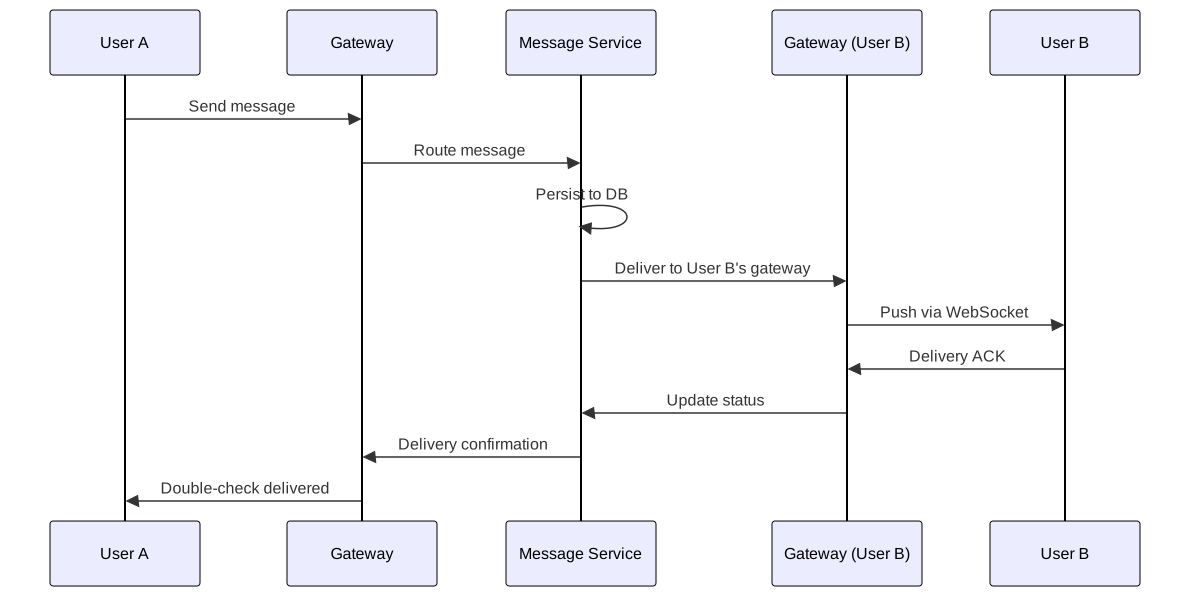
Key characteristics:
- Each gateway maintains user-to-connection mapping
- Message service routes directly to recipient’s gateway
- Synchronous delivery with acknowledgment chain
Trade-offs:
- ✅ Lowest latency (direct routing)
- ✅ Simple mental model
- ✅ Strong ordering guarantees
- ❌ Gateway state management complexity
- ❌ User migration on gateway failure
- ❌ Limited group size due to fan-out cost
Real-world example: WhatsApp uses this approach with TCP persistent connections. Each server maintains ~1-2M connections. Messages route through servers using recipient’s assigned gateway.
Path B: Queue-Centric (Async Fan-out)
Best when:
- Very large groups/channels (1000+ members)
- Geographic distribution across regions
- Tolerance for slightly higher latency (100-500ms)
- Need for replay and audit capabilities
Architecture:

Key characteristics:
- Messages published to Kafka partitioned by conversation
- Fan-out workers consume and distribute to recipients
- Decouples send from delivery for reliability
Trade-offs:
- ✅ Handles large fan-out efficiently
- ✅ Built-in replay capability
- ✅ Better failure isolation
- ❌ Higher latency (queue hop)
- ❌ More complex infrastructure
- ❌ Ordering requires partition strategy
Real-world example: Slack uses this approach with Kafka handling 6.5 Gbps peak throughput across 10 clusters. Channel servers use consistent hashing to maintain per-channel ordering.
Path C: Hybrid (Push for Small, Pull for Large)
Best when:
- Mix of 1:1, small groups, and large channels
- Need to balance latency vs. resource usage
- Celebrity/influencer use cases with massive follower counts
Architecture:

Key characteristics:
- Small groups use direct push for lowest latency
- Large groups use async fan-out to avoid write amplification
- Threshold typically 50-100 members
Trade-offs:
- ✅ Optimal latency for common case (1:1 and small groups)
- ✅ Scales to large channels without overwhelming gateways
- ✅ Flexible resource allocation
- ❌ Two code paths to maintain
- ❌ Threshold tuning required
- ❌ Slightly inconsistent delivery characteristics
Real-world example: Discord uses this approach. Small servers get direct fan-out; large servers (100+ members) route through Kafka for distributed processing.
Path Comparison
| Factor | Connection-Centric | Queue-Centric | Hybrid |
|---|---|---|---|
| Latency (p50) | 50-100ms | 100-300ms | 50-300ms |
| Max group size | ~500 | Unlimited | Unlimited |
| Complexity | Moderate | High | Highest |
| Failure isolation | Gateway-level | Topic-level | Mixed |
| Replay capability | Limited | Native | Mixed |
| Production examples | Slack | Discord |
This Article’s Focus
This article focuses on Path C (Hybrid) because:
- Covers the full spectrum of use cases (1:1 to large channels)
- Represents modern production architectures (Discord, Telegram)
- Demonstrates trade-off thinking expected in system design interviews
- Balances latency optimization with scalability
High-Level Design
Component Overview

WebSocket Gateway
Manages persistent connections and routes messages between clients and services.
Responsibilities:
- WebSocket connection lifecycle (connect, heartbeat, disconnect)
- Authentication and session validation
- Message routing to appropriate services
- Presence event broadcasting
- Graceful connection migration on shutdown
Design decisions:
| Decision | Choice | Rationale |
|---|---|---|
| Protocol | WebSocket over TLS | Full-duplex, minimal overhead, universal support |
| Session affinity | Consistent hashing by user_id | Predictable routing, simplifies state management |
| Heartbeat interval | 30 seconds | Balance between detection speed and overhead |
| Connection timeout | 90 seconds | 3 missed heartbeats before disconnect |
| Max connections/server | 500K | Linux file descriptor limits with tuning |
Scaling approach:
- Horizontal scaling with consistent hashing
- User-to-gateway mapping stored in Redis
- Graceful drain on shutdown (notify clients to reconnect)
Message Service
Core service for message processing, persistence, and routing.
State per message:
interface Message { messageId: string // UUID, client-generated for idempotency conversationId: string // 1:1 or group conversation senderId: string content: MessageContent timestamp: number // Server-assigned Unix timestamp sequenceNumber: bigint // Per-conversation monotonic sequence status: MessageStatus // PENDING | SENT | DELIVERED | READ expiresAt?: number // Optional TTL for ephemeral messages}
interface MessageContent { type: "text" | "image" | "file" | "location" text?: string mediaUrl?: string metadata?: Record<string, any>}
type MessageStatus = "PENDING" | "SENT" | "DELIVERED" | "READ"Message flow:
- Receive: Gateway forwards message with client-generated messageId
- Deduplicate: Check messageId in recent message cache (idempotency)
- Validate: Verify sender membership in conversation, rate limits
- Persist: Write to ScyllaDB with server timestamp and sequence number
- Route: Determine delivery path (direct push vs. Kafka)
- Acknowledge: Return sequence number to sender
- Fan-out: Distribute to recipients via appropriate channel
Presence Service
Handles online/offline status, typing indicators, and last-seen timestamps.
Design decisions:
- No persistence: Presence reconstructed from heartbeats
- TTL-based: Status expires automatically on disconnect
- Pub/Sub distribution: Redis pub/sub for real-time updates
- Throttled updates: Max 1 presence update per second per user
Data structures:
interface UserPresence { userId: string status: "online" | "away" | "offline" lastSeen: number // Unix timestamp deviceType: "mobile" | "web" | "desktop" typingIn?: string // conversationId if typing typingExpires?: number // Auto-clear after 5 seconds}Presence subscription model:
- Users subscribe to presence of their contacts on connect
- Changes broadcast via Redis pub/sub to subscribed gateways
- Gateways filter and forward to relevant connected clients
Sync Service
Handles message history retrieval and offline synchronization.
Sync protocol:
- Client maintains
lastSequenceNumberper conversation - On reconnect, client sends list of (conversationId, lastSeq) pairs
- Server returns all messages with sequence > lastSeq
- Client merges into local database, deduplicating by messageId
Pagination strategy:
- Default page size: 50 messages
- Cursor-based pagination using (conversationId, sequenceNumber)
- Supports forward (newer) and backward (older) fetching
API Design
WebSocket Protocol
Connection Handshake
wss://chat.example.com/ws?token={jwt}&device_id={uuid}Initial connection message (server → client):
{ "type": "connected", "connectionId": "conn_abc123", "serverTime": 1706886400000, "heartbeatInterval": 30000, "resumeToken": "resume_xyz789"}Client → Server Messages
Send Message:
{ "type": "message.send", "id": "req_001", "payload": { "messageId": "msg_uuid_client_generated", "conversationId": "conv_abc123", "content": { "type": "text", "text": "Hello, world!" } }}Typing Indicator:
{ "type": "typing.start", "payload": { "conversationId": "conv_abc123" }}Mark Read:
{ "type": "message.read", "payload": { "conversationId": "conv_abc123", "upToSequence": 1542 }}Heartbeat:
{ "type": "heartbeat", "timestamp": 1706886400000}Server → Client Messages
Message Acknowledgment:
{ "type": "message.ack", "id": "req_001", "payload": { "messageId": "msg_uuid_client_generated", "sequenceNumber": 1543, "timestamp": 1706886400123 }}New Message (from another user):
{ "type": "message.new", "payload": { "messageId": "msg_xyz789", "conversationId": "conv_abc123", "senderId": "user_456", "content": { "type": "text", "text": "Hi there!" }, "sequenceNumber": 1544, "timestamp": 1706886401000 }}Delivery Receipt:
{ "type": "message.delivered", "payload": { "conversationId": "conv_abc123", "messageIds": ["msg_uuid_1", "msg_uuid_2"], "deliveredTo": "user_456", "timestamp": 1706886402000 }}Read Receipt:
{ "type": "message.read_receipt", "payload": { "conversationId": "conv_abc123", "readUpToSequence": 1544, "readBy": "user_456", "timestamp": 1706886403000 }}Presence Update:
{ "type": "presence.update", "payload": { "userId": "user_456", "status": "online", "typingIn": null }}Typing Indicator:
{ "type": "typing.update", "payload": { "conversationId": "conv_abc123", "userId": "user_456", "isTyping": true }}REST API
Sync Messages (Offline Recovery)
Endpoint: POST /api/v1/sync
Request:
{ "conversations": [ { "conversationId": "conv_abc", "lastSequence": 1500 }, { "conversationId": "conv_xyz", "lastSequence": 2300 } ], "limit": 100}Response (200 OK):
{ "conversations": [ { "conversationId": "conv_abc", "messages": [ { "messageId": "msg_001", "senderId": "user_123", "content": { "type": "text", "text": "Hello" }, "sequenceNumber": 1501, "timestamp": 1706886400000, "status": "DELIVERED" } ], "hasMore": false } ], "serverTime": 1706886500000}Create Conversation
Endpoint: POST /api/v1/conversations
Request:
{ "type": "direct", "participantIds": ["user_456"]}Response (201 Created):
{ "conversationId": "conv_new123", "type": "direct", "participants": [ { "userId": "user_123", "role": "member" }, { "userId": "user_456", "role": "member" } ], "createdAt": "2024-02-03T10:00:00Z"}Create Group
Endpoint: POST /api/v1/groups
Request:
{ "name": "Project Team", "participantIds": ["user_456", "user_789"], "settings": { "onlyAdminsCanPost": false, "allowMemberInvites": true }}Response (201 Created):
{ "conversationId": "conv_group_abc", "type": "group", "name": "Project Team", "participants": [ { "userId": "user_123", "role": "admin" }, { "userId": "user_456", "role": "member" }, { "userId": "user_789", "role": "member" } ], "memberCount": 3, "createdAt": "2024-02-03T10:00:00Z"}Message History
Endpoint: GET /api/v1/conversations/{id}/messages?before={sequence}&limit=50
Response (200 OK):
{ "messages": [ { "messageId": "msg_xyz", "senderId": "user_456", "content": { "type": "text", "text": "Earlier message" }, "sequenceNumber": 1450, "timestamp": 1706880000000 } ], "hasMore": true, "nextCursor": "seq_1449"}Error Responses
| Code | Error | When |
|---|---|---|
| 400 | INVALID_MESSAGE | Message format invalid |
| 401 | UNAUTHORIZED | Invalid or expired token |
| 403 | FORBIDDEN | Not a member of conversation |
| 404 | CONVERSATION_NOT_FOUND | Conversation doesn’t exist |
| 409 | DUPLICATE_MESSAGE | messageId already processed |
| 429 | RATE_LIMITED | Too many messages |
Rate limit response:
{ "error": "RATE_LIMITED", "message": "Message rate limit exceeded", "retryAfter": 5, "limit": "100 messages per minute"}Data Modeling
Message Storage (ScyllaDB)
Table design for time-series message access:
CREATE TABLE messages ( conversation_id UUID, sequence_number BIGINT, message_id UUID, sender_id UUID, content_type TEXT, content_text TEXT, content_media_url TEXT, timestamp TIMESTAMP, status TEXT, expires_at TIMESTAMP, PRIMARY KEY ((conversation_id), sequence_number)) WITH CLUSTERING ORDER BY (sequence_number DESC);Why ScyllaDB:
- Optimized for time-series data (messages ordered by sequence)
- Partition per conversation enables efficient range queries
- No garbage collection pauses (C++ implementation)
- Linear horizontal scaling
Performance characteristics:
- Read latency p99: 15ms (vs. 40-125ms for Cassandra)
- Write latency p99: 5ms
- Partition size recommendation: < 100MB (~200K messages per conversation)
Partition hot-spot mitigation:
- Very active conversations split into time-bucketed partitions
- Partition key: (conversation_id, time_bucket)
- Time bucket: daily for active chats, monthly for archives
Message Deduplication Cache (Redis)
Purpose: Prevent duplicate message processing (idempotency)
# Set messageId with 24-hour TTLSETEX msg:dedup:{message_id} 86400 1
# Check before processingEXISTS msg:dedup:{message_id}User and Conversation Metadata (PostgreSQL)
CREATE TABLE users ( id UUID PRIMARY KEY DEFAULT gen_random_uuid(), username VARCHAR(50) UNIQUE NOT NULL, display_name VARCHAR(100), avatar_url TEXT, phone_hash VARCHAR(64) UNIQUE, created_at TIMESTAMPTZ DEFAULT NOW(), last_active_at TIMESTAMPTZ);
CREATE TABLE conversations ( id UUID PRIMARY KEY DEFAULT gen_random_uuid(), type VARCHAR(20) NOT NULL, -- 'direct' or 'group' name VARCHAR(100), -- NULL for direct avatar_url TEXT, created_by UUID REFERENCES users(id), created_at TIMESTAMPTZ DEFAULT NOW(), updated_at TIMESTAMPTZ DEFAULT NOW(), last_message_at TIMESTAMPTZ, last_sequence BIGINT DEFAULT 0, member_count INT DEFAULT 0, settings JSONB DEFAULT '{}');
CREATE TABLE conversation_members ( conversation_id UUID REFERENCES conversations(id) ON DELETE CASCADE, user_id UUID REFERENCES users(id) ON DELETE CASCADE, role VARCHAR(20) DEFAULT 'member', -- 'admin', 'member' joined_at TIMESTAMPTZ DEFAULT NOW(), last_read_sequence BIGINT DEFAULT 0, muted_until TIMESTAMPTZ, PRIMARY KEY (conversation_id, user_id));
-- IndexesCREATE INDEX idx_members_user ON conversation_members(user_id);CREATE INDEX idx_conversations_updated ON conversations(updated_at DESC);Session and Connection State (Redis)
# User's active connections (set)SADD user:conn:{user_id} {connection_id}SREM user:conn:{user_id} {connection_id}
# Connection → Gateway mapping (hash)HSET conn:{connection_id} gateway "gateway-1.us-east-1" user_id "user_123" device_id "device_abc" connected_at 1706886400000
# User presence (hash with TTL)HSET presence:{user_id} status "online" last_seen 1706886400000 device_type "mobile"EXPIRE presence:{user_id} 120
# Typing indicators (with auto-expire)SETEX typing:{conversation_id}:{user_id} 5 1Database Selection Matrix
| Data Type | Store | Rationale |
|---|---|---|
| Messages | ScyllaDB | Time-series optimized, low latency, horizontal scale |
| User profiles | PostgreSQL | ACID, complex queries, moderate scale |
| Conversation metadata | PostgreSQL | Relational queries, ACL management |
| Sessions, presence | Redis Cluster | Sub-ms latency, TTL support, pub/sub |
| Message dedup cache | Redis | Fast lookups, automatic expiry |
| Media files | S3 | Object storage, CDN integration |
| Analytics events | Kafka → ClickHouse | High-volume time-series analytics |
Low-Level Design
Message Delivery Pipeline
Direct Push (Small Groups)
For conversations with < 100 members:
12 collapsed lines
class DirectPushHandler { private readonly redis: RedisCluster private readonly messageStore: MessageStore
async deliverMessage(message: Message): Promise<void> { // 1. Get all members of conversation const members = await this.getConversationMembers(message.conversationId)
// 2. For each member, find their active connections const deliveryTasks = members .filter((m) => m.userId !== message.senderId) .map(async (member) => { const connections = await this.redis.smembers(`user:conn:${member.userId}`)
if (connections.length > 0) { // User is online - push directly await Promise.all(connections.map((connId) => this.pushToConnection(connId, message))) return { userId: member.userId, status: "pushed" } } else { // User is offline - queue for push notification await this.queuePushNotification(member.userId, message) return { userId: member.userId, status: "queued" } } })
const results = await Promise.all(deliveryTasks)
// 3. Update delivery status const deliveredTo = results.filter((r) => r.status === "pushed").map((r) => r.userId)
if (deliveredTo.length > 0) { await this.notifyDeliveryReceipt(message, deliveredTo) } }
private async pushToConnection(connId: string, message: Message): Promise<void> { const connInfo = await this.redis.hgetall(`conn:${connId}`) const gateway = connInfo.gateway
// Send via internal RPC to gateway await this.gatewayClient.send(gateway, { type: "deliver", connectionId: connId, message, }) }}Kafka Fan-out (Large Groups)
For conversations with >= 100 members:
15 collapsed lines
class KafkaFanoutHandler { private readonly kafka: KafkaProducer private readonly FANOUT_TOPIC = "messages.fanout"
async publishForFanout(message: Message, memberCount: number): Promise<void> { // Partition by conversation for ordering guarantee await this.kafka.send({ topic: this.FANOUT_TOPIC, messages: [ { key: message.conversationId, value: JSON.stringify({ message, memberCount, publishedAt: Date.now(), }), }, ], }) }}
// Fan-out consumer (multiple instances)class FanoutConsumer { private readonly BATCH_SIZE = 100
async processMessage(record: KafkaRecord): Promise<void> { const { message, memberCount } = JSON.parse(record.value)
// Process members in batches to avoid memory pressure let offset = 0 while (offset < memberCount) { const memberBatch = await this.getMemberBatch(message.conversationId, offset, this.BATCH_SIZE)
await Promise.all(memberBatch.map((member) => this.deliverToMember(member, message)))
offset += this.BATCH_SIZE } }}Message Ordering and Sequencing
Sequence Number Assignment
8 collapsed lines
class SequenceGenerator { private readonly redis: RedisCluster
async getNextSequence(conversationId: string): Promise<bigint> { // Atomic increment in Redis const sequence = await this.redis.incr(`seq:${conversationId}`) return BigInt(sequence) }}
class MessageProcessor { async processIncoming(conversationId: string, message: IncomingMessage): Promise<ProcessedMessage> { // Acquire conversation lock for ordering const lock = await this.acquireLock(`lock:msg:${conversationId}`, 5000)
try { // Assign sequence number const sequenceNumber = await this.sequenceGenerator.getNextSequence(conversationId)
// Assign server timestamp const timestamp = Date.now()
const processed: ProcessedMessage = { ...message, sequenceNumber, timestamp, status: "SENT", }
// Persist with sequence number await this.messageStore.insert(processed)
return processed } finally { await lock.release() } }}Client-Side Ordering
10 collapsed lines
class ClientMessageBuffer { private pendingMessages: Map<string, Message[]> = new Map() private lastSequence: Map<string, bigint> = new Map()
onMessageReceived(message: Message): void { const expected = (this.lastSequence.get(message.conversationId) || 0n) + 1n
if (message.sequenceNumber === expected) { // In order - deliver immediately this.deliverToUI(message) this.lastSequence.set(message.conversationId, message.sequenceNumber)
// Check for buffered messages that can now be delivered this.flushBuffer(message.conversationId) } else if (message.sequenceNumber > expected) { // Out of order - buffer and request missing this.bufferMessage(message) this.requestMissing(message.conversationId, expected, message.sequenceNumber) } // If sequence < expected, it's a duplicate - ignore }
private flushBuffer(conversationId: string): void { const buffer = this.pendingMessages.get(conversationId) || [] buffer.sort((a, b) => Number(a.sequenceNumber - b.sequenceNumber))
let expected = (this.lastSequence.get(conversationId) || 0n) + 1n while (buffer.length > 0 && buffer[0].sequenceNumber === expected) { const msg = buffer.shift()! this.deliverToUI(msg) this.lastSequence.set(conversationId, msg.sequenceNumber) expected++ }
this.pendingMessages.set(conversationId, buffer) }}Presence System
Heartbeat Processing
10 collapsed lines
class PresenceManager { private readonly PRESENCE_TTL = 120 // seconds private readonly TYPING_TTL = 5 // seconds
async handleHeartbeat(userId: string, deviceType: string): Promise<void> { const now = Date.now()
// Update presence with TTL await this.redis .multi() .hset(`presence:${userId}`, { status: "online", last_seen: now, device_type: deviceType, }) .expire(`presence:${userId}`, this.PRESENCE_TTL) .exec()
// Publish presence change to subscribers await this.redis.publish( `presence:changes`, JSON.stringify({ userId, status: "online", timestamp: now, }), ) }
async handleDisconnect(userId: string): Promise<void> { // Check if user has other active connections const connections = await this.redis.smembers(`user:conn:${userId}`)
if (connections.length === 0) { // No more connections - mark offline const now = Date.now()
await this.redis.hset(`presence:${userId}`, { status: "offline", last_seen: now, })
await this.redis.publish( `presence:changes`, JSON.stringify({ userId, status: "offline", lastSeen: now, }), ) } }
async setTyping(userId: string, conversationId: string): Promise<void> { await this.redis.setex(`typing:${conversationId}:${userId}`, this.TYPING_TTL, "1")
// Notify conversation members await this.redis.publish( `typing:${conversationId}`, JSON.stringify({ userId, isTyping: true, }), ) }}Presence Subscription
12 collapsed lines
class PresenceSubscriber { private subscribedUsers: Set<string> = new Set()
async subscribeToContacts(userId: string, contactIds: string[]): Promise<void> { // Get current status of all contacts const pipeline = this.redis.pipeline() contactIds.forEach((id) => { pipeline.hgetall(`presence:${id}`) }) const results = await pipeline.exec()
// Send initial presence state const presences = contactIds.map((id, i) => ({ userId: id, ...(results[i][1] || { status: "offline" }), }))
this.sendToClient({ type: "presence.bulk", payload: { presences } })
// Subscribe to changes contactIds.forEach((id) => this.subscribedUsers.add(id)) }
onPresenceChange(change: PresenceChange): void { if (this.subscribedUsers.has(change.userId)) { this.sendToClient({ type: "presence.update", payload: change, }) } }}Offline Sync Protocol
15 collapsed lines
class SyncService { async syncConversations( userId: string, syncState: Array<{ conversationId: string; lastSequence: bigint }>, ): Promise<SyncResponse> { const results: ConversationSync[] = []
for (const { conversationId, lastSequence } of syncState) { // Verify user is member const isMember = await this.checkMembership(userId, conversationId) if (!isMember) continue
// Fetch missed messages const messages = await this.messageStore.getMessagesAfter( conversationId, lastSequence, 100, // limit per conversation )
// Get conversation metadata if changed const conversation = await this.conversationStore.get(conversationId)
results.push({ conversationId, messages, hasMore: messages.length === 100, lastSequence: messages.length > 0 ? messages[messages.length - 1].sequenceNumber : lastSequence, unreadCount: await this.getUnreadCount(userId, conversationId), }) }
// Also check for new conversations const newConversations = await this.getNewConversations(userId, syncState)
return { conversations: results, newConversations, serverTime: Date.now(), } }}Frontend Considerations
Connection Management
Reconnection with exponential backoff:
15 collapsed lines
class WebSocketManager { private ws: WebSocket | null = null private reconnectAttempt = 0 private readonly MAX_RECONNECT_DELAY = 30000 private readonly BASE_DELAY = 1000
connect(): void { this.ws = new WebSocket(this.buildUrl())
this.ws.onopen = () => { this.reconnectAttempt = 0 this.onConnected() }
this.ws.onclose = (event) => { if (!event.wasClean) { this.scheduleReconnect() } }
this.ws.onerror = () => { // Will trigger onclose } }
private scheduleReconnect(): void { const delay = Math.min( this.BASE_DELAY * Math.pow(2, this.reconnectAttempt) + Math.random() * 1000, // Jitter this.MAX_RECONNECT_DELAY, )
this.reconnectAttempt++
setTimeout(() => this.connect(), delay) }}Local Message Storage
IndexedDB schema for offline support:
20 collapsed lines
interface LocalDBSchema { messages: { key: [string, number] // [conversationId, sequenceNumber] value: Message indexes: { "by-conversation": string "by-timestamp": number "by-status": string } } conversations: { key: string // conversationId value: ConversationMeta indexes: { "by-updated": number } } syncState: { key: string // conversationId value: { lastSequence: number; lastSync: number } }}
class LocalMessageStore { private db: IDBDatabase
async saveMessage(message: Message): Promise<void> { const tx = this.db.transaction("messages", "readwrite") await tx.objectStore("messages").put(message) }
async getMessages(conversationId: string, options: { before?: number; limit: number }): Promise<Message[]> { const tx = this.db.transaction("messages", "readonly") const index = tx.objectStore("messages").index("by-conversation")
const range = IDBKeyRange.bound([conversationId, 0], [conversationId, options.before || Number.MAX_SAFE_INTEGER])
const messages: Message[] = [] let cursor = await index.openCursor(range, "prev")
while (cursor && messages.length < options.limit) { messages.push(cursor.value) cursor = await cursor.continue() }
return messages }}Optimistic Updates
10 collapsed lines
class MessageSender { async sendMessage(conversationId: string, content: MessageContent): Promise<void> { const clientMessageId = crypto.randomUUID() const optimisticMessage: Message = { messageId: clientMessageId, conversationId, senderId: this.currentUserId, content, timestamp: Date.now(), sequenceNumber: -1n, // Pending status: "PENDING", }
// 1. Show immediately in UI this.messageStore.addOptimistic(optimisticMessage) this.ui.appendMessage(optimisticMessage)
// 2. Persist to local DB await this.localDb.saveMessage(optimisticMessage)
// 3. Send to server try { const ack = await this.ws.sendAndWait({ type: "message.send", payload: { messageId: clientMessageId, conversationId, content, }, })
// 4. Update with server-assigned values const confirmedMessage = { ...optimisticMessage, sequenceNumber: ack.sequenceNumber, timestamp: ack.timestamp, status: "SENT", }
this.messageStore.updateOptimistic(clientMessageId, confirmedMessage) await this.localDb.saveMessage(confirmedMessage) } catch (error) { // 5. Mark as failed this.messageStore.markFailed(clientMessageId) this.ui.showRetryOption(clientMessageId) } }}Virtual List for Message History
15 collapsed lines
interface VirtualListConfig { containerHeight: number itemHeight: number // Estimated, variable heights supported overscan: number // Extra items to render above/below viewport}
class VirtualMessageList { private visibleRange = { start: 0, end: 0 } private heightCache = new Map<string, number>()
calculateVisibleRange(scrollTop: number): { start: number; end: number } { const messages = this.getMessages() let accumulatedHeight = 0 let start = 0 let end = messages.length
// Find start index for (let i = 0; i < messages.length; i++) { const height = this.getItemHeight(messages[i]) if (accumulatedHeight + height > scrollTop - this.config.overscan * 50) { start = i break } accumulatedHeight += height }
// Find end index accumulatedHeight = 0 for (let i = start; i < messages.length; i++) { accumulatedHeight += this.getItemHeight(messages[i]) if (accumulatedHeight > this.config.containerHeight + this.config.overscan * 50) { end = i + 1 break } }
return { start, end } }
// Render only visible messages render(): MessageItem[] { const { start, end } = this.visibleRange return this.getMessages().slice(start, end) }}Infrastructure
Cloud-Agnostic Components
| Component | Purpose | Options |
|---|---|---|
| WebSocket Gateway | Persistent connections | Nginx (ws), HAProxy, Envoy |
| Message Queue | Async delivery, ordering | Kafka, Pulsar, NATS JetStream |
| KV Store | Sessions, presence | Redis, KeyDB, Dragonfly |
| Message Store | Message persistence | ScyllaDB, Cassandra, DynamoDB |
| Relational DB | User/group metadata | PostgreSQL, CockroachDB |
| Object Store | Media files | MinIO, Ceph, S3-compatible |
| Push Gateway | Mobile notifications | Self-hosted or APNs/FCM proxy |
AWS Reference Architecture

Service configurations:
| Service | Configuration | Rationale |
|---|---|---|
| WebSocket (Fargate) | 4 vCPU, 8GB, 500K conn/pod | Memory for connection state |
| Message Service | 2 vCPU, 4GB | Stateless, CPU-bound |
| Fan-out Workers | 2 vCPU, 4GB, Spot | Cost optimization for async |
| ElastiCache Redis | r6g.2xlarge cluster mode | Sub-ms presence lookups |
| Keyspaces | On-demand | Serverless Cassandra for messages |
| RDS PostgreSQL | db.r6g.xlarge Multi-AZ | Metadata, moderate write load |
| MSK | kafka.m5.large, 3 brokers | 6.5 Gbps throughput capacity |
Scaling Considerations
WebSocket connection limits:
- Linux default: 1024 file descriptors per process
- Tuned: 1M+ with sysctl adjustments
- Practical per pod: 500K (memory constrained)
- 50M concurrent users → 100 gateway pods minimum
Kafka partitioning:
- Partition by conversation_id for ordering
- Minimum partitions: 100 (allows 100 parallel consumers)
- Hot partition handling: re-partition extremely active conversations
Message storage partitioning:
- ScyllaDB partition key: conversation_id
- Max partition size: 100MB (~200K messages)
- Very active conversations: add time bucket to partition key
Presence fan-out:
- Redis pub/sub scales to ~10K subscribers per channel
- For users with 10K+ contacts: use hierarchical pub/sub or dedicated presence servers
Conclusion
This design provides real-time chat and messaging with:
- Sub-500ms message delivery via WebSocket with hybrid push/pull fan-out
- At-least-once delivery with client-side deduplication for reliability
- Strong per-conversation ordering through server-assigned sequence numbers
- Seamless offline support via local storage and sync protocol
- Scalable presence using Redis pub/sub with heartbeat-based status
Key architectural decisions:
- Hybrid fan-out balances latency (direct push) with scalability (Kafka for large groups)
- Server-assigned timestamps eliminate clock skew issues
- Client-generated message IDs enable idempotent retry
- Per-conversation partitioning ensures ordering without global coordination
Known limitations:
- Server dependency for message ordering (no P2P)
- At-least-once delivery requires client deduplication logic
- Presence accuracy limited by heartbeat interval (30s staleness possible)
- Large group delivery latency higher than 1:1 messages
Future enhancements:
- End-to-end encryption with Signal protocol
- Reactions and threaded replies
- Message editing and deletion with tombstones
- Voice and video calling integration (WebRTC)
Appendix
Prerequisites
- Distributed systems fundamentals (consistency models, partitioning)
- Real-time communication patterns (WebSocket, pub/sub)
- Message queue concepts (Kafka partitions, consumer groups)
- Database selection trade-offs (SQL vs. NoSQL)
Terminology
| Term | Definition |
|---|---|
| Fan-out | Distributing a message to multiple recipients |
| Sequence number | Monotonically increasing identifier for ordering messages within a conversation |
| Presence | User’s online/offline status and activity indicators |
| Idempotency | Property ensuring duplicate requests produce the same result |
| Heartbeat | Periodic signal from client to server indicating connection is alive |
| ACK | Acknowledgment message confirming receipt |
| TTL | Time-to-live; automatic expiration of data after specified duration |
Summary
- Real-time chat requires persistent connections (WebSocket), reliable delivery (at-least-once with dedup), and ordering guarantees (server-assigned sequence numbers)
- Hybrid fan-out (direct push for small groups, Kafka for large) balances latency with scalability
- ScyllaDB provides time-series optimized storage with sub-15ms p99 read latency
- Redis handles ephemeral state: sessions, presence, typing indicators with pub/sub distribution
- Client-side sync protocol with sequence tracking enables seamless offline-to-online transitions
- Scale to 350K+ messages/second with horizontal gateway scaling and partitioned message queues
References
Real-World Implementations:
- How Discord Stores Trillions of Messages - ScyllaDB migration and performance gains
- How Discord Serves 15 Million Users on One Server - Elixir and BEAM architecture
- Real-time Messaging at Slack - Channel server architecture
- LinkedIn’s Real-Time Presence Platform - Presence at scale
Protocol Specifications:
- RFC 6455 - The WebSocket Protocol - WebSocket specification
- XMPP Core (RFC 6120) - Extensible Messaging and Presence Protocol
- MQTT Version 5.0 (OASIS Standard) - IoT messaging protocol
Distributed Systems Theory:
- Time, Clocks, and the Ordering of Events - Lamport’s foundational paper
- Exactly-Once Semantics in Apache Kafka - Kafka’s exactly-once implementation
Related Articles:
- Design Collaborative Document Editing - Real-time sync with OT/CRDT
- Design a Notification System - Multi-channel push delivery