Design Collaborative Document Editing (Google Docs)
A comprehensive system design for real-time collaborative document editing covering synchronization algorithms, presence broadcasting, conflict resolution, storage patterns, and offline support. This design addresses sub-second convergence for concurrent edits while maintaining document history and supporting 10-50 simultaneous editors.

Abstract
Collaborative document editing requires solving three interrelated problems: real-time synchronization (all users see changes within milliseconds), conflict resolution (concurrent edits don’t corrupt the document), and durability (no edit is ever lost).
Core architectural decisions:
| Decision | Choice | Rationale |
|---|---|---|
| Sync algorithm | OT with server ordering | Avoids TP2 complexity; proven at Google scale |
| Transport | WebSocket | Full-duplex, 1-10ms latency after handshake |
| Persistence | Event-sourced operation log | Enables revision history, undo, and conflict replay |
| Presence | Ephemeral broadcast | Cursors don’t need durability; memory-only |
| Offline | Operation queue with reconciliation | Local-first editing, sync on reconnect |
Key trade-offs accepted:
- Server dependency for ordering (no true P2P) in exchange for correctness guarantees
- Unbounded operation log growth requiring periodic snapshots
- Higher memory on collaboration servers (one process per active document)
What this design optimizes:
- Sub-100ms operation propagation to all connected clients
- Guaranteed convergence regardless of network conditions
- Full revision history with efficient retrieval
Requirements
Functional Requirements
| Requirement | Priority | Notes |
|---|---|---|
| Real-time text editing | Core | Character-level granularity |
| Concurrent multi-user editing | Core | 10-50 simultaneous editors |
| Live cursor/selection display | Core | See where others are editing |
| Revision history | Core | View/restore any previous version |
| Rich text formatting | Core | Bold, italic, headings, lists |
| Comments and suggestions | Extended | Anchored to text ranges |
| Offline editing | Extended | Queue operations, sync on reconnect |
| Tables, images, embeds | Extended | Block-level elements |
Non-Functional Requirements
| Requirement | Target | Rationale |
|---|---|---|
| Availability | 99.9% (3 nines) | User-facing, but brief outages acceptable |
| Edit propagation latency | p99 < 200ms | Real-time feel requires sub-second |
| Document load time | p99 < 2s | Cold start with full history |
| Concurrent editors | 50 per document | Google Sheets supports ~50; Docs ~10 |
| Operation durability | 99.999% | No edit should ever be lost |
| Revision retention | Indefinite | Full history for compliance |
Scale Estimation
Users:
- Monthly Active Users (MAU): 500M (Google Docs scale)
- Daily Active Users (DAU): 100M (20% of MAU)
- Peak concurrent users: 10M
Documents:
- Total documents: 5B
- Active documents (edited in last 30 days): 500M (10%)
- Documents open concurrently at peak: 50M
Traffic:
- Operations per active editor: 1-5 per second (typing)
- Average editing session: 15 minutes
- Peak concurrent editors: 50M documents × 3 editors avg = 150M editing sessions
- Operations per second at peak: 150M × 2 ops/sec = 300M ops/sec globally
Storage:
- Average operation size: 100 bytes (insert/delete + metadata)
- Operations per document per day: 10,000 (active document)
- Daily operation storage: 500M docs × 10K ops × 100B = 500TB/day
- With snapshots (daily): 500M × 50KB = 25TB/day
Design Paths
Path A: Operational Transformation (Server-Ordered)
Best when:
- Always-online with reliable connectivity
- Central infrastructure already exists
- Correctness is paramount (financial, legal documents)
- Team has OT implementation experience or uses existing library
Architecture:
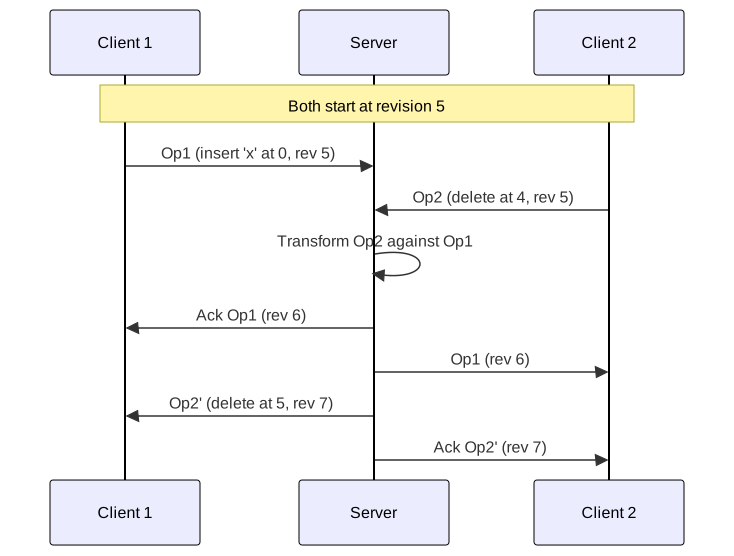
Key characteristics:
- Server assigns canonical operation order
- Clients transform incoming ops against pending local ops
- Single source of truth eliminates TP2 requirement
Trade-offs:
- ✅ Proven correct (Google Docs, Wave, CKEditor)
- ✅ Simpler transformation functions (only TP1 needed)
- ✅ Efficient wire format (operations are small)
- ❌ Server round-trip required for each operation batch
- ❌ Limited offline capability (buffer only)
- ❌ Server is single point of failure per document
Real-world example: Google Docs uses Jupiter-derived OT since 2010. Every character change is saved as an event in a revision log. The document renders by replaying the log from the start (with periodic checkpoints for performance).
Path B: CRDT-Based (Decentralized)
Best when:
- Offline-first is critical requirement
- P2P scenarios (no server available)
- Multi-device sync with unreliable networks
- Mathematical convergence proofs required
Architecture:

Key characteristics:
- Operations commute without server coordination
- Each device maintains full CRDT state
- Convergence guaranteed by mathematical properties
Trade-offs:
- ✅ True offline support
- ✅ P2P synchronization possible
- ✅ No server bottleneck
- ❌ Higher memory (tombstones, metadata)
- ❌ Slower document loading (replay history)
- ❌ More complex intent preservation for rich text
Real-world example: Figma uses a CRDT-inspired approach with server reconciliation. They deliberately stop short of full CRDT to truncate history and reduce overhead. Yjs and Automerge are pure CRDT implementations used by many collaborative editors.
Path C: Hybrid (Server-Ordered with CRDT Properties)
Best when:
- Need offline support but have server infrastructure
- Want CRDT convergence guarantees with OT efficiency
- Building on modern algorithms (Eg-walker, Fugue)
Architecture:
- Store append-only operation DAG (like CRDT)
- Use server for canonical ordering (like OT)
- Merge branches using CRDT-like algorithms
- Free memory when not actively merging
Trade-offs:
- ✅ Best of both: efficient steady-state, robust merging
- ✅ Order of magnitude better performance than pure CRDT
- ✅ Supports true offline with branch merging
- ❌ Newest approach, less production validation
- ❌ More complex implementation
Real-world example: Figma adopted Eg-walker for their code layers feature (2024). Joseph Gentle and Martin Kleppmann proved it achieves O(n log n) merge complexity versus O(n²) for traditional OT.
Path Comparison
| Factor | OT (Server) | CRDT | Hybrid |
|---|---|---|---|
| Correctness proof | Straightforward | Mathematical | Mathematical |
| Offline support | Buffer only | Native | Native |
| Server dependency | Required | Optional | Optional |
| Memory overhead | Low | High | Medium |
| Implementation | Moderate | Complex | Complex |
| Production examples | Google Docs | Notion, Linear | Figma Code |
This Article’s Focus
This article focuses on Path A (OT with server ordering) because:
- It’s the most battle-tested approach (15+ years in production at Google)
- Most use cases have reliable connectivity
- Simpler to implement correctly
- Existing libraries (ShareDB, ot.js) provide solid foundations
Path B (CRDT) details are covered in CRDTs for Collaborative Systems.
High-Level Design
Component Overview

WebSocket Gateway
Manages persistent connections between clients and collaboration servers.
Responsibilities:
- Connection lifecycle (connect, heartbeat, disconnect)
- Route messages to document processors
- Broadcast presence updates
- Handle reconnection and state recovery
Design decisions:
| Decision | Choice | Rationale |
|---|---|---|
| Protocol | WebSocket | Full-duplex, 2-14 byte overhead vs HTTP |
| Session affinity | Sticky by document | All editors of a document hit same server |
| Heartbeat | 30 second interval | Detect dead connections |
| Reconnection | Exponential backoff | Prevent thundering herd |
Scaling approach:
- Horizontal scaling with consistent hashing by document ID
- One server “owns” each active document
- Ownership transfers on server failure via distributed lock
Document Processor (OT Engine)
The core synchronization component that transforms and orders operations.
State per active document:
interface DocumentState { documentId: string revision: number // Monotonic operation counter content: DocumentContent // Current document state pendingOps: Map<ClientId, Operation[]> // Ops awaiting transform clients: Map<ClientId, ClientState> // Connected clients}
interface ClientState { clientId: string lastAckedRevision: number cursor: CursorPosition | null color: string // For presence display}Operation flow:
- Receive: Client sends operation with base revision
- Validate: Check revision is not stale beyond buffer
- Transform: Transform against all operations since base revision
- Apply: Update document state
- Persist: Write to operation log
- Broadcast: Send transformed operation to all clients
Memory management:
- Keep document state in memory while active
- Evict after 5 minutes of inactivity
- Reload from latest snapshot + recent operations
Presence Service
Handles ephemeral state: cursors, selections, user indicators.
Design decisions:
- No persistence: Presence is reconstructed on reconnect
- Throttled broadcast: Max 20 updates/second per client
- Coalesced updates: Batch cursor movements before broadcast
Data structure:
interface PresenceUpdate { clientId: string documentId: string cursor: { anchor: number // Selection start (character position) head: number // Selection end (cursor position) } | null user: { id: string name: string avatar: string color: string // Assigned per-document } timestamp: number}Document API
Handles document CRUD, access control, and version retrieval.
Endpoints:
| Endpoint | Method | Purpose |
|---|---|---|
/documents | POST | Create document |
/documents/{id} | GET | Load document (latest or specific revision) |
/documents/{id}/operations | GET | Fetch operation range for history |
/documents/{id}/snapshot | POST | Create manual snapshot |
/documents/{id}/revisions | GET | List revision metadata |
/documents/{id}/permissions | PUT | Update access control |
API Design
WebSocket Protocol
Client → Server Messages
Send Operation:
{ "type": "operation", "documentId": "doc_abc123", "clientId": "client_xyz", "baseRevision": 142, "operation": { "ops": [{ "retain": 50 }, { "insert": "Hello, " }, { "retain": 100 }, { "delete": 5 }] }, "timestamp": 1706886400000}Update Presence:
{ "type": "presence", "documentId": "doc_abc123", "cursor": { "anchor": 150, "head": 150 }, "selection": null}Server → Client Messages
Operation Acknowledgment:
{ "type": "ack", "documentId": "doc_abc123", "revision": 143, "transformedOp": { ... }}Broadcast Operation (to other clients):
{ "type": "remote_operation", "documentId": "doc_abc123", "clientId": "client_other", "revision": 143, "operation": { ... }, "user": { "id": "user_123", "name": "Alice" }}Presence Broadcast:
{ "type": "remote_presence", "documentId": "doc_abc123", "presences": [ { "clientId": "client_other", "cursor": { "anchor": 200, "head": 210 }, "user": { "id": "user_123", "name": "Alice", "color": "#4285f4" } } ]}REST API
Create Document
Endpoint: POST /api/v1/documents
Request:
{ "title": "Untitled Document", "content": "", "folderId": "folder_abc", "templateId": "template_xyz"}Response (201 Created):
{ "id": "doc_abc123", "title": "Untitled Document", "revision": 0, "createdAt": "2024-02-03T10:00:00Z", "createdBy": { "id": "user_123", "name": "Alice" }, "permissions": { "owner": "user_123", "editors": [], "viewers": [] }, "wsEndpoint": "wss://collab.example.com/ws/doc_abc123"}Load Document
Endpoint: GET /api/v1/documents/{id}?revision={optional}
Response (200 OK):
{ "id": "doc_abc123", "title": "Project Proposal", "revision": 1542, "content": { "type": "doc", "content": [ { "type": "heading", "attrs": { "level": 1 }, "content": [{ "type": "text", "text": "Introduction" }] }, { "type": "paragraph", "content": [{ "type": "text", "text": "..." }] } ] }, "snapshot": { "revision": 1500, "createdAt": "2024-02-03T09:00:00Z" }, "pendingOperations": 42, "collaborators": [{ "id": "user_456", "name": "Bob", "online": true }]}List Revisions
Endpoint: GET /api/v1/documents/{id}/revisions?limit=50&before={revision}
Response (200 OK):
{ "revisions": [ { "revision": 1542, "timestamp": "2024-02-03T10:30:00Z", "user": { "id": "user_123", "name": "Alice" }, "summary": "Edited section 3", "operationCount": 15 }, { "revision": 1500, "timestamp": "2024-02-03T09:00:00Z", "user": { "id": "user_456", "name": "Bob" }, "summary": "Added introduction", "operationCount": 203, "isSnapshot": true } ], "hasMore": true, "nextCursor": "rev_1499"}Error Responses
| Code | Error | When |
|---|---|---|
| 400 | INVALID_OPERATION | Operation format invalid |
| 409 | REVISION_CONFLICT | Base revision too old |
| 410 | DOCUMENT_DELETED | Document was deleted |
| 423 | DOCUMENT_LOCKED | Document temporarily locked |
| 429 | RATE_LIMITED | Too many operations |
Revision conflict handling:
{ "error": "REVISION_CONFLICT", "message": "Base revision 100 is too old. Current: 150", "currentRevision": 150, "missingOperations": "/api/v1/documents/doc_abc/operations?from=100&to=150"}Client must fetch missing operations, transform local pending operations, and retry.
Data Modeling
Document Metadata (PostgreSQL)
CREATE TABLE documents ( id UUID PRIMARY KEY DEFAULT gen_random_uuid(), title TEXT NOT NULL, owner_id UUID NOT NULL REFERENCES users(id), folder_id UUID REFERENCES folders(id), current_revision BIGINT DEFAULT 0, latest_snapshot_revision BIGINT, content_type VARCHAR(50) DEFAULT 'rich_text', created_at TIMESTAMPTZ DEFAULT NOW(), updated_at TIMESTAMPTZ DEFAULT NOW(), deleted_at TIMESTAMPTZ,
-- Denormalized for read performance collaborator_count INT DEFAULT 0, word_count INT DEFAULT 0, last_edited_by UUID REFERENCES users(id), last_edited_at TIMESTAMPTZ);
-- Access controlCREATE TABLE document_permissions ( document_id UUID REFERENCES documents(id) ON DELETE CASCADE, user_id UUID REFERENCES users(id), role VARCHAR(20) NOT NULL, -- 'owner', 'editor', 'commenter', 'viewer' granted_at TIMESTAMPTZ DEFAULT NOW(), granted_by UUID REFERENCES users(id), PRIMARY KEY (document_id, user_id));
CREATE INDEX idx_documents_owner ON documents(owner_id, updated_at DESC);CREATE INDEX idx_documents_folder ON documents(folder_id, updated_at DESC);CREATE INDEX idx_permissions_user ON document_permissions(user_id);Operation Log (DynamoDB)
Table design for append-heavy workload:
| Partition Key | Sort Key | Attributes |
|---|---|---|
document_id | revision | operation, client_id, user_id, timestamp, checksum |
Schema:
{ "document_id": "doc_abc123", "revision": 1542, "operation": { "ops": [{ "retain": 50 }, { "insert": "Hello" }] }, "client_id": "client_xyz", "user_id": "user_123", "timestamp": 1706886400000, "checksum": "sha256:abc123...", "ttl": null}Why DynamoDB:
- Append-only workload (write-optimized)
- Predictable latency at scale
- Built-in TTL for old operations (after snapshot)
- Range queries by revision efficient
Capacity planning:
- Write capacity: 300M ops/sec globally → partition across documents
- Single document: 100 ops/sec max (50 editors × 2 ops/sec)
- Read capacity: Burst on document load, then minimal
Snapshots (S3)
Naming convention:
s3://doc-snapshots/{document_id}/{revision}.json.gzSnapshot content:
{ "documentId": "doc_abc123", "revision": 1500, "createdAt": "2024-02-03T09:00:00Z", "content": { "type": "doc", "content": [...] }, "metadata": { "wordCount": 5420, "characterCount": 32150, "imageCount": 12 }, "checksum": "sha256:..."}Snapshot strategy:
- Create snapshot every 1000 operations
- Or every 1 hour of activity
- Or on manual request (revision history view)
- Keep all snapshots for compliance
Active Document Cache (Redis)
Data structures:
# Document state (hash)HSET doc:{id}:state revision 1542 content "{serialized_content}" last_updated 1706886400000
# Connected clients (sorted set by last activity)ZADD doc:{id}:clients {timestamp} {client_id}
# Pending operations queue (list)RPUSH doc:{id}:pending "{operation_json}"
# Presence (hash with TTL per client)HSET doc:{id}:presence:{client_id} cursor_anchor 150 cursor_head 150 user_name "Alice" user_color "#4285f4"EXPIRE doc:{id}:presence:{client_id} 60Eviction policy:
- Documents evicted after 5 minutes of no activity
- Presence entries auto-expire after 60 seconds without refresh
Low-Level Design
OT Transformation Engine
Operation Format
Using a format similar to Quill Delta / Google Wave:
type Operation = { ops: (RetainOp | InsertOp | DeleteOp)[]}
type RetainOp = { retain: number attributes?: Record<string, any> // For formatting changes}
type InsertOp = { insert: string | { image: string } | { embed: any } attributes?: Record<string, any>}
type DeleteOp = { delete: number}Example operations:
// Insert "Hello" at position 0{ ops: [{ insert: "Hello" }]}
// Delete 3 characters at position 10{ ops: [{ retain: 10 }, { delete: 3 }]}
// Bold characters 5-10{ ops: [{ retain: 5 }, { retain: 5, attributes: { bold: true } }]}Transformation Functions
10 collapsed lines
function transform(op1: Operation, op2: Operation, priority: "left" | "right"): [Operation, Operation] { // op1' = transform(op1, op2) - op1 transformed against op2 // op2' = transform(op2, op1) - op2 transformed against op1 // Guarantee: apply(apply(doc, op1), op2') === apply(apply(doc, op2), op1')
const ops1 = [...op1.ops] const ops2 = [...op2.ops] const result1: Op[] = [] const result2: Op[] = []
let i1 = 0, i2 = 0
while (i1 < ops1.length || i2 < ops2.length) { const o1 = ops1[i1] const o2 = ops2[i2]
// Case: insert vs anything - inserts go first if (o1 && "insert" in o1) { if (priority === "left") { result2.push({ retain: insertLength(o1) }) result1.push(o1) i1++ continue } } if (o2 && "insert" in o2) { result1.push({ retain: insertLength(o2) }) result2.push(o2) i2++ continue }
// Case: retain vs retain if (o1 && "retain" in o1 && o2 && "retain" in o2) { const len = Math.min(o1.retain, o2.retain) result1.push({ retain: len, attributes: o1.attributes }) result2.push({ retain: len, attributes: o2.attributes }) consumeLength(ops1, i1, len) consumeLength(ops2, i2, len) continue }
// Case: delete vs retain if (o1 && "delete" in o1 && o2 && "retain" in o2) { const len = Math.min(o1.delete, o2.retain) result1.push({ delete: len }) // o2 doesn't produce output - deleted content consumeLength(ops1, i1, len) consumeLength(ops2, i2, len) continue }
// Case: retain vs delete if (o1 && "retain" in o1 && o2 && "delete" in o2) { const len = Math.min(o1.retain, o2.delete) // o1 doesn't produce output - deleted content result2.push({ delete: len }) consumeLength(ops1, i1, len) consumeLength(ops2, i2, len) continue }
// Case: delete vs delete - both delete same content if (o1 && "delete" in o1 && o2 && "delete" in o2) { const len = Math.min(o1.delete, o2.delete) // Neither produces output - already deleted consumeLength(ops1, i1, len) consumeLength(ops2, i2, len) continue } }
return [{ ops: result1 }, { ops: result2 }]}Server-Side Processing
15 collapsed lines
class DocumentProcessor { private state: DocumentState private opLog: OperationLog private broadcaster: Broadcaster
async processOperation(clientId: string, baseRevision: number, operation: Operation): Promise<ProcessResult> { // 1. Validate base revision if (baseRevision < this.state.revision - MAX_REVISION_LAG) { throw new RevisionConflictError(this.state.revision) }
// 2. Transform against all operations since base let transformedOp = operation for (let rev = baseRevision + 1; rev <= this.state.revision; rev++) { const serverOp = await this.opLog.getOperation(this.state.documentId, rev) ;[transformedOp] = transform(transformedOp, serverOp, "right") }
// 3. Apply to document state const newContent = applyOperation(this.state.content, transformedOp) const newRevision = this.state.revision + 1
// 4. Persist operation (async, but before ack) await this.opLog.append({ documentId: this.state.documentId, revision: newRevision, operation: transformedOp, clientId, timestamp: Date.now(), })
// 5. Update in-memory state this.state.content = newContent this.state.revision = newRevision
// 6. Broadcast to other clients this.broadcaster.broadcastOperation( this.state.documentId, clientId, // Exclude sender newRevision, transformedOp, )
// 7. Return acknowledgment return { revision: newRevision, transformedOp, } }}Client-Side State Machine
12 collapsed lines
type ClientOTState = | { type: "synchronized"; serverRevision: number } | { type: "awaitingAck"; serverRevision: number; pending: Operation } | { type: "awaitingWithBuffer"; serverRevision: number; pending: Operation; buffer: Operation }
class ClientOT { private state: ClientOTState = { type: "synchronized", serverRevision: 0 } private document: DocumentContent
onLocalEdit(operation: Operation): void { switch (this.state.type) { case "synchronized": // Send immediately this.sendToServer(operation, this.state.serverRevision) this.state = { type: "awaitingAck", serverRevision: this.state.serverRevision, pending: operation, } break
case "awaitingAck": // Buffer - compose with existing buffer or create new this.state = { type: "awaitingWithBuffer", serverRevision: this.state.serverRevision, pending: this.state.pending, buffer: operation, } break
case "awaitingWithBuffer": // Compose into buffer this.state = { ...this.state, buffer: compose(this.state.buffer, operation), } break }
// Apply locally immediately this.document = applyOperation(this.document, operation) }
onServerAck(revision: number): void { switch (this.state.type) { case "awaitingAck": this.state = { type: "synchronized", serverRevision: revision } break
case "awaitingWithBuffer": // Send buffered operations this.sendToServer(this.state.buffer, revision) this.state = { type: "awaitingAck", serverRevision: revision, pending: this.state.buffer, } break } }
onRemoteOperation(revision: number, operation: Operation): void { // Transform remote op against pending/buffer let transformedRemote = operation
if (this.state.type === "awaitingAck" || this.state.type === "awaitingWithBuffer") { ;[, transformedRemote] = transform(this.state.pending, operation, "left")
// Also transform pending against remote const [newPending] = transform(this.state.pending, operation, "left") this.state = { ...this.state, pending: newPending } }
if (this.state.type === "awaitingWithBuffer") { ;[, transformedRemote] = transform(this.state.buffer, transformedRemote, "left")
const [newBuffer] = transform(this.state.buffer, operation, "left") this.state = { ...this.state, buffer: newBuffer } }
// Apply transformed remote operation this.document = applyOperation(this.document, transformedRemote) }}Snapshot and Compaction
Snapshot Worker
8 collapsed lines
class SnapshotWorker { private readonly SNAPSHOT_THRESHOLD = 1000 // Operations since last snapshot private readonly SNAPSHOT_INTERVAL_MS = 3600000 // 1 hour
async processDocument(documentId: string): Promise<void> { const doc = await this.documentStore.getMetadata(documentId) const latestSnapshot = await this.snapshotStore.getLatest(documentId)
const opsSinceSnapshot = doc.currentRevision - (latestSnapshot?.revision ?? 0) const timeSinceSnapshot = Date.now() - (latestSnapshot?.createdAt ?? 0)
if (opsSinceSnapshot < this.SNAPSHOT_THRESHOLD && timeSinceSnapshot < this.SNAPSHOT_INTERVAL_MS) { return // No snapshot needed }
// Build document state let content = latestSnapshot?.content ?? emptyDocument() const operations = await this.opLog.getRange(documentId, (latestSnapshot?.revision ?? 0) + 1, doc.currentRevision)
for (const op of operations) { content = applyOperation(content, op.operation) }
// Store snapshot await this.snapshotStore.create({ documentId, revision: doc.currentRevision, content, createdAt: Date.now(), })
// Mark old operations for TTL expiry (keep last 100 for recent history) await this.opLog.setTTL(documentId, 0, doc.currentRevision - 100, TTL_30_DAYS) }}Frontend Considerations
Editor Integration
Rich text editors with OT support:
| Editor | OT/CRDT Support | Notes |
|---|---|---|
| ProseMirror | Steps (OT-like) | Used by Notion, Atlassian |
| Slate | Plugin-based | Flexible, needs OT library |
| Quill | Delta format | Native OT support |
| TipTap | ProseMirror-based | Modern API |
Integration pattern (ProseMirror example):
15 collapsed lines
class CollaborativeEditor { private view: EditorView private otClient: ClientOT private ws: WebSocket
constructor(container: HTMLElement, documentId: string) { // Initialize OT client this.otClient = new ClientOT()
// Connect WebSocket this.ws = new WebSocket(`wss://collab.example.com/ws/${documentId}`) this.ws.onmessage = this.handleServerMessage.bind(this)
// Initialize editor with collaboration plugin this.view = new EditorView(container, { state: EditorState.create({ plugins: [collab({ version: 0 }), this.cursorPlugin(), this.presencePlugin()], }), dispatchTransaction: this.handleLocalChange.bind(this), }) }
private handleLocalChange(tr: Transaction): void { const newState = this.view.state.apply(tr) this.view.updateState(newState)
if (tr.docChanged) { // Convert ProseMirror steps to OT operations const steps = sendableSteps(newState) if (steps) { const operation = stepsToOperation(steps.steps) this.otClient.onLocalEdit(operation) this.ws.send( JSON.stringify({ type: "operation", operation, baseRevision: this.otClient.serverRevision, }), ) } } }}Presence Rendering
Cursor overlay approach:
20 collapsed lines
interface RemoteCursor { clientId: string user: { name: string; color: string } anchor: number head: number}
class CursorOverlay { private cursors: Map<string, RemoteCursor> = new Map()
updateCursor(cursor: RemoteCursor): void { this.cursors.set(cursor.clientId, cursor) this.render() }
removeCursor(clientId: string): void { this.cursors.delete(clientId) this.render() }
private render(): void { // Convert character positions to screen coordinates for (const [clientId, cursor] of this.cursors) { const coords = this.positionToCoords(cursor.head)
// Render cursor caret this.renderCaret(clientId, coords, cursor.user.color)
// Render selection highlight if anchor !== head if (cursor.anchor !== cursor.head) { this.renderSelection(clientId, cursor.anchor, cursor.head, cursor.user.color) }
// Render name label this.renderNameLabel(clientId, coords, cursor.user) } }}Performance optimizations:
| Technique | Purpose | Implementation |
|---|---|---|
| Throttle cursor updates | Reduce network traffic | Max 20 updates/sec |
| Batch presence broadcasts | Reduce message count | Collect 50ms, send batch |
| Use CSS transforms | Avoid layout thrashing | transform: translate() |
| Virtual cursor layer | Don’t modify editor DOM | Absolute positioned overlay |
Offline Support
Operation queue for offline editing:
10 collapsed lines
class OfflineQueue { private db: IDBDatabase private queueName = "pendingOperations"
async enqueue(documentId: string, operation: Operation): Promise<void> { const tx = this.db.transaction(this.queueName, "readwrite") const store = tx.objectStore(this.queueName)
await store.add({ documentId, operation, timestamp: Date.now(), id: crypto.randomUUID(), }) }
async syncPending(documentId: string): Promise<void> { const pending = await this.getPending(documentId)
for (const item of pending) { try { await this.sendOperation(item) await this.remove(item.id) } catch (e) { if (e instanceof RevisionConflictError) { // Fetch missing ops, transform, retry await this.handleConflict(documentId, item) } else { throw e } } } }}Infrastructure
Cloud-Agnostic Components
| Component | Purpose | Options |
|---|---|---|
| WebSocket Gateway | Real-time connections | Nginx, HAProxy, Envoy |
| Message Queue | Operation streaming | Kafka, RabbitMQ, NATS |
| KV Store | Active document state | Redis, Memcached, KeyDB |
| Document Store | Operation log | Cassandra, ScyllaDB, DynamoDB |
| Object Store | Snapshots, media | MinIO, Ceph, S3-compatible |
| Relational DB | Metadata, ACL | PostgreSQL, CockroachDB |
AWS Reference Architecture

Service configurations:
| Service | Configuration | Rationale |
|---|---|---|
| WebSocket (Fargate) | 4 vCPU, 8GB RAM | Memory for active documents |
| API (Fargate) | 2 vCPU, 4GB RAM | Stateless, scale on traffic |
| Workers (Fargate Spot) | 2 vCPU, 4GB RAM | Cost optimization for async work |
| ElastiCache | r6g.xlarge cluster | Sub-ms latency for hot documents |
| RDS PostgreSQL | db.r6g.2xlarge Multi-AZ | Metadata queries, ACL |
| DynamoDB | On-demand | Predictable per-op pricing |
| S3 | Standard + Intelligent-Tiering | Hot snapshots, cold history |
Scaling Considerations
WebSocket connection limits:
- Single server: ~65K connections (Linux file descriptor limit)
- Solution: Consistent hashing by document ID across server pool
- Active documents per server: ~10K (memory constrained)
Document processor memory:
- Average document state: 100KB
- Active document with history buffer: 500KB
- 8GB server → ~16K active documents max
Operation log partitioning:
- DynamoDB partition key: document_id
- Hot partition: 3000 WCU per partition
- Solution: Document sharding if single doc exceeds limits (rare)
Conclusion
This design provides real-time collaborative document editing with:
- Sub-200ms operation propagation via WebSocket and server-ordered OT
- Strong convergence guarantees without P2P complexity
- Full revision history through event-sourced operation log
- Offline resilience with IndexedDB operation queue and conflict resolution
Key architectural decisions:
- Server-ordered OT eliminates TP2 correctness concerns
- Periodic snapshots bound operation replay cost
- Ephemeral presence avoids persistence overhead for cursors
- Per-document process isolation simplifies scaling
Known limitations:
- Server dependency for real-time sync (no true P2P)
- Memory pressure at high concurrent editor counts
- Snapshot creation adds latency for very active documents
Future enhancements:
- Hybrid OT/CRDT for better offline support (Eg-walker approach)
- Incremental snapshot deltas to reduce storage
- Smarter presence coalescing for large collaborator counts
Appendix
Prerequisites
- Distributed systems fundamentals (eventual consistency, vector clocks)
- Real-time communication patterns (WebSocket, SSE)
- Event sourcing concepts
- Understanding of OT or CRDTs (see related articles)
Terminology
| Term | Definition |
|---|---|
| OT | Operational Transformation - algorithm for transforming concurrent operations |
| TP1/TP2 | Transformation properties ensuring convergence |
| Revision | Monotonic counter representing document state version |
| Operation | Atomic change to document (insert, delete, format) |
| Snapshot | Full document state at a specific revision |
| Presence | Ephemeral state like cursors and selections |
| Tombstone | Marker for deleted content in CRDT systems |
Summary
- Real-time collaborative editing requires synchronization algorithms (OT or CRDT), presence broadcasting, and event-sourced persistence
- Server-ordered OT dominates production use (Google Docs, CKEditor) because it avoids TP2 correctness issues
- WebSocket provides full-duplex communication with 1-10ms latency after handshake
- Operation log + periodic snapshots enables full revision history while bounding replay cost
- Presence is ephemeral—cursors and selections stored in memory only, reconstructed on reconnect
- Scale to 50 concurrent editors per document with ~200ms operation propagation latency
References
Architecture and Implementation:
- How Figma’s Multiplayer Technology Works - Figma Engineering Blog
- Making Multiplayer More Reliable - Figma transaction journal design
- Realtime Editing of Ordered Sequences - Fractional indexing at Figma
- The Data Model Behind Notion - Block-based architecture
- Sharding Postgres at Notion - Database scaling patterns
- Scaling the Linear Sync Engine - Local-first sync architecture
Operational Transformation:
- Apache Wave OT Whitepaper - Detailed protocol specification
- Google Drive Blog: What’s Different About New Google Docs - Architecture overview
- Lessons Learned from CKEditor 5 - Production OT for rich text
Algorithms and Research:
- Eg-walker: Collaborative Text Editing - Gentle & Kleppmann, EuroSys 2025
- Real Differences between OT and CRDT - ACM 2020 comparison
- Performance of Real-Time Collaborative Editors at Large Scale - Scaling analysis
Related Articles:
- Operational Transformation - Deep dive into OT algorithms
- CRDTs for Collaborative Systems - Alternative approach for offline-first