Design Dropbox File Sync
A system design for a file synchronization service that keeps files consistent across multiple devices. This design addresses the core challenges of efficient data transfer, conflict resolution, and real-time synchronization at scale—handling 500+ petabytes of data across 700 million users.

Abstract
File sync is fundamentally a distributed state reconciliation problem with three key insights:
- Content-defined chunking breaks files at content-determined boundaries (not fixed offsets), so insertions don’t invalidate all subsequent chunks—enabling ~90% deduplication across file versions
- Three-tree model (local, remote, synced) provides an unambiguous merge base to determine change direction without conflicts
- Block-level addressing (content hash as ID) makes upload idempotent and enables cross-user deduplication at petabyte scale
The critical tradeoff: eventual consistency with conflict preservation. Rather than complex merge algorithms, create “conflicted copies” when concurrent edits occur—simple, predictable, and avoids data loss.
Requirements
Functional Requirements
| Feature | Priority | Scope |
|---|---|---|
| File upload/download | Core | Full implementation |
| Cross-device sync | Core | Full implementation |
| Selective sync | Core | Full implementation |
| File versioning | Core | 30-day history |
| Conflict handling | Core | Conflicted copies |
| Shared folders | High | Full implementation |
| Link sharing | High | Read/write permissions |
| LAN sync | Medium | P2P optimization |
| Offline access | Medium | Client-side |
| Search | Low | Metadata only |
Non-Functional Requirements
| Requirement | Target | Rationale |
|---|---|---|
| Availability | 99.99% | Business-critical data |
| Sync latency (same region) | p50 < 2s, p99 < 10s | User perception threshold |
| Upload throughput | 100 MB/s per client | Saturate typical connections |
| Storage durability | 99.9999999999% (12 nines) | Data loss is unacceptable |
| Consistency | Eventual (< 5s typical) | Acceptable for file sync |
| Deduplication ratio | > 2:1 cross-user | Storage cost optimization |
Scale Estimation
Users:
- Registered users: 700M
- DAU: 70M (10% of registered)
- Peak concurrent: 7M
Files:
- Files per user: 5,000 average
- Total files: 3.5 trillion
- New files per day: 1.2B
Storage:
- Average file size: 150KB
- Total storage: 500PB+
- Daily ingress: 180TB (1.2B × 150KB)
Traffic:
- Metadata operations: 10M RPS (reads dominate)
- Block uploads: 500K RPS
- Block downloads: 2M RPS
- Notification connections: 7M concurrent WebSockets
Design Paths
Path A: Block-Based Sync (Chosen)
Best when:
- Large files that change incrementally (documents, code repositories)
- Cross-user deduplication is valuable
- Bandwidth optimization is critical
Architecture: Files split into content-defined chunks (~4MB blocks), each identified by content hash. Only changed blocks transfer.
Key characteristics:
- Deduplication at block level
- Delta sync requires only changed blocks
- Block storage can be globally deduplicated
Trade-offs:
- ✅ 2,500x bandwidth reduction for incremental changes
- ✅ Cross-user deduplication (identical blocks stored once)
- ✅ Resumable uploads (block-level checkpointing)
- ❌ Complexity in chunking algorithms
- ❌ Small file overhead (metadata > content for tiny files)
- ❌ Client CPU cost for hashing
Real-world example: Dropbox uses 4MB blocks with SHA-256 hashing. Magic Pocket stores 500+ PB with 600K+ drives, achieving significant deduplication across their user base.
Path B: Whole-File Sync
Best when:
- Small files only (< 1MB average)
- Simple implementation required
- Files rarely modified (write-once)
Architecture: Files uploaded/downloaded atomically. No chunking.
Trade-offs:
- ✅ Simple implementation
- ✅ Lower client CPU (no chunking)
- ❌ No delta sync (full re-upload on any change)
- ❌ No cross-file deduplication
- ❌ Large files block on full transfer
Real-world example: Simple cloud storage for photos (Google Photos initially) where files are write-once and relatively small.
Path Comparison
| Factor | Block-Based | Whole-File |
|---|---|---|
| Delta sync | Yes (block-level) | No |
| Deduplication | Cross-user, cross-file | None |
| Bandwidth efficiency | High (2,500x for edits) | Low |
| Client complexity | High | Low |
| Small file overhead | Higher | None |
| Best for | Documents, code | Photos, small media |
This Article’s Focus
This article focuses on Path A (Block-Based Sync) because file sync services primarily handle documents and files that change incrementally, where bandwidth optimization provides the most value.
High-Level Design
Client Architecture: Three Trees Model
The sync engine maintains three tree structures representing file state:
┌─────────────────────────────────────────────────────────────┐│ Client Sync Engine │├─────────────────┬─────────────────┬─────────────────────────┤│ Local Tree │ Synced Tree │ Remote Tree ││ (disk state) │ (merge base) │ (server state) │├─────────────────┼─────────────────┼─────────────────────────┤│ file.txt (v3) │ file.txt (v2) │ file.txt (v2) ││ new.txt │ - │ - ││ - │ deleted.txt │ - │└─────────────────┴─────────────────┴─────────────────────────┘Why three trees? Without a synced tree (merge base), you cannot distinguish:
- “User deleted file locally” vs “File was never synced here”
- “User created file locally” vs “File deleted on server”
Sync algorithm:
- Compare Local vs Synced → detect local changes
- Compare Remote vs Synced → detect remote changes
- Apply non-conflicting changes bidirectionally
- Handle conflicts (see Conflict Resolution section)
Node identification: Files identified by unique ID (not path), enabling O(1) atomic directory renames instead of O(n) path updates.
Chunking: Content-Defined Chunking (CDC)
Fixed-size chunking fails catastrophically when content is inserted:
Fixed chunking (4-byte blocks):Before: [ABCD][EFGH][IJKL]Insert X at position 2:After: [ABXC][DEFG][HIJK][L...] ← All blocks change!
Content-defined chunking:Before: [ABC|DEF|GHIJ] (boundaries at content patterns)Insert X at position 2:After: [ABXC|DEF|GHIJ] ← Only first block changesGear Hash Algorithm
Dropbox and modern implementations use Gear hash for chunk boundary detection:
// Gear hash: FP_i = (FP_{i-1} << 1) + GearTable[byte]const GEAR_TABLE: Uint32Array = new Uint32Array(256) // Random values
function findChunkBoundary( data: Uint8Array, minSize: number, maxSize: number, mask: number, // e.g., 0x1FFF for ~8KB average): number { let fp = 0
// Skip minimum chunk size (cut-point skipping optimization) for (let i = 0; i < Math.min(minSize, data.length); i++) { fp = ((fp << 1) + GEAR_TABLE[data[i]]) >>> 0 }
// Search for boundary for (let i = minSize; i < Math.min(maxSize, data.length); i++) { fp = ((fp << 1) + GEAR_TABLE[data[i]]) >>> 0 if ((fp & mask) === 0) { return i + 1 // Boundary found } }
return Math.min(maxSize, data.length) // Force boundary at max}Performance: Gear hash performs 1 ADD + 1 SHIFT + 1 array lookup per byte, vs Rabin’s 2 XORs + 2 SHIFTs + 2 lookups. FastCDC achieves 10x faster than Rabin-based CDC.
Chunk parameters:
| Parameter | Typical Value | Rationale |
|---|---|---|
| Min chunk | 2KB | Avoid tiny chunks |
| Average chunk | 8KB (small files) / 4MB (large files) | Balance dedup vs overhead |
| Max chunk | 64KB / 16MB | Bound worst-case |
| Mask bits | 13 (8KB avg) | 2^13 = 8192 expected bytes between boundaries |
Dropbox specifics: 4MB blocks, SHA-256 content hash as block identifier.
Block Storage Architecture

Block addressing: Content hash (SHA-256) as block ID. Two identical blocks anywhere in the system share storage.
Storage hierarchy:
- Block (4MB max): Unit of upload/download, content-addressed
- Bucket (1GB): Aggregation of blocks for efficient disk I/O
- Cell (~50-100PB): Failure domain, independent replication
- Zone: Geographic region
Durability math:
- 3-zone replication
- Within each zone: erasure coding or replication
- Target: 99.9999999999% annual durability (< 1 block lost per 100 billion)
Metadata Service
Metadata operations dominate traffic (10:1 vs block operations). Design for high read throughput.
Schema Design
-- File metadata (sharded by namespace_id)CREATE TABLE files ( namespace_id BIGINT NOT NULL, -- User/shared folder file_id UUID NOT NULL, -- Stable identifier path TEXT NOT NULL, -- Current path (mutable) blocklist UUID[] NOT NULL, -- Ordered list of block hashes size BIGINT NOT NULL, content_hash BYTEA NOT NULL, -- Hash of concatenated blocks modified_at TIMESTAMPTZ NOT NULL, revision BIGINT NOT NULL, -- Monotonic version is_deleted BOOLEAN DEFAULT FALSE,
PRIMARY KEY (namespace_id, file_id));
-- Enables path lookups within namespaceCREATE INDEX idx_files_path ON files(namespace_id, path) WHERE NOT is_deleted;
-- Journal for sync cursor (append-only)CREATE TABLE journal ( namespace_id BIGINT NOT NULL, journal_id BIGINT NOT NULL, -- Monotonic cursor file_id UUID NOT NULL, operation VARCHAR(10) NOT NULL, -- 'create', 'modify', 'delete', 'move' timestamp TIMESTAMPTZ NOT NULL,
PRIMARY KEY (namespace_id, journal_id));Sharding strategy: By namespace_id (user account or shared folder). Co-locates all user’s files on same shard.
Journal pattern: Clients track sync position via journal_id. On reconnect, fetch all changes since last cursor—O(changes) not O(files).
Caching Strategy
┌────────────────────────────────────────────────────────────┐│ Cache Hierarchy │├──────────────────┬──────────────────┬──────────────────────┤│ Client Cache │ Edge Cache │ Origin Cache ││ (SQLite) │ (Regional) │ (Global) │├──────────────────┼──────────────────┼──────────────────────┤│ Full tree state │ Hot metadata │ Frequently accessed ││ Block cache │ TTL: 5 seconds │ TTL: 30 seconds ││ Offline access │ Namespace-keyed │ File-id keyed │└──────────────────┴──────────────────┴──────────────────────┘Invalidation: Write-through to cache on metadata mutations. Short TTL acceptable because clients reconcile via journal cursor.
Notification Service
Real-time sync requires push notifications when remote changes occur.
Options:
| Mechanism | Latency | Connections | Use Case |
|---|---|---|---|
| Polling | 5-30s | Stateless | Simple, legacy |
| Long polling | 1-5s | Semi-persistent | Moderate scale |
| WebSocket | < 100ms | Persistent | Real-time sync |
| SSE | < 100ms | Persistent (one-way) | Server push only |
Chosen: WebSocket with fallback to long polling
Connection scaling:
- 7M concurrent connections at peak
- Each connection: ~10KB memory
- Total: ~70GB memory for connection state
- Horizontal scaling via connection affinity (consistent hashing on user_id)
Notification payload (minimal):
{ "namespace_id": "ns_abc123", "journal_id": 158293, "hint": "file_changed" // Client fetches details via API}Keep payloads minimal—notification triggers sync, doesn’t contain data.
API Design
Sync Flow APIs
List Changes (Cursor-Based)
GET /api/v2/files/list_folder/continueRequest:
{ "cursor": "AAGvR5..." // Opaque cursor encoding (namespace_id, journal_id)}Response:
{ "entries": [ { "tag": "file", "id": "id:abc123", "path_display": "/Documents/report.pdf", "rev": "015a3e0c4b650000000", "size": 1048576, "content_hash": "e3b0c44298fc1c149afbf4c8996fb924...", "server_modified": "2024-01-15T10:30:00Z" }, { "tag": "deleted", "id": "id:def456", "path_display": "/old-file.txt" } ], "cursor": "AAGvR6...", "has_more": false}Why cursor-based:
- Stable under concurrent modifications
- Client can disconnect/reconnect and resume exactly
- O(1) database lookup vs O(n) offset skip
Upload Session (Block-Based)
Phase 1: Start session
POST /api/v2/files/upload_session/start{ "session_type": "concurrent", // Allows parallel block uploads "content_hash": "e3b0c44..." // Optional: skip if file unchanged}Phase 2: Append blocks (parallelizable)
POST /api/v2/files/upload_session/append_v2Content-Type: application/octet-streamDropbox-API-Arg: {"cursor": {"session_id": "...", "offset": 0}}
[4MB binary block data]Phase 3: Finish and commit
POST /api/v2/files/upload_session/finish{ "cursor": { "session_id": "...", "offset": 12582912 }, "commit": { "path": "/Documents/large-file.zip", "mode": "overwrite", "mute": false // true = don't notify other clients immediately }}Response includes block deduplication:
{ "id": "id:abc123", "size": 12582912, "blocks_reused": 2, // Blocks already existed "blocks_uploaded": 1, // New blocks stored "bytes_transferred": 4194304 // Only new block data}Block Sync Protocol
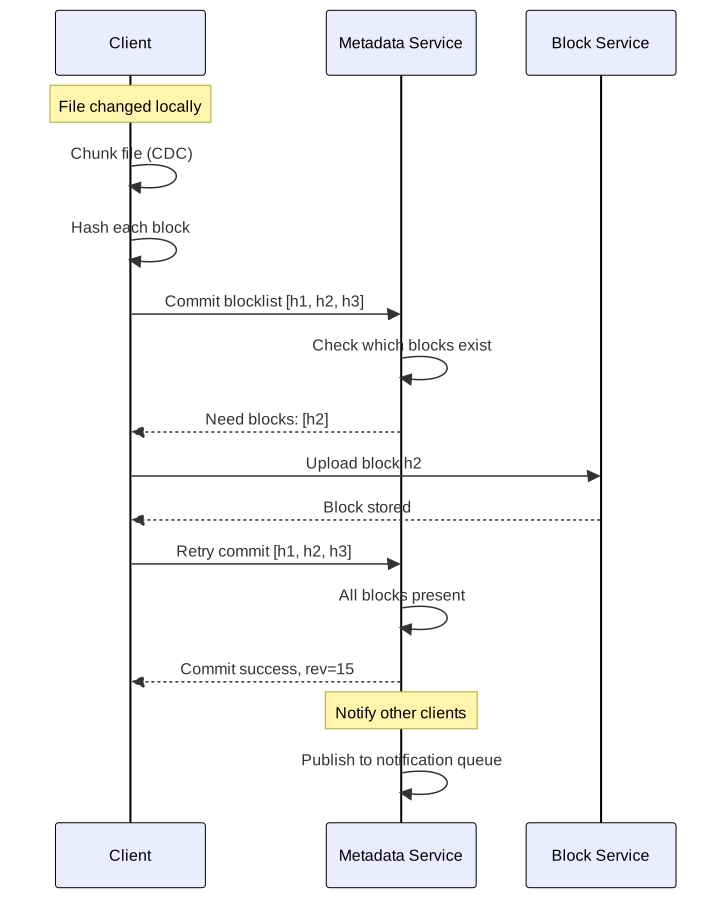
Streaming sync optimization: Clients can prefetch blocks from partial blocklists before commit finalizes—reduces end-to-end sync time by 2x for large files.
Low-Level Design: Conflict Resolution
Conflict Detection
Conflicts occur when both local and remote trees changed the same file since the synced tree state:
Timeline:t0: Synced tree = {file.txt, rev=5}t1: Local edit → Local tree = {file.txt, rev=5, modified}t2: Remote edit → Remote tree = {file.txt, rev=6}t3: Sync attempt → CONFLICT (local modified, remote also modified)Detection algorithm:
def detect_conflict(local: Node, remote: Node, synced: Node) -> ConflictType: local_changed = local != synced remote_changed = remote != synced
if not local_changed: return ConflictType.NONE # Apply remote if not remote_changed: return ConflictType.NONE # Apply local if local == remote: return ConflictType.NONE # Same change, no conflict
# Both changed differently if local.is_delete and remote.is_delete: return ConflictType.NONE # Both deleted, no conflict if local.is_delete or remote.is_delete: return ConflictType.EDIT_DELETE
return ConflictType.EDIT_EDITConflict Resolution Strategy
Chosen approach: Conflicted copies
When conflict detected:
- Keep the remote version at original path
- Create local version as
filename (Computer Name's conflicted copy YYYY-MM-DD).ext - User manually resolves by keeping preferred version
Why not auto-merge:
- File formats are opaque (binary, proprietary)
- Wrong merge = data corruption (worse than duplicate)
- User knows intent; algorithm cannot
- Simple, predictable behavior
Alternative strategies (not chosen):
| Strategy | Pros | Cons | Use Case |
|---|---|---|---|
| Last-write-wins | Simple | Data loss | Logs, non-critical |
| Vector clocks | Tracks causality | Complex, metadata overhead | Distributed DBs |
| CRDTs | Auto-merge | Limited data types | Collaborative text |
| OT (Operational Transform) | Real-time collab | Extreme complexity | Google Docs |
Edge Cases
Edit-delete conflict:
- Remote deleted, local edited → Restore file with local edits
- Local deleted, remote edited → Keep remote version, local delete is lost
Directory conflicts:
- Move vs edit: Apply move, file content syncs to new location
- Move vs move: Create conflicted folder name
- Delete folder with unsynced children: Preserve unsynced files in special recovery folder
Rename loops:
- A renames folder X→Y, B renames Y→X simultaneously
- Resolution: Arbitrary tiebreaker (lexicographic on device ID)
Low-Level Design: Delta Sync
For files that change incrementally (e.g., appending to logs, editing documents), transferring only the diff provides massive bandwidth savings.
Block-Level Delta
When a file changes, recompute chunk boundaries:
Before: [Block A][Block B][Block C] (hash_a) (hash_b) (hash_c)
Edit middle of Block B:
After: [Block A][Block B'][Block C] (hash_a) (hash_b') (hash_c)
Blocks to upload: only Block B' (hash_b')Bandwidth saved: 66% (2 of 3 blocks reused)Content-defined chunking is critical: Fixed-size chunks would shift all boundaries after an insertion, invalidating all subsequent blocks.
Sub-Block Delta (Binary Diff)
For further optimization within changed blocks, use rsync-style rolling checksums:
def compute_delta(old_block: bytes, new_block: bytes) -> Delta: """Rsync algorithm: find matching regions, send only diffs.""" BLOCK_SIZE = 700 # Rolling checksum window
# Build index of old block's checksums old_checksums = {} for i in range(0, len(old_block) - BLOCK_SIZE, BLOCK_SIZE): weak = adler32(old_block[i:i+BLOCK_SIZE]) strong = sha256(old_block[i:i+BLOCK_SIZE]) old_checksums[weak] = (i, strong)
# Scan new block with rolling checksum delta = [] i = 0 while i < len(new_block) - BLOCK_SIZE: weak = rolling_adler32(new_block, i, BLOCK_SIZE)
if weak in old_checksums: offset, expected_strong = old_checksums[weak] actual_strong = sha256(new_block[i:i+BLOCK_SIZE])
if actual_strong == expected_strong: # Match found - emit COPY instruction delta.append(Copy(source_offset=offset, length=BLOCK_SIZE)) i += BLOCK_SIZE continue
# No match - emit literal byte delta.append(Literal(new_block[i])) i += 1
return deltaRolling checksum: Adler-32 based, can update in O(1) as window slides:
a(i+1, i+n) = a(i, i+n-1) - old_byte + new_byteb(i+1, i+n) = b(i, i+n-1) - n*old_byte + a(i+1, i+n)checksum = b * 65536 + aReal-world impact: Binary diff on a 100MB database file with 1KB change: ~2KB transfer instead of 100MB (50,000x reduction).
Low-Level Design: Bandwidth Optimization
Compression Pipeline
Dropbox’s Broccoli (modified Brotli) achieves 30% bandwidth savings:
┌─────────────────────────────────────────────────────┐│ Compression Pipeline │├─────────────────────────────────────────────────────┤│ 1. Chunk file (CDC) ││ 2. Compress each chunk independently (parallel) ││ 3. Concatenate compressed streams ││ 4. Upload concatenated result │├─────────────────────────────────────────────────────┤│ Broccoli modifications: ││ - Uncompressed meta-block header for context ││ - Disabled dictionary references across blocks ││ - Enables parallel compression + concatenation │└─────────────────────────────────────────────────────┘Performance impact:
| Metric | Before Broccoli | After Broccoli |
|---|---|---|
| Upload bandwidth | 100% | ~70% (30% savings) |
| Download bandwidth | 100% | ~85% (15% savings) |
| p50 upload latency | baseline | 35% faster |
| p50 download latency | baseline | 50% faster |
LAN Sync
When multiple clients on same LAN have the same blocks, transfer locally instead of through cloud:
Discovery: UDP broadcast on port 17500 (IANA-reserved for Dropbox)
Protocol:
GET https://<lan-peer>/blocks/{namespace_id}/{block_hash}Authorization: Bearer <namespace-scoped-certificate>Security: Per-namespace SSL certificates issued by Dropbox servers, rotated when shared folder membership changes. Prevents unauthorized block access even on local network.
Bandwidth savings: 100% of block data stays on LAN for shared team folders.
Upload Prioritization
Not all files are equal. Prioritize based on:
- User-initiated actions (explicit upload) > Background sync
- Small files > Large files (faster perceived completion)
- Recently modified > Old files
- Active documents > Archives
Implementation: Priority queue with aging to prevent starvation.
Frontend Considerations
Desktop Client Architecture
┌────────────────────────────────────────────────────────────┐│ Desktop Client │├──────────────────────────────────────────────────────────────┤│ ┌─────────────┐ ┌─────────────┐ ┌─────────────────────┐ ││ │ File System │ │ Sync Engine │ │ Network Layer │ ││ │ Watcher │ │ │ │ │ ││ │ │ │ Three Trees │ │ HTTP/2 multiplexing │ ││ │ inotify/ │──│ Reconciler │──│ WebSocket notify │ ││ │ FSEvents │ │ │ │ Block upload/down │ ││ │ │ │ Conflict │ │ │ ││ │ │ │ Handler │ │ Retry + backoff │ ││ └─────────────┘ └─────────────┘ └─────────────────────┘ ││ ││ ┌─────────────────────────────────────────────────────────┐││ │ Local Database │││ │ SQLite: tree state, block cache index, sync cursor │││ └─────────────────────────────────────────────────────────┘│└──────────────────────────────────────────────────────────────┘File system watching:
- macOS: FSEvents (coalesced, efficient)
- Linux: inotify (per-file, watch limits ~8192 default)
- Windows: ReadDirectoryChangesW
Watch limit handling: For large folders exceeding inotify limits, fall back to periodic polling with checksums.
Sync Status UI
Users need visibility into sync state:
interface SyncStatus { state: "synced" | "syncing" | "paused" | "offline" | "error" pendingFiles: number pendingBytes: number currentFile?: { path: string progress: number // 0-100 speed: number // bytes/sec } errors: SyncError[]}Status indicators:
- ✓ Green checkmark: Fully synced
- ↻ Blue arrows: Syncing in progress
- ⏸ Gray pause: Paused (user-initiated or bandwidth limit)
- ⚠ Yellow warning: Conflicts or errors need attention
- ✕ Red X: Critical error (auth failed, storage full)
Selective Sync
Large Dropbox accounts may exceed local disk. Allow users to choose which folders sync locally:
interface SelectiveSyncConfig { // Folders to sync (whitelist approach) includedPaths: string[]
// Or folders to exclude (blacklist approach for "sync everything except") excludedPaths: string[]
// Smart sync: files appear in finder but download on-demand smartSyncEnabled: boolean smartSyncPolicy: "local" | "online-only" | "mixed"}Smart Sync (virtual files):
- Files appear in file browser with cloud icon
- Open file → triggers download
- Configurable: keep local after access vs evict after N days
- Requires OS integration (Windows: Cloud Files API, macOS: File Provider)
Infrastructure Design
Cloud-Agnostic Concepts
| Component | Concept | Requirements |
|---|---|---|
| Block storage | Object store with content addressing | High durability, geo-replication |
| Metadata store | Sharded relational DB | Strong consistency, high read throughput |
| Cache | Distributed key-value | Sub-ms latency, TTL support |
| Notification | Pub/sub with persistent connections | Millions of concurrent connections |
| Compute | Container orchestration | Auto-scaling, rolling deploys |
AWS Reference Architecture
┌─────────────────────────────────────────────────────────────┐│ AWS Infrastructure │├─────────────────────────────────────────────────────────────┤│ ││ ┌──────────────┐ ┌──────────────┐ ┌─────────────┐ ││ │ Route 53 │────▶│ CloudFront │────▶│ ALB │ ││ │ (DNS) │ │ (CDN) │ │ │ ││ └──────────────┘ └──────────────┘ └──────┬──────┘ ││ │ ││ ┌────────────────────────────────────────────────▼──────┐ ││ │ ECS / EKS │ ││ │ ┌──────────┐ ┌──────────┐ ┌──────────┐ ┌──────────┐ │ ││ │ │ API │ │ Metadata │ │ Block │ │ Notify │ │ ││ │ │ Gateway │ │ Service │ │ Service │ │ Service │ │ ││ │ └──────────┘ └──────────┘ └──────────┘ └──────────┘ │ ││ └───────────────────────────────────────────────────────┘ ││ ││ ┌─────────────────────────────────────────────────────────┐││ │ Data Layer │││ │ │││ │ ┌──────────────┐ ┌──────────────┐ ┌──────────────┐ │││ │ │ Aurora │ │ ElastiCache │ │ S3 │ │││ │ │ PostgreSQL │ │ Redis │ │ (Block Store)│ │││ │ │ (Metadata) │ │ (Cache) │ │ │ │││ │ └──────────────┘ └──────────────┘ └──────────────┘ │││ │ │││ │ ┌──────────────┐ ┌──────────────┐ │││ │ │ DynamoDB │ │ SQS/SNS │ │││ │ │ (Journal) │ │ (Events) │ │││ │ └──────────────┘ └──────────────┘ │││ └─────────────────────────────────────────────────────────┘│└─────────────────────────────────────────────────────────────┘| Component | AWS Service | Configuration |
|---|---|---|
| Metadata DB | Aurora PostgreSQL | Multi-AZ, read replicas |
| Block storage | S3 | Cross-region replication, 11 nines durability |
| Cache | ElastiCache Redis | Cluster mode, 100+ nodes |
| Notifications | API Gateway WebSocket + Lambda | 7M concurrent connections |
| Queue | SQS FIFO | Deduplication, ordering |
| CDN | CloudFront | Edge caching for static assets |
Self-Hosted Alternatives
| Managed Service | Self-Hosted | When to Consider |
|---|---|---|
| Aurora | PostgreSQL + Patroni | Cost at 100+ TB scale |
| S3 | MinIO / Ceph | Data sovereignty, cost |
| ElastiCache | Redis Cluster | Specific Redis modules |
| API Gateway WS | Custom WS server | Connection limits, cost |
Dropbox’s approach: Built custom storage system (Magic Pocket) at 50+ PB scale—$75M/year savings vs S3.
Conclusion
File sync at scale requires:
- Content-defined chunking for efficient delta sync and deduplication
- Three-tree model for unambiguous conflict detection
- Content-addressed blocks for idempotent uploads and cross-user deduplication
- Conflicted copies for safe conflict resolution (no data loss)
- Real-time notifications via WebSocket for sync latency
Key tradeoffs accepted:
- Eventual consistency (acceptable for file sync, not for transactional data)
- Client complexity (chunking, hashing, tree reconciliation)
- Storage overhead for deduplication metadata
Not covered: Team administration, audit logging, compliance features (HIPAA, SOC 2), mobile-specific optimizations.
Appendix
Prerequisites
- Understanding of content-addressable storage
- Familiarity with eventual consistency models
- Basic knowledge of compression algorithms
Summary
- Content-defined chunking (Gear hash/FastCDC) enables delta sync with only changed blocks transferred
- Three-tree model (local, synced, remote) provides unambiguous merge base for bidirectional sync
- Block-level content addressing enables cross-user deduplication at petabyte scale
- Conflicted copy strategy avoids data loss without complex merge algorithms
- WebSocket notifications + cursor-based APIs enable sub-second sync latency
References
- Dropbox: Rewriting the heart of our sync engine - Three-tree model and Rust rewrite
- Dropbox: Streaming File Synchronization - Block sync protocol details
- Dropbox: Inside the Magic Pocket - Storage infrastructure at 500+ PB scale
- Dropbox: Broccoli - Syncing faster by syncing less - Compression optimization
- Dropbox: Inside LAN Sync - P2P sync protocol
- FastCDC: A Fast and Efficient Content-Defined Chunking Approach - USENIX ATC 2016
- LBFS: A Low-bandwidth Network File System - Rabin fingerprinting for chunking
- The rsync algorithm - Rolling checksum delta sync