Frontend Data Fetching Patterns and Caching
Patterns for fetching, caching, and synchronizing server state in frontend applications. Covers request deduplication, cache invalidation strategies, stale-while-revalidate mechanics, and library implementations.

Abstract
Frontend data fetching reduces to managing three tensions: freshness vs latency (serve stale data immediately or wait for network?), correctness vs complexity (normalize cache for consistency or accept duplication?), and memory vs performance (cache everything or evict aggressively?).
The core patterns:
- Request deduplication: Multiple components requesting the same data share one in-flight promise—prevents duplicate network calls and ensures consistency
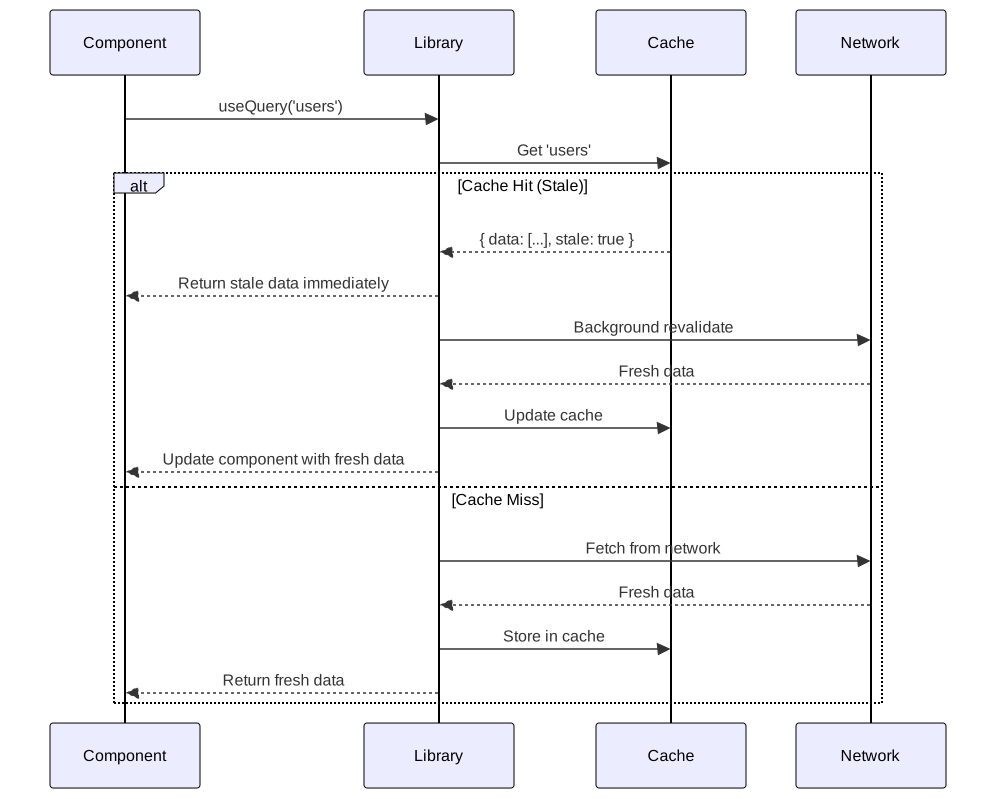
- Stale-while-revalidate: Return cached data instantly, revalidate in background—users see content immediately, fresh data arrives silently
- Cache normalization: Store entities once by ID, reference everywhere—mutations update all views automatically, but adds complexity
- Cache invalidation: Tag-based or key-based invalidation after mutations—the hardest problem, usually solved by refetching
- Garbage collection: Inactive queries evicted after configurable timeout—prevents memory leaks without manual cleanup
Libraries differ in their defaults: TanStack Query uses staleTime: 0 (always stale, always revalidate), SWR deduplicates within 1 second, Apollo normalizes by __typename:id, RTK Query uses tag-based invalidation without normalization.
HTTP Caching Fundamentals
Understanding HTTP caching is foundational—application-level caching builds on top of (or bypasses) browser cache behavior defined in RFC 9111.
Cache-Control Semantics
The Cache-Control header governs how browsers and intermediaries cache responses. Key directives from RFC 9111:
| Directive | Meaning | Use Case |
|---|---|---|
max-age=N | Response fresh for N seconds | Static assets, API responses with known TTL |
no-cache | Must revalidate before use | Dynamic content that might change |
no-store | Never cache | Sensitive data, user-specific responses |
private | Only browser can cache | User-specific data (not CDN-cacheable) |
public | Any cache can store | Static assets, public API responses |
s-maxage=N | Shared cache (CDN) TTL | Different TTL for edge vs browser |
stale-while-revalidate=N | Serve stale while revalidating | RFC 5861 extension for async refresh |
RFC 9111 replaced RFC 7234 in June 2022 with clarifications but no breaking changes. The stale-while-revalidate extension remains defined in RFC 5861.
Conditional Requests and Validation
When cached content is stale, browsers send conditional requests to check if the cached version is still valid:
Client: GET /api/users/123 If-None-Match: "abc123"
Server: 304 Not Modified (no body, use cached version)
-- or --
Server: 200 OK ETag: "def456" (new body, update cache)Validator types:
- Strong ETag (
"abc123"): Byte-for-byte identical. Required for range requests. - Weak ETag (
W/"abc123"): Semantically equivalent. Allows minor variations (whitespace, formatting). - Last-Modified: Timestamp-based. Less precise, 1-second resolution.
Design rationale: ETags exist because Last-Modified has 1-second resolution—multiple changes within a second produce identical timestamps. ETags use content hashes or version numbers for exact change detection.
Stale-While-Revalidate in HTTP
RFC 5861 defines the stale-while-revalidate Cache-Control extension:
Cache-Control: max-age=600, stale-while-revalidate=30This means:
- Response is fresh for 600 seconds
- After 600s, serve stale content while revalidating in background
- Stale serving allowed for up to 30 additional seconds
- After 630s total, must wait for revalidation
Why this matters: The browser handles background revalidation automatically—no JavaScript required. However, application-level SWR (SWR library, TanStack Query) provides finer control and works with any response, not just those with proper headers.
Request Deduplication
Request deduplication ensures multiple components requesting the same data produce exactly one network request. Without it, a page with 5 components using useUser(123) would fire 5 identical API calls.
The Promise Memoization Pattern
The core pattern is simple: store the in-flight promise, return it to all callers:
4 collapsed lines
// Promise cache for in-flight requestsconst inflightRequests = new Map<string, Promise<unknown>>()
// Deduplicated fetch functionasync function fetchWithDeduplication<T>(key: string, fetcher: () => Promise<T>): Promise<T> { // Return existing promise if request in flight const existing = inflightRequests.get(key) if (existing) return existing as Promise<T>
// Create new request and cache the promise const promise = fetcher().finally(() => { inflightRequests.delete(key) // Clean up after settlement })
inflightRequests.set(key, promise) return promise}Key insight: The promise itself is cached, not the response. All callers await the same promise, so they all receive the result when it resolves—whether success or failure.
Library Implementations
TanStack Query (React Query v5):
- Deduplication is automatic and always-on for identical query keys
- Multiple hooks with the same key share one underlying promise
- No configurable deduplication window—requests dedupe while in-flight
- Option merging takes “most pessimistic” values when multiple components use different options (e.g., lowest
staleTime)
SWR (Vercel):
- Default 1-second deduplication window via
dedupingInterval - Requests within the window share the same promise
- Window is configurable per-hook or globally
- Focused on “eventual consistency” over strict deduplication
// SWR global configuration<SWRConfig value={{ dedupingInterval: 2000 }}> {/* Requests within 2 seconds share the same promise */}</SWRConfig>Apollo Client:
- Request deduplication at the transport layer (HttpLink)
- Additionally, normalized cache means fetching the same entity from different queries returns the same object reference
- Deduplication is opt-out via
defaultOptions.watchQuery.fetchPolicy
RTK Query:
- Deduplication per endpoint + argument combination
- Cache entry created on first subscription, shared by subsequent ones
- Reference counting: cache entry kept while ≥1 subscriber exists
Edge Cases and Gotchas
Race conditions with mutations: If a mutation fires while a query is in-flight, the query result might be stale before it arrives. Libraries handle this differently:
- TanStack Query:
invalidateQueriesduring mutation waits for in-flight queries to settle, then refetches - SWR:
mutate(key)cancels in-flight requests for that key - Apollo: Mutation’s
updatefunction runs after mutation completes, before query refetch
Error propagation: All callers receive the same error when a deduplicated request fails. This is usually desirable—if the API is down, all components should know. But it means one component’s error boundary affects all components using the same data.
Deduplication scope: Most libraries deduplicate per-application instance. Server-side rendering creates a new query client per request to prevent data leaking between users.
Application-Level Caching
Application caches store fetched data in memory, separate from the browser’s HTTP cache. This enables instant UI updates, optimistic mutations, and fine-grained cache control.
Cache Architecture Patterns
Per-Query Cache (TanStack Query, SWR, RTK Query):
Each unique query key maps to one cache entry containing the response:
Cache Structure: ["users", 123] → { data: User, dataUpdatedAt: 1234567890 } ["users", 456] → { data: User, dataUpdatedAt: 1234567891 } ["posts", { authorId: 123 }] → { data: Post[], dataUpdatedAt: 1234567892 }Trade-off: Simple to understand and implement. But if the same user appears in multiple queries, each query has its own copy. Updating user 123 in one query doesn’t automatically update it in others.
Normalized Cache (Apollo Client, Relay):
Entities stored once by ID, queries reference them:
Normalized Cache: User:123 → { id: 123, name: "Alice", email: "..." } User:456 → { id: 456, name: "Bob", email: "..." } ROOT_QUERY.users → [Reference(User:123), Reference(User:456)] ROOT_QUERY.posts({authorId:123}) → [Reference(Post:1), Reference(Post:2)]Trade-off: Mutations automatically update all views of an entity—change User:123 once, every query referencing it reflects the change. But normalization adds complexity: custom keyFields for unique identification, merge functions for pagination, handling of cache inconsistencies.
Cache Invalidation Strategies
Cache invalidation is the hardest problem. The cache doesn’t know when server data changes unless told.
Time-based (TTL):
- Data considered stale after N seconds
- TanStack Query:
staleTime(default 0—always stale) - SWR:
refreshIntervalfor polling - Simple but imprecise—data might change immediately or not for hours
Mutation-based:
Invalidate related queries after mutations:
3 collapsed lines
const queryClient = useQueryClient()
const mutation = useMutation({ mutationFn: updateUser, onSuccess: () => { // Invalidate and refetch all user queries queryClient.invalidateQueries({ queryKey: ["users"] }) // Or be specific queryClient.invalidateQueries({ queryKey: ["users", userId] }) },})Tag-based (RTK Query):
Queries declare what tags they provide; mutations declare what tags they invalidate:
6 collapsed lines
const api = createApi({ baseQuery: fetchBaseQuery({ baseUrl: "/api" }), tagTypes: ["User", "Post"], endpoints: (builder) => ({ getUsers: builder.query({ query: () => "users", providesTags: (result) => result ? [...result.map(({ id }) => ({ type: "User" as const, id })), "User"] : ["User"], }), updateUser: builder.mutation({ query: ({ id, ...body }) => ({ url: `users/${id}`, method: "PUT", body, }), invalidatesTags: (result, error, { id }) => [{ type: "User", id }], }), }),})Design rationale for tags: RTK Query chose tags over normalized cache because normalization is complex and error-prone. Tags provide explicit, predictable invalidation without the edge cases of automatic cache updates.
Garbage Collection
Without garbage collection, caches grow unbounded. Libraries implement automatic cleanup:
TanStack Query:
gcTime(formerlycacheTime): Time inactive query stays in memory (default 5 minutes)- Query becomes “inactive” when no components subscribe
- After
gcTime, entry removed and next request refetches from network staleTimeandgcTimeare independent—longstaleTimedoesn’t extendgcTime
SWR:
- No explicit GC configuration
- Uses
dedupingIntervaland reference counting - Cache entries cleaned when no active subscribers
Apollo Client:
gc()method for manual garbage collectioncache.evict({ id: 'User:123' })for specific entriescache.gc()removes unreachable objects after eviction
Memory Limits and Constraints
Browser memory varies significantly:
| Device | Typical Heap Limit |
|---|---|
| Desktop Chrome (64-bit) | 4-16 GB |
| Mobile Safari (iPhone 7+) | 1-2 GB |
| Older mobile devices | 645 MB - 1 GB |
Practical implications:
- Large normalized caches can exhaust mobile memory
- Profile cache size in production with
performance.measureUserAgentSpecificMemory() - Consider LRU eviction for high-volume applications
- SSR requires request-scoped caches to prevent cross-user data leaks
Stale-While-Revalidate Pattern
The stale-while-revalidate (SWR) pattern serves cached data immediately while fetching fresh data in the background. Users see content instantly; updates arrive silently.
Pattern Mechanics
Implementation Details
TanStack Query’s approach:
2 collapsed lines
const { data, isStale, isFetching } = useQuery({ queryKey: ["users"], queryFn: fetchUsers, staleTime: 60_000, // Data fresh for 60 seconds refetchOnWindowFocus: true, // Revalidate when tab regains focus refetchOnMount: true, // Revalidate when component mounts})
// isStale: true if past staleTime// isFetching: true if background fetch in progress// data: always the cached value (stale or fresh)Revalidation triggers:
| Trigger | TanStack Query | SWR | Apollo |
|---|---|---|---|
| Mount | refetchOnMount | revalidateOnMount | fetchPolicy |
| Window focus | refetchOnWindowFocus | revalidateOnFocus | Manual |
| Network reconnect | refetchOnReconnect | revalidateOnReconnect | Manual |
| Interval | refetchInterval | refreshInterval | pollInterval |
Why window focus matters: Users frequently switch tabs. When they return, cached data might be minutes old. Focus-triggered revalidation ensures they see current data without explicit refresh.
Optimistic Updates vs. SWR
SWR handles read consistency. Optimistic updates handle write latency:
5 collapsed lines
const queryClient = useQueryClient()
const mutation = useMutation({ mutationFn: updateUser, // Optimistically update cache before mutation completes onMutate: async (newUser) => { // Cancel in-flight refetches await queryClient.cancelQueries({ queryKey: ["users", newUser.id] })
// Snapshot current value for rollback const previousUser = queryClient.getQueryData(["users", newUser.id])
// Optimistically update queryClient.setQueryData(["users", newUser.id], newUser)
return { previousUser } }, // Rollback on error onError: (err, newUser, context) => { queryClient.setQueryData(["users", newUser.id], context?.previousUser) }, // Refetch after success to ensure consistency onSettled: () => { queryClient.invalidateQueries({ queryKey: ["users"] }) },})Design trade-off: Optimistic updates make UI feel instant but require rollback logic. Some teams prefer waiting for mutation success—simpler code, slightly slower perceived performance.
Pagination Patterns
Pagination affects both API design and cache structure. The choice between cursor and offset pagination has significant performance implications.
Cursor vs. Offset Pagination
Offset pagination:
GET /api/posts?offset=100&limit=20- Skip first N records, return next M
- Familiar UX: “Page 1, 2, 3…”
- Performance degrades with offset: Database must scan and discard first N rows
- Consistency issues: Insert/delete between pages causes duplicates or gaps
Cursor pagination:
GET /api/posts?cursor=eyJpZCI6MTIzfQ&limit=20- Opaque pointer to position in dataset
- O(1) performance: Database seeks directly to cursor position
- Consistent: Insertions/deletions don’t affect pagination
- Trade-off: No “jump to page 50” capability
Performance comparison (real-world benchmarks):
| Offset | Query Time |
|---|---|
| 0 | 5ms |
| 10,000 | 50ms |
| 100,000 | 500ms |
| 1,000,000 | 5,000ms |
Cursor pagination maintains ~5ms regardless of position.
Infinite Scroll Implementation
5 collapsed lines
import { useInfiniteQuery } from '@tanstack/react-query'
function useInfinitePosts() { return useInfiniteQuery({ queryKey: ['posts'], queryFn: ({ pageParam }) => fetchPosts({ cursor: pageParam }), initialPageParam: undefined, getNextPageParam: (lastPage) => lastPage.nextCursor, getPreviousPageParam: (firstPage) => firstPage.prevCursor, })}
// Usage with intersection observer for infinite scrollfunction PostList() { const { data, fetchNextPage, hasNextPage, isFetchingNextPage } = useInfinitePosts()
const loadMoreRef = useIntersectionObserver(() => { if (hasNextPage && !isFetchingNextPage) { fetchNextPage() } })
return (6 collapsed lines
<> {data?.pages.flatMap((page) => page.posts.map((post) => <Post key={post.id} post={post} />))} <div ref={loadMoreRef} /> </> )}Cache Structure for Paginated Data
TanStack Query: Pages stored as array in single cache entry:
["posts"] → { pages: [ { posts: [...], nextCursor: "abc" }, { posts: [...], nextCursor: "def" }, { posts: [...], nextCursor: null } ], pageParams: [undefined, "abc", "def"]}Apollo Client: Requires custom merge function for pagination:
8 collapsed lines
const cache = new InMemoryCache({ typePolicies: { Query: { fields: { posts: { keyArgs: ["authorId"], // Different cache entries per author merge(existing = { edges: [] }, incoming) { return { ...incoming, edges: [...existing.edges, ...incoming.edges], } }, }, }, }, },})Prefetching Next Page
Prefetch the next page before users reach the end:
4 collapsed lines
const queryClient = useQueryClient()
// Prefetch when user is N items from the endfunction usePrefetchNextPage(currentCursor: string, threshold = 5) { useEffect(() => { queryClient.prefetchInfiniteQuery({ queryKey: ["posts"], queryFn: ({ pageParam }) => fetchPosts({ cursor: pageParam }), initialPageParam: currentCursor, }) }, [currentCursor])}Error Handling and Retries
Network requests fail. Robust data fetching requires systematic error handling and intelligent retry strategies.
Retry Strategies
Exponential backoff with jitter (AWS recommended pattern):
function calculateBackoff(attempt: number, baseDelay = 1000, maxDelay = 30000): number { // Exponential: 1s, 2s, 4s, 8s, 16s... const exponentialDelay = baseDelay * Math.pow(2, attempt) // Cap at maximum const cappedDelay = Math.min(exponentialDelay, maxDelay) // Add jitter (0-100% of delay) to prevent thundering herd const jitter = Math.random() * cappedDelay return cappedDelay + jitter}Why jitter matters: Without jitter, all clients retry at the same time after an outage, overwhelming the recovering server. Jitter spreads retries over time.
Library defaults:
| Library | Default Retries | Backoff |
|---|---|---|
| TanStack Query | 3 | Exponential (1s, 2s, 4s) |
| SWR | 0 (no automatic retry) | N/A |
| Apollo | 0 (link-level config) | Configurable |
| RTK Query | 0 | N/A |
Retryable vs. Non-Retryable Errors
Not all errors should trigger retries:
| Status Code | Retryable | Reason |
|---|---|---|
| 408 Request Timeout | Yes | Transient, likely succeeds on retry |
| 429 Too Many Requests | Yes (with backoff) | Rate limit, wait and retry |
| 500-503 Server Error | Yes | Server issue, might recover |
| 400 Bad Request | No | Client error, won’t change |
| 401 Unauthorized | No | Auth issue, retry won’t help |
| 403 Forbidden | No | Permission denied |
| 404 Not Found | No | Resource doesn’t exist |
3 collapsed lines
const { data } = useQuery({ queryKey: ["users"], queryFn: fetchUsers, retry: (failureCount, error) => { // Don't retry client errors if (error.status >= 400 && error.status < 500) { return false } // Retry server errors up to 3 times return failureCount < 3 }, retryDelay: (attemptIndex) => Math.min(1000 * 2 ** attemptIndex, 30000),})Idempotency for Safe Retries
Retrying non-idempotent requests (POST, PATCH) risks duplicate side effects. The Idempotency-Key header (IETF draft) solves this:
4 collapsed lines
async function createPayment(amount: number) { const idempotencyKey = crypto.randomUUID()
const response = await fetch("/api/payments", { method: "POST", headers: { "Content-Type": "application/json", "Idempotency-Key": idempotencyKey, }, body: JSON.stringify({ amount }), })
return response.json()}How it works:
- Client generates unique key for each logical operation
- Server stores key → response mapping
- If request retried with same key, server returns stored response
- Prevents duplicate charges, duplicate orders, etc.
Widely supported: Stripe, Adyen, and most payment gateways require idempotency keys for mutations.
Circuit Breaker Pattern
Prevent cascading failures when a service is down:
5 collapsed lines
class CircuitBreaker { private failures = 0 private lastFailure: number | null = null private state: "closed" | "open" | "half-open" = "closed"
constructor( private threshold = 5, private timeout = 30000, ) {}
async execute<T>(fn: () => Promise<T>): Promise<T> { if (this.state === "open") { if (Date.now() - (this.lastFailure ?? 0) > this.timeout) { this.state = "half-open" } else { throw new Error("Circuit breaker is open") } }
try { const result = await fn() this.onSuccess() return result } catch (error) { this.onFailure() throw error } }
private onSuccess() { this.failures = 0 this.state = "closed" }
8 collapsed lines
private onFailure() { this.failures++ this.lastFailure = Date.now() if (this.failures >= this.threshold) { this.state = "open" } }}States:
- Closed: Normal operation, requests pass through
- Open: After N failures, fail immediately without network call
- Half-Open: After timeout, allow one test request
Library Comparison
TanStack Query (React Query v5)
Architecture: Per-query cache with automatic garbage collection.
Key concepts:
staleTime: How long data considered fresh (default: 0)gcTime: How long inactive queries stay in cache (default: 5 minutes)- Query keys: Array-based, supports complex objects
- Devtools: Excellent built-in debugging
Strengths: Intuitive API, great TypeScript support, framework-agnostic (React, Vue, Solid, Svelte).
Limitations: No normalized cache—same entity in different queries = different copies.
Version note: v5 (released 2023) renamed
cacheTimetogcTimefor clarity. The v4 → v5 migration requires updating this option name.
SWR (Vercel)
Architecture: Minimal, focused on stale-while-revalidate pattern.
Key concepts:
dedupingInterval: Deduplication window (default: 2 seconds)refreshInterval: Polling interval- Focus/reconnect revalidation by default
- Optimized for 60% fewer re-renders via selective state updates
Strengths: Tiny bundle (~4KB), simple API, good defaults for most cases.
Limitations: Less powerful than TanStack Query for complex scenarios (pagination, optimistic updates).
Apollo Client
Architecture: Normalized cache with GraphQL-specific optimizations.
Key concepts:
InMemoryCache: Flattened object store keyed by__typename:idTypePolicies: Custom cache behavior per typefetchPolicy: Controls cache vs. network priority- Automatic cache updates after mutations
Strengths: Automatic consistency via normalization, powerful for GraphQL.
Limitations: GraphQL-specific, normalized cache complexity, larger bundle.
Cache normalization example:
5 collapsed lines
const cache = new InMemoryCache({ typePolicies: { User: { // Use email as unique identifier instead of id keyFields: ["email"], }, Product: { fields: { // Compute displayPrice from cached price displayPrice: { read(_, { readField }) { const price = readField<number>("price") return price ? `$${price.toFixed(2)}` : null }, }, }, }, },})RTK Query
Architecture: Built on Redux Toolkit, tag-based cache invalidation.
Key concepts:
providesTags: What data a query providesinvalidatesTags: What tags a mutation invalidates- Automatic refetch when tags invalidate
- Per-endpoint cache configuration
Strengths: Great for Redux apps, explicit invalidation logic, good TypeScript inference.
Limitations: Redux dependency, no normalized cache, more boilerplate than alternatives.
Decision Matrix
| Factor | TanStack Query | SWR | Apollo | RTK Query |
|---|---|---|---|---|
| Bundle size | ~13KB | ~4KB | ~50KB | ~15KB + Redux |
| Learning curve | Low | Very low | Medium | Medium |
| GraphQL | Via plugin | Via plugin | Native | Via plugin |
| Normalization | No | No | Yes | No |
| DevTools | Excellent | Good | Excellent | Good |
| Framework support | React, Vue, Solid, Svelte | React | React, iOS, Kotlin | React |
| Best for | Most REST/GraphQL apps | Simple apps | GraphQL-heavy apps | Redux apps |
Conclusion
Frontend data fetching is a solved problem at the library level—TanStack Query, SWR, Apollo, and RTK Query handle the hard parts. The challenge is choosing the right tool and understanding its trade-offs.
Key decisions:
-
Normalized vs. per-query cache: Normalized (Apollo) guarantees consistency but adds complexity. Per-query (TanStack Query, SWR) is simpler but requires manual invalidation.
-
Stale time configuration:
staleTime: 0(TanStack Query default) means constant background refetching. Increase it for data that changes rarely. Balance freshness against network cost. -
Pagination strategy: Cursor pagination performs better at scale. Offset is acceptable for small datasets with jump-to-page requirements.
-
Error handling: Retry transient errors with exponential backoff and jitter. Use idempotency keys for mutations. Circuit breakers prevent cascading failures.
The common mistake is over-engineering: reaching for normalized caching when per-query suffices, implementing complex optimistic updates when showing a loading spinner is acceptable, or building custom solutions when libraries handle it better.
Appendix
Prerequisites
- Understanding of HTTP caching headers (
Cache-Control,ETag) - Familiarity with Promises and async/await
- Basic knowledge of React hooks (for library examples)
- Understanding of REST API pagination concepts
Terminology
- Stale data: Cached data past its configured freshness time, still usable but should be revalidated
- GC (Garbage Collection): Automatic removal of unused cache entries to free memory
- Normalized cache: Cache structure where entities are stored once by ID and referenced from multiple queries
- Deduplication: Combining multiple identical requests into a single network call
- Idempotent: Operation that produces the same result regardless of how many times it’s executed
- Circuit breaker: Pattern that fails fast when a service is known to be down, preventing wasted requests
Summary
- HTTP caching (RFC 9111, RFC 5861) provides browser-level caching with
Cache-Control, conditional requests via ETags, and stale-while-revalidate for background refresh - Request deduplication stores in-flight promises—multiple components with the same query key share one network request
- Application caching stores responses in memory; per-query cache is simpler, normalized cache ensures consistency
- Cache invalidation strategies: time-based (TTL), mutation-based (invalidate after write), tag-based (RTK Query’s explicit dependency tracking)
- Stale-while-revalidate serves cached data immediately, revalidates in background—configurable via
staleTimeand revalidation triggers - Cursor pagination outperforms offset at scale (O(1) vs O(N)); use offset only for small datasets with page-number requirements
- Retry strategies: exponential backoff with jitter for transient errors, idempotency keys for safe mutation retries, circuit breakers for cascading failure prevention
References
Specifications
- RFC 9111 - HTTP Caching - Authoritative HTTP cache semantics (replaced RFC 7234)
- RFC 5861 - HTTP Cache-Control Extensions - stale-while-revalidate and stale-if-error extensions
- RFC 9110 - HTTP Semantics - Idempotent method definitions (GET, PUT, DELETE)
- IETF Draft - Idempotency-Key Header - Standardized idempotency key format
Official Documentation
- TanStack Query Documentation - Query concepts, caching, and mutations
- SWR Documentation - Performance optimizations and configuration
- Apollo Client Cache Configuration - Normalized cache and type policies
- RTK Query Overview - Tag-based invalidation and cache behavior
Implementation References
- AWS Builders Library - Timeouts, Retries, and Backoff - Exponential backoff with jitter patterns
- MDN - HTTP Caching - Browser caching behavior
- MDN - HTTP Conditional Requests - ETag and Last-Modified validation