JavaScript Event Loop
Master the JavaScript event loop architecture across browser and Node.js environments, understanding task scheduling, microtasks, and performance optimization techniques.
TLDR
JavaScript Event Loop is the core concurrency mechanism that enables single-threaded JavaScript to handle asynchronous operations through a sophisticated task scheduling system with microtasks and macrotasks.
Core Architecture Principles
- Single-threaded Execution: JavaScript runs on one thread with a call stack and run-to-completion guarantee
- Event Loop: Central mechanism orchestrating asynchronous operations around the engine
- Two-tier Priority System: Microtasks (high priority) and macrotasks (lower priority) with strict execution order
- Host Environment Integration: Different implementations for browsers (UI-focused) and Node.js (I/O-focused)
Universal Priority System
- Synchronous Code: Executes immediately on the call stack
- Microtasks: Promise callbacks, queueMicrotask, MutationObserver (processed after each macrotask)
- Macrotasks: setTimeout, setInterval, I/O operations, user events (processed in event loop phases)
- Execution Order: Synchronous → nextTick → Microtasks → Macrotasks → Event Loop Phases
Browser Event Loop
- Rendering Integration: Integrated with 16.7ms frame budget for 60fps
- Task Source Prioritization: User interaction (high) → DOM manipulation (medium) → networking (medium) → timers (low)
- requestAnimationFrame: Executes before repaint for smooth animations
- Microtask Starvation: Potential issue where microtasks block macrotasks indefinitely
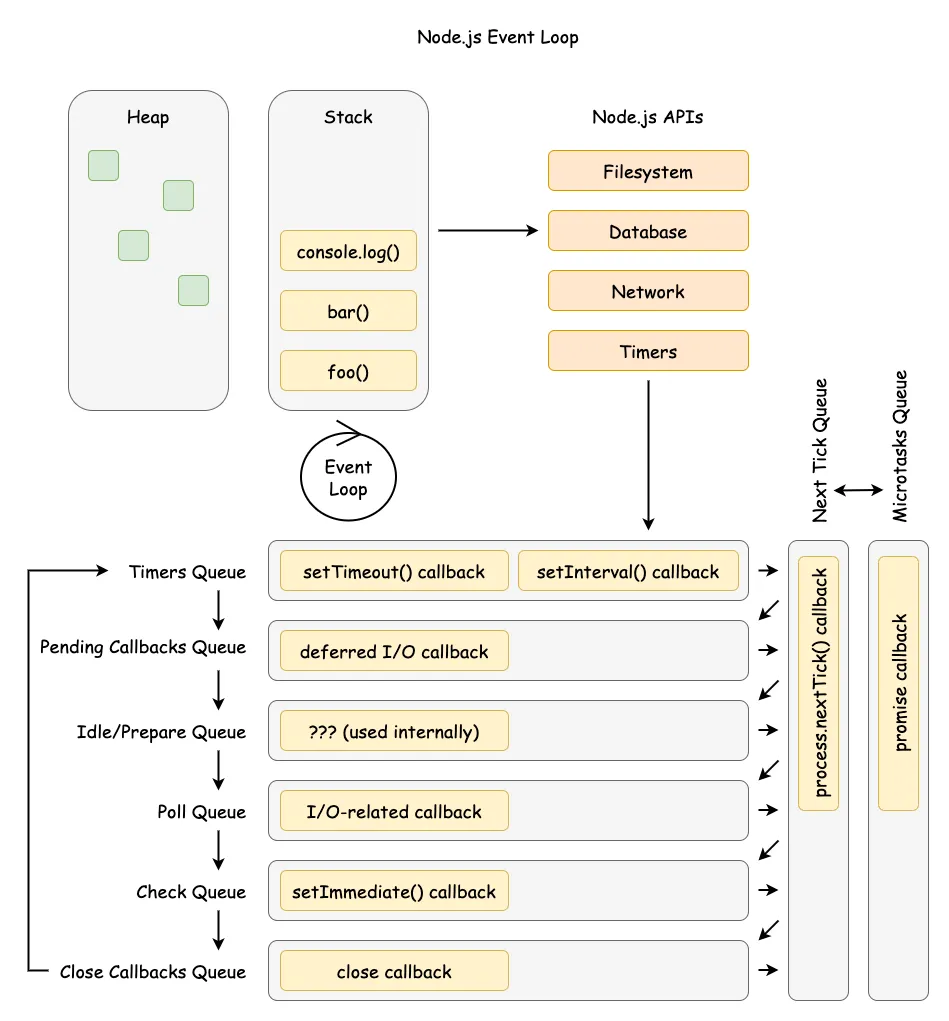
Node.js Event Loop (libuv)
- Phased Architecture: Six phases (timers → pending → idle → poll → check → close)
- Poll Phase Logic: Blocks for I/O or timers, exits early for setImmediate
- Thread Pool: CPU-intensive operations (fs, crypto, DNS) use worker threads
- Direct I/O: Network operations handled asynchronously on main thread
- Node.js-specific APIs: process.nextTick (highest priority), setImmediate (check phase)
Performance Optimization
- Keep Tasks Short: Avoid blocking the event loop with long synchronous operations
- Proper Scheduling: Choose microtasks vs macrotasks based on priority needs
- Avoid Starvation: Prevent microtask flooding that blocks macrotasks
- Environment-specific: Use requestAnimationFrame for animations, worker_threads for CPU-intensive tasks
True Parallelism
- Worker Threads: Independent event loops for CPU-bound tasks
- Memory Sharing: Structured clone, transferable objects, SharedArrayBuffer
- Communication: Message passing with explicit coordination
- Safety: Thread isolation prevents race conditions
Monitoring & Debugging
- Event Loop Lag: Measure time between event loop iterations
- Bottleneck Identification: CPU-bound vs I/O-bound vs thread pool issues
- Performance Tools: Event loop metrics, memory usage, CPU profiling
- Best Practices: Environment-aware scheduling, proper error handling, resource management
- The Abstract Concurrency Model
- Universal Priority System: Tasks and Microtasks
- Browser Event Loop Architecture
- Node.js Event Loop: libuv Integration
- Node.js-Specific Scheduling
- True Parallelism: Worker Threads
- Best Practices and Performance Optimization
The Abstract Concurrency Model
JavaScript’s characterization as a “single-threaded, non-blocking, asynchronous, concurrent language” obscures the sophisticated interplay between the JavaScript engine and its host environment. The event loop is not a language feature but the central mechanism provided by the host to orchestrate asynchronous operations around the engine’s single-threaded execution.
Runtime Architecture
Core Execution Primitives
The ECMAScript specification defines three fundamental primitives:
- Call Stack: LIFO data structure tracking execution context
- Heap: Unstructured memory region for object allocation
- Run-to-Completion Guarantee: Functions execute without preemption
Specification Hierarchy
Universal Priority System: Tasks and Microtasks
All modern JavaScript environments implement a two-tiered priority system governing asynchronous operation scheduling.
Queue Processing Model
Priority Hierarchy
Microtask Starvation Pattern
// Pathological microtask starvationfunction microtaskFlood() { Promise.resolve().then(microtaskFlood)}microtaskFlood()
// This macrotask will never executesetTimeout(() => { console.log("Starved macrotask")}, 1000)Browser Event Loop Architecture
The browser event loop is optimized for UI responsiveness, integrating directly with the rendering pipeline.
WHATWG Processing Model
Rendering Pipeline Integration
Task Source Prioritization
Node.js Event Loop: libuv Integration
Node.js implements a phased event loop architecture optimized for high-throughput I/O operations.
libuv Architecture
Phased Event Loop Structure
Poll Phase Logic
Thread Pool vs Direct I/O
Node.js-Specific Scheduling
Node.js provides unique scheduling primitives with distinct priority levels.
Priority Hierarchy
nextTick vs setImmediate Execution
setTimeout vs setImmediate Ordering
True Parallelism: Worker Threads
Worker threads provide true parallelism by creating independent event loops.
Worker Architecture
Memory Sharing Patterns
Best Practices and Performance Optimization
Environment-Agnostic Principles
Browser-Specific Optimization
Node.js-Specific Optimization
Performance Monitoring
Conclusion
The JavaScript event loop is not a monolithic entity but an abstract concurrency model with environment-specific implementations. Expert developers must understand both the universal principles (call stack, run-to-completion, microtask/macrotask hierarchy) and the divergent implementations (browser’s rendering-centric model vs Node.js’s I/O-centric phased architecture).
Key takeaways for expert-level development:
- Environment Awareness: Choose scheduling primitives based on the target environment
- Performance Profiling: Identify bottlenecks in the appropriate layer (event loop, thread pool, OS I/O)
- Parallelism Strategy: Use worker threads for CPU-intensive tasks while maintaining event loop responsiveness
- Scheduling Mastery: Understand when to use microtasks vs macrotasks for optimal performance
The unified mental model requires appreciating common foundations while recognizing environment-specific mechanics that dictate performance and behavior across the JavaScript ecosystem.
References
- The Node.js Event Loop Official Docs
- Libuv Design - The I/O Loop
- Node Interactive 2016 Talk - Everything You Need to Know About Node.js Event Loop - Bert Belder, IBM
- Node Interactive 2016 Talk Presentation
- A Deep Dive Into the Node js Event Loop - Tyler Hawkins
- A Deep Dive Into the Node js Event Loop - Code & Slides
- Node’s Event Loop From the Inside Out by Sam Roberts, IBM
- WHATWG HTML Living Standard - Event Loops
- ECMAScript 2024 - Jobs and Job Queues